

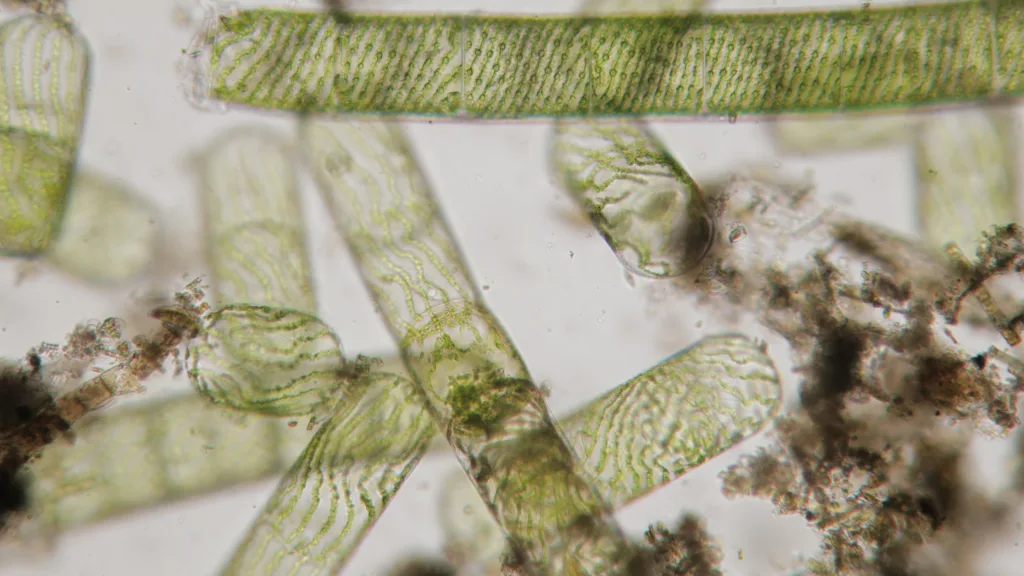
Spirogyra is a filamentous green algae. It is free floating in nature. It is mainly found in freshwater bodies like ponds, lakes and slow moving streams.
It is commonly called water silk or pond scum. This name is given because its filament is soft, slimy and slippery. The filament is covered by mucilaginous sheath.
The plant body of Spirogyra is unbranched and thread like. It is made up of cylindrical cells arranged end to end. The cells form long filament in water.
The most important character of Spirogyra is its spiral chloroplast. The chloroplast is ribbon shaped and arranged helically inside the cell. Due to this spiral chloroplast the name Spirogyra is given.
Spirogyra performs photosynthesis. It fixes carbon dioxide and releases oxygen in water. So it is important in aquatic ecosystem.
It also acts as food for small aquatic animals. Small fishes, zooplankton and other aquatic organisms feed on it. Thus it forms part of freshwater food chain.
Spirogyra reproduces by vegetative and sexual method. Vegetative reproduction occurs by fragmentation. Sexual reproduction occurs by conjugation, where tube like connection is formed between filaments.
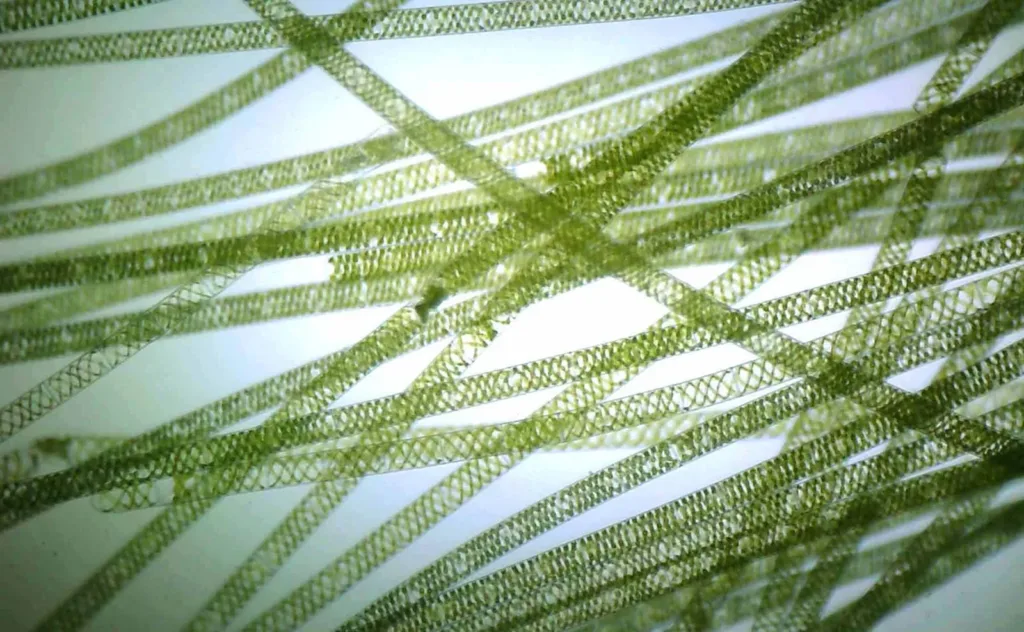
Characteristics of Spirogyra
- Spirogyra is mainly found in freshwater habitat. It is free floating green algae. It occurs in ponds, lakes and slow moving streams.
- The plant body is multicellular and filamentous. The filament is unbranched and thread like. It is made up of cylindrical cells joined end to end.
- The filament of Spirogyra is slippery in touch. This is due to the presence of mucilaginous sheath outside the filament. So it is commonly called water silk or pond scum.
- The cell wall is two layered. The inner layer is made up of cellulose and it is tough. The outer layer is made up of pectose or pectin, which dissolves in water and forms slimy sheath.
- The most important character of Spirogyra is spiral chloroplast. Each cell has 1 to 16 ribbon shaped chloroplasts. These chloroplasts are arranged spirally inside the cell.
- Pyrenoids are present on the chloroplast. These are granular bodies. They are protein-starch complexes and store starch and proteins.
- Each cell has large central vacuole. It maintains pressure inside the cell. A single nucleus is present in the centre and it is suspended by cytoplasmic strands.
- Spirogyra is autotrophic in nutrition. It prepares its own food by photosynthesis. During this process oxygen is released into water.
- The filaments float freely in water. They can show slow bending, twisting and curving movement. This helps them to orient towards light.
- Spirogyra reproduces by different methods. Vegetative reproduction occurs by fragmentation. Asexual reproduction occurs by special spores. Sexual reproduction occurs by conjugation, in which tube like connection is formed between cells.
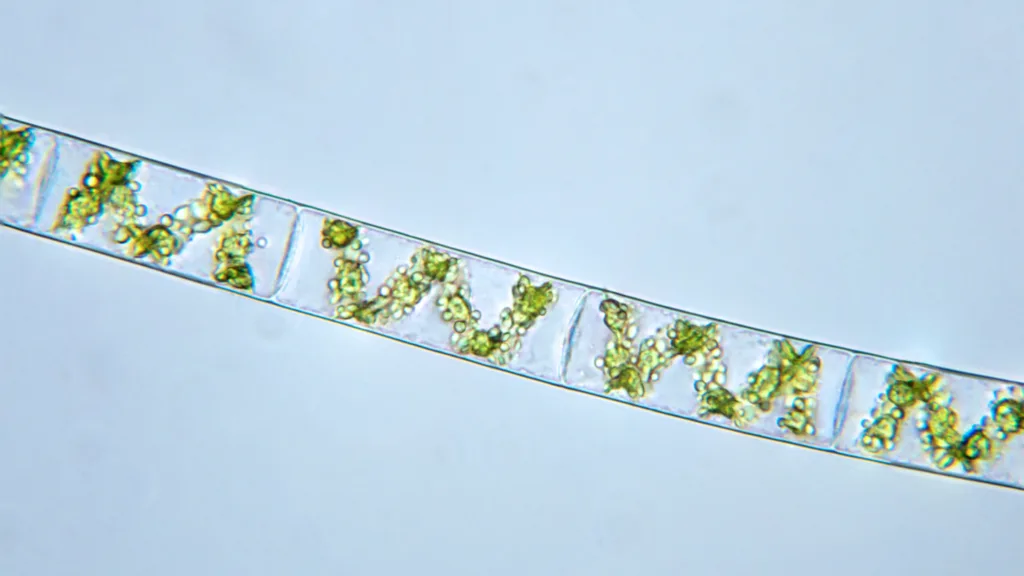
Classification of Spirogyra
About 400 species of Spirogyra are found in various freshwater bodies across the globe. E. Fritsch (1935) described or proposed the following taxonomic classification of Spirogyra in his book “The Structure and Reproduction of Algae”:
| Domain | Eukaryota |
| Kingdom | Plantae |
| Phylum | Chlorophyta |
| Class | Zygnematophyceae |
| Order | Zygnematales |
| Family | Zygnemataceae |
| Genus | Spirogyra |
Habitat of Spirogyra
- Spirogyra is a widely distributed freshwater algae. It is found in different parts of the world. It is present on every continent and also reported from Antarctica.
- It mainly grows in shallow freshwater bodies. It is found in stagnant or slow moving water. Common places are ponds, lakes, pools, tanks, ditches and temporary rain water pools.
- Most species of Spirogyra occur as free floating tangled mass. These masses float near the surface of water. Sometimes they also remain on the sediment below.
- The floating mass is slimy and green. It is commonly called pond scum or water silk. This form is very common in ponds and stagnant water.
- Some species can live in flowing water also. Spirogyra adnata and Spirogyra fluviatilis are found in streams and rivers. They attach to the bottom surface by root like structures.
- These root like structures are called rhizoids or haptera. They help the filament to remain fixed on benthic substrates. So the filament is not easily carried away by water current.
- Spirogyra grows well in nutrient rich water. It is common in eutrophic water where nutrients are high. It may also occur in stressed places like municipal wastewater and toxic acid mine drainage.
Morphology or Structure of Spirogyra
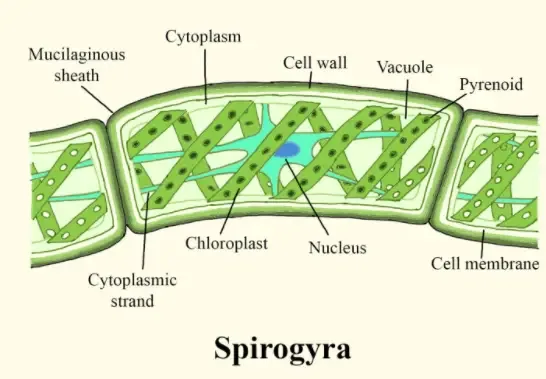
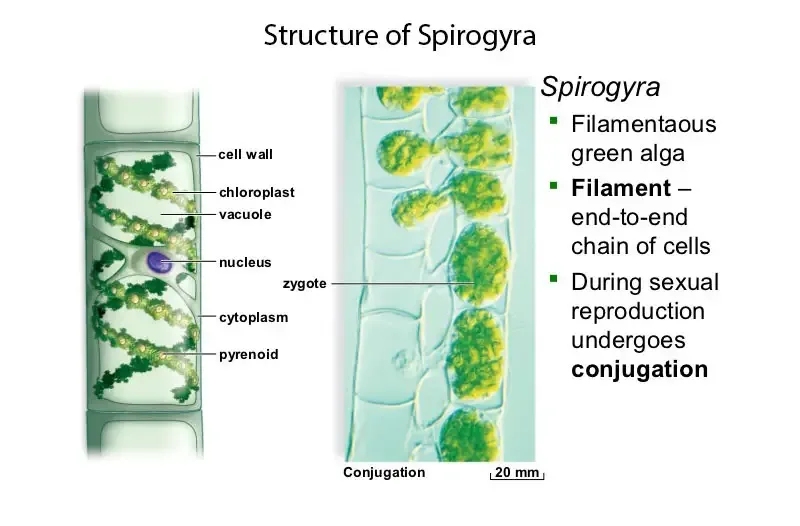
- Spirogyra has simple thallus body. The thallus is multicellular and filamentous. It is unbranched and made up of elongated cylindrical cells joined end to end in one row.
- The filament of Spirogyra may be 10 to 150 micrometer in width. Its length may be several centimetres. Sometimes it may become up to one meter long.
- Each cell has two layered cell wall. The inner layer is made up of cellulose and it gives rigidity to the cell. The outer layer is made up of pectose or pectic substance.
- The outer pectose layer dissolves in water. Due to this thick transparent mucilage sheath is formed around the whole filament. This sheath makes the filament slippery and slimy in touch.
- The adjacent cells are separated by transverse walls or septa. These septa may be different in different species. They may be plane, replicate, semi-replicate, colligate or unduliseptate type.
- Each cell has a large central vacuole. It is filled with cell sap and occupies most part of the cell. This vacuole maintains turgor pressure and keeps the filament firm.
- A single nucleus is present in the centre of the cell. It contains a nucleolus. The nucleus is suspended in the middle of vacuole by fine radiating cytoplasmic strands.
- The most important structure of Spirogyra is spiral chloroplast. Each cell has 1 to 16 ribbon shaped green chloroplasts. These chloroplasts are arranged helically in the peripheral cytoplasm.
- On the chloroplast, many pyrenoids are present at regular intervals. These are granular proteinaceous bodies. Each pyrenoid has protein core surrounded by starch plates and it stores starch and proteins.
- A thin layer of cytoplasm is present just inside the cell membrane. It is called primordial utricle. It contains mitochondria, dictyosomes and endoplasmic reticulum.
- Most species of Spirogyra are free floating. But some species living in flowing water may have holdfast like structure. In Spirogyra fluviatilis, non-green basal cells are modified into lobed hapterons or rhizoids for attachment to underwater surface.
Nutrition of Spirogyra
- Spirogyra is autotrophic in nutrition. It prepares its own food. It does not depend on other organisms for food.
- The food is prepared by photosynthesis. It takes dissolved carbon dioxide from water and uses sunlight for this process. In this way carbohydrate is formed inside the cells.
- The light energy is trapped by chlorophyll. The main chlorophylls are chlorophyll a and chlorophyll b. These pigments are present in spiral shaped chloroplasts.
- The prepared food is stored as starch and proteins. This storage occurs in special bodies called pyrenoids. The pyrenoids are present at regular intervals on the chloroplast.
- Spirogyra also absorbs dissolved minerals from water. These minerals are required for its normal growth. It grows more abundantly in nutrient rich freshwater.
Movement Mechanism of Spirogyra
- Spirogyra does not have flagella for active swimming. Its filaments show slow movement. The filament can bend, twist, curve and again become straight.
- These movements are coordinated in the filament. It is not fast movement like motile algae. It is slow movement of the long thread like body.
- The main use of this movement is to get light. The filament bends and orients towards sunlight. This helps more surface of filament to receive light for photosynthesis.
- When many filaments collect near the surface, they form dense mat. In this condition the twisting of filaments creates friction between them. This friction helps the whole algal mat to move slowly forward.
- During day time, Spirogyra produces oxygen by photosynthesis. Oxygen bubbles remain trapped inside the tangled slimy filaments. These bubbles make the heavy mat float on the water surface.
- Thus movement of Spirogyra occurs mainly by bending, twisting, friction between filaments and floating by oxygen bubbles. These movements help in light exposure and surface floating.
Energy Production of Spirogyra
- Spirogyra is autotrophic algae. It prepares its own food and energy by photosynthesis. For this process it takes dissolved carbon dioxide from water and uses sunlight.
- The light energy is absorbed by chlorophyll. This green pigment is present inside ribbon shaped or spiral shaped chloroplasts. These chloroplasts are the main site of food formation.
- During photosynthesis, light energy is changed into chemical energy. The food formed is stored as starch and lipid. These materials remain stored in special proteinaceous bodies called pyrenoids.
- Spirogyra also performs cellular respiration. In this process oxygen is used and carbon dioxide is released. This gives metabolic energy for survival, mainly at night or cloudy time when photosynthesis becomes stopped.
- Spirogyra also has importance in industrial energy production. It stores large amount of starch and lipid in its biomass. For this reason it is studied as third generation biofuel source.
- The harvested biomass of Spirogyra can be used for making bioethanol and biodiesel. Bioethanol is produced by fermentation. Biodiesel is produced by chemical transesterification.
- Use of Spirogyra for biofuel is considered as green energy method. It does not need crop land like normal agricultural plants. It can also be grown in wastewater ponds for biomass production.
Cultural Media for Spirogyra
- Pringsheim’s culture medium
Pringsheim’s culture medium is commonly used for cultivation of Spirogyra in laboratory. It is used mainly for growing vegetative filaments. In this medium the filaments remain green and continue normal growth. - Modified Pringsheim’s medium
Modified Pringsheim’s medium is used for inducing sexual reproduction in Spirogyra. It is prepared as half strength medium and without nitrogen. This nitrogen free condition helps in conjugation and zygospore formation. - Agarized modified medium
The modified medium may also be used in agarized form. Sometimes 0.003% CaCl₂ is added in it. This helps to support the conjugation process in Spirogyra. - Bold’s basal medium
Bold’s basal medium is also used for culturing Spirogyra under controlled laboratory condition. It supports algal growth. It may also help in promoting conjugation process. - Czurda medium
Czurda medium is another culture medium used for experimental work on Spirogyra. It is used in studies where effect of different pH condition on the algae is tested. - Experimental solutions
For stress experiment, Spirogyra may be kept for short time in different experimental solutions. Distilled water with sucrose concentration from 0.2% to 4.0% may be used. Very low NaCl concentration such as 0.2% may also be used. - Salt effect
Spirogyra cannot tolerate high salt concentration. Higher amount of NaCl becomes harmful or lethal to the organism. So salt solution is used carefully only in low concentration during experiment.
Life Cycle of Spirogyra
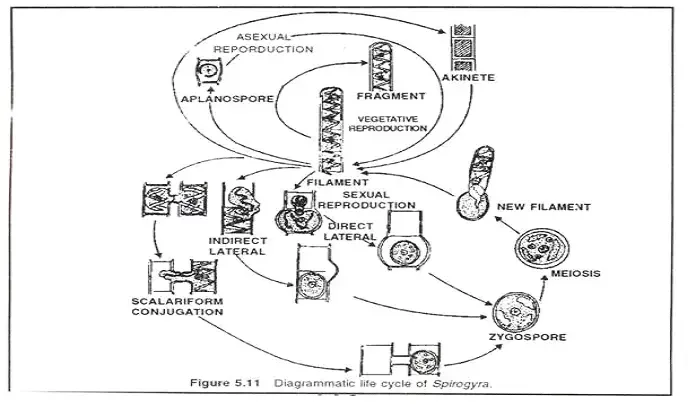
- Spirogyra shows haplontic life cycle. The main plant body is haploid (n) vegetative filament. The diploid (2n) stage is very short and it is present only as zygospore.
- During favourable condition, Spirogyra mainly reproduces by fragmentation. In this process the filament breaks into small pieces. Each piece divides repeatedly and elongates to form a new haploid filament.
- In some species, asexual reproduction takes place by formation of non-motile spores. These spores may be aplanospores, akinetes or azygospores. They are formed mostly when condition becomes unfavourable.
- These asexual spores may remain dormant for some time. When favourable condition returns, they germinate. Then new Spirogyra filaments are formed from them.
- Sexual reproduction in Spirogyra occurs by conjugation. It usually takes place at the end of growing season or during unfavourable condition. The whole protoplast of the cell changes into non-motile gamete called aplanogamete.
- In conjugation, gametes of compatible cells fuse with each other. The fusion occurs through conjugation tube. It may take place between two different filaments or between adjacent cells of same filament.
- When conjugation occurs between two different filaments, it is called scalariform conjugation. In this condition, conjugation tubes are formed between opposite cells of two filaments and it looks ladder like.
- When conjugation occurs between adjacent cells of same filament, it is called lateral conjugation. Here the gamete passes from one cell to nearby cell and fusion takes place.
- After fusion, diploid zygote is formed. This zygote develops thick three layered wall around it. Then it becomes resistant zygospore.
- The zygospore enters into dormant stage. It can survive extreme bad condition like winter freezing or summer drought. The parent filaments may die and decay, but zygospore remains alive.
- When favourable condition comes again, the zygospore absorbs water and germinates. It undergoes meiosis and forms four haploid nuclei.
- Out of four haploid nuclei, three nuclei disintegrate. Only one nucleus remains functional. This nucleus controls the formation of germ tube.
- The germ tube comes out and grows. It divides repeatedly and forms new haploid Spirogyra filament. In this way life cycle again continues.
Reproduction of Spirogyra
Spirogyra reproduces by three methods. These are vegetative reproduction, asexual reproduction and sexual reproduction. Vegetative reproduction is common in favourable condition. Asexual and sexual reproduction generally occur during unfavourable condition.
1. Vegetative Reproduction
Vegetative reproduction in Spirogyra takes place by fragmentation. It is the most common method and occurs mainly during favourable condition. In this process the long filament breaks into small pieces.
The breaking of filament may occur due to mechanical injury, change in salinity, change in temperature or dissolution of middle lamella between the cells. Each broken fragment contains some living cells. These cells divide repeatedly and the fragment elongates to form a new Spirogyra filament.
So in vegetative reproduction no spore and no gamete is formed. Only a part of the parent filament directly grows into new filament.
2. Asexual Reproduction
Asexual reproduction is found in some species of Spirogyra. It usually occurs during unfavourable condition. In this method non-motile resting spores are formed.
The main asexual spores are aplanospores, akinetes and azygospores or parthenospores.
Aplanospores are formed when the protoplast of the cell shrinks. After shrinking it secretes a thin protective wall around itself. Later it germinates and forms new filament when favourable condition returns.
Akinetes are also formed like aplanospores. But the wall of akinete is much thicker and stronger. It is made up of cellulose and pectin. It remains dormant and helps the alga to survive bad condition.
Azygospores are formed when gametes fail to fuse during sexual reproduction. The unfused gamete forms thick wall around it. Then it behaves like resting spore and germinates asexually into new filament.
3. Sexual Reproduction
Sexual reproduction in Spirogyra takes place by conjugation. It is isogamous type because the fusing gametes are morphologically similar. It generally occurs at the end of growing season or during unfavourable condition.
In conjugation, the whole protoplast of a cell behaves as non-motile gamete. These gametes are called aplanogametes. The gametes do not come out and swim. They fuse through a passage or conjugation tube.
There are two types of conjugation in Spirogyra. These are scalariform conjugation and lateral conjugation.
In scalariform conjugation, two compatible filaments lie side by side. Opposite cells of the two filaments form conjugation tubes. The structure looks like a ladder. The male gamete passes through the tube and fuses with female gamete of opposite cell.
In lateral conjugation, the fusion occurs between two adjacent cells of the same filament. It may be direct, where passage forms through middle lamella. It may be indirect, where a conjugation canal is formed outside like a loop between adjacent cells.
After fusion, diploid zygospore is formed. It develops thick three layered wall and enters into resting stage. During favourable condition, the zygospore germinates, undergoes meiosis and forms new haploid Spirogyra filament.
Economic Importance of Spirogyra
- Spirogyra is useful in aquatic habitat. It fixes carbon dioxide during photosynthesis and releases oxygen in water. This oxygen is necessary for fishes and other aquatic organisms.
- It acts as natural food of many aquatic animals. Small fishes, snapping turtles, snails, amphipods and mosquito larvae feed on Spirogyra. So it has value in aquatic food chain.
- In many Asian countries Spirogyra is used as food by human. It is nutritive in nature. It contains good amount of protein and vitamins like vitamin A and vitamin E.
- Spirogyra has pharmaceutical importance also. It contains natural bioactive compounds. These compounds may show antibiotic, antiviral, antioxidant, anti-inflammatory and cytotoxic activities.
- Some species like Spirogyra neglecta contain useful compounds. These compounds are studied for cancer chemoprevention. So it has importance in medicinal research.
- Spirogyra is useful in bioremediation. It can absorb heavy metals from polluted water. Metals like lead, copper, zinc and uranium may be removed by it.
- It is also used for removal of toxic dyes. It can grow in municipal wastewater and acid mine drainage. In this way it helps in cleaning polluted water.
- Spirogyra stores lipid and starch in its cells. For this reason it is studied for biofuel production. It may be used for making bioethanol and biodiesel.
- It is considered as third generation biofuel source. It does not need agricultural land like crop plants. So it may be useful as sustainable biofuel feedstock.
- Spirogyra is easy to culture in laboratory. Therefore it is used in scientific research. It is also sometimes used in water gardens as ornamental plant and as food in fish aquarium.
- Spirogyra may also become harmful when it grows too much. Dense mats can block artificial water channels. It may also create problem in fishing and swimming.
- Large growth of Spirogyra can foul filter system of reservoirs. It may spoil drinking water quality. So it has both useful and harmful economic importance.
Ecological Importance of Spirogyra
- Spirogyra releases oxygen in water during photosynthesis. This oxygen is needed by fishes and other aquatic organisms. So it helps in maintaining aquatic life.
- It fixes carbon dioxide from water. By this process it takes part in carbon cycle. It also helps in oxygen cycle because oxygen is produced during photosynthesis.
- Spirogyra acts as food for many aquatic organisms. Zooplankton, small fishes, snapping turtles, snails, mosquito larvae and amphipods feed on it. So it forms important food base in freshwater ecosystem.
- The presence of Spirogyra may show the condition of water. It grows well in nutrient rich water. So its heavy growth indicates nutrient enriched water body.
- Spirogyra is useful in cleaning polluted water. Its mucilaginous sheath is highly hydrophilic and works like natural cation exchange matrix. It can absorb heavy metals like lead, copper, zinc and iron.
- It can also remove toxic metalloids from polluted water. In this way Spirogyra helps in bioremediation of municipal wastewater and acid mine drainage.
Examples of Spirogyra
- Spirogyra adnata is a species of Spirogyra. It is usually found in slow running water. It is one of the freshwater form of this genus.
- Spirogyra aplanospora is known for formation of aplanospores. These are thin walled non-motile resting spores. They are formed during unfavourable condition.
- Spirogyra dubia can attach with underwater surface. It uses special root like structures called haptera. These structures help the filament to remain fixed.
- Spirogyra farlowii forms thick walled resting spores. These spores are called akinetes. They help the organism to survive harsh environmental condition.
- Spirogyra fluviatilis is adapted to flowing water. It has lobed non-green basal cells. These cells attach the filament to the substrate.
- Spirogyra groenlandica can form azygospores or parthenospores. These are formed when gametes fail to fuse during sexual reproduction.
- Spirogyra maxima has broad vegetative cells. It also contains many spiral chloroplasts. This species is recognized by these characters.
- Spirogyra neglecta is important because it has bioactive compounds. These compounds are studied for cancer chemopreventive property.
- Spirogyra porticalis is the type species of the genus. It has high antioxidant capacity. It is also important for pharmaceutical potential.
- Spirogyra rhizopus develops non-green rhizoidal outgrowths. These help in anchoring the filaments to the bottom of water bodies.
- Spirogyra varians is studied for pharmaceutical use. It also has high nutritional value. So it is an important example of Spirogyra.
- Other examples of Spirogyra are Spirogyra elongata, Spirogyra affinis, Spirogyra majuscula and Spirogyra corrugata.
How to Observe Spirogyra Under the Microscope?
- First take a small amount of Spirogyra filament from pond water or culture. The filament is usually green, slimy and thread like. It should be taken carefully because the filaments may break easily.
- Take a clean glass slide. Put one or two drops of water on the slide. Place a small piece of Spirogyra filament in the water drop and spread it gently with the help of needle.
- Place a coverslip slowly over the filament. Air bubble should be avoided. Extra water may be removed from the side of coverslip by using filter paper.
- Put the prepared slide on the stage of light microscope. First observe under low power objective. At about 10X magnification, Spirogyra appears as long green thread like colonies called filaments.
- After getting the filament clearly, observe under higher magnification. The filament is made up of cylindrical cells. The cells are joined end to end and there is no clear base or apex in the filament.
- Under microscope, the width of filament may be seen in the range of 10 to 150 micrometer. The cells are long and cylindrical. The cross walls between the cells can also be seen.
- The most important structure to observe is spiral chloroplast. Each cell contains 1 to 16 ribbon shaped chloroplasts. These chloroplasts are coiled spirally inside the cell.
- Small granular bodies are present on the spiral chloroplast. These are called pyrenoids. They store starch and appear as small dots or granules along the chloroplast.
- A large central vacuole is present inside each cell. A single nucleus is present in the centre of the cell. It remains suspended by cytoplasmic strands, but it may not be clearly visible in normal unstained slide.
- The cell wall can be observed around each cell. The filaments are made up of cells arranged in one row. This arrangement gives the typical unbranched filamentous structure of Spirogyra.
- For better microscopic study, Spirogyra can also be observed by phase contrast microscope, DIC microscope and fluorescence microscope. These methods give more clear image of internal parts.
- For more detailed surface study, Spirogyra may be examined by scanning electron microscope (SEM). It gives detailed surface view of filament and cell wall, but it is not used in simple classroom observation.
References
- Takano, T., et al. (2019). Identification of 13 Spirogyra species (Zygnemataceae) by traits of sexual reproduction induced under laboratory culture conditions. Scientific Reports, 9(1), 7458.
- Bradley, W. H. (1962). Chloroplast in Spirogyra from the Green River Formation of Wyoming. American Journal of Science, 260(6), 455-459.
- Cell wall characteristics during sexual reproduction of Mougeotia sp. (Zygnematophyceae) revealed by electron microscopy, glycan microarrays and RAMAN spectroscopy. (n.d.). PMC.
- Checking your browser – reCAPTCHA. (n.d.).
- BYJU’S. (n.d.). Classification of Spirogyra.
- McIntosh, K., Pickett-Heaps, J., & Gunning, B. E. S. (1995). Cytokinesis in Spirogyra: Integration of cleavage and cell-plate formation. International Journal of Plant Sciences, 156(1), 1-8.
- Phu Quoc Jeep Tour. (n.d.). Draw the life cycle of spirogyra.
- OERTX. (n.d.). Green Algae: Precursors of Land Plants.
- Hidden genetic diversity in the green alga Spirogyra (Zygnematophyceae, Streptophyta). (n.d.). PMC.
- El-Sheekh, M., Schagerl, M., Gharieb, M., & Elsoud, G. A. (2017). Induction of sexual reproduction and zygospore patterns in the filamentous green alga Spirogyra Link (Conjugatophyceae: Zygnematales). Journal of BioScience and Biotechnology, 6(2), 147-154.
- Wongsawad, P., & Peerapornpisal, Y. (2014). Morphological and molecular profiling of Spirogyra from northeastern and northern Thailand using inter simple sequence repeat (ISSR) markers. Saudi Journal of Biological Sciences, 21(4), 391-510.
- López-Bautista, J. M., Waters, D. A., & Chapman, R. L. (2003). Phragmoplastin, green algae and the evolution of cytokinesis. International Journal of Systematic and Evolutionary Microbiology, 53, 1715-1718.
- UNH Center for Freshwater Biology. (2026). Phycokey – Spirogyra.
- Manaaki Whenua – Landcare Research. (n.d.). Spirogyra (Zygnemataceae).
- Physics Wallah. (n.d.). Spirogyra – Classification, Diagram, Characteristics, and Reproduction.
- Wikipedia. (2026). Spirogyra.
- Nikon’s MicroscopyU. (2025). Spirogyra Filamentous Algae.
- Vedantu. (n.d.). Spirogyra: Detailed Structure, Reproduction, and Key Features for NEET Preparation.
- Sahoo, A. (2023). Spirogyra: Salient Features, Occurrence, Thallus Structure, Reproduction. Biology Learner.
- Sahoo, A. (2023). Spirogyra: Salient Features, Occurrence, Thallus Structure, Reproduction. Biology Learner.
- Science Facts. (2023). Spirogyra: Structure & Characteristics with Labeled Diagram.
- Vedantu. (n.d.). Structure, Diagram, Fragmentation, and Reproduction for NEET.
- Systematics, Cytomorphology, and Reproductive Plasticity in Spirogyra: An Evolutionary Bridge in the Streptophyte Lineage. (n.d.).
- VanWinkle-Swift, K. P., & Rickoll, W. L. (1997). The zygospore wall of Chlamydomonas monoica (Chlorophyceae): Morphogenesis and evidence for the presence of sporopollenin. Journal of Phycology, 33, 655-665.
- Plantae. (n.d.). The Spirogyra genome and the origin of that spiral chloroplast.
- The Spirogyra genome: signatures of shared and divergent division and differentiation. (n.d.). bioRxiv.
- Ramadan, Y. M. (n.d.). The main groups of Blue-Green algae. College of Education-Shaqlawa.
- The University of Chicago Press. (2025). University of Chicago Press Journals: Cookie absent.
- Wikipedia. (2025). Zygnemataceae.
- Dangat, B. T. (n.d.). Topic: Spirogyra. Vivekanand College, Kolhapur.
I think this note is very well for me