

What is Diauxic growth?
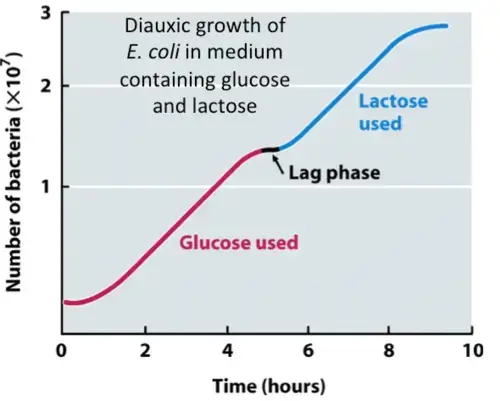
When a bacterium is incubated in a medium containing two sugars one monosaccharide and another di or polysaccharide (like glucose and lactose). The bacteria first utilize glucose and complete their lag and log phase. After completion of glucose utilization, they used lactose and produce and another lag phase due to the synthesis of their lactose breaking enzyme. Such types of growth have two lag phases called diauxic growth and the curve is called a diauxic curve.
- The Diauxic growth is also known as the diphasic growth represented by two growth curves intervened by a short lag phase produced by an organism utilizing two different substrates, one of which is glucose.
- The enzyme required for the utilization of lactose is β-galactosidase, which splits lactose into glucose and galactose, and the bacterium utilizes glucose for growth.
- Galactose can be used, but after it is converted into glucose.
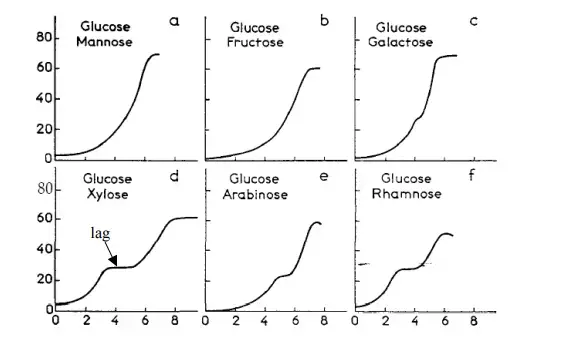
- It has been confirmed that E. coli growing in a medium carrying both glucose and galactose produces a diauxic (diphasic) growth curve as in the case of glucose and lactose.
- The same response will be observed in the case of other sugars including arabinose, maltose, sorbitol, etc. When they are utilized in a mixture with glucose by E. coli. each of these sugars is used only after the glucose has been used up in the growth medium.
- The Diauxic growth curve contains two lag phases includes the first lag phase and the Second lag phase.
- The first lag phase occurs due to the adjustment of organisms to the new medium conditions. This was followed by the utilization of glucose.
- The Second lag phase occurs when glucose is depleted from the medium and organisms become prepared to utilize lactose.
Why does diauxic growth occur?
- The process of diauxic growth is complex, it is thought that the catabolite repression or the glucose effect probably plays a part in it.
- During the catabolite repression of lac- operon of E. coli, glucose first exerts an inhibitory effect on the transcription of the lac genes. As a result of this, the lactose-utilizing enzymes are not synthesized, even if lactose is already in the medium.
- When glucose is completely utilized by E. coli, the bacterium is now competent to transcribe the lac-operon genes resulting in the production of necessary enzymes which are required for the lactose metabolization.
Obtaining Diauxic growth curve
If we put E. coli in a medium with two types of sugars such as lactose and glucose, the glucose can directly metabolize, and lactose needs to be further processed in order to be metabolized by the cell. The cell will first prefer to digest the glucose, which endows the cell with a higher growth rate (making it more fit), and only when glucose is exhausted from the medium will it start to synthesize the machinery needed to transport and digest, and ultimately grow, albeit more slowly, on the second sugar. Thus growth on a mixture of sugars, therefore, exhibits the following phases: (1) fast growth on glucose (2) lag period (3) slower growth on lactose (4) saturation. This experiment was carried out by Monod in the 1940’s during his PhD work.
FAQ
What is diauxic growth?
Diauxic growth refers to the sequential utilization of two or more different carbon sources by microorganisms, such as bacteria and yeast.
How does diauxic growth occur?
Diauxic growth occurs when a microorganism is presented with two or more sources of carbon, and it switches from utilizing one carbon source to another.
What are the stages of diauxic growth?
The stages of diauxic growth typically include lag phase, exponential growth on the first carbon source, a diauxic shift, exponential growth on the second carbon source, and stationary phase.
Why do microorganisms undergo diauxic growth?
Microorganisms undergo diauxic growth because they can obtain a higher overall yield of energy and biomass by utilizing two or more different carbon sources.
What factors affect diauxic growth?
The factors that affect diauxic growth include the availability and utilization rate of each carbon source, the presence of other nutrients, and the metabolic pathways available to the microorganism.
How is diauxic growth measured?
Diauxic growth can be measured by monitoring changes in cell growth, metabolic activity, and substrate utilization over time.
Can diauxic growth be prevented?
Diauxic growth can be prevented by limiting the availability of the second carbon source, or by engineering the microorganism to have a preference for a single carbon source.
What is the significance of diauxic growth?
The significance of diauxic growth lies in its potential for industrial applications, such as the production of biofuels, pharmaceuticals, and other valuable chemicals.
How does diauxic growth differ from auxotrophic growth?
Diauxic growth differs from auxotrophic growth in that it involves the utilization of two or more carbon sources, whereas auxotrophic growth involves the requirement for a single specific nutrient.
Can diauxic growth occur in eukaryotic cells?
Yes, diauxic growth can occur in eukaryotic cells, including yeast, although it is more commonly observed in prokaryotic cells such as bacteria.
References
- https://www.slideshare.net/SivaSss1/bacterial-growth-diauxic-growthsynchronous-growth-and-continuous-growth
- https://en.wikipedia.org/wiki/Diauxic_growth
- https://www.accessscience.com/content/diauxic-growth-diauxie/BR0105151
- http://rpdata.caltech.edu/courses/aph162/2009/files_2009/handouts/diauxic_pre-class.pdf
- https://www.biotechfront.com/2021/02/diauxic-growth-of-bacteria.html