

What is Germplasm conservation?
Germplasm conservation is the process of preserving the genetic material of plants and animals for future use. It is the protection and maintenance of all hereditary material present in a species. The germplasm includes all genes and alleles which are transferred from one generation to the next generation.
This process is important because many plant varieties and wild species are disappearing due to habitat destruction, modern agricultural practices and climate change. When these varieties are lost their useful genetic characters are also lost. These characters may include resistance to diseases pests and environmental stresses. Therefore germplasm conservation is done to maintain genetic diversity and to protect valuable genetic resources.
Germplasm conservation is generally carried out by two main methods. These are–
In situ conservation – In this method the species are conserved in their natural habitat or ecosystem. It includes conservation of plants in forests natural reserves and traditional farms.
Ex situ conservation – In this method the genetic material is conserved outside its natural habitat. Seeds tissues or whole plants are preserved in seed banks botanical gardens tissue culture laboratories and through cryopreservation.
The major objective of germplasm conservation is to provide genetic resources for plant breeding and scientific research. It also helps in developing improved crop varieties with high yield and better resistance. Thus this process is important for sustainable agriculture and future food security.
History of Germplasm Conservation
- Some of the important developments in the history of germplasm conservation are–
- Around 10,000 years ago – Humans started domestication of wild species. Seeds and plant propagules were saved from one season to next season.
- 700 BC – Seed saving practice was taught and practiced in China and India.
- 1882 – Alphonse de Candolle published Origin of Cultivated Plants. It was early scientific work describing origin of agricultural plants.
- Late 19th century – First experiments of seed cryopreservation were carried out for long term preservation.
- 1920s – Formal seed banks were established for safeguarding agricultural crops. In 1926 N. I. Vavilov introduced the concept of centres of origin of crop plants.
- 1948 – International Union for Conservation of Nature (IUCN) was established as global environmental union.
- 1950s – Conservation efforts officially started due to rapid erosion of plant and animal genetic resources caused by modern agriculture.
- 1961 – Food and Agriculture Organization (FAO) organized first international technical meeting on plant exploration and introduction.
- 1971 – Consultative Group on International Agricultural Research (CGIAR) was established. In same period gene pools concept (primary, secondary and tertiary) was introduced by Harlan and De Wet.
- 1974 – International Board of Plant Genetic Resources (IBPGR) was established at FAO headquarters in Rome.
- Mid 1970s – In vitro conservation methods were proposed for vegetatively propagated plant species.
- 1984 – Nordic Gene Bank started storing backup germplasm in abandoned coal mine in Svalbard, Norway.
- Late 1980s – DNA banks were developed for storage of genomic DNA to complement seed conservation.
- 1992 – Convention on Biological Diversity (CBD) was signed to promote conservation of plant genetic resources. In same year IBPGR became International Plant Genetic Resources Institute (IPGRI).
- 1994 – CGIAR centres signed agreement with FAO and their collections were included under International Network of Ex situ Collections.
- 1996 – FAO adopted Global Plan of Action for conservation and sustainable use of plant genetic resources.
- 2001 – International Treaty on Plant Genetic Resources for Food and Agriculture (ITPGRFA) was signed for conservation and exchange of crop genetics.
- 2002 – Global Strategy for Plant Conservation was adopted under CBD.
- 2004 – Global Crop Diversity Trust was founded to provide permanent funding for crop diversity collections.
- 2008 – Svalbard Global Seed Vault was officially opened as secure long term backup facility.
- 2014 – Nagoya Protocol came into force for fair and equitable sharing of genetic resources.
- 2015 – Korean Seed Vault was established as additional global backup facility mainly for wild plants and tree species.
Methods of Germplasm Storage and Conservation
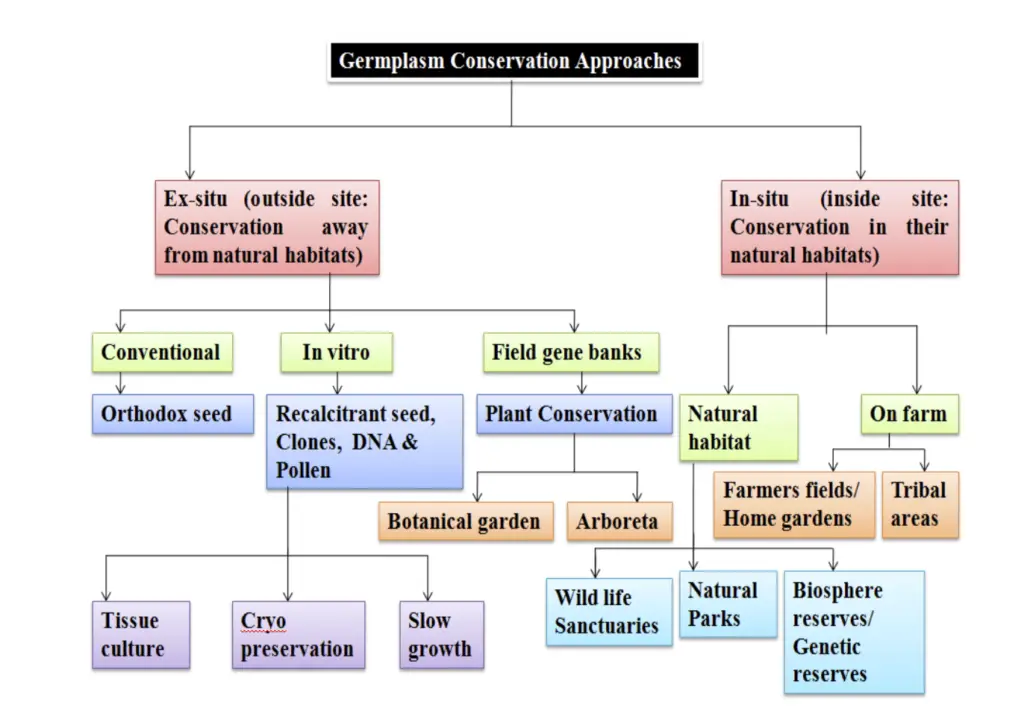
The methods of germplasm storage and conservation are mainly classified into two types. These are– In situ conservation and Ex situ conservation.
A. In situ Conservation Methods
In this method the genetic resources are conserved in their natural habitat or traditional farming system. It is the process of maintaining plants within their natural ecosystem.
- Protected areas and Natural reserves – Wild crop relatives and endangered species are conserved in their native habitat such as national parks, biosphere reserves and wildlife sanctuaries.
- On farm conservation – Traditional crop varieties (landraces) are continuously cultivated and managed by farmers in their own agricultural fields. It helps in maintaining genetic variability under natural conditions.
- Home gardens – Different locally developed crops like fruits, vegetables, medicinal plants and spices are maintained in small populations in backyard or community gardens.
B. Ex situ Conservation Methods
In this method the genetic material is preserved outside its natural habitat. The plant materials are maintained under artificial or controlled conditions.
- Seed banks – Seeds are dried to low moisture content and stored at low temperature (–18°C). It is most widely used method for orthodox seeds like cereals and legumes.
- Field gene banks – Living plants are grown and maintained in fields or orchards. It is used for vegetatively propagated crops and recalcitrant seeds like banana, cocoa and rubber.
- In vitro conservation – Plant tissues, cells or shoot tips are maintained in sterile culture media under laboratory condition. Slow growth techniques are used by reducing temperature and light.
- Cryopreservation – Plant materials such as seeds, embryos, meristems or cells are stored at ultra low temperature in liquid nitrogen (–196°C). At this temperature metabolic activities are completely stopped.
- Pollen storage – Pollen grains are dried and stored at low temperature. It is useful for preservation of paternal genes and safe germplasm exchange.
- DNA banks – Genomic DNA or RNA are extracted and stored at low temperature. It preserves genetic information for future studies and breeding programmes.
- Botanical gardens and arboreta – Living collections of wild, endangered and ornamental plants are maintained for conservation, research and education purpose.
A. Ex Situ Conservation
Ex situ conservation is the method of conserving genetic resources outside their natural habitat. It is the preservation of seeds, tissues, pollen or whole plants away from original ecosystem. The biological materials are removed from natural environmental condition and maintained under artificial controlled system.
In this method the evolutionary process is slowed or stopped. The conserved material do not undergo natural selection and adaptation. It is maintained in static condition so that original genetic characters are preserved without environmental influence.
It acts as safety backup for species which are threatened in wild condition due to habitat destruction, climate change, over exploitation and natural disasters. It is referred to as insurance policy for protection of plant genetic resources.
The collections are centralized in seed banks, gene banks and botanical gardens. It makes genetic materials easily accessible for researchers and plant breeders. It helps in crop improvement and future food security.
This method is not replacement of in situ conservation. It works as complementary strategy and provides long term secure storage. The materials are maintained under low moisture, sub zero temperature or sterile laboratory condition to extend viability and lifespan.
Characteristics of Ex Situ Conservation
Some of the important characteristics of Ex situ conservation are as follows–
- Off site conservation – Genetic materials such as seeds, pollen, tissues or whole plants are preserved outside their natural habitat. It is maintained away from original ecosystem.
- Static evolutionary condition – The conserved materials do not undergo natural selection. Evolutionary process is slowed or stopped under controlled storage condition.
- Controlled artificial environment – Genetic resources are stored under regulated conditions like low moisture and sub zero temperature in seed banks or sterile laboratory condition in tissue culture.
- High accessibility – The collections are centralized and easily available for plant breeders, researchers and farmers. It helps in crop improvement and scientific study.
- Space efficiency – Large amount of genetic diversity can be stored in small space especially in seed banks and cryopreservation units.
- Acts as safety backup – It works as insurance against loss of species due to habitat destruction, climate change, over exploitation or natural disasters.
- Periodic regeneration required – Seeds and tissues gradually lose viability even under storage. Therefore they are periodically regenerated which may sometimes cause genetic changes.
Primary Methods of Ex Situ Conservation
Some of the primary methods of Ex situ conservation are as follows–
- Seed banks – Seeds are dried to low moisture content and stored at sub zero temperature (–18°C to –20°C). It is mainly used for orthodox seeds which can tolerate drying and freezing. It helps in long term preservation of genetic material.
- Field gene banks and Botanical gardens – Living plant collections are grown and maintained in fields, orchards or arboreta. It is mainly used for vegetatively propagated crops, perennial plants and species having recalcitrant seeds which cannot survive drying and freezing.
- In vitro conservation (Tissue culture) – Plant cells, tissues, meristems or organs are maintained in sterile nutrient medium under laboratory condition. Slow growth techniques are used by reducing temperature and light to extend subculture period.
- Cryopreservation – Plant materials such as seeds, shoot tips or embryos are stored at ultra low temperature in liquid nitrogen (–196°C). At this temperature cell division and metabolic activities are completely stopped.
- Pollen storage – Pollen grains are dried and stored at low temperature. It is useful for preservation and exchange of paternal genetic material.
- DNA banks – Genomic DNA or sequence information are extracted and stored at low temperature. It preserves genetic information for future molecular and biotechnological studies.
Advantages of Ex Situ Conservation
Some of the important advantages of Ex situ conservation are as follows–
- Centralized storage – Large number of plant species and genetic materials are stored in limited space. It allows high density conservation under controlled condition.
- Easy access for research – Germplasm is maintained in one place and it is easily accessible for scientists and plant breeders. It is useful for evaluation and crop improvement programmes.
- Protection from threats – It protects species from habitat destruction, climate change, natural disasters and human interference. It acts as safety backup for endangered species.
- Cost effective method – Seed banking and similar methods are relatively cheap for long term preservation. Overall maintenance cost is centralized.
- Long term viability – In seed banks and cryopreservation the biological activities are slowed or suspended. Genetic stability is maintained for many years.
- Safe study of species – Plants can be studied without disturbing natural population. It helps in understanding plant biology and conservation strategies.
- Conservation of difficult species – It is useful for species which are difficult to conserve in natural habitat such as recalcitrant seed plants and parasitic plants.
- Disease free maintenance – In vitro conservation maintains germplasm under sterile and pathogen free condition. It prevents spread of diseases.
Disadvantages of Ex Situ Conservation
Some of the important disadvantages of Ex situ conservation are as follows–
- Halted evolutionary process – Plants conserved outside natural habitat do not undergo natural selection. Adaptation to new environmental condition, pests and diseases is stopped.
- Vulnerability to facility failure – Seed banks and gene banks depend on continuous power supply and maintenance. Power failure, cooling breakdown, natural disaster or political problems may cause heavy loss of germplasm.
- High cost and labour requirement – Field gene banks and in vitro culture requires large land area, sterile condition and skilled personnel. It is expensive and labour intensive.
- Risk of genetic drift – Seeds lose viability with time and they are periodically regenerated. If regeneration is done with small population size rare alleles may be lost and genetic diversity is reduced.
- Genetic mutation – Long term storage and tissue culture condition may cause harmful mutations or somaclonal variations in plant material.
- Not suitable for all species – Seed banking is suitable mainly for orthodox seeds. It is not applicable for recalcitrant seeds and vegetatively propagated crops without special techniques.
- Regeneration backlog – Due to lack of funding many gene banks are unable to test viability and regenerate seeds on time. Old seed collections may lose viability permanently.
- Exposure in field gene banks – Living collections maintained in open field are exposed to pests, diseases, drought and flood.
- Incomplete genetic representation – Ex situ collections represent only the diversity collected at that time. Some wild relatives and neglected species may not be included.
B. In Situ Conservation
In situ conservation is the method of conserving plant species in their natural habitat. It is the protection and maintenance of plants in the ecosystem where they originally developed. The conservation is carried out in forests, natural reserves or traditional farming systems.
It is a dynamic process. The plant populations remain as part of living ecosystem. Natural selection continues to operate and plants undergo continuous evolution with changing environmental condition.
In this method plants co evolve with local pollinators, pests, pathogens and soil microorganisms. Adaptation to climate change and environmental stress takes place naturally over time. The genetic resources are not kept in static condition.
It protects not only individual species but also the entire ecosystem and ecological interactions required for survival. The aim is to maintain viable and self sustaining populations of rare and wild species in native surroundings.
Human intervention is minimum in case of wild species. In traditional crop landraces continuous cultivation by farmers helps in maintaining genetic diversity under natural field condition.
Methods of In Situ Conservation
Some of the important methods of In situ conservation are as follows–
- Genetic reserves / Natural reserves – Genetic diversity is conserved in natural wild populations. Crop wild relatives are located, monitored and managed in their native habitat for long term conservation.
- On farm conservation – Traditional crop varieties (landraces) are continuously cultivated and maintained by farmers in their own agricultural fields. It helps in conserving genetic variability under natural farming condition.
- Home and community gardens – Locally developed crops such as vegetables, fruits, medicinal plants and spices are grown in small population in backyards or community plots. It helps in maintaining local genetic diversity for household use.
- Biosphere reserves – Large protected areas are established for conservation of wild populations and traditional farming systems. It is divided into core zone, buffer zone and transition zone for proper management.
- National parks – Government maintained natural areas where habitat manipulation is not allowed. Plant species and wildlife are protected in their natural ecosystem.
- Wildlife sanctuaries – Protected areas designated for safeguarding rare and endangered species from human interference. Natural environment is maintained for survival of different organisms.
Characteristics of In Situ Conservation
Some of the important characteristics of In situ conservation are as follows–
- Natural location – Conservation is carried out in natural habitat or traditional farming system. The species are maintained in the ecosystem where they originally developed.
- Dynamic process – It is a dynamic conservation method. Plants remain part of living ecosystem and continue to undergo natural selection.
- Continuous adaptation – The populations adapt to changing climatic condition, pests and diseases. Evolutionary process continues under natural environment.
- Ecosystem preservation – Not only the target plant species is protected but also pollinators, soil organisms and other ecological interactions are maintained.
- Minimum human intervention – Natural evolutionary process is allowed to occur with minimum artificial interference. In case of landraces farmers continuously cultivate and manage them.
- Maintains evolutionary potential – It maintains genetic variability and evolutionary potential of species rather than keeping them in static condition.
- Exposure to threats – Since species are conserved in wild or field condition they remain exposed to habitat loss, climate change and natural disasters.
- Limited accessibility – Genetic materials are scattered over large areas and it is difficult for researchers and breeders to access them easily.
- High land requirement – Large area of land is required to maintain viable population. It involves high land and opportunity cost.
Advantages of In Situ Conservation
Some of the important advantages of In situ conservation are as follows–
- Dynamic evolutionary adaptation – Plants and animals remain in natural habitat and continue to evolve. Adaptation to climate change, pests and diseases takes place naturally.
- Generation of new genetic variation – Continuous natural selection and farmer selection helps in formation of new recombinants. Rare alleles are maintained in population for future use.
- Whole ecosystem preservation – Not only target species is conserved but also entire ecosystem is protected. Pollinators, soil organisms and other associated biodiversity are maintained.
- Natural gene exchange – Gene flow occurs naturally between wild relatives and cultivated crops. Useful genes may be transferred under natural condition.
- Socio economic benefits – It supports livelihood of rural and resource poor farmers. It improves diet, nutrition and self sufficiency.
- Maintenance of traditional knowledge – Indigenous knowledge and low input farming practices are preserved. Cultural heritage associated with traditional agriculture is maintained.
- Community participation – Local communities have control and access over their own genetic resources. Farmers become part of conservation system.
- No specialized technology required – It does not require advanced laboratory techniques or artificial storage system. Conservation can be carried out under natural field condition.
Limitations of In Situ Conservation
Some of the important limitations of In situ conservation are as follows–
- Exposure to environmental threats – Species conserved in natural habitat are exposed to extreme weather, climate change, pests and diseases. Natural disasters and human conflicts may also cause loss of populations.
- Habitat fragmentation – Natural habitats may be degraded or fragmented due to human activities. Small and isolated areas may not support proper survival and evolution of species.
- Limited accessibility – Genetic materials maintained in wild or traditional farms are not easily accessible for plant breeders. Evaluation and characterization of useful traits becomes difficult.
- Large area requirement – A single protected area contains only small part of total genetic diversity. Large number of reserves are required for complete conservation which is costly and labour intensive.
- Opportunity cost of land – Land used for genetic reserves cannot be used for other agricultural or developmental purposes. It restricts alternative land use.
- Risk of crop replacement – On farm conservation depends on farmers participation. Farmers may replace traditional landraces with modern high yielding varieties due to economic pressure.
- Monitoring difficulty – Continuous monitoring and management is required for survival of species. It is difficult to control and supervise under natural and complex environmental condition.
Importance of Germplasm Storage
- Ensures future food security – It ensures availability of diverse genetic materials for future crop production. It is required for sustaining agricultural productivity for increasing population.
- Prevents genetic erosion – It prevents loss of rare and endangered plant species. Genetic erosion is caused by habitat destruction, human activities and modern uniform agriculture.
- Supports crop improvement – It provides basic genetic material for plant breeding programmes. New high yielding and nutritionally improved varieties are developed from these genetic resources.
- Provides resistance to pests and diseases – Useful resistant genes are preserved in germplasm collections. These genes are introduced into cultivated crops for protection against new pests and diseases.
- Helps in climate adaptation – Genetic variations which tolerate drought, flood and extreme temperatures are conserved. These are useful under changing environmental conditions.
- Preserves traditional varieties – Landraces and wild relatives are maintained as record of plant evolution and indigenous agricultural practices.
- Useful in scientific research – Seeds, tissues and DNA materials are available for studies in plant physiology, genetics and biotechnology.
Differences between In Situ Conservation and Ex Situ Conservation
Some of the important differences between In situ conservation and Ex situ conservation are as follows–
- Location of conservation –
In situ conservation is carried out in natural habitat or traditional farming system.
Ex situ conservation is carried out outside the natural habitat in seed banks, field gene banks or laboratories. - Evolutionary nature –
In situ conservation is a dynamic process. Plants continue to undergo natural selection and adaptation with changing environment.
Ex situ conservation is a static process. The biological activities are slowed or suspended under controlled condition. - Main objective –
The main objective of in situ conservation is to maintain evolutionary potential of species and ecosystem balance.
The main objective of ex situ conservation is to provide secure storage and easy availability of genetic resources. - Accessibility for research –
In situ genetic materials are scattered and difficult to access for plant breeders.
Ex situ collections are centralized and easily available for crop improvement and evaluation. - Risks and threats –
In situ conservation is affected by habitat destruction, climate change, natural disasters and replacement by modern varieties.
Ex situ conservation is affected by equipment failure, power problems, lack of funding and genetic changes during regeneration. - Cost and space requirement –
In situ conservation requires large area of land and long term management.
Ex situ conservation requires less space especially in seed banks and it is more space efficient. - Suitability of species –
In situ conservation is suitable for wild relatives, landraces and species depending on natural ecosystem.
Ex situ conservation is mainly suitable for orthodox seeds and also used for clonal crops through tissue culture and cryopreservation.
References
- Bellon, M. R., Dulloo, E., Sardos, J., Thormann, I., & Burdon, J. J. (2017). In situ conservation—Harnessing natural and human‐derived evolutionary forces to ensure future crop adaptation. Evolutionary Applications, 10(10), 965-977. https://doi.org/10.1111/eva.12521
- Dar, R. A., Ahmad, M., Kumar, S., & Reshi, M. (2015). Agriculture germplasm resources: A tool of conserving diversity. Scientific Research and Essays, 10(9), 326-338. https://doi.org/10.5897/SRE2015.6206
- Food and Agriculture Organization of the United Nations. (2010). The second report on the state of the world’s plant genetic resources for food and agriculture. FAO.
- Kumari, P., Borah, P., Gupta, K. K., & Singh, R. (2023). Genetic diversity and germplasm conservation in plant breeding. In D. K. Janghel (Ed.), Genetic Revolution in Agriculture: Unleashing the Power of Plant Genetics (pp. 200-217). Elite Publishing House.
- Lee, H. (2023). Ex situ conservation efforts for plant diversity protection with a focus on seeds. The Open Agriculture Journal, 17, e187433152307250. https://doi.org/10.2174/18743315-v17-230822-2023-15
- Maxted, N., Kell, S., & Magos Brehm, J. (2011). Options to promote food security: On-farm management and in situ conservation of plant genetic resources for food and agriculture (Background Study Paper No. 51). Commission on Genetic Resources for Food and Agriculture, FAO.
- Priyanka, V., Kumar, R., Dhaliwal, I., & Kaushik, P. (2021). Germplasm conservation: Instrumental in agricultural biodiversity—A review. Sustainability, 13(12), 6743. https://doi.org/10.3390/su13126743
- Rao, V. R. (2009). In situ/on-farm conservation of crop biodiversity. Indian Journal of Genetics and Plant Breeding, 69(4), 284-293.
- Roque-Borda, C. A., Kulus, D., de Souza, A. V., Kaviani, B., & Vicente, E. F. (2021). Cryopreservation of agronomic plant germplasm using vitrification-based methods: An overview of selected case studies. International Journal of Molecular Sciences, 22(11), 6157. https://doi.org/10.3390/ijms22116157
- Salgotra, R. K., & Chauhan, B. S. (2023). Genetic diversity, conservation, and utilization of plant genetic resources. Genes, 14(1), 174. https://doi.org/10.3390/genes14010174
- Stolton, S., Maxted, N., Ford-Lloyd, B., Kell, S., & Dudley, N. (2006). Food stores: Using protected areas to secure crop genetic diversity. WWF International.
- Tarraf, W., & De Carlo, A. (2024). In vitro biotechnology for conservation and sustainable use of plant genetic resources. Plants, 13(14), 1897. https://doi.org/10.3390/plants13141897
- Volk, G. M., & Moreau, T. L. (2023). Climate change impacts management of genebanks and botanic gardens. In G. M. Volk, T. L. Moreau, & P. F. Byrne (Eds.), Conserving and using climate-ready plant collections. Colorado State University.
- Yadav, R. K., Paliwal, S., Soni, A., Asati, R., Chauhan, S., & Yadav, P. K. (2024). Conservation of germplasm. In Breeding for abiotic stress resistance (pp. 105-119).