Phylogeny Explained – Tracing Life’s Evolutionary Roots

Transcript
Phylogeny is a fundamental concept in modern biology.
Phylogeny is the study of evolutionary lineage and historical development of organisms.
It traces the evolutionary history and relationships between species through time.
Phylogeny helps us understand how different species are related through their evolutionary history.
By tracing evolutionary relationships, phylogeny reveals how species descended from common ancestors and diversified over time.
The term originated from the German word ‘Phylogenie’ coined by the biologist Ernst Haeckel in 1866.
Phylogeny is fundamental to modern biological classification and evolutionary biology.
Phylogeny provides the essential framework for understanding the relationships between species and the history of life on Earth.
Now that we understand what phylogeny is, we can explore how it is visualized and studied.
Phylogenetic trees are visual representations of evolutionary relationships between organisms.
These trees grow from a common ancestor at the root and branch out to show how species diverge over time.
Let’s look at the basic components of a phylogenetic tree.
The root represents the common ancestor of all organisms in the tree.
Branches represent evolutionary lineages that change over time.
Internal nodes represent divergence points where lineages split.
Tips or leaves represent the species or organisms being studied.
Now, let’s see how to read a phylogenetic tree with a realistic example.
This tree shows the evolutionary relationships between five vertebrate species.
Humans and chimpanzees are most closely related, sharing a recent common ancestor.
This node represents the common ancestor of humans, chimpanzees, and gorillas.
Branching points on the tree show when lineages diverged from each other during evolution.
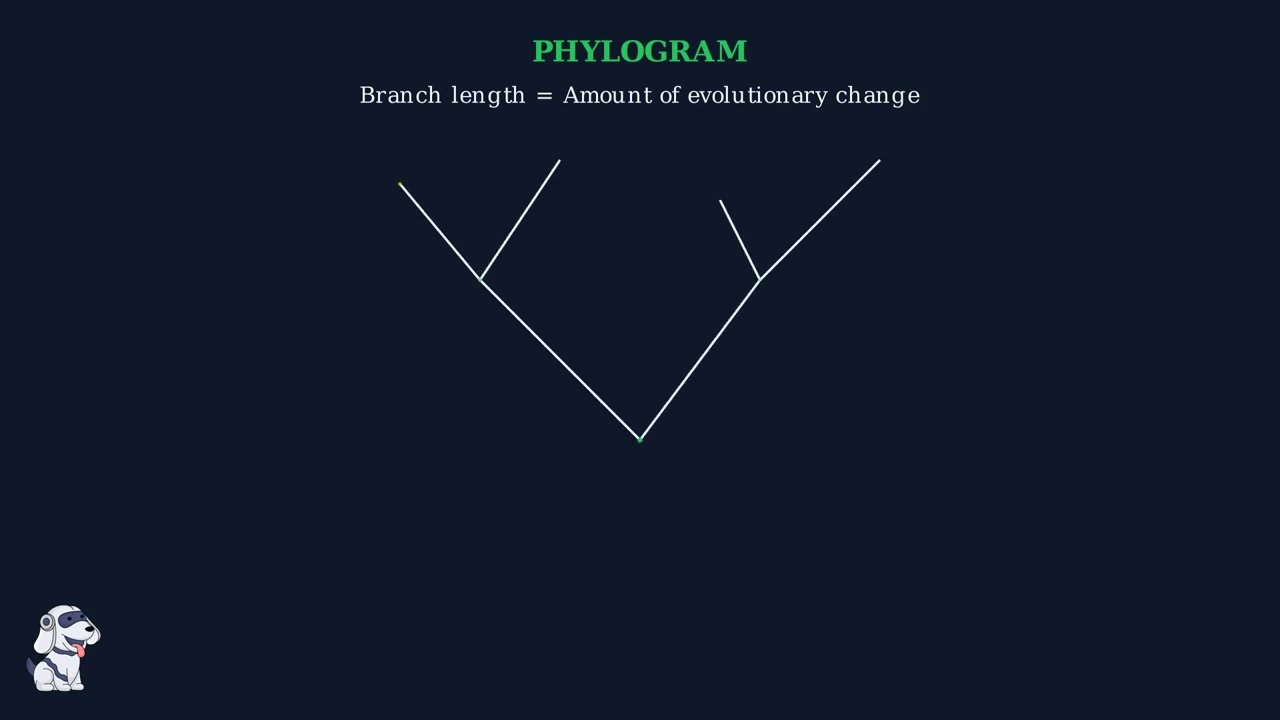
To summarize, when reading a phylogenetic tree, remember that species connected by fewer nodes are more closely related, each node represents a common ancestor, and branch lengths can indicate time or the amount of evolutionary change.
Microbial phylogeny is the study of evolutionary relationships among microorganisms, particularly bacteria.
Microbial phylogeny has revolutionized our understanding of microbial diversity, revealing that microorganisms are far more diverse than previously thought.
It challenged the traditional five-kingdom system of classification that grouped all microbes together, showing this was a vast oversimplification.
This work established a new understanding of the earliest forms of life on Earth and their evolutionary history.
Carl Woese’s groundbreaking work in the 1970s transformed our understanding of microbial life. He analyzed ribosomal RNA sequences to determine evolutionary relationships between organisms.
Woese’s research led to the reclassification of all life into three domains: Bacteria, Archaea, and Eukarya.
The discovery of Archaea was revolutionary. These microbes were as different from bacteria as bacteria are from eukaryotes, despite their similar appearance under the microscope.
The field of microbial phylogeny fundamentally changed our understanding of life’s diversity and revealed ancient evolutionary relationships that were previously unknown.
It also highlighted the importance of molecular methods in taxonomy, which continue to transform how we classify organisms today.
The Three-Domain System is a revolutionary classification approach that emerged from phylogenetic studies in the late 1970s.
It was developed by Carl Woese and George Fox in 1977, based on their analysis of ribosomal RNA sequences.
The system divides all life on Earth into three distinct domains.
The first domain is Bacteria. These are single-celled organisms without a nucleus. Their cell walls contain peptidoglycan, a unique molecular structure.
The second domain is Archaea. While also single-celled without a nucleus, they differ fundamentally from bacteria. Many archaea thrive in extreme environments, such as hot springs or highly saline water.
The third domain is Eukarya, which includes all organisms with cells containing a true nucleus. This domain encompasses plants, animals, fungi, and many single-celled organisms.
The classification into three domains is based on fundamental molecular differences.
This table shows key molecular differences between the three domains.
These differences include membrane lipid structure, RNA polymerase complexity, initiator tRNA, and the presence of histone proteins.
The Three-Domain System represents a significant advancement over previous classification schemes.
The previous Five-Kingdom classification system was based primarily on visible characteristics. It grouped all microbes into just two kingdoms and failed to recognize true evolutionary relationships.
In contrast, the Three-Domain System is based on genetic relationships. It properly distinguishes Archaea from Bacteria and accurately reflects evolutionary history, all supported by genomic evidence.
This phylogenetic tree illustrates the evolutionary relationships between the three domains.
All living organisms descend from a Last Universal Common Ancestor, or LUCA.
The Bacteria domain branched off first.
Later, the lineage split again, giving rise to Archaea and Eukarya.
One of the most significant findings from this system is that Archaea and Eukarya share a more recent common ancestor than either does with Bacteria.
Convergent evolution is the independent development of similar traits in unrelated species.
This occurs when different species face similar environmental pressures, leading to similar adaptations despite not sharing a recent common ancestor.
A classic example of convergent evolution is the similar body shape of dolphins and sharks.
Despite one being a mammal and the other a fish, they both evolved streamlined bodies that are optimized for swimming.
When building phylogenetic trees based solely on physical characteristics, convergent evolution can be misleading.
Scientists might incorrectly group dolphins and sharks together because they share similar body shapes.
Molecular data, like DNA sequences, helps scientists distinguish between true evolutionary relationships and convergent traits.
DNA analysis shows that sharks share more genetic similarities with other fish, while dolphins are genetically closer to other mammals.
Using molecular data, scientists can construct more accurate phylogenetic trees that reflect true evolutionary relationships.
This accurate tree shows that dolphins are more closely related to other mammals, while sharks are more closely related to other fish, despite their similar body shapes.
Molecular data helps scientists distinguish between genuine evolutionary relationships and similar traits that evolved independently through convergent evolution.
Other examples of convergent evolution include wings in birds, bats, and insects; eyes in vertebrates, mollusks, and arthropods; and echolocation in bats and dolphins.
Phylogenetic analysis faces significant computational challenges as datasets grow larger and more complex.
One of the main challenges is the exponential growth of possible tree arrangements as the number of species increases.
For just 3 species, there are only 3 possible trees. With 4 species, this jumps to 15 trees. But by the time we reach 10 species, we’re dealing with over 2 million possible trees.
The growth continues exponentially. With 20 species, we already have more than 10^20 possible trees. And for 50 species, the number exceeds 10^74 – more than the estimated number of atoms in the universe.
This follows a specific mathematical formula where the number of possible rooted binary trees grows factorially with the number of species.
As we add more species to analyze, the tree structures become increasingly complex. Even comparing just a few additional species dramatically increases the computational challenge.
Another complexity is that different phylogenetic methods can produce different trees from the same data.
Methods like Maximum Likelihood, Bayesian Inference, Maximum Parsimony, and Neighbor-Joining each have different assumptions and can yield different evolutionary relationships.
Analyzing large phylogenetic datasets requires significant computational resources and specialized approaches.
Despite advances in algorithms and computing power, the exponential growth of possible trees means that computational complexity will remain a significant challenge for phylogenetic research.
Molecular clocks are a key concept in evolutionary biology, used to estimate when species diverged from common ancestors.
The molecular clock hypothesis, proposed in the 1960s, suggests that genetic mutations accumulate at a relatively constant rate over time.
This can be visualized as DNA sequences changing in predictable patterns, similar to how clock hands move at a steady pace.
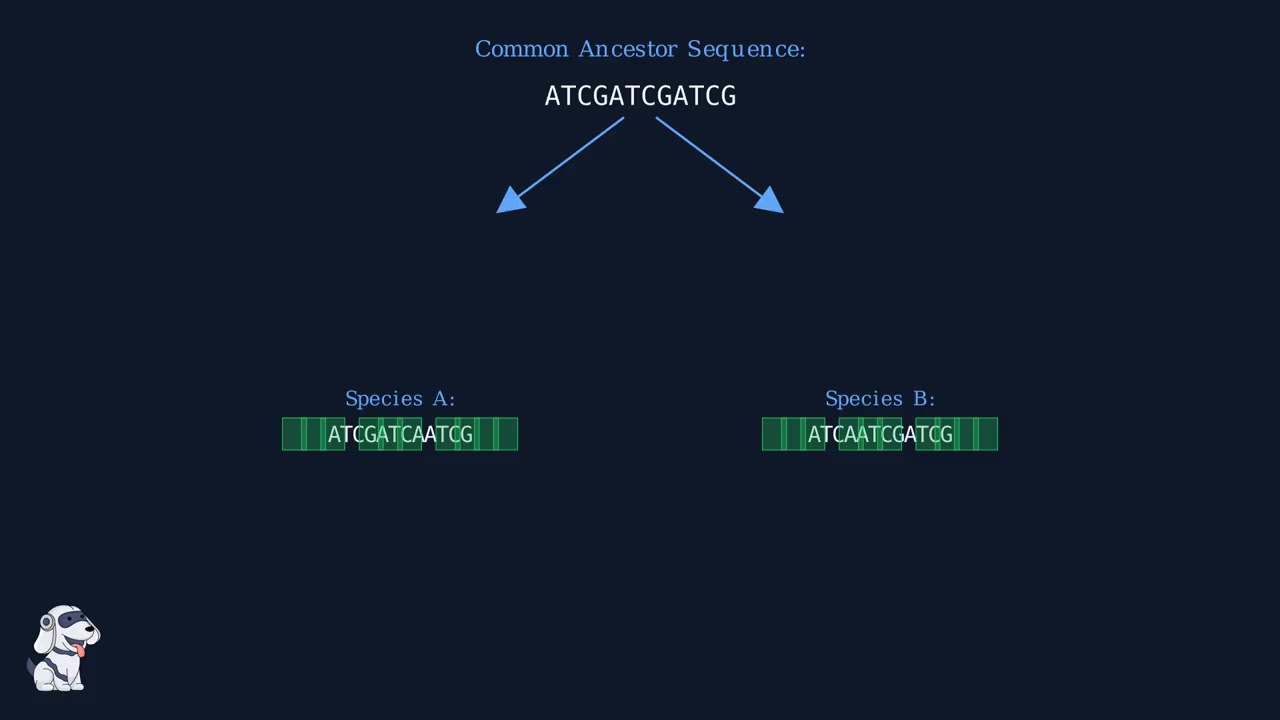
As time passes, random mutations occur in DNA sequences. If these mutations are neutral – not affecting survival – they accumulate at a steady rate.
Molecular clocks are used to estimate when species diverged from their common ancestors.
By comparing DNA sequences between species and counting the differences, scientists can estimate the time since their divergence.
For example, if species B and C share twenty million mutations from their common ancestor, while species A differs by forty million mutations, we can place these divergence events on a timeline.
Despite their usefulness, molecular clocks have several limitations that affect their reliability.
The most significant limitation is that mutation rates are not actually constant. They can vary in several important ways.
First, different species can have different baseline mutation rates due to factors like generation time and DNA repair mechanisms.
Second, within a genome, different genes evolve at different rates depending on their function and how constrained they are by natural selection.
Third, mutation rates aren’t necessarily constant over evolutionary time scales. They can speed up or slow down.
Additional factors like selection pressure and population size further complicate the reliability of molecular clocks.
To address these limitations, scientists calibrate molecular clocks using fossil evidence.
First, uncalibrated molecular clocks provide estimated divergence times based solely on mutation counts.
Fossils provide known time points in evolutionary history. When these fossils can be linked to specific branching points in a phylogenetic tree, they serve as calibration points.
By adjusting the molecular clock rates to match these fossil-dated divergence events, scientists create a calibrated molecular clock that provides more accurate time estimates.
With proper calibration and careful selection of genetic markers, molecular clocks remain a powerful tool for understanding the timing of evolutionary events.
Phylogenetic analysis has numerous applications in medical research.
Phylogenetic trees are powerful tools for tracking disease outbreaks.
By analyzing the genetic relationships between pathogen samples from different patients and locations, scientists can reconstruct transmission chains.
This timeline shows how an outbreak can be traced from a single index case to multiple clusters over time.
This approach has been crucial for understanding the spread of pathogens like SARS-CoV-2, Ebola, and foodborne illness outbreaks.
Phylogenetic analysis also helps track how pathogens evolve over time.
As pathogens replicate, they accumulate genetic changes through mutations, gene acquisition, and recombination events.
By constructing phylogenetic trees, scientists can pinpoint when and where specific genetic changes occurred, helping us understand pathogen adaptation.
One critical application is understanding the development of antibiotic resistance.
Phylogenetic analysis reveals how resistance genes spread between bacterial populations and how multi-drug resistance emerges.
Bacteria can develop resistance through various mechanisms, including target modification, efflux pumps, and enzymatic inactivation of antibiotics.
By tracking the evolutionary history of resistance genes, we can better understand how resistance spreads and develop strategies to combat it.
Comparing pathogen genomes through phylogenetic analysis helps identify virulence factors.
By comparing closely related pathogenic and non-pathogenic strains, researchers can identify genetic elements associated with disease-causing ability.
Virulence factors include toxins, adhesins, invasion factors, and immune evasion systems that enable pathogens to cause disease.
This comparative approach has led to the discovery of numerous virulence determinants that serve as targets for new antimicrobial therapies.
Perhaps one of the most important applications of phylogeny is in vaccine development.
Phylogenetic analysis helps identify regions of pathogen genomes that remain stable across different strains.
These conserved regions often make ideal vaccine targets because they’re less likely to mutate and evade immunity.
Phylogeny-informed vaccine design improves cross-protection against multiple strains and helps predict how pathogens might evolve to escape vaccine-induced immunity.
This approach has been instrumental in developing vaccines for influenza, HIV research, and most recently, SARS-CoV-2 variants.
Biogeography is the study of how species are distributed across the globe and the patterns that emerge from these distributions.
Phylogeny helps scientists understand why related species occur in the same regions, how geographical barriers shape distribution patterns, and when species diverged in relation to geological events.
One of the most significant applications of phylogeny in biogeography is connecting evolutionary tree patterns with continental drift. As landmasses separated over millions of years, the species on them evolved in isolation.
Biogeographers study two main processes that explain species distributions: vicariance, where a population is divided by a new geographical barrier, and dispersal, where species cross existing barriers to colonize new areas.
Phylogeography combines genetic data with geographical information to understand how populations have migrated and evolved over time. By examining genetic variations across space, scientists can trace migration routes, identify past barriers to gene flow, and reconstruct population histories.
A classic example of biogeography is the Wallace Line, a boundary through Indonesia that separates Asian fauna from Australian fauna. This sharp division occurs because the deep ocean channels between these landmasses prevented many species from crossing, resulting in two dramatically different evolutionary trajectories.
Biogeography has numerous practical applications. It helps conservationists protect endemic species, predicts how species might respond to climate change, improves our understanding of invasive species, reconstructs historical climate patterns, and identifies biodiversity hotspots for conservation priorities.
Microbial and viral phylogeny presents unique challenges in reconstructing evolutionary relationships.
Microbes and viruses present several key challenges for phylogenetic analysis.
Horizontal gene transfer occurs when genetic material moves between unrelated organisms rather than from parent to offspring.
This process disrupts the traditional tree-like structure of evolution, creating a complex network of relationships that’s difficult to map.
This creates a web-like rather than tree-like evolutionary pattern, making traditional phylogenetic analysis more challenging.
Viral phylogeny is crucial for tracking disease evolution and spread, as demonstrated with COVID-19.
As SARS-CoV-2 evolved, it branched into different variants like Alpha and Delta.
Further mutations led to Omicron variants such as BA.1, BA.2, BA.4, and BA.5, each with distinct characteristics.
Phylogenetic analysis of viral genomes allows scientists to track variant emergence, monitor transmission patterns, identify key mutations, and predict future evolution.
Bacterial phylogeny reveals ancient evolutionary innovations that shaped life on Earth.
Cyanobacteria developed oxygen-producing photosynthesis, fundamentally changing Earth’s atmosphere.
Proteobacteria evolved nitrogen fixation, enabling the conversion of atmospheric nitrogen to ammonia that plants can use.
Understanding microbial phylogeny is crucial for revealing early life evolution, identifying metabolic innovations, guiding biotechnology applications, and informing medical interventions.
To summarize our exploration of microbial and viral phylogeny:
Vertebrate phylogeny traces the evolutionary relationships among animals with backbones.
The vertebrate family tree began with early fish around 500 million years ago.
Jawless fish, like lampreys, were among the earliest vertebrates.
The evolution of jaws was a critical innovation that led to more efficient feeding.
Jawed fish diversified into sharks, ray-finned fish, and lobe-finned fish.
The development of limbs from fins allowed some fish to venture onto land, leading to amphibians.
The amniotic egg freed reptiles from returning to water to reproduce, a major step in terrestrial adaptation.
Birds evolved from dinosaurs, a group of reptiles, developing feathers and the ability to fly.
Endothermy, or warm-bloodedness, evolved separately in birds and mammals, allowing activity regardless of external temperature.
Vertebrate evolution is marked by several major transitions over hundreds of millions of years.
The first vertebrates appeared over 500 million years ago with key features like a notochord and nerve cord.
Jawed vertebrates evolved around 440 million years ago when gill arches were repurposed into hinged jaws.
The transition to land occurred around 375 million years ago with animals like Tiktaalik, which had limb-like fins.
The amniotic egg appeared around 340 million years ago, allowing embryos to develop away from water.
Mammal-like reptiles evolved around 320 million years ago with specialized teeth and skull openings.
Birds first appeared around 150 million years ago, evolving feathers and lightweight skeletons for flight.
Vertebrate phylogeny reveals how key innovations led to major evolutionary transitions, helping us understand the development of diverse animal forms we see today.
Related Videos