

Urochordata is a subphylum of marine chordates that includes sea squirts, salps, doliolids, pyrosomes and appendicularians. They are commonly referred to as tunicates. The body of these animals is generally covered by an outer covering called tunic.
The tunic contains cellulose, which is an unusual condition among animals. Members are found only in marine habitat. They may be solitary or colonial and the body form is also very different among different groups.
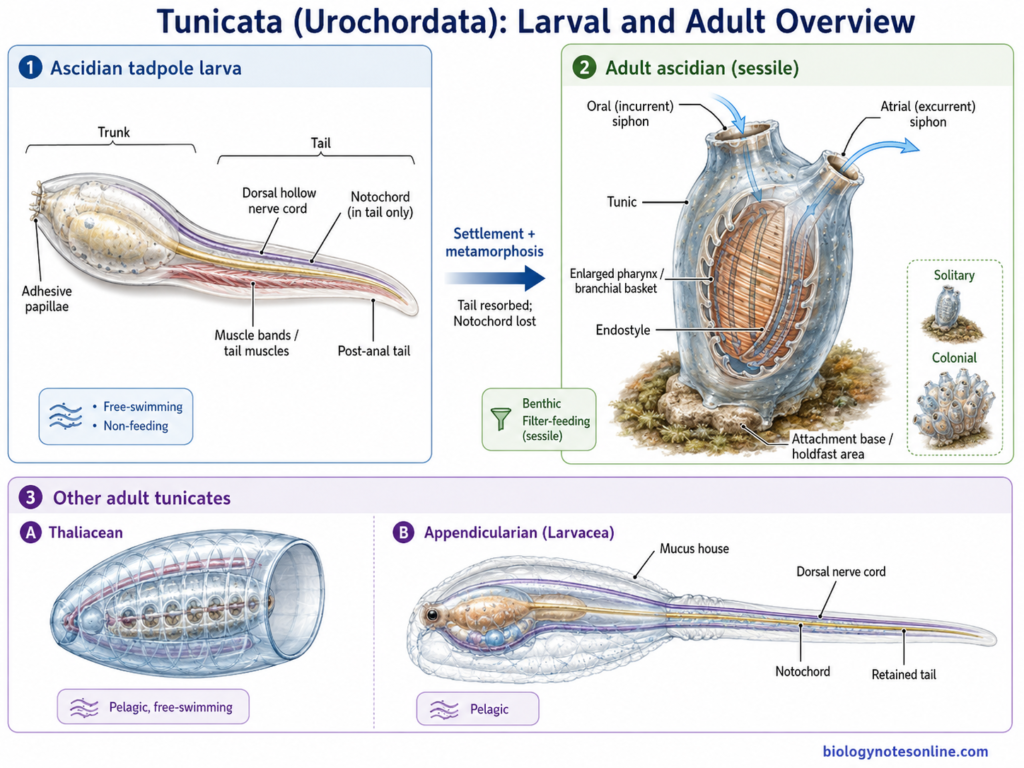
The chordate characters are clearly seen in the larval stage of most ascidians. The larva has a notochord, dorsal nerve cord and a post-anal tail. During metamorphosis, the tail and notochord are lost in most ascidians and the adult becomes attached to the substratum. However, this is not found in all tunicates. Appendicularians retain the notochord and tail in the adult stage, while members of Thaliacea remain free-swimming.
Urochordata is the traditional name used for this group. The name Tunicata is commonly used in the present classification and scientific literature. Both names are still found in zoological books.
Tunicata is one of the major groups under Chordata. Molecular studies place the tunicates close to vertebrates and they are considered the sister group of Vertebrata.
What Are Urochordata?
Urochordata are marine invertebrate chordates, commonly known as tunicates. The name Urochordata is traditionally used for this group. In present taxonomy, Tunicata is the accepted name in the World Register of Marine Species (WoRMS), while Urochordata is listed as its junior synonym. However, the term Urochordata is still commonly used in zoological books and scientific literature.
The members are called tunicates because their body is surrounded by an outer covering called the tunic. This tunic contains cellulose and covers the body of tunicates. The group includes ascidians or sea squirts, salps, doliolids, pyrosomes and appendicularians.
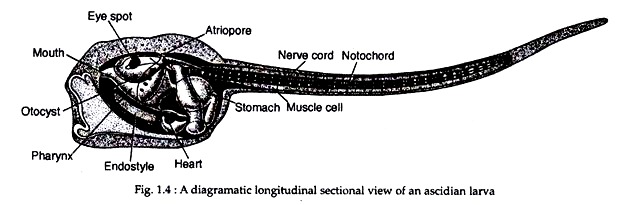
The chordate characters are particularly clear in the tadpole-like larva of many tunicates. The larva possesses a notochord in its tail, dorsal hollow nerve cord and post-anal tail. Pharyngeal slits are also present as a characteristic chordate feature. These features show their position under the phylum Chordata.
Adult body form is not the same in all members. Ascidians are generally attached to a substratum during adult life. Thaliaceans and appendicularians are pelagic forms and remain free in the water. Therefore, all Urochordata should not be described as sessile animals.
Urochordata at a glance
| Features | Urochordata (Tunicata) |
|---|---|
| Phylum | Chordata |
| Accepted name in WoRMS | Tunicata |
| Traditional name | Urochordata |
| Common name | Tunicates |
| Type of animals | Marine invertebrate chordates |
| Body covering | Tunic |
| Characteristic larval form | Tadpole-like larva in many tunicates |
| Notochord | Present in the tail of the characteristic larva |
| Nerve cord | Dorsal hollow nerve cord |
| Adult habit | Sessile as well as pelagic forms are present |
| Common members | Sea squirts, salps, doliolids, pyrosomes and appendicularians |
Key Characteristics of Tunicates
- Tunicates are exclusively marine chordates. The members are found in the sea, both in the benthos and planktonic region.
- The members may be solitary or colonial. Ascidians include both solitary and colonial forms, while many other tunicates live freely in the water.
- A characteristic outer covering called tunic is present. It is an extracellular covering secreted by the epidermis and contains cellulose. This structure is an important characteristic feature of Tunicata.
- The mode of life is not similar in all tunicates. Adult ascidians are generally benthic and attached, whereas thaliaceans and appendicularians are pelagic forms. Thus, all tunicates are not sessile animals.
- Two openings or siphons are conspicuous in the adult ascidian body. Water enters through the oral or incurrent siphon and passes out through the atrial or excurrent siphon.
- The pharynx or branchial basket is greatly enlarged in ascidians and contains numerous openings called stigmata. Ciliary movement helps in passing water through these openings.
- Tunicates are mainly filter-feeding animals. Food particles from water are trapped in mucus associated with the pharyngeal region. The endostyle produces mucus and takes part in this feeding process.
- The coelom is greatly reduced in Tunicata. Separate paired coelomic cavities, like those considered for the ancestral deuterostome condition, are not developed in tunicates. A pericardial cavity is associated with the heart in ascidians.
- In ascidians, a tubular heart is present and circulation is generally described as open. The heart shows a peculiar condition where the direction of its pumping changes periodically, so the direction of blood flow is reversed.
- Reproduction is both sexual and asexual, depending on the member. Sexual reproduction is common, while colonial tunicates can also form new zooids by budding or blastogenesis.
- The characteristic tadpole larva shows important chordate characters. It possesses a notochord, dorsal hollow nerve cord and muscular post-anal tail. These characters are particularly clear in the larvae of ascidians.
- During metamorphosis of a typical ascidian larva, the tail is resorbed and the notochord is lost. This condition should not be applied to every tunicate, because appendicularians retain a tail and notochord during the adult stage.
Chordate Features in the Larva
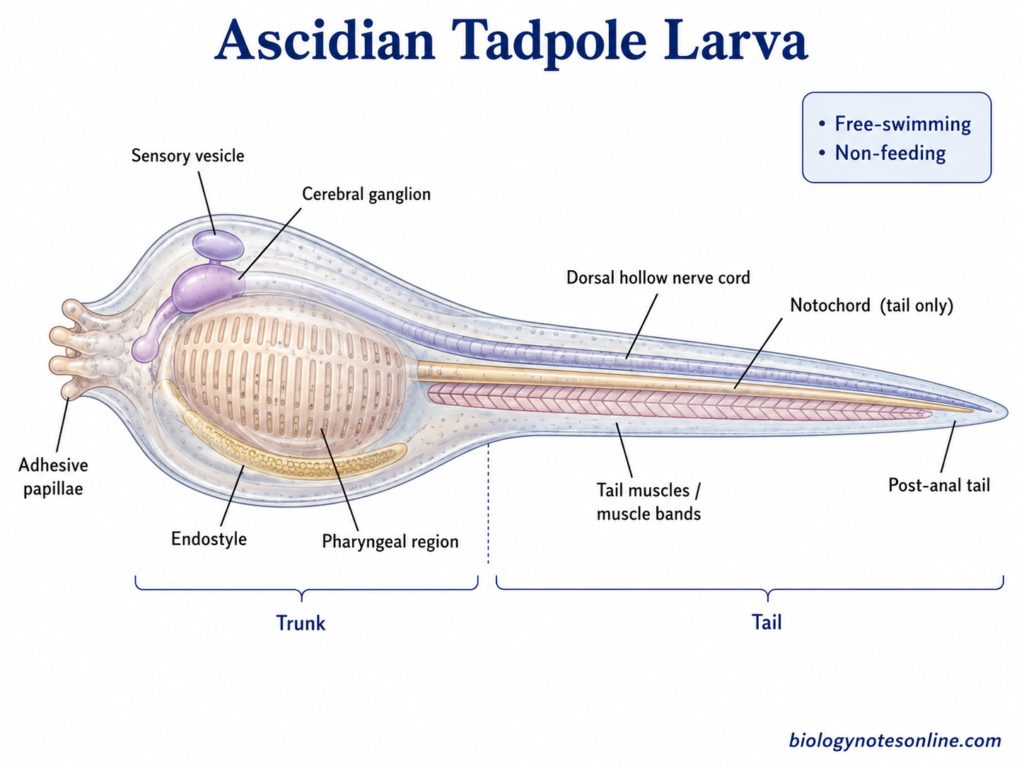
The tadpole larva of ascidians shows the basic chordate body plan. These larval characters are an important evidence for placing Tunicata (Urochordata) under the phylum Chordata.
The following are the major chordate features seen in the ascidian larva-
- Notochord– The notochord is present in the tail region of the larva. It forms a longitudinal supporting rod along the tail. In Ciona, the notochord is formed by a single row of cells.
- Dorsal hollow nerve cord– A dorsal neural tube or nerve cord is present above the notochord. The nervous system extends from the sensory region of the trunk into the tail. The caudal nerve cord is involved with the swimming movement of the larva.
- Post-anal tail– The larva possesses a well-developed tail extending behind the body region containing the gut. It is one of the characteristic chordate features. The tail contains notochord, nerve cord and rows of muscle cells.
- Tadpole-like locomotion– The ascidian larva is a free-swimming tadpole-like form. Muscles are arranged on both sides of the notochord. Their contraction produces bending of the tail and helps the larva in swimming before settlement.
- Pharyngeal slits– Pharyngeal gill slits are one of the basic characters of chordates and are well developed in the ascidian pharynx. However, they should not be described as a major functional feature of the ordinary free-swimming ascidian tadpole. The tadpole larva is generally non-feeding, and the large functional pharyngeal region develops with metamorphosis and juvenile formation.
- Endostyle– The endostyle is another important chordate character and is present along the ventral region of the ascidian pharynx. It is mainly associated with the pharyngeal feeding apparatus. In the typical ascidian life cycle, the notochord and dorsal nerve cord are prominent in the tadpole larva, whereas the pharynx and endostyle are much more characteristic of the post-larval and adult body.
The familiar tadpole condition is particularly clear in ascidians such as Ciona. It should not be considered exactly same in all tunicates. Some molgulid ascidians have secondarily evolved tailless larvae, while appendicularians retain the tail and notochord beyond the larval stage.
Adult Form and Lifestyle
The adult form of tunicates differs considerably among the different groups. The familiar sac-like and attached adult condition is mainly found in ascidians. Thaliaceans and appendicularians are free-swimming forms.
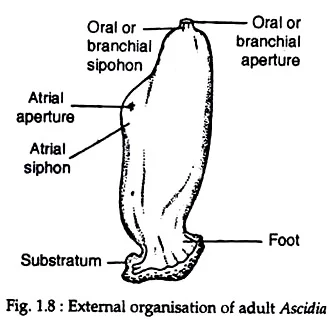
- Most adult ascidians are benthic animals and remain attached to rocks, shells and other hard substratum. The body is generally sac-like and covered by the tunic. An oral or incurrent siphon and an atrial or excurrent siphon are present in the adult body.
- During metamorphosis, the tadpole larva becomes changed into the adult ascidian. The larval tail is resorbed and the notochord is lost. The adult body therefore looks very different from the chordate-like larva.
- The adult ascidian is mainly a filter-feeding animal. A large pharyngeal or branchial region occupies much of the body. Water enters through the oral siphon and leaves through the atrial siphon.
- Ascidians may be solitary or colonial. In solitary forms, each individual occurs as a separate animal. Ciona and Ascidia are common examples. Colonial ascidians consist of many zooids associated together, and asexual budding is important in formation and growth of the colony.
- Thaliaceans are different from the attached ascidians. They are pelagic tunicates and spend their life swimming or floating in the open water. Salps and doliolids have generally transparent, barrel-like bodies. Their life cycles may contain both sexual and asexual stages.
- Some thaliaceans also form colonies or aggregated stages. Pyrosomes, for example, are colonial pelagic tunicates. Thus, colonial life in Tunicata is not restricted only to benthic ascidians.
- Appendicularians (Larvacea) are small pelagic tunicates. They remain free-swimming and do not change into the typical sessile ascidian-like adult. The adult retains a muscular tail containing the notochord and dorsal nerve cord. It gives the animal a tadpole-like appearance even during adult life.
- Appendicularians are solitary forms. Many of them produce an external mucus structure called a house, which is used during filter feeding. Oikopleura is a common example of this group.
Body Organization
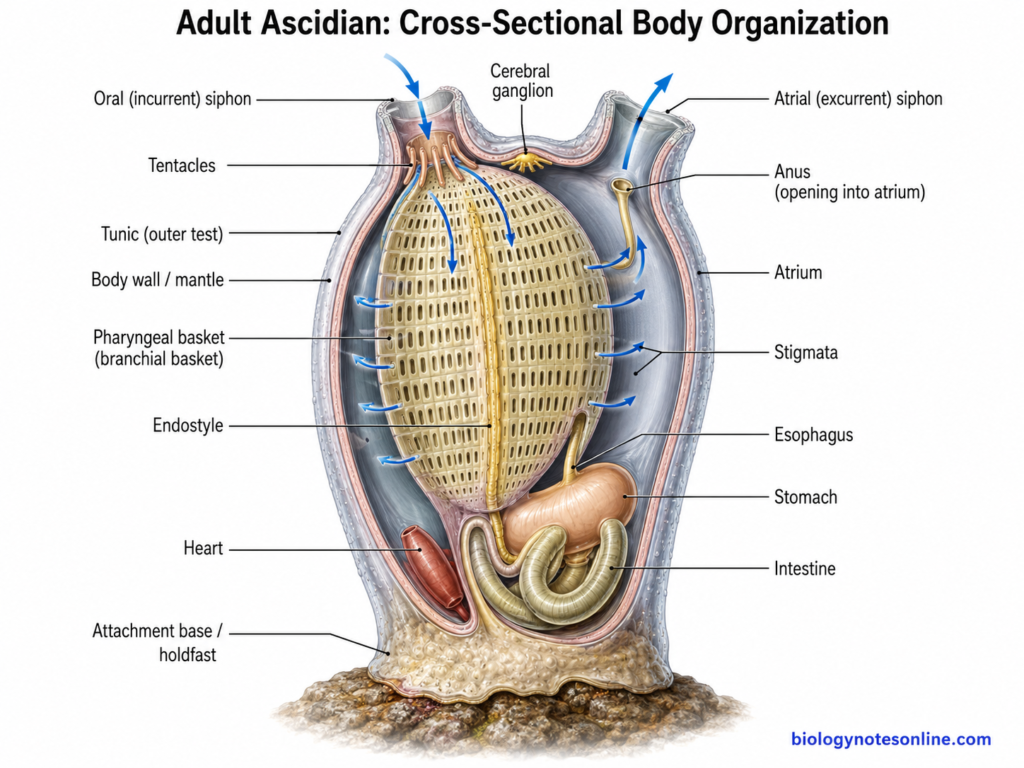
The body organization of tunicates varies in different groups. The commonly described sac-like body is mainly the adult ascidian condition. In these animals, a large pharyngeal region occupies most of the internal body.
The major structures of an adult ascidian body are as follows-
- Tunic– The body is externally covered by a thick covering called the tunic or test. It is an extracellular matrix present outside the epidermis. Cellulose is a major structural component of the tunic along with proteins and other polysaccharides.
- Body wall or mantle– A body wall is present below the tunic. It consists of epidermal and muscular regions and encloses the internal organs. The muscles are particularly developed around the siphons and help in contraction of the body.
- Siphons– Two siphons are generally present in an adult ascidian. The oral siphon receives water into the body, while the atrial siphon allows water to pass outside. Tentacles are present near the oral opening in many ascidians.
- Pharyngeal basket– The pharynx is greatly enlarged and forms a large branchial or pharyngeal basket. Numerous openings called stigmata are present in it. Water entering from the oral siphon passes through these openings. The branchial basket occupies a large part of the ascidian body.
- Endostyle– It is a longitudinal groove located on the ventral side of the pharynx. The endostyle produces mucus which helps in trapping food particles from the water. Cilia are also associated with the movement of mucus and food.
- Atrium– The pharyngeal basket is surrounded externally by a large cavity called the atrium. Water passes through the pharyngeal stigmata into this cavity and finally leaves through the atrial siphon. The anus also opens into the atrial region.
- Digestive tract– The alimentary canal consists of the esophagus, stomach and intestine. In many ascidians, the gut forms a curved or U-shaped loop. The intestine ends by the anus which opens into the atrium.
- Heart and circulation– A simple tubular and valveless heart is present near the visceral region. Blood passes through vessels and spaces of the body. A peculiar feature is that the direction of heart contraction reverses after intervals, and the direction of blood flow also becomes reversed.
- Nervous system– The nervous system of adult ascidians is much reduced compared with the tadpole larva. A cerebral ganglion is present in the region between the siphons and nerves extend from it to different parts of the body. The organization of this ganglion and its nerves may differ among ascidian species.
This type of body structure mainly represents Ascidiacea. Pelagic thaliaceans have a modified barrel-like or transparent body organization, while appendicularians retain a distinct trunk and muscular tail during adult life.
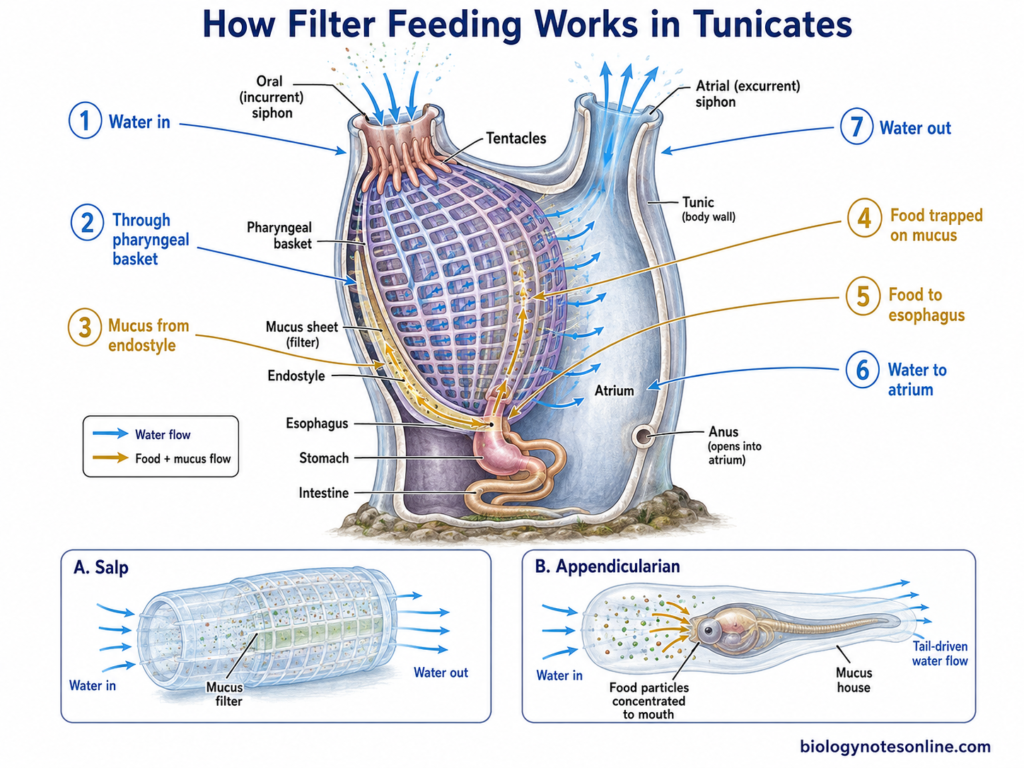
How Filter Feeding Works
Tunicates are mainly filter-feeding or suspension-feeding animals. In adult ascidians, the pharyngeal basket, endostyle, cilia and mucus take part in feeding. Water is passed continuously through the pharynx during this process.
The filter feeding process in ascidians takes place as follows-
- Entry of water– Seawater enters into the body through the oral or incurrent siphon. Small suspended particles, plankton and other organic materials also enter along with the water.
- Water movement through pharynx– The water now enters the large pharyngeal basket. Its wall contains numerous small openings called stigmata. Cilia present around the openings produce the water current.
- Formation of mucus filter– The endostyle is present along the ventral region of the pharynx. It secretes mucus. This mucus forms a thin sheet or filter over the inner surface of the pharyngeal basket.
- Trapping of food particles– Suspended food particles become trapped on the mucus filter. The water continues to pass through the stigmata. The pharyngeal basket therefore acts as the main filtering region.
- Movement of food– The mucus containing trapped food is moved by ciliary action. It is carried towards the digestive tract.
- Passage of filtered water– After passing through the stigmata, filtered water enters the atrium. It is finally discharged outside through the atrial or excurrent siphon.
- Digestion of food– The collected food passes into the esophagus and then through the remaining digestive tract. Digestion and absorption take place there. The mucus filter is continuously formed during active feeding.
- Feeding in salps– Salps are also mucus-filter feeders. In these pelagic tunicates, movement of water is associated with contraction of the body muscles. Water passes through the body and suspended food particles are collected on the mucus filter.
- Feeding in appendicularians– Appendicularians show a different feeding mechanism. They secrete a large external mucus structure called the house. Beating of the muscular tail pumps water through the filters of this house. Suspended food particles are concentrated and then passed towards the mouth.
Classification and Major Groups
Traditional zoology recognizes three principal groups. Current databases continue to use Ascidiacea, Thaliacea and Appendicularia at class level, but molecular phylogenetic studies show that traditional Ascidiacea is paraphyletic.
The three major groups of Tunicata (Urochordata) are as follows-
1. Ascidiacea
Ascidiacea includes the animals commonly referred to as sea squirts. Most of the adults are benthic and remain attached to a substratum. They form the largest traditional group of tunicates.
- Habit- Adult ascidians are mostly sessile. They are found attached to rocks and other submerged surfaces.
- Forms- Solitary, social and colonial forms are present. In colonial forms, many zooids may occur together in a common tunic. Social forms show an intermediate type of association.
- Larva- A typical ascidian develops through a free-swimming tadpole larva. The tail contains the notochord, muscle cells and dorsal nerve cord. Some ascidian lineages, however, have secondarily lost the typical tailed larval condition.
- Metamorphosis- The tadpole larva settles on the substratum and metamorphosis takes place. The larval tail is largely resorbed and the notochord disappears in the typical form. A sessile filter-feeding adult is then formed.
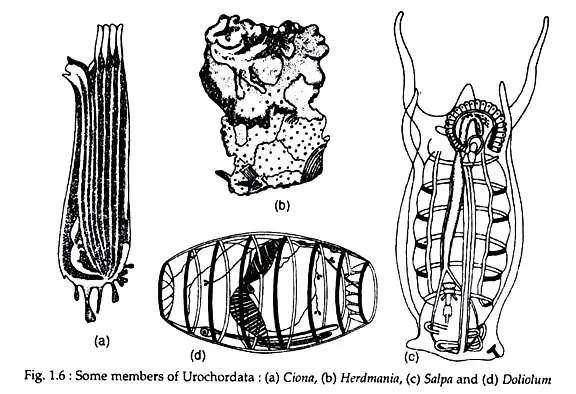
- Examples- Ciona, Herdmania, Styela and Botryllus. Botryllus is a colonial ascidian, while Ciona and Herdmania represent solitary forms.
2. Thaliacea
Thaliacea consists of entirely pelagic tunicates. The members live in the open water and are included among gelatinous zooplankton. Salps, doliolids and pyrosomes are the important members of this class.
- Body form- The body is generally transparent or gelatinous. Salps and doliolids commonly have a barrel-like body, while pyrosomes form colonies.
- Pelagic habit- Unlike the adult ascidians, these animals are not permanently attached to a substratum. They remain pelagic throughout their life.
- Water movement- Water is passed through the body during feeding and locomotion. In salps, contraction of circular muscle bands expels water through the atrial opening and produces jet propulsion.
- Life cycle- The reproductive cycle is complex in many thaliaceans. Sexual and asexual generations occur, particularly well known in salps and doliolids.
- Major forms- The class contains salps, doliolids and pyrosomes. These represent Salpida, Doliolida and Pyrosomatida respectively in the traditional class arrangement.
- Examples- Salpa, Doliolum and Pyrosoma.
3. Appendicularia (Larvacea)
Appendicularia includes small planktonic tunicates. They are also commonly called larvaceans. In present WoRMS classification, Appendicularia is used as the accepted class name and Larvacea is treated as its synonym.
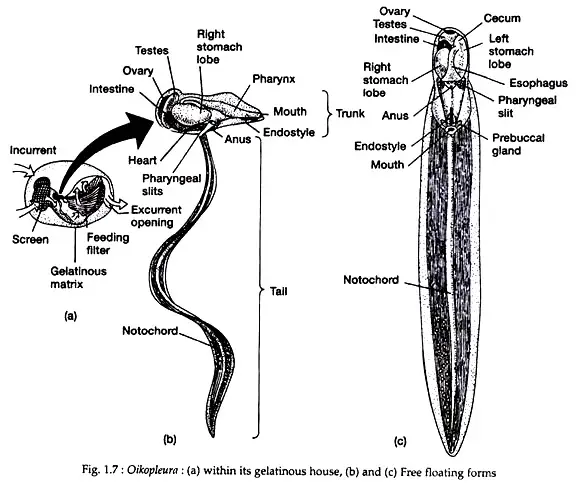
- Body form- The body consists of a small trunk and a long muscular tail. The adult therefore remains tadpole-like in appearance.
- Retention of chordate characters- The tail and notochord are retained during adult life. This is different from the typical adult ascidian where the larval tail and notochord are lost during metamorphosis.
- Mucous house- Most appendicularians secrete a large extracellular mucus structure called the house. The animal lives and feeds inside this structure.
- Filter feeding- Movement of the muscular tail pumps water through the filters of the house. Small suspended food particles are trapped and concentrated during this process.
- Example- Oikopleura is one of the best-known appendicularians. Oikopleura dioica is also widely used for developmental and genomic studies.
Major Groups of Urochordata Comparison
| Features | Ascidiacea | Thaliacea | Appendicularia |
|---|---|---|---|
| Common form | Sea squirts | Salps, doliolids and pyrosomes | Larvaceans |
| Adult habit | Mostly benthic and sessile | Pelagic | Pelagic |
| Body form | Generally sac-like | Generally transparent or gelatinous | Trunk with muscular tail |
| Solitary/colonial condition | Solitary, social and colonial forms | Solitary and colonial/aggregate stages occur | Mainly solitary |
| Typical larva | Tadpole larva common | Development differs among the groups | Adult retains larval-like body |
| Notochord in adult | Lost in typical adult ascidian | Not retained as in appendicularians | Retained in tail |
| Special feature | Metamorphosis into benthic adult | Pelagic life and complex life cycles | External mucous feeding house |
| Examples | Ciona, Herdmania, Styela, Botryllus | Salpa, Doliolum, Pyrosoma | Oikopleura |
Reproduction and Development
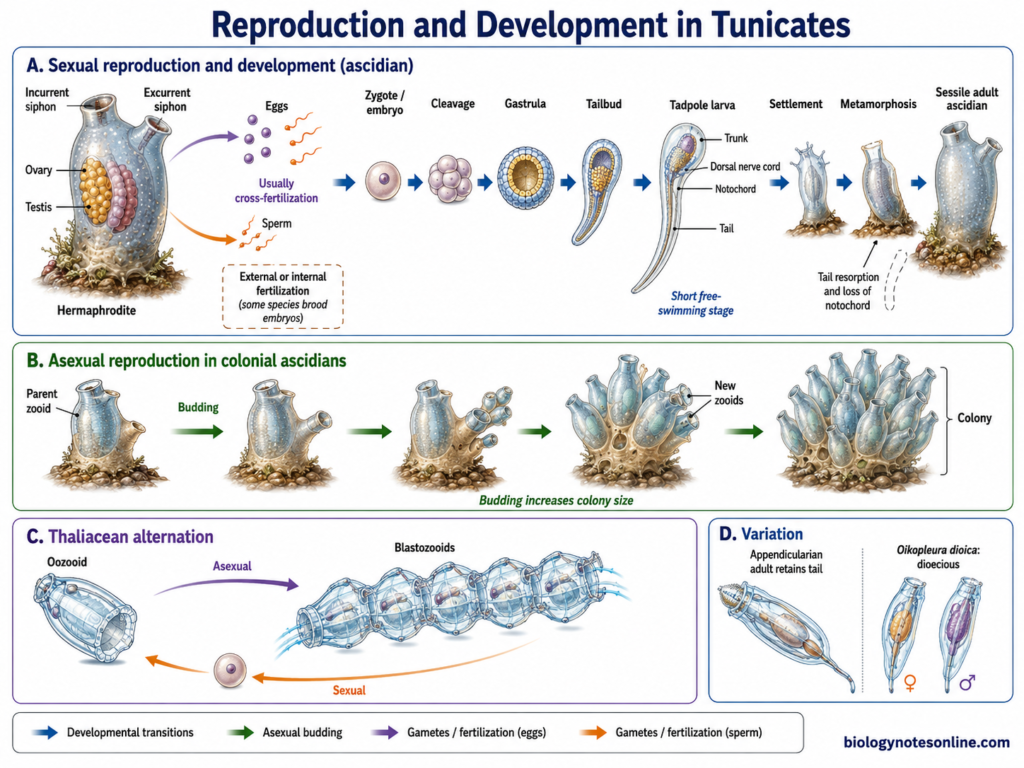
Reproduction in tunicates occurs mainly by sexual reproduction. Asexual reproduction is also found in many colonial forms. The reproductive condition is not same in all the groups of Tunicata.
The following are the important features of reproduction and development in tunicates-
- Sexual reproduction– Sexual reproduction occurs by the formation and fusion of male and female gametes. It is present in solitary as well as colonial tunicates. Solitary ascidians reproduce sexually, while many colonial ascidians can reproduce by both sexual and asexual methods.
- Hermaphroditism– Hermaphroditism is common in ascidians and many other tunicates. The same individual may produce both eggs and sperm. Many ascidian species also possess mechanisms that reduce or prevent self-fertilization. However, hermaphroditism is not universal in Tunicata. Oikopleura dioica is a dioecious appendicularian with separate male and female individuals.
- Fertilization– Fertilization may be external or internal depending on the species. In Ciona, eggs and sperm are released into seawater and fertilization takes place outside the parent body. In some colonial ascidians, sperm is released into water but fertilization and development of eggs take place within the parental zooid.
- Embryonic development– After fertilization, the zygote undergoes cleavage and forms the embryo. Gastrulation, neurulation and tailbud stages follow during a typical ascidian development. The embryo finally develops into the characteristic tadpole-like larva.
- Asexual reproduction– Asexual reproduction is particularly common in colonial ascidians. It generally takes place by budding, also referred to as blastogenesis in several colonial forms. New zooids are produced from the parent and these remain associated to form or increase the colony.
- Budding in colonial ascidians– Different forms of budding occur in different ascidian groups. In Botryllus schlosseri, buds develop repeatedly and form new adult zooids. Sexual embryogenesis and asexual blastogenesis can therefore occur in the same colonial animal.
- Reproduction in thaliaceans– Many thaliaceans have a complex life cycle containing sexual and asexual phases. In salps, a solitary oozooid reproduces asexually and forms a chain of blastozooids. These blastozooids reproduce sexually. Doliolids show an even more complex condition with different zooids concerned with feeding, transport and reproduction.
- Larval stage– In typical ascidians, development produces a free-swimming tadpole larva. It contains the notochord, dorsal nerve cord and muscular tail. The larval stage is generally present for a short period before settlement.
- Larval dispersal– The swimming larva helps in movement away from the parental site and in selection of a suitable place for settlement. Actual dispersal differs among species and is also affected by water currents and larval duration. After settlement, the typical ascidian larva attaches to the substratum and metamorphosis begins.
Examples of Urochordata
Different examples of Urochordata (Tunicata) are found under Ascidiacea, Thaliacea and Appendicularia. They include attached sea squirts as well as pelagic tunicates. Some of the important examples are as follows-
Examples of Ascidiacea
- Ciona robusta– It is an ascidian placed under the order Phlebobranchia and family Cionidae. Ciona is also widely used as a model tunicate in different biological studies.
- Herdmania momus– It is a solitary ascidian. The species belongs to the order Stolidobranchia and family Pyuridae.
- Styela plicata– It is another solitary ascidian. It is commonly found in harbours and marinas of warm and temperate regions, and has a wide geographical distribution.
- Botryllus schlosseri– It is a colonial ascidian. The colony consists of many small zooids embedded in a common tunic. Zooids become arranged in star-shaped systems and are connected by a common vascular system.
Examples of Thaliacea
- Salpa fusiformis– It is a pelagic salp of the order Salpida. The members of salps are free-swimming thaliaceans and live as part of marine plankton.
- Doliolum denticulatum– It is a member of Doliolida. The species is a marine doliolid and is distributed mainly through temperate to tropical waters.
- Pyrosoma atlanticum– It belongs to the order Pyrosomatida. It is a pelagic pyrosome. Pyrosomes are colonial members of Thaliacea and differ from the solitary adult condition seen in many ascidians.
Examples of Appendicularia (Larvacea)
- Oikopleura dioica– It is a small planktonic member of Appendicularia. The larval-like appearance is retained during its adult life. It secretes an external mucus structure called the house, which is used for filter feeding.
- Fritillaria borealis– It is another example of Appendicularia and belongs to the family Fritillariidae. The species has a circum-global distribution.
Biological and Evolutionary Significance
Urochordata (Tunicata) has an important position in the study of chordate evolution. The members are also useful in developmental biology, genomics and marine ecological studies. Some of the important biological and evolutionary significance are as follows-
- Relationship with vertebrates– Tunicates are the sister group of Vertebrata and represent the closest living invertebrate relatives of vertebrates. Due to this position, they are important for understanding the early evolution of vertebrates and the common ancestor of tunicates and vertebrates.
- Basic chordate body plan– The tadpole larva of ascidians shows a notochord, dorsal nerve cord and muscular post-anal tail. The larva has a comparatively simple organization, but many basic developmental mechanisms are shared with vertebrates. Thus, ascidians are useful for studying how the chordate body plan originated and changed during evolution.
- Model organism– Ciona is one of the important experimental animals used in developmental and evolutionary biology. Its embryo has relatively few cells and the genome is compact. Gene expression, cell lineage and gene-regulatory networks can therefore be studied at very fine level.
- Genome evolution– Tunicate genomes show remarkable changes in genome organization and evolutionary rate. Ciona and Oikopleura have been particularly useful for comparison with other chordates. Oikopleura has a highly compact genome, while many tunicate genes show rapid molecular evolution.
- Cellulose production– Tunicates are unusual among animals because they can produce cellulose, an important component of the tunic. Their cellulose synthase (CesA) gene is considered to have originated from a bacterial gene by horizontal gene transfer. This acquisition is an important event in the evolution of the characteristic tunicate body covering.
- Regeneration studies– Some tunicates possess strong regenerative ability. Ciona can regenerate parts of the siphons and nervous system, while colonial forms such as Botryllus schlosseri can produce new zooids by budding and also show extensive vascular regeneration. These animals are therefore used for the study of regeneration and stem cell biology.
- Allorecognition– Colonial ascidians such as Botryllus can distinguish genetically compatible colonies from incompatible ones. Compatible colonies may fuse their vascular systems, whereas incompatible colonies show rejection. This condition has made Botryllus an important model for studying allorecognition, histocompatibility and self/non-self recognition.
- Marine food webs– Tunicates are important suspension feeders in marine ecosystems. Pelagic tunicates such as salps can consume very small planktonic particles and transfer this material to larger organisms. During dense blooms, their feeding can strongly affect the structure and transfer of energy through marine food webs.
- Carbon cycling– Salps and other pelagic tunicates produce large and rapidly sinking fecal pellets. These transport organic carbon from surface waters toward deeper ocean regions and take part in the biological carbon pump. Salp blooms can sometimes contribute a large fraction of the downward particulate organic carbon flux.
- Fossil importance– The fossil tunicate Megasiphon thylakos from the middle Cambrian is about 500 million years old and has an ascidian-like body with two siphons and prominent muscles. It indicates that several basic features of the modern tunicate body plan were already present during the Cambrian period. Its exact position within early Tunicata, however, remains uncertain.
Urochordata (Tunicata) vs Cephalochordata
Urochordata (Tunicata) and Cephalochordata are two groups of marine invertebrate chordates. Both possess the basic chordate characters, but their adult body organization is different. Tunicates show greater modification of chordate characters during their life cycle, particularly in ascidians. (academic.oup.com)
| Features | Urochordata (Tunicata) | Cephalochordata |
|---|---|---|
| Common name | Members are commonly called tunicates. Ascidians are also referred to as sea squirts. | Members are called lancelets or amphioxus. |
| Habitat | Exclusively marine. Benthic and pelagic forms are present. | Exclusively marine. Adults are mainly benthic and commonly remain partly buried in sand or other soft bottom. (pmc.ncbi.nlm.nih.gov) |
| Notochord position | In the typical ascidian larva, the notochord is restricted to the tail region. (pmc.ncbi.nlm.nih.gov) | The notochord extends almost throughout the entire length of the body, including towards the anterior end. (pmc.ncbi.nlm.nih.gov) |
| Persistence of notochord | The notochord is lost during metamorphosis in typical adult ascidians. It is retained in adult appendicularians, therefore this condition is not same in all tunicates. (pmc.ncbi.nlm.nih.gov) | The notochord is retained throughout life and continues to form an important axial supporting structure in the adult. (pmc.ncbi.nlm.nih.gov) |
| Body organization | Adult body varies greatly. Ascidians generally have a sac-like body with a large pharyngeal basket and siphons. Thaliaceans and appendicularians show a pelagic body form. (pmc.ncbi.nlm.nih.gov) | The body is elongated, laterally compressed and fish-like. The general chordate body plan remains clear in the adult. (pmc.ncbi.nlm.nih.gov) |
| Adult lifestyle | Adult ascidians are mainly sessile, while thaliaceans and appendicularians are pelagic. Thus, all adult tunicates are not sessile. (pmc.ncbi.nlm.nih.gov) | Adults are free-living benthic animals. They generally remain partly buried with the anterior end exposed and feed by ciliary filter feeding. (pmc.ncbi.nlm.nih.gov) |
| Tunic | A characteristic outer tunic is present. It contains cellulose and represents one of the defining features of Tunicata. (academic.oup.com) | A cellulose-containing tunic like that of tunicates is absent. |
| Segmentation | The adult ascidian body does not show the distinct serial muscle segmentation found in lancelets. The ascidian larval tail has rows of muscle cells associated with swimming. (academic.oup.com) | The body shows distinct segmental organization. Numerous myomeres or segmented muscle blocks are arranged along the sides of the body. (pmc.ncbi.nlm.nih.gov) |
| Pharyngeal region | The pharynx is greatly enlarged in adult ascidians and forms a branchial basket with numerous stigmata. | A large pharynx with numerous pharyngeal slits is also present and takes part in filter feeding. (pmc.ncbi.nlm.nih.gov) |
| Chordate characters in adult | Several chordate characters become reduced or disappear during ascidian metamorphosis. Appendicularians are an important exception. | Major chordate characters remain clearly developed in the adult body. (academic.oup.com) |
| Representative examples | Ciona, Herdmania, Styela, Botryllus, Salpa, Doliolum, Pyrosoma, Oikopleura. | Branchiostoma lanceolatum, Branchiostoma floridae, Asymmetron lucayanum. |
| Evolutionary relationship | Tunicates are currently recognized as the sister group of vertebrates, making them the closest living invertebrate relatives of Vertebrata. | Cephalochordates form the earlier-branching chordate lineage relative to the tunicate + vertebrate group. They are not the closest living relatives of vertebrates. (nature.com) |
FAQ
1. Is Urochordata the same as Tunicata?
Yes. Urochordata is the traditional name used for the group, while Tunicata is the currently accepted name. WoRMS accepts Tunicata as a subphylum of Chordata and lists Urochordata as a junior synonym. Both terms are still found in zoological literature.
2. Why are tunicates called sea squirts?
The name sea squirt is particularly used for ascidians. When disturbed, the body contracts and water may be forcefully expelled through the siphonal openings. This squirting habit gives them the common name sea squirts.
3. Where is the notochord found in Urochordata?
In the classical ascidian tadpole larva, the notochord is present in the tail region. It lies along the larval tail and acts as an axial supporting structure during swimming.
4. Do adult tunicates have a notochord?
Not in all members. In typical ascidians, the larval notochord is resorbed during metamorphosis and is absent in the adult. Appendicularians, such as Oikopleura, retain the tail and notochord during adult life.
5. Are all tunicates sessile?
No. Adult ascidians are mainly benthic and sessile, but this condition does not occur throughout Tunicata. Thaliaceans are pelagic and appendicularians are also free-swimming planktonic forms.
6. Are tunicates vertebrates?
No. Tunicates are invertebrate chordates. They do not possess a vertebral column. Molecular phylogenetic studies, however, place Tunicata as the sister group of Vertebrata, making tunicates the closest living invertebrate relatives of vertebrates.
7. What is tunicin?
Tunicin is a term used for the cellulose obtained from the tunic of tunicates. It should not be used for the entire tunic. The tunic is an extracellular covering containing cellulose together with other extracellular components.
8. Why are tunicates important in evolution?
Tunicates are important because they form the sister group of vertebrates. Tunicata and Vertebrata together form the clade Olfactores. Their simple chordate larvae and conserved developmental genes are useful for studying the early origin of vertebrate characters and chordate evolution.
References
- Alié, A., Hiebert, L. S., Simion, P., Scelzo, M., Prünster, M. M., Lotito, S., Delsuc, F., Douzery, E. J. P., Dantec, C., Lemaire, P., Darras, S., Kawamura, K., Brown, F. D., & Tiozzo, S. (2018). Convergent acquisition of nonembryonic development in styelid ascidians. Molecular Biology and Evolution, 35(7), 1728–1743. https://academic.oup.com/mbe/article/35/7/1728/4969531
- Anselmi, C., Ishizuka, K. J., Palmeri, K. J., Burighel, P., Voskoboynik, A., Hotta, K., & Manni, L. (2025). Speed vs completeness: A comparative study of solitary and colonial tunicate embryogenesis. Frontiers in Cell and Developmental Biology, 13, 1540212. https://www.frontiersin.org/journals/cell-and-developmental-biology/articles/10.3389/fcell.2025.1540212/full
- Berná, L., & Alvarez-Valin, F. (2014). Evolutionary genomics of fast evolving tunicates. Genome Biology and Evolution, 6(7), 1724–1738. https://academic.oup.com/gbe/article/6/7/1724/549366
- Bone, Q. (Ed.). (1998). The biology of pelagic tunicates. Oxford University Press. https://academic.oup.com/book/53146
- Bone, Q., Carré, C., & Chang, P. (2003). Tunicate feeding filters. Journal of the Marine Biological Association of the United Kingdom, 83(5), 907–919. https://www.cambridge.org/core/journals/journal-of-the-marine-biological-association-of-the-united-kingdom/article/abs/tunicate-feeding-filters/CCAA91F91C181B71DBFEBE182DD78349
- Brozovic, M., Martin, C., Dantec, C., Dauga, D., Mendez, M., Simion, P., Percher, M., Laporte, B., Scornavacca, C., Di Gregorio, A., Fujiwara, S., Gineste, M., Lowe, E. K., Piette, J., Racioppi, C., Ristoratore, F., Sasakura, Y., Takatori, N., Brown, C. T., & Lemaire, P. (2016). ANISEED 2015: A digital framework for the comparative developmental biology of ascidians. Nucleic Acids Research, 44(D1), D808–D818. https://academic.oup.com/nar/article/44/D1/D808/2503134
- Brunetti, R., Griggio, F., Mastrototaro, F., Gasparini, F., & Gissi, C. (2020). Toward a resolution of the cosmopolitan Botryllus schlosseri species complex (Ascidiacea, Styelidae): Mitogenomics and morphology of clade E (Botryllus gaiae). Zoological Journal of the Linnean Society, 190(4), 1175–1192. https://academic.oup.com/zoolinnean/article-abstract/190/4/1175/5813975
- Caccavale, F., Osca, D., D’Aniello, S., & Crocetta, F. (2021). Molecular taxonomy confirms that the northeastern Atlantic and Mediterranean Sea harbor a single lancelet, Branchiostoma lanceolatum (Pallas, 1774) (Cephalochordata: Leptocardii: Branchiostomatidae). PLOS ONE, 16(5), e0251358. https://journals.plos.org/plosone/article?id=10.1371%2Fjournal.pone.0251358
- Dardaillon, J., Dauga, D., Simion, P., Faure, E., Onuma, T. A., DeBiasse, M. B., Louis, A., Nitta, K. R., Naville, M., Besnardeau, L., Reeves, W., Wang, K., Fagotto, M., Guéroult-Bellone, M., Fujiwara, S., Dumollard, R., Veeman, M., Volff, J.-N., Roest Crollius, H., & Lemaire, P. (2020). ANISEED 2019: 4D exploration of genetic data for an extended range of tunicates. Nucleic Acids Research, 48(D1), D668–D675. https://academic.oup.com/nar/article/48/D1/D668/5611675
- DeBiasse, M. B., Colgan, W. N., Harris, L., Davidson, B., & Ryan, J. F. (2020). Inferring tunicate relationships and the evolution of the tunicate Hox cluster with the genome of Corella inflata. Genome Biology and Evolution, 12(6), 948–964. https://academic.oup.com/gbe/article/12/6/948/5811565
- Deibel, D., & Lowen, B. (2012). A review of the life cycles and life-history adaptations of pelagic tunicates to environmental conditions. ICES Journal of Marine Science, 69(3), 358–369. https://academic.oup.com/icesjms/article/69/3/358/598151
- Delsuc, F., Brinkmann, H., Chourrout, D., & Philippe, H. (2006). Tunicates and not cephalochordates are the closest living relatives of vertebrates. Nature, 439(7079), 965–968. https://www.nature.com/articles/nature04336
- Delsuc, F., Philippe, H., Tsagkogeorga, G., Simion, P., Tilak, M.-K., Turon, X., López-Legentil, S., Piette, J., Lemaire, P., & Douzery, E. J. P. (2018). A phylogenomic framework and timescale for comparative studies of tunicates. BMC Biology, 16, 39. https://link.springer.com/article/10.1186/s12915-018-0499-2
- Fodor, A. C. A., Powers, M. M., Andrykovich, K., Liu, J., Lowe, E. K., Brown, C. T., Di Gregorio, A., Stolfi, A., & Swalla, B. J. (2021). The degenerate tale of ascidian tails. Integrative and Comparative Biology, 61(2), 358–369. https://academic.oup.com/icb/article/61/2/358/6244187
- Fujikake, Y., Fukuda, K., Matsushita, K., Iwatani, Y., Fujimoto, K., & Nishino, A. S. (2024). Pulsation waves along the Ciona heart tube reverse by bimodal rhythms expressed by a remote pair of pacemakers. Journal of Experimental Biology, 227(10), jeb246810. https://journals.biologists.com/jeb/article/227/10/jeb246810/348291/Pulsation-waves-along-the-Ciona-heart-tube-reverse
- Govindarajan, A. F., Bucklin, A., & Madin, L. P. (2011). A molecular phylogeny of the Thaliacea. Journal of Plankton Research, 33(6), 843–853. https://academic.oup.com/plankt/article/33/6/843/1461839
- Hessel, L., Albers, J., Michalek, A., Böttner, T., Duke, E., Siveke, I., Herlitze, S., Goldschmidt, J., & Huhn, M. (2026). Insights into unique anatomical structures of the ascidian Halocynthia papillosa obtained by multimodal imaging. Communications Biology, 9, 557. https://www.nature.com/articles/s42003-026-10102-5
- Hinman, V. F., & Degnan, B. M. (2001). Homeobox genes, retinoic acid and the development and evolution of dual body plans in the ascidian Herdmania curvata. American Zoologist, 41(3), 664–675. https://academic.oup.com/icb/article/41/3/664/2092685
- Holland, N. D., & Somorjai, I. M. L. (2020). Serial blockface SEM suggests that stem cells may participate in adult notochord growth in an invertebrate chordate, the Bahamas lancelet. EvoDevo, 11, 22. https://link.springer.com/article/10.1186/s13227-020-00167-6
- Hoyle, G. (1953). Spontaneous squirting of an ascidian, Phallusia mammillata Cuvier. Journal of the Marine Biological Association of the United Kingdom, 31(3), 541–562. https://www.cambridge.org/core/journals/journal-of-the-marine-biological-association-of-the-united-kingdom/article/abs/spontaneous-squirting-of-an-ascidian-phalliusia-mammillata-cuvier/95DAD9EA89E97803CC01374442514092
- Jeffery, W. R. (2019). Progenitor targeting by adult stem cells in Ciona homeostasis, injury, and regeneration. Developmental Biology, 448(2), 279–290. https://pmc.ncbi.nlm.nih.gov/articles/PMC6408316/
- Jiang, A., Zhang, W., Wei, J., Liu, P., & Dong, B. (2023). Transcriptional analysis of the endostyle reveals pharyngeal organ functions in ascidian. Biology, 12(2), 245. https://www.mdpi.com/2079-7737/12/2/245
- Jiang, D., & Smith, W. C. (2007). Ascidian notochord morphogenesis. Developmental Dynamics, 236(7), 1748–1757. https://onlinelibrary.wiley.com/doi/10.1002/dvdy.21184
- Jokura, K., Nishino, J. M., Ogasawara, M., & Nishino, A. (2020). An α7-related nicotinic acetylcholine receptor mediates the ciliary arrest response in pharyngeal gill slits of Ciona. Journal of Experimental Biology, 223(10), jeb209320. https://journals.biologists.com/jeb/article/223/10/jeb209320/224433/An-7-related-nicotinic-acetylcholine-receptor
- Karahan, A., Öztürk, E., Temiz, B., & Blanchoud, S. (2022). Studying Tunicata whole-body regeneration using Botrylloides anceps. In S. Blanchoud & B. Galliot (Eds.), Whole-body regeneration: Methods and protocols (pp. 311–332). Humana. https://link.springer.com/protocol/10.1007/978-1-0716-2172-1_16
- Kawamorita, H., Fujiwara, H., Itayama, K., Onuma, T. A., Sasakura, Y., & Ogasawara, M. (2026). Endostyle glandular element-specific expression of vWF-like genes in protochordates. Tissue and Cell, 103, 103666. https://pubmed.ncbi.nlm.nih.gov/42242045/
- Kowarsky, M., Anselmi, C., Hotta, K., Burighel, P., Zaniolo, G., Caicci, F., Rosental, B., Neff, N. F., Ishizuka, K. J., Palmeri, K. J., Okamoto, J., Gordon, T., Weissman, I. L., Quake, S. R., Manni, L., & Voskoboynik, A. (2021). Sexual and asexual development: Two distinct programs producing the same tunicate. Cell Reports, 34(4), 108681. https://pmc.ncbi.nlm.nih.gov/articles/PMC7949349/
- Kubo, A., Imai, K. S., & Satou, Y. (2009). Gene-regulatory networks in the Ciona embryos. Briefings in Functional Genomics and Proteomics, 8(4), 250–255. https://academic.oup.com/bfg/article/8/4/250/296156
- Lanoizelet, M., Elkhoury Youhanna, C., Roure, A., & Darras, S. (2024). Molecular control of cellulosic fin morphogenesis in ascidians. BMC Biology, 22, 74. https://link.springer.com/article/10.1186/s12915-024-01872-7
- Lemaire, P. (2011). Evolutionary crossroads in developmental biology: The tunicates. Development, 138(11), 2143–2152. https://journals.biologists.com/dev/article/138/11/2143/44373/Evolutionary-crossroads-in-developmental-biology
- Lemaire, P., & Piette, J. (2015). Tunicates: Exploring the sea shores and roaming the open ocean. A tribute to Thomas Huxley. Open Biology, 5(6), 150053. https://royalsocietypublishing.org/doi/10.1098/rsob.150053
- Manni, L., Gasparini, F., Hotta, K., Ishizuka, K. J., Ricci, L., Tiozzo, S., Voskoboynik, A., & Dauga, D. (2014). Ontology for the asexual development and anatomy of the colonial chordate Botryllus schlosseri. PLOS ONE, 9(5), e96434. https://journals.plos.org/plosone/article?id=10.1371%2Fjournal.pone.0096434
- Morales-González, S., Giles, E. C., Quesada-Calderón, S., & Saenz-Agudelo, P. (2019). Fine-scale hierarchical genetic structure and kinship analysis of the ascidian Pyura chilensis in the southeastern Pacific. Ecology and Evolution, 9(17), 9855–9868. https://pmc.ncbi.nlm.nih.gov/articles/PMC6745665/
- Nanglu, K., Lerosey-Aubril, R., Weaver, J. C., & Ortega-Hernández, J. (2023). A mid-Cambrian tunicate and the deep origin of the ascidiacean body plan. Nature Communications, 14, 3832. https://www.nature.com/articles/s41467-023-39012-4
- Paululat, A., & Purschke, G. (2025). Urochordata (Tunicata, tunicates). In Metazoa: Morphology and evolution of animals. Springer. https://link.springer.com/chapter/10.1007/978-3-662-69904-1_11
- Pickett, C. J., Ryan, J. F., & Davidson, B. (2024). Acquisition of polymorphism in the chordate doliolids. Integrative and Comparative Biology, 64(5), 1255–1268. https://academic.oup.com/icb/article/64/5/1255/7712485
- Pineda, M. C., López-Legentil, S., & Turon, X. (2011). The whereabouts of an ancient wanderer: Global phylogeography of the solitary ascidian Styela plicata. PLOS ONE, 6(9), e25495. https://journals.plos.org/plosone/article?id=10.1371%2Fjournal.pone.0025495
- Popsuj, S., Cohen, L., Ward, S., Lewis, A., Yoshida, S., Herrera, R. A., Cota, C. D., & Stolfi, A. (2024). CRISPR/Cas9 protocols and applications in the tunicate Ciona. Integrative and Comparative Biology, 64(5), 1182–1193. https://academic.oup.com/icb/article/64/5/1182/7710122
- Riisgård, H. U., & Larsen, P. S. (2025). Filtration and respiration of filter-feeding marine invertebrates are linked through allometric power-law functions. Biology Open, 14(6), bio062024. https://journals.biologists.com/bio/article/14/6/bio062024/368263/Filtration-and-respiration-of-filter-feeding
- Rychel, A. L., Smith, S. E., Shimamoto, H. T., & Swalla, B. J. (2006). Evolution and development of the chordates: Collagen and pharyngeal cartilage. Molecular Biology and Evolution, 23(3), 541–549. https://academic.oup.com/mbe/article/23/3/541/1110188
- Sánchez-Serna, G., Badia-Ramentol, J., Bujosa, P., Ferrández-Roldán, A., Torres-Águila, N. P., Fabregà-Torrus, M., Wibisana, J. N., Mansfield, M. J., Plessy, C., Luscombe, N. M., Albalat, R., & Cañestro, C. (2025). Less, but more: New insights from appendicularians on chordate Fgf evolution and the divergence of tunicate lifestyles. Molecular Biology and Evolution, 42(1), msae260. https://academic.oup.com/mbe/article/42/1/msae260/7926171
- Schreiber, L., Kjeldsen, K. U., Funch, P., Jensen, J., Obst, M., López-Legentil, S., & Schramm, A. (2016). Endozoicomonas are specific, facultative symbionts of sea squirts. Frontiers in Microbiology, 7, 1042. https://www.frontiersin.org/journals/microbiology/articles/10.3389/fmicb.2016.01042/full
- Shenkar, N., & Swalla, B. J. (2011). Global diversity of Ascidiacea. PLOS ONE, 6(6), e20657. https://journals.plos.org/plosone/article?id=10.1371%2Fjournal.pone.0020657
- Shi, W., Peyrot, S. M., Munro, E., & Levine, M. (2009). FGF3 in the floor plate directs notochord convergent extension in the Ciona tadpole. Development, 136(1), 23–28. https://journals.biologists.com/dev/article/136/1/23/65099/FGF3-in-the-floor-plate-directs-notochord
- Stach, T. (2009). Anatomy of the trunk mesoderm in tunicates: Homology considerations and phylogenetic interpretation. Zoomorphology, 128, 97–109. https://link.springer.com/article/10.1007/s00435-008-0076-2
- Steinberg, D. K., Stamieszkin, K., Maas, A. E., Durkin, C. A., Passow, U., Estapa, M. L., Omand, M. M., McDonnell, A. M. P., Karp-Boss, L., Galbraith, M., & Siegel, D. A. (2023). The outsized role of salps in carbon export in the subarctic Northeast Pacific Ocean. Global Biogeochemical Cycles, 37(1), e2022GB007523. https://pmc.ncbi.nlm.nih.gov/articles/PMC10078299/
- Stolfi, A., & Levine, M. (2011). Neuronal subtype specification in the spinal cord of a protovertebrate. Development, 138(5), 995–1004. https://journals.biologists.com/dev/article/138/5/995/44895/Neuronal-subtype-specification-in-the-spinal-cord
- Stukel, M. R., Décima, M., Fender, C. K., Gutierrez-Rodriguez, A., & Selph, K. E. (2024). Gelatinous filter feeders increase ecosystem efficiency. Communications Biology, 7, 1039. https://www.nature.com/articles/s42003-024-06717-1
- Sutherland, K. R., & Weihs, D. (2017). Hydrodynamic advantages of swimming by salp chains. Journal of the Royal Society Interface, 14(133), 20170298. https://royalsocietypublishing.org/doi/10.1098/rsif.2017.0298
- Swalla, B. J. (2024). Deuterostome ancestors and chordate origins. Integrative and Comparative Biology, 64(5), 1175–1181. https://academic.oup.com/icb/article/64/5/1175/7727798
- Taketa, D. A., Cengher, L., Rodriguez, D., Langenbacher, A. D., & De Tomaso, A. W. (2024). Allorecognition in the colonial tunicate Botryllus schlosseri. Integrative and Comparative Biology, 64(5), 1269–1277. https://academic.oup.com/icb/article/64/5/1269/7710119
- Tamura, N., Oda-Ishii, I., & Satou, Y. (2026). Unique tunicate traits possibly encoded by horizontally transferred genes. Genome Biology and Evolution, 18(7), evag170. https://academic.oup.com/gbe/article/18/7/evag170/8728286
- Troedsson, C., Bouquet, J.-M., Skinnes, R., Acuña, J.-L., Zech, K., Frischer, M. E., & Thompson, E. M. (2009). Regulation of filter-feeding house components in response to varying food regimes in the appendicularian Oikopleura dioica. Journal of Plankton Research, 31(12), 1453–1463. https://academic.oup.com/plankt/article/31/12/1453/1501463
- Valero-Gracia, A., Marino, R., Crocetta, F., Nittoli, V., Tiozzo, S., & Sordino, P. (2016). Comparative localization of serotonin-like immunoreactive cells in Thaliacea informs tunicate phylogeny. Frontiers in Zoology, 13, 45. https://link.springer.com/article/10.1186/s12983-016-0177-6
- Veeman, M. T., Chiba, S., & Smith, W. C. (2011). Ciona genetics. Methods in Molecular Biology, 770, 401–422. https://pmc.ncbi.nlm.nih.gov/articles/PMC3149854/
- Wang, Y.-B., Chen, S.-H., Lin, C.-Y., & Yu, J.-K. (2012). EST and transcriptome analysis of cephalochordate amphioxus—Past, present and future. Briefings in Functional Genomics, 11(2), 96–106. https://academic.oup.com/bfg/article/11/2/96/213204
- Yoshida, K., Nakahata, A., Treen, N., Sakuma, T., Yamamoto, T., & Sasakura, Y. (2017). Hox-mediated endodermal identity patterns pharyngeal muscle formation in the chordate pharynx. Development, 144(9), 1629–1634. https://journals.biologists.com/dev/article/144/9/1629/48401/Hox-mediated-endodermal-identity-patterns
- Zeng, L., Jacobs, M. W., & Swalla, B. J. (2006). Coloniality has evolved once in stolidobranch ascidians. Integrative and Comparative Biology, 46(3), 255–268. https://academic.oup.com/icb/article/46/3/255/617004
- Zhao, Y., & Li, J. (2014). Excellent chemical and material cellulose from tunicates: Diversity in cellulose production yield and chemical and morphological structures from different tunicate species. Cellulose, 21, 3427–3441. https://link.springer.com/article/10.1007/s10570-014-0348-6