

Reverse Transcription PCR (RT-PCR) is a molecular technique used to detect and amplify RNA. It is used because normal PCR cannot directly amplify RNA. In this technique, RNA is first converted into complementary DNA (cDNA).
This conversion is done by the enzyme reverse transcriptase. The formed cDNA is more stable than RNA and it works as a template for PCR. Then DNA polymerase amplifies the selected DNA sequence by repeated cycles of heating and cooling.
In this process, many copies of the target sequence are formed. It is used for study of gene expression and also for detection of RNA viruses like HIV, influenza, and SARS-CoV-2. RT-PCR may be done by one-step method or two-step method.
Objectives of Reverse Transcription PCR (RT-PCR)
The following are the objectives of Reverse Transcription PCR (RT-PCR)
- To amplify the specific segment of RNA and to produce many copies of that selected RNA segment.
- To diagnose infectious diseases which are caused by virus, bacteria, fungi, and parasites.
- To study mRNA and micro RNA and to know the level of gene expression in the cell.
- To identify unknown species and also to detect RNA viruses such as HIV, SARS virus, dengue virus, and HCV.
- To prepare complementary DNA (cDNA) from eukaryotic mRNA which can be inserted into prokaryotic cell.
- To observe the result of gene insertion and gene therapy.
- To detect gene mutation, tissue specific mutant alleles, and special mRNA formed by cancer cells.
- To validate RNA interference (RNAi) for studying the loss of function of selected genes.
- To use in genetic engineering and viral studies by amplification of target RNA.
- To detect genetically modified organisms (GMOs)
Principle of Reverse Transcription PCR (RT-PCR)
Principle of Reverse Transcription PCR (RT-PCR) is based on reverse transcription and normal PCR amplification. In this method, the starting material is RNA. The RNA is first converted into complementary DNA (cDNA) because PCR can amplify only DNA.
In reverse transcription, a short DNA primer attaches with the RNA template. The enzyme reverse transcriptase adds nucleotides and forms cDNA. The RNA strand is then removed or degraded, leaving the cDNA strand.
The formed cDNA is used as template for PCR. The cDNA is heated for separation of strands. Then primers bind with the target sequence during cooling. After this DNA polymerase adds nucleotides and forms new DNA strands.
These steps are repeated for many cycles. As a result, millions of copies of the target cDNA are produced. This amplified product shows the presence of the original RNA sample.
Requirements of Reverse Transcription PCR (RT-PCR)
- The following are the requirements of Reverse Transcription PCR (RT-PCR)
- Sample RNA is the starting material of this reaction. It is usually messenger RNA (mRNA) which is taken from the sample. This RNA is converted into complementary DNA (cDNA) before amplification.
- Reverse transcriptase enzyme is used to make cDNA from the RNA template. It is an RNA-dependent DNA polymerase enzyme. It is the main enzyme which carries out the reverse transcription step.
- DNA polymerase enzyme is required for amplification of the formed cDNA. Generally Taq DNA polymerase is used because it can tolerate high temperature. It adds nucleotides to the primer and forms new DNA strand.
- Primers are short single stranded nucleotide sequences. They attach with the target sequence and starts the synthesis. Oligo(dT) primers, random primers, and sequence-specific primers are used according to the type of reaction.
- Deoxynucleotide triphosphates (dNTPs) are artificial nucleotide building blocks. These are dATP, dCTP, dGTP, and dTTP. These are used for formation of new cDNA and DNA strand.
- PCR buffers and chemicals provide suitable condition for the reaction. It maintains the reaction environment and helps enzyme activity. Magnesium ions (Mg²⁺) is also required as cofactor for proper working of enzyme.
- Thermocycler is the PCR machine used for changing the temperature of reaction. It gives the required temperature for denaturation, annealing, and elongation. These cycles help in amplification of the target cDNA.
Types of Reverse Transcription PCR (RT-PCR)
The following are the types of Reverse Transcription PCR (RT-PCR)
1. One-Step RT-PCR
In this type, both reverse transcription and PCR amplification are carried out in a single reaction tube.
First, the RNA is converted into complementary DNA (cDNA) by reverse transcriptase. Then the same cDNA is amplified by PCR in the same tube.
This method is simple and takes less time. It needs less handling of sample and chance of contamination is also reduced. It also decreases pipetting error because both reactions are done in closed tube.
2. Two-Step RT-PCR
In this type, reverse transcription and PCR amplification are carried out in two separate reactions.
First, the RNA is converted into complementary DNA (cDNA) in one tube. Then a part of this cDNA is transferred into another tube for PCR amplification.
This method takes more time and there is more chance of contamination due to transfer of sample. But it gives more control over the reaction. The formed cDNA can also be stored and used later for other tests.
What is One-Step RT-PCR?
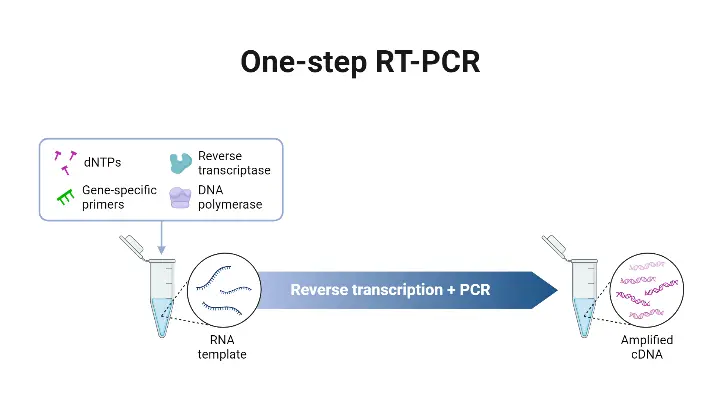
One-Step RT-PCR is a type of RT-PCR in which reverse transcription and PCR amplification takes place in a single closed reaction tube.
The following are the important points of One-Step RT-PCR
- RNA is converted into complementary DNA (cDNA) and the formed cDNA is amplified in the same tube.
- All required reagents are added at the beginning of the reaction.
- The reaction tube is not opened between reverse transcription and PCR amplification.
- It uses sequence-specific primers for the selected RNA target.
- It is faster and simple method because less handling of sample is needed.
- It reduces pipetting error and cross contamination because sample transfer is not required.
- It is useful for testing large number of samples and routine diagnostic work.
- It is less flexible than two-step RT-PCR because same reaction condition is used for both enzymes.
- The formed cDNA cannot be stored for later use because it is used in the same reaction.
- Fresh RNA sample is needed when the experiment is repeated or new target is studied.
- There may be primer-dimer formation and non-specific binding because primers are present during reverse transcription step.
- It is mainly used for high-throughput screening, routine diagnosis, and study of known gene targets.
What is Two-Step RT-PCR?
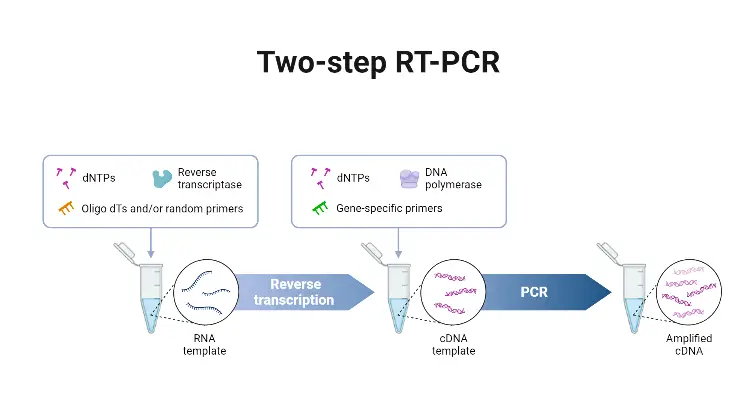
Two-Step RT-PCR is a type of RT-PCR in which reverse transcription and PCR amplification are done in two separate reaction tubes.
The following are the important points of Two-Step RT-PCR
- RNA is first converted into complementary DNA (cDNA) in one reaction tube.
- A part of the formed cDNA is transferred into another tube for PCR amplification.
- In this method, both reactions are done separately.
- Different buffers, reagents, and enzymes can be used for reverse transcription and PCR step.
- The reverse transcription step can use random hexamer primers, oligo(dT) primers, sequence-specific primers, or their combination.
- The formed cDNA is stable and can be stored for later use.
- From one original RNA sample, many different gene targets can be amplified later.
- It is more sensitive because each reaction can be adjusted separately.
- It gives better result when RNA sample is very less or limited.
- It has less chance of non-specific binding and primer-dimer formation when the reaction is properly adjusted.
- It takes more time because the cDNA must be transferred from first tube to second tube.
- There is more chance of contamination and pipetting error because the tube is opened during transfer.
- It is mainly used when many targets are studied from few samples or when difficult sequences needs special reaction condition.
Differences between Two-Step RT-PCR and One-Step RT-PCR
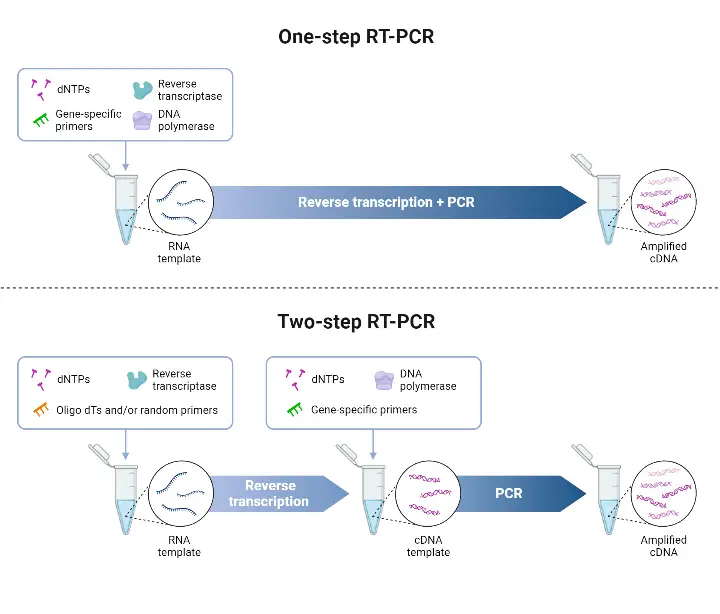
The following are the differences between Two-Step RT-PCR and One-Step RT-PCR
- One-Step RT-PCR is carried out in a single reaction tube. Two-Step RT-PCR is carried out in two different reaction tubes.
- In One-Step RT-PCR, reverse transcription and PCR amplification takes place in the same tube. In Two-Step RT-PCR, reverse transcription is done first and then PCR amplification is done separately.
- In One-Step RT-PCR, the formed cDNA is directly used in the same reaction. In Two-Step RT-PCR, the formed cDNA is transferred into another tube for amplification.
- In One-Step RT-PCR, the cDNA cannot be stored because it is used in the reaction. In Two-Step RT-PCR, the cDNA is stable and can be stored for later use.
- One-Step RT-PCR mainly uses sequence-specific primers. Two-Step RT-PCR can use oligo(dT) primers, random hexamers, sequence-specific primers, or their combination.
- In One-Step RT-PCR, one buffer condition is used for both enzymes. In Two-Step RT-PCR, different condition can be used for reverse transcription and PCR amplification.
- One-Step RT-PCR is less flexible because both steps occur together. Two-Step RT-PCR is more flexible because both steps are controlled separately.
- One-Step RT-PCR is faster and simple method. Two-Step RT-PCR takes more time and more handling is needed.
- In One-Step RT-PCR, chance of contamination is less because the tube is not opened. In Two-Step RT-PCR, chance of contamination is more because cDNA is transferred from one tube to another.
- One-Step RT-PCR is useful for testing large number of samples for few known targets. Two-Step RT-PCR is useful when RNA sample is less and many targets are studied from same sample.
- One-Step RT-PCR may show less sensitivity because same reaction condition is used. Two-Step RT-PCR generally gives better sensitivity because each step can be optimized separately.
| Characters | One-Step RT-PCR | Two-Step RT-PCR |
|---|---|---|
| Number of tube | It is carried out in single reaction tube. | It is carried out in two different reaction tubes. |
| Reaction process | Reverse transcription and PCR amplification takes place in same tube. | Reverse transcription is done first and then PCR amplification is done separately. |
| Use of cDNA | The formed cDNA is directly used in the same reaction. | The formed cDNA is transferred into another tube for amplification. |
| Storage of cDNA | The cDNA cannot be stored because it is used in the reaction. | The cDNA is stable and can be stored for later use. |
| Primers used | It mainly uses sequence-specific primers. | It can use oligo(dT) primers, random hexamers, sequence-specific primers, or their combination. |
| Reaction condition | One buffer condition is used for both enzymes. | Different condition can be used for reverse transcription and PCR amplification. |
| Flexibility | It is less flexible because both steps occur together. | It is more flexible because both steps are controlled separately. |
| Time | It is faster and simple method. | It takes more time and more handling is needed. |
| Contamination | Chance of contamination is less because the tube is not opened. | Chance of contamination is more because cDNA is transferred from one tube to another. |
| Sensitivity | It may show less sensitivity because same reaction condition is used. | It generally gives better sensitivity because each step can be optimized separately. |
| Uses | It is useful for testing large number of samples for few known targets. | It is useful when RNA sample is less and many targets are studied from same sample. |
Steps/Procedure of Reverse Transcription PCR (RT-PCR)
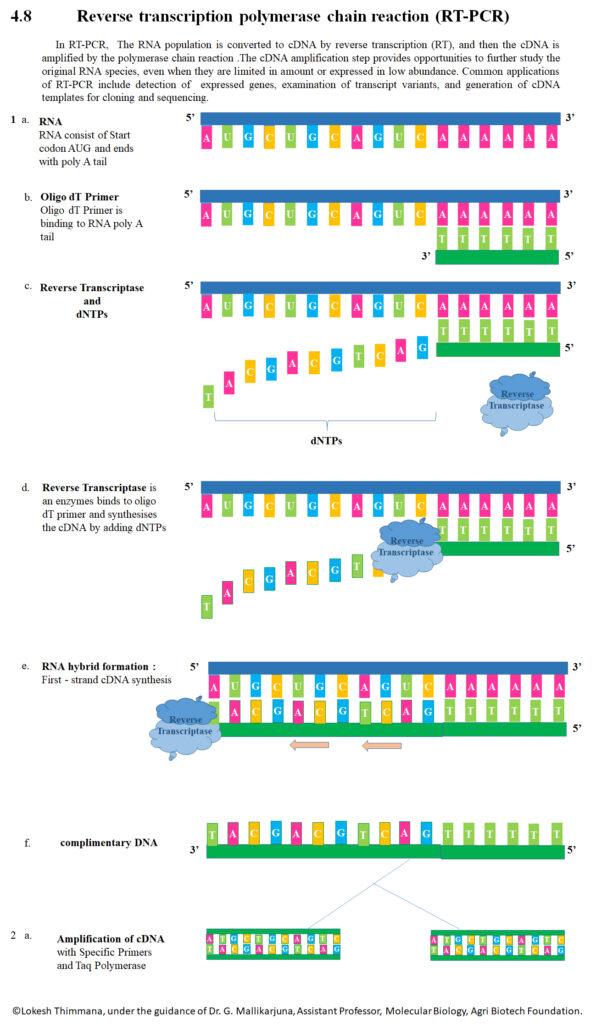
The following are the steps of Reverse Transcription PCR (RT-PCR)
1. Preparation of RNA sample
In this step, RNA is extracted from biological material. The RNA should be purified and should not be degraded. The inhibitors are removed from the sample because it may affect the reaction.
2. Removal of genomic DNA
The genomic DNA present in the sample is removed. It is done by DNase treatment or by designing primers across exon-exon junctions. This prevents non-specific amplification.
3. Preparation of primers
The primers are designed for the target sequence. The primer should have proper specificity and proper melting temperature. Primer dimer and self binding should be avoided.
4. Preparation of reaction mixture
The reaction mixture is prepared with sample RNA, reverse transcriptase, DNA polymerase, dNTPs, buffer, Mg²⁺, and primers. The thermal cycler is also prepared for the reaction.
5. Annealing of primer with RNA
In this step, primer is allowed to bind with the RNA template. The primer may be gene-specific primer, random hexamer primer, or oligo(dT) primer. This binding helps reverse transcriptase to start the reaction.
6. Formation of cDNA
The enzyme reverse transcriptase forms complementary DNA (cDNA) from the RNA template. This reaction is carried out at suitable temperature, usually about 40-50°C. The time may be about 10-30 minutes depending on enzyme.
7. Denaturation
The formed cDNA is taken for PCR amplification. In denaturation, the double stranded DNA is heated at about 94-95°C. The two strands are separated.
8. Annealing
In this step, the temperature is reduced. The primers bind with the complementary sequence of cDNA. The temperature is kept according to the melting temperature of primer.
9. Extension
In this step, DNA polymerase adds nucleotides to the primer. New DNA strand is formed. The temperature is kept according to the optimum temperature of DNA polymerase.
10. Repetition of cycles
The steps of denaturation, annealing, and extension are repeated many times. Usually 25-40 cycles are used. Many copies of the target DNA are produced.
11. Analysis of product
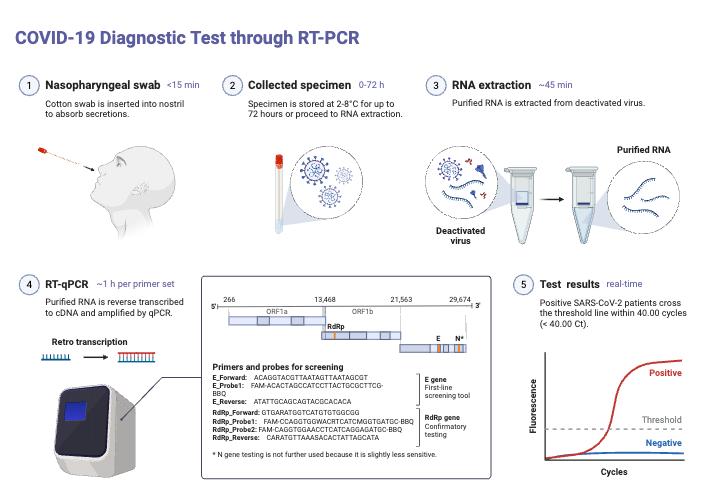
The amplified product is analysed after the reaction. In end point method, gel electrophoresis is used and the bands are seen by staining. In real-time RT-PCR, fluorescence is measured during the reaction.
12. Interpretation of data
The result is interpreted from the formed product. In real-time method, threshold cycle (Ct) and melt curve are observed. Internal control and replicates are used to check the reaction.
Applications of Reverse Transcription PCR (RT-PCR)
The following are the applications of Reverse Transcription PCR (RT-PCR)
- To study the level of mRNA in the cell and to know the pattern of gene expression.
- For validation of RNA interference (RNAi) in studying loss of function of selected genes.
- To detect and measure viral RNA load in infections caused by SARS-CoV-2, HIV, HCV, influenza, Ebola, and Zika virus.
- For diagnosis of infectious diseases caused by bacteria, fungi, and parasites.
- To detect special mRNA transcripts and biomarkers formed by cancer cells.
- For detection of circulating tumour cells and monitoring of minimal residual disease in leukemia and lymphoma.
- To study inherited genetic disorders and mutations by analysing specific mRNA expression.
- For diagnosis of genetic diseases such as Lesch-Nyhan syndrome.
- To prepare intron free complementary DNA (cDNA) from eukaryotic mRNA.
- For insertion of formed cDNA into prokaryotic cell like E. coli for recombinant protein production.
- To check the result of gene insertion and to observe the result of gene therapy.
- For drug target validation and study of new disease biomarkers.
- To see the change of gene expression after drug treatment.
- To detect and measure genetically modified organisms (GMOs) in crops and food products.
- For monitoring microbial fermentation process and enzyme production.
- To detect microbial contamination in biopharmaceutical products.
Advantages of Reverse Transcription PCR (RT-PCR)
The following are the advantages of Reverse Transcription PCR (RT-PCR)
- It is a rapid technique and produces millions of copies of mRNA sequence in short time.
- It is highly sensitive because very small amount of starting RNA sample is needed.
- It can detect very minute amount of mRNA, even about 5 picogram.
- It is more sensitive than older method like Northern blotting.
- It is specific because primers bind with the selected target sequence only.
- It is simple to perform and the reaction is controlled by thermocycler machine.
- It does not need continuous human handling during the reaction.
- It can be used for both qualitative and quantitative study of RNA.
- It can show the presence of specific RNA and also measure its amount.
- It can amplify RNA even when the sample is partly degraded, if the primer binding region is not damaged.
- It is useful for accurate diagnosis of RNA viruses and also for identification of viral strain.
- It reduces the time required for diagnosis of viral infections.
- It is used to detect transcripts of many genes and to study gene expression.
- It is useful for study of gene mutation, early cancer diagnosis, and monitoring of gene therapy result.
Limitations of Reverse Transcription PCR (RT-PCR)
The following are the limitations of Reverse Transcription PCR (RT-PCR)
- It is used only for amplification of RNA, mainly mRNA.
- Before doing the reaction, the sequence information of target RNA should be known for designing primers.
- Reverse transcriptase enzyme has no proofreading activity. So, mistake may occur during formation of cDNA.
- Base exchange, mutation, or frameshift may be formed during reverse transcription step.
- It is highly sensitive to contamination. Small amount of unwanted DNA or cross contamination may give wrong result.
- False positive or false negative result may occur due to contamination and poor handling.
- The reaction may be inhibited by contaminants like detergents, ethanol, humic acids, or hemoglobin.
- Small amount of organic or inorganic inhibitors can decrease the sensitivity or may stop the reaction.
- It is an enzyme and temperature dependent process. So, proper temperature control is needed.
- Minor change in temperature can reduce the activity of enzymes and affect amplification.
- If the RNA template is degraded or has complex secondary structure, complete cDNA may not be formed.
- Sometimes reverse transcriptase may stop before reaching the end of the RNA strand, and incomplete cDNA is produced.
- Traditional RT-PCR is not very accurate for end point quantification.
- The method needs complex reaction mixture and careful preparation.
- It is tedious method and requires trained person for proper handling and result interpretation.
References
- Thermo Fisher Scientific. (2009). 260/280 and 260/230 Ratios (T042-Technical Bulletin). NanoDrop Spectrophotometers.
- Coffin, J. M. (2021). 50th anniversary of the discovery of reverse transcriptase. Molecular Biology of the Cell, 32(2), 91-210.
- ResearchGate. (n.d.). A comparison of droplet digital PCR and RT-qPCR for BCR-ABL1 monitoring in chronic myeloid leukemia.
- AAT Bioquest. (n.d.). Advantages & limits of nested PCR vs. standard PCR.
- PubMed Central. (n.d.). Analysis of one-step and two-step real-time RT-PCR using SuperScript III.
- Hardie, M. (n.d.). Ancient family reunion: PCR reunites humans to ancestors. GoldBio.
- PubMed Central. (n.d.). Application of reverse transcription-PCR and real-time PCR in nanotoxicity research.
- Rodrigues, T., de Moura, B. G., de Miranda, G. T. C., Toledo, C. L., Bravo, L. F., & Costa, A. D. T. (2026). Application of qPCR testing in clinical diagnostics: A brief review of its history, challenges and perspectives. AIMS Molecular Science, 13(2), 180-204.
- PubMed Central. (n.d.). Brief guide to RT-qPCR.
- PubMed Central. (n.d.). Clinical utility of droplet digital PCR to monitor BCR-ABL1 transcripts of patients with Philadelphia chromosome–positive acute lymphoblastic leukemia post-chimeric antigen receptor19/22 T-cell cocktail therapy.
- Thermo Fisher Scientific. (n.d.). DNase treatment & removal reagents.
- MarketsandMarkets. (2024). Digital PCR and qPCR market outlook 2029: The future of precision diagnostics.
- Bochicchio, M. T., Petiti, J., Berchialla, P., Izzo, B., Giugliano, E., Ottaviani, E., Errichiello, S., Rege-Cambrin, G., Venturi, C., Luciano, L., Daraio, F., Calistri, D., Rosti, G., Saglio, G., Martinelli, G., Pane, F., Cilloni, D., Gottardi, E. M., & Fava, C. (2021). Droplet digital PCR for BCR–ABL1 monitoring in diagnostic routine: Ready to start? Cancers, 13(21), 5470.
- Cold Spring Harbor Laboratory. (2022). Fifty years of reverse transcriptase. History of Science Meeting – Library.
- MyBioSource. (n.d.). Future directions and innovations in PCR technology. Learning Center.
- PubMed Central. (n.d.). Genomic BCR-ABL1 breakpoint characterization by a multi-strategy approach for “personalized monitoring” of residual disease in chronic myeloid leukemia patients.
- Wikipedia contributors. (2026). MIQE. In Wikipedia, The Free Encyclopedia.
- Bio-Rad Laboratories. (2023). MIQE guidelines for real-time PCR: Checklist for authors, reviewers, and editors.
- Kennedy, S. (2025). MIQE guidelines: Do your RT-qPCRs make the grade? Bitesize Bio.
- RDML Consortium. (n.d.). MIQE: Minimum information for publication of quantitative real-time PCR experiments.
- Sigma-Aldrich. (n.d.). MIQE: Real-time PCR experiment standards.
- Branford, S., & Apperley, J. F. (2022). Measurable residual disease in chronic myeloid leukemia. Haematologica, 107(12), 2794-2809.
- Bio-Synthesis. (2025). Methods for removing DNA contamination from RNA samples.
- Wieczorek, D., Delauriere, L., & Schagat, T. (n.d.). Methods of RNA quality assessment. Promega Corporation.
- PubMed Central. (n.d.). Monitoring of minimal residual disease (MRD) in chronic myeloid leukemia.
- BOC Sciences. (n.d.). Nested PCR: Principle, protocol and applications.
- LabMal Academy. (2020). One-step and two-step RT-qPCR.
- Bioline. (n.d.). One-step real-time RT-PCR versus two-step real-time RT-PCR.
- Thermo Fisher Scientific. (n.d.). PCR troubleshooting guide.
- Author Unknown. (n.d.). PCR, RT-PCR, NESTED-PCR, MULTIPLEX PCR.
- Bowlby, B. (2023). PCR: Celebrating 40 years of development. BioTechniques.
- Khehra, N., Padda, I. S., & Zubair, M. (2025). Polymerase chain reaction (PCR). In StatPearls. StatPearls Publishing.
- PubMed Central. (n.d.). Prognostic value of MRD monitoring based on BCR-ABL1 copy numbers in Philadelphia chromosome positive acute lymphoblastic leukemia.
- QIAGEN. (n.d.). RNA quantification and quality control methods.
- Genomics Core Facility. (n.d.). RNA-seq sample guidelines. The Huck Institutes.
- MilliporeSigma. (n.d.). RT-PCR troubleshooting.
- PubMed Central. (n.d.). RT-qPCR versus digital PCR: How do they impact differently on clinical management of chronic myeloid leukemia patients?
- MilliporeSigma. (n.d.). RT-qPCR – Quantitative reverse transcription PCR.
- CD Genomics. (n.d.). Real-time PCR applications in biotechnology and beyond.
- PubMed Central. (n.d.). Real-time PCR: Revolutionizing detection and expression analysis.
- PubMed Central. (n.d.). Real-time polymerase chain reaction: Current techniques, applications, and role in COVID-19 diagnosis.
- Caister Academic Press. (n.d.). Real-time PCR applications.
- Mordor Intelligence. (2025). Real-time PCR, digital PCR, and end-point PCR market report 2030.
- ResearchGate. (n.d.). Real-time quantitative PCR to assess the authenticity of ancient DNA amplification.
- PubMed Central. (n.d.). Recent developments and future directions in point-of-care next-generation CRISPR-based rapid diagnosis.
- Green, M. R., & Sambrook, J. (2019). Removing DNA contamination from RNA samples by treatment with RNase-free DNase I. Cold Spring Harbor Protocols.
- Synthego. (n.d.). Reverse transcription mechanism explained simply.
- Dahal, P. (2025). Reverse transcription PCR (RT-PCR): Principle, enzymes, types, steps, uses. Microbe Notes.
- Roche Life Science. (n.d.). Reverse transcription technology.
- Wikipedia contributors. (2026). Reverse transcriptase. In Wikipedia, The Free Encyclopedia.
- Wikipedia contributors. (2025). Reverse transcription polymerase chain reaction. In Wikipedia, The Free Encyclopedia.
- Integrated DNA Technologies. (n.d.). Starting with RNA—One-step or two-step RT-qPCR?
- Author Unknown. (n.d.). The analytical evolution and mechanistic depth of reverse transcription polymerase chain reaction in contemporary molecular diagnostics.
- Excedr. (2022). The basics of reverse transcription PCR (RT-PCR).
- PubMed. (n.d.). The discovery of reverse transcriptase.
- PubMed Central. (n.d.). The future of point-of-care nucleic acid amplification diagnostics after COVID-19.
- Takara Bio. (n.d.). Troubleshooting your PCR.
- PubMed Central. (n.d.). Two-step versus one-step RNA-to-CT™ 2-step and one-step RNA-to-CT™ 1-step: Validity, sensitivity, and efficiency.
- MyBioSource. (n.d.). Types of PCR: Conventional, real-time, reverse transcriptase, digital, and multiplex PCR.
- Zymo Research. (2025). What are PCR inhibitors?
- AAT Bioquest. (n.d.). What are the differences between real time PCR and nested PCR?