

Picric Acid Test is a qualitative chemical test used for the detection of reducing sugars in a given sample. It detects sugars which can act as reducing agents under alkaline conditions.
The test is based on the reducing property of these sugars. In alkaline medium, the reducing sugar reacts with yellow picric acid (2,4,6-trinitrophenol). During this reaction, picric acid is reduced to the red-coloured picramic acid. The reaction is accompanied by a distinct change in colour.
The picric acid test reagent provides the picric acid required for this reaction. The test is performed by heating the sample with picric acid under alkaline conditions, which favour the reduction of picric acid by reducing sugars.
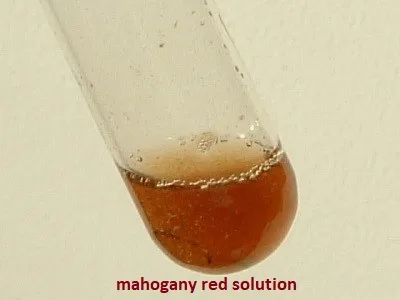
Formation of a red or mahogany-red colour is considered a positive result. It indicates the presence of reducing sugars in the tested sample.
What is Picric Acid Test?
Picric Acid Test is a chemical test used for the detection of reducing sugars in a given sample. It is generally used as a qualitative test in carbohydrate analysis, where the presence of reducing carbohydrate is detected by colour reaction.
The reagent used in this test is picric acid, chemically known as 2,4,6-trinitrophenol. Under alkaline condition and on heating, reducing sugars reduce the yellow picric acid and a red coloured picramic acid is formed.
A red to mahogany-red colour is considered as positive Picric Acid Test. It indicates that reducing sugar is present in the tested carbohydrate sample. The picric acid reaction has also been used in colorimetric estimation of reducing sugars.
Objectives of Picric Acid Test
- To detect the presence of reducing sugars in a given carbohydrate sample. The Picric Acid Test is specifically described for determination of reducing carbohydrates.
- To identify the reducing property of carbohydrates by their reaction with picric acid under alkaline condition. Reducing sugars reduce yellow picric acid to the red coloured reaction product.
- To differentiate reducing carbohydrates from non-reducing carbohydrates on the basis of the colour reaction.
- To use the picric acid reduction reaction for qualitative analysis of reducing sugars. The same reaction has also been used for colorimetric estimation of reducing sugars in carbohydrate analysis.
Principle of Picric Acid Test
Picric Acid Test is based on the reducing property of reducing sugars. These sugars show reducing activity when heated under alkaline condition. In this reaction, yellow picric acid (2,4,6-trinitrophenol) acts as the accepting reagent and it is reduced by the sugar.
The reducing sugar is oxidized during this process while picric acid undergoes reduction. A red coloured reduction product is then formed. This produces the characteristic colour of the test. The change of yellow colour to red or mahogany-red colour is considered as a positive result for reducing sugar.
Role of Sodium Carbonate–
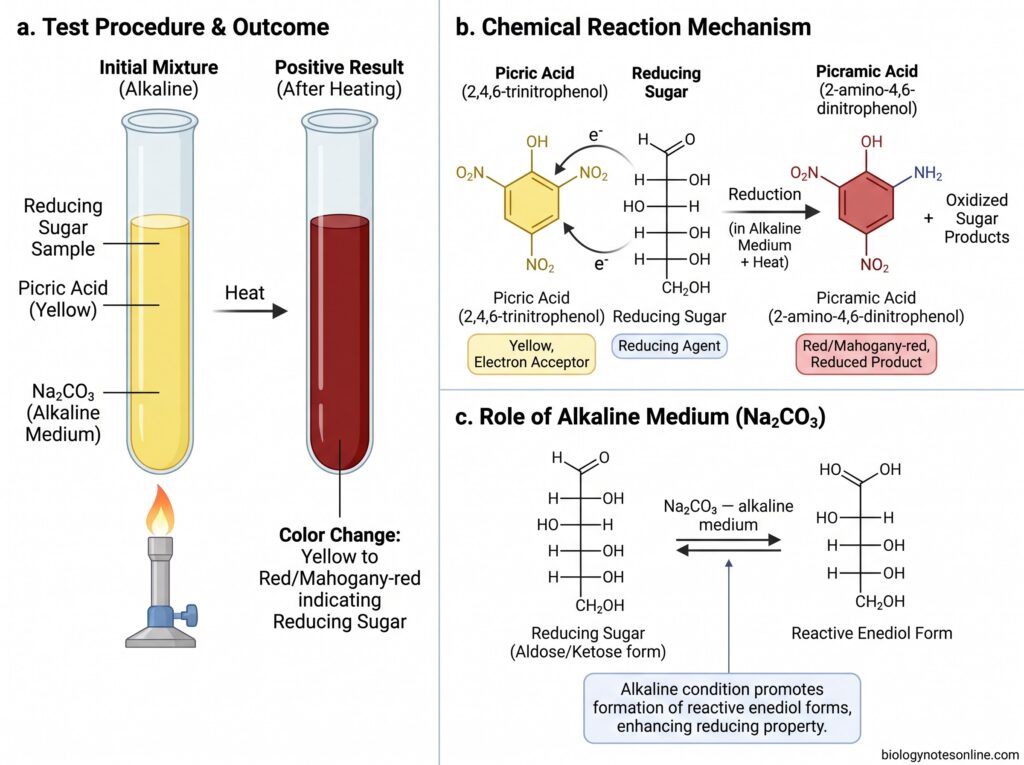
Sodium carbonate (Na₂CO₃) is used to provide the alkaline medium required for the Picric Acid Test. The reducing action of sugars takes place more readily under this condition. In alkaline medium, the sugar can form reactive enediol forms which show reducing property.
Heating of the sample with picric acid in this alkaline condition allows the reduction reaction to take place. Thus, sodium carbonate mainly provides the suitable alkaline condition required for the colour development.
Formation of Picramic Acid/Colored Reduction Products
During this process, yellow picric acid is reduced by the reducing sugar. Reduction of a nitro group of picric acid results in the formation of picramic acid (2-amino-4,6-dinitrophenol) and related coloured reduction products. These products are red to deep mahogany-red in colour.
The reaction can be represented as follows-
Picric acid (yellow) + Reducing sugar → Picramic acid/colored reduction products (red or mahogany-red)
Therefore, formation of the red or mahogany-red colour indicates the presence of reducing sugar in the sample.
Why Does Fructose Give a Positive Test?
Fructose is a ketose sugar. However, it also gives a positive Picric Acid Test. In alkaline condition, fructose undergoes enolization and forms an enediol intermediate.
This intermediate can be converted into aldose forms which have reducing activity. These forms reduce picric acid during heating. Therefore, fructose also develops the red or mahogany-red colour and gives a positive test.
Reaction of Picric Acid Test
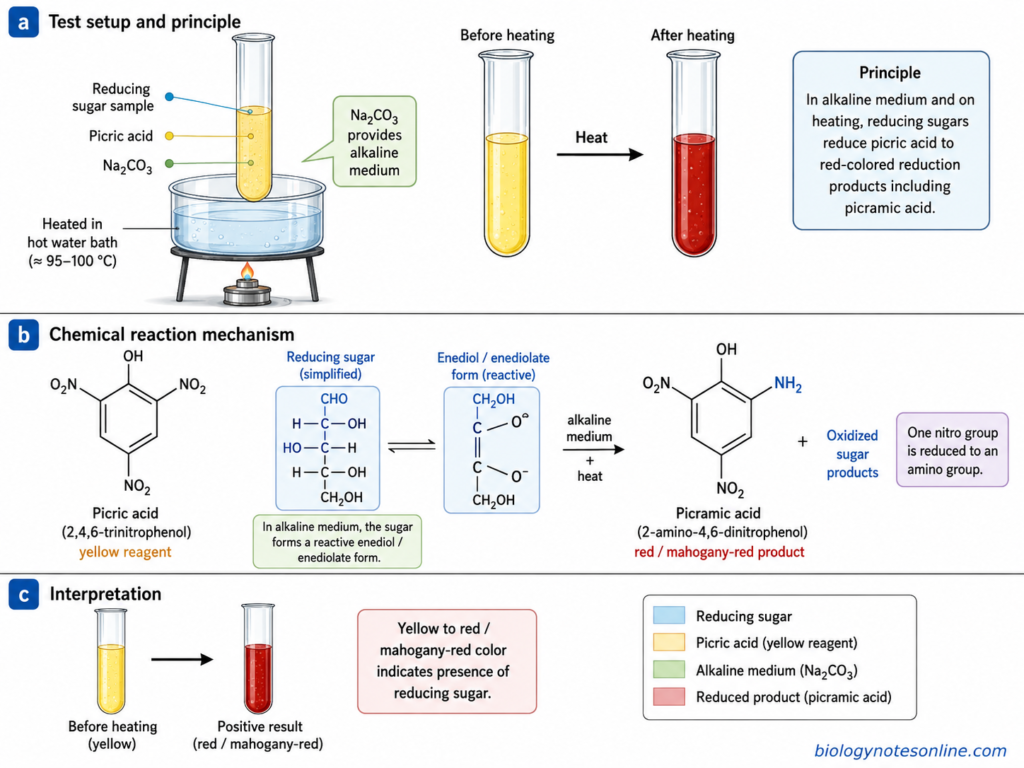
In Picric Acid Test, the reducing sugar reacts with yellow picric acid in alkaline condition on heating. Sodium carbonate provides the alkaline medium for the reaction. During this process, reducing sugar is oxidized while picric acid is reduced.
The reduced product formed is picramic acid (2-amino-4,6-dinitrophenol). It is red to deep mahogany-red in colour. The reduction involves conversion of a nitro group (–NO₂) of picric acid into an amino group (–NH₂). Thus, yellow colour of picric acid changes to red or mahogany-red during a positive reaction.
The reaction is as follows-
Reducing sugar + Picric acid (yellow)
↓ Alkaline medium + Heat
Oxidized sugar products + Picramic acid (red/mahogany-red)
The picric acid reduction reaction has been used for detection as well as colorimetric determination of reducing sugars.
Requirements for Picric Acid Test
The following are the requirements for Picric Acid Test–
- Test solution containing the carbohydrate sample.
- Saturated picric acid solution.
- 10% sodium carbonate (Na₂CO₃) solution for providing alkaline condition.
- Test tubes.
- Pipette or dropper for transferring the solutions.
- Boiling water bath for heating the reaction mixture.
- Test tube holder or test tube rack.
- Distilled water for preparation or dilution of the required solutions.
Procedure of Picric Acid Test
The following are the steps of Picric Acid Test–
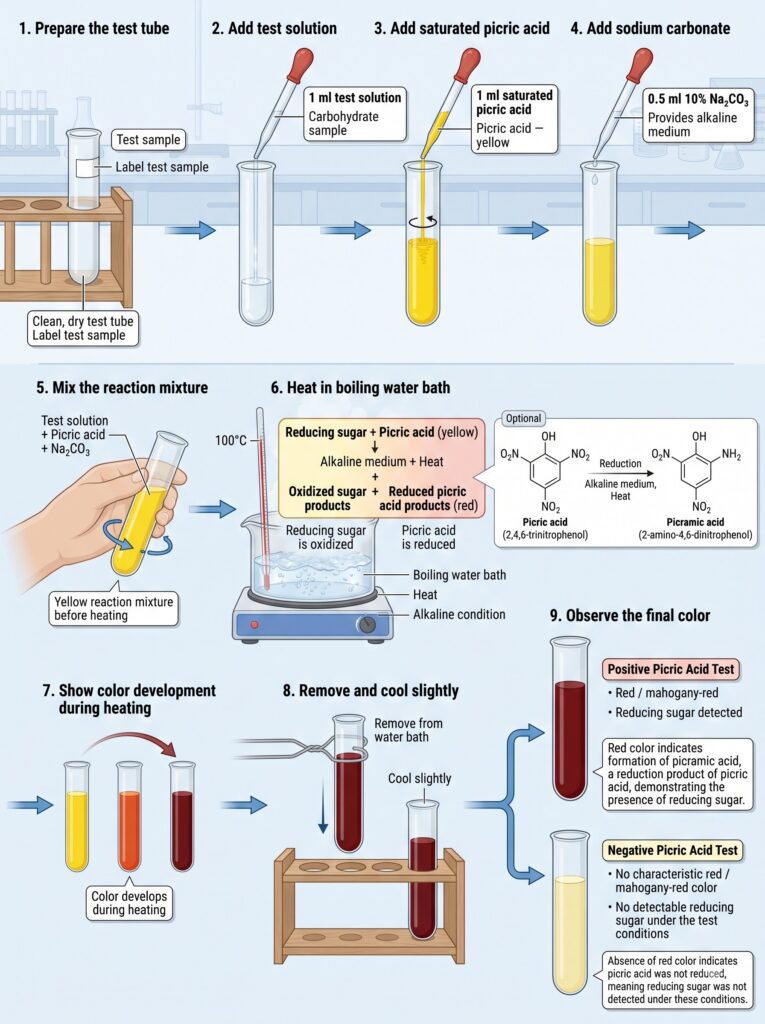
- Take a clean and dry test tube and label it properly for the test sample.
- Add 1 ml of the test solution into the test tube with the help of a pipette. The sample should contain the carbohydrate to be tested.
- Add 1 ml of saturated picric acid solution to the test solution. Mix the contents of the tube properly.
- Now add 0.5 ml of 10% sodium carbonate (Na₂CO₃) solution into the same test tube. Sodium carbonate makes the reaction mixture alkaline.
- Mix the contents carefully so that the test solution and reagents are mixed properly. The solution at this stage contains yellow coloured picric acid.
- Place the test tube in a boiling water bath and heat the reaction mixture. During heating, reducing sugar present in the sample reacts with picric acid under alkaline condition.
- In this process, the reducing sugar reduces picric acid and coloured reduction products are formed. The yellow colour gradually changes depending upon the reducing activity of the sample.
- Remove the test tube from the water bath after sufficient colour has developed and allow it to cool slightly.
- Observe the final colour of the reaction mixture. Formation of red or mahogany-red colour is considered as a positive Picric Acid Test.
- If the characteristic red or mahogany-red colour is not formed, the test is considered negative for detectable reducing sugar under the test condition.
Observation and Result of Picric Acid Test
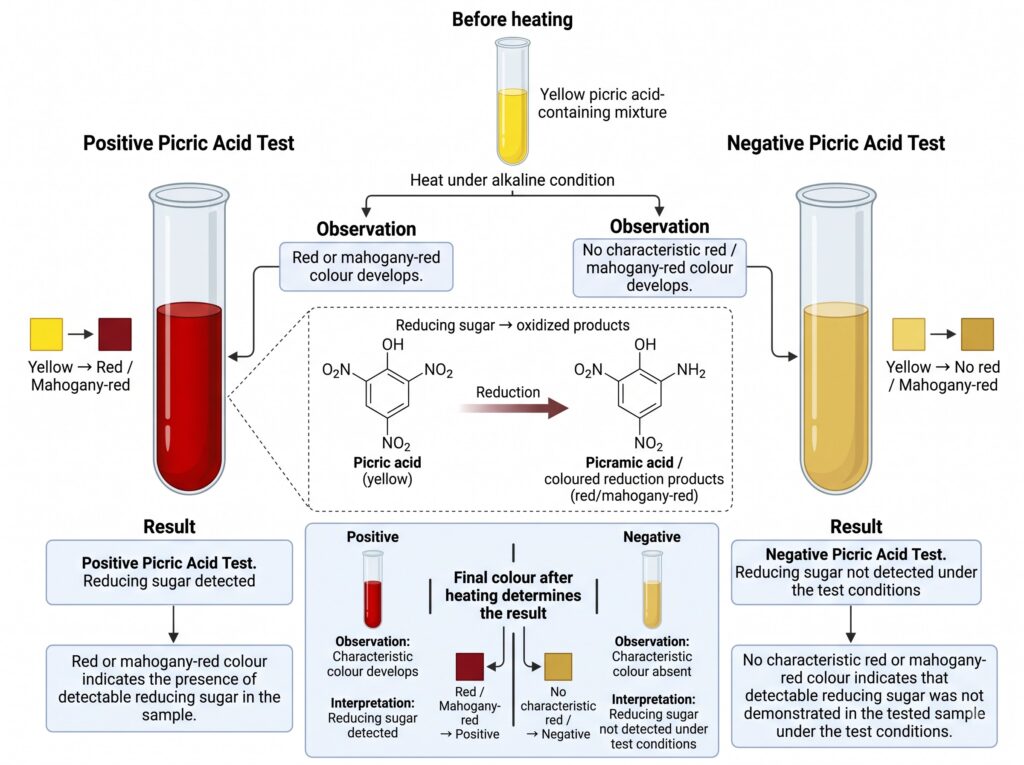
The observation of Picric Acid Test is based on the colour developed after heating the test sample with picric acid under alkaline condition. Reducing sugars react with picric acid and produce the characteristic coloured reaction.
Positive Picric Acid Test
Observation- Development of red or mahogany-red colour in the reaction mixture is observed. The colour is produced due to reduction of picric acid by the reducing sugar.
Result- The test is considered positive. It indicates the presence of reducing sugar in the given sample.
Negative Picric Acid Test
Observation- No characteristic red or mahogany-red colour is developed. The positive colour reaction is absent.
Result– The Picric Acid Test is considered negative. It indicates that detectable reducing sugar is absent in the tested sample under the test conditions.
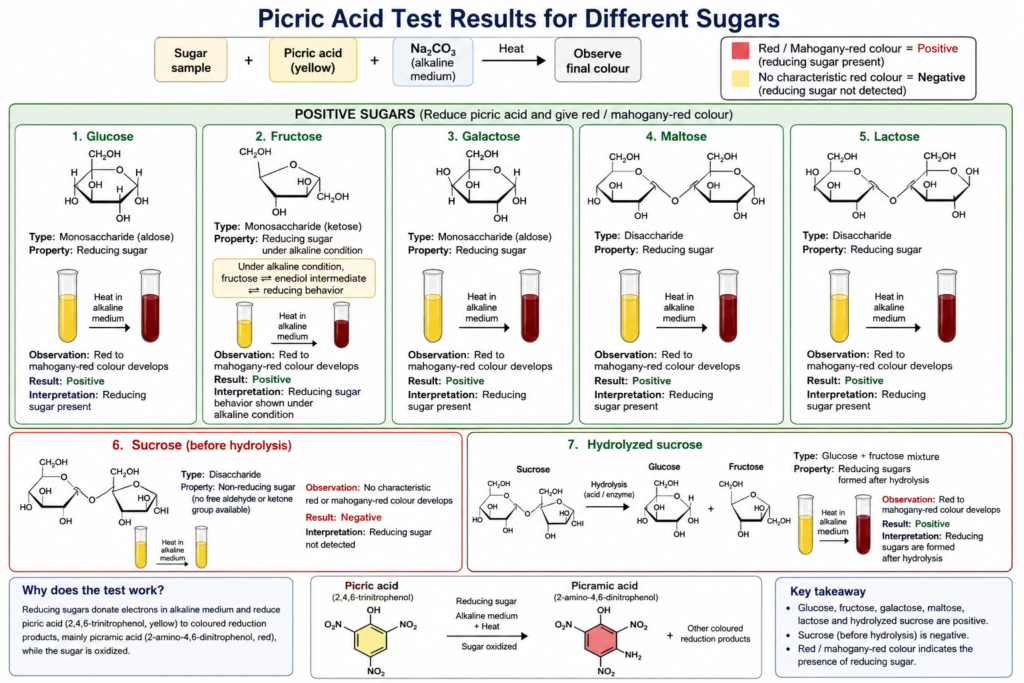
Picric Acid Test Results for Different Sugars
Different sugars give different results in Picric Acid Test depending upon their reducing property. Glucose, fructose, galactose, maltose and lactose are reducing sugars, while sucrose is a non-reducing sugar. The following are the results-
| Sugar | Type of Sugar | Reducing Property | Picric Acid Test | Observation | Result |
|---|---|---|---|---|---|
| Glucose | Monosaccharide, aldose | Reducing sugar | Positive | Red to mahogany-red colour develops | Reducing sugar is present |
| Fructose | Monosaccharide, ketose | Reducing sugar under alkaline condition | Positive | Red to mahogany-red colour develops | Reducing sugar is present |
| Galactose | Monosaccharide, aldose | Reducing sugar | Positive | Red to mahogany-red colour develops | Reducing sugar is present |
| Maltose | Disaccharide | Reducing sugar | Positive | Red to mahogany-red colour develops | Reducing sugar is present |
| Lactose | Disaccharide | Reducing sugar | Positive | Red to mahogany-red colour develops | Reducing sugar is present |
| Sucrose | Disaccharide | Non-reducing sugar | Negative | Characteristic red or mahogany-red colour is not developed | Reducing sugar is not detected |
| Hydrolyzed sucrose | Glucose + fructose mixture | Reducing | Positive | Red to mahogany-red colour develops | Reducing sugars are formed after hydrolysis |
Picric acid reacts with reducing sugars and is reduced to the red coloured picramic acid. Thus, sugars having reducing activity give the characteristic positive colour.
The picric acid test for glucose is positive because glucose is a reducing aldose. Picric acid test for fructose is also positive. Fructose is a ketose, but under alkaline condition it can undergo interconversion through enediol forms and shows reducing activity.
The maltose picric acid test and lactose picric acid test are positive because both are reducing disaccharides. They contain a free reducing end which can take part in the reaction. Picric acid test for sucrose, on the other hand, is negative before hydrolysis because sucrose is non-reducing. After hydrolysis, glucose and fructose are formed and the reaction becomes positive.
Why Do Reducing Sugars Give the Picric Acid Test?
Reducing sugars are the carbohydrates that can act as reducing agents in a chemical reaction. The major reason for this reducing nature is the presence of a free anomeric carbon. It is also called reducing end of the sugar. When present in solution, the cyclic and open-chain forms remain in equilibrium and a small amount of the carbonyl form is continuously produced. This form is responsible for the reducing activity.
In aldoses such as glucose and galactose, opening of the ring gives an aldehyde group. The aldehyde group can be oxidized. During Picric Acid Test under alkaline condition, this oxidation is accompanied by reduction of picric acid, producing the characteristic coloured reaction. Thus, sugars having an available reducing end give positive test.
The case of fructose is different. It is a ketose and the open-chain molecule contains ketone group instead of aldehyde. However in alkaline medium, fructose undergoes enolization and an enediol intermediate is formed, which can rearrange into aldose forms. These forms now show reducing activity. Therefore fructose also reduces picric acid and gives the positive reaction even though it is a ketose sugar.
Sucrose, on the other hand, does not behave in the same manner. The glycosidic linkage of sucrose involves anomeric carbon of glucose as well as the anomeric carbon of fructose, so both of these positions are already occupied in the bond. There is no free reducing end. The usual ring opening for formation of a free carbonyl group therefore cannot take place and sucrose is a non-reducing sugar.
After hydrolysis, sucrose is broken down into glucose and fructose. Both are reducing sugars. Hence, hydrolyzed sucrose gives positive Picric Acid Test while unhydrolyzed sucrose normally does not.
Factors Affecting the Picric Acid Test
The reaction of Picric Acid Test depends on different conditions. Amount of reducing sugar, reagent concentration and heating are some of them. The major factors are-
- Concentration of reducing sugar– The amount of reducing sugar present in the sample affects colour development. Higher amount of sugar reduces more picric acid within the working range of the test. At very low concentration, only a weak red colour may be obtained.
- Concentration of picric acid– Proper amount of picric acid is required for the reaction. The concentration of this reagent changes the final colour obtained. In glucose estimation, picric acid is generally kept in excess so that maximum and constant colour can develop.
- Alkaline condition– The test is carried out in alkaline medium, which is generally produced by sodium carbonate (Na₂CO₃). Proper alkalinity is required for reduction of picric acid. When the alkaline condition is low, colour development may also be poor. Excess alkalinity can affect the developed colour.
- Heating temperature– Heating helps the reaction between reducing sugar and alkaline picric acid. A boiling water bath is commonly used for this purpose. If heating is low or not uniform, the reaction becomes slower and less colour may be formed.
- Heating time– The time of heating also affects the test result. Colour continues to develop during heating. Therefore, the samples are generally heated for a fixed period so that similar reaction conditions are maintained.
- Proportion of reagents– The amount of test solution, picric acid and sodium carbonate should be maintained in proper proportion. Change in their quantity can change the alkaline condition as well as the amount of reagent available for reaction. Fixed reagent volumes are therefore used during the test.
- Interfering substances– The alkaline picrate reaction is not completely specific only for reducing sugars. Some other substances present in a complex sample can also react or interfere with the colour formed. Due to this, the composition of the sample can sometimes affect the test result.
Limitations of Picric Acid Test
The Picric Acid Test has some limitations. The following are the important limitations-
- Low specificity– The test is not specific only for reducing sugars. Other reducing substances may also interfere with the colour reaction.
- Cannot identify individual sugars– Different reducing sugars can give similar positive colour. Therefore, the test cannot differentiate glucose, fructose, lactose or maltose.
- Non-reducing sugars are not detected directly– Sugars such as sucrose usually give negative test before hydrolysis.
- Reaction conditions affect the result– Heating, alkalinity and reagent concentration should be maintained properly. Change in these conditions can change the colour development.
- Mainly a qualitative test– The red or mahogany-red colour indicates reducing sugar, but exact amount cannot be obtained by simple visual observation.
- Interference from sample components– Some substances present in complex samples may also react with alkaline picrate and affect the result.
- Picric acid requires careful handling– Picric acid is a hazardous chemical, particularly when dry. Proper storage and handling are required.
Advantages of Picric Acid Test
The Picric Acid Test has some advantages for detection of reducing sugars. It gives a visible colour reaction and the same reaction can also be used for colorimetric estimation. The following are the advantages-
- Simple method– The procedure is simple and requires only picric acid, sodium carbonate, test solution and heating.
- Clear colour reaction– Reduction of yellow picric acid produces red coloured picramic acid. The colour change can be observed easily in a positive test.
- Detects different reducing sugars– The reaction is not limited only to glucose. Other reducing sugars can also react with alkaline picrate.
- No special instrument for qualitative test– The positive reaction can be detected from the developed colour. Thus, ordinary laboratory glassware and heating are sufficient for the qualitative test.
- Can be used for quantitative estimation– The picric acid reduction reaction has also been used in colorimetric determination of reducing sugars.
- Useful with different biological samples– Picric acid methods have been used for estimation of sugars in plant materials, blood and dairy samples.
Applications of Picric Acid Test
The Picric Acid Test has been used for different works related to carbohydrate analysis. Some of the important applications are-
- Detection of reducing sugars– It is used for detecting reducing sugars in a given carbohydrate sample by the colour reaction of alkaline picric acid.
- Estimation of reducing sugars– The developed colour can be measured colorimetrically. Thus, reducing sugar present in a sample can also be estimated under controlled conditions.
- Analysis of plant carbohydrates– Picric acid reduction method has been used for estimation of reducing sugars and sucrose in plant materials.
- Estimation of starch– After suitable hydrolysis, the method has also been applied for determination of starch and other reserve polysaccharides in plants.
- Determination of lactose– The picric acid colorimetric method has been used for estimation of lactose in milk and milk products.
- Blood sugar estimation– Picric acid method was historically used for estimation of sugar in blood. It was one of the earlier colorimetric methods used for this purpose.
- Urine sugar estimation– The reaction was also used historically for determination of sugar in urine, before more specific methods became available.
Precautions and Safety
Some of the important precautions and safety measures of Picric Acid Test are-
- Picric acid should be kept wet– Dry picric acid is hazardous and can become sensitive to heat, friction and shock. It should never be allowed to dry during storage.
- Dry crystals should not be handled– If crystals are present around the bottle cap or the reagent has dried, the container should not be opened or disturbed. It requires handling by trained safety personnel.
- Contact with metals should be avoided– Picric acid can form metal picrates with metals such as copper, lead, iron and zinc. These salts can be more sensitive than picric acid itself.
- Protective equipment should be used– Laboratory coat, suitable gloves and safety goggles should be worn while performing the test. Direct contact of picric acid with skin and eyes should be avoided.
- Heating should be done carefully– The reaction mixture is heated using the required water bath. Direct flame and unnecessary heating should be avoided while working with picric acid.
- Reagents should be measured properly– Picric acid and sodium carbonate should be added in the required quantity. Splashing of the alkaline reaction mixture should be avoided.
- Clean glassware should be used– Test tubes and pipettes should be clean so that other reducing substances do not interfere with the colour reaction.
- Waste should be handled properly– Picric acid containing solutions should be collected as chemical waste and disposed according to laboratory hazardous-waste procedures. Containers and contaminated materials should not be allowed to dry.
Picric Acid Test and Jaffé Test – Are They the Same?
Picric Acid Test and Jaffé Test are related reactions, but they are not considered the same test in routine laboratory use. Both use picric acid in alkaline medium, which is the major reason for confusion between these two tests.
In Picric Acid Test for reducing sugars, the reducing sugar reacts with alkaline picric acid on heating. Yellow picric acid is reduced and a deep red or mahogany-red coloured product is formed. This reaction has been used for detection and estimation of reducing carbohydrates.
The Jaffé Test, on the other hand, is mainly used for determination of creatinine. Creatinine reacts with alkaline picrate and an orange coloured reaction product is produced. This reaction is commonly used for estimation of creatinine in serum and urine.
There is some overlap between them. The Jaffé colour reaction has also been adapted for determination of lactose, and other reducing sugars were found to give picric acid reaction. Thus, both are based on alkaline picrate chemistry, but their usual analyte, purpose and interpretation are different.
| Feature | Picric Acid Test | Jaffé Test |
|---|---|---|
| Main analyte | Reducing sugars | Creatinine |
| Reagent | Picric acid + alkali | Alkaline picrate |
| Main colour | Red/mahogany-red | Orange |
| Main use | Carbohydrate analysis | Creatinine estimation |
| Same test? | No. Related chemistry only | No. Related chemistry only |
Picric Acid Test vs Fehling’s Test
| Feature | Picric Acid Test | Fehling’s Test |
|---|---|---|
| Purpose | Used for detection of reducing sugars | Used for detection of reducing sugars |
| Main reagent | Picric acid (2,4,6-trinitrophenol) | Fehling’s solution A and Fehling’s solution B |
| Important chemicals | Picric acid and sodium carbonate | Copper(II) sulfate, sodium potassium tartrate and sodium hydroxide |
| Medium | Alkaline medium | Strong alkaline medium |
| Principle | Reducing sugar reduces yellow picric acid on heating | Reducing sugar reduces Cu²⁺ ions to Cu⁺ ions |
| Reduced product | Picramic acid/coloured reduction products | Cuprous oxide (Cu₂O) |
| Initial colour | Yellow | Deep blue |
| Positive result | Red or mahogany-red colour develops | Brick-red precipitate is formed |
| Nature of reaction | Mainly colour development | Precipitate formation |
| Glucose | Positive | Positive |
| Fructose | Positive | Positive |
| Lactose | Positive | Positive |
| Maltose | Positive | Positive |
| Sucrose | Negative before hydrolysis | Negative before hydrolysis |
| Heating | Heating is required | Heating is required |
| Reagent preparation | Comparatively simple reagent system | Fehling’s A and B are prepared separately and mixed before use |
| Main use | Qualitative detection and also colorimetric estimation of reducing sugars | Mainly qualitative detection of reducing sugars |
| Major difference | Reduction of picric acid gives red coloured products | Reduction of copper salt gives brick-red Cu₂O precipitate |
| Safety point | Picric acid needs careful handling, especially in dry condition | Strong alkali in Fehling’s reagent can cause irritation and burns |
Picric Acid Test vs Benedict’s Test
| Feature | Picric Acid Test | Benedict’s Test |
|---|---|---|
| Purpose | Used for detection of reducing sugars | Used for detection of reducing sugars |
| Main reagent | Picric acid (2,4,6-trinitrophenol) | Copper(II) sulfate, sodium citrate and sodium carbonate |
| Medium | Alkaline medium, generally provided by sodium carbonate | Alkaline medium provided by sodium carbonate |
| Principle | Reducing sugar reduces yellow picric acid during heating | Reducing sugar reduces Cu²⁺ ions to Cu⁺ during heating |
| Reduced product | Picramic acid/coloured reduction products | Cuprous oxide (Cu₂O) precipitate |
| Initial colour | Yellow | Blue |
| Positive result | Red or mahogany-red colour develops | Green, yellow, orange to brick-red precipitate may develop |
| Nature of positive reaction | Mainly colour development | Colour change with precipitate formation |
| Glucose | Positive | Positive |
| Fructose | Positive | Positive |
| Lactose | Positive | Positive |
| Maltose | Positive | Positive |
| Sucrose | Negative before hydrolysis | Negative before hydrolysis |
| Heating | Heating in a water bath is required | Heating is required |
| Quantitative use | Picric acid reaction has also been used for colorimetric estimation | Colour change can give a rough semi-quantitative indication |
| Specificity | Not specific for an individual reducing sugar | Also cannot identify the particular reducing sugar |
| Major difference | Reduction of picric acid produces red coloured products | Reduction of copper ions produces coloured Cu₂O precipitate |
| Safety | Picric acid requires careful handling, particularly it should not be allowed to dry | Benedict’s reagent is comparatively easier to handle in routine laboratory work |
Summary of Picric Acid Test
| Feature | Picric Acid Test |
|---|---|
| Test type | Qualitative test for reducing sugars |
| Reagent | Picric acid (2,4,6-trinitrophenol) |
| Alkaline reagent | Sodium carbonate (Na₂CO₃) |
| Principle | Reducing sugars reduce picric acid in alkaline condition on heating |
| Initial colour | Yellow |
| Reduced product | Picramic acid/coloured reduction products |
| Positive result | Red or mahogany-red colour |
| Positive test indicates | Presence of reducing sugar |
| Negative result | No characteristic red or mahogany-red colour |
| Glucose | Positive |
| Fructose | Positive |
| Lactose | Positive |
| Maltose | Positive |
| Sucrose | Negative before hydrolysis |
| Main use | Detection of reducing sugars in carbohydrate sample |
| Other use | Colorimetric estimation of reducing sugars under controlled conditions |
| Important factor | Proper alkalinity, heating time and reagent concentration |
| Major limitation | It cannot identify the individual reducing sugar |
| Safety point | Picric acid should not be allowed to dry |
References
- Bamford, C. H., & Collins, J. R. (1955). Kinetic studies on carbohydrates in alkaline conditions. III. Interconversion of D-glucose, D-fructose and D-mannose in feebly alkaline solution. Proceedings of the Royal Society of London. Series A, Mathematical and Physical Sciences, 228(1172), 100–119. https://doi.org/10.1098/rspa.1955.0036
- Benedict, S. R., & Osterberg, E. (1918). A method for the determination of sugar in normal urine. Journal of Biological Chemistry, 34(1), 195–201. https://www.sciencedirect.com/science/article/pii/S0021925818865449
- Benedict, S. R., & Osterberg, E. (1921). A method for the determination of sugar in normal urine. Journal of Biological Chemistry, 48(1), 51–57. https://www.sciencedirect.com/science/article/pii/S0021925818860434
- Bierman, H. R., & Doan, F. J. (1924). A colorimetric picric acid method for determining lactose. Journal of Dairy Science, 7(4), 381–392. https://doi.org/10.3168/jds.S0022-0302(24)94033-1
- Hameed, O. M., Shaker, O. M., Ben Slima, A., & Makni, M. (2024). Biochemical profiling and physicochemical and biological valorization of Iraqi honey: A comprehensive analysis. Molecules, 29(3), 671. https://doi.org/10.3390/molecules29030671
- Hernández-López, A., Sánchez Félix, D. A., Zuñiga Sierra, Z., García Bravo, I., Dinkova, T. D., & Avila-Alejandre, A. X. (2020). Quantification of reducing sugars based on the qualitative technique of Benedict. ACS Omega, 5(50), 32403–32410. https://doi.org/10.1021/acsomega.0c04467
- Jain, B. P., Pandey, S., & Goswami, S. K. (2024). Protocols in biochemistry and clinical biochemistry (2nd ed.). Elsevier. https://www.sciencedirect.com/book/9780443139451/protocols-in-biochemistry-and-clinical-biochemistry
- James, C. S. (1995). Analytical chemistry of foods. Springer. https://doi.org/10.1007/978-1-4615-2165-5
- Johnson, G. (1893). On the estimation of sugar in urine by the picric acid method. British Medical Journal, 1(1680), 512. https://doi.org/10.1136/bmj.1.1680.512
- Khramov, V. A., Kolomeĭtseva, A. S., & Papichev, N. V. (2008). Jaffe color test-based microtechnique for determination of milk lactose. Gigiena i Sanitariia, (3), 86–87. https://pubmed.ncbi.nlm.nih.gov/18590158/
- Lewis, R. C., & Benedict, S. R. (1915). A method for the estimation of sugar in small quantities of blood. Journal of Biological Chemistry, 20(1), 61–72. https://doi.org/10.1016/S0021-9258(18)88273-4
- Nagasawa, T., Sato, K., & Kasumi, T. (2023). Interaction of organogermanium compounds with saccharides in aqueous solutions: Promotion of aldose-to-ketose isomerization and its molecular mechanism. Journal of Applied Glycoscience, 70(4), 81–97. https://doi.org/10.5458/jag.jag.JAG-2023_0004
- Navarro, D. M. D. L., Abelilla, J. J., & Stein, H. H. (2019). Structures and characteristics of carbohydrates in diets fed to pigs: A review. Journal of Animal Science and Biotechnology, 10, 39. https://doi.org/10.1186/s40104-019-0345-6
- Odebunmi, E. O., & Owalude, S. O. (2008). Kinetics and mechanism of oxidation of some simple reducing sugars by permanganate ion in alkaline medium. Journal of the Iranian Chemical Society, 5(4), 623–630. https://doi.org/10.1007/BF03246143
- Ohta, N., & Morita, H. (1965). Studies on the spectrophotometric determination of glucose with picric acid. Bunseki Kagaku, 14(8), 682–687. https://doi.org/10.2116/bunsekikagaku.14.682
- Perry, N. A., & Doan, F. J. (1950). A picric acid method for the simultaneous determination of lactose and sucrose in dairy products. Journal of Dairy Science, 33(3), 176–185. https://doi.org/10.3168/jds.S0022-0302(50)91883-2
- Syal, K., Banerjee, D., & Srinivasan, A. (2013). Creatinine estimation and interference. Indian Journal of Clinical Biochemistry, 28(2), 210–211. https://doi.org/10.1007/s12291-013-0299-y
- Thomas, W., & Dutcher, R. A. (1924a). The colorimetric determination of carbohydrates in plants by the picric acid reduction method. I. The estimation of reducing sugars and sucrose. Journal of the American Chemical Society, 46(7), 1662–1669. https://doi.org/10.1021/ja01672a015
- Thomas, W., & Dutcher, R. A. (1924b). The colorimetric determination of carbohydrates in plants by the picric acid reduction method. II. The determination of starch and other “reserve” polysaccharides. Journal of the American Chemical Society, 46(7), 1670–1675. https://doi.org/10.1021/ja01672a016
- Toora, B. D., & Rajagopal, G. (2002). Measurement of creatinine by Jaffe’s reaction: Determination of concentration of sodium hydroxide required for maximum color development in standard, urine and protein free filtrate of serum. Indian Journal of Experimental Biology, 40(3), 352–354. https://pubmed.ncbi.nlm.nih.gov/12635710/
- Viraraghavan, S., & Blass, K. G. (1990). Effect of glucose upon alkaline picrate: A Jaffé interference. Journal of Clinical Chemistry and Clinical Biochemistry, 28(2), 95–105. https://doi.org/10.1515/cclm.1990.28.2.95
- Wyman, J. F., Serve, M. P., Hobson, D. W., Lee, L. H., & Uddin, D. E. (1992). Acute toxicity, distribution, and metabolism of 2,4,6-trinitrophenol (picric acid) in Fischer 344 rats. Journal of Toxicology and Environmental Health, 37(2), 313–327. https://doi.org/10.1080/15287399209531672
- Zhang, J. R., Yue, Y. Y., Luo, H. Q., & Li, N. B. (2016). Supersensitive and selective detection of picric acid explosive by fluorescent Ag nanoclusters. Analyst, 141(3), 1091–1097. https://doi.org/10.1039/C5AN02251G