

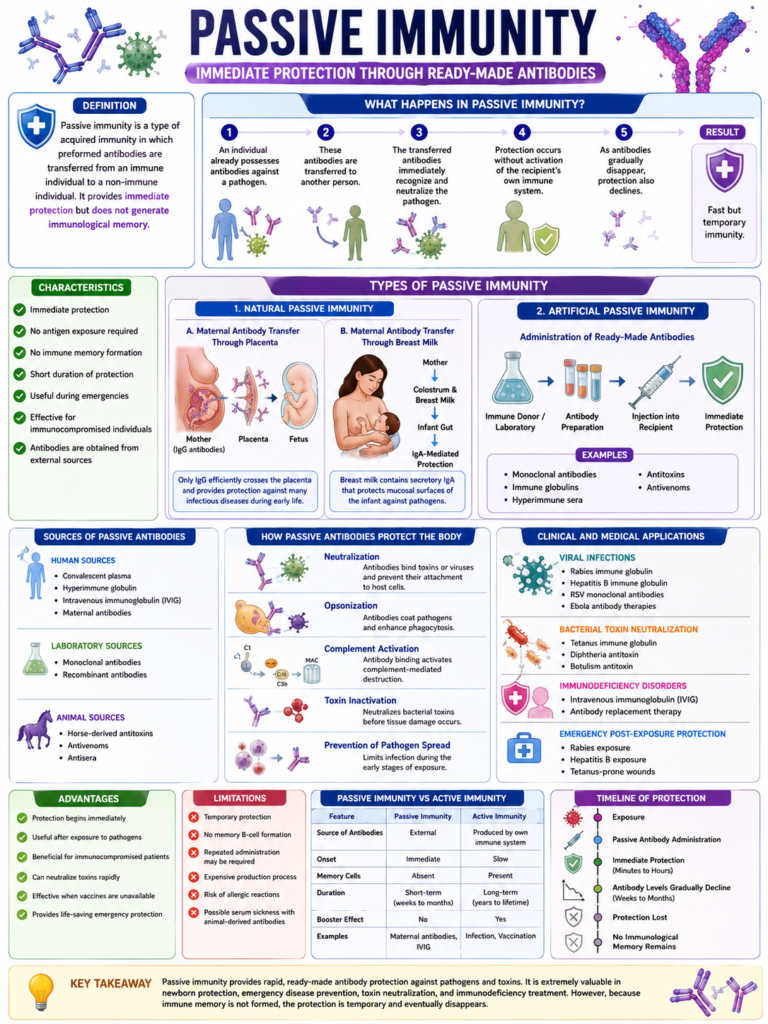
Passive immunity is the type of immunity in which ready-made antibodies are given to a person or animal from outside source. It is not produced by the own immune system of the body. In this immunity the immune system remain passive and only gets protection.
It gives very quick protection against infection, toxin or any harmful antigen. But it is not long lasting because immunological memory is not formed. The antibodies present in the body are broken down after some weeks or months.
Passive immunity is of two types, natural and artificial. Natural passive immunity occurs when the mother transfers antibodies to foetus through placenta. It also occurs through breast milk where antibodies are transferred to the newborn baby.
Artificial passive immunity occurs when antibodies are given directly from outside in medical condition. It includes immune globulin, antivenom, antibody rich blood products and monoclonal antibodies. It is mostly used to give immediate protection after exposure to disease or toxin.
Basic Concept of Passive Immunity
Passive immunity is the type of immunity in which ready-made antibodies are transferred from outside source to give immediate but temporary protection.
Passive immunity is a type of immune defence in which pre-formed antibodies are transferred from immune donor to non-immune recipient. In this immunity, the body does not make antibody by its own immune system. The protection is directly obtained from outside source.
In passive immunity, the immune system does not actively process the antigen. Memory B-cells and memory T-cells are not formed. So it gives immediate protection, but the protection is temporary and remain only for few weeks to few months.
Passive immunity is mainly of two types, natural and artificial. Natural passive immunity occurs when mother transfers antibodies to foetus through placenta during pregnancy. It also occurs after birth through colostrum and breast milk.
Artificial passive immunity is produced by injecting ready-made antibodies in medical condition. It includes antibody-rich serum, immune globulins, antitoxins and monoclonal antibodies. It is used for rapid protection against diseases like rabies, tetanus and respiratory syncytial virus (RSV).
Characteristics of Passive Immunity
- Transfer of pre-formed antibodies
Passive immunity involves transfer of ready-made antibodies from outside source. It may be from immune human, animal or laboratory prepared antibodies. The recipient body does not actively produce these antibodies. - Immediate protection
It gives immediate protection against specific infection or toxin. The protection starts soon after the antibodies enter into the body. This is the major advantage of passive immunity. - Temporary protection
The protection is short lasting. It usually remains for few weeks to few months. This happens because the transferred antibodies are slowly degraded and not produced again by the host body. - Absence of immunological memory
In passive immunity, memory B-cells and memory T-cells are not formed. So it does not give long term protection. If same pathogen enter again, the body may need antibody again. - Natural or artificial acquisition
Passive immunity may be acquired naturally or artificially. Natural passive immunity occurs when mother transfers antibodies to baby through placenta or breast milk. Artificial passive immunity occurs by giving immune globulins, antivenoms or monoclonal antibodies by injection.
Types of Passive Immunity
- Natural passive immunity – Natural passive immunity is a type of passive immunity in which ready-made antibodies are transferred naturally from one individual to another. It mainly occurs from mother to baby. The maternal antibodies pass to the foetus through placenta during pregnancy. After birth, the antibodies are also passed through colostrum and breast milk. This gives short time protection to the newborn.
- Artificial passive immunity – Artificial passive immunity is a type of passive immunity in which pre-formed antibodies are given from outside by medical method. It is given when immediate protection is needed against disease or toxin. The antibodies are given by injection or infusion. Examples are human immune globulins, animal derived antitoxins, antivenoms and laboratory prepared monoclonal antibodies. This protection is temporary because the given antibodies are destroyed after some time.
Natural Passive Immunity
- Natural passive immunity is a type of passive immunity in which pre-formed disease fighting antibodies are naturally transferred from immune mother to the foetus or newborn baby. The baby does not produce these antibodies by own immune system and only receive protection.
- During pregnancy, the mother transfers Immunoglobulin G (IgG) antibodies to the foetus through placenta. These antibodies give protection to the baby before birth. It is mainly seen in humans and some other mammals.
- After birth, maternal antibodies are transferred to the newborn through breast milk and colostrum. Colostrum is the first milk which is rich in nutrients and antibodies. It mainly contains secretory IgA, which protects the gastrointestinal tract and respiratory tract of infant.
- In humans and primates, antibodies are transferred before birth and also after birth. But in animals like horses, cows and pigs, the placental structure does not allow antibody transfer before birth. So these animals are born without antibodies and depend on colostrum just after birth.
- Natural passive immunity gives immediate protection but it is short lasting. In human infant, this protection may remain up to about one year. After that the transferred antibodies are slowly broken down and the baby’s own active immune system starts to develop.
Artificial Passive Immunity
- Artificial passive immunity is a type of passive immunity in which ready-made antibodies are given from outside to the patient. It is given in medical condition. It gives immediate protection against specific disease or toxin.
- In this immunity, the body does not produce the antibodies. The antibody is already formed and then injected into the body. So the action is fast but it is not long lasting.
- It is used after exposure to pathogen where quick protection is needed. It is also used in immunodeficiency condition where the body cannot synthesize antibodies properly. It is also used for neutralization of severe toxin.
- Artificial passive immunity was started in 1890 by Emil von Behring and Shibasaburo Kitasato. They used blood serum of immunized animals for treating tetanus and diphtheria. This process was known as serotherapy.
- Human immune globulins (IG, IVIG, SCIG) are antibody preparations made from pooled plasma of healthy human donors. It is used to treat or prevent various infections. It is also used in primary immunodeficiency disorders.
- Hyperimmune globulins are prepared from plasma of human donors having high amount of antibody against particular antigen. It is used against rabies, tetanus, varicella-zoster and hepatitis B.
- Antitoxins and antivenoms are mixture of polyclonal antibodies. These are mostly obtained from immunized animals like horse. It is used to neutralize snake venom and bacterial toxins like botulism and diphtheria.
- Recombinant monoclonal antibodies (mAbs) are laboratory prepared antibodies. It is highly purified and acts against one specific epitope. Example is palivizumab, used for prevention of Respiratory Syncytial Virus (RSV) in high-risk infants.
Mechanism of Passive Immunity
The mechanism of passive immunity occurs by transfer of already formed antibodies into the body. These antibodies are not produced by the recipient immune system. They are directly received from mother or given from outside source.
Natural transplacental transfer
Step 1
Maternal Immunoglobulin G (IgG) is taken from mother blood into the placental cells. These cells are called syncytiotrophoblasts. The entry of antibody occurs by non-specific pinocytosis.
Step 2
The vesicles containing IgG fuse with endosomes. Inside the endosome the pH becomes acidic, below 6.5. In this acidic condition, IgG binds with Neonatal Fc Receptor (FcRn).
Step 3
The IgG-FcRn complex is not destroyed by lysosome. It is protected inside the recycling endosome. In this step the antibody is carried across the placental cell.
Step 4
The complex reaches the foetal side of placenta. Here the pH is neutral, about 7.4. So IgG separates from FcRn and enters into the foetal blood.
Natural mucosal transfer through milk
Step 1
In the mammary gland, polymeric antibodies like dimeric IgA and pentameric IgM bind with polymeric immunoglobulin receptor (pIgR). This binding occurs on the basal side of epithelial cell.
Step 2
The antibody receptor complex enters into vesicle. It is carried through the epithelial cell towards the milk side. This process is called transcytosis.
Step 3
At the apical side, the outer part of pIgR is cut by enzyme. The antibody is released into colostrum and breast milk. The cut part remains attached with antibody and is called Secretory Component.
Step 4
The newborn takes this antibody containing milk. The Secretory Component protects the antibody from digestive enzymes. These antibodies mainly protect the intestine and respiratory tract of infant.
Artificial passive immunity
Step 1
In artificial passive immunity, ready-made antibodies are given directly into the body. These antibodies may be immune globulins, antitoxins, antivenoms or monoclonal antibodies.
Step 2
The antibodies are injected into blood, muscle or under the skin. After injection, they circulate in the body. No active antigen processing is needed in this process.
Step 3
The antibodies bind with the specific pathogen or toxin. They neutralize toxin and block the harmful action of antigen. They also help in opsonization, so the pathogen can be removed easily.
Step 4
In this immunity, memory B-cells and memory T-cells are not formed. So the protection is fast but temporary. After some time the transferred antibodies are degraded naturally.
Sources of Antibodies in Passive Immunity
- Maternal placenta – Maternal placenta is a natural source of antibodies in passive immunity. During pregnancy, mother transfers Immunoglobulin G (IgG) to the developing foetus through placenta. These antibodies give systemic protection to the baby before birth.
- Breast milk and colostrum – Breast milk and colostrum are natural sources of antibodies after birth. The mother transfers protective antibodies like secretory IgA and IgG to the newborn baby. Colostrum is antibody rich first milk and it gives protection mainly in intestine and respiratory tract.
- Human blood plasma – Human blood plasma is an artificial source of antibodies. It is collected from many healthy human donors and used for preparing immune globulins. Plasma from recovered or selected donors having high antibody amount is used for making hyperimmune globulins.
- Immunized animals – Immunized animals are used for obtaining antibodies like antitoxins and antivenoms. These antibodies are mostly taken from blood serum of horse. Cows are also used for antibody rich bovine colostrum and chickens are used for egg yolk antibodies called IgY.
- Laboratory grown cell lines – Laboratory grown cell lines are used for producing monoclonal antibodies (mAbs). These antibodies are produced from cloned cell lines such as hybridomas. Hybridoma is formed by fusion of antibody producing plasma cell with immortal myeloma cell.
- Recombinant biotechnology platforms – Recombinant biotechnology platforms are modern source of antibodies and antibody fragments. These are produced by genetically engineered expression systems. Examples are bacteria like E. coli, yeast, transgenic plants like tobacco, maize and rice, and transgenic farm animals.
Examples of Passive Immunity
Natural passive immunity
- Maternal antibodies through placenta – IgG antibodies are transferred from mother to foetus through placenta. It occurs during pregnancy. This gives protection to the baby before birth. The foetus does not synthesize these antibodies.
- Antibodies through breast milk and colostrum – Antibodies are also transferred from mother to newborn through breast milk and colostrum. Colostrum contains high amount of antibodies. In foals, calves and piglets, this is very necessary because antibodies are not transferred through placenta.
Artificial passive immunity
- Standard human immune globulin (IG) – It is prepared from pooled plasma of healthy human donors. It contains ready-made antibodies. It is used against Hepatitis A, measles, rubella and varicella infections.
- Intravenous immune globulin (IVIG) – It is a human antibody preparation given through intravenous route. It is given in higher dose or repeated dose. It is used in Kawasaki disease, primary immunodeficiency, immune thrombocytopenia (ITP) and paediatric HIV.
- Hyperimmune globulins – These are prepared from donors having high titre of antibody against particular antigen. Some examples are Hepatitis B immune globulin (HBIG), Rabies immune globulin (HRIG), Tetanus immune globulin (TIG), Varicella-zoster immune globulin (VZIG) and Anti-Rho(D) hyperimmune globulin.
- Antitoxins and antivenoms – These are polyclonal antibody mixtures. They are obtained mostly from immunized animals like horse. It is used to neutralize toxins and venoms. Examples are diphtheria antitoxin, botulinum antitoxin and snake antivenoms.
- Recombinant monoclonal antibodies (mAbs) – These are laboratory prepared antibodies. It is highly specific and acts on single antigen or toxin. Examples are palivizumab and nirsevimab for Respiratory Syncytial Virus (RSV) and raxibacumab for inhalation anthrax.
Difference Between Active and Passive Immunity
| Basis | Active immunity | Passive immunity |
|---|---|---|
| Source of protection | In active immunity, the own immune system of host is stimulated by natural infection or vaccination. The body actively produce its own antibodies. | In passive immunity, ready-made antibodies are received from outside source. It may come from mother, human plasma or animal source. |
| Onset of action | It does not give immediate protection. It takes some time, generally one to two weeks, for immune response to become protective. | It gives immediate protection. The action starts soon after the antibodies are transferred into the body. |
| Duration of defence | It gives long lasting protection. Sometimes it may remain for many years or life long. | It gives short lasting protection. It usually remain for few weeks to few months because transferred antibodies are degraded. |
| Immunological memory | Memory B-cells and memory T-cells are formed. So the body can respond faster during next exposure. | Memory cells are not formed. So after the antibodies are removed, the person may again become susceptible to same pathogen. |
| Cellular engagement | It needs active participation of immune system. Innate and adaptive immune cells take part in the immune response. | It does not need active cellular processing of the recipient immune system. The immune system remain passive and only receives protection. |
Advantages of Passive Immunity
- Passive immunity gives immediate and rapid protection. It does not need many days or weeks for activation of B-cells. The protection starts when ready-made antibodies are transferred into the body.
- It is useful for immunocompromised individuals. In these persons, the immune system cannot produce proper antibodies. So the given antibodies directly protect the body without active immune response.
- It is very important in post-exposure prophylaxis. It is used after exposure to dangerous pathogen or toxin. It gives quick protection in condition like tetanus, botulism and snake venom.
- Natural passive immunity is important for foetus and newborn baby. The mother gives antibodies through placenta, colostrum and breast milk. These antibodies protect the baby before its own immune system become fully developed.
- It is used when vaccination is not suitable. Some persons cannot safely receive vaccine. In that condition, passive immunization is used as better treatment for immediate protection.
- It is also useful in places where active vaccine response may be poor. The ready-made antibodies give direct protection. So it is useful in some highly endemic areas and in weak immune condition.
Limitations of Passive Immunity
- Passive immunity gives only temporary protection. The recipient body does not produce these antibodies by itself. So the antibodies are not formed again and after few weeks or few months the protection becomes lost.
- Immunological memory is absent in passive immunity. Memory B-cells and memory T-cells are not formed. So it does not give long term defence and the same pathogen can infect again.
- Artificial passive immunity may cause side effects. Injection of immune globulins may produce pain, fever, chills, nausea and headache. In some cases severe allergic reaction like anaphylaxis may occur.
- Serum sickness may occur when antibodies are taken from animal source. Horse derived antitoxins may act as foreign protein in human body. So hypersensitivity reaction may be produced.
- Production of antibodies is costly and difficult. It needs collection, pooling and purification of human or animal plasma. Laboratory preparation of monoclonal antibodies is also expensive and time taking process.
- It is not effective against all types of infections. Systemic antibodies may not work properly against intracellular infections and some mucosal pathogens. Rapidly changing viruses like HIV and Hepatitis C may escape from these antibodies.
- Some toxins cannot be neutralized after binding with body tissue. Example is botulism toxin, which becomes difficult to neutralize after attachment. So passive immunity must be given early.
- Administration is sometimes difficult. It may need intravenous infusion or painful injection in clinical condition. If antibodies are given orally, they may be destroyed by stomach acid and digestive enzymes before showing effect.
Clinical and Medical Applications of Passive Immunity
- Respiratory Syncytial Virus (RSV) – Palivizumab and nirsevimab are used in high risk infants. It is given for prevention of RSV infection. RSV-IGIV is also used as antibody preparation.
- Rabies – Human Rabies Immune Globulin (HRIG) is given after dog bite or rabies exposure. It is put in wound site and also given intramuscularly. It neutralizes rabies virus before nerve spread.
- Hepatitis A and B – Standard immune globulin is used in Hepatitis A exposure. HBIG is used in Hepatitis B exposure. It is given in needle stick injury and newborn of infected mother.
- Varicella and measles – VZIG is given after chickenpox exposure. It is used in newborn and immunocompromised person. Standard immune globulin is given in measles exposure.
- Cytomegalovirus (CMV) – CMV-IGIV is used for prevention of CMV disease. It is used in kidney transplant and stem cell transplant patient.
- Vaccinia – Vaccinia immune globulin (VIG) is used in complication after smallpox vaccine. It is used in eczema vaccinatum.
- Tetanus – Tetanus Immune Globulin (TIG) is used in wound case of unimmunized person. It is also used in active tetanus. It neutralizes free toxin.
- Botulism – Botulinum antitoxin is used in botulism. Horse derived antitoxin is used in food borne and wound botulism. BabyBIG is used in infant botulism.
- Diphtheria – Equine diphtheria antitoxin (eDAT) is used in respiratory diphtheria. It is given with antibiotic. It neutralizes circulating toxin.
- Toxic shock and anthrax – IVIG is used in severe staphylococcal and streptococcal toxic shock syndrome. Raxibacumab is used in inhalation anthrax. It neutralizes anthrax toxin.
- Immunodeficiency – IVIG and SCIG are used as antibody replacement. It is used in primary immunodeficiency disorder. It is also used in paediatric HIV and chronic B-cell lymphocytic leukemia.
- Autoimmune disease – High dose IVIG is used in Kawasaki disease, ITP, Guillain-Barré syndrome and myasthenia gravis. It helps to remove harmful autoantibody.
- FcRn blocking – Efgartigimod blocks FcRn receptor. It lowers disease causing autoantibody. It is used in generalized myasthenia gravis.
- Hemolytic disease of newborn – Anti-Rho(D) hyperimmune globulin is given to Rh-negative mother. It prevents reaction against Rh-positive foetal red cells.
- Veterinary use – Foals, calves and piglets need colostrum after birth. If colostrum is not taken, it is called Failure of Passive Transfer (FPT). Donor colostrum or plasma is given for protection from sepsis and joint infection.
References
- Antibody Fc engineering for enhanced neonatal Fc receptor binding and prolonged circulation half-life. (n.d.). PubMed Central (PMC).
- Bisesi, M. S. (2023). Behring discovers the diphtheria antitoxin. EBSCO Research Starters.
- Benirschke, K. (2007). Comparative placentation > Placentation.
- Comparative aspects of trophoblast development and placentation. (n.d.). PubMed Central (PMC).
- Comprehensive treatise on passive humoral immunity: Definitions, comparative physiology, molecular mechanics, and clinical pharmacology. (n.d.).
- Diphtheria antitoxin treatment: From pioneer to neglected. (n.d.). PubMed Central (PMC).
- Dunea, G. (2024). Emil von Behring and passive antibody therapy. Hektoen International.
- Engineering neonatal Fc receptor-mediated recycling and transcytosis in recombinant proteins by short terminal peptide extensions. (n.d.). Proceedings of the National Academy of Sciences (PNAS).
- Michell, R. V. (2016, October 28). Failure of passive transfer in calves [Clinicopathologic Conference]. Mississippi State University College of Veterinary Medicine.
- Kanzawa, A. (2024, March 12). Failure of passive transfer in foals. Veterinary Medicine at Illinois.
- Failure of passive transfer in foals. (2019, November 6). Camden Equine Centre.
- FcRn transport of maternal IgG. (A) FcRn expression in the placenta… (n.d.). ResearchGate.
- FcRn, but not FcγRs, drives maternal-fetal transplacental transport of human IgG antibodies. (n.d.). Proceedings of the National Academy of Sciences (PNAS).
- Biointron. (2024, September 9). FcRn: The neonatal Fc receptor.
- FcRn: The architect behind the immune and non-immune functions of IgG and albumin. (n.d.). PubMed Central (PMC).
- Centers for Disease Control and Prevention. (2024, July 30). Immunity types. Vaccines & Immunizations.
- Maternal gatekeepers: How maternal antibody Fc characteristics… (n.d.). PubMed Central (PMC).
- Neonatal fragment crystallizable receptor. (2026, May 7). In Wikipedia.
- Beisel, W. R. (1999). Overview of the immune system and other host defense mechanisms. In Military strategies for sustainment of nutrition and immune function in the field. National Academies Press (US).
- PIGR. (n.d.). Abcam.
- Passive immunity establishment through colostral IgG absorption… (n.d.). PubMed Central (PMC).
- Tizard, I. R. (2025, June). Passive immunity in animals. Merck Veterinary Manual.
- Keller, M. A., & Stiehm, E. R. (2000). Passive immunity in prevention and treatment of infectious diseases. Clinical Microbiology Reviews, 13(4), 602–614.
- Savoy, M. L. (2026, April). Passive immunization. Merck Manual Professional Version.
- Marcotte, H., & Hammarström, L. (2015). Passive immunization: Toward magic bullets. Mucosal Immunology, 1403–1434.
- Passive immunity. (2026, January 10). In Wikipedia.
- Lasocka, J., Bielawski, A., & Lachert, E. (2021). Passive immunization in the combat against infectious diseases (COVID-19 included). Journal of Transfusion Medicine, 14(2), 50–57.
- Grubbs, H., & Kahwaji, C. I. (2023, August 14). Physiology, active immunity. In StatPearls. StatPearls Publishing.
- Bowen, R. (2011, September 25). Placental structure and classification.
- Placentation & fetal membranes. (n.d.).
- Polymeric immunoglobulin receptor. (2026, February 5). In Wikipedia.
- Mimoun, A. M., Delignat, S. D., Peyron, I. P., Daventure, V. D., Lecerf, M. L., Dimitrov, J. D., Kaveri, S. V., Bayry, J. B., & Lacroix-Desmazes, S. L. (2020). Relevance of the materno-fetal interface for the induction of antigen-specific immune tolerance. Frontiers in Immunology, 11, 810.
- Remembering Emil von Behring: From tetanus treatment to antibody cooperation with phagocytes. (n.d.). PubMed Central (PMC).
- Wei, H., & Wang, J.-Y. (2021). Role of polymeric immunoglobulin receptor in IgA and IgM transcytosis. International Journal of Molecular Sciences, 22(5), 2284.
- The role of the polymeric immunoglobulin receptor and secretory immunoglobulins during mucosal infection and immunity. (n.d.). PubMed Central (PMC).
- Stadtmueller, B. M., Huey-Tubman, K. E., López, C. J., Yang, Z., Hubbell, W. L., & Bjorkman, P. J. (2016). The structure and dynamics of secretory component and its interactions with polymeric immunoglobulins. eLife, 5, e10640.
- Li, Q., Huang, Z., Saeed, Z., Greer, O., Harker, J. A., & Shah, N. M. (2026). Transplacental antibody transfer: Mechanisms, pregnancy-related disruptions, and emerging experimental models. Antibodies, 15(1), 14.
- Transplacental antibody transfer: Mechanisms, pregnancy-related disruptions, and emerging experimental models. (n.d.). PubMed Central (PMC).
- Children’s Hospital of Philadelphia. (2026, May 27). Types of immunity.
- What is failure of passive transfer in foals? A comprehensive look. (n.d.). Plasvacc USA.