

A pandemic is an epidemic of an infectious disease that spreads over a very wide geographic area, crossing countries or continents, and usually affects a large number of people.
The term “pandemic disease” is used for an infectious disease showing this type of worldwide or very wide epidemic spread. “Pandemic” mainly describes how widely the disease has spread in geography and population. Severity is different.
A pandemic disease may produce mild, moderate, or severe illness, and high disease severity alone does not make an outbreak a pandemic.
Characteristics of a Pandemic
- Wide geographic extension- Pandemic spreads over a large geographic area, involving many countries, continents, or worldwide populations. It affects large number of people. Local spread is not sufficient.
- Disease movement- Infection moves from one geographic region to another and does not remain limited to the original area.
- High attack rates and explosiveness- Large number of cases may occur within a short period. Rapid or explosive rise can occur, but it is not necessary for every pandemic.
- Infectiousness and transmission- Pandemic diseases are infectious and spread through populations. In many human pandemics, person-to-person transmission keeps the infection spreading between communities and regions.
- Minimal population immunity- Population may have little pre-existing immunity, particularly against a new pathogen or new form of a known pathogen. This leaves more susceptible people for infection. Low immunity is common in pandemic influenza, but is not required for every pandemic.
- Novelty- A pandemic may involve a newly emerged infectious agent or a new variant of an existing pathogen. “Newness” is not necessary in all definitions. Wide geographic spread is more consistent.
- Disease severity- Disease may be mild, moderate, or severe. High mortality is not required. Pandemicity refers mainly to geographic spread, while severity refers to the health effects of disease.
Pandemic vs Epidemic, Outbreak, and Endemic Disease
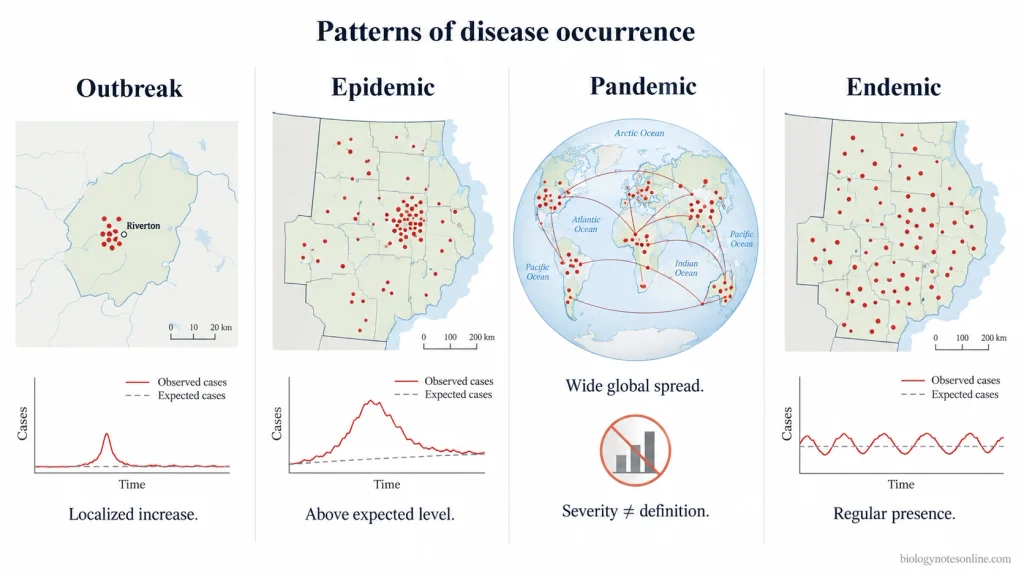
- Pandemic- An epidemic spreading across countries or continents and affecting a very wide geographic area and large populations.
- Epidemic– Disease cases increase above the normally expected level in a particular population, place, and time.
- Outbreak- A localized increase of disease above the expected level. The term may also be used similar to epidemic, mainly for a smaller or limited area.
- Endemic disease- Disease remains regularly or constantly present in a particular population or geographic area, usually around an expected level. Seasonal changes may occur.
How Pandemics Emerge and Spread
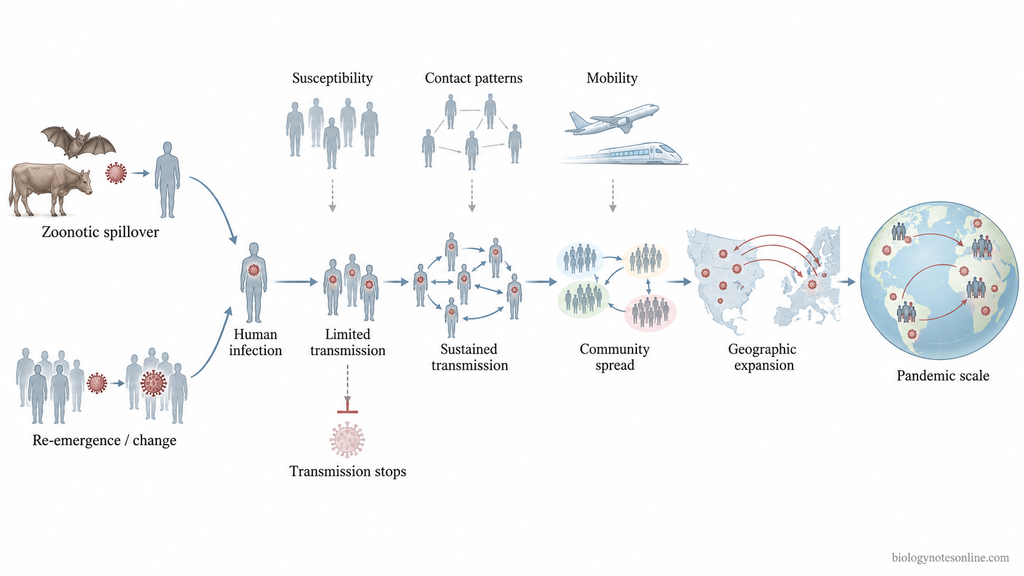
- Pandemics do not begin through one fixed route. A pathogen may newly enter humans from an animal source, while an existing human pathogen can re-emerge or change in ways that increase its spread.
- After emergence, the pathogen must infect susceptible people and pass onward. Many introductions remain as single cases or small clusters and do not develop further.
- Efficient human-to-human transmission is a critical step. It may already be present, or develop as the pathogen adapts and host or environmental conditions favour transmission.
- Once sustained transmission is established, chains of infection spread through communities and larger populations. Contact patterns and population susceptibility can affect how quickly this occurs.
- Travel and movement can carry the infection into distant regions. When sustained spread extends across countries or continents and involves large populations, it reaches a pandemic scale.
Pandemic Status and Transitions
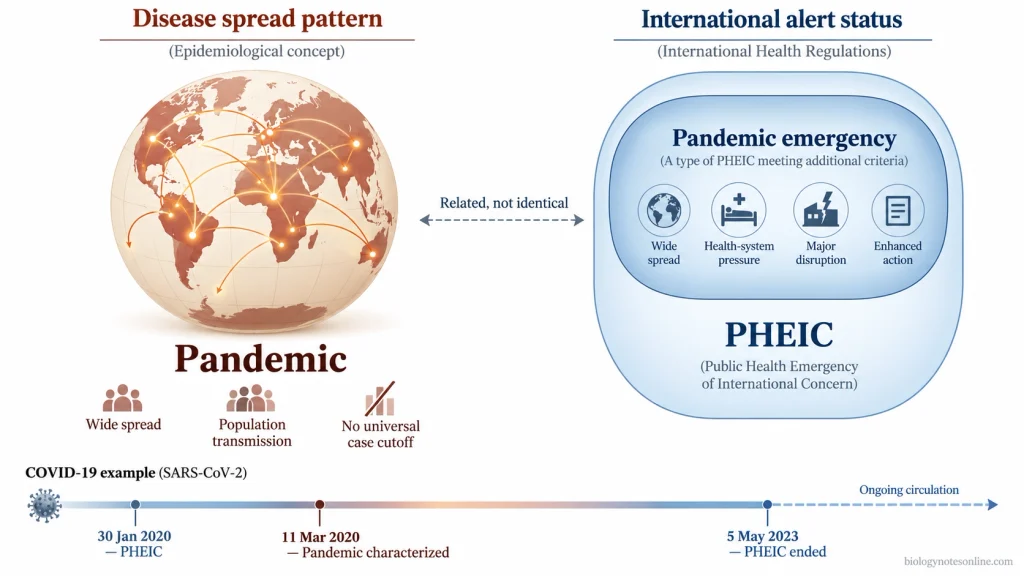
- Pandemic terminology is assessed from the epidemiological pattern of an infectious disease, especially its wide geographic spread and transmission across populations. It is not decided only from the total number of cases.
- There is no single numerical cut-off for every pandemic. Definitions remain largely qualitative, and no universally accepted quantitative threshold of cases or affected regions is used for all diseases.
- Pandemic patterns can change as transmission, population susceptibility and other epidemiological conditions change. The pathogen may still remain in circulation when the earlier emergency situation has passed.
- An emergency status is different from the epidemiological use of “pandemic”. Under the International Health Regulations (IHR), emergency categories are assessed using scientific evidence, international spread, risks to human health and the need for coordinated response.
- Ending an emergency designation means that the event no longer meets that emergency definition at that time. It does not mean that the pathogen has disappeared or the disease has been eradicated, as was also made clear when the COVID-19 Public Health Emergency of International Concern (PHEIC) ended in 2023.
Major Pandemics in History
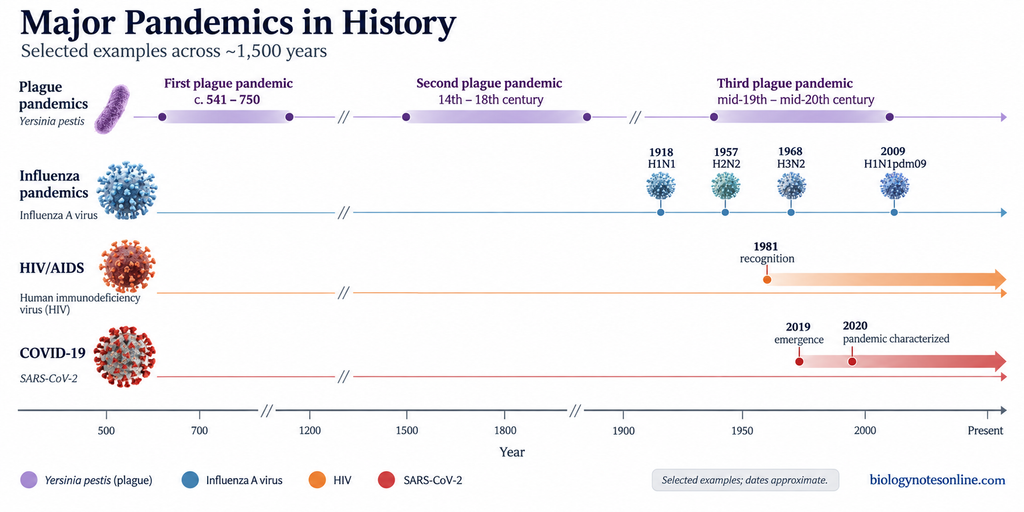
Some of the important pandemics recorded in human history are given below:
| Pandemic/disease | Pathogen | Approximate period | Geographic scope | Historical significance |
|---|---|---|---|---|
| Plague pandemics | Yersinia pestis | 541–750/767, 1346–18th century, and mid-19th–mid-20th century | Mediterranean, Europe and parts of Asia during earlier pandemics. The third pandemic spread worldwide. | Three major plague pandemics are historically recorded. These include the Plague of Justinian, the second pandemic associated with the “Black Death”, and the third plague pandemic. |
| Historical influenza pandemics | Influenza A(H1N1), A(H2N2) and A(H3N2) viruses | 1918–1920, 1957–1958 and 1968–1969 | Worldwide | The 1918 pandemic was the most destructive of the three 20th-century influenza pandemics. The later 1957 and 1968 pandemics were caused by different influenza A subtypes and also spread globally. |
| HIV/AIDS pandemic | Mainly HIV-1 group M | Recognized from 1981 onward | Worldwide, with particularly heavy burden in sub-Saharan Africa | AIDS was first recognized in 1981. HIV later developed into a worldwide pandemic and became a major long-term challenge for treatment, prevention and global health. |
| 2009 H1N1 influenza pandemic | Influenza A(H1N1)pdm09 virus | 2009–2010 | Worldwide | It was the first influenza pandemic of the 21st century. The virus spread rapidly and cases were reported from more than 200 countries and territories. |
| COVID-19 pandemic | SARS-CoV-2 | Emerged in 2019, pandemic declared in 2020 | Worldwide | SARS-CoV-2 emerged in late 2019 and spread extensively across the world. COVID-19 was declared a pandemic on March 11, 2020. |
Effects of Pandemics
- Health effects- Pandemics can produce widespread illness, deaths and sometimes long-term health problems. The burden can become very high when a large population is exposed.
- Healthcare disruption- A sudden rise in patients can put heavy pressure on hospitals, health workers, medicines and other medical supplies. Routine healthcare may also be affected during large pandemic waves.
- Economic effects- Illness, absence from work and changes in public behaviour can reduce economic activity. Trade, travel, businesses and employment may also be disturbed.
- Social effects- Pandemics can affect schooling, movement and normal social activities. Fear and stigma against particular groups may also develop during infectious-disease outbreaks.
- Unequal effects- The effects are not distributed equally. Populations with weaker health systems, fewer resources or existing social disadvantages can experience greater health and economic difficulties.
- Variable impact- Not every pandemic produces the same damage. Its effects depend on the pathogen, disease severity and transmission, the population affected, available healthcare, place and the period in which the pandemic occurs.
Future Pandemic Risk
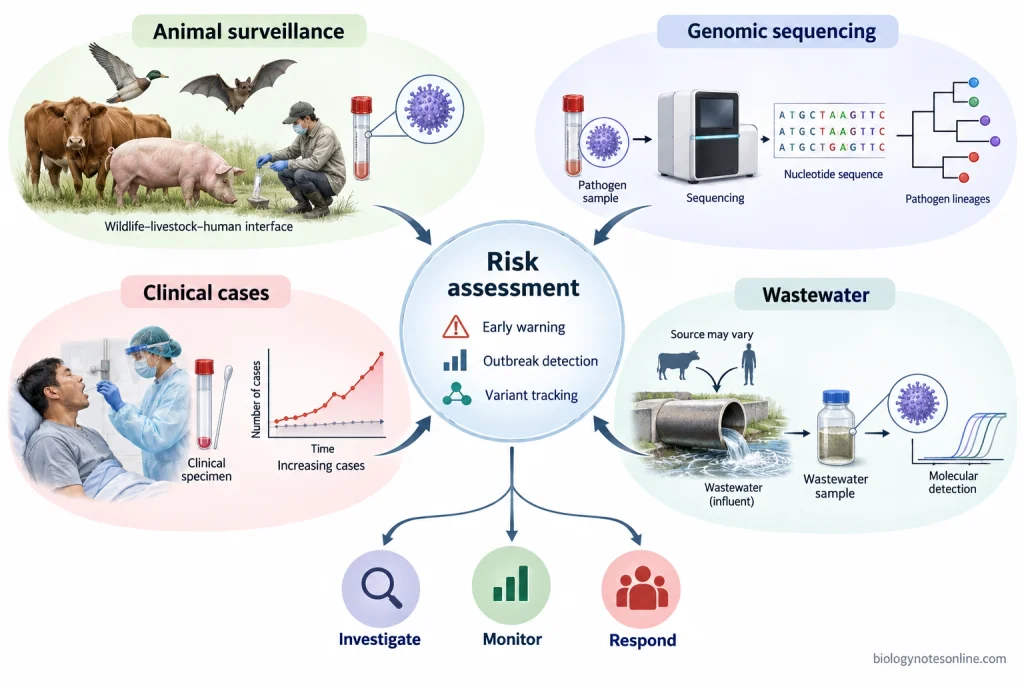
- Another pandemic- Another pandemic can occur in future, but its exact time, place, or pathogen cannot be predicted reliably. The exact nature of the next pandemic also remains uncertain.
- Spillover risk- Pathogens circulating in animals and infections appearing at the human-animal interface can be monitored. Most spillover events, however, stop without producing a pandemic.
- Early warning- Unusual disease clusters, increasing cases and other outbreak signals are watched through disease surveillance. Such systems can pick up a threat after signs begin to appear, rather than telling exactly when a future pandemic will start.
- Genomic surveillance- Genetic sequencing is used to detect new pathogens and follow changes in known ones. It can also track emerging variants and their spread through populations.
- Environmental surveillance- Wastewater can be checked for pathogens with pandemic potential and may detect early community transmission or spillover signals.
- Forecast limits- Scientists cannot reliably determine which emerging pathogen will develop efficient human-to-human transmission, when this change will occur, or whether an outbreak will finally spread to pandemic scale.
Pandemic at a Glance
| Feature | Quick summary |
|---|---|
| Definition | A pandemic is an epidemic of an infectious disease spreading across countries or continents and involving large populations. |
| Main defining feature | Very wide geographic spread with sustained transmission across populations. |
| Severity | High severity or mortality is not necessary. Geographic spread and disease severity are different concepts. |
| How it develops | A pathogen emerges or re-emerges, infects susceptible people, establishes efficient transmission and spreads into wider geographic areas. Not every pandemic follows exactly the same route. |
| Pandemic vs epidemic | An epidemic is disease occurrence above the expected level in a particular population or area. A pandemic extends across much wider geographic regions. |
| Pandemic vs outbreak | An outbreak is generally more localized and limited in scale. |
| Pandemic vs endemic | An endemic disease remains regularly present within a particular population or geographic area. |
| Pandemic status | There is no single numerical case threshold used for every disease. Spread pattern, population involvement and epidemiological conditions are considered. |
| Emergency status | Ending an emergency declaration does not mean the pathogen has disappeared or the disease is eradicated. |
| Major examples | Plague pandemics, 1918 influenza, 1957 and 1968 influenza, HIV/AIDS, 2009 H1N1 influenza and COVID-19. |
| Major effects | Widespread illness and deaths, pressure on healthcare, economic disruption, social effects and unequal burden among populations. |
| Future risk | Another pandemic can occur, but its exact pathogen, place and timing cannot be reliably predicted. Surveillance can detect emerging pathogens, unusual disease clusters and changes in transmission. |
Common Misconceptions about Pandemic
| Common misconception | Correct fact |
|---|---|
| A pandemic must cause very severe disease. | Pandemic mainly describes wide geographic spread. Disease severity can be mild, moderate, or severe. |
| A fixed number of cases makes a disease pandemic. | There is no universal numerical case cut-off for every disease. Geographic spread and sustained transmission are more important. |
| Every pandemic is caused by a completely new pathogen. | Some pandemics involve new pathogens or variants, but complete novelty is not required. |
| Every outbreak can become a pandemic. | Most outbreaks remain localized or disappear. Sustained and wider transmission is required for pandemic spread. |
| Pandemic and epidemic mean the same thing. | An epidemic occurs above the expected disease level in a population or area. A pandemic spreads across much wider geographic regions. |
| Endemic means the disease is harmless. | Endemic means a disease remains regularly present in a population or area. It does not describe disease severity. |
| Ending an emergency means the pandemic pathogen is gone. | An emergency declaration can end while the pathogen continues to circulate and cause disease. |
| Scientists can predict the next pandemic exactly. | Scientists can monitor emerging pathogens and transmission signals, but the exact pathogen, place, and timing cannot be reliably predicted. |
References
- Akande, O. W., Carter, L. L., Abubakar, A., Achilla, R., Barakat, A., Gumede, N., Guseinova, A., Inbanathan, F. Y., Kato, M., Koua, E., Leite, J., Marklewitz, M., Mendez-Rico, J., Monamele, C., Musul, B., Nahapetyan, K., Naidoo, D., Ochola, R., Ozel, M., … Samaan, G. (2023). Strengthening pathogen genomic surveillance for health emergencies: Insights from the World Health Organization’s regional initiatives. Frontiers in Public Health, 11, 1146730. https://doi.org/10.3389/fpubh.2023.1146730
- Al Hajjar, S., & McIntosh, K. (2010). The first influenza pandemic of the 21st century. Annals of Saudi Medicine, 30(1), 1–10. https://doi.org/10.4103/0256-4947.59365
- Arthi, V., & Parman, J. (2021). Disease, downturns, and wellbeing: Economic history and the long-run impacts of COVID-19. Explorations in Economic History, 79, 101381. https://doi.org/10.1016/j.eeh.2020.101381
- Barbieri, R., Signoli, M., Chevé, D., Costedoat, C., Tzortzis, S., Aboudharam, G., Raoult, D., & Drancourt, M. (2021). Yersinia pestis: The natural history of plague. Clinical Microbiology Reviews, 34(1), e00044-19. https://doi.org/10.1128/CMR.00044-19
- Cohen, M. S., Hellmann, N., Levy, J. A., DeCock, K., & Lange, J. (2008). The spread, treatment, and prevention of HIV-1: Evolution of a global pandemic. The Journal of Clinical Investigation, 118(4), 1244–1254. https://doi.org/10.1172/JCI34706
- Escudero-Pérez, B., Lalande, A., Mathieu, C., & Lawrence, P. (2023). Host–pathogen interactions influencing zoonotic spillover potential and transmission in humans. Viruses, 15(3), 599. https://doi.org/10.3390/v15030599
- Grassly, N. C., Shaw, A. G., & Owusu, M. (2025). Global wastewater surveillance for pathogens with pandemic potential: Opportunities and challenges. The Lancet Microbe, 6(1), 100939. https://doi.org/10.1016/j.lanmic.2024.07.002
- Institute of Medicine. (1992). Emerging infections: Microbial threats to health in the United States. National Academy Press. https://doi.org/10.17226/2008
- Institute of Medicine. (2009). Microbial evolution and co-adaptation: A tribute to the life and scientific legacies of Joshua Lederberg: Workshop summary. The National Academies Press. https://doi.org/10.17226/12586
- Institute of Medicine. (2010). The domestic and international impacts of the 2009-H1N1 influenza A pandemic: Global challenges, global solutions: Workshop summary. The National Academies Press. https://doi.org/10.17226/12799
- Kilbourne, E. D. (2006). Influenza pandemics of the 20th century. Emerging Infectious Diseases, 12(1), 9–14. https://doi.org/10.3201/eid1201.051254
- Krämer, A., Akmatov, M., & Kretzschmar, M. (2010). Principles of infectious disease epidemiology. In A. Krämer, M. Kretzschmar, & K. Krickeberg (Eds.), Modern infectious disease epidemiology: Concepts, methods, mathematical models, and public health (pp. 85–99). Springer. https://doi.org/10.1007/978-0-387-93835-6_5
- Madhav, N., Oppenheim, B., Gallivan, M., Mulembakani, P., Rubin, E., & Wolfe, N. (2017). Pandemics: Risks, impacts, and mitigation. In D. T. Jamison, H. Gelband, S. Horton, P. Jha, R. Laxminarayan, C. N. Mock, & R. Nugent (Eds.), Disease control priorities: Improving health and reducing poverty (3rd ed., pp. 315–345). The World Bank. https://doi.org/10.1596/978-1-4648-0527-1_ch17
- Morens, D. M., Folkers, G. K., & Fauci, A. S. (2009). What is a pandemic? The Journal of Infectious Diseases, 200(7), 1018–1021. https://doi.org/10.1086/644537
- Norzin, T., Ghiasbeglou, H., Patricio, M., Romanova, S., Zaghlool, A., Tanguay, F., & Zhao, L. (2023). Event-based surveillance: Providing early warning for communicable disease threats. Canada Communicable Disease Report, 49(2/3), 29–34. https://doi.org/10.14745/ccdr.v49i23a01
- Parker, N., Schneegurt, M., Thi Tu, A.-H., Lister, P., & Forster, B. M. (2016). Microbiology. OpenStax. https://openstax.org/books/microbiology/pages/1-introduction
- Sheahan, T. P., & Frieman, M. B. (2020). The continued epidemic threat of SARS-CoV-2 and implications for the future of global public health. Current Opinion in Virology, 40, 37–40. https://doi.org/10.1016/j.coviro.2020.05.010
- Singer, B. J., Thompson, R. N., & Bonsall, M. B. (2021). The effect of the definition of ‘pandemic’ on quantitative assessments of infectious disease outbreak risk. Scientific Reports, 11, 2547. https://doi.org/10.1038/s41598-021-81814-3
- Weiss, R. A., & Sankaran, N. (2022). Emergence of epidemic diseases: Zoonoses and other origins. Faculty Reviews, 11, 2. https://doi.org/10.12703/r/11-2