

What Is an Epidemic?
An epidemic is the occurrence of cases of a disease or another health-related event in a community or population at a level clearly higher than what is normally expected for that population, place, and period of time.
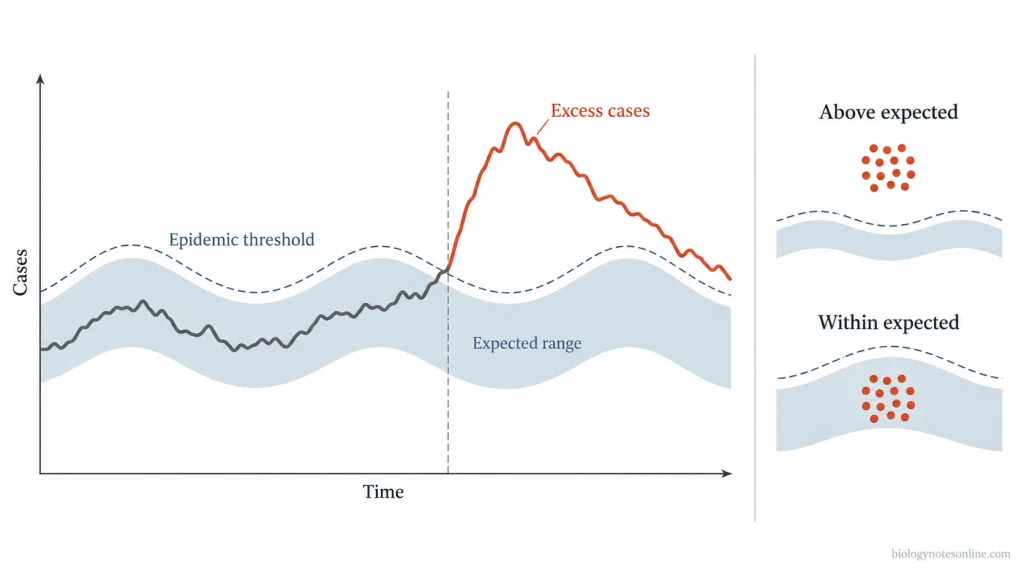
The important part of this definition is “above the expected level”. Expected occurrence is not a single fixed number that can be applied everywhere. It is based on the usual pattern of that particular disease, generally obtained from surveillance information collected from the same population or from a comparable population.
The number of cases must be considered along with the population, geographical area, and time. Ten cases may have very different epidemiological meaning in two different places. Even in the same place, ten cases occurring during different periods may not have the same meaning.
There is no universal number of cases after which every disease becomes an epidemic. Previous occurrence of the disease, population involved, place, and time are some of the important factors used for determining whether the observed number is unusual.
“Epidemic disease” is not a permanent group of diseases having some specific biological property. It describes how a disease is occurring within a particular population at that time.
A disease may occur at its usual or endemic level. Later, the same disease may occur epidemically when its frequency increases clearly above the expected level. Epidemic and endemic are patterns describing disease occurrence in populations.
Expected Disease Levels and Epidemic Thresholds
The baseline level is the usual amount of disease occurring in a population. Surveillance carried out over a period of time gives information about this usual occurrence. An increase in disease can then be compared with this baseline.
Baseline level does not always remain constant. In many infections, it changes according to season. Longer-term trends can also change what amount of disease is normally expected during a particular week, month, or year.
An epidemic threshold is a level above the baseline which is used to identify excess disease occurrence that may indicate epidemic activity.
Depending on the disease, these thresholds may be developed from historical surveillance data with statistical methods. Disease-specific public-health criteria can also be used. The epidemic threshold is not same for every infection or population.
Even surveillance systems monitoring the same disease may need locally calculated thresholds. The normal disease activity and its seasonal pattern can differ between populations and geographical areas.
The actual number of cases may sometimes be very small. If a disease is normally absent or extremely rare in a population, even a single case can be unusual enough to begin an epidemiological investigation.
For diseases that occur regularly, a much larger number of cases can still remain within its expected range. The threshold is related to the normal frequency of the particular disease, rather than only to a large-looking number of patients.
Who Determines Whether an Epidemic Is Occurring?
- Public-health surveillance systems provide the information used for detecting unusual occurrence of disease. Case reports, laboratory findings, rates, and their changes over time are monitored.
- Epidemiologists compare the observed disease pattern with its expected pattern. When an unusual signal is detected, diagnosis and reporting pattern may also be checked before considering the increase as a true epidemic event.
- Epidemiologists are particularly involved in collection and interpretation of surveillance information. They also alert the responsible health authorities when an unusual disease occurrence is detected.
- For diseases having an established alert or epidemic threshold, the surveillance value can be directly compared with that threshold.
- Other situations require epidemiological assessment because a simple numerical cut-off may not be available. In such conditions, the disease involved, population at risk, expected occurrence, laboratory evidence, and clustering according to place and time can become part of the investigation.
- Local and national public-health authorities use these information for recognition of the event and for deciding the required public-health response.
- The World Health Organization (WHO) has a broader international role. WHO provides technical guidance and terminology used in surveillance and outbreak work. It also carries out global detection, verification, and risk assessment of acute public-health events.
- Countries themselves are required to maintain surveillance capacities for detecting events occurring above expected levels. Relevant events are reported through their public-health systems.
- Under the International Health Regulations (IHR), national focal points notify WHO about events that may constitute a public health emergency of international concern. This role is different from WHO personally “declaring” every local epidemic occurring throughout the world.
What Causes an Epidemic?
An epidemic occurs when one or more conditions change enough to increase the occurrence of disease above its expected level in a particular population, place, and time. The cause is not always one factor. Changes in the disease agent, exposure, transmission, host susceptibility, and surrounding environment can act separately or several of them may work together.
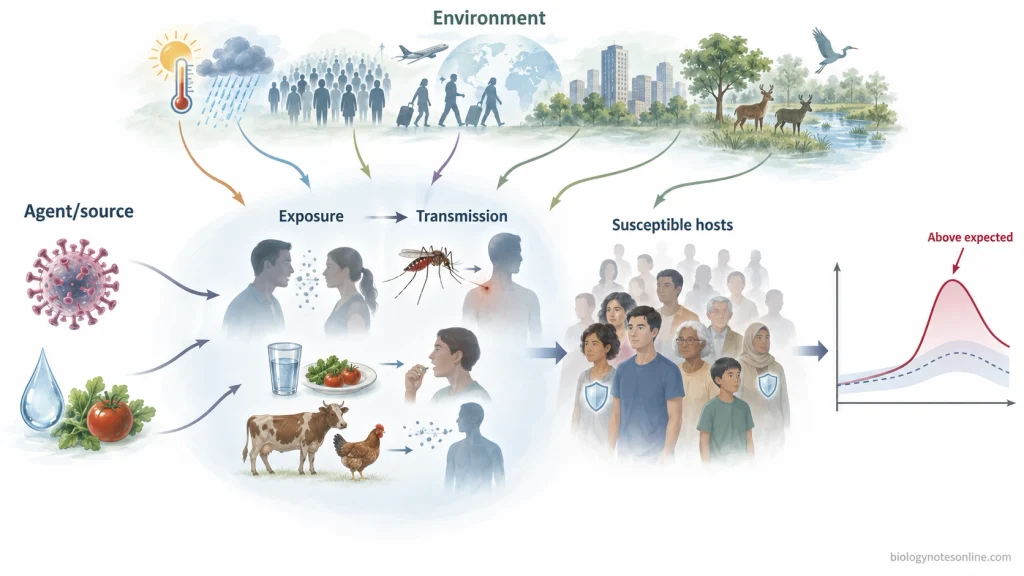
- Introduction of a new disease agent- An infectious agent can enter a population or geographical area where it was absent before. If enough susceptible hosts are present, infection can then spread. The source may be an infected person or animal, vector, contaminated food or water, or another environmental source.
- Changes in the disease-causing agent- An increase in the amount or dose of an agent can increase occurrence of disease. Changes in a pathogen may also affect its transmission, virulence, host range, or ability to escape existing immunity. Such changes do not occur in every epidemic.
- Increase in susceptible hosts- Epidemic spread is favored when a sufficient number of susceptible persons are available. Susceptibility can be high when a population has little previous immunity to an agent, or it can increase due to changes affecting the host response. Immunosuppression is one such condition.
- More effective transmission- Disease can rise when the agent gets passed on more efficiently from its source to susceptible hosts. Increased contact between people, crowding, changes in contact behavior, or higher exposure to vectors can produce such conditions. For infectious diseases, factors increasing contact rate, number of susceptible individuals, or infectiousness can increase disease spread.
- Increased exposure to the source- Sometimes the agent itself has not become new. More people simply come into contact with it. Changes in travel, occupation, human behavior, food or water contamination, and movement into new ecological areas can increase exposure. Changes that bring humans, animals, and disease vectors into closer contact may also open up new opportunities for infection.
- Environmental and population changes- Temperature and humidity can affect survival and transmission of some pathogens, while seasonal conditions can alter the abundance and distribution of vectors. Population density, urbanization, land-use change, movement of people, and globalization can modify the host-agent-environment interaction. Several of these conditions may operate at the same time.
- Common-source exposure- A group of people may be exposed to the same contaminated food, water, air, or other source within a short or extended period. Epidemic occurrence is not limited only to person-to-person spread. Some outbreaks are produced by noninfectious agents also, including toxins and chemicals present in a shared exposure source.
Types of Epidemics
Epidemics can be classified according to the way exposure occurs and how the disease spreads through a population. The following are the major types-
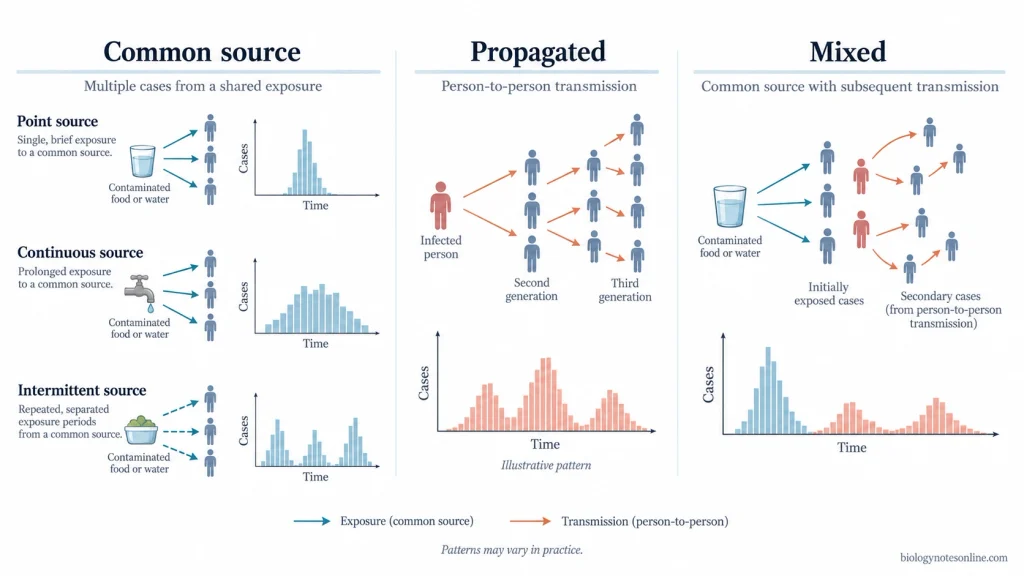
- Common-source epidemic- A common-source epidemic occurs when a group of people are exposed to the same source of disease or harmful agent. The source can be contaminated food, water, air, chemicals, or another common exposure. Depending on the duration and pattern of exposure, it can be of three types.
- a) Point-source epidemic- It results from a single or brief exposure to a common source. People are usually exposed around the same period, and the cases develop within approximately one incubation period of the disease. A rapid rise followed by decline is commonly seen in its epidemic curve.
- b) Continuous common-source epidemic- In this type, exposure to the source continues for an extended period. New cases keep coming up as long as susceptible persons remain exposed. The epidemic curve is therefore spread over a longer period rather than forming one narrow peak.
- c) Intermittent common-source epidemic- Exposure occurs at irregular intervals instead of continuously. Cases may appear in separated groups or irregular peaks. Contamination of a source that occurs from time to time can produce this pattern.
- Propagated epidemic- It is also called a progressive epidemic. The disease is transmitted from an infected individual to another susceptible individual, directly or indirectly. Secondary and later generations of cases are produced, so the epidemic curve may show successive waves. Person-to-person transmission is a common form, although transmission can involve other routes depending on the infectious agent.
- Mixed epidemic- A mixed epidemic contains features of both common-source and propagated epidemics. It may begin when several persons become infected from one common source. Some of these infected persons then pass the infection to other individuals, producing secondary cases after the initial common-source cases. Food-borne infectious outbreaks can sometimes develop in this manner.
How Epidemics Are Detected and Investigated
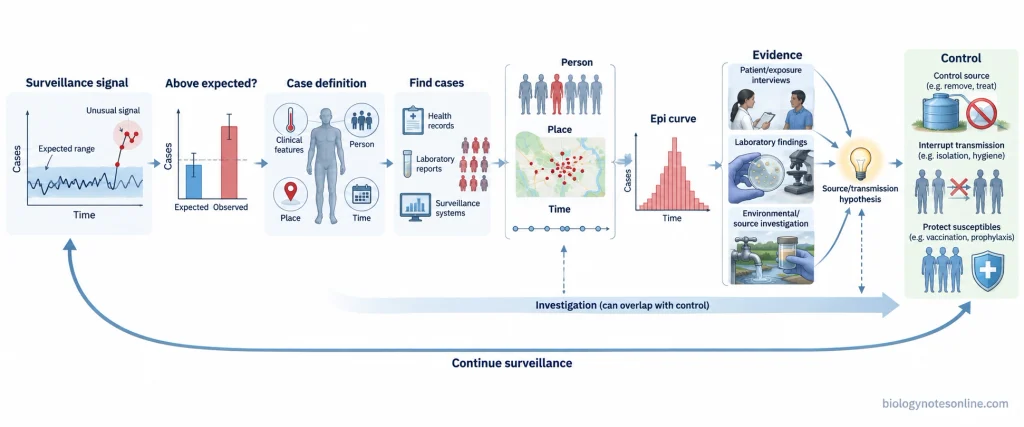
Epidemics are usually detected from surveillance information when the number or pattern of disease cases becomes unusual for a population. From this initial signal, epidemiologists investigate the cases to determine the magnitude, time of occurrence, affected population, possible source, and mode of spread.
Surveillance and the Expected Baseline
- Disease surveillance- Surveillance systems continuously collect and analyze information about diseases occurring in a population. The observed cases are compared with the previous or expected occurrence of that disease. A sudden increase can give the first signal for investigation. Changes in reporting, diagnostic testing, or population size are also checked, because these can produce an apparent increase without a true epidemic.
- Expected baseline- The baseline represents the usual level or pattern of disease recorded from earlier surveillance. For seasonal diseases, this level can rise and fall during different parts of the year. Historical data are commonly used for working out such expected patterns.
- Some diseases have a defined alert or epidemic threshold. When surveillance values cross the alert threshold, investigation or preparedness may be started, while an epidemic threshold can trigger a stronger public-health response. The threshold is disease and population specific, and different methods are used for calculating it. Influenza surveillance, for example, can use historical baseline activity to estimate the beginning of epidemic activity.
Defining and Counting Cases
- Case definition- A case definition is prepared so that investigators have the same criteria for deciding who will and will not be counted as a case. It commonly includes clinical findings, laboratory evidence when available, and epidemiological limits involving person, place, and time.
- Early in an investigation, the definition may be relatively broad to pick up possible cases. As more information becomes available, it can be modified and made more specific. The same current definition should be applied consistently to the persons being investigated.
- Cases meeting the definition are then counted and additional cases are searched for. This gives a better estimate of how large the epidemic is rather than depending only on the cases that first attracted attention. Clinical records, laboratory reports and other surveillance records can be used during this case finding.
Describing Cases by Person, Place, and Time
- Person- The cases are examined according to characteristics of affected individuals, such as age, sex, occupation, residence, or another characteristic relevant to the disease. Differences between groups may give clues about which population had greater exposure or risk.
- Place- Investigators look at where the cases live, work, visited, or were exposed. Cases may be plotted on a map to identify geographical clustering. A concentration around a particular location can bring up a possible common exposure for further investigation, but the geographical pattern alone does not establish the cause.
- Time- Date and, where needed, time of illness onset are recorded. This establishes when cases began appearing and whether they occurred close together or over a longer period. With person and place information, the time pattern is used for developing hypotheses about exposure and transmission.
Epidemic Curves
- An epidemic curve (epi curve) is a graphical presentation of cases according to the time of illness onset. Usually, time is shown on the x-axis and number of cases on the y-axis. It gives information about the magnitude and timing of an epidemic, its peaks, unusual cases or “outliers”, and the possible period in which exposure occurred.
- In a point-source epidemic, persons are exposed over a relatively brief period. Cases tend to cluster closely in time and commonly appear within about one incubation period. A sharp rise and concentrated peak can be seen.
- With a continuous common-source epidemic, exposure continues for a longer time. New cases can therefore occur across an extended period instead of being packed around a single narrow peak.
- A propagated epidemic involves spread through successive transmission, commonly from one infected person to another susceptible person. Several waves or successive peaks may develop as secondary and later cases occur.
- The shape of an epi curve gives clues about the source and mode of spread, but it is not proof of either one. Case interviews, laboratory findings, exposure histories, environmental investigation, and analytical epidemiological studies can be required to test the hypothesis produced from these patterns.
Examples of Epidemics
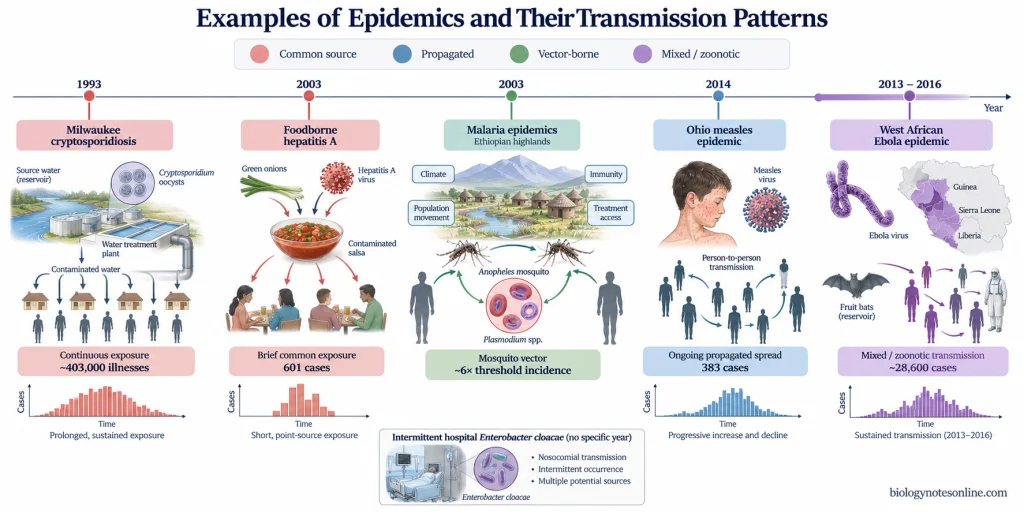
Epidemics do not all develop in the same manner. Some begin from one contaminated source, some continue through person-to-person transmission, while others depend on vectors, animals, or more than one route of transmission.
Common-Source Epidemic Examples
- Foodborne hepatitis A epidemic- In 2003, a large outbreak of hepatitis A occurred among people who had eaten at a restaurant in Pennsylvania. 601 cases were identified. Most affected patrons had eaten there during October 3 to 6, and epidemiological investigation strongly linked illness with contaminated green onions used in foods, particularly mild salsa. This represents a short common-source exposure because many persons received the infectious agent from the same contaminated food over a brief period compared with the incubation period of hepatitis A.
- Milwaukee cryptosporidiosis epidemic- A large waterborne epidemic occurred in Milwaukee, Wisconsin, during 1993. Cryptosporidium oocysts passed through one municipal water-treatment plant, and about 403,000 people were estimated to develop outbreak-associated watery diarrhea. Contaminated water was supplied for a period rather than being one single meal or exposure. It is an example of prolonged or continuous common-source exposure.
- Intermittent common-source exposure- In some epidemics the contaminated source becomes available only from time to time, so cases come up irregularly. A prolonged hospital outbreak involving OXA-48-producing Enterobacter cloacae affected 41 patients and was linked by genomic investigation to the hospital water environment, particularly contaminated shower drains. It was described as an intermittent common-source outbreak.
Propagated Epidemic Examples
- Measles epidemic- Measles gives a clear example of a propagated epidemic because an infected person can pass the virus to other susceptible persons and new generations of cases are then formed. During a 2014 outbreak in an underimmunized Amish community in Ohio, two unvaccinated men returned from the Philippines while incubating measles. 383 outbreak-related cases were reported, and most transmission took place within households. Around 89% of the cases were unvaccinated.
- The spread in a propagated epidemic is therefore different from people becoming ill after drinking the same contaminated water or eating one contaminated food. Each infected host can become a new source for further transmission. Measles outbreaks in other populations have also been strongly associated with contact with measles cases and lack of vaccination.
Mixed, Vector-Borne, or Zoonotic Examples
- West African Ebola epidemic- Ebola shows how the transmission of a real epidemic can be more complex. The 2013-2016 West African epidemic was traced to a probable zoonotic introduction into a human index case. After this initial spillover, the epidemic was maintained mainly by human-to-human transmission through direct contact with infected persons, body fluids, or contaminated materials.Molecular studies showed extensive transmission chains across Guinea, Liberia, and Sierra Leone. The initial animal-to-human event and the later propagated human transmission are different parts of the same epidemic process.
- Malaria epidemics- Malaria is transmitted through Anopheles mosquito vectors, so its epidemic pattern cannot be explained by direct person-to-person contact. Malaria epidemics were documented in the Ethiopian highlands in 2003, where disease incidence in studied epidemic areas reached on average about six times the threshold level. Changes affecting mosquito transmission, climate, immunity, population movement, and treatment can influence epidemic malaria in highland areas.
Is There a Fixed List of “Epidemic Diseases”?
- No. “Epidemic disease” is not a permanent biological class containing a fixed list of diseases. An epidemic is identified when disease occurrence in a defined community or population becomes clearly greater than its normal or expected occurrence for that place and time.
- Measles, malaria, influenza, cholera, or another disease should not always be labelled an “epidemic disease” simply because it has produced epidemics before. The same disease may occur at its usual level in one population and become epidemic in another population, or in the same population at another period, when the number of cases rises above what is expected. The number required for an epidemic also varies according to the disease and its previous pattern of occurrence.
How Epidemics Are Controlled and Prevented
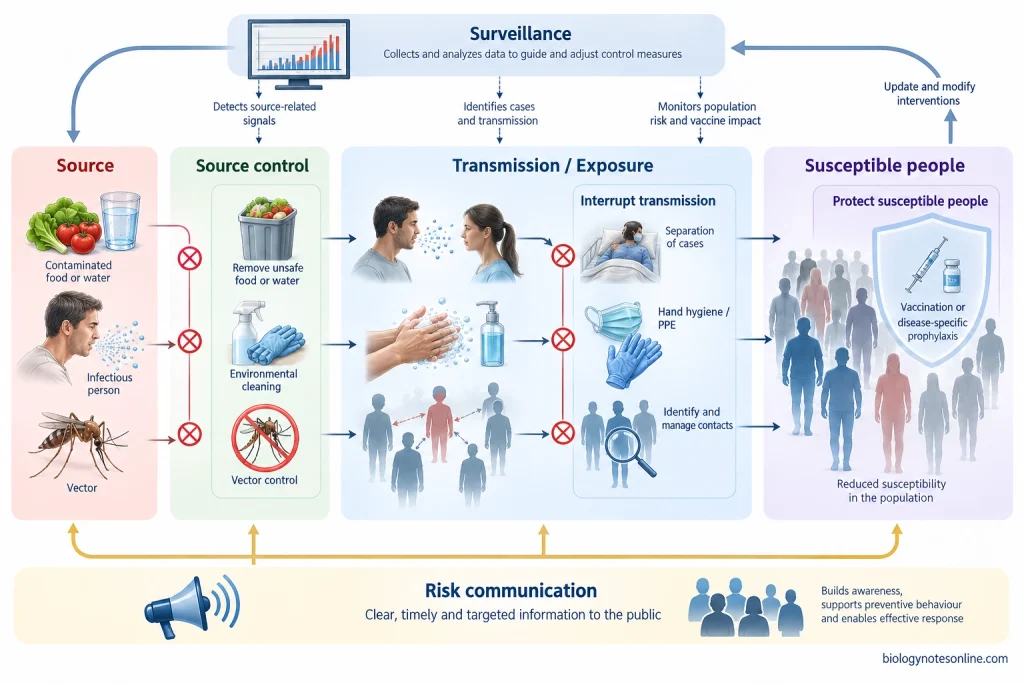
The measures used for controlling an epidemic depend on the source, route of transmission, causative agent, and susceptible population. Control measures are not same for all epidemics.
Controlling the Source or Exposure
- Contaminated food or water- Contaminated food is removed from use or recalled. Unsafe water can be treated, disinfected, or replaced with a safe water supply.
- Environmental control- Cleaning and disinfection are used when environment acts as a source. Safe food handling and correction of sewage or water-treatment failure may also be required.
- Vector control- In vector-borne epidemics, mosquitoes or other vectors are controlled. Removal of breeding sites, larval control, insecticides, treated nets, and environmental management are some of the measures used.
Interrupting Transmission
- Isolation- Infectious cases are separated from susceptible persons where isolation can reduce the spread. It is disease specific.
- Infection-control measures- Hand hygiene, disinfection, respiratory precautions, PPE, and safe handling of contaminated materials are used according to the route of transmission.
- Contact management- Contacts are traced and followed. Depending on the disease, they may be monitored or tested. Vaccination, prophylaxis, or quarantine may also be used.
Protecting Susceptible Populations
- Vaccination- Vaccination is used to reduce the number of susceptible persons. During an epidemic, vaccines may be given to contacts, unvaccinated groups, or high-risk populations.
- Some vaccines can also be given after exposure. Examples include measles, hepatitis A, and varicella vaccines.
- Prophylaxis- Drugs, immunoglobulins, vaccines, etc. may be given to exposed persons where applicable. The type of prophylaxis used depends on the disease.
Surveillance and Public-Health Communication
- Continued surveillance- New cases are continuously detected and recorded. Their number, place, and affected groups are monitored.
- Checking control measures- If cases continue to come up, the source may still be present. Another route of transmission may also have been missed.
- Public-health communication- People are informed about the route of spread, risk, and required preventive measures. It may include vaccination, hygiene, avoiding contaminated sources, or seeking medical care.
Epidemics at a Glance – Quick Summary
| Topic | Quick Summary |
|---|---|
| Epidemic | Occurrence of disease above the expected level in a particular population, place, and time. |
| Expected level | Usual or baseline occurrence of a disease in that population. |
| Epidemic threshold | Disease-specific level above which occurrence may be considered unusually high. |
| Fixed case number | No fixed number. It depends on the disease, population, place, and usual occurrence. |
| Major causes | Increased exposure, transmission, susceptible population, changes in agent, or environmental conditions. Several factors may act together. |
| Common-source epidemic | People are exposed to the same source, e.g., contaminated food or water. |
| Point-source epidemic | Exposure occurs once or within a short period. Cases usually appear close together. |
| Continuous-source epidemic | Exposure continues for a longer period and cases continue to occur. |
| Intermittent-source epidemic | Exposure occurs irregularly, producing separated groups or peaks of cases. |
| Propagated epidemic | Disease spreads from infected individuals to susceptible persons, producing successive cases or waves. |
| Mixed epidemic | Begins from a common source and later continues by person-to-person spread. |
| Detection | Surveillance identifies an unusual increase above the expected baseline. |
| Case definition | Standard criteria used to identify and count cases consistently. |
| Person, place, time | Shows who is affected, where cases occur, and when illness began. |
| Epidemic curve | Graph of cases according to time of illness onset. It helps study magnitude, timing, exposure period, and pattern of spread. |
| Source control | Removal of contaminated food or water, environmental cleaning, or vector control where required. |
| Interrupting transmission | Isolation, infection-control measures, and contact management according to the disease. |
| Protecting susceptible people | Vaccination, prophylaxis, immunoglobulins, or other disease-specific protection. |
| Surveillance during control | New cases are continuously monitored to check whether control measures are working. |
| Public-health communication | Provides practical information about risk, transmission, and required preventive measures. |
| Examples | Foodborne outbreaks, cholera outbreaks, measles epidemics, malaria epidemics, and Ebola epidemics. |
| “Epidemic disease” | Not a permanent class of disease. A disease becomes epidemic when its occurrence exceeds the expected level in a particular epidemiological setting. |
Common Misconceptions about Epidemics – Quick Summary
| Misconception | Correct Idea |
|---|---|
| An epidemic means a very large number of cases. | Not always. Even a small number can be epidemic if it is clearly above the expected level. |
| There is a fixed case number for declaring an epidemic. | No fixed number. It depends on the disease, population, place, time, and usual occurrence. |
| Only infectious diseases cause epidemics. | Epidemics can involve infectious diseases and other health events, including toxic or environmental exposures. |
| Every epidemic spreads from person to person. | No. Some are caused by a common source, such as contaminated food or water. |
| All epidemics have one single cause. | Several factors may act together, such as increased exposure, transmission, susceptibility, or environmental change. |
| “Epidemic disease” is a fixed group of diseases. | It is not a permanent disease class. A disease is epidemic only in a particular epidemiological setting when occurrence exceeds the expected level. |
| Measles, cholera, influenza, or malaria are always epidemic diseases. | These diseases may occur at endemic, sporadic, or epidemic levels depending on place and time. |
| WHO declares every epidemic worldwide. | Local and national public-health authorities detect and manage many epidemics. WHO provides international guidance, surveillance support, and coordination where required. |
| Crossing an epidemic threshold proves the source of disease. | A threshold indicates unusual occurrence. The source and mode of spread still need investigation. |
| An epidemic curve proves how an outbreak started. | It gives clues about timing and transmission pattern, but does not prove the source by itself. |
| One control method works for every epidemic. | Control depends on the agent, source, transmission route, and susceptible population. |
| An epidemic ends as soon as cases begin to fall. | Surveillance is continued to check for new cases and confirm that transmission or exposure has been controlled. |
References
- Aitken, C., & Jeffries, D. J. (2001). Nosocomial spread of viral disease. Clinical Microbiology Reviews, 14(3), 528–546. https://doi.org/10.1128/CMR.14.3.528-546.2001
- Albert, V., Ramamurthy, T., Das, S., Dolma, K. G., Majumdar, T., Baruah, P. J., Hazarika, S. C., Apum, B., & Das, M. (2024). Comprehending the risk of foodborne and waterborne disease outbreaks: Current situation and control measures with special reference to the Indian scenario. Heliyon, 10(16), e36344. https://doi.org/10.1016/j.heliyon.2024.e36344
- Behera, B. K., Prasad, R., & Behera, S. (2022). Public health and management. In Healthcare strategies and planning for social inclusion and development: Volume 1: Health for all—Challenges and opportunities in healthcare management (pp. 1–40). Academic Press. https://doi.org/10.1016/B978-0-323-90446-9.00001-0
- Benelli, G., Jeffries, C. L., & Walker, T. (2016). Biological control of mosquito vectors: Past, present, and future. Insects, 7(4), 52. https://doi.org/10.3390/insects7040052
- Brachman, P. S. (1996). Epidemiology. In S. Baron (Ed.), Medical microbiology (4th ed., Chapter 9). University of Texas Medical Branch at Galveston. https://www.ncbi.nlm.nih.gov/books/NBK7993/
- Curran, E. T. (2018). Outbreak column 22: How to manage an outbreak. Journal of Infection Prevention, 19(5), 244–251. https://doi.org/10.1177/1757177417739682
- Dudas, G., Carvalho, L. M., Bedford, T., Tatem, A. J., Baele, G., Faria, N. R., Park, D. J., Ladner, J. T., Arias, A., Asogun, D., Bielejec, F., Caddy, S. L., Cotten, M., D’Ambrozio, J., Dellicour, S., Di Caro, A., Diclaro, J. W., II, Duraffour, S., Elmore, M. J., . . . Rambaut, A. (2017). Virus genomes reveal factors that spread and sustained the Ebola epidemic. Nature, 544(7650), 309–315. https://doi.org/10.1038/nature22040
- Evans, A. S. (2009). Epidemiological concepts. In P. S. Brachman & E. Abrutyn (Eds.), Bacterial infections of humans: Epidemiology and control (pp. 1–50). Springer. https://doi.org/10.1007/978-0-387-09843-2_1
- Gallagher, T., & Lipsitch, M. (2019). Postexposure effects of vaccines on infectious diseases. Epidemiologic Reviews, 41(1), 13–27. https://doi.org/10.1093/epirev/mxz014
- Gastañaduy, P. A., Budd, J., Fisher, N., Redd, S. B., Fletcher, J., Miller, J., McFadden, D. J., III, Rota, J., Rota, P. A., Hickman, C., Fowler, B., Tatham, L., Wallace, G. S., de Fijter, S., Fiebelkorn, A. P., & DiOrio, M. (2016). A measles outbreak in an underimmunized Amish community in Ohio. The New England Journal of Medicine, 375(14), 1343–1354. https://doi.org/10.1056/NEJMoa1602295
- Gastañaduy, P. A., Banerjee, E., DeBolt, C., Bravo-Alcántara, P., Samad, S. A., Pastor, D., Rota, P. A., Patel, M., Crowcroft, N. S., & Durrheim, D. N. (2018). Public health responses during measles outbreaks in elimination settings: Strategies and challenges. Human Vaccines & Immunotherapeutics, 14(9), 2222–2238. https://doi.org/10.1080/21645515.2018.1474310
- Girmay, A., & Dadi, A. F. (2019). Being unvaccinated and having a contact history increased the risk of measles infection during an outbreak: A finding from measles outbreak investigation in rural district of Ethiopia. BMC Infectious Diseases, 19, 345. https://doi.org/10.1186/s12879-019-3973-8
- Hall, A. J., Wikswo, M. E., Manikonda, K., Roberts, V. A., Yoder, J. S., & Gould, L. H. (2013). Acute gastroenteritis surveillance through the National Outbreak Reporting System, United States. Emerging Infectious Diseases, 19(8), 1305–1309. https://doi.org/10.3201/eid1908.130482
- Hollingsworth, T. D. (2009). Controlling infectious disease outbreaks: Lessons from mathematical modelling. Journal of Public Health Policy, 30(3), 328–341. https://doi.org/10.1057/jphp.2009.13
- Institute of Medicine & National Research Council. (2003). The science of public health surveillance. In Scientific criteria to ensure safe food (pp. 28–68). National Academies Press. https://doi.org/10.17226/10690
- Jacob, S. T., Crozier, I., Fischer, W. A., II, Hewlett, A., Kraft, C. S., de La Vega, M.-A., Soka, M. J., Wahl, V., Griffiths, A., Bollinger, L., & Kuhn, J. H. (2020). Ebola virus disease. Nature Reviews Disease Primers, 6, Article 13. https://doi.org/10.1038/s41572-020-0147-3
- Khan, A. S., Amara, P. S., & Morse, S. A. (2020). Forensic public health: Epidemiological and microbiological investigations for biosecurity. In B. Budowle, S. E. Schutzer, & S. A. Morse (Eds.), Microbial forensics (3rd ed., pp. 105–122). Academic Press. https://doi.org/10.1016/B978-0-12-815379-6.00008-8
- Kuehne, A., Keating, P., Polonsky, J., Haskew, C., Schenkel, K., Le Polain de Waroux, O., & Ratnayake, R. (2019). Event-based surveillance at health facility and community level in low-income and middle-income countries: A systematic review. BMJ Global Health, 4(6), e001878. https://doi.org/10.1136/bmjgh-2019-001878
- Kumar, G., Baharia, R., Singh, K., Gupta, S. K., Joy, S., Sharma, A., & Rahi, M. (2024). Addressing challenges in vector control: A review of current strategies and the imperative for novel tools in India’s combat against vector-borne diseases. BMJ Public Health, 2(1), e000342. https://doi.org/10.1136/bmjph-2023-000342
- Kurup, K. K., John, D., Ponnaiah, M., & George, T. (2019). Use of systematic epidemiological methods in outbreak investigations from India, 2008–2016: A systematic review. Clinical Epidemiology and Global Health, 7(4), 648–653. https://doi.org/10.1016/j.cegh.2019.02.010
- Lindahl, J. F., & Grace, D. (2015). The consequences of human actions on risks for infectious diseases: A review. Infection Ecology & Epidemiology, 5(1), 30048. https://doi.org/10.3402/iee.v5.30048
- Mac Kenzie, W. R., Hoxie, N. J., Proctor, M. E., Gradus, M. S., Blair, K. A., Peterson, D. E., Kazmierczak, J. J., Addiss, D. G., Fox, K. R., Rose, J. B., & Davis, J. P. (1994). A massive outbreak in Milwaukee of Cryptosporidium infection transmitted through the public water supply. The New England Journal of Medicine, 331(3), 161–167. https://doi.org/10.1056/NEJM199407213310304
- Mandl, K. D., Overhage, J. M., Wagner, M. M., Lober, W. B., Sebastiani, P., Mostashari, F., Pavlin, J. A., Gesteland, P. H., Treadwell, T., Koski, E., Hutwagner, L., Buckeridge, D. L., Aller, R. D., & Grannis, S. (2004). Implementing syndromic surveillance: A practical guide informed by the early experience. Journal of the American Medical Informatics Association, 11(2), 141–150. https://doi.org/10.1197/jamia.M1356
- Mathieu, E., & Sodahlon, Y. (2008). Epidemic investigation. In H. K. Heggenhougen (Ed.), International encyclopedia of public health (pp. 401–413). Academic Press. https://doi.org/10.1016/B978-012373960-5.00183-0
- Mathieu, E., & Sodahlon, Y. (2017). Epidemic investigation. In S. R. Quah (Ed.), International encyclopedia of public health (2nd ed., pp. 518–529). Academic Press. https://doi.org/10.1016/B978-0-12-803678-5.00137-5
- National Academies of Sciences, Engineering, and Medicine. (2020). Evidence-based practice for public health emergency preparedness and response. National Academies Press. https://doi.org/10.17226/25650
- Negash, K., Kebede, A., Medhin, A., Argaw, D., Babaniyi, O., Guintran, J. O., & Delacollette, C. (2005). Malaria epidemics in the highlands of Ethiopia. East African Medical Journal, 82(4), 186–192. https://doi.org/10.4314/eamj.v82i4.9279
- Nurjadi, D., Scherrer, M., Frank, U., Mutters, N. T., Heininger, A., Späth, I., Eichel, V. M., Jabs, J., Probst, K., Müller-Tidow, C., Brandt, J., Heeg, K., & Boutin, S. (2021). Genomic investigation and successful containment of an intermittent common source outbreak of OXA-48-producing Enterobacter cloacae related to hospital shower drains. Microbiology Spectrum, 9(3), e01380-21. https://doi.org/10.1128/Spectrum.01380-21
- Procházka, B., & Kynčl, J. (2015). Estimating the baseline and threshold for the incidence of diseases with seasonal and long-term trends. Central European Journal of Public Health, 23(4), 352–359. https://doi.org/10.21101/cejph.a4392
- Reintjes, R., & Zanuzdana, A. (2010). Outbreak investigations. In A. Krämer, M. Kretzschmar, & K. Krickeberg (Eds.), Modern infectious disease epidemiology: Concepts, methods, mathematical models, and public health (pp. 159–176). Springer. https://doi.org/10.1007/978-0-387-93835-6_9
- Schiavo, R., Leung, M. M., & Brown, M. (2014). Communicating risk and promoting disease mitigation measures in epidemics and emerging disease settings. Pathogens and Global Health, 108(2), 76–94. https://doi.org/10.1179/2047773214Y.0000000127
- Straif-Bourgeois, S., Ratard, R., & Kretzschmar, M. (2014). Infectious disease epidemiology. In I. Pigeot & W. Ahrens (Eds.), Handbook of epidemiology (2nd ed., pp. 2041–2119). Springer. https://doi.org/10.1007/978-0-387-09834-0_34
- Telisinghe, L., Waite, T. D., Gobin, M., Ronveaux, O., Fernandez, K., Stuart, J. M., & Scholten, R. J. P. M. (2015). Chemoprophylaxis and vaccination in preventing subsequent cases of meningococcal disease in household contacts of a case of meningococcal disease: A systematic review. Epidemiology and Infection, 143(11), 2259–2268. https://doi.org/10.1017/S0950268815000849
- Thayer, M. B., Marzan-Rodriguez, M., Torres Aponte, J., Rivera, A., Rodriguez, D. M., Rysava, K., Paz-Bailey, G., Adams, L. E., & Johansson, M. A. (2025). Dengue epidemic alert thresholds for surveillance and decision-making in Puerto Rico: Development and prospective application of an early warning system using routine surveillance data. BMJ Open, 15(9), e106182. https://doi.org/10.1136/bmjopen-2025-106182
- Tulchinsky, T. H., & Varavikova, E. A. (2014). Communicable diseases. In The new public health (3rd ed., pp. 149–236). Academic Press. https://doi.org/10.1016/B978-0-12-415766-8.00004-5
- Ungchusak, K., Heymann, D., & Pollack, M. (2019). Public health surveillance: A vital alert and response function. In S. B. Macfarlane & C. AbouZahr (Eds.), The Palgrave handbook of global health data methods for policy and practice (pp. 183–203). Palgrave Macmillan. https://doi.org/10.1057/978-1-137-54984-6_10
- van Seventer, J. M., & Hochberg, N. S. (2017). Principles of infectious diseases: Transmission, diagnosis, prevention, and control. In S. R. Quah (Ed.), International encyclopedia of public health (2nd ed., pp. 22–39). Academic Press. https://doi.org/10.1016/B978-0-12-803678-5.00516-6
- Vaughan, J. P., Victora, C., & Chowdhury, A. M. R. (2021). Outbreaks and epidemics. In Practical epidemiology: Using epidemiology to support primary health care (pp. 73–92). Oxford University Press. https://doi.org/10.1093/med/9780192848741.003.0006
- Vega, T., Lozano, J. E., Meerhoff, T., Snacken, R., Mott, J., Ortiz de Lejarazu, R., & Nunes, B. (2013). Influenza surveillance in Europe: Establishing epidemic thresholds by the moving epidemic method. Influenza and Other Respiratory Viruses, 7(4), 546–558. https://doi.org/10.1111/j.1750-2659.2012.00422.x
- Weinberg, J. (2005). Surveillance and control of infectious diseases at local, national and international levels. Clinical Microbiology and Infection, 11(Suppl. 1), 12–14. https://doi.org/10.1111/j.1469-0691.2005.01083.x
- Wheeler, C., Vogt, T. M., Armstrong, G. L., Vaughan, G., Weltman, A., Nainan, O. V., Dato, V., Xia, G., Waller, K., Amon, J., Lee, T. M., Highbaugh-Battle, A., Hembree, C., Evenson, S., Ruta, M. A., Williams, I. T., Fiore, A. E., & Bell, B. P. (2005). An outbreak of hepatitis A associated with green onions. The New England Journal of Medicine, 353(9), 890–897. https://doi.org/10.1056/NEJMoa050855