

Algae are simple, mostly aquatic and photosynthetic organisms. They contain chlorophyll and prepare their own food. During photosynthesis oxygen is released by them.
The plant body of algae is simple. It is not divided into true root, stem and leaves. Flowers are also absent. Such simple body is called thallus.
Algae show much variation in size. Some are microscopic and unicellular forms, called microalgae. Some are large multicellular forms, such as seaweeds and kelps. Some kelps may grow several meters long.
Algae are mainly found in water. They occur in oceans, lakes, ponds and rivers. Some algae also grow on damp soil, snow and moist places.
Some algae live with other organisms. Algae with fungi form lichens. This is a symbiotic association.
Algae are very important in aquatic habitat. They form the base of food chain. They use sunlight and carbon dioxide and produce food, energy and oxygen. Large amount of oxygen of earth is obtained from algae.
Size of Algal Cell
The size of algal cell varies from very small microscopic forms to very large multicellular seaweeds. The following are the size ranges of algae-
- Typical microalgae
These are microscopic single celled algae. Their size is generally 3-10 μm in diameter or length. They are not seen by naked eye. - Picophytoplankton
These are very small planktonic algae. Their size ranges from 0.2-2 μm. Prochlorococcus is a very small marine cyanobacterium. It is about 0.5-0.8 μm across. - Nanoplankton
These algae are about 2-20 μm in size. Micromonas pusilla is a small unicellular alga. It is about 1 μm in diameter. - Microplankton
These are larger microscopic planktons. Their size is 20-200 μm. Diatoms like Fragilaria and Synedra are about 25-40 μm long and 2-4 μm wide. - Mesoplankton
These forms are larger than microplankton. Their size ranges from 200 μm-5 mm. They are present in planktonic habitat. - Macroscopic seaweeds
In seaweeds, individual cells are microscopic but the whole thallus becomes very large. Giant kelp Macrocystis pyrifera may reach up to 60 meter long.
Shape of Algal Cell
The shape of algal cell is variable. The following are the common shapes of algal cells-
- Spherical or rounded shape
Many unicellular algae are spherical or rounded. Some are also ovoid. Example is Porphyridium. - Droplet like or pear shaped
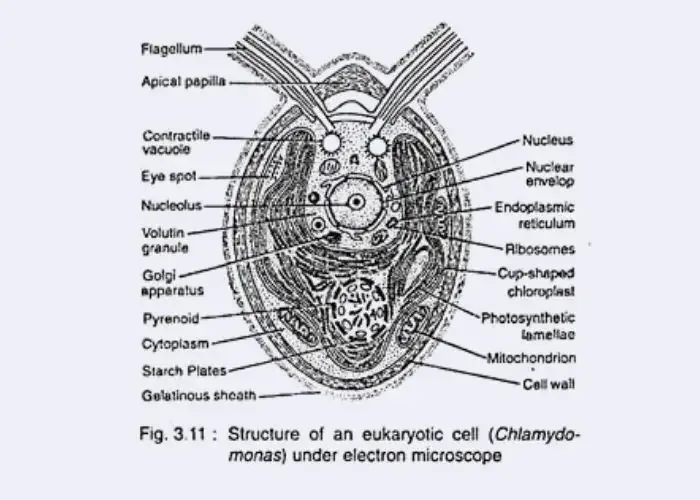
Some motile unicellular algae are droplet like or pear shaped. They move with the help of flagella. Example is Chlamydomonas. - Oblong or elongated shape
Some algae are oblong or elongated. These are mostly free floating unicellular forms. The body is longer than broad. - Spiral shape
Some unicellular algae show spiral shape. These are generally non-motile forms. Example is Arthrospira or Spirulina. - Star shaped
Some algae are star shaped. They show symmetrical and geometric body. Example is Staurastrum. - Boat shaped or needle like
Some diatoms are boat shaped or needle like. This is common in pennate diatoms. Their body is elongated and bilaterally symmetrical. - Circular or cylindrical shape
Some diatoms are circular or cylindrical. This is common in centric diatoms. They show radial symmetry. - Triangular, square or elliptical shape
Some diatoms may be triangular, square or elliptical. These shapes are also found in different diatom cells.
Morphology of Algae
The morphological forms of algae are as follows-
- Unicellular forms
In this type, the body is made up of single cell. The single cell performs all functions of life. It may be motile or non-motile.- a. Motile unicellular form– These forms move by flagella or amoeboid movement. Example is Chlamydomonas.
- b. Non-motile unicellular form– These forms do not have flagella. They are carried by water current. Example is Chlorella.
- Colonial forms
In this type, many single cells remain together. They are generally embedded in common mucilaginous mass. The colony may be regular or irregular.- a. Coenobial colony– The colony has fixed number of cells. Shape of colony is also definite. Example is Volvox.
- b. Palmelloid colony– The cells remain loosely arranged in mucilage. Definite shape and size is absent.
- c. Dendroid colony– The colony is tree like. Cells are joined by branched mucilaginous stalks.
- d. Rhizopodial colony– The cells are connected with each other by long cytoplasmic projections.
- Filamentous forms
In this type, cells divide in one plane. The cells remain attached end to end. A thread like body is formed. a. Unbranched filament– The filament is simple and linear. Branches are absent. Example is Spirogyra. b. Branched filament– The filament gives lateral branches. Example is Cladophora. c. Heterotrichous filament– In this type, the body has two systems. One is prostrate system which creeps and attaches to substratum. Other is erect system which grows upward. - Pseudoparenchymatous forms
In this type, many filaments become closely packed. They may interweave and fuse together. A false tissue like body is formed. Example is Polysiphonia. - Siphonous or coenocytic forms
In this type, the thallus is long and tubular. Septa or cross walls are absent. Many nuclei are present in continuous cytoplasm. Example is Vaucheria. - Parenchymatous forms
In this type, cells divide in two or three planes. True tissue like body is formed. The thallus may be flat sheet, hollow tube or complex plant like body. Examples are Ulva and Laminaria.
Thallus Organization in Multicellular Algae
The thallus organization in multicellular algae are as follows-
- Filamentous thallus
In this type, the thallus is made up of thread like row of cells. Cells are arranged one after another. It is formed by repeated transverse division of cells.- a. Unbranched filament– The filament is simple and without branches. Examples are Ulothrix and Spirogyra.
- b. Branched filament– The filament gives lateral branches. It forms branched network like body.
- Siphonous thallus
In this type, the thallus is tubular and usually branched. Cross walls or septa are absent. The whole body acts like a single large cell.- a. The cytoplasm is continuous. Many nuclei are present in it. This condition is called coenocytic condition.
- b. Examples are Caulerpa and Vaucheria.
- Parenchymatous thallus
In this type, cells divide in two or more planes. True tissue like body is formed. The thallus becomes flat, tubular or complex three dimensional.- a. Some forms are sheet like, as in Ulva.
- b. Some forms are large and plant like, as in Laminaria.
- Pseudoparenchymatous thallus
In this type, true tissue is not formed. One or more central filaments and their branches become closely packed. They interweave and form false tissue like body.- a. It looks like parenchymatous body but it is formed from filaments.
- b. Examples are Gracilaria and Polysiphonia.
Cell Structures in Algae
The following are the important cell structures of algae–
- Cell wall
It is the outermost covering of algal cell. It gives shape and support to the cell. In green algae, it is made up of cellulose and pectin. In brown algae, alginate and fucoidan are present. In red algae, agar and carrageenan are present. In diatoms, the wall is made up of silica and it is called frustule. In cyanobacteria, the wall is made up of peptidoglycan. - Nucleus
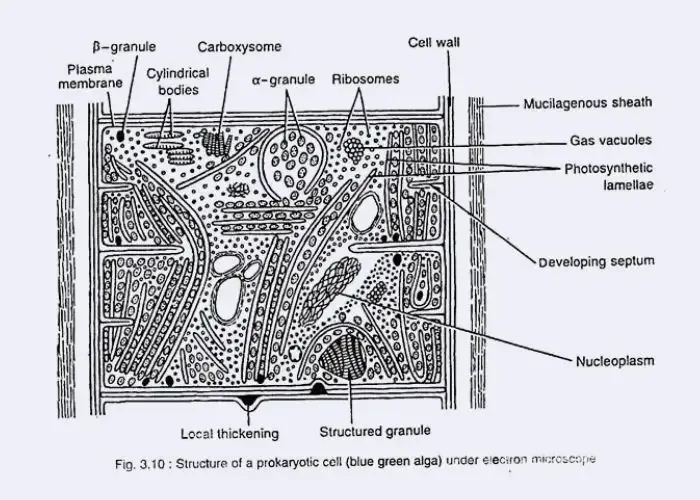
Eukaryotic algae have true nucleus. It is bounded by double nuclear membrane. DNA is present inside the nucleus. In some algae more than one nucleus may be present. In cyanobacteria, true nucleus is absent and naked DNA is present in nucleoid or centroplasm. - Chloroplast or plastid
Chloroplast is the photosynthetic organelle of algae. It contains pigments like chlorophyll, fucoxanthin and phycoerythrin. The shape of chloroplast may be cup shaped, spiral, star shaped or reticulate. In cyanobacteria, chloroplast is absent and photosynthesis occurs in thylakoids. - Pyrenoids
Pyrenoids are dense protein bodies. They are present inside or near the chloroplast. They help in carbon fixation. They also help in formation and storage of starch. - Flagella
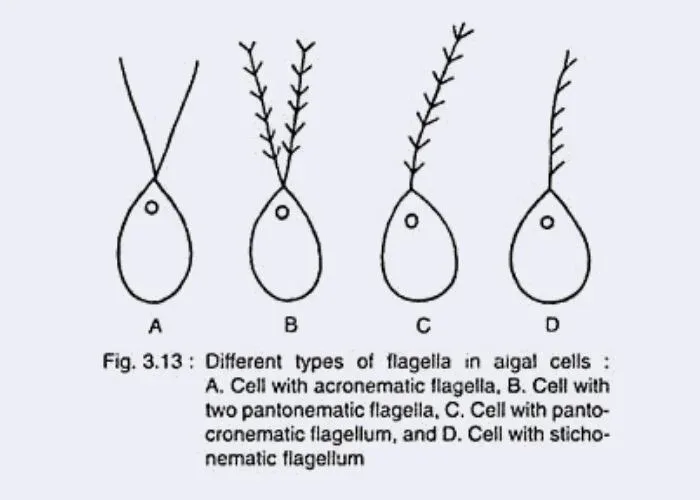
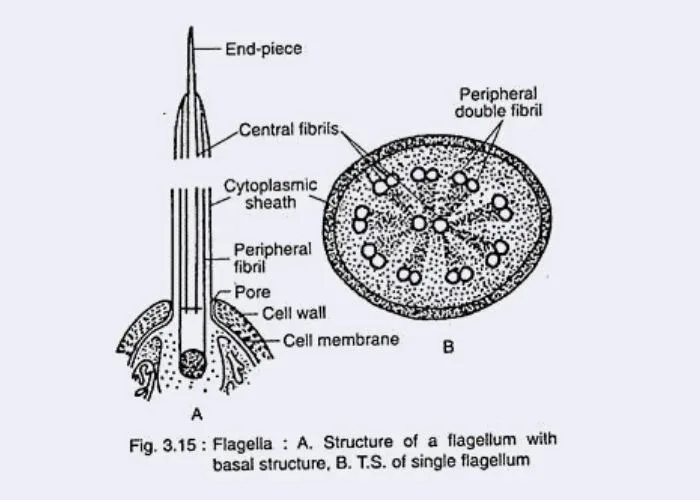
Flagella are whip like protoplasmic structures. They are present in motile algal cells. They help in movement. Flagella may be smooth whiplash type or hairy tinsel type. Red algae and cyanobacteria do not have flagella. - Eyespot or stigma
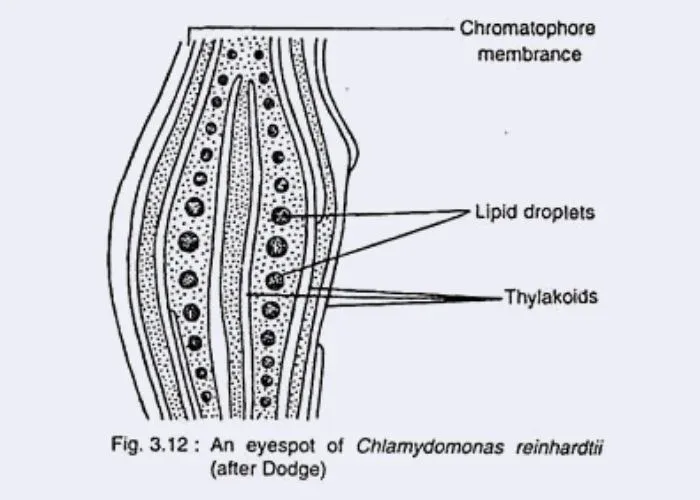
Eyespot is a small pigmented body. It is found in motile algae. It helps to detect the direction of light. Due to this, the algal cell can move towards light. This movement is called phototaxis. - Cytoplasm and cell organelles
Cytoplasm is the living matrix of the cell. In eukaryotic algae, different organelles are present in cytoplasm. Mitochondria are used for respiration. Endoplasmic reticulum, Golgi bodies and vacuoles are also present. Vacuoles store materials and maintain water balance. - Mucilage sheath
It is a gelatinous outer covering. It is found in many cyanobacteria and some diatoms. It protects the cell from drying, UV radiation and grazing animals. - Storage granules
Storage granules are present in cytoplasm. These are common in cyanobacteria. α-granules store cyanophycean starch or glycogen. Lipid globules store fats. Volutin bodies store phosphorus and cyanophycin granules store nitrogenous material. - Heterocysts and akinetes
These are special cells found in filamentous cyanobacteria. Heterocysts are thick walled cells and they fix atmospheric nitrogen. Akinetes are resting spores. They survive during unfavourable condition. - Holdfast
Holdfast is root like structure. It is present in large seaweeds. It attaches the thallus to rocks or coral. It mainly gives attachment and does not act like true root. - Air bladders or pneumatocysts
These are gas filled sacs. They are found in large brown algae like kelp. They help the thallus to float. They keep the photosynthetic parts near the lighted surface of water.
Specialized Morphological Structures in Algae
The following are the specialized morphological structures in algae–
- Pyrenoids
Pyrenoids are protein rich bodies. They are present in the chloroplast of some green and red algae. They help in carbon fixation. Starch is also formed and stored around them. - Holdfasts
Holdfast is root like structure. It is found in large seaweeds. It fixes the algal body to rocks, coral reefs and other submerged surfaces. It helps the algae to remain attached in strong water current. - Heterocysts
Heterocysts are special thick walled cells. They are found in some filamentous cyanobacteria. Photosynthetic pigments are absent or reduced in them. They contain enzymes for nitrogen fixation and convert atmospheric nitrogen into usable ammonia. - Air bladders or pneumatocysts
These are gas filled sacs. They are found in large brown algae. They help in floating of the thallus. They keep the photosynthetic fronds near the water surface for getting light. - Eyespots or stigma
Eyespot is a small light sensitive structure. It is found in motile unicellular algae. It helps to detect light direction. By this, the organism moves towards suitable light for photosynthesis. This is called phototaxis. - Mucilage sheath
It is a thick gelatinous outer covering. It surrounds some cyanobacteria and diatoms. It protects the cells from drying, harmful UV radiation and grazing animals. - Akinetes
Akinetes are thick walled resting spores. They are formed by some filamentous algae. They survive under unfavourable environmental condition. When condition becomes favourable, they germinate. - Hormogonia
Hormogonia are short motile chains of cells. They break away from main filament or colony. They glide and help in dispersal. Later they form new colonies.
References
- 2.2.4: Algae – Biology LibreTexts. (n.d.). Biology LibreTexts.
- 23.1E: The Evolution of Plastids – Biology LibreTexts. (n.d.). Biology LibreTexts.
- GreenWater Laboratories. (2026). Algae & Cyanobacteria. GreenWater Laboratories.
- Algae and their chloroplasts with particular reference to the dinoflagellates. (n.d.).
- Sharma, N. (2025, June 17). Algal Morphology: Structure, Sizes, Shapes, Composition. Microbe Notes.
- Manoylov, K., & Spaulding, S. (2021). Bacillariophyta. Rocky Mountain Lake Algae.
- Hachicha, R., Elleuch, F., Ben Hlima, H., Dubessay, P., de Baynast, H., Delattre, C., Pierre, G., Hachicha, R., Abdelkafi, S., Michaud, P., & Fendri, I. (2022). Biomolecules from Microalgae and Cyanobacteria: Applications and Market Survey. Applied Sciences, 12(4), 1924. https://doi.org/10.3390/app12041924
- Cell structure of cyanobacteria and eukaryotic algae commonly seen in… (n.d.). ResearchGate.
- Continued evolutionary surprises among dinoflagellates. (n.d.). PNAS.
- Cyanobacteria. (2026, May 8). In Wikipedia.
- Cyanobacteria: Model Microorganisms and Beyond. (n.d.). PMC – NIH.
- Cyanobacterial Cell Walls: News from an Unusual Prokaryotic Envelope. (n.d.). PMC – NIH.
- Cyanobacterial Heterocysts. (n.d.). PMC – NIH.
- Cyanobacterial morphology. (2026, April 28). In Wikipedia.
- Cyanophycin. (2024, February 20). In Wikipedia.
- Diatom. (2026, May 11). In Wikipedia.
- Diatom structure. (n.d.). Manaaki Whenua – Landcare Research.
- Diatoms. (2002). University College London.
- Evidence for the Retention of Two Evolutionary Distinct Plastids in Dinoflagellates with Diatom Endosymbionts. (n.d.). PMC – NIH.
- Evolutionary and Biophysical Paradigms of Algal Morphology: Structural Diversity, Eukaryotic Ultrastructure, and Comparative Prokaryotic Cytology. (n.d.).
- Flagellum. (2026, April 10). In Wikipedia.
- Formation and functional significance of storage products in cyanobacteria. (n.d.). ResearchGate.
- MoonlitMelody. (2023). General Characters of Algae. EduBirdie.
- Nuclear DNA Content Estimates in Multicellular Green, Red and Brown Algae: Phylogenetic Considerations. (n.d.). PMC – NIH.
- PNAS. (n.d.).
- Paleoclimate DIATOMS. (n.d.). National Centre for Polar and Ocean Research (NCPOR), Goa.
- John, D. M., Whitton, B. A., & Brook, A. J. (2024). Phylum Chlorophyta (Green Algae). In The Freshwater Algal Flora of the British Isles (pp. 364-765). Cambridge University Press. https://doi.org/10.1017/CHOL9781108784122.024
- Plastid evolution. (2026, March 10). In Wikipedia.
- Polyphosphate: A Multifunctional Metabolite in Cyanobacteria and Algae. (n.d.). PMC – NIH.
- gkumarimahesh. (n.d.). Prokaryotic and Eukaryotic Algal cell structure. SlideShare.
- Tiwari, S. (n.d.). RANGE OF THALLUS STRUCTURE IN ALGAE. Gyan Sanchay.
- Range of Thallus Organisation in Algae. (n.d.). LND College, Motihari.
- Red algae. (2026, May 11). In Wikipedia.
- Structure and Function. (n.d.). Exploring Our Fluid Earth.
- Bharti, N. (n.d.). CYANOBACTERIAL CELL. R N College.
- The endosymbiotic origin, diversification and fate of plastids. (n.d.). PMC – NIH.
- Archibald, J. M., & Keeling, P. J. (2004). The Evolutionary History of Plastids: A Molecular Phylogenetic Perspective. In Organelles, Genomes and Eukaryote Phylogeny (pp. 55-69). CRC Press LLC.
- The pyrenoid: the eukaryotic CO2-concentrating organelle. (n.d.). PMC – NIH.
- Weird Science: Serial Endosymbiosis. (n.d.). Exploring Our Fluid Earth.
- alpha granules of cyanobacterial cells contain A. (n.d.). Vedantu.
- Range of thallus organization. (n.d.). Kamrup College.
- Askiitians Tutor Team. (n.d.). α- granules of cyanobacterial cells contain. askIITians.
- Askiitians Tutor Team. (n.d.). α- granules of cyanobacterial cells contain. askIITians.