

Double Beam Balance is a mechanical laboratory balance used for measuring the mass of an object. It has two beams and the mass is measured by comparing an unknown mass with known standard masses. The balance is brought into an equilibrium position for measurement and it does not require electrical power for its operation.
What is a Double Beam Balance?
Double Beam Balance is a mechanical weighing instrument used to measure the mass of an object. It commonly has two graduated weighing ranges with movable riders or poises, which are adjusted until the beam reaches balance. The instrument works mechanically and does not require electrical power for normal weighing.
In the common laboratory double-beam type, the graduated beams carry sliding masses of different ranges. These riders are moved along the marked scale and their values are used for finding the mass. A double beam balance may have one weighing pan/platform or two pans/platforms, depending on the model and its purpose. Two-platform models can also be used for comparative weighing, where masses of two objects or the difference between their masses are compared. Some models also contain separate standard masses along with the riders for larger measurements.
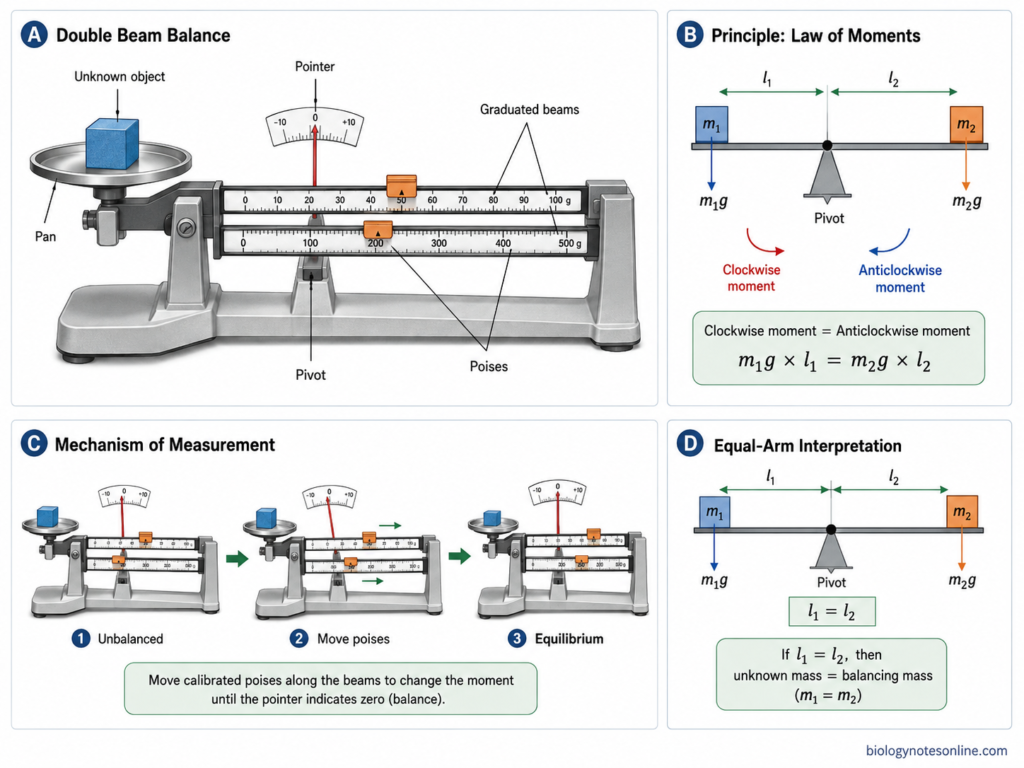
Principle of Double Beam Balance
Double Beam Balance works on the law of moments or torque equilibrium. The beam is supported around a pivot or support system. When the balance comes to equilibrium, the turning effect produced in one direction is balanced by the turning effect in opposite direction. Thus, the net torque around the pivot becomes zero.
The principle can be written as-
Clockwise moment = Anticlockwise moment
The moment depends on the downward force and its distance from the pivot. In a balance this force is produced by gravity acting on the masses. Therefore, an unknown mass can be balanced against known masses or calibrated riders/poises by changing their position along the beam.
For an ideal equal-arm comparison, the equilibrium condition is-
m₁g × l₁ = m₂g × l₂
where, m₁ and m₂ are the two masses, g is acceleration due to gravity and l₁ and l₂ are their distances from the pivot. When both arms are equal, l₁ = l₂. The same gravitational acceleration also acts on both sides, therefore the unknown mass becomes equal to the known balancing mass at equilibrium.
In a double beam balance, the known poises are moved along graduated beams until the pointer shows the balanced position. Their masses and distances from the pivot produce the required balancing moment. The calibrated positions of these poises thus allow the mass of the object to be determined.
Parts of Double Beam Balance With Diagram
The parts of a Double Beam Balance may show some difference according to the model. Two-pan comparative balances and other mechanical beam designs do not always have exactly same construction. The common parts are as follows-
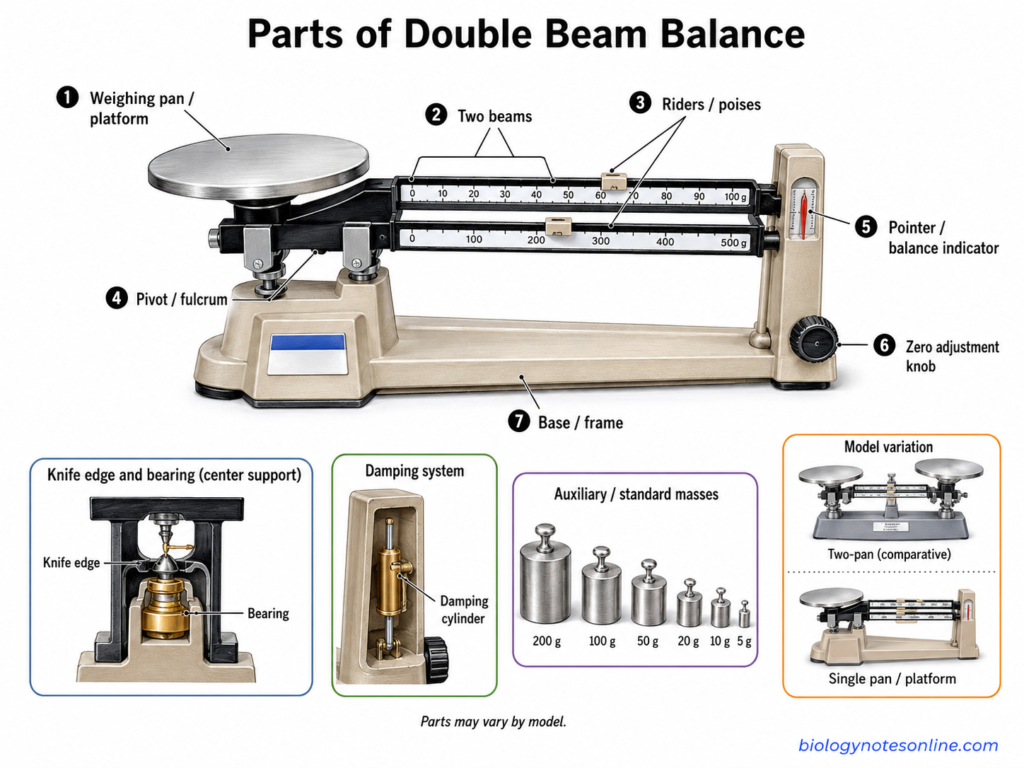
- Weighing Pan or Platform – This is the part used for keeping the object to be weighed. In comparative models, two pans may be present, one on each side of the balance. Some mechanical beam balances use a single weighing pan or platform. OHAUS Harvard Trip is a two-pan comparative balance.
- Two Beams – Two horizontal beams form the main measuring part of a double beam balance. The beams contain graduated or notched positions along which the balancing masses are moved. The OHAUS Harvard Trip, for example, contains two deep-notched and tiered beams.
- Riders or Poises – These are known sliding masses fitted on the beams. They are moved from one position to another until the balance reaches equilibrium. Their position on the graduated beam is used for determining the mass. OHAUS refers to these as built-in sliding masses in its two-beam balance.
- Pivot or Fulcrum – The beam assembly is supported around a central pivot system, allowing the beam to move when the two sides are not balanced. At equilibrium the opposing torques around this support become balanced. Beam balances commonly use low-friction bearing or knife-edge arrangements for this movement.
- Knife Edges and Bearings – These form the sensitive supporting arrangement of many mechanical balances. Hardened steel edges and bearings reduce unnecessary resistance during movement of the beam. The Harvard Trip balance uses hardened steel edges with floating agate bearings.
- Pointer or Balance Indicator – It indicates whether the balance has reached its zero or equilibrium position. The pointer moves when one side produces greater turning effect. Some educational two-pan balances use a separate steel pointer, while the indication system can differ in other models.
- Zero Adjustment or Counterbalancing Knob – It is used to bring the empty balance to its correct zero position before weighing. Small initial imbalance can be corrected with this part. Some models use a counterbalancing knob, whereas others contain a spring-loaded zero adjust system.
- Damping System – The beam normally oscillates for some time after a mass is placed on the balance. A damping system reduces these oscillations so that the final balance position can be obtained more quickly. Magnetic damping is present in some double-beam models, while some educational balances use manual dampening.
- Base or Frame – The base supports the beam, pan arrangement and other mechanical parts of the balance. It also keeps the instrument in a stable position during weighing. Depending on the model, the base can be made from metal or strong plastic material.
- Auxiliary or Standard Masses – Some double beam balances are supplied with or can use additional known masses when a greater weighing range is required. These masses work together with the sliding poises. Their presence and capacity depend upon the particular balance model.
How Does a Double Beam Balance Work?
The working of a Double Beam Balance is based on bringing the beam back to its balanced or zero position. In a common rider-type double beam balance, known sliding masses are moved on the graduated beams until the unknown mass is balanced. Mechanical weigh-beam instruments use this null-balance method for measurement.
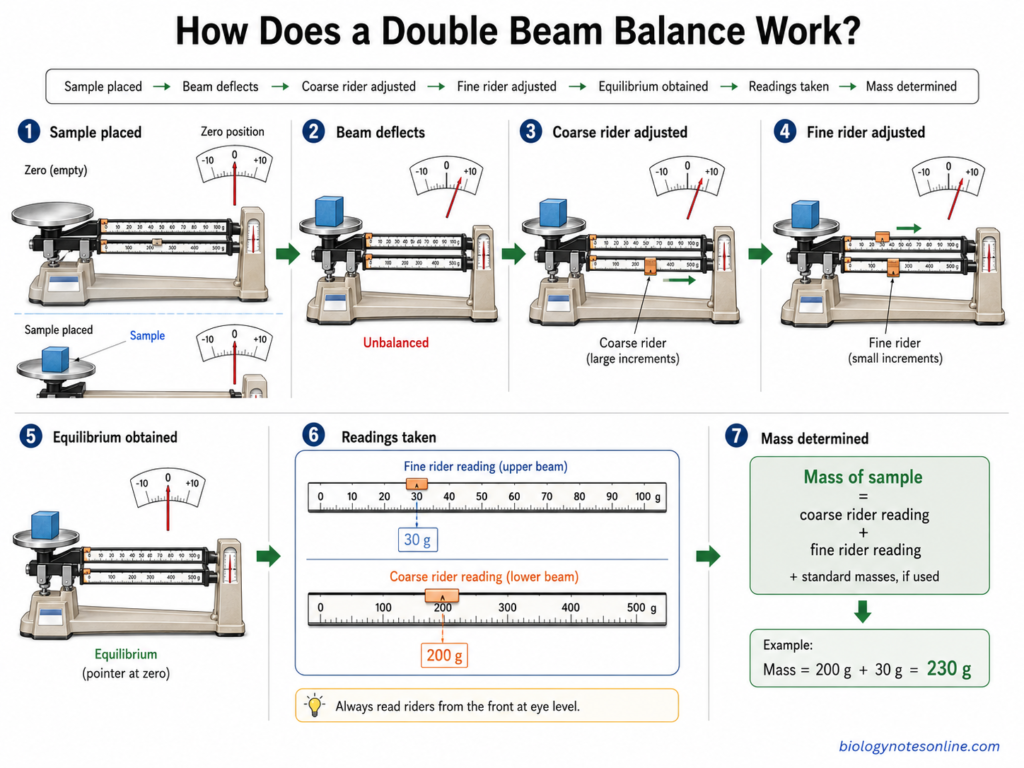
Sample placed → beam deflects → coarse rider adjusted → fine rider adjusted → equilibrium obtained → readings added → mass determined
The following are the steps involved in working of a Double Beam Balance-
- Sample is placed – First, the balance is checked at zero position. The object whose mass is to be measured is then placed on the weighing pan or platform. The added mass causes movement of the beam from its balanced position.
- Beam deflects – After placing the sample, the beam and its indicator move away from the zero or equilibrium mark. This indicates that the sample has not yet been balanced by the known masses. The balance is now adjusted using the riders.
- Coarse rider is adjusted – The rider or poise having the larger measuring range is moved first along its graduated beam. It provides the major part of the balancing mass. The rider is moved to a suitable position without passing the balance point.
- Fine rider is adjusted – The smaller-range rider is then moved gradually. It is used for the finer measurement. In this step, small changes in rider position are made until the beam comes very close to its zero position. Weigh-beam instruments similarly use known movable masses on graduated bars for bringing the pointer to the null point.
- Equilibrium is obtained – Adjustment is continued until the pointer or beam indicator stays at the balance mark, or oscillates equally around it depending on the balance design. At this condition, the unknown sample has been balanced by the known rider settings.
- Readings are taken – The value indicated by each rider is now read from its respective graduated beam. The riders should be properly positioned at the marked divisions before their values are recorded. Laboratory use of beam balances similarly determines mass by moving the riders until the balance index becomes level.
- Mass is determined – Finally, the readings of the two riders are added. This gives the mass of the sample for a rider-only double-beam arrangement. If separate standard masses are also used by the particular model, their values are included with the rider readings.
Operating Procedure of Double Beam Balance
The operating procedure of a Double Beam Balance can be divided into three stages. The exact arrangement may differ with the balance model, but the basic weighing procedure remains similar for mechanical rider-type balances.
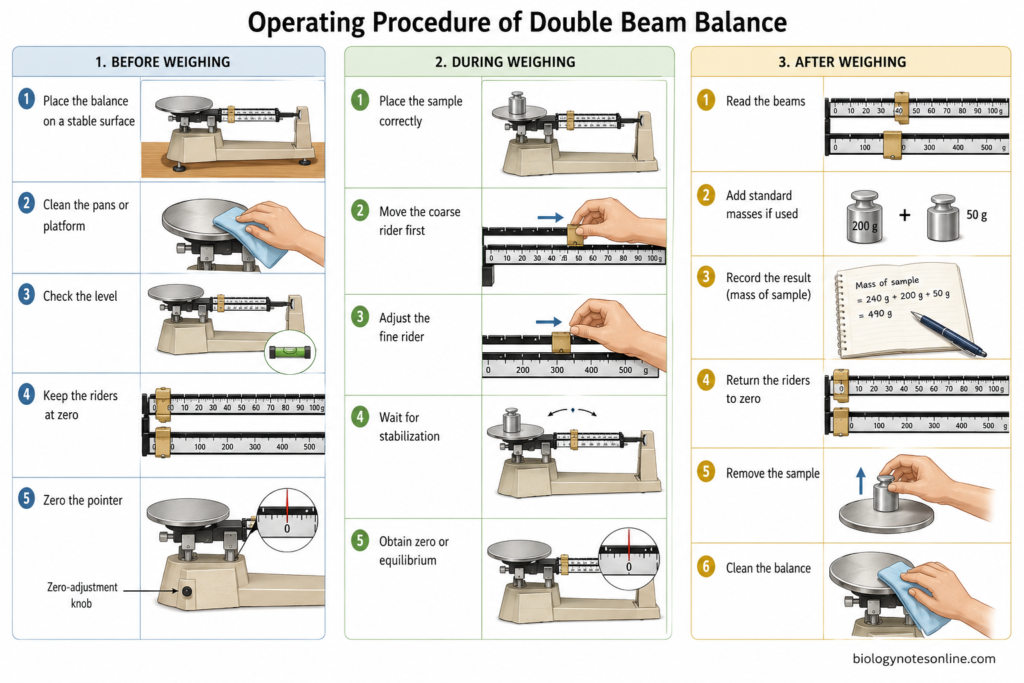
Before weighing
- Place the balance on a stable surface – The balance is kept on a firm, smooth and flat surface. Vibrations or movement of the supporting table should be avoided during measurement.
- Clean the pans or platform – The weighing pan and other exposed parts should be clean. Dust or foreign materials can interfere with proper weighing. Corrosive substances should not be placed directly on the balance platform.
- Check the level – The balance should remain level before weighing. If leveling adjustment is provided in the particular model, it is adjusted properly. A level and stable position is necessary for reliable operation of weighing balances.
- Keep the riders at zero – All riders or poises are first returned to their zero positions. Any auxiliary or attachment masses should also be removed unless required for the measurement.
- Zero the pointer – With the pan empty and riders at zero, the pointer is checked. The zero-adjustment knob is moved until the pointer comes to the zero mark or correct balance position. This should be done before weighing the sample.
During weighing
- Place the sample correctly – The object is placed carefully on the weighing pan or platform. In a top-loading model, it is preferably kept near the centre of the platform. The beam then moves from its zero position.
- Move the coarse rider first – The rider with the larger range is adjusted first. It is moved along the graduated beam until the balance point is approached. If the pointer passes the zero position, the rider is moved back to the previous suitable position.
- Adjust the fine rider – The smaller or fine rider is then moved slowly. This provides the smaller adjustment required for obtaining the final reading.
- Wait for stabilization – The beam is allowed to settle after adjustment of the riders. Some mechanical balances contain magnetic damping which decreases oscillation and allows the beam to come to rest more quickly.
- Obtain zero or equilibrium – The fine rider is adjusted until the pointer reaches the zero mark or shows the proper equilibrium position. At this stage, the sample is balanced by the calibrated rider settings and any additional standard masses being used.
After weighing
- Read the beams – The position of each rider is read from its respective graduated beam. The reading should be taken only after the balance has reached equilibrium.
- Add standard masses if used – The readings of the riders are added together. If attachment or standard masses were used for extending the weighing capacity, their calibrated values are also included.
- Record the result – The final value is recorded as the mass of the sample, generally with the unit indicated on the balance.
- Return the riders – After completing the measurement, the riders are brought back to their zero positions. This also prepares the balance for its next zero check.
- Remove the sample – The weighed object is taken from the pan carefully. No unnecessary load should be left on the balance after the measurement.
- Clean the balance – Finally, the pan or platform is cleaned and any spilled material is removed. Foreign material should not be allowed to collect around the bearings, knife edges or damping arrangement.
How to Read a Double Beam Balance
The double beam balance reading is taken only after the balance has reached its zero or equilibrium position. The values shown by the two riders are read separately and then added. If known external standard masses are also used during weighing, their values are included in the final mass. Mechanical beam balances determine mass by comparison with known masses, while sliding masses permit finer measurement along a graduated beam.
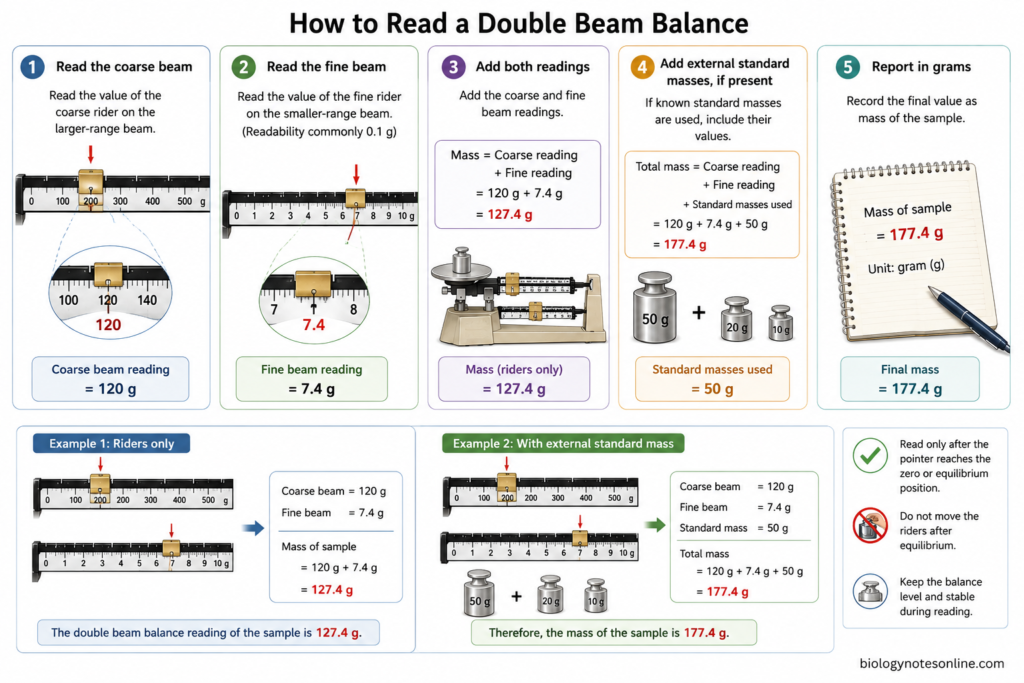
Step 1 – Read the coarse beam
First, observe the position of the coarse rider on the larger-range beam. Read the graduated value corresponding to its final position. This beam gives the major part of the double beam balance measurement.
The rider should not be moved after equilibrium is obtained.
Step 2 – Read the fine beam
Now read the fine rider from the second graduated beam. It provides the smaller part of the measurement and permits a more precise final reading.
The graduations and readability can differ according to the balance model. Therefore, the marked divisions of that particular instrument should be followed. For example, the OHAUS Harvard Trip is a two-beam mechanical balance with built-in sliding masses and a stated readability of 0.1 g.
Step 3 – Add both readings
The two beam readings are then added together.
Mass = Coarse beam reading + Fine beam reading
If only the built-in riders are required for balancing the sample, this total gives the mass of the object.
Step 4 – Add external standard masses, if present
Some double beam balances can also be used with known standard masses. These are particularly used when the required balancing mass is greater than that provided by the riders alone. OHAUS lists a standard weight set for its Harvard Trip two-pan balance.
When such known masses are used as part of the balancing load-
Total mass = Coarse reading + Fine reading + Standard masses used
Step 5 – Report in grams
The obtained value is finally recorded as the mass of the sample. The unit commonly marked on laboratory double beam balances is gram (g). The OHAUS Harvard Trip, for example, gives its measurement unit in grams.
Example calculation
Suppose a sample is balanced and the readings are-
Coarse beam = 120 g
Fine beam = 7.4 g
No external mass is used.
Mass of sample = 120 g + 7.4 g
= 127.4 g
Thus, the double beam balance reading of the sample is 127.4 g.
If a 50 g standard mass was also required for balancing in a model using external standards-
Total mass = 120 g + 7.4 g + 50 g
= 177.4 g
Therefore, the mass of the sample is 177.4 g.
Capacity, Readability and Sensitivity of Double Beam Balance
The capacity, readability and sensitivity are important characteristics of a Double Beam Balance. These terms describe different properties of the instrument and should not be considered the same. NIST guidance also treats capacity, sensitivity and readability as separate characteristics of a weighing balance.
1. Capacity
Capacity is the maximum mass that a balance is designed to weigh. The sample should be kept within this specified limit.
A balance having a capacity of 2000 g can weigh loads up to its stated maximum of 2000 g. Greater load should not be placed on the instrument. Capacity can be different for different double beam balance models.
For example, the OHAUS Harvard Trip 1550-SD has a maximum capacity of 2000 g. This value is a specification of this particular model and not of every double beam balance.
2. Readability
Readability refers to the smallest increment that can be read from the graduated scale of the balance. It determines the smallest step available while taking the reading.
For a mechanical balance, the graduations of the beam and position of the rider determine this reading interval. A smaller readability value permits smaller differences in mass to be read. Readability, however, should not be taken as a complete statement of measurement accuracy. NIST treats readability or scale resolution as one of several factors affecting balance measurement.
The OHAUS Harvard Trip 1550-SD has a specified readability of 0.1 g. Therefore, its graduated weighing system can be read in increments of 0.1 g.
3. Sensitivity
Sensitivity is the ability of a balance to respond to a small change in mass. When a small additional mass is added, a sensitive balance produces an observable change in the beam or pointer position.
In mechanical balance measurements, sensitivity can be checked by adding a small known sensitivity weight and observing the resulting change in balance indication. Thus, sensitivity is concerned with the response of the balance, and it is not simply another name for readability. NIST mass-measurement procedures use a small calibrated weight specifically for evaluating balance sensitivity.
For precision mechanical balances, sensitivity may also be expressed by relating a change in scale indication with a known change in mass. The exact numerical sensitivity depends on the balance construction and adjustment.
Specifications vary between models.
For example, the OHAUS Harvard Trip 1550-SD has 2000 g maximum capacity and 0.1 g readability. These figures are only an example of one double-beam model. They should not be used as the general capacity or readability of all Double Beam Balances.
Calibration and Zero Adjustment of Double Beam Balance
Zero adjustment is done to bring the empty Double Beam Balance to its correct zero position before measurement. Calibration or verification is then checked with a known reference mass. In strict metrology, a full calibration requires suitable calibrated reference standards, whereas a routine known-mass check is mainly a verification of balance performance.
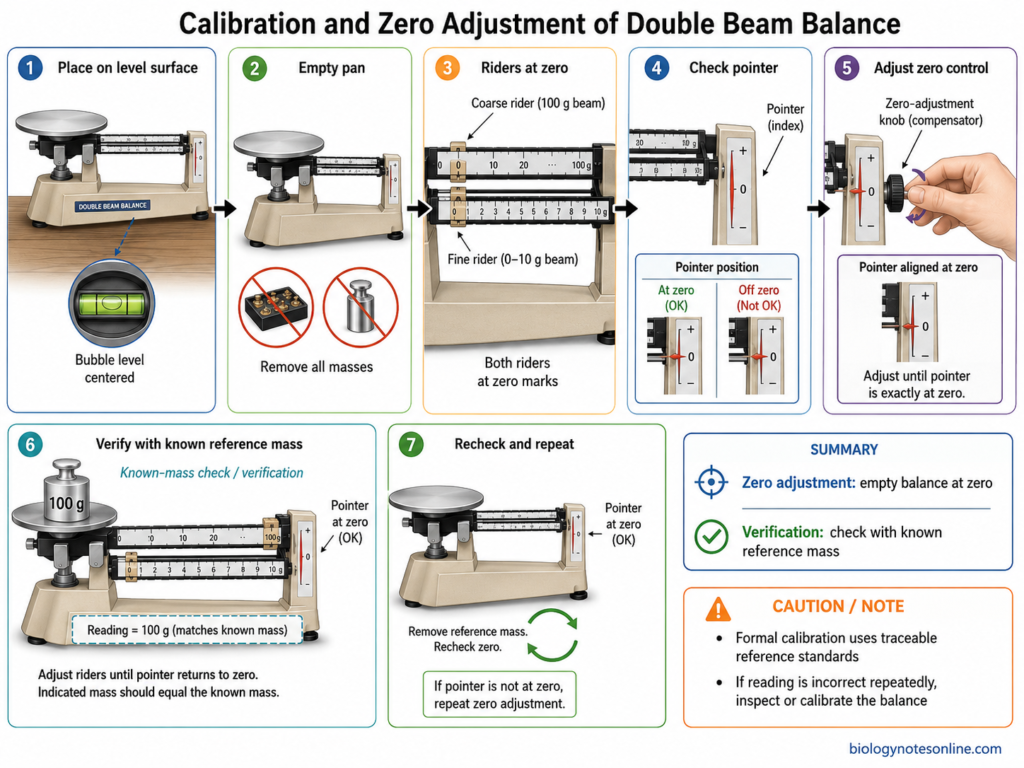
The following are the steps for zero adjustment and checking of a Double Beam Balance-
- Place the balance on a level surface – Keep the balance on a smooth, flat and stable surface. The surface should be free from unnecessary vibration. Proper positioning is first checked before adjustment of the balance. OHAUS also specifies a smooth flat surface during mechanical balance setup.
- Remove all samples – The weighing pan or platform should be completely empty. Any attachment masses used during previous weighing are also removed. Zero adjustment should be carried out without a sample on the weighing pan.
- Return riders to zero – Move all riders or poises back to their zero marks on the graduated beams. They should be seated correctly at their zero positions. The balance is now ready for checking of its pointer.
- Check the pointer – Observe the pointer or balance index when the pan is empty and riders are at zero. If the pointer remains at the zero mark, no zero correction is required. If it stays above or below the mark, adjustment is needed.
- Adjust the zero control – Turn the zero-adjustment knob or compensator slowly until the pointer comes to the zero position. The adjustment should be made without any sample on the pan. OHAUS mechanical balances contain a zero adjust system for re-establishing this balance point.
- Verify using a known reference mass – After zeroing, place a suitable known standard or reference mass on the balance and check its indicated value. Reference standards used for formal calibration should have known calibrated values and suitable metrological traceability. NIST mass procedures use calibrated working standards for this purpose. Labnics also recommends periodic calibration of its NDDB-100 double beam balance using the supplied standard weights.
- Repeat if necessary – Remove the reference mass and again check the zero position. If required, repeat the zero adjustment and reference-mass check. If the balance repeatedly fails to give the expected value, the balance should be inspected or properly calibrated before accurate measurements are continued. Repeated checks with known standards are used to monitor weighing performance.
Sources of Error in Double Beam Balance
Several errors can affect the measurement obtained from a Double Beam Balance. Some are caused by improper adjustment and reading, while others occur due to environmental conditions or wear of mechanical parts. NIST weighing guidance identifies environment and operator use as important sources of weighing uncertainty.
| Error | Cause | Effect/Prevention |
|---|---|---|
| Zero error | The pointer does not remain at zero when the pan is empty and riders are at zero. Improper zero adjustment or material present on the pan can cause it. | All measurements may show an offset. Check the empty balance first and adjust the zero control before weighing. |
| Parallax error | The rider or graduated scale is viewed from an angle instead of directly in front of the mark. | A value slightly higher or lower may be read. Observe the graduation at proper eye level. |
| Incorrect rider position | The rider or poise is not correctly seated on its graduation or notch. | It produces an incorrect balancing moment and wrong reading. Riders should be properly positioned before the value is recorded. Labnics also recommends checking that sliding weights are correctly seated when readings become inconsistent. |
| Unlevel balance | The instrument is placed on an inclined or uneven surface. | The normal equilibrium position can be disturbed. Keep the balance on a level and stable surface before zero adjustment and weighing. |
| Vibration | Movement from the table, nearby machinery or repeated handling causes vibration of the balance. | The beam and pointer continue to move, making the final reading difficult. Use a firm vibration-free surface. Vibration is also recognized as an environmental source affecting weighing measurements. |
| Air current | Strong air movement acts on the pan, sample or beam assembly. | Small changes or continuous movement of the indication may occur. Weighing should be performed away from drafts and strong air flow. |
| Dirty pan | Dust, spilled sample or other material remains on the weighing pan. | The unwanted material can be included in the measured mass or disturb zero. Keep the pan clean before and after measurement. |
| Dust on knife edges/bearings | Dirt or debris collects around the knife edges and bearings. | Free movement of the beam can be affected and results may become inconsistent. The supporting parts should remain clean and undamaged. |
| Worn pivot/bearings | Repeated use, damage or mechanical wear occurs at the pivot, knife edges or bearings. | Friction and irregular beam movement can increase. Sensitivity and repeatability may decrease. Worn knife edges or agate bearings should be inspected when readings remain inconsistent. |
| Improper loading | The sample is placed carelessly, touches another part, spills, or is not correctly supported on the pan. | It may interfere with normal beam movement and give an unreliable mass. Place the sample correctly on the weighing pan and prevent contact with surrounding parts. |
| Oscillation before reading | The reading is taken while the beam is still moving after loading or rider adjustment. | The correct equilibrium position may be missed. Allow the beam to stabilize first. Magnetic damping, when present, reduces this oscillation. |
| Overloading | A sample greater than the rated capacity of the balance is placed on it. | It can give unreliable measurement and may damage the pan, bearings or beam mechanism. Never exceed the specified maximum capacity of the particular model. |
| Incorrect standard masses | Wrong, damaged, contaminated or unsuitable reference masses are used during comparison or checking. | A systematic error can enter the final result. Use suitable known and calibrated standard masses. NIST mass procedures emphasize appropriate reference standards in balance calibration and comparison measurements. |
The amount of error depends on the balance design, condition and its sensitivity. Proper zero checking, clean mechanical parts, correct rider setting and stable weighing conditions help in reducing these errors.
Precautions While Using a Double Beam Balance
The following are some of the important precautions while using a Double Beam Balance–
- Zero the balance – Keep all riders at zero and check the pointer before measurement.
- Use a stable bench – Place the balance on a flat, level and vibration-free surface.
- Do not exceed capacity – Never place mass greater than the specified capacity of the balance.
- Handle masses carefully – Standard masses should be handled carefully. Avoid unnecessary touching.
- Do not place chemicals directly – Chemicals should be kept in a suitable container before weighing.
- Avoid drafts and vibration – Air currents and vibration can disturb the beam and affect reading.
- Keep bearings clean – Knife edges and bearings should remain clean and free from dust.
- Wait for stabilization – Take the reading only after the pointer becomes stable at equilibrium.
- Read at correct angle – Observe the scale directly to avoid parallax error.
- Return riders after use – Bring all riders back to zero and remove the sample after weighing.
Uses of Double Beam Balance
Some of the important uses of a Double Beam Balance include:
- Used to measure the mass of objects in physics and laboratory experiments.
- It is commonly used for comparative weighing between two objects.
- Used to determine the difference in mass between two samples, especially in two-pan models.
- It can be used in experiments where known mass is required for density and other physical measurements.
- Beam balances are also used for comparing and checking standard masses. High-quality models can be employed in mass calibration work.
- It is widely useful in school and teaching laboratories for learning mass measurement and handling of mechanical balances.
- Double beam models with sliding masses are useful when both coarse and finer mass adjustment are required during weighing.
Advantages of Double Beam Balance
Some of the important advantages of a Double Beam Balance include:
- No electrical power is required – It works mechanically and can be used without electricity or batteries.
- Useful for comparative weighing – Mass can be compared with known masses under equilibrium condition. Beam balances are well suited for mass comparison.
- Simple operation – Sliding riders or poises are moved on the beams to obtain the required balance position.
- Allows finer measurement – Graduated beams and movable masses permit small changes in mass to be measured. The actual readability depends on the model.
- Easy zero adjustment – Many models contain a counterbalancing or zero-adjustment arrangement for setting the balance before weighing.
- Suitable for repeated laboratory weighing – The mechanical arrangement can be used repeatedly for routine mass measurements and comparisons.
- Strong mechanical construction – Many laboratory models use metal beams, hardened edges and durable bearing systems. However, construction differs between models.
Limitations of Double Beam Balance
Some of the important limitations of a Double Beam Balance include:
- Limited readability – It cannot measure very small mass changes like high-resolution analytical balances. Readability also varies with the model.
- Manual operation – Riders have to be moved by hand until equilibrium is obtained. Thus, weighing may take more time than an electronic balance.
- Affected by vibration and air currents – These can disturb movement of the beam and make the reading unstable.
- Needs proper zero adjustment – The balance should be correctly zeroed before measurement. Improper zero setting gives an incorrect mass reading.
- Reading error can occur – The graduated beams and pointer are read manually. Improper viewing or incorrect rider position can produce reading error.
- Mechanical parts can wear – Knife edges, pivots and bearings are important for free movement of the beam. Wear or friction in these parts can affect sensitivity of a mechanical balance.
- Limited weighing capacity – Every balance has a specified maximum capacity. Samples above this range cannot be properly weighed and may damage the instrument.
- Requires careful handling – Incorrect placement of riders, masses or sample can affect the final measurement. The result also depends on proper operation by the user.
Double Beam Balance vs Triple Beam Balance
A Double Beam Balance and Triple Beam Balance are mechanical instruments used for measuring mass. Both use graduated beams and movable riders or poises, but their beam arrangement and reading system are different.
| Feature | Double Beam Balance | Triple Beam Balance |
|---|---|---|
| Number of beams | It has two graduated beams. | It contains three graduated beams. |
| Riders/poises | Usually uses riders on two beams for balancing and measurement. | Three riders are used, one on each beam. |
| Mass measurement | Mass is determined by adding readings from the two beams. | Readings from all three beams are added to obtain mass. |
| Coarse and fine measurement | One beam generally gives a larger reading and the other provides finer adjustment. | Separate beams provide coarse, intermediate and finer adjustment. |
| Reading process | Two rider readings are noted and added. | Three rider readings are taken and added together. |
| Weighing arrangement | Depending on model, it may have one pan/platform or two pans. | Common laboratory triple beam balances usually have a single weighing pan. |
| Comparative weighing | Two-pan double beam models are especially useful for comparative weighing. | Mainly used for direct mass measurement with calibrated riders. |
| Readability | Readability depends on beam graduations and particular model. | Common educational models often provide finer reading through the third beam. |
| Capacity | Maximum capacity varies according to model and use. | Capacity also differs between triple beam balance models. |
| Operation | The two riders are adjusted until equilibrium is obtained. | All three riders are adjusted until the pointer reaches equilibrium. |
| Power requirement | It is a mechanical balance and normally requires no electricity. | It is also mechanical and does not require electrical power for normal weighing. |
| Common use | Used for laboratory weighing, teaching and comparative mass measurements. | Commonly used in school and laboratory work for routine mass measurement. |
| Main difference | Uses two beams for determining the mass. | Uses three beams, giving an additional graduated weighing range. |
The major difference between double beam balance and triple beam balance is the number of graduated beams and riders used for measurement. A triple beam balance provides three separate rider readings, whereas a double beam balance uses two.
Double Beam Balance vs Double Pan Balance
A Double Beam Balance and a Double Pan Balance are not exactly opposite types of balances. The term double beam describes the beam arrangement, whereas double pan describes the presence of two weighing pans. In some instruments both terms can apply to the same balance. For example, the OHAUS Harvard Trip 1550-SD has two beams and two pans.
| Feature | Double Beam Balance | Double Pan Balance |
|---|---|---|
| Meaning of terminology | The name mainly refers to a balance having two beams used in its weighing system. | The name refers to a balance having two pans, generally arranged on opposite sides of the balance. |
| Number of beams | It has two beams by definition of the term. Their exact arrangement differs with model. | The term does not itself specify the number of beams. Traditional equal-arm types commonly use a main balance beam. |
| Number of pans | It may have one pan/platform or two pans, depending on design. The Harvard Trip is one example having two pans. | It has two pans. One can carry the unknown mass and the other the reference or balancing load. |
| Riders | Movable riders or poises are commonly used on graduated beams for obtaining the mass reading. OHAUS describes built-in sliding masses on its two-beam model. | Riders are not required by the term itself. Some designs can contain a rider or sensitivity weight, while others mainly use external masses. |
| Standard masses | External standard masses may or may not be used. It depends on the particular balance construction and weighing range. | Known standard masses are commonly used in traditional two-pan weighing, with the test object or mass being compared against them. |
| Method of measurement | The riders are adjusted on the beams until the required equilibrium is obtained. Their calibrated readings give or contribute to the measured mass. | The unknown and known masses are balanced on opposite pans until equilibrium is reached. Precision two-pan balances are also used by substitution methods for mass comparison. |
| Typical application | Used for routine laboratory weighing, teaching and comparative weighing, depending on model. The Harvard Trip is specifically designed for comparative weighing. | Commonly used for comparison of masses and for weighing an unknown against known standards. Two-pan equal-arm balances have also been used for high-precision mass comparison. |
Double beam tells about the number of beams, while double pan tells about the number of pans. These terms should not be treated as completely separate balance designs. A balance can be both double beam and double pan at the same time.
Double Beam Balance vs Analytical Balance
| Feature | Double Beam Balance | Analytical Balance |
|---|---|---|
| Type | It is a mechanical balance having two beams in its weighing arrangement. | It is a high-precision laboratory balance. Modern analytical balances are generally electronic. |
| Measurement | Used for routine measurement and comparison of mass. | Used for very accurate measurement of small mass differences. |
| Working system | Works by mechanical balancing of moments around a pivot. | Modern types commonly use an electromagnetic force compensation system. |
| Riders/poises | Movable riders or poises are used on the beams. | Riders are normally not used in modern analytical balances. |
| Readability | Readability is comparatively lower and depends on the model. | It provides much higher readability, commonly 0.1 mg (0.0001 g) or better in some models. |
| Sensitivity | Less sensitive to very small changes in mass. | Highly sensitive to small changes in mass. |
| Capacity | Capacity varies according to the particular double beam model. | Usually has a lower capacity compared with general-purpose balances, though it depends on model. |
| Power requirement | No electrical power is normally required. | Modern analytical balances require electrical power. |
| Draft protection | A draft shield is generally not present in routine models. | Usually contains a draft shield to reduce effects of air movement. |
| Reading method | Beam readings are taken from the positions of the riders and then added. | The mass is generally shown directly on a digital display. |
| Speed of measurement | Rider adjustment is done manually and may take more time. | Measurement is usually faster after the reading becomes stable. |
| Environmental effect | Vibration and air movement can affect the beam position. | It is much more sensitive to drafts, vibration, temperature changes and static effects. |
| Calibration | Zero adjustment and known standard masses can be used for checking the balance. | Calibration is performed using suitable calibrated reference masses, internally or externally depending on model. |
| Typical application | Used in teaching laboratories, routine weighing and comparative weighing. | Used in analytical chemistry, pharmaceutical, research and quantitative laboratory work where high precision is required. |
| Main advantage | Simple construction and no electricity is required. | Provides very high precision and small mass readability. |
| Main limitation | It cannot measure very small mass changes like an analytical balance. | It is more sensitive to environmental conditions and requires careful operation. |
The major difference is the precision and method of measurement. A Double Beam Balance uses mechanical riders and beam equilibrium, whereas an Analytical Balance is mainly used when much smaller mass differences have to be measured.
Double Beam Balance Quick Revision Table
| Feature | Description |
|---|---|
| Instrument type | It is a mechanical weighing instrument used for measuring mass. |
| Principle | Works on the law of moments and torque equilibrium around a pivot. |
| Beams | It contains two graduated beams used for weighing. |
| Riders/Poises | Movable known masses are shifted along the beams until balance is obtained. |
| Pan arrangement | It may have one pan/platform or two pans, depending on model. |
| Power requirement | No electrical power is normally required. |
| Measurement | Mass is obtained after the beam reaches its zero or equilibrium position. |
| Reading | Coarse and fine beam readings are read separately and then added. |
| Standard masses | External known masses may also be used in some models. |
| Capacity | Maximum mass the balance is designed to weigh. It varies with model. |
| Readability | Smallest scale increment that can be read from the balance. |
| Sensitivity | Ability of the balance to respond to a small change in mass. |
| Zero adjustment | Riders are kept at zero and the pointer is adjusted before weighing. |
| Calibration check | A known reference mass can be used to verify the balance reading. |
| Common errors | Zero error, parallax, vibration, air currents, wrong rider position and unlevel setup. |
| Precautions | Keep the balance level and clean. Do not overload and wait for pointer stabilization. |
| Uses | Used for laboratory weighing, teaching and comparative weighing. |
| Advantage | Simple mechanical operation and no electricity is required. |
| Limitation | It has lower readability than a modern analytical balance and requires manual adjustment. |
| Main difference from triple beam balance | A double beam balance uses two beams, while a triple beam balance uses three. |
| Main difference from double pan balance | Double beam refers to beam arrangement, while double pan refers to number of pans. |
References
- Borys, M., Schwartz, R., Reichmuth, A., & Nater, R. (2012). Fundamentals of mass determination. Springer. https://doi.org/10.1007/978-3-642-11937-8
- Davis, R. S. (1987). Note on the choice of a sensitivity weight in precision weighing. Journal of Research of the National Bureau of Standards, 92(3), 239–242. https://doi.org/10.6028/jres.092.020
- Department of Education, Regional Office VIII. (2026). FY 2026 learning tools and equipment: Science and mathematics equipment technical specifications. https://region8.deped.gov.ph/wp-content/uploads/2026/05/Annex-D-LTE-SME-FY-2026.pdf
- Gläser, M., & Kochsiek, M. (Eds.). (2010). Handbook of metrology. Wiley-VCH. https://books.google.com/books?id=tVX9Cu1aQQwC
- Goel, J. P., & Goyal, M. (2020). Practical/laboratory manual physics class XI based on NCERT guidelines. SBPD Publications. https://books.google.com/books?id=Tu_sDwAAQBAJ
- Jones, F. E., & Schoonover, R. M. (2002). Handbook of mass measurement. Chapman & Hall/CRC. https://doi.org/10.1201/9781420038453
- OHAUS Corporation. (n.d.). Harvard Trip mechanical scale, 1550-SD. https://us.ohaus.com/en-us/Products/Balances-Scales/Mechanical-Scales-Balances/Harvard-Trip/1550-SD
- OHAUS Corporation. (n.d.). Mechanical scales and balances. https://us.ohaus.com/en-us/products/balances-scales/mechanical-scales-balances
- OHAUS Corporation. (n.d.). Harvard Trip balance series 1400 and 1500: Instruction manual. Scientific Laboratory Supplies. https://www.scientificlabs.co.uk/handlers/libraryFiles.ashx?filename=Manuals_B_BAL1000.pdf
- Robens, E., & Dąbrowski, A. (2006). Extension of the measuring range of balances. Journal of Thermal Analysis and Calorimetry, 86(1), 17–21. https://doi.org/10.1007/s10973-006-7571-9
- Urone, P. P., & Hinrichs, R. (2022). College physics 2e. OpenStax. https://openstax.org/books/college-physics-2e/pages/1-introduction-to-science-and-the-realm-of-physics-physical-quantities-and-units
- Walker, J. (1887). The theory and use of a physical balance. Clarendon Press. https://books.google.com/books?id=fRE_AAAAYAAJ