

Nucleoid is a compact region of a prokaryotic cell that contains its chromosomal DNA. It occurs in bacteria and archaea. The nucleoid contains the chromosome along with different DNA-binding proteins and associated RNA. Unlike a true nucleus, it lacks a nuclear membrane. Thus, the chromosomal material is not separated from the cytoplasm by a membrane.
What Is a Nucleoid?
Nucleoid is an irregular DNA-rich region found in prokaryotic cells where the main chromosome is present. It is not enclosed by a nuclear envelope, therefore the chromosomal material remains in direct contact with the cytoplasm.
The term nucleoid means “nucleus-like”. It contains the main chromosomal DNA with different nucleoid-associated proteins and RNA molecules. These components help in the packing and organization of the chromosome within the cell.
Unlike the eukaryotic nucleus, nucleoid is not a membrane-bound structure. It is mainly present as a compact and irregular region inside bacterial and archaeal cells.
Where Is the Nucleoid Found?
- The nucleoid is found in prokaryotic cells. In bacteria and archaea, the chromosomal material is present within the cytoplasm because a true membrane-bound nucleus is absent.
- In bacterial cell, the main chromosome remains in this region. The long DNA molecule is folded and compacted to fit within the small cell.
- No nuclear membrane occurs around the nucleoid. The cytoplasm is therefore not separated from the chromosomal region by a membrane, as found around the nucleus of eukaryotic cells.
- The nucleoid may occupy a considerable part of the bacterial cytoplasm. It is not a fixed rounded body like a nucleus.
- Its arrangement also does not remain always same. During DNA replication, gene expression and other activities of chromosome, changes occur in the local and overall structure of the nucleoid.
Characteristics of the Nucleoid
The following are the main characteristics of nucleoid–
- Nucleoid is an irregular DNA-rich region found in prokaryotic cells, which contains the main chromosome of the cell.
- No nuclear membrane or nuclear envelope is present surrounding it.
- The major component of nucleoid is the chromosomal DNA. RNA and different proteins associated with the chromosome are also present in this region.
- In most bacteria, the main chromosome is circular. However, the chromosome number and its form are not same in all prokaryotes.
- The DNA present in nucleoid is highly compacted so that a long chromosome can be accommodated within the small cell. DNA supercoiling also takes part in this organization.
- Different nucleoid-associated proteins (NAPs) are associated with the bacterial chromosome. These proteins can bend, wrap or bridge DNA and help in arrangement of nucleoid.
- Nucleoid has no fixed shape like the eukaryotic nucleus.
- The nucleoid is dynamic in nature, and its local as well as overall organization changes during DNA replication, recombination and gene expression.
- Its degree of compaction can also change according to growth phase and environmental conditions of the bacterial cell.
Structure of the Nucleoid
The nucleoid is mainly formed of highly organized chromosomal DNA, along with different DNA-binding proteins and RNA. It has no surrounding nuclear membrane. The long chromosome is folded and compacted at different levels within the small prokaryotic cell.
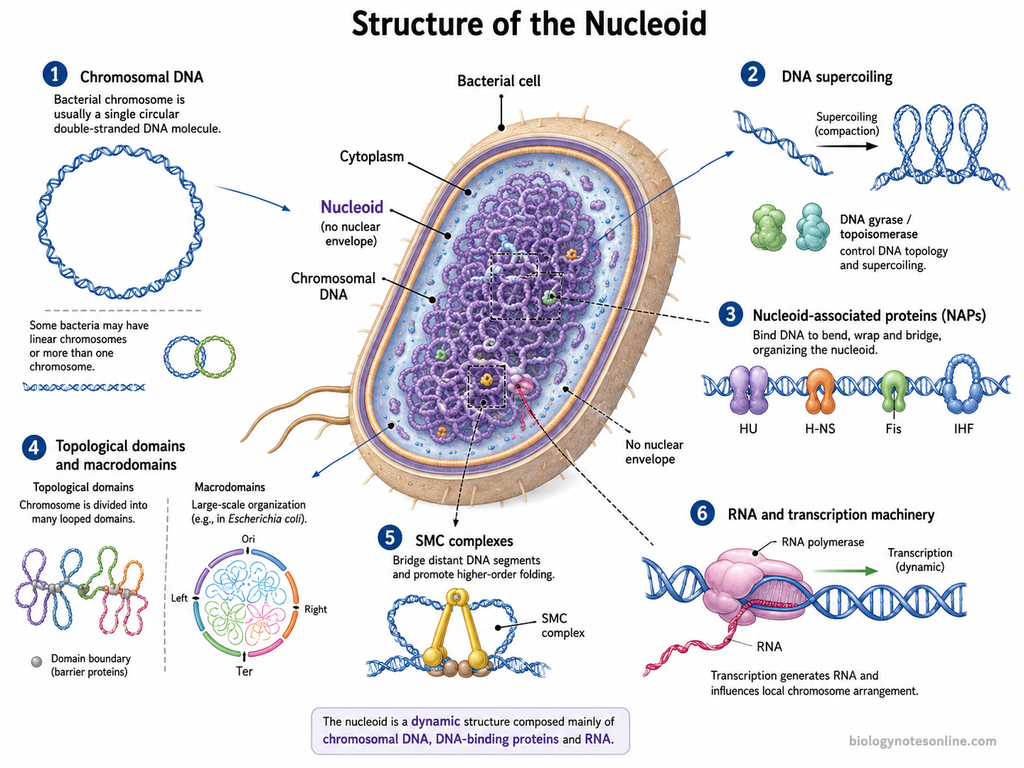
The following are the main structural components and organization of nucleoid-
- Chromosomal DNA – It forms the major structural material of the nucleoid. In many bacteria, the chromosome is present as a single circular double-stranded DNA molecule, but this condition is not same in all bacteria. Linear chromosomes and more than one chromosome are also found in some species.
- DNA supercoiling – The chromosomal DNA remains supercoiled which helps in its compaction. Supercoiling produces folded DNA structures and also affects the organization of different regions of chromosome. DNA gyrase and other topoisomerases are involved in controlling this DNA topology.
- Nucleoid-associated proteins (NAPs) – These are DNA-binding proteins associated with the bacterial chromosome. HU, H-NS, Fis and IHF are some of the important examples. They can bend, wrap or bridge DNA and take part in formation of nucleoid structure.
- Topological domains – The chromosome is divided into many smaller regions or domains. DNA within one such region can maintain its own supercoiling to some extent, which helps in organization of the large chromosome.
- Macrodomains – Larger organized chromosome regions are called macrodomains. These have been well studied in Escherichia coli, where different parts of chromosome occupy particular regions within the cell. The same arrangement is not necessarily present in every bacterial species.
- SMC complexes – Structural Maintenance of Chromosomes (SMC) proteins take part in higher level folding and organization of chromosomal DNA. They help in bringing different DNA regions together and are also associated with chromosome segregation.
- RNA and transcription machinery – RNA molecules and actively working RNA polymerase are also associated with the nucleoid. Transcription can influence DNA supercoiling and local arrangement of the chromosome, therefore nucleoid structure does not remain fixed.
- Nuclear envelope – No nuclear envelope is present around the nucleoid. The organized chromosome therefore remains directly within the cytoplasmic region instead of forming a separate membrane-bound nucleus.
How Is DNA Packed Inside the Nucleoid?
The long chromosomal DNA has to be highly compacted to remain within the small bacterial cell. DNA packing in the nucleoid takes place at different levels, mainly by supercoiling, formation of DNA domains and interaction with chromosome-associated proteins.
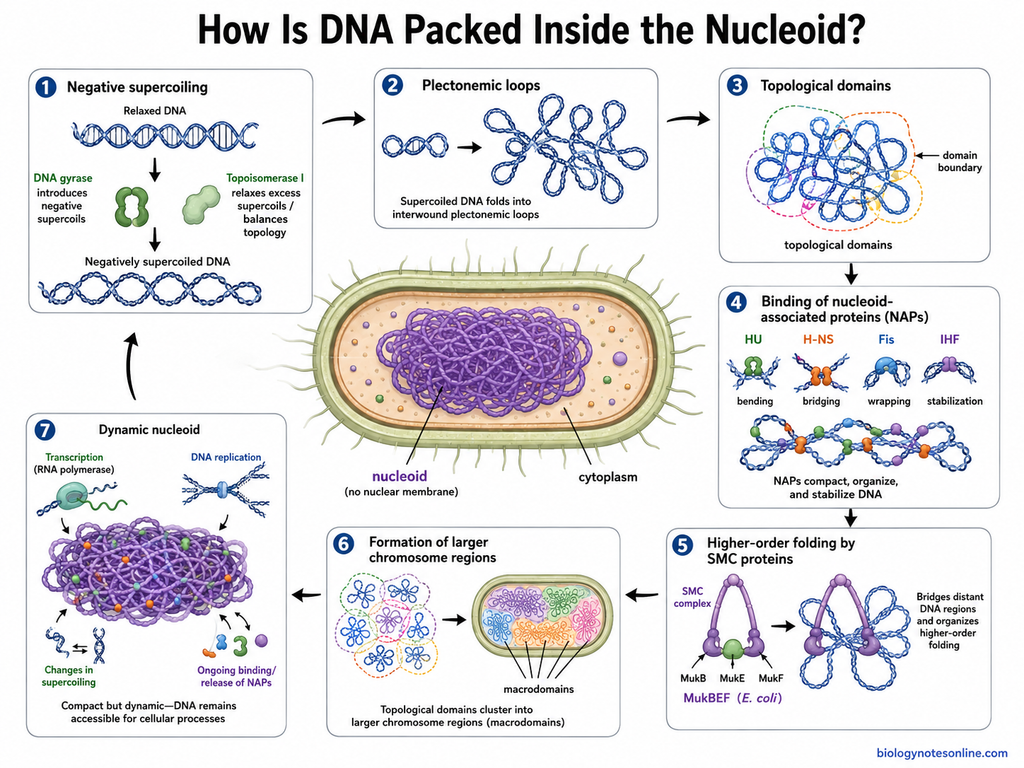
The following are the main steps involved in packing of DNA inside the nucleoid-
- Negative supercoiling – The first major level of DNA compaction is produced by negative supercoiling. DNA gyrase introduces negative supercoils into the chromosome, causing DNA to twist over itself and form plectonemic structures. Topoisomerase I acts in the opposite direction and helps in maintaining the proper level of supercoiling.
- Formation of plectonemic loops – Supercoiled DNA forms a number of interwound loops and branches. This greatly decreases the space occupied by the long DNA molecule. The chromosome therefore does not remain as an extended DNA strand inside the cell.
- Formation of topological domains – The supercoiled chromosome is further organized into many smaller topological domains. Supercoiling within one domain can be maintained partly independent from the nearby domains. These regions provide another level of organization of bacterial DNA.
- Binding of nucleoid-associated proteins – Different nucleoid-associated proteins (NAPs) bind with chromosomal DNA. HU, H-NS, Fis and IHF are some of the important examples in bacteria such as Escherichia coli. They bend, bridge, wrap or stabilize DNA and help in formation of a more compact nucleoid.
- Higher-order folding by SMC proteins – Structural Maintenance of Chromosomes (SMC) complexes take part in the higher level organization of the chromosome. These complexes bring DNA regions into an ordered arrangement and also have an important role during chromosome segregation. In E. coli, the related MukBEF complex performs this type of function.
- Formation of larger chromosome regions – The smaller organized DNA regions finally contribute to larger spatial arrangement of the chromosome. In E. coli, some parts of chromosome are organized into larger regions called macrodomains. Thus, the chromosome becomes compacted as well as arranged at particular positions within the bacterial cell.
- Dynamic nucleoid formation – The final nucleoid is not a permanently fixed mass of DNA. Transcription, DNA replication, supercoiling and DNA-binding proteins continuously affect its local and overall organization. Hence, DNA remains compact but also accessible for different cellular processes.
Nucleoid-Associated Proteins (NAPs)
Nucleoid-associated proteins (NAPs) are DNA-binding proteins associated with the bacterial chromosome. They help in packing and organization of DNA inside the nucleoid.
Some of the important nucleoid-associated proteins are-
- HU protein – It binds and bends DNA. HU helps in chromosome organization and also takes part in replication and recombination.
- H-NS protein – H-NS binds mainly to AT-rich DNA regions. It can bridge DNA segments and also acts as a regulator of gene expression.
- Fis protein – Fis bends DNA and affects DNA topology. It is present in high amount during rapid bacterial growth.
- IHF protein – IHF binds specific DNA sequences and produces strong bending of DNA. It also takes part in recombination and transcription.
- Dps protein – Dps becomes abundant during stationary phase and starvation. It condenses DNA and protects it from oxidative damage.
- Lrp protein – Lrp binds DNA and mainly regulates gene expression. It can also affect chromosome organization.
- Growth-dependent NAPs – The amount of different NAPs changes during bacterial growth. Fis is common during rapid growth, while Dps becomes abundant during stationary phase.
| Protein | DNA interaction | Major role |
|---|---|---|
| HU | Binds and bends DNA | DNA compaction and chromosome organization |
| H-NS | Binds and bridges DNA, mainly AT-rich regions | Nucleoid organization and gene repression |
| Fis | Binds and bends DNA | Controls DNA topology and transcription |
| IHF | Binds specific DNA sequences and bends DNA strongly | Recombination and transcription regulation |
| Dps | Binds and condenses DNA | DNA protection during starvation and oxidative stress |
| Lrp | Binds and wraps DNA | Regulation of gene expression and chromosome organization |
Functions of the Nucleoid
The nucleoid performs different functions related to storage, organization and transmission of genetic material. The following are the main functions of nucleoid-
- Storage of genetic material – The nucleoid contains the main chromosomal DNA of the prokaryotic cell. It carries most of the genetic information required for cellular functions.
- DNA compaction – It provides an organized arrangement for the long bacterial chromosome. Supercoiling and different DNA-binding proteins help in this compaction.
- DNA replication – Replication of the bacterial chromosome takes place within the nucleoid region. The duplicated chromosomes are then organized for their separation.
- Gene expression – Transcription takes place on chromosomal DNA present in the nucleoid. Nucleoid organization and NAPs can also affect the expression of many genes.
- Chromosome segregation – The nucleoid organization helps in proper separation of newly replicated chromosomes. This allows each daughter cell to receive the genetic material during cell division.
- DNA repair and recombination – The chromosome remains organized but accessible to proteins involved in DNA repair and recombination. These processes are necessary for maintenance of genome integrity.
- Cell cycle organization – Changes in nucleoid organization occur with chromosome replication and segregation. These events are closely associated with bacterial cell growth and division.
Nucleoid During Bacterial Cell Division
During bacterial cell division, the nucleoid undergoes replication, reorganization and segregation so that each daughter cell receives a chromosome. These events occur together with cell growth and septum formation.
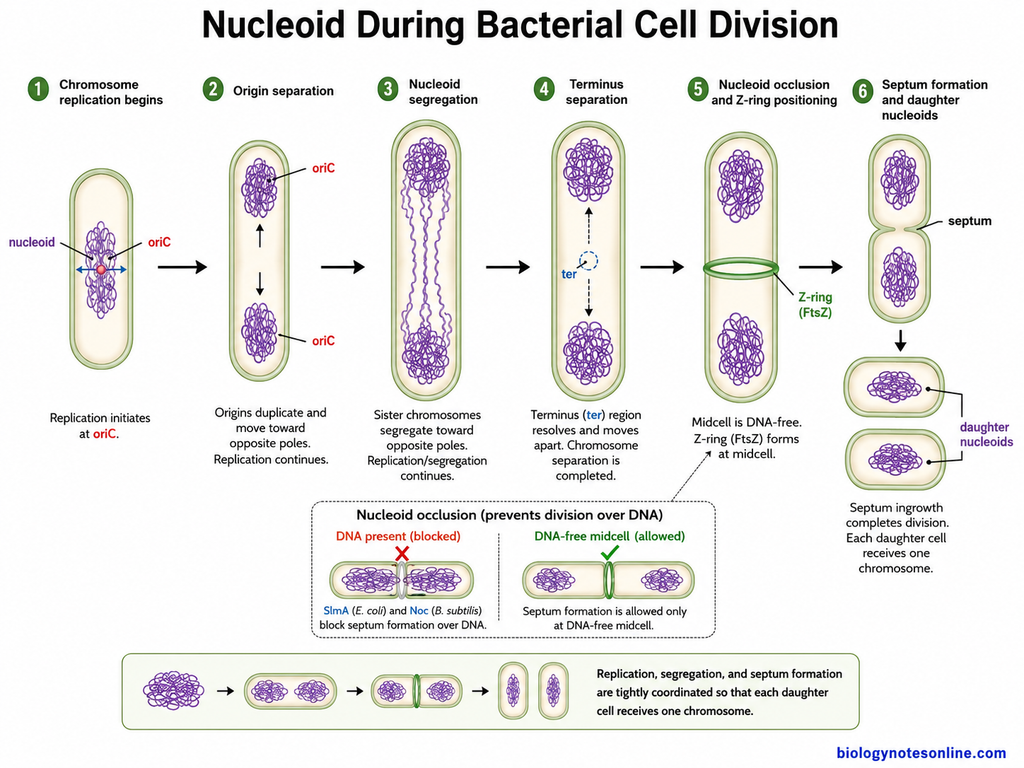
The following are the main changes of nucleoid during bacterial cell division-
- Chromosome replication – Replication begins from the origin of replication (oriC). New copies of the bacterial chromosome are formed.
- Origin separation – Newly replicated origin regions separate early and move away from each other. Chromosome segregation begins while DNA replication is still taking place.
- Nucleoid segregation – The two sister chromosomes are gradually separated into opposite regions of the growing cell. The nucleoid also changes its shape and organization during this process.
- Terminus separation – The last replicated terminus regions are resolved and separated near the later stage of chromosome segregation. This completes separation of the two chromosomes.
- Nucleoid occlusion – Division over unsegregated chromosomal DNA is prevented by a mechanism called nucleoid occlusion. SlmA performs this function in Escherichia coli, whereas Noc is present in Bacillus subtilis.
- Z-ring formation – After chromosome regions are cleared from the division site, FtsZ can form the Z-ring at the proper position. This marks the site for septum formation.
- Formation of daughter nucleoids – Septum formation separates the bacterial cell into two daughter cells. Each daughter cell normally receives one organized copy of the chromosome, forming its own nucleoid.
Nucleoid in Bacteria and Archaea
The nucleoid is present in both bacteria and archaea. In both groups, chromosomal DNA remains within the cytoplasm without a surrounding nuclear envelope, but the proteins involved in its packing are different in many groups.
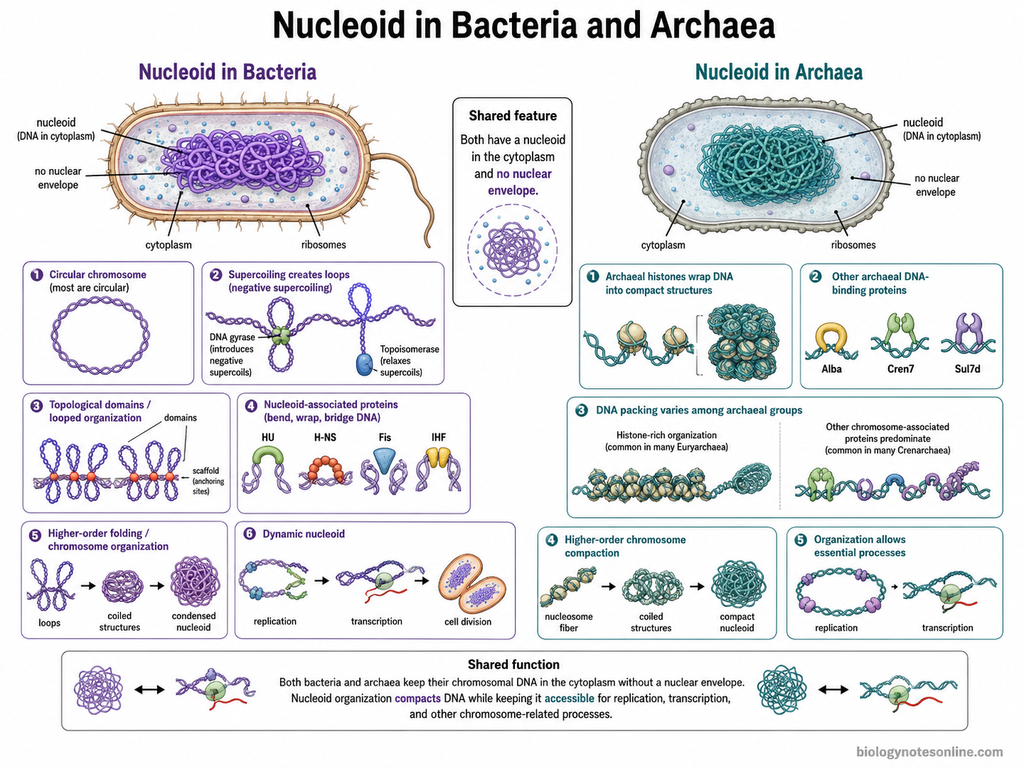
Nucleoid in Bacteria
- Bacterial nucleoid – In bacteria, the chromosome is compacted by DNA supercoiling, nucleoid-associated proteins and higher-order folding.
- Bacterial NAPs – Proteins such as HU, H-NS, Fis and IHF bind with DNA. They bend, wrap or bridge DNA and help in organization of nucleoid.
- Bacterial chromosome – Most bacteria possess circular chromosomes, although this is not same in all bacterial species.
- DNA organization – The bacterial chromosome forms loops and topological domains. This helps in packing the long DNA molecule within the small cell.
- Dynamic structure – The bacterial nucleoid does not remain fixed. Its organization changes during DNA replication, transcription and cell division.
Nucleoid in Archaea
- Archaeal nucleoid – Archaea also contain their chromosome in a non-membrane-bound nucleoid region. The mode of DNA packing varies among different archaeal groups.
- Archaeal histones – Many archaea contain histone proteins which bind and wrap DNA. These proteins help in compaction of the chromosome.
- Other DNA-binding proteins – Alba, Cren7 and Sul7d are chromosome-associated proteins found in different archaea. Their occurrence is not same in all groups.
- Chromosome organization – Some archaea mainly use histones, whereas others depend more on different DNA-binding proteins. Several types can also occur together.
- Common function – Archaeal nucleoid organization helps in DNA compaction and also allows replication, transcription and other chromosome-related processes.
How Is the Nucleoid Observed?
The nucleoid can be observed by different microscopic and molecular methods. DNA staining is commonly used for its direct visualization, while advanced techniques are used to study chromosome organization in more detail.
The following are the main methods used to observe the nucleoid-
- DNA staining – DNA-specific fluorescent dyes such as DAPI are commonly used. The stained nucleoid appears as a bright fluorescent region within the bacterial cell.
- Fluorescence microscopy – It is widely used to study nucleoid shape, position and changes during cell growth. Fluorescent DNA-binding proteins can also be used for nucleoid labeling.
- Phase-contrast microscopy – The nucleoid can be distinguished in some living bacterial cells because its refractive properties differ from the surrounding cytoplasm. It is useful without fluorescent staining.
- Electron microscopy – Thin sections of bacterial cells can be examined by electron microscopy (EM). It has been used for studying nucleoid morphology and its arrangement inside the cell, although fixation can affect the appearance of DNA.
- Cryo-electron tomography – Cryo-ET provides three-dimensional images of bacterial cells in a near-native frozen condition. The nucleoid region can be identified and its relation with other cellular structures can be studied.
- Super-resolution microscopy – Methods of super-resolution and single-molecule imaging provide more detailed information than conventional light microscopy. These are used to study NAPs, chromosome organization and nucleoid dynamics in living cells.
- Chromosome conformation capture – Methods such as 3C and Hi-C do not directly produce a microscopic image of the nucleoid. They detect contacts between different chromosome regions and are used to determine higher-order organization of the bacterial chromosome.
Importance of the Nucleoid
The nucleoid is important because it provides a compact and organized form of the prokaryotic chromosome. Its significance is not limited to DNA storage, but also to proper maintenance and inheritance of the bacterial genome.
The following are some of the important significance of nucleoid-
- Compact genome arrangement – A bacterial chromosome is much longer than the cell itself. Nucleoid organization allows this large DNA molecule to remain compact within a very small cellular space.
- Accessibility of DNA – The chromosome remains highly compacted but is still accessible to proteins working on DNA. This balance is important for normal cellular activities.
- Proper chromosome inheritance – Ordered nucleoid structure helps the replicated chromosomes to separate correctly. It is important so that daughter cells receive their genetic material during division.
- Genome stability – Proper chromosome organization decreases unwanted entanglement of the long DNA molecule. It also provides an arrangement compatible with DNA repair and recombination.
- Coordination of cellular processes – Different processes such as replication, transcription and chromosome segregation are closely associated with chromosome organization. Thus, nucleoid arrangement has significance beyond simple DNA packing.
- Control of gene activity – Changes in chromosome folding can influence the activity of different genes. Nucleoid-associated proteins (NAPs) are also important regulators of transcription.
- Response to environmental conditions – Nucleoid organization can change according to environmental conditions and growth state. Such changes help in adjustment of chromosome activity according to cellular condition.
Nucleoid vs Plasmid
| Feature | Nucleoid | Plasmid |
|---|---|---|
| Definition | Irregular DNA-rich region containing the main chromosome of a prokaryotic cell | Small extra-chromosomal DNA molecule present separately from the main chromosome |
| Location | Present within the cytoplasm | Also present within the cytoplasm |
| Main DNA | Contains the main chromosomal DNA | Contains additional DNA apart from the main chromosome |
| Size | Contains a very large chromosome | Usually much smaller than the bacterial chromosome |
| Shape | Nucleoid itself has an irregular shape | Plasmids are commonly circular DNA molecules, although linear forms also occur |
| Copy number | Usually associated with one main chromosome copy before replication | May occur in one, few or many copies in a cell |
| Replication | Chromosomal DNA replicates as part of the bacterial cell cycle | Replicates independently using its own origin of replication |
| Genes present | Contains genes mainly required for normal growth, metabolism and reproduction | Often carries accessory genes such as antibiotic resistance, virulence or special metabolic genes |
| Essentiality | Main chromosome present in nucleoid is generally essential for survival | Most plasmids are not essential under normal conditions |
| Associated proteins | Chromosomal DNA is associated with nucleoid-associated proteins (NAPs) | Plasmid DNA can also bind DNA-associated proteins |
| Transfer between cells | Main chromosome is not usually transferred as an independent DNA element | Some plasmids can move between bacterial cells by conjugation |
| Relationship | Nucleoid is the region where the bacterial chromosome is organized | Plasmid remains as a separate replicating DNA element outside the main chromosome |
Nucleoid vs Nucleus
| Feature | Nucleoid | Nucleus |
|---|---|---|
| Definition | Irregular DNA-rich region of a prokaryotic cell | Membrane-bound organelle containing the main genetic material of eukaryotic cells |
| Occurrence | Found in bacteria and archaea | Found in eukaryotic cells |
| Membrane | Not surrounded by a nuclear envelope | Surrounded by a double-membraned nuclear envelope |
| Nature | It is a region, not a membrane-bound organelle | It is a membrane-bound cell organelle |
| DNA | Contains the main prokaryotic chromosome | Contains several eukaryotic chromosomes |
| Chromosome shape | Usually circular in bacteria, but exceptions are present | Generally linear chromosomes |
| DNA-associated proteins | DNA is associated with NAPs in bacteria and histone-like proteins or histones in many archaea | DNA is associated mainly with histone proteins |
| Nucleolus | Nucleolus is absent | One or more nucleoli may be present |
| Separation from cytoplasm | Chromosomal region remains directly exposed to the cytoplasm | Genetic material is separated from cytoplasm by nuclear envelope |
| Transcription and translation | These processes can occur closely and may be coupled in bacteria | Transcription occurs in nucleus, while translation occurs mainly in cytoplasm |
| Organization | DNA is compacted by supercoiling, proteins and chromosome domains | DNA is packed into chromatin and higher-order chromosome structures |
| Main significance | Organizes and accommodates the prokaryotic genome within the cell | Protects and organizes the eukaryotic genome and provides a separate compartment for nuclear processes |
Nucleoid vs Bacterial Chromosome
| Feature | Nucleoid | Bacterial Chromosome |
|---|---|---|
| Definition | Irregular DNA-rich region present inside bacterial cell | Main DNA molecule carrying bacterial genetic information |
| Nature | A cellular region | A DNA molecule |
| Location | Present within the cytoplasm | Located mainly within the nucleoid |
| Composition | Contains chromosomal DNA, associated proteins and RNA | Mainly double-stranded DNA with associated proteins |
| Membrane | Not surrounded by a nuclear membrane | No membrane directly surrounds the chromosome |
| Shape | Irregular and changes during cell growth | Usually circular, but linear chromosomes are also found in some bacteria |
| Organization | Formed by compacted and organized chromosomal material | DNA is supercoiled, folded and organized into different domains |
| Associated proteins | Contains different nucleoid-associated proteins (NAPs) | NAPs bind directly with chromosomal DNA |
| Main role | Provides an organized region for chromosome packing and cellular genetic processes | Stores and carries genes required for bacterial growth and reproduction |
| Relationship | Nucleoid contains and organizes the bacterial chromosome | Bacterial chromosome forms the major DNA component of nucleoid |
Frequently Asked Questions About Nucleoid
What is a nucleoid?
A nucleoid is an irregular DNA-rich region of a prokaryotic cell containing the main chromosome. It is not surrounded by a nuclear membrane.
Where is the nucleoid found?
The nucleoid is found in the cytoplasm of prokaryotic cells, including bacteria and archaea.
What is the main function of the nucleoid?
Its main function is to contain and organize the chromosomal DNA. It also provides the chromosome for replication and gene expression.
Is the nucleoid surrounded by a membrane?
No. The nucleoid has no nuclear envelope or surrounding membrane.
What does the nucleoid contain?
It mainly contains chromosomal DNA, along with DNA-associated proteins and RNA.
What type of DNA is present in the nucleoid?
The nucleoid contains mainly double-stranded chromosomal DNA. In most bacteria, this chromosome is circular.
Is the nucleoid present in bacteria?
Yes. The bacterial chromosome is organized within the nucleoid region of the cell.
Do archaea have a nucleoid?
Yes. Archaea also have a nucleoid, but their DNA may be organized by histones or other DNA-binding proteins.
Do eukaryotic cells have a nucleoid?
No. Eukaryotic chromosomal DNA is mainly present inside a membrane-bound nucleus, instead of a nucleoid.
Is a nucleoid an organelle?
No. The nucleoid is not considered a membrane-bound organelle. It is a region of the cytoplasm where the chromosome is concentrated.
Is the nucleoid the same as a chromosome?
No. The chromosome is the DNA molecule, whereas the nucleoid is the region containing the chromosome together with associated proteins and RNA.
What is the difference between a nucleoid and a plasmid?
The nucleoid contains the main chromosomal DNA. A plasmid is usually a smaller, independently replicating DNA molecule separate from the main chromosome.
What is the difference between a nucleus and a nucleoid?
A nucleus is surrounded by a nuclear envelope. A nucleoid has no surrounding membrane and is found in prokaryotic cells.
Why does bacterial DNA need to be supercoiled?
DNA supercoiling helps compact the long chromosome so that it can fit within the small bacterial cell. It also affects chromosome organization.
Does the nucleoid contain proteins?
Yes. Different nucleoid-associated proteins (NAPs) remain associated with DNA and help in its organization and packing.
Does the nucleoid contain RNA?
Yes. RNA, particularly newly synthesized RNA associated with transcription, can remain associated with the nucleoid.
Is bacterial DNA always circular?
No. Most bacterial chromosomes are circular, but linear chromosomes are also present in some bacteria.
Can bacteria contain more than one chromosome?
Yes. Although most bacteria have one main chromosome, some bacterial species contain two or more chromosomes or large secondary replicons.
References
- Amemiya, H. M., Schroeder, J., & Freddolino, P. L. (2021). Nucleoid-associated proteins shape chromatin structure and transcriptional regulation across the bacterial kingdom. Transcription, 12(4), 182–218. https://doi.org/10.1080/21541264.2021.1973865
- Badrinarayanan, A., Le, T. B. K., & Laub, M. T. (2015). Bacterial chromosome organization and segregation. Annual Review of Cell and Developmental Biology, 31, 171–199. https://doi.org/10.1146/annurev-cellbio-100814-125211
- Brown, T. A. (2002). Genomes (2nd ed.). Wiley-Liss. https://www.ncbi.nlm.nih.gov/books/NBK21128/
- Cambré, A., & Aertsen, A. (2020). Bacterial vivisection: How fluorescence-based imaging techniques shed a light on the inner workings of bacteria. Microbiology and Molecular Biology Reviews, 84(4), e00008-20. https://doi.org/10.1128/MMBR.00008-20
- Cooper, G. M. (2000). The cell: A molecular approach (2nd ed.). Sinauer Associates. https://www.ncbi.nlm.nih.gov/books/NBK9839/
- Dame, R. T., Rashid, F.-Z. M., & Grainger, D. C. (2020). Chromosome organization in bacteria: Mechanistic insights into genome structure and function. Nature Reviews Genetics, 21(4), 227–242. https://doi.org/10.1038/s41576-019-0185-4
- Dillon, S. C., & Dorman, C. J. (2010). Bacterial nucleoid-associated proteins, nucleoid structure and gene expression. Nature Reviews Microbiology, 8(3), 185–195. https://doi.org/10.1038/nrmicro2261
- Dorman, C. J. (2004). H-NS: A universal regulator for a dynamic genome. Nature Reviews Microbiology, 2(5), 391–400. https://doi.org/10.1038/nrmicro883
- Dorman, C. J. (2013). Genome architecture and global gene regulation in bacteria: Making progress towards a unified model? Nature Reviews Microbiology, 11(5), 349–355. https://doi.org/10.1038/nrmicro3007
- Fournes, F., Val, M.-E., Skovgaard, O., & Mazel, D. (2018). Replicate once per cell cycle: Replication control of secondary chromosomes. Frontiers in Microbiology, 9, 1833. https://doi.org/10.3389/fmicb.2018.01833
- Gahlmann, A., & Moerner, W. E. (2014). Exploring bacterial cell biology with single-molecule tracking and super-resolution imaging. Nature Reviews Microbiology, 12(1), 9–22. https://doi.org/10.1038/nrmicro3154
- Henneman, B., van Emmerik, C., van Ingen, H., & Dame, R. T. (2018). Structure and function of archaeal histones. PLoS Genetics, 14(9), e1007582. https://doi.org/10.1371/journal.pgen.1007582
- Hołówka, J., & Zakrzewska-Czerwińska, J. (2020). Nucleoid associated proteins: The small organizers that help to cope with stress. Frontiers in Microbiology, 11, 590. https://doi.org/10.3389/fmicb.2020.00590
- Jin, D. J., Cagliero, C., & Zhou, Y. N. (2013). Role of RNA polymerase and transcription in the organization of the bacterial nucleoid. Chemical Reviews, 113(11), 8662–8682. https://doi.org/10.1021/cr4001429
- Kleckner, N., Fisher, J. K., Stouf, M., White, M. A., Bates, D., & Witz, G. (2014). The bacterial nucleoid: Nature, dynamics and sister segregation. Current Opinion in Microbiology, 22, 127–137. https://doi.org/10.1016/j.mib.2014.10.001
- Laursen, S. P., Bowerman, S., & Luger, K. (2021). Archaea: The final frontier of chromatin. Journal of Molecular Biology, 433(6), 166791. https://doi.org/10.1016/j.jmb.2020.166791
- Leonard, A. C., & Grimwade, J. E. (2010). Initiation of DNA replication. EcoSal Plus, 4(1). https://doi.org/10.1128/ecosalplus.4.4.1
- Milne, J. L. S., & Subramaniam, S. (2009). Cryo-electron tomography of bacteria: Progress, challenges and future prospects. Nature Reviews Microbiology, 7(9), 666–675. https://doi.org/10.1038/nrmicro2183
- Molan, K., & Žgur Bertok, D. (2022). Small prokaryotic DNA-binding proteins protect genome integrity throughout the life cycle. International Journal of Molecular Sciences, 23(7), 4008. https://doi.org/10.3390/ijms23074008
- Parker, N., Schneegurt, M., Tu, A.-H. T., Lister, P., & Forster, B. M. (2016). Microbiology. OpenStax. https://openstax.org/details/books/microbiology
- Peeters, E., Driessen, R. P. C., Werner, F., & Dame, R. T. (2015). The interplay between nucleoid organization and transcription in archaeal genomes. Nature Reviews Microbiology, 13(6), 333–341. https://doi.org/10.1038/nrmicro3467
- Reyes-Lamothe, R., & Sherratt, D. J. (2019). The bacterial cell cycle, chromosome inheritance and cell growth. Nature Reviews Microbiology, 17(8), 467–478. https://doi.org/10.1038/s41579-019-0212-7
- Robinow, C., & Kellenberger, E. (1994). The bacterial nucleoid revisited. Microbiological Reviews, 58(2), 211–232. https://doi.org/10.1128/mr.58.2.211-232.1994
- Salton, M. R. J., & Kim, K.-S. (1996). Structure. In S. Baron (Ed.), Medical microbiology (4th ed.). University of Texas Medical Branch at Galveston. https://www.ncbi.nlm.nih.gov/books/NBK8477/
- Schwab, S., & Dame, R. T. (2025). Identification, characterization and classification of prokaryotic nucleoid-associated proteins. Molecular Microbiology, 123(3), 206–217. https://doi.org/10.1111/mmi.15298
- Shen, B. A., & Landick, R. (2019). Transcription of bacterial chromatin. Journal of Molecular Biology, 431(20), 4040–4066. https://doi.org/10.1016/j.jmb.2019.05.041
- Verma, S. C., Qian, Z., & Adhya, S. L. (2019). Architecture of the Escherichia coli nucleoid. PLoS Genetics, 15(12), e1008456. https://doi.org/10.1371/journal.pgen.1008456
- Wang, X., Montero Llopis, P., & Rudner, D. Z. (2013). Organization and segregation of bacterial chromosomes. Nature Reviews Genetics, 14(3), 191–203. https://doi.org/10.1038/nrg3375
- Woldringh, C. L. (2023). The bacterial nucleoid: From electron microscopy to polymer physics—A personal recollection. Life, 13(4), 895. https://doi.org/10.3390/life13040895
- Wu, L. J., & Errington, J. (2012). Nucleoid occlusion and bacterial cell division. Nature Reviews Microbiology, 10(1), 8–12. https://doi.org/10.1038/nrmicro2671
- Yatskevich, S., Rhodes, J., & Nasmyth, K. (2019). Organization of chromosomal DNA by SMC complexes. Annual Review of Genetics, 53, 445–482. https://doi.org/10.1146/annurev-genet-112618-043633