

Water Distiller is a device which is used for purification of water by distillation process. It gives clean water by heating the water and then cooling the steam. It is based on evaporation and condensation of water.
In water distiller, the raw water is taken in a boiling chamber. The water is heated until it boils and forms steam. During this process, the impurities such as heavy metals, dissolved salts, minerals, and bacteria are left in the boiling chamber.
The steam produced from boiling water is passed into a cooling part. This part is generally a condenser coil. Here the steam becomes cool and changes into water droplets.
The water droplets are then collected in another container. This water is called distilled water. It is free from many impurities like lead, arsenic, fluoride, and viruses.
Some water distiller has activated carbon filter also. It removes volatile organic compounds (VOCs) and synthetic chemicals which may come with the steam. Thus water distiller is used to get pure water for drinking, laboratory, medical use and household appliances.
Working Principle of Water Distiller
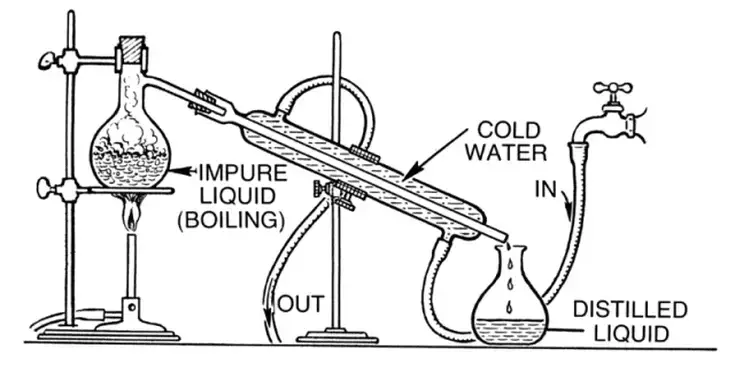
Principle of Water Distiller is based on evaporation and condensation. Water is heated to form steam. The steam is cooled and pure water is obtained.
In this process, raw water is kept in boiling chamber. Heat is given by heating element. The water starts boiling and changes into steam.
The impurities are not changed into steam. Heavy metals, dissolved solids, minerals, and bacteria remain in the boiling chamber. This is because their boiling point is higher than water.
The steam then goes to condenser coil. Here the steam is cooled by fan or cooling surface. It again changes into water drops.
These water drops are collected in another container. Some distiller also has activated carbon post-filter. It removes volatile organic compounds (VOCs) which may come with the steam.
Parts of a Water Distiller
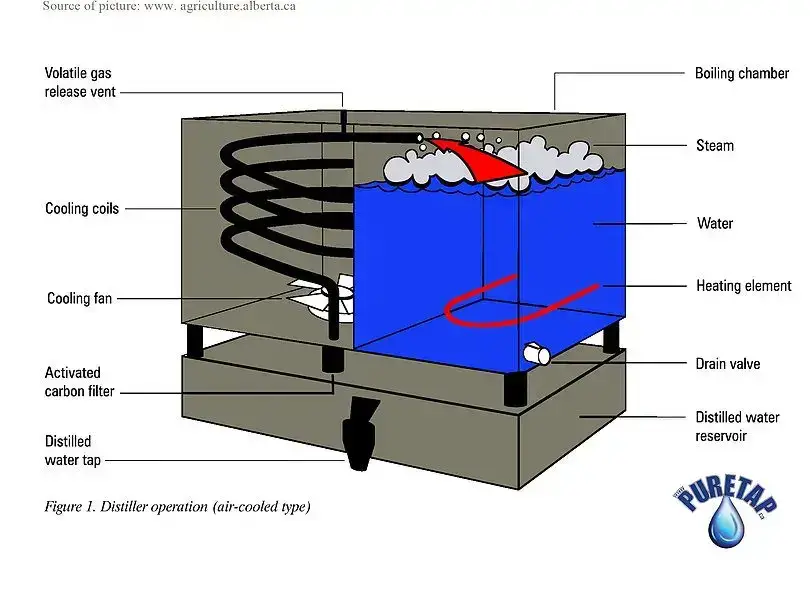
Parts of a Water Distiller
- Boiling Chamber – It is the tank where source water is placed and heated. The water boils here and forms steam. It is also called vapour generator.
- Heating Element – It is used to give heat to the water. It brings the water to rolling boil. It is also called immersion resistor.
- Condenser – It is the cooling part of water distiller. The steam passes through condenser coil and changes again into liquid water.
- Cooling Fan – It is used to cool the vapour inside the condenser. It helps the steam to form water droplets.
- Activated Carbon Filter – It is a post-filter present near the outlet or spout. It removes volatile organic compounds (VOCs), bad smell and taste.
- Storage Tank – It is the vessel where distilled water is collected. It may be glass, plastic or stainless steel. It is also called collection container or carafe.
- Volatile Gas Vents – These are present in some distiller. It allows volatile organic chemicals to escape from the unit.
- Silicone Seals and O-rings – These are gasket-like parts. It prevents steam from escaping and maintains pressure inside the distiller.
- Water Level Gauge and Control Valve – These are present in large or automatic distiller. It shows water level and controls water flow into boiling tank.
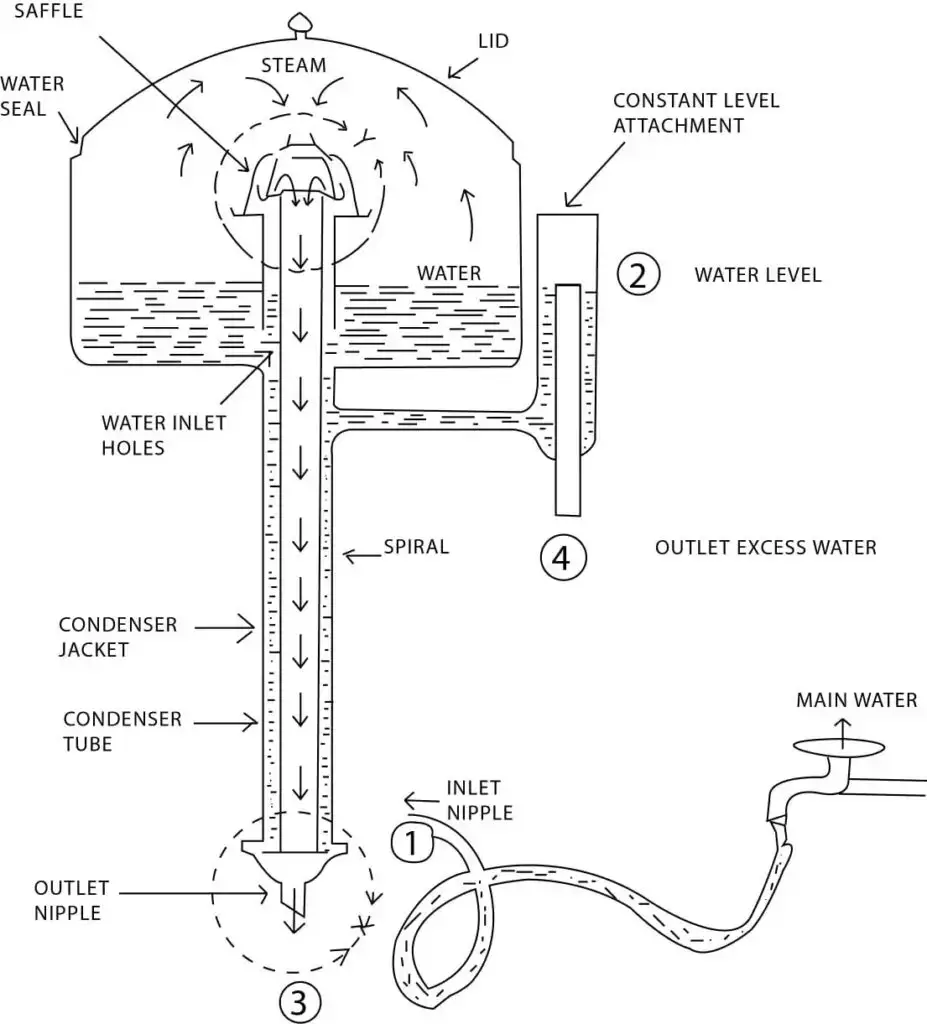
Types of Water Distillers
The following are the types of water distillers-
- Manual Distillers – These are simple type of distillers. In this type, water is poured manually into the boiling chamber for each cycle. It generally produces about 1 gallon water at one time.
- Automatic Distillers – These are connected directly with water line. It produces pure water continuously. It has float valve or electronic sensor to stop the system when storage tank becomes full.
- Plumbing Distillers – These distillers are fitted with the plumbing system of a building. It supplies distilled water through the plumbing line.
- Countertop or Household Distillers – These are small and portable distillers. It is used in houses for small family or single user. It can be placed on kitchen counter.
- Mid-Capacity Home Units – These are used for moderate water requirement. It produces about 3 to 5 gallons water per day. It generally has automatic shut-off system.
- Large Capacity or Commercial Distillers – These are used in large houses, offices, laboratories and medical facilities. It works automatically. It can produce from 6 gallons to very large amount of water per day.
- Multi-Effect Distillation (MED) – It is a large-scale distillation system. In this type, heat of vaporization is used again in many stages at decreasing pressure. It is used for seawater desalination and pharmaceutical water production.
- Vapor Compression Distillation (VCD) – It is also called Mechanical Vapor Recompression (MVR). In this type, a compressor increases the pressure and temperature of vapour. This vapour is then used to heat the incoming water.
- Clean Steam Generators (CSG) – These are used to produce pure steam from feedwater. It is mainly used for sterilization of equipment.
- Single-Basin Solar Stills – It is a basic solar distiller. It has black basin containing water and a slanted transparent cover. Solar heat evaporates the water and the vapour condenses on the cover.
- Multi-Basin Solar Stills – These solar stills have many basins or stages. It increases evaporation and condensation. It produces more water than single-basin still.
- Modified Solar Stills (MSS) – These are improved solar stills. It may have reflectors, cooling fans, phase change materials and lenses. These parts increase heat storage and sunlight concentration.
- Alternative Geometry Solar Stills – These are solar stills having special shapes. The shapes help to catch more sunlight and improve condensation. Examples are tubular, pyramidal and inverted absorber solar stills.
Operating Procedure of Water Distiller
- Raw water or tap water is first taken. It is poured slowly into the boiling chamber of the water distiller. The water should not be filled above the marked level. If more water is filled, then boiling water may spill inside the unit.
- The boiling chamber is checked properly before closing. The chamber should be placed in correct position. The lid should be fitted tightly so that steam does not come out from wrong side.
- The collection container is kept below the outlet or spout. The mouth of the container should be just below the spout. It is done so that distilled water drops directly into the container.
- The distiller is then connected with electric power source. The switch is turned on. After switching on, the heating element starts to heat the water present in the boiling chamber.
- The water becomes hot and then starts boiling. After boiling, water changes into steam. In this step, heavy metals, minerals, bacteria, and other contaminants do not pass with steam. They remain in the boiling chamber.
- The steam formed from boiling water rises upward. It passes into the condenser coil or cooling chamber. The steam is not collected directly. It is first allowed to cool.
- In the condenser coil, the steam loses heat. Cooling fan or cooling surface helps in this cooling. The steam again changes into small water droplets. This is called condensation.
- The condensed water droplets move towards the outlet. Before collection, the droplets may pass through activated carbon filter. This filter removes volatile organic compounds (VOCs) and odour which may come with steam.
- The purified water then comes out through the spout. It drips slowly into the collection container. This collected water is distilled water. It is clean and mineral-free water.
- After the distillation cycle is completed, the machine is switched off. The plug is removed from the power source. The unit is allowed to cool before opening the boiling chamber.
- The remaining water and impurities are thrown out from the boiling chamber. The chamber is then rinsed with clean water. It is wiped dry before next use.
- The boiling chamber should be cleaned regularly. If it is not cleaned, mineral scale may form inside it. This can reduce heating and also affect the working of water distiller.
Applications of Water Distiller
The following are the applications of water distiller-
- It is used to provide clean water for drinking. It is also used for cooking, making food, beverages and baby formula.
- It is used in medical and healthcare work. Distilled water is used for sterilizing surgical tools, operating autoclaves, washing wounds and dental procedures.
- It is used in laboratory and scientific research. It is used for mixing chemical reagents, cleaning glassware and running sensitive diagnostic instruments.
- It is used in health and personal care devices. CPAP machines and Neti pots are filled with distilled water to prevent mineral deposition and infection.
- It is used in household appliances. Steam irons and humidifiers use distilled water to prevent limescale formation.
- It is used in automotive maintenance. It is used in lead-acid car batteries and for diluting radiator coolant. It helps to prevent mineral corrosion and battery failure.
- It is used for general cleaning. Cars, windows and computer monitors are washed with distilled water to get clear and spot-free surface.
- It is used in aquariums and hydroponics. Distilled water gives toxin-free water for fish tank and helps in exact nutrient control in indoor gardening.
- It is used in industrial and commercial manufacturing. It is used in preparation of pharmaceuticals, cosmetics and food or beverage processing.
- It is used in wastewater treatment and desalination. It helps in concentrating high-salinity wastewater and also used to make seawater usable.
- It is used during outdoor survival and emergency condition. Water from streams, lakes or unsafe supply can be purified by distillation.
Advantages of Water Distiller
The following are the advantages of water distiller-
- It gives highly pure water. Distillation removes about 99.9% impurities from water. It removes heavy metals, fluoride, bacteria, viruses and dissolved solids.
- It does not waste water during purification. In this process, water is boiled and condensed. So there is no rejected waste water like some other systems.
- It does not need plumbing or difficult installation. Countertop water distiller is only connected with electric plug. Then it can be used.
- It is useful for many purposes. The water is free from minerals. So it is used in steam irons, humidifiers, CPAP machines and car batteries to prevent scale formation.
- It is cost effective for long use. Distilled water can be made at home. So continuous buying of bottled distilled water is not needed.
- It helps to reduce plastic waste. When distilled water is made at home, use of single-use plastic bottle becomes less.
- It is simple to maintain. The boiling chamber is cleaned or descaled after some time. Activated carbon post-filter is also changed when required.
Limitations of Water Distiller
The following are the limitations of water distiller-
- It consumes more energy. Water is heated continuously to form steam. So electricity or heat source is needed for whole process.
- It produces water slowly. Distillation takes more time because water is purified drop by drop. A household distiller may take 4 to 6 hours to make one gallon water.
- The taste of distilled water may be flat. This is because minerals and some oxygen are removed during distillation. So the water may taste neutral or bland.
- It removes useful minerals also. Calcium and magnesium present in water are also removed with other impurities.
- It may not remove all chemicals completely. Some volatile organic compounds (VOCs) have lower boiling point than water. These chemicals may evaporate with steam and condense again with water.
- It needs activated carbon post-filter for better removal of VOCs. Without this filter, some volatile chemicals may remain in distilled water.
- It needs regular cleaning. Minerals and impurities left in the boiling chamber form hard scale. This scale should be removed by descaling.
- If scale is not cleaned, the heating element may be damaged. It can also reduce the working efficiency of water distiller.
Precautions Should be taken When Operating a Water Distiller
The following are the precautions should be taken when operating a water distiller-
- The lid should not be opened when the distiller is working. Hot steam may come out and causes burn.
- The boiling chamber should not be touched during distillation. It becomes very hot. The storage tank also may remain hot just after the cycle.
- The plug should be removed before cleaning or repairing. The machine should be allowed to cool completely.
- The distiller should be kept in a well ventilated place. During cooling and condensation, warm air is released from the machine.
- The distillation system should not be completely closed. It should have proper venting. Otherwise pressure may build up inside.
- The water level should be checked during operation. The boiling chamber should not become completely dry.
- The collection container should also be watched. It should not overflow during collection of distilled water.
- The unit should be connected with proper grounded electric outlet. Poor electrical connection may cause fire, injury or damage of machine.
- If overheating signal is shown, the distiller should be switched off. The cause of overheating should be checked before starting again.
- The glass collection bottle should be checked for crack. It should not be exposed to sudden temperature change.
- The seals, gaskets and tubes should be checked regularly. There should be no leakage of steam or water.
- Corrosive cleaners and steel wool should not be used for cleaning. These can scratch and damage the stainless steel lining.
How to clean your water distiller?
The following are the steps to clean water distiller-
- After every distillation cycle, the remaining water in the boiling chamber should be thrown out. This water contains minerals and impurities.
- The boiling chamber is rinsed with clean water. Then it is wiped dry before next use. This slows down mineral scale formation.
- The outer part of the distiller is wiped with a damp cloth. Dust and grease should not be allowed to collect near the vents and fan.
- For deep cleaning, the plug is first removed. The distiller is allowed to cool. Then the lid is removed and the boiling chamber is drained.
- Large loose pieces of mineral scale are removed from the chamber. It should be done gently.
- Tap water is filled in the chamber just above the scale line. Then distiller cleaning powder or food-grade citric acid is added. White vinegar can also be used.
- Corrosive cleaners or steel wool should not be used. These can damage the stainless steel surface of the chamber.
- The unit is plugged in and the water is heated until it boils. Then the plug is removed. The cleaning solution is allowed to remain inside the chamber.
- If scale is heavy, the lid is kept open and the solution is left for several hours or overnight.
- The dirty water and dissolved scale are drained out. The inner wall is gently wiped with sponge.
- The boiling chamber is rinsed with clean water two or more times. It should be cleaned properly before next use.
- The collection jug is washed once in a week. Warm water and mild dish detergent is used. Then it is rinsed and dried.
- Activated carbon post-filter is changed after 30 to 40 days. It should also be changed if bad taste or black specks are seen.
- The cooling fan and condenser coils are cleaned after few months. A soft brush, vacuum or compressed air is used to remove dust.
References
- Lower, S. (2022, September 27). 4.5: Separating volatile solutions – distillation. Chemistry LibreTexts.
- RIGID HVAC. (n.d.). 5 key differences between air cooled and water cooled condenser.
- Avensia Group. (2021, September). 8 uses of distilled water in the health industry.
- Khalaf, M. O., Özdemir, M. R., & Sultan, H. S. (2025). A comprehensive review of solar still technologies and cost: Innovations in materials, design, and techniques for enhanced water desalination efficiency. Water, 17(10), 1515. https://doi.org/10.3390/w17101515
- Bohidar, S. K., Sarathi, Y., & Sen, P. K. (2015). A review on solar distillation and its working. International Journal For Technological Research In Engineering, 2(8), 1458-1460.
- ChemWorld. (n.d.). ASTM D1193 water.
- ResearchGate. (n.d.). Advancements in solar still water desalination: A comprehensive review of design enhancements and performance optimization.
- Battlbox. (n.d.). An in-depth guide to the distilling water process: Techniques, benefits, and applications.
- Welsh, M. (n.d.). Boiler scale removal guide: Clean scale from your boiler. Chardon Labs.
- ETI. (n.d.). Chemical descaling explained: How to choose the right scale remover for industrial equipment.
- CO-Z. (2024, December 4). Common water distiller problems and how to fix them.
- Desai, S. (2025, February 18). Comparison of WFI production methods: Multi-effect distillation vs. vapor compression. Bioprocess Online.
- ASTM International. (2006). Standard specification for reagent water (ASTM D1193-06).
- ASTM International. (1999). Standard specification for reagent water (ASTM D1193-99e1).
- The Chemicals Man. (n.d.). De-scaling solution for distilled water plant application.
- Altum Technologies. (2026, January 21). Descaling: The complete guide to removing scale buildup in industrial systems.
- Agaja, S. A., Opara, C. E., & Ofojetu, C. H. (2021). Design, construction and application of a solar water distiller. International Journal of Advances in Engineering and Management, 3(11), 79-88. https://doi.org/10.35629/5252-03117988
- Miracle. (n.d.). Difference between air-cooled and water-cooled condensers.
- Jasperse. (n.d.). Distillation 65 [Lab manual]. Chem 355.
- Kamrin, M., Hayden, N., Christian, B., Bennack, D., & D’Itri, F. (1991). Distillation for home water treatment (WQ-12). Cooperative Extension Service, Purdue University.
- Khan Academy. (n.d.). Distillation curves [Video].
- Pure Water, Inc. (n.d.). Distilled water vs RO water.
- Strahl, A. (2025, September 29). Distilled water vs reverse osmosis: What’s best for your home? US Water Systems.
- Johnson, S. (2025, June 7). Distilled vs RO water systems: Reverse osmosis is better. Frizzlife.
- Durastill Inc. (n.d.). Instructions for fan-cooled electric water distiller models 30H, 30J, 46A, and 46C.
- West Virginia University. (2017). Experiment 3 – distillation.
- The Water Distiller Store. (n.d.). FAQ.
- Puretec Industrial Water. (n.d.). Guide to ASTM high purity water quality standards.
- Living Whole. (2024, March 27). How does a water distiller work?
- Rocky Mountain Water Distillers. (n.d.). How OFTEN to clean water distiller?
- Rocky Mountain Water Distillers. (n.d.). How to clean a Durastill water distiller – VIDEO + PDF guide.
- Ace Water Shop. (2026, March 30). How to maintain and clean your water distiller for longevity.
- Veolia Water Technologies. (n.d.). Industrial water distillation.
- Choubani, K., & Ben Rabha, M. (2025). Innovative solar still desalination: Effects of fans, lenses, and porous materials on thermal performance under renewable energy integration. Inventions, 10(6), 109. https://doi.org/10.3390/inventions10060109
- Lab2 distillation handout1. (n.d.).
- Waterman Engineers Australia. (2025, June 24). Multi-effect distillation with thermal vapour compression for seawater desalination.
- LPR Global Inc. (n.d.). Packaged wastewater treatment system – vapor compression distillation. US Korea Hotlink.
- Woodard, J. (2022, July 15). Reverse osmosis vs distilled water. Fresh Water Systems.
- Teach Engineering. (n.d.). Solar distillation.
- Wikipedia. (2026, April 10). Solar still.
- Chu, J. (2024, October 8). Solar-powered desalination system requires no extra batteries. MIT News.
- My Pure Water. (n.d.). Support & troubleshooting.
- Technical compendium on water distillation systems: Principles, engineering architectures, and industrial-scale applications. (n.d.).
- CO-Z. (2026, February 27). The ultimate guide to water distillers: Ensuring purity in every drop.
- Troubleshooting a water distiller – How to repair a water distiller [Video]. (n.d.). YouTube.
- My Pure Water. (n.d.). Troubleshooting the Pure Water Mini Classic.
- Appropedia. (n.d.). Understanding solar stills/Part I.
- Stout Energy. (2026, July 29). Understanding the distinction between air-cooled and water-cooled chillers.
- The Chemistry Blog. (n.d.). Uses of distilled water.
- Aqua-Chem. (n.d.). Vapor compression distillation vs multiple effect distillation.
- Molewater. (n.d.). Vapor compression distiller | High-efficiency VCD system.
- Wikipedia. (2025, March 7). Vapor-compression evaporation.
- HTAC. (2024, November 13). Water cooled vs air cooled condensers: What are differences.
- Eric. (2025, November 22). Water distiller buying guide: What to know before you buy. VEVOR.
- H2O Labs. (n.d.). Water distiller comparison.
- H2O Labs. (n.d.). Water distiller trouble shooting guide for H2o Labs model 200.
- Karki, P. (2022, December 5). Water distiller- principle, parts, types, uses, examples. Microbe Notes.
- Duraline Systems. (n.d.). Water distillers – The best water for your autoclave.
- Fresh Water Systems. (n.d.). Water distillers comparison.
- Chemical Development Team. (2018, April 12). Water formed scale – common scaling types in refineries. FQE Chemicals.
- Sigma-Aldrich. (n.d.). Water, deionized distilled, ASTM type II distilled, ASTM type II 7732-18-5.
- CO-Z. (2026, January 16). What is a water distiller and how does it work?
- Woodard, J. (2018, December 26). What is a water distiller and how does it work? Fresh Water Systems.
- Guangzhou Chunke Environmental Technology Co. Ltd. (2024, June 26). What is a household water distiller? Does it consume a lot of electricity?
- Leo Bios. (2025, June 24). What is distilled water used for in the laboratory? Ucallmlabs.
- Herold, N. (2024, October 28). What is the difference between vapor compression vs. multiple effect distillation. MECO.
- GZ Team A. (2025, May 23). Why distilled water is crucial in medical labs. GZ Industrial Supplies.