

Decanter centrifuge is an industrial machine which is used to separate solid materials from liquids present in a slurry. It is also known as horizontal bowl centrifuge, solid bowl centrifuge, or scroll centrifuge.
It works by spinning at very high speed. In this process, a strong centrifugal force is produced which increases the natural gravitational settling process. This force may be about 3000 to 4000 times greater than normal gravity.
During this process, the denser solid particles are forced outward against the wall of the rotating bowl. An internal screw conveyor or scroll pushes the solid particles towards the solids discharge port.
The lighter and clarified liquid is called centrate. It flows in opposite direction and comes out through another outlet. It is used in wastewater treatment, food and beverage processing, mining, oil recovery, and chemical manufacturing.
Working Principle of Decanter Centrifuges
Working Principle of Decanter Centrifuges is based on the separation of solid and liquid by high speed centrifugal force. In this process, the slurry is allowed to enter into the rotating bowl through a central feed tube. The rotating bowl produces force which is much greater than normal gravity.
The separation occurs due to difference in density. The heavier and denser solid particles are pushed outward and deposited against the inner wall of the bowl. The lighter liquid phase moves inward and forms a separate liquid layer. This liquid layer is called pond.
Inside the bowl, a screw conveyor is present. It is also called scroll or auger. This conveyor rotates in the same direction of the bowl but at a little different speed. This speed difference is called differential speed.
The scroll continuously scrapes the compacted solid particles from the wall of the bowl. Then it pushes them towards the tapered conical end of the machine. This conical part is commonly called beach.
During this process, the solid particles are moved against centrifugal force and become more dewatered. Then the solids are discharged through the discharge ports present at the small end of the centrifuge.
At the same time, the clarified liquid flows in opposite direction towards the larger cylindrical end of the bowl. It spills over adjustable weir plates or removed by an impeller. Thus, the dried solids and purified liquid are continuously discharged from the machine.
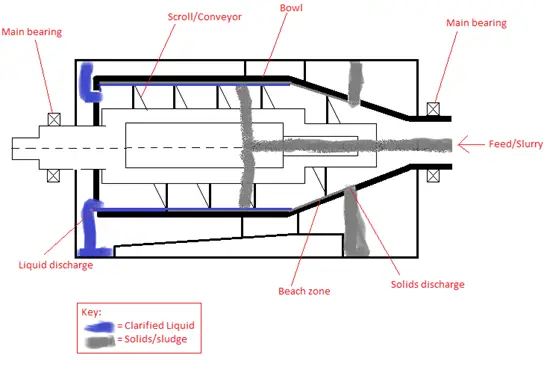
Parts of Decanter Centrifuges
The following are the main parts of Decanter centrifuges–
- Rotating Bowl
It is the main cylindrical and conical chamber of the centrifuge. In this part, high speed rotation produces centrifugal force for separation. - Screw Conveyor (Scroll or Auger)
It is an internal rotating part having helical flights. It rotates at slightly different speed than the bowl and moves the settled solids towards the discharge end. - Feed Pipe (Inlet Tube)
It is a stationary tube through which the slurry is continuously pumped into the centre of the centrifuge. - Discharge Ports
These are the outlets present at the opposite ends of the bowl. The separated solids and clarified liquid or centrate come out through these ports. - Weir Plates (Dam Plates)
These are adjustable plates present at the liquid discharge end. It controls the level or depth of liquid inside the bowl, which is called pond. - Drive System (Motors and Gearbox)
It is the power source of the machine. It consists of electric main drive motor for the bowl, secondary back-drive motor and gearbox for controlling the differential speed of the conveyor. - Frame and Casing
The frame is a heavy duty base which supports the whole machine. The casing covers the rotating parts, contains the process and collects the separated phases. - Main Bearings
These are heavy duty bearings present on the end hubs. They support the high speed rotation of the bowl and conveyor assembly. - Wear Protection
It includes abrasion resistant materials such as tungsten carbide tiles or stellite liners. These protect the scroll flights and solid discharge ports from erosion. - Vibration Isolators (Dampers)
These are special mounts attached with the base frame. It reduces noise and keeps balance during high speed operation. - Baffles / Oil Rings
These are internal barriers present in 3-phase decanter centrifuges. They separate lighter liquid such as oil from heavier liquid such as water before discharge.
How the Decanter Process Works
The following are the steps of Decanter centrifuge process–
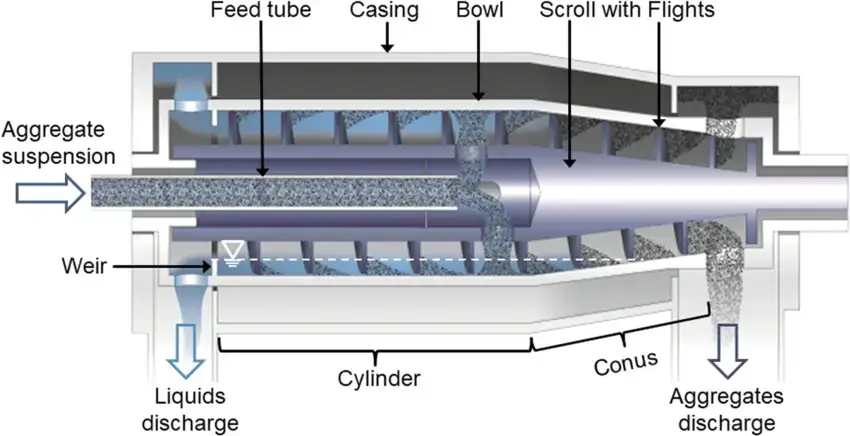
- The unseparated mixture of liquid and solid is pumped into the machine through a central feed pipe. This mixture is called slurry. Then it is directed into the rapidly rotating bowl.
- The bowl rotates at very high speed and produces strong centrifugal force. This force pushes the heavier and denser solid particles outward and compacted against the inner wall of the bowl.
- The liquid is lighter than the solid materials. So, it forms a separate concentric layer inside the bowl and remains closer to the centre of the bowl.
- An internal screw conveyor or scroll rotates in the same direction as the bowl. But it rotates at a slightly different speed. Due to this speed difference, the conveyor continuously scrapes the settled solids from the bowl wall.
- The conveyor slowly pushes the collected solids towards the tapered conical section of the bowl. This section is called beach. Here, the extra moisture drains off and the dried solids are ejected through discharge ports at the end of the machine.
- At the same time, the lighter and clarified liquid is called centrate. It flows in opposite direction towards the wider cylindrical end of the bowl. Then it comes out through liquid discharge ports or adjustable weir plates.
Parameters and influencing factors of the separation
The following are the important parameters and factors which influence the separation efficiency of Decanter centrifuge–
- Bowl speed controls the strength of centrifugal force. Higher bowl speed produces greater force. This helps the solid particles to settle faster and improves the clarity of liquid.
- Differential speed is the difference between the speed of rotating bowl and internal screw conveyor. It controls the residence time of solids inside the machine. It also maintains the balance between throughput and dryness of discharged solids.
- Pond depth is the liquid level inside the bowl. It is adjusted by using weir plates. A deeper pond gives better liquid clarity, while a shallow pond increases the dry beach area and produces drier solid cake.
- Feed flow rate is the rate at which slurry enters into the centrifuge. If the flow rate is very high, then the particles may come out before complete settling. So, proper flow rate is important for separation.
- Bowl dimensions include diameter and length of the bowl. A larger bowl diameter increases the centrifugal force and settling area. A longer bowl allows the material to remain for more time inside the centrifuge.
- Beach angle is the steepness of the conical part of the bowl. It affects the movement of solids towards the discharge end. It also affects the final dryness of the sludge.
- Conveyor pitch is the spacing between the blades of the screw conveyor. It controls how the solids are transported outside the bowl. It also affects the torque of the machine.
- Particle size and distribution affects the settling rate of solids. Larger and heavier particles settle more quickly than fine particles. When the particle size is very different, the separation becomes difficult.
- Density difference between solid particles and liquid phase is very important. Greater density difference gives faster and more efficient separation. If the difference is less, separation becomes slow.
- Fluid viscosity and temperature affects the movement of solid particles. High viscous liquid gives more resistance and slows down settling. Heating is used in some cases to reduce viscosity and improve separation.
- Feed solids concentration means the amount of solids present in the incoming slurry. High solid concentration increases viscosity and mechanical load on the screw conveyor.
- Chemical conditioning is done by adding chemicals like flocculants or coagulants. These chemicals join small particles into larger and heavier clumps. This improves the separation process.
Applications of Decanter Centrifuges
Some of the important applications of Decanter centrifuges are-
- Decanter centrifuge is used in wastewater treatment for dewatering and thickening of municipal and industrial sludge.
- It is also used for treatment of leachate and recovery of water in Zero Liquid Discharge (ZLD) system.
- In food industries, it is used for clarification of fruit juices, wine and beer.
- It is used in dairy industries for processing of whey, lactose and other dairy products.
- It is used for recovery of starch and extraction of edible oils such as olive oil, avocado oil and palm oil.
- In oil and gas industries, it is used for processing of drilling mud and crude oil tank bottoms.
- It is used for refining petroleum and also for purification of waste oils, diesel and lubricants.
- In mining industries, it is used for dewatering of aggregate tailings and mineral slurries.
- It is used for classification of minerals like kaolin clay and calcium carbonate.
- It is also used for recovery of important metals such as gold, silver, copper and platinum.
- In chemical industries, it is used for separation of catalysts from reaction mixtures and recovery of solvents.
- It is used in production of polymers, bleaching agents, acids and fertilizers.
- In pharmaceutical and biotechnology field, it is used for extraction of active pharmaceutical ingredients.
- It is also used for harvesting of algae and processing of fermentation broths and cellular cultures.
- In biofuel industries, it is used for production of ethanol and biodiesel.
- It is used for processing of fish meal, fish oil, animal fats and proteins.
- It is also used for separation of dairy manure.
- In construction and tunneling work, it is used for dewatering of slurry produced from tunnel boring machines and marine dredging.
Advantages of Decanter Centrifuges
Some of the important advantages of Decanter centrifuges are-
- It can work continuously without stop and start cycle. So, the slurry is processed regularly and less manual labour is required.
- It can process large amount of material in short time. Due to this, less number of machines may be required in a plant.
- Decanter centrifuge requires less installation area. It occupies smaller space than other separation equipments like filter press.
- It has enclosed and vapour tight bowl system. So, bad odour, toxic fumes and gases cannot escape easily into the surroundings.
- It gives cleaner operation and also protects the worker from direct contact with the material.
- It can handle change in flow rate and change in product mixture. The final result is not affected much.
- It can separate different particle sizes, from about 1 micron to 15 mm or more.
- It can be adjusted easily according to the required product quality. The pond depth can be changed to get more dry sludge or more clear liquid.
- It has strong construction and replaceable wear parts. So, good quality decanter centrifuge can work for many years.
- It reduces the volume of waste by compacting and dewatering the solids. This reduces cost of storage, transport, landfill disposal and incineration fuel.
- Three-phase decanter or tricanter can separate solid from two immiscible liquids at the same time. Example, oil and water can be separated in one pass.
- It is easy to install and operate. It can be started and stopped quickly because the system is mostly self-contained.
Limitations of Decanter Centrifuges
Some of the important limitations of Decanter centrifuges are-
- Decanter centrifuge has high initial cost. It needs more investment than other separation equipments like filter press.
- It requires high power for its operation. The large motors are used to produce high G-force, so more energy is consumed.
- It may produce noise and vibration during working. This is due to fast rotation of heavy internal parts.
- The noise level may be about 70-80 dB(A). So, proper mounting and control is required.
- It is difficult to separate very light and fine particles. Fine biological solids like cells and viruses are not separated easily when their specific gravity is close to the liquid phase.
- The high mechanical force inside the centrifuge may damage the shear sensitive solid materials.
- It may cause breakage or attrition of some solid particles during separation.
- Abrasive materials may cause wear of the machine parts. So, costly hard-surfacing materials are needed to protect the scroll.
- Important parts like bearings and gearboxes need regular lubrication and periodic replacement.
- It needs proper maintenance for long time use. Otherwise the separation efficiency and machine life may be reduced.
What is the difference between centrifuge and decanter?
The following are the main difference between decanter centrifuge and disc centrifuge–
- Decanter centrifuge is itself a type of centrifuge. But in industries, it is commonly compared with disc centrifuge.
- Decanter centrifuge rotates around a horizontal axis. But disc centrifuge rotates around a vertical axis.
- Decanter centrifuge produces lower centrifugal force. It generally produces about 2500 to 4000 G.
- Disc centrifuge produces higher centrifugal force. It may produce about 7000 to more than 10000 G.
- Decanter centrifuge can handle bulk sludge and high solid containing fluids. It can process fluid having up to about 50% solids by volume.
- Disc centrifuge is used for low solid concentration fluids. It generally handles not more than about 8% solids by volume.
- Decanter centrifuge is used for separation of larger particles. It can separate particles from about 50 microns to 10 mm or more.
- Disc centrifuge can separate very fine particles because it produces high force. It can separate particles up to about 0.5 micron.
- Decanter centrifuge is mainly used for separation of bulk solids from liquids.
- Disc centrifuge is mainly used for liquid-liquid separation. Example, separation of oil and water.
- In decanter centrifuge, the separated solids are discharged continuously by an internal rotating auger.
- In disc centrifuge, the collected solids are discharged in batch mode at fixed time intervals.
- Decanter centrifuge has simple and strong construction. It has less internal moving parts.
- Disc centrifuge has more complex construction. It needs hydraulic sub-system and operating water for sludge ejection.
The following are the difference between decanter centrifuge and disc centrifuge–
| Basis | Decanter centrifuge | Disc centrifuge |
|---|---|---|
| Type | It is a type of centrifuge used mainly for solid-liquid separation. | It is also a type of centrifuge used mainly for liquid-liquid separation. |
| Axis of rotation | It rotates around a horizontal axis. | It rotates around a vertical axis. |
| Centrifugal force | It produces lower centrifugal force, about 2500 to 4000 G. | It produces higher centrifugal force, about 7000 to more than 10000 G. |
| Solid concentration | It can handle bulk sludge and fluids having up to 50% solids by volume. | It is used for low solid fluids, generally not more than 8% solids by volume. |
| Particle size | It separates larger particles, about 50 microns to 10 mm or more. | It separates very fine particles up to about 0.5 micron. |
| Main use | It is mainly used for separation of bulk solids from liquids. | It is mainly used for separation of two immiscible liquids like oil and water. |
| Solid discharge | The separated solids are discharged continuously by an internal rotating auger. | The collected solids are discharged in batch mode at fixed time intervals. |
| Construction | It has simple and strong construction with less internal moving parts. | It has more complex construction with hydraulic sub-system and operating water. |
References
- ResearchGate. (n.d.). (PDF) AI-Driven Process Control for Enhancing Safety and Efficiency in Oil Refining. https://www.researchgate.net/publication/397913708_AI-Driven_Process_Control_for_Enhancing_Safety_and_Efficiency_in_Oil_Refining
- Australian Olive Association. (2017). 2 Phase & 3 Phase Decanters.
- Dolphin Marine & Industrial Centrifuges. (2020). 6 Causes of Decanter Centrifuge Vibration and How to Fix Them. https://dolphincentrifuge.com/decanter-centrifuge-vibration/
- Centrisys/CNP. (2022). A Comprehensive Guide to Decanter Centrifuge Operation, Service, Maintenance, and Repair. https://img.wwdmag.com/files/base/ebm/wwdmag/document/2022/06/1655328680156-ebook_decanter_centrifuge_comprehensive_guide_2022.pdf
- Centrisys/CNP. (2026). A Comprehensive Guide to Decanter Centrifuge Operation, Service, Maintenance, and Repair. https://www.centrisys-cnp.com/decanter-centrifuge-operations-guide
- Technavio. (2025, December). AI For Process Optimization Market Growth Analysis – Size and Forecast 2025-2029. https://www.technavio.com/report/ai-for-process-optimization-market-industry-analysis
- ResearchGate. (n.d.). An Efficient Modelling and Simulation Framework of a Decanter Centrifuge for Solid-Liquid Separations. https://www.researchgate.net/publication/401025521_An_efficient_modelling_and_simulation_framework_of_a_decanter_centrifuge_for_Solid-Liquid_Separations
- HAUS Centrifuge Technologies. (n.d.). COMPARISON BETWEEN HYDRAULIC DRIVE AND DUAL DRIVE DECANTERS. https://www.hausworld.com/blog-473-COMPARISON-BETWEEN-HYDRAULIC-DRIVE-AND-DUAL-DRIVE-DECANTERS.html
- Diamond T Services. (n.d.). Centrifuge vs. Filter Press for Dredging & Tunneling Dewatering. https://diamondtservices.com/centrifuge-vs-filter-press-dredging-tunneling/
- Krishnapur, P. (2023, July 19). Converting RPM to G-force in Centrifugation. Assay Genie. https://www.assaygenie.com/blog/converting-rpm-to-g-force
- Victory Machinery Technology Co., Ltd. (n.d.). Cyclo Drive vs Planetary: Which is Better for Heavy Load?. Victory Motor. https://www.victory-motor.com/cyclo-drive-vs-planetary-heavy-load.html
- GEA Group. (n.d.). Decanter Centrifuge. https://www.gea.com/en/products/centrifuges-separation/decanter-centrifuge/
- Alfa Laval. (2011, September 23). Decanter Centrifuge Alfa Laval. http://www.fdm.com.pe/wp-content/uploads/2018/11/ALFA-LAVAL-MANUAL-SEP.-ALDEC-45.pdf
- ZK SEPARATION. (n.d.). Decanter Centrifuge Maintenance Guide. https://www.zkcentrifuge.com/maintenance/decanter-maintenance.html
- Intel Market Research. (2025, November 28). Decanter Centrifuge Market Outlook 2025-2032. https://www.intelmarketresearch.com/decanter-centrifuge-market-12798
- World News Report. (n.d.). Decanter Centrifuge Market to Surpass USD 2.77 Billion by 2032, Analysis by Maximize Market Research. https://world.einnews.com/amp/pr_news/908725587/decanter-centrifuge-market-to-surpass-usd-2-77-billion-by-2032-analysis-by-maximize-market-research
- Jiangsu Hanpu Mechanical Technology Co., Ltd. (n.d.). Decanter Centrifuge Operation, Maintenance, and Repair Guide. https://www.hanputech.com/info/decanter-centrifuge-guide-102881344.html
- Zhangjiagang City Peony Machinery Co., Ltd. (n.d.). Decanter Centrifuge Process Capacity & Efficiency: Key Factors Explained. https://www.separator-centrifuge.com/news/decanter-centrifuge-process-capacity-320319.html
- ZK SEPARATION. (n.d.). Decanter Centrifuge vs Filter Press: Complete Comparison Guide. https://www.zkcentrifuge.com/blog/decanter-vs-filter-press.html
- GEA Group. (n.d.). Decanter Centrifuge | Centrifuges & Separation Equipment. https://www.gea.com/products/centrifuges-separation/decanter-centrifuge/?i=food
- Dolphin Centrifuge. (n.d.). Decanter Centrifuge | Working, Types, Benefits, Cost, Specs, Uses. https://dolphincentrifuge.com/decanter-centrifuge/
- McLanahan Corporation. (n.d.). Decanter Centrifuges Support. https://www.mclanahan.com/parts-and-service/decanter-centrifuges-support
- Zhang, E. (n.d.). Decanter Centrifuges: Principles, Operation, and Applications. Phoenix Equipment. https://www.phxequip.com/resource-detail/107/decanter-centrifuges-principles-operation-and-applications
- Wikipedia. (2026, March 30). Decanter centrifuge. https://en.wikipedia.org/wiki/Decanter_centrifuge
- SEPARATECH. (n.d.). Decanter centrifuge lubrication. https://www.separatech.com/decanter-centrifuge-lubrication/
- Dolphin Centrifuge. (n.d.). Difference Between Decanter and Disc Centrifuge | Technical Comparison. https://dolphincentrifuge.com/difference-between-decanter-centrifuge-disc-centrifuge/
- McLanahan Corporation. (n.d.). Everything You Need to Know About Decanter Centrifuges for Aggregate Tailings. https://www.mclanahan.com/blog/everything-you-need-to-know-about-decanter-centrifuges-for-aggregate-tailings
- Flottweg SE. (n.d.). FLOTTWEG CENTRIFUGE TECHNOLOGY FOR THE MINING INDUSTRY Maximize Recovery and Profit. https://www.flottweg.com/fileadmin/user_upload/data/pdf-downloads/Mining-EN.pdf
- Solids Control World. (2025, May 14). Factors in Decanter Centrifuge Efficiency. https://solidscontrolworld.com/blog/factors-affecting-the-separation-efficiency-of-decanter-centrifuge-and-ways-to-improve-it/
- Handex Consulting & Remediation. (n.d.). Filter Press vs. Centrifuge: Which One Do I Need to Use?. https://www.hcr-llc.com/blog/plate-and-frame-filter-press-vs.-centrifuge-which-one-do-i-need-to-use
- Flottweg SE. (n.d.). Flottweg Tricanter®: The original 3 phase decanter centrifuge. https://www.flottweg.com/product-lines/tricanterr/
- Geological Digressions. (2023, March 9). Fluid flow: Stokes Law and particle settling. https://www.geological-digressions.com/fluid-flow-stokes-law-and-particle-settling/
- Merck Millipore. (n.d.). G Force Calculator: RCF to RPM. https://www.sigmaaldrich.com/US/en/support/calculators-and-apps/g-force-calculator
- Merck Millipore. (n.d.). G Force Calculator: RCF to RPM – Merck Millipore. https://www.merckmillipore.com/JP/ja/support/calculators-and-apps/g-force-calculator
- Centrifuge World. (n.d.). How Does a Decanter Centrifuge Work?. https://centrifuge.com/how-a-decanter-centrifuge-works/
- Drucker Diagnostics. (n.d.). How to Calculate G-Force (RCF): Centrifuge Formula & Guide. https://druckerdiagnostics.com/resources/blog/a-step-by-step-guide-to-calculating-g-force/
- Centrisys/CNP. (n.d.). How to Check the Lubrication Flow on a Decanter Centrifuge. https://www.centrisys-cnp.com/blog/how-to-check-the-lubrication-flow-on-a-decanter-centrifuge
- FLK Drive. (n.d.). Planetary Gearboxes VS Cycloidal Gearboxes. https://www.flkdrive.com/planetary-gearboxes-vs-cycloidal-gearboxes/
- Transmission Machinery Co., Ltd. (n.d.). Planetary vs Cycloidal Gearboxes – Transcyko. https://transcyko.com/planetary-vs-cycloidal-gearboxes/
- Alfa Laval. (n.d.). Preventive Maintenance Decanter v 1.5 PPS00190EN. https://www.alfalaval.com/globalassets/documents/products/separation/centrifugal-separators/decanters/presentations/alfa-laval-decanter-preventive-maintenance-presentation.pdf
- ResearchGate. (n.d.). Schematic diagram of decanter centrifuges. https://www.researchgate.net/figure/Schematic-diagram-of-decanter-centrifuges_fig1_362973033
- Centrisys/CNP. (n.d.). Should You Change Your Decanter Centrifuge Bowl Direction?. https://www.centrisys-cnp.com/blog/difference-between-leading-and-lagging-with-a-hydraulic-backdrive
- Huading Separator. (n.d.). Stokes’ Law: Principles of Centrifugal Separation. https://www.huading-separator.com/knowledge_center/stokes-law/
- Flottweg SE. (n.d.). THE FLOTTWEG TRICANTER® A HIGH-QUALITY …. https://www.flottweg.com/fileadmin/user_upload/data/pdf-downloads/Tricanter-EN.pdf
- [Author Unknown]. (n.d.). Technical Treatise on Decanter Centrifuge Systems: Engineering Principles, Operational Optimization, and Global Industrial Paradigms.
- Aaron Equipment Company. (n.d.). To Disc or Decant: Which Centrifuge Is Right For Me?. https://www.aaronequipment.com/news/centrifuges/to-disc-or-decant-which-centrifuge-is-right-for-me-
- ResearchGate. (n.d.). Towards a Digital Twin of a Decanter Centrifuge for Wastewater Management. https://www.researchgate.net/publication/396441706_Towards_a_Digital_Twin_of_a_Decanter_Centrifuge_for_Wastewater_Management
- Shenzhou Machinery. (n.d.). Troubleshooting Common Issues in Sludge Decanter Centrifuge Operations. https://www.lnszjx.com/a-news-troubleshooting-common-issues-in-sludge-decanter-centrifuge-operations.html
- Trucent. (n.d.). What is Stokes’ Law?. https://www.trucent.com/what-is-stokes-law/
- Bhute, R. (2026, March 31). Zero Liquid Discharge Market Size and Forecast, 2026-2033. Coherent Market Insights. https://www.coherentmarketinsights.com/market-insight/zero-liquid-discharge-market-3263
- MarketsandMarkets. (2026, March 16). Zero Liquid Discharge Systems Market worth $12.40 billion by 2030 – Exclusive Report by MarketsandMarkets™. PR Newswire. https://www.prnewswire.com/news-releases/zero-liquid-discharge-systems-market-worth-12-40-billion-by-2030—exclusive-report-by-marketsandmarkets-302714546.html
- MarketsandMarkets. (2026, May). Zero Liquid Discharge Systems Market worth $12.40 billion by 2030. https://www.marketsandmarkets.com/Market-Reports/zero-liquid-discharge-system-market-214039545.html
- Alfa Laval. (n.d.). Zero Liquid Discharge. https://www.alfalaval.com/industries/water-waste-treatment/industrial-water-and-waste-treatment/zero-liquid-discharge/
- Alfa Laval. (n.d.). alfa-laval-decanter-centrifuge-operating-principles.pdf. https://www.alfalaval.com/globalassets/documents/products/separation/centrifugal-separators/decanters/alfa-laval-decanter-centrifuge-operating-principles.pdf
- Alfa Laval. (n.d.). decanter centrifuge technology.