

Centrifugal Separators are mechanical devices that are used to separate the components of a mixture on the basis of their different densities.
It is generally operated by an electric motor and rotates a bowl or chamber at very high speed. During this rotation, a strong centrifugal force is produced which acts like artificial gravity.
The heavier particles or heavier liquid moves outward towards the wall of the rotating bowl. The lighter substances remain near the centre of the bowl. By this process, solid particles are separated from liquid or two immiscible liquids such as oil and water are separated from each other.
Centrifugal separator is used for rapid and continuous separation of mixtures. This separation is mainly based on accelerated sedimentation produced by centrifugal force.
Working Principle of Centrifugal Separator
Working Principle of Centrifugal Separator is based on the principle of centrifugal force and density difference of the components of a mixture.
When the mixture is introduced into the rotating bowl, the bowl rotates at very high speed. Due to this high speed rotation, a strong centrifugal force is produced inside the bowl. This force acts many times greater than the normal gravitational force.
The heavier and denser particles or liquid move outward towards the wall of the bowl. The lighter liquid remains near the centre of the rotating axis. Thus, the separation takes place according to the density of the components.
In many centrifugal separators, disc stack is present. It is made up of a series of inclined conical plates. These plates divide the liquid into thin layers and reduce the distance travelled by the particles. Therefore the separation becomes faster and more efficient.
After separation, the heavy solids or dense liquid and the lighter liquid are removed through separate outlets. This allows continuous separation of liquid-solid or liquid-liquid mixture.
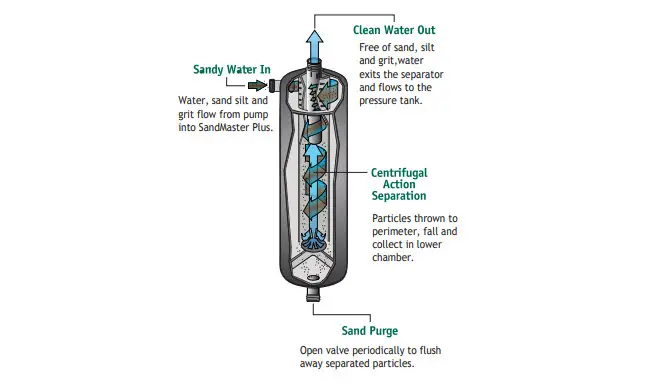
What Can a Centrifugal Separator Separate?
- Centrifugal Separator can separate different components of a mixture according to their density.
- It can separate two immiscible liquids which do not mix with each other. This is called liquid-liquid separation. For example, oil is separated from water and cream is separated from skim milk.
- It can also separate solid particles from a liquid suspension. This is called solid-liquid separation. In this process, solid particles are removed from liquid. For example, pulp is separated from fruit juice, yeast is separated from beer and cells are separated from culture broth.
- Centrifugal separator can separate three phases also. In this process, two liquids and one solid phase are separated at the same time. For example, water and metal sludge are separated from lubricating oil.
- The following are some of the important materials separated by centrifugal separator-
- In dairy and food industries, cream, fat, bacteria, spores, yeast, pulp and impurities of edible oils are separated.
- In industrial fluids and fuels, water, rust, sludge, tramp oil and metal fines are separated.
- In biopharmaceutical and medical field, microbial cells, mammalian cells, cell debris, blood plasma, red blood cells, white blood cells, proteins and vaccines are separated.
- In wastewater and environmental treatment, organic sludge, soil, sand, suspended solids and grit are separated.
Instrumentation/Parts of Centrifugal Separators
1. Bowl body (Drum/Shell) – It is the main high speed rotating chamber. The actual separation takes place inside this bowl.
2. Bowl hood – It is the upper cover of the bowl body. It encloses the bowl and holds the internal parts.
3. Sliding piston – It is a movable part present at the bottom of the bowl. It opens the discharge ports and removes the accumulated sludge.
4. Lock rings – These are threaded steel rings. They tightly secure the bowl hood with the bowl body.
5. Disc stack – It is a stack of conical plates. It increases the settling area and helps in fast separation of liquid and fine solids.
6. Distributor (Disc carrier) – It holds the disc stack in proper position. It also guides the incoming fluid into the separation zone.
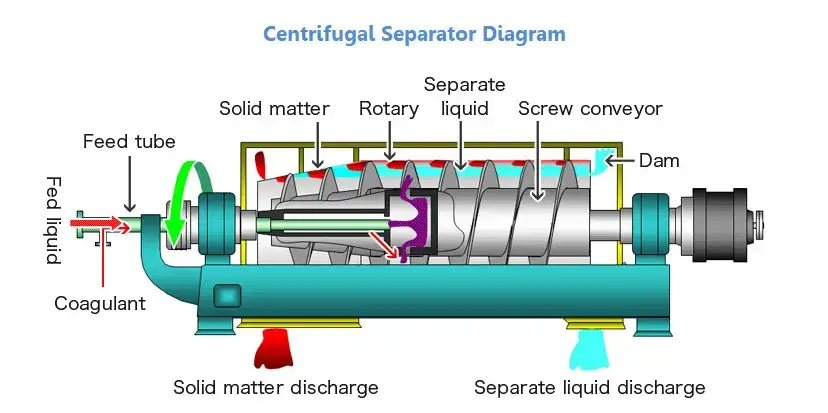
7. Horizontal scroll (Auger/Screw conveyor) – It is present in decanter centrifuge. It pushes the heavy solids towards the discharge end.
8. Feed pipe or feed tube – It is the entry point of the unseparated mixture. The liquid-solid or liquid-liquid mixture enters through this pipe.
9. Paring disc (Centripetal pump) – It is a stationary impeller like part. It pumps the clean separated liquid out of the separator.
10. Gravity disc – It is a ring with a fixed size hole. It controls the interface between two liquid phases such as oil and water.
11. Sludge ejection ports – These are openings present on the bowl body. The separated solid sludge is discharged through these ports.
12. Port liners – These are protective steel clips. They protect the sludge ports from abrasive wear.
13. Drive mechanism – It is usually an electric motor or gas engine. It provides rotational power to the separator.
14. Bowl spindle – It is the main vertical shaft. It supports the bowl and transfers rotation from the motor.
15. Gearbox, bearings and belts – These parts transfer power and regulate speed. They help the spindle and bowl to rotate smoothly.
16. Control panel – It is used to control the machine. Speed, purge time and performance are adjusted from this panel.
17. Flow meters and regulating valves – These are used to measure flow rate and regulate back pressure of the liquid outlet.
18. Operating water system – It uses water pressure to operate the sliding piston. It helps in opening and closing during sludge discharge.
19. Sensors – These are used to detect vibration, motor current and speed. They give alarm or stop the machine when fault occurs.
20. Nylon seal rings, O-rings and gaskets – These are sealing parts. They prevent leakage from the rotating bowl during high centrifugal force.
Types of Centrifugal Separators
1. Disc stack centrifuge – It is a vertical centrifugal separator having a stack of conical discs. It increases the surface area for settling and is used for low solid containing liquids.
2. Clarifier – It is a type of disc stack centrifuge. It is used for solid-liquid separation where solid particles are removed from liquid.
3. Purifier – It is also a type of disc stack centrifuge. It is used for three phase separation where two liquids and one solid phase are separated.
4. Concentrator – It is used to concentrate one component from the mixture. It separates and increases the amount of desired phase.
5. Decanter centrifuge – It is a horizontal scroll separator. It has a long cylindrical bowl and an internal screw conveyor. It is used for mixtures having high solid concentration.
6. Tubular bowl centrifuge – It has a long narrow tube which rotates at very high speed. It is used to separate very fine particles and liquids having small density difference.
7. Basket centrifuge – It has a rotating basket with filter cloth or screen. Liquid passes through the wall of the basket and solid particles are retained inside the basket.
8. Peeler centrifuge – It is used for batch separation. The solid particles form a filter cake on the screen and this cake is removed by a peeling arm.
9. Pusher centrifuge – It is also called horizontal basket centrifuge. It continuously pushes the solid material out of the basket after liquid is removed.
10. Chamber bowl separator – It is used for polishing of liquids. It is mainly used in chemical and pharmaceutical industries where solids are recovered as dry cake.
11. Nozzle separator – It is a continuous type separator. It clarifies liquid and concentrates solid at the same time. The concentrated solid is discharged through nozzles present on the periphery.
12. Scroll separator – It has a scroll mechanism. It separates solid particles from liquid or gas by moving them towards the edge for collection.
13. Hydroclone or hydrocyclone – It separates solid particles from liquid suspension by centrifugal action and fluid resistance. It is commonly used in mineral processing, mining and paper mills.
Operating Procedure of Centrifugal Separators
- At first, the required operating condition is selected. The speed (RPM), relative centrifugal force (RCF), temperature and running time are fixed according to the type of mixture.
- In batch or laboratory centrifuge, the tubes are filled equally. The tubes are placed opposite to each other in the rotor. This prevents imbalance and excess vibration during rotation.
- In liquid-liquid separation, the heavier liquid phase is introduced first into the bowl. This forms a liquid seal and prevents the lighter liquid from passing through wrong outlet.
- The liquid-solid or liquid-liquid mixture is then passed into the centrifuge. It enters through the central feed pipe or inlet into the rotating bowl.
- The bowl rotates at very high speed. The incoming fluid is accelerated with the speed of the bowl. During this process, strong centrifugal force is developed.
- The heavier and denser particles move outward towards the wall of the bowl. The lighter liquid moves towards the centre of the rotating axis. Thus separation occurs according to density difference.
- During operation, the feed flow rate, speed and back pressure are adjusted. This helps to improve the clarity and efficiency of separation.
- The separated light and heavy liquid phases are removed through separate outlets. In some separators, paring discs or centripetal pumps are used for discharge of clean liquid.
- The solid sludge collected in the bowl is removed according to the design of the separator. It may be discharged continuously by screw conveyor or nozzles, intermittently by self-cleaning ports or manually after stopping the machine.
- After the process is completed, the separator is cleaned properly. Cleaning-in-place (CIP) may be used by passing caustic and acidic solution through the machine.
- The seals, bearings, rotor and bowl parts are checked regularly. Worn parts are replaced to prevent leakage, vibration and mechanical fault.
Uses of Centrifugal Separator
- Centrifugal separator is used in food and beverage industries. In dairy industry, it is used for milk standardization, separation of cream from skim milk, whey processing and removing bacteria or heat-resistant spores. It is also used for clarification of fruit juices, beer, wine, tea and coffee.
- It is used to remove pulp, yeast and natural organic matter from different liquid food products. It is also used for refining edible fats and vegetable oils like olive oil, palm oil and lemon oil.
- It is used in biopharmaceutical industries for harvesting cell cultures, bacteria and yeast from fermentation broth. It is also used for purification of vaccines, proteins and antibiotics.
- In medical field, it is used for separation of blood components. Plasma and red blood cells are separated by using centrifugal separator.
- It is used in marine and power generation industries. Marine diesel, heavy fuel oil (HFO) and lubricating oil are purified by this separator.
- It is used to remove water condensation, rust, sludge and abrasive catalytic fines from fuel oil and lubricating oil. This helps in protection of engines and steam turbines.
- It is used in metalworking industries for cleaning machining coolants, cutting oils and quench oils. Tramp oil and abrasive metal debris are removed from these fluids.
- It is also used for sorting abrasive particles by size. For example, kaolin clay used in paper coating is classified by centrifugal separator.
- It is used in wastewater treatment for dewatering municipal sewage sludge. It is also used for purification of industrial wastewater.
- It is used to remove suspended grit and scale from cooling tower water. This prevents fouling of spray nozzles and heat exchangers.
- It is used in petroleum industry for de-watering and de-sludging of crude oil. It is also used for treatment of drilling mud and refinery slop oil.
- In chemical industries, it is used for recovery of catalysts, separation of chemical crystals and isolation of precipitates.
- It is used for recycling of used mineral oils and waste cooking oils.
- It is used in biofuel production. Algae oil is extracted and biodiesel is separated from glycerin by using centrifugal separator.
Advantages of Centrifugal Separators
- Centrifugal separator is small in size as compared to settling tanks and large filtration units. It can be placed in less space and still it can process large amount of mixture.
- It gives high separation efficiency. Due to high speed rotation, artificial gravity is produced which is many times greater than normal gravity. So very small particles can also be separated.
- It is used for continuous operation. In many industrial separators, separated solids are removed automatically during running condition. So the process does not need to stop again and again.
- It has low operating cost. It does not require filter paper or other disposable filter media. Therefore the cost of buying and replacing filter material is reduced.
- It is strong and durable. Most centrifugal separators are made up of stainless steel and corrosion resistant material. So they can work for long time under industrial condition.
- It causes very less loss of liquid product. The separated liquid is removed carefully and the purging system removes only the waste part. So the valuable liquid is not lost much.
- It can be used for many types of mixtures. It is suitable for liquid-liquid separation and solid-liquid separation. It is used in dairy, biopharmaceutical, wastewater, mining and other industries.
- It helps to reduce environmental pollution. It is used to recover usable water, clean waste oil and reduce the amount of sludge. So the waste load becomes less.
Limitations of Centrifugal Separators
- Centrifugal separator has high initial cost. It is more costly than simple filters, filter press and gravity settling tanks.
- It needs skilled operator for proper running. Unskilled worker cannot operate it properly because the machine has many mechanical and control parts.
- It requires regular maintenance. Bearings, seals and rotor balancing are checked again and again because the bowl rotates at very high speed.
- It is not an absolute filter. It separates particles by density difference and centrifugal force. So it cannot remove exact particle size like micron rated filter.
- It needs extra utilities for operation. Some separators need clean water, compressed air and electrical power. This may create problem in remote place.
- It has complex control system. Speed, vibration, balance and sludge discharge are controlled by automatic system. So the operation becomes more complicated.
- It may create safety problem if not maintained properly. High speed rotation can cause vibration, imbalance and mechanical damage.
- It has long lead time for purchase and installation. Due to precision parts and complex manufacturing, new centrifugal separator may take long time to receive.
References
- Here is the list of all 53 sources from your notebook, formatted in a simple APA 7 style based on the available author, publication date, and title information:
- AELAB. (2025, May 16). Top 10 common centrifuge problems and troubleshooting tips (E. Wu, Auth.).
- Alfa Laval. (n.d.). Alfa-Laval decanter centrifuge operating principles [PDF document].
- Alfa Laval. (n.d.). Alfa Laval hermetic design.
- Alfa Laval. (n.d.). Centrifugal separators.
- Alfa Laval. (n.d.). CultureOne™ separator for single-use bioprocessing.
- Alfa Laval. (2001, April). Disc stack centrifuge technology [PDF document].
- Alfa Laval. (2008, August). Disc stack separator technology [PDF document].
- Alfa Laval. (n.d.). eMotion: Continued innovation in disc stack separator technology [Video]. YouTube.
- Alfa Laval. (n.d.). High-efficiency separators and decanters.
- Alfa Laval. (n.d.). How a disc stack centrifuge works.
- Alfa Laval. (n.d.). How centrifugal separation works.
- Alfa Laval. (n.d.). How does a disc stack centrifuge work.
- Alfa Laval. (n.d.). Innovative technologies of Alfa Laval disc stack separators.
- Alfa Laval. (n.d.). Separators for food and beverage.
- Beckman Coulter. (n.d.). Relative centrifugal field (RCF).
- Cannon, D. (2019, October 16). Centrifugal separators: Working principle, benefits, and applications discussed. Cannon Water Technology.
- Chardon Labs. (n.d.). Benefits of using centrifugal separators in commercial water treatment (M. Welsh, Auth.).
- Dickson, R. (2026, March 5). Centrifuge speed interactive calculator. Firgelli Automations.
- Dolphin Centrifuge. (2020). Disc centrifuge parts glossary: An illustrated guide.
- Eppendorf. (2019, July 22). Basics in centrifugation – Calculating relative centrifugal force and selecting a centrifuge and rotors.
- FC-BIOS SDN BHD. (n.d.). Centrifuge mastery: Troubleshooting common uncertainties.
- Flottweg SE. (n.d.). The disc stack of a Flottweg separator.
- FLTR. (n.d.). Centrifugal separators overview.
- Glanlab Instrument. (2026, February 5). Quick guide: How to troubleshoot a centrifuge when it vibrates, makes noise or won’t separate?
- Huading Separator. (2026, April 20). Stokes’ law: Principles of centrifugal separation.
- Jiangsu Hanpu Mechanical Technology Co., Ltd. (2025, May 7). Understanding the best centrifugal solid liquid separator: How it works and its benefits.
- Karwan, C. (2024, February 16). Common centrifuge issues and how to fix them. New Life Scientific.
- Liaoyang Sinotech Technology Development Co., Ltd. (n.d.). Principle and application of tubular centrifuge.
- MilliporeSigma. (n.d.). Centrifugation basics.
- Prabhu, S. (2020). Alfa Laval centrifugal separator | Working, uses, benefits, types & size. Dolphin Centrifuge.
- Prabhu, S. (2020). Alfa Laval industrial centrifuges | Types, uses, advantages, specifications. Dolphin Centrifuge.
- Premier Separator Services. (2025, August 15). Solving common Alfa Laval separator issues (Chloe, Auth.).
- SEPARATECH. (n.d.). High speed tubular bowl centrifuge GQ and GF types.
- SEPARATECH. (n.d.). Tubular bowl centrifuge working principle and main structure.
- Separator Spares & Equipment, LLC. (n.d.). Industrial centrifuge.
- Separator Spares & Equipment, LLC. (n.d.). Operating principle of centripetal pump (paring disc) [Video]. YouTube.
- Separator Spares & Equipment, LLC. (n.d.). Unlocking filtration efficiency with centrifugal force!
- Separators Inc. (n.d.). Centrifuges 101: Everything you need to know.
- Shenzhou Machinery. (2024, March 28). The tubular centrifuge working principle: How is it working?
- Sigma-Aldrich. (n.d.). Centrifugation basics.
- Tetra Pak. (n.d.). Centrifugal separators.
- Tetra Pak. (n.d.). Centrifugal separators and milk standardization. In Dairy processing handbook.
- Tetra Pak. (n.d.). Dairy and juice separators and how they work.
- Tetra Pak. (n.d.). Efficient, reliable, flexible: Separation solutions from Tetra Pak.
- Tetra Pak. (n.d.). Polynode technology.
- Tetra Pak. (n.d.). Science of separation.
- Tetra Pak. (n.d.). Stokes’ law – explaining the science of separation [Video]. YouTube.
- Tetra Pak. (n.d.). Tetra Pak separators [Video]. YouTube.
- Thapa Shrestha, U. (2012, December 31). The basic separation technique. My Scientific Blog – Research and Articles.
- Trucent. (2021, November 16). What is Stokes’ law?
- Trucent. (2022, January 13). Centrifugal separators: Working principle and design.
- Unknown. (n.d.). Advanced engineering and physical principles of industrial centrifugal separation: A comprehensive technical analysis [Markdown document].
- VinTD123. (2021). How does the centripetal pump in purifiers work? [Online forum post]. Reddit.