

Hematocrit centrifuge is a laboratory instrument used for separation of blood components. It works by high speed centrifugal force. The blood sample is kept in narrow capillary tube and then it is rotated very fast.
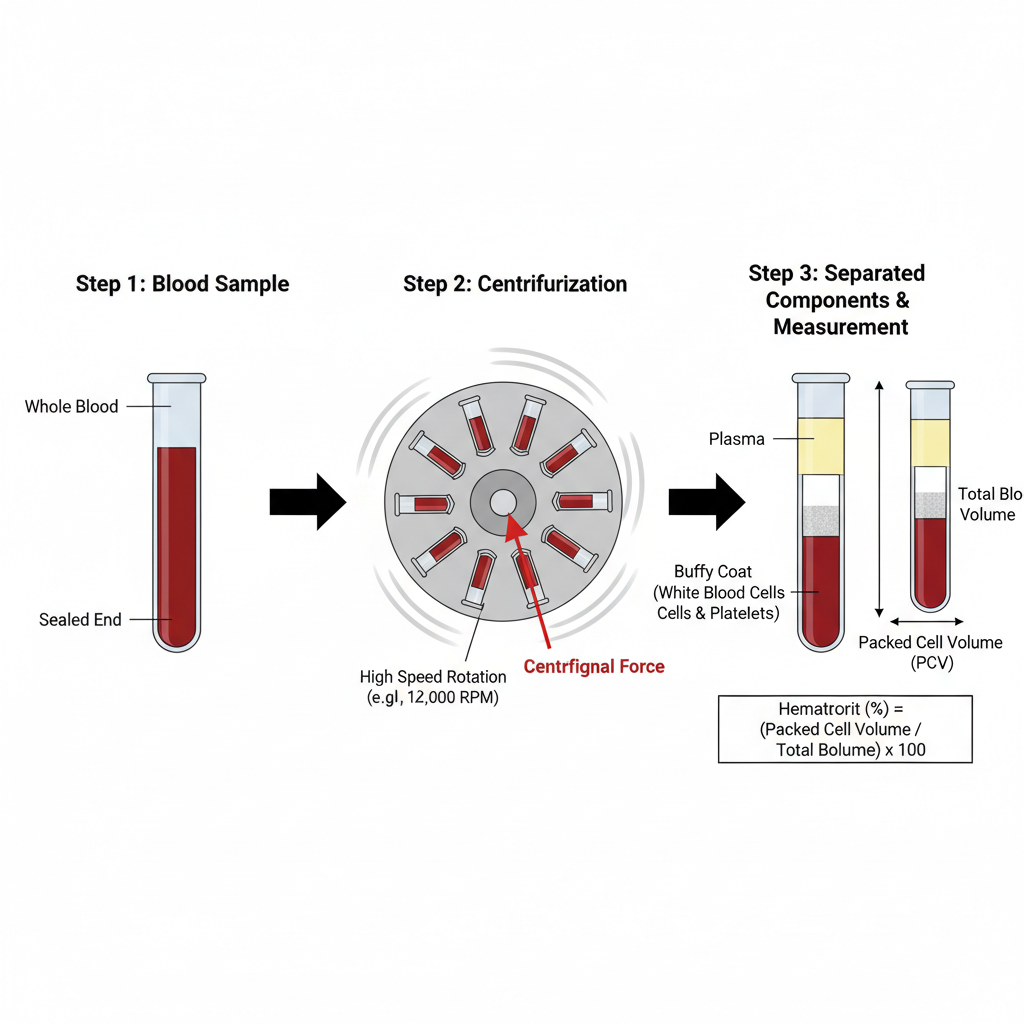
During centrifugation, the heavier red blood cells (RBCs) move to the bottom of the tube. The plasma remains at the upper part. Between them, a thin layer is formed which is called buffy coat. It contains white blood cells (WBCs) and platelets.
It is mainly used to measure Packed Cell Volume (PCV) or hematocrit. This value shows the percentage of red blood cells in the total blood volume. It helps to know the red blood cell mass of a person.
Hematocrit centrifuge is useful in diagnosis of anemia, polycythemia and other blood related conditions. Low hematocrit may indicate anemia. High hematocrit may indicate increased red blood cells or loss of plasma.
The word hematocrit is formed from hemato and Greek word krites. It means to judge or separate blood. Earlier, blood separation was done by large tube method called macrohematocrit method.
In macrohematocrit method, Wintrobe tube was used. Later, microhematocrit method became common. It uses small capillary tube and high speed hematocrit centrifuge.
This method needs very small amount of blood and gives result quickly. So it is useful for children and patients where less blood sample is available. Even now, it is used as an important method in clinics and for checking automated hematology analyzers.
Working Principle of Hematocrit centrifuge
Working Principle of Hematocrit Centrifuge is based on the principle of centrifugal sedimentation. When the blood sample is rotated at high speed, a strong centrifugal force is produced. This force acts on the blood cells according to their density.
In this process, the heavier red blood cells (RBCs) move towards the bottom of the capillary tube. They are packed together and form a compact red cell layer. This packed layer is used for the measurement of hematocrit value.
The lighter part of blood remains above the packed cells. The plasma forms the upper layer. In between the RBCs and plasma, a thin whitish layer is formed which is called buffy coat.
The buffy coat contains white blood cells (WBCs) and platelets. Thus the blood is separated into three layers after centrifugation. These are packed RBCs at the bottom, buffy coat in the middle and plasma at the top.
Parts of Hematocrit Centrifuge and their Functions
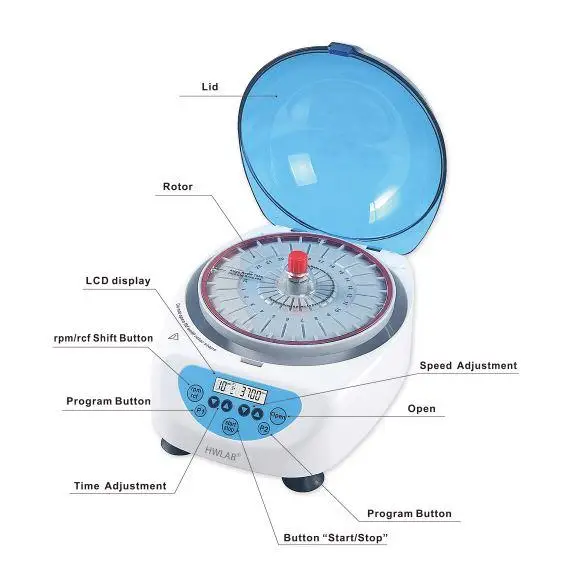
- Motor – Motor is the main driving part of the hematocrit centrifuge. It gives power to the rotor for rotation. Due to this motor, the rotor rotates at very high speed and centrifugal force is produced.
- Rotor – Rotor is a circular metallic part which is used to hold the microhematocrit capillary tubes. It has small grooves or chambers for keeping the tubes. During working, the rotor rotates and separates the blood components according to their density.
- Peripheral gasket – Peripheral gasket is a rubber ring present at the outer side of the rotor. The sealed end of the capillary tube rests on this gasket. It works as a cushion and prevents breaking of glass tube during high speed rotation.
- Rotor lid and locking nut – Rotor lid is used to cover the rotor after placing the capillary tubes. Locking nut is used to tighten the rotor lid. These parts keep the capillary tubes fixed in their position during centrifugation.
- Centrifuge lid and interlock system – Centrifuge lid is the outer cover of the machine. It protects the user during spinning. Interlock system prevents the motor from starting when the lid is open and also keeps the lid locked until the rotor stops completely.
- Control panel and display – Control panel is present on the front side of the centrifuge. It has buttons for start, stop, speed and time setting. The display shows the speed, time and running condition of the centrifuge.
- Imbalance detector – Imbalance detector is a safety part of the centrifuge. It detects uneven loading of capillary tubes inside the rotor. If the tubes are not placed in balanced manner, it stops the machine and gives error signal.
- Microhematocrit reader – Microhematocrit reader is used after centrifugation for reading the separated blood column. It helps to calculate the packed cell volume (PCV) or hematocrit value. It may be present separately or attached with the centrifuge.
- Housing and non-slip feet – Housing is the outer casing of the hematocrit centrifuge. It protects the internal parts and also contains broken tube pieces if breakage occurs. Non-slip feet are present at the base and keeps the machine stable on the laboratory table.
Operating Procedure of Hematocrit Centrifuge
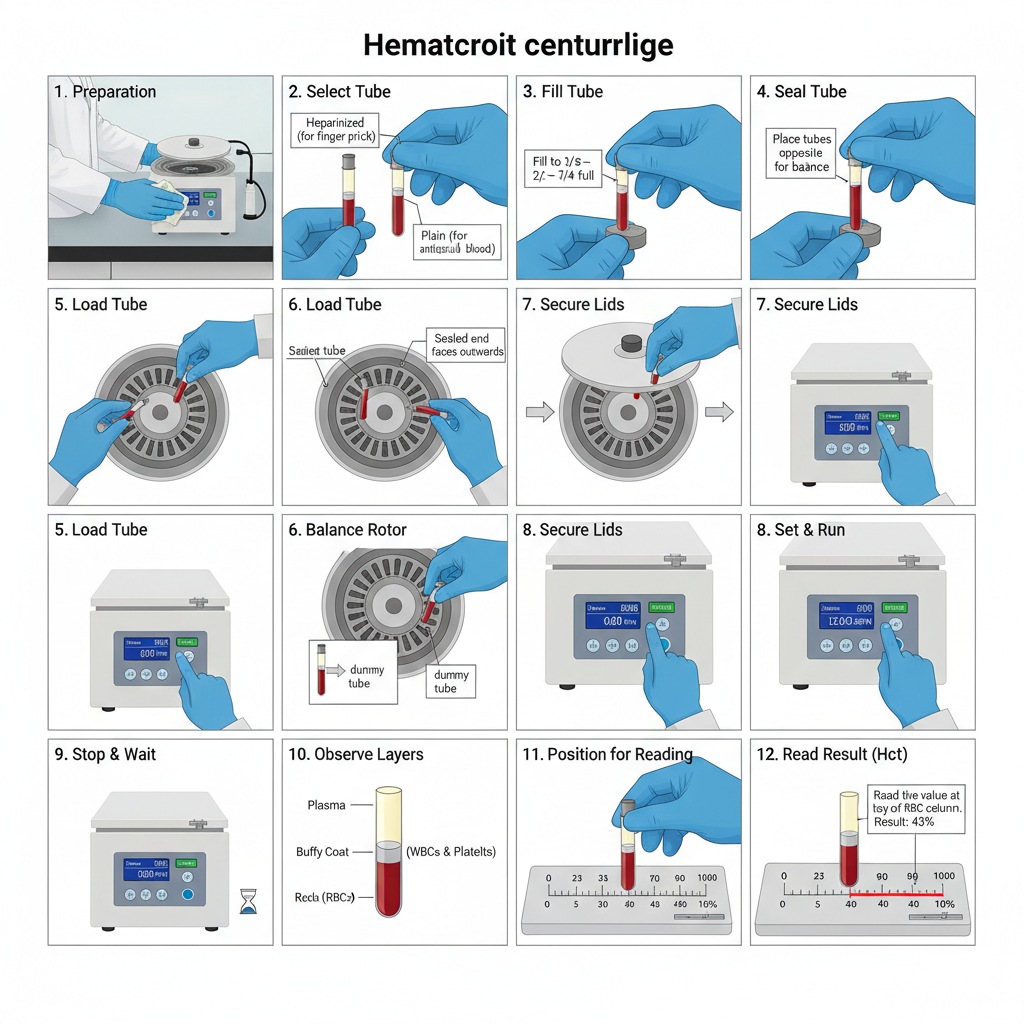
- First the suitable capillary tube is selected. Heparinized capillary tube is used for fresh finger prick blood and non-heparinized capillary tube is used for blood already mixed with EDTA anticoagulant.
- The capillary tube is held in slightly inclined position. The blood enters into the tube by capillary action. The tube is filled about three-fourth of its length.
- The dry end of the capillary tube is sealed with sealing clay or plasticine. It is pressed straight into the clay and a firm plug is formed. This prevents leakage of blood during spinning.
- The sealed capillary tubes are placed in the grooves of the rotor. The sealed end should be directed outward and should rest against the rubber gasket of the rotor.
- The tubes are placed opposite to each other for proper balancing. If one sample is present, another tube with same amount of blood or water is placed opposite to it.
- The inner rotor lid is placed over the capillary tubes. Then the locking nut is tightened properly so that the tubes remain fixed during centrifugation.
- The outer lid of the hematocrit centrifuge is closed and locked. The centrifuge should not be started when the lid is open.
- The speed and time are adjusted in the control panel. Generally the centrifuge is run at 10,000 to 12,500 rpm for 3 to 5 minutes.
- After completion of time, the centrifuge is allowed to stop by itself. The rotor should not be stopped by hand because sudden stopping may disturb the separated blood layers.
- After the rotor stops completely, the lid is opened and the capillary tubes are removed carefully. The tubes should not be shaken.
- The tube is placed on microhematocrit reader or reading card. The bottom of packed red blood cell (RBC) column is adjusted with 0% line and the top of plasma layer is adjusted with 100% line.
- The reading is taken at the junction of packed RBCs and buffy coat. This gives the hematocrit value or packed cell volume (PCV) in percentage.
How to load hematocrit blood test into centrifuge
- First the blood is taken into suitable capillary tube. The tube is filled about three-fourth part of its length. It should not be filled completely.
- The dry end of the capillary tube is sealed with sealing clay. The tube is pressed into the clay and a firm plug is made. This prevents leakage of blood during centrifugation.
- The capillary tube is placed in the groove of the rotor. The sealed end of the tube should be placed outward side. It should rest properly against the rubber gasket of the rotor.
- The tubes are placed in opposite direction to each other. This is done for balancing of the rotor. The tubes should be placed at 180° opposite position.
- If there is odd number of blood sample, then one empty capillary tube is filled with water and placed opposite to the sample tube. This works as counterbalance.
- The capillary tubes should fit properly in the rotor grooves. They should not remain loose or outside the groove. Improper placing may break the tube during high speed rotation.
- The inner rotor lid is placed over the loaded capillary tubes. The locking nut or screw is tightened properly. This keeps the tubes fixed in their position.
- The outer lid of the hematocrit centrifuge is closed gently and locked. After this the machine is ready for centrifugation.
Uses of hematocrit centrifuge
- Hematocrit centrifuge is used for the determination of hematocrit value or packed cell volume (PCV) of blood.
- It is used to diagnose anemia. In anemia, the red blood cell (RBC) mass becomes low and the hematocrit value is decreased.
- It is used to monitor the treatment of anemia. It helps to see the effect of iron therapy, blood transfusion, erythropoietin therapy and other treatment.
- It is used to detect polycythemia. In this condition, the number of RBCs becomes abnormally high and the hematocrit value is increased.
- It is used to assess dehydration and fluid loss. During dehydration, plasma volume decreases and the blood becomes concentrated.
- It is used to know the oxygen carrying capacity of blood. More RBCs means more capacity to carry oxygen, and less RBCs means less oxygen carrying capacity.
- It is used in pre-surgical blood examination. It helps to know whether the patient is fit for operation or not.
- It is used to monitor chronic diseases which affect blood formation. These include kidney disease, lung disease and heart disease.
- It is used to observe the quality of plasma after centrifugation. The plasma may show hemolysis, icterus or lipemia by its colour and appearance.
- It is used to roughly estimate white blood cells (WBCs) and platelets. This is done by observing the thickness of the buffy coat layer.
- It is used for the detection of blood parasites. The buffy coat may contain parasites like Plasmodium, Trypanosoma and microfilariae.
- It is used as a manual method for checking automated hematology analyzer result. The PCV value obtained by hematocrit centrifuge is used for quality control and comparison.
- It is used in blood bank for checking packed red cell quality. It helps to confirm the packed cell volume in red cell concentrate.
- It is used in veterinary diagnosis also. Small blood samples of animals like dog, cat, cattle and other animals can be examined by this centrifuge.
- It is also used in laboratory research for separation of small volume samples. It helps in processing blood components and other biological materials.
Advantages of hematocrit centrifuge
- Hematocrit centrifuge gives result within short time. The separation of blood components takes place within few minutes. So it is useful for quick clinical decision.
- It is a low cost method for determination of hematocrit value or packed cell volume (PCV). It does not need costly reagents. So it is useful for routine laboratory work.
- It requires very small amount of blood sample. Only a small capillary tube filled with blood is enough. So it is useful in children, newborn babies and patients where venous blood collection is difficult.
- It gives direct measurement of packed red blood cells (RBCs). The blood is separated physically by centrifugation and the packed cell column is measured directly.
- It helps in visual observation of separated blood layers. The plasma layer can be checked for hemolysis, icterus and lipemia. The buffy coat can also be observed.
- It is used as reference method for checking automated hematology analyzer result. Manual PCV value helps in calibration and quality control of automated machines.
- It is useful when automated analyzer gives doubtful result. The sample can be checked manually by hematocrit centrifuge and the result can be verified.
- It is simple to operate. No complicated chemical reagent is required. The instrument can be used easily in small laboratory and rural health centre.
- It is portable and occupies less space. So it can be used in point of care testing and places where large instruments are not available.
- It gives reliable result when the tube is filled, sealed and balanced properly. It is also more dependable than manual RBC counting in many routine conditions.
Limitations of hematocrit centrifuge
- Hematocrit centrifuge cannot pack the red blood cells (RBCs) completely. Small amount of plasma may remain trapped between the packed cells. Due to this the hematocrit value may be slightly high.
- Abnormal RBCs may not settle properly during centrifugation. In conditions like sickle cell anemia, the cells are abnormal in shape and stiff. So more plasma may remain trapped and the result may become incorrect.
- Clotted blood sample gives wrong result. If clot is present in the capillary tube, the cells cannot pack properly. So the blood sample should be mixed properly with anticoagulant before filling.
- The reading of packed cell volume (PCV) is done manually. So error may occur during alignment of tube on the reading scale. This depends on the observer also.
- The result should be read soon after centrifugation. If the tube is kept for long time, the separated layers may start to mix again. This gives inaccurate hematocrit value.
- Improper sealing of capillary tube causes leakage of blood. If the clay plug is not firm, blood may come out during high speed rotation. This may give falsely low PCV value.
- Excess amount of EDTA affects the result. If anticoagulant is more than blood, the RBCs may shrink. This causes falsely low hematocrit reading.
- Hemolysis of blood sample gives incorrect result. If RBCs are damaged during collection, mixing or storage, they do not form proper packed layer. So the result may become low.
- Proper speed and time are needed for correct result. If centrifuge is run for less time or at low speed, the RBCs will not pack completely. This may give falsely high reading.
- Different animal blood may need different centrifugation time. In veterinary use, all species do not give correct result by same time and speed. So wrong setting may give inaccurate result.
References
- AHN Biotechnologie GmbH. (2020). HC-01 (iFuge HCT) manual (0152-970000-02-003-R2).
- Allied Health. (n.d.). Performing a microhematocrit [Video]. YouTube.
- Analis. (n.d.). Optimize blood testing w/ Sigma micro hematocrit centrifuges.
- Bamberg, R., Gwyn, T., Miller, J., Thompson, M., & Transou, P. (2008). The effects of over-anticoagulated blood on hematocrit values by the microcentrifuge method. Clinical Laboratory Science, 21(3), 146-150.
- CARE Hospitals. (n.d.). Packed cell volume (PCV) test: Purpose, procedures, test results and normal range.
- Clampitt, R. (2002, June 11). Method of measuring erythrocyte sedimentation rate (ESR) or plasma fibrinogen of a blood sample (U.S. Patent No. 6,403,328 B1). U.S. Patent and Trademark Office.
- Cryostar Industries. (n.d.). Simple ways to maintain a centrifuge: Expert tips for performance.
- Defense Technical Information Center (DTIC). (n.d.). A re-evaluation of trapped plasma in the microhematocrit determination.
- Drucker Diagnostics. (n.d.). Centrifuge calibration check: Step-by-step guide.
- eClinpath. (n.d.). Hematocrit/packed cell volume. Cornell University College of Veterinary Medicine.
- GlanLab Instrument. (2024, August 28). The role of hematocrit centrifuges.
- GlanLab Instrument. (2026, February 10). Centrifuge calibration guide for labs.
- Hinotek. (n.d.). What is a hematocrit centrifuge?
- Hunan Michael Laboratory Instrument Co., Ltd. (2026, March 5). Hematocrit centrifuge use: A comprehensive guide from manufacturers.
- International Process Solutions. (n.d.). Centrifuge calibration services | Ensure accuracy, compliance & safety.
- Labco Scientific. (n.d.). Hematocrit centrifuge user manual.
- Labnics Ltd. (n.d.). Haematocrit centrifuge NHC-100 operation manual.
- Labotronics. (n.d.). Hematocrit centrifuge troubleshooting: Rotor imbalance & brush replacement schedule.
- Live Project Store. (n.d.). Design and construction of electrical centrifuge.
- Mason Technology. (n.d.). Centrifuge calibration | ISO 17025 accredited.
- Metropolis Healthcare. (2025, August 26). PCV blood test: Decoding the significance of packed cell volume in blood tests.
- MKE. (2026, February 21). Analysis and design for high speed hematocrit centrifuge machine. Hunan Michael Laboratory Instrument Co., Ltd.
- Mondal, H., & Zubair, M. (2024, October 6). Hematocrit. In StatPearls. StatPearls Publishing.
- Narayanan, S. (2005, October). Preanalytical issues related to blood sample mixing. Acutecaretesting.org.
- National Center for Biotechnology Information (PMC). (n.d.). Estimation of minimum centrifugation time of microhematocrit tubes to obtain accurate results of packed cell volume and total solids in donkeys, dogs, sheep, and cows.
- National Center for Biotechnology Information (PMC). (n.d.). The buffy coat method: A tool for detection of blood parasites without staining procedures.
- Puckrin, Z. (2022, August 9). Protocol for buffy coat preparation from whole blood. REPROCELL.
- Scitek Global. (n.d.). Hematocrit centrifuge CFG-H12.
- Stephen, A. I., Ubwa, S. T., Igbum, O. G., Hati, S. S., & Alex, N. I. (2017). Analytical comparison between microhematocrit and automated methods for packed cell volume (PCV) determination. International Journal of Hematology and Blood Disorders, 2(1), 1-4.
- Technical Safety Services (TSS). (2025, December 29). How to calibrate a centrifuge.
- UNICO. (n.d.). CMH30 micro hematocrit centrifuge | 24 place. United Products & Instruments Inc.
- Unknown Author. (n.d.). Comprehensive analysis of hematocrit centrifugation: Biophysical principles, mechanical engineering, and clinical diagnostic protocols.
- University of Bristol. (2017). Packed cell volume (PCV).
- Wennecke, G. (2004, September). Hematocrit – a review of different analytical methods. Acutecaretesting.org.
- Yashoda Hospitals. (n.d.). What is PCV test and its uses, test results, and normal range?