

Spleen is the largest secondary lymphoid organ in human body. It is a soft, spongy and reddish purple organ. It filters the blood and not lymph.
It is present in the upper left part of abdomen. This region is called left hypochondriac region. It lies behind and lateral to the stomach, below the left dome of diaphragm. It is protected by 9th, 10th and 11th ribs.
The spleen is covered by a thin fibroelastic capsule. This capsule protects the soft internal part of spleen. It also allows little expansion of spleen.
Internally spleen is divided into two main parts. These are white pulp and red pulp. The white pulp is lymphoid part and the red pulp is blood filtering part.
White pulp contains large number of T-cells, B-cells and macrophages. It helps in immune response. It detects blood borne pathogens and helps in antibody formation.
Red pulp forms the major part of spleen. It has venous sinuses and splenic cords. In this region blood flow becomes slow. So macrophages can remove old and damaged RBCs.
Spleen also stores some blood components. It stores platelets, some RBCs and monocytes. These may be released during blood loss or during severe inflammation.
Spleen protects the body against encapsulated bacteria like Streptococcus pneumoniae, Neisseria meningitidis and Haemophilus influenzae. So it is important in immunity.
During fetal life, spleen helps in blood cell formation. This is called hematopoiesis. But this function generally stops before birth.
Spleen is not essential for survival. But after removal of spleen, the person becomes weak in immunity. Removal of spleen is called splenectomy. After splenectomy, severe infection may occur more easily.
The historical Latin name of spleen is Lien. This name was used in older anatomical description. It is also related with the study of spleen in early medical history.
Marcello Malpighi was an Italian physician and biologist. He studied the structure of spleen in early period. Due to his work, the lymphoid nodules of spleen were called Malpighian bodies.
These Malpighian bodies are related with the white pulp of spleen. The name was given in honour of Marcello Malpighi. It is an important historical name in splenic anatomy.
In 1896, Albrecht first described the ectopic overgrowth of splenic tissue. This means spleen tissue was found growing in abnormal place in the body. This was an important observation related with splenic tissue.
Later, Buchbinder and Likoff in 1939 gave the clinical term splenosis. Splenosis is the acquired condition where splenic tissue spreads and regenerates in other parts of body. It usually occurs after injury or surgery of spleen.
Spleen is the largest secondary lymphoid organ of human body. It is a soft, spongy and reddish purple organ. It filters blood, removes old RBCs and helps in immune response.
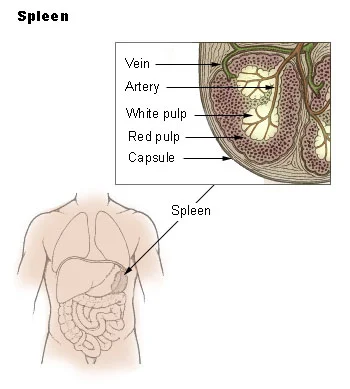
Location of the Spleen
- Spleen is located in the upper left quadrant of the abdomen. This region is called left hypochondriac region.
- It is placed obliquely on the left side. It lies parallel to the 9th, 10th and 11th ribs. These ribs give physical protection to the spleen.
- It lies just below the left dome of diaphragm. So it is present in close relation with diaphragm.
- It is situated posterolateral to the stomach. The stomach lies directly anterior to the spleen.
- It is present superior to the left kidney and left adrenal gland. These structures lie medial and posterior to the spleen.
- The medial side of spleen is related with the tail of pancreas. So pancreas is an important relation of spleen.
- It lies above the left colic flexure. This flexure is also called splenic flexure of large intestine.
- Spleen is an intraperitoneal organ. It is almost completely covered by peritoneum and is suspended by ligaments.
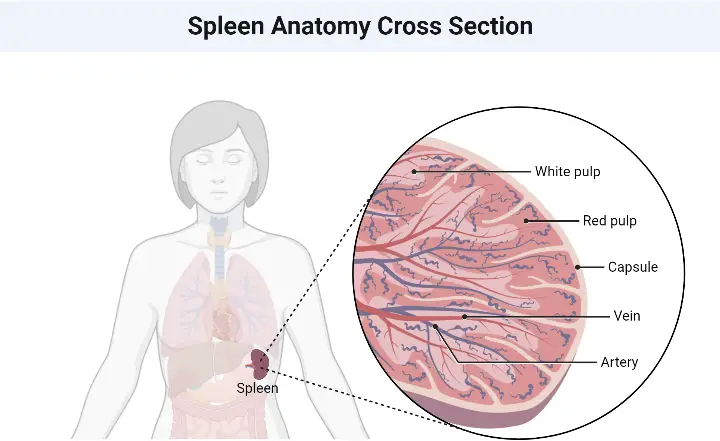
Gross Anatomy of Spleen
- Spleen is about 10 to 12 cm in length. It is about 7 cm in breadth and 3 to 4 cm in thickness.
- The weight of spleen is usually about 150 to 200 grams. But it may vary in different individuals.
- It is a soft and spongy organ. It is highly vascular. Its colour is dark reddish-purple.
- The shape of spleen is not same in all individuals. It is usually curved wedge shaped or tetrahedral in shape.
- The whole spleen is covered by a thin fibroelastic connective tissue capsule. This capsule gives protection to the soft tissue of spleen. It also allows slight expansion.
- The spleen has two main surfaces. These are diaphragmatic surface and visceral surface.
- Diaphragmatic surface is convex and smooth. It is related with the left dome of diaphragm.
- Visceral surface is concave and irregular. It shows impressions for nearby organs like stomach, left kidney, colon and pancreas.
- The spleen has three borders. These are superior border, inferior border and intermediate border.
- Superior border is sharp and clear. It has one to six notches near the anterior end. Most commonly 1 to 3 notches are present. These notches are remains of fetal lobulation.
- Inferior border is smooth and rounded. It forms the lower border of spleen.
- Intermediate border is rounded. It is directed medially towards the right side.
- The spleen has two ends or poles. These are anterior end and posterior end.
- Anterior end is broad and expanded. It looks almost like an extended border.
- Posterior end is narrow and rounded. It faces medially and rests on the upper pole of left kidney.
- The spleen has two angles. These are antrobasal angle and posterobasal angle.
- Antrobasal angle is present at the junction of superior border and anterior end. It is the most forward projecting point of spleen.
- Posterobasal angle is present at the junction of inferior border and anterior end.
- Splenic hilum is present on the visceral surface. It lies on the gastric impression between superior and intermediate borders.
- The splenic hilum is the region through which splenic blood vessels, nerves and lymphatic channels enter and leave the spleen.
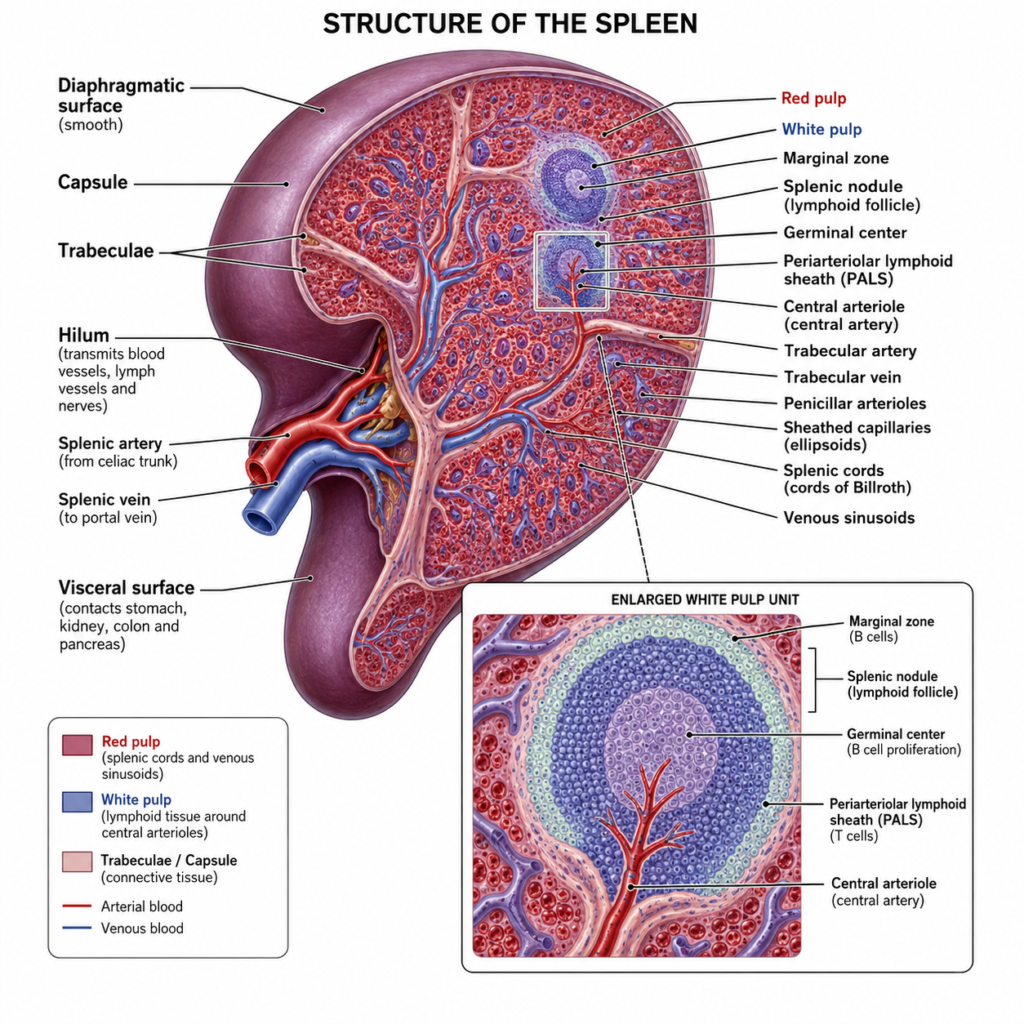
External Features of Spleen or Morphology of Spleen
- Shape and colour– Spleen is usually wedge shaped or tetrahedral organ. It is soft, highly vascular and dark purple in colour.
- Size and weight– It is about 1 inch thick, 3 inches broad and 5 inches long. In metric value it is about 3 to 4 cm × 7 cm × 10 to 12 cm. Weight is about 150 to 200 grams.
- Surfaces– The spleen has two surfaces.
- Diaphragmatic surface– It is convex and smooth. It faces towards the diaphragm.
- Visceral surface– It is concave and irregular. It has impressions for stomach, kidney, colon and pancreas.
- Ends or poles– The spleen has two ends.
- Anterior end– It is also called lateral end. It is broad and expanded. It looks like a continuous border.
- Posterior end– It is also called medial end. It is narrow and rounded. It is directed medially towards vertebral column and rests on upper pole of left kidney.
- Borders– The spleen has three borders.
- Superior border– It separates gastric impression from diaphragmatic surface. It has notches near its anterior end.
- Inferior border– It is smooth and rounded. It separates renal impression from diaphragmatic surface.
- Intermediate border– It is rounded and directed medially towards right side.
- Angles– The spleen has two angles.
- Antrobasal angle– It is present where superior border meets anterior end. It is the most forward projecting part of spleen.
- Posterobasal angle– It is present where inferior border meets anterior end.
- Splenic hilum– It is present on inferomedial part of gastric impression. It lies between superior and intermediate borders. Blood vessels, lymphatics and nerves enter and leave through this region.
Histological Structure of Spleen
- Stroma– It forms the supporting framework of spleen. It gives support to the soft internal tissue.
- Fibroelastic capsule– It is the outer covering of spleen. It is a thick flexible connective tissue layer. It is made up of collagen fibres, elastic fibres and few smooth muscle cells.
- Trabeculae– These are inward extensions of capsule. They pass into the splenic parenchyma. They give support and also carry trabecular arteries and trabecular veins.
- Parenchyma– It is the functional tissue of spleen. It is mainly divided into white pulp and red pulp. Between them a transitional part is present, called marginal zone.
- White pulp– It forms about 15 to 25% of splenic parenchyma. It is immune active lymphoid tissue. It is arranged around the incoming blood vessels.
- Central arterioles– These are small branches of splenic artery. They pass through the centre of white pulp.
- Periarteriolar lymphoid sheath (PALS)– It is dense cylindrical lymphoid tissue around central arteriole. It mainly contains T-lymphocytes and macrophages.
- Lymphoid follicles– These are rounded nodules attached with PALS. They are also called Malpighian corpuscles and mainly contain B-lymphocytes.
- Germinal centre– It is formed when antigen stimulates the lymphoid follicle. Here B-cells divide rapidly and help in antibody formation.
- Marginal zone– It is present between white pulp and red pulp. Here blood flow becomes slow. It contains dendritic cells, marginal metallophilic macrophages and marginal zone macrophages, which trap virus, bacteria and debris from blood.
- Red pulp– It forms about 75 to 85% of splenic parenchyma. It is the blood filtering part of spleen. It removes old, damaged and rigid RBCs.
- Splenic cords– These are also called cords of Billroth. They are spongy meshwork of reticular connective tissue and fibroblasts, containing many RBCs, monocytes and macrophages.
- Venous sinuses– These are wide tubular vascular channels. They are lined by long special endothelial cells and have discontinuous hoop like basement membrane.
- Filtration mechanism– In spleen, open circulation is present. Blood comes directly into splenic cords and then blood cells pass through narrow inter-endothelial slits to enter venous sinuses. Healthy RBCs pass, but old and stiff RBCs remain trapped and destroyed by macrophages.
- White pulp– It forms about 15 to 25% of splenic parenchyma. It is immune active lymphoid tissue. It is arranged around the incoming blood vessels.
White Pulp of the Spleen
- White pulp is the lymphoid part of spleen. It forms about 15 to 25% of the splenic parenchyma.
- It acts as immune centre of spleen. It works like lymph node but here it checks blood and not lymph.
- The main function of white pulp is to detect blood borne pathogens. It starts adaptive immune response and helps in antibody formation.
- Central arterioles are present inside the white pulp. These are small branches of splenic artery.
- These arterioles bring blood inside the white pulp. This blood is monitored by the immune cells present in this region.
- Around the central arteriole, a dense cylindrical lymphoid tissue is present. This is called periarteriolar lymphoid sheath (PALS).
- PALS mainly contains T-lymphocytes and macrophages. So it is the T-cell dependent region of white pulp.
- Near the PALS, rounded lymphoid nodules are present. These are called lymphoid follicles or Malpighian corpuscles.
- Malpighian corpuscles contain large number of B-lymphocytes. So this part is B-cell rich area of spleen.
- When any pathogen or antigen enters in blood, the follicles become active. Then a pale central area appears in the follicle. This is called germinal centre.
- In germinal centre, B-lymphocytes divide rapidly. They mature and form plasma cells. These plasma cells produce antibodies.
- Around the white pulp, there is a border region. This is called marginal zone.
- Marginal zone lies between white pulp and red pulp. Here blood flow becomes slow and antigens are easily trapped.
- It contains special macrophages, dendritic cells and marginal zone B-cells. These cells capture antigens from the blood.
- The captured antigen is presented to lymphocytes of white pulp. Then immune response is started against that antigen.
Red Pulp of Spleen
- Red pulp forms the major part of splenic parenchyma and it forms about 75 to 85% of the spleen.
- It is the blood filtering part of spleen and removes old, damaged and stiff RBCs from blood.
- It also controls blood quality, recycles iron and stores important blood components.
- Red pulp is made up of splenic cords and venous sinuses.
- Splenic cords are also called cords of Billroth and they are spongy meshwork of reticular connective tissue and fibroblasts, containing many RBCs, macrophages, monocytes and platelets.
- Venous sinuses are wide tubular vascular channels present near the splenic cords and they are lined by long special endothelial cells with discontinuous basement membrane and narrow slits.
- In red pulp, open circulation is present where arteries end suddenly and blood comes directly into the splenic cords, so blood moves slowly.
- Blood cells have to pass through narrow slits of venous sinuses to return into circulation, where healthy flexible RBCs pass easily but old and stiff RBCs remain trapped.
- The trapped damaged RBCs are engulfed by red pulp macrophages and this process is called phagocytosis.
- Macrophages also remove bacteria, virus and cell debris from blood and recycle iron from destroyed RBCs.
- Red pulp stores about one-third of body platelets, some RBCs and many monocytes, which may be released during injury, inflammation or major blood loss.
- During fetal life, red pulp helps in blood cell formation before bone marrow takes over this function.
Cellular Components of Spleen
- Lymphocytes– These are the important immune cells of spleen. They are mainly present in white pulp and marginal zone.
- T-lymphocytes– These are mainly packed in periarteriolar lymphoid sheath (PALS). They monitor blood for foreign antigens and start adaptive immune response. Some effector T-cells also move into red pulp and helps in clearing bacterial infection.
- B-lymphocytes– These are present in lymphoid follicles or Malpighian corpuscles. When pathogen comes, they divide rapidly in germinal centre and help in antibody response.
- Marginal zone B-cells– These are special B-cells of marginal zone. They give rapid antibody response, mainly against encapsulated bacteria like Streptococcus pneumoniae.
- NKT cells– These are present in marginal zone and red pulp. They secrete cytokines quickly and connect innate and adaptive immunity.
- Plasma cells– These are formed from activated B-cells. They mature in white pulp and then migrate into red pulp, where they secrete protective antibodies.
- Macrophages– These are important scavenger cells of spleen. They are present in red pulp, marginal zone and germinal centres.
- Red pulp macrophages– These are present in splenic cords. They engulf and destroy old, stiff and damaged RBCs. They also recycle iron from destroyed red blood cells.
- Marginal metallophilic macrophages– These are arranged in ring like manner at inner border of marginal zone. They capture viral and bacterial antigens from blood and transfer them to dendritic cells.
- Marginal zone macrophages– These are present in outer marginal zone. They capture nonopsonized pathogens like yeasts, bacteria and viruses.
- Tingible body macrophages– These are present in germinal centres. They remove dead or apoptotic B-cells formed during immune response.
- Other immune cells– These cells help in antigen presentation and inflammation response.
- Dendritic cells– These are antigen presenting cells of marginal zone and white pulp. They capture antigens from blood and present them to lymphocytes.
- Monocytes– These are stored in large number in red pulp cords. During severe inflammation or tissue injury, they are released and move to affected site.
- Circulating and structural cells– These cells are related with blood storage, filtration and splenic support.
- Red blood cells– These are densely present in red pulp. They pass through narrow slits to return into circulation. Old and rigid RBCs are trapped and removed.
- Platelets– These are stored in red pulp. The spleen stores about one-third of total platelet reserve of body.
- Specialized endothelial cells– These line the venous sinuses. They are long rod like cells and form narrow slits for testing flexibility of RBCs.
- Fibroblasts and reticular cells– These are structural cells of spleen. They form supportive meshwork or stroma of splenic cords.
Development Process of Spleen
- Embryonic origin– The development of spleen starts early in embryonic life. It begins around 5th to 6th week of gestation.
- Initial formation– The spleen develops from mesodermal mesenchymal cells. These cells proliferate as a local mass between the two layers of dorsal mesogastrium.
- Rotation and position– During embryonic development, the primitive stomach rotates. Due to this rotation, the dorsal mesogastrium shifts to left side and carries the developing spleen with it.
- Final location– After shifting, spleen comes to its final position in the left upper abdomen. It is placed between the 9th to 11th ribs.
- Ligament formation– The left surface of mesogastrium fuses with the peritoneum over the left kidney. This forms the dorsal attachment of spleen, called splenorenal ligament or lienorenal ligament.
- Lobulation– In early stage, spleen is formed by many separate mesenchymal lobules. These lobules fuse with each other as gestation continues.
- Splenic notches– The grooves present between early lobules do not disappear completely. Their remains are seen as characteristic notches on the superior border of adult spleen.
- Fetal hematopoiesis– During fetal life, spleen works as a blood forming organ.
- Cell migration– Blood forming cells migrate into spleen from the yolk sac wall and region near the dorsal aorta.
- Week 7– Hematopoietic cells are seen in spleen from about 7th week.
- Second trimester– In this period, spleen actively forms both red blood cells and white blood cells.
- Fifth month– The blood forming function of spleen decreases. It generally stops around 5th month of gestation, because bone marrow takes over this function.
- Internal tissue maturation– The internal structure of spleen develops step by step.
- Week 8– Splenic hilum starts to form. Internal venous sinuses also begin to develop.
- Weeks 15 to 21– Reticular supporting framework is formed. T-lymphocytes and B-lymphocytes begin to collect around arterioles and primitive white pulp is formed.
- Weeks 22 to 24– Immune cells become arranged in specific areas. T-cells form periarteriolar lymphoid sheath (PALS) and B-cells form lymph follicles. The marginal zone also appears around white pulp at this time.
Functions of Spleen
- Blood filtration– Spleen filters the blood. This is mainly done by red pulp. Old, damaged and rigid RBCs are removed from the blood.
- RBC quality control– It checks the red blood cells. It removes small cell debris like Howell-Jolly bodies. It also helps immature reticulocytes to become mature biconcave RBCs.
- Immune function– White pulp acts like lymph node. But it works for blood. It detects foreign antigen present in blood and starts immune response.
- Antibody formation– The spleen is a site for lymphocyte maturation. B-cells become active and form plasma cells. These plasma cells produce antibodies.
- Protection from bacteria– Spleen is important against encapsulated bacteria. Mainly Streptococcus pneumoniae, Neisseria meningitidis and Haemophilus influenzae.
- Phagocytosis– Many macrophages are present in spleen. They engulf bacteria, virus, fungi and foreign particles. They also destroy old blood cells.
- Storage function– Spleen stores about one-third of body platelets. It also stores some RBCs and large number of monocytes.
- Release during emergency– During severe blood loss or inflammation, spleen contracts. It releases stored platelets, RBCs and monocytes into blood. This is like natural blood reserve.
- Hematopoiesis– In fetal life, spleen produces blood cells. It produces both RBCs and WBCs, mainly during second trimester.
- Adult blood formation– Normally after birth, blood formation is done by bone marrow. But in severe anemia, spleen may again start blood cell formation.
Step by Step Filtration Process of Spleen
- Step 1: Entry of blood– Blood enters into spleen by splenic artery. Then it passes into smaller arteries and capillary branches.
- Step 2: Open circulation– The capillaries open into red pulp. Blood comes directly into splenic cords. These cords are also called cords of Billroth.
- Step 3: Slow movement– In this region blood is not closed inside proper vessel. So it moves slowly. It spreads through spongy cord like tissue.
- Step 4: Contact with macrophages– Many macrophages are present here. Blood remains in contact with them for more time. They check foreign particles, bacteria, debris and old blood cells.
- Step 5: Passage test– To leave the red pulp, RBCs have to pass through narrow gaps. These gaps are present in wall of venous sinuses. They are called inter-endothelial slits.
- Step 6: Healthy RBC– Young RBCs are flexible. They can bend and squeeze. So they pass through these slits and enter into venous sinuses.
- Step 7: Reticulocyte change– Reticulocytes also pass through the narrow slits. During this passage they lose extra surface part. Then they become more mature biconcave RBCs.
- Step 8: Old RBC trapping– Old or damaged RBCs become stiff. Abnormal RBCs also cannot bend properly. So they fail to pass through the slits and remain in splenic cords.
- Step 9: Cell rupture– The trapped cells get mechanical pressure. Some cells break here. This is called lysis.
- Step 10: Phagocytosis– Red pulp macrophages engulf the trapped cells. This is called phagocytosis. The damaged RBCs are destroyed and iron is recycled.
- Step 11: Filtered blood– Healthy blood enters into venous sinuses. Then it collects into larger veins.
- Step 12: Exit of blood– Finally blood leaves spleen through splenic vein. Then it joins portal circulation and goes towards liver.
Blood Circulation Process Through the Spleen
- Step 1: Arterial entry– Blood enters the spleen through splenic artery. It is a branch of celiac trunk. Entry is through splenic hilum.
- Step 2: Trabecular arteries– Inside the spleen, splenic artery divides. These branches pass in trabeculae. So they are called trabecular arteries.
- Step 3: Central arteriole– From trabeculae, arteries enter the white pulp. Here they are called central arterioles.
- Step 4: White pulp part– Around central arteriole, lymphoid tissue is present. T-cells and B-cells are present here. They check blood antigen.
- Step 5: Penicillar arteries– Central arteriole then leaves the white pulp. It passes towards red pulp. It divides into small straight vessels called penicillar arteries.
- Step 6: Capillaries– Penicillar arteries divide into capillaries. Some are sheathed capillaries. Some are unsheathed capillaries.
- Step 7: Open circulation– In human spleen, mainly open circulation is present. Capillaries open into red pulp. Blood comes into splenic cords or cords of Billroth.
- Step 8: Slow flow– Blood moves slowly in cords. It is not inside proper closed vessel here. So macrophages get more time to check it.
- Step 9: Macrophage action– Red pulp macrophages remove bacteria, debris and old blood cells. Damaged RBCs are also trapped here.
- Step 10: Venous sinus entry– Blood cells have to enter venous sinuses again. For this they pass through narrow slits between endothelial cells.
- Step 11: RBC selection– Healthy RBCs are flexible. They bend and pass. Old and stiff RBCs cannot pass, so they remain in splenic cords.
- Step 12: RBC destruction– Trapped RBCs are engulfed by macrophages. This is phagocytosis. Iron is also recycled.
- Step 13: Closed circulation– Small amount of blood may pass directly from capillaries to sinuses. This is called closed circulation.
- Step 14: Venous collection– Filtered blood enters venous sinuses. Then it passes into collecting veins. These form trabecular veins.
- Step 15: Exit– Trabecular veins join to form splenic vein. Splenic vein leaves through hilum.
- Step 16: Portal vein– Splenic vein joins superior mesenteric vein. Then hepatic portal vein is formed. Blood goes towards liver.
Open and Closed Circulation Theory of Spleen
Open and closed circulation theory is related with the blood flow in red pulp of spleen. It explains how blood passes from terminal arterial capillaries to venous sinuses. This was a debated topic in splenic microcirculation.
Closed circulation theory says that arterial capillaries are directly connected with venous sinuses. In this theory blood always remains inside the endothelial lining of vessels. So blood flows from capillary to sinus without coming out in splenic tissue.
Open circulation theory says that capillaries end blindly in the red pulp. Blood comes out directly into splenic cords or cords of Billroth. Here blood is not inside a proper vessel.
In open circulation, blood moves slowly through the cord tissue. Then blood cells have to enter the venous sinuses again. For this, they pass through narrow gaps present between endothelial cells of sinus wall.
Compromise theory says both open and closed circulation may occur. When spleen is distended, circulation is open. When spleen is contracted, circulation becomes closed. This was proposed to explain both views.
Modern study shows that in human spleen, terminal capillaries do not join directly with venous sinuses. So the circulation of human spleen is mainly open type. This supports the open circulation theory.
The open circulation is useful for filtration of blood. RBCs come directly in contact with splenic cord tissue and macrophages. Young and flexible RBCs can pass through narrow sinus gaps.
Old, damaged and rigid RBCs cannot pass through these gaps. They remain trapped in red pulp. Then macrophages engulf and destroy them. This is the main filtering advantage of open circulation.
Clinical Significance of Spleen
- Splenic rupture and hemorrhage– Spleen is highly vascular organ and it has comparatively weak capsule. So it is commonly injured in blunt abdominal trauma, mainly motor vehicle accident. Rupture or laceration of spleen causes internal hemorrhage and hemorrhagic shock. In severe condition splenectomy or emergency surgical repair is required.
- Splenomegaly– It is abnormal enlargement of spleen. It may occur due to infections, malignancy like lymphoma and leukemia, or due to portal hypertension. Enlarged spleen has more chance of rupture, even by mild trauma. Clinically it enlarges diagonally towards right iliac fossa and superior border notches helps to differentiate it from left kidney tumour.
- Hypersplenism– It is condition where enlarged or overactive spleen removes normal blood cells excessively. It causes decreased blood cells in circulation. It commonly produces anemia, thrombocytopenia and leukopenia.
- Immunocompromise and asplenia– Spleen is not essential for survival but functional spleen is important for immunity. In absence of spleen, such as after splenectomy or autoinfarction in sickle cell anemia, the person becomes immunocompromised. Defense against encapsulated bacteria is decreased, mainly Streptococcus pneumoniae, Neisseria meningitidis and Haemophilus influenzae.
- OPSI– Overwhelming post-splenectomy infection (OPSI) is severe septic infection seen in asplenic patient. It develops very fast and may become fatal. It can progress to multi-organ failure within hours. So vaccination and immediate antibiotic treatment at first fever is important.
- Accessory spleen and splenosis– Extra splenic tissue may be congenital, called accessory spleen. It may also be acquired after splenic rupture, when splenic pulp spreads in abdomen, called splenosis. These nodules may look like malignant tumour or enlarged lymph nodes in imaging. If accessory spleen remains after therapeutic splenectomy, it may enlarge and disease may recur, as in immune thrombocytopenic purpura.
- Blood smear indicators– When spleen is absent or not functioning, abnormal and aged RBCs are not removed from blood. So blood smear may show Howell-Jolly bodies, Heinz bodies and Pappenheimer bodies.
- Kehr’s sign– Rapid stretching of splenic capsule may occur in splenic hematoma, abscess or infarct. This irritates the diaphragm. Pain is referred to left shoulder through phrenic nerve. This referred pain is called Kehr’s sign.
Diseases and Disorders of Spleen
- Congenital anomalies– These are developmental defects of spleen present from birth.
- Accessory spleen– It is also called splenule or splenunculus. One or more extra small splenic nodules are present separate from main spleen. These nodules are usually functional.
- Congenital asplenia– It is rare condition where person is born without spleen. So immunity becomes weak, mainly against encapsulated bacteria.
- Polysplenia– It is also called Chaudhry disease. In this condition many small spleens are formed instead of one normal spleen.
- Wandering spleen– In this condition spleen is displaced from its normal position. It occurs due to loose or malformed supporting ligaments.
- Splenogonadal or splenopancreatic fusion– It is rare anomaly. Splenic tissue fuses with gonad or tail of pancreas during embryonic development.
- Trauma and structural conditions– These conditions occur due to injury or abnormal position and spread of splenic tissue.
- Splenic rupture– It is tearing of splenic capsule and tissue. It is mostly due to blunt abdominal trauma like car accident. Because spleen is highly vascular, it may cause severe internal hemorrhage.
- Splenosis– It is acquired condition. Splenic pulp spreads into abdomen or pelvis after rupture or surgery and grows as many small splenic nodules.
- Splenic torsion– It is twisting of vascular pedicle of spleen or accessory spleen. It causes severe pain, venous congestion and may cause necrosis.
- Enlargement and overactivity– These are common clinical conditions related with increased size or increased function of spleen.
- Splenomegaly– It means abnormal enlargement of spleen. It is not a disease itself. It occurs in malaria, portal hypertension, blood disorders and malignancy.
- Hypersplenism– In this condition spleen becomes overactive. It destroys normal RBCs, WBCs and platelets excessively. So anemia, leukopenia and thrombocytopenia occurs.
- Vascular disorders– These are due to blockage of splenic blood vessels.
- Splenic infarct– It is localized death of splenic tissue. It occurs due to blockage of splenic artery or its branches.
- Splenic vein thrombosis– It means clot formation in splenic vein. It may cause local portal hypertension and splenomegaly.
- Hematological and systemic diseases– These disorders involve spleen due to blood disease or body wide disease.
- Functional asplenia– It is loss of splenic function though spleen is present. It is common in sickle cell disease. Repeated infarction makes spleen small and non-functional. This is called autosplenectomy.
- Immune thrombocytopenic purpura– It is an autoimmune blood disorder. Spleen destroys platelets by antibody mediated process and platelet count becomes low.
- Malignancy– Blood cancers like leukemia, lymphoma and Hodgkin disease may infiltrate spleen. They cause marked enlargement of spleen.
- Infectious complications– These are serious infections related with absent spleen or infection inside spleen.
- OPSI– Overwhelming post-splenectomy infection is rapid and fatal infection after splenectomy or functional asplenia. It is mainly caused by encapsulated bacteria like Streptococcus pneumoniae.
- Splenic abscess– It is pus filled lesion inside spleen. It is rare but dangerous. It usually occurs by spread of bacteria through blood, commonly in endocarditis.
- Cysts and benign neoplasms– These are non-malignant lesions of spleen.
- Splenic cysts– These are fluid filled sacs in spleen. It may be simple cyst, epidermoid cyst, lymphoepithelial cyst or parasitic hydatid cyst.
- Cavernous hemangioma– It is benign vascular tumour of spleen. It is non-cancerous and formed by blood vessel spaces.
Limitations of Splenic Functions
- Non-vital organ– Spleen has many immune and blood related functions. But it is not essential for survival. After removal of spleen, liver, red bone marrow and lymph nodes can do many of its functions.
- Blood filtration only– Spleen filters blood only. It does not filter lymph. Though it is largest secondary lymphoid organ, lymph filtering is done by lymph nodes.
- Loss of hematopoiesis– In fetal life, spleen produces blood cells. This function is active mainly in second trimester. Before birth, this work is taken by bone marrow. In adult, spleen forms blood cells only in severe anemia or some blood diseases.
- Weak structure– Spleen has thin and weak fibroelastic capsule. So it can rupture easily in blunt abdominal trauma. Rupture may cause severe internal bleeding.
- Limited replacement by other organs– Other organs cannot fully replace the special filtering system of spleen. The open circulation and narrow inter-endothelial slits are special for spleen. So in absence of spleen, old RBCs and Howell-Jolly bodies may remain in blood.
- Immune weakness– Loss of splenic function causes weak immunity. It mainly decreases protection against encapsulated bacteria like Streptococcus pneumoniae. So the person has lifelong risk of overwhelming post-splenectomy infection (OPSI).
Advantages of Splenic Functions
- Blood filtration– Spleen has special open microcirculation. It acts like strict blood filter. Healthy flexible RBCs pass through narrow inter-endothelial slits. Old, damaged and rigid RBCs cannot pass and are destroyed by macrophages.
- RBC maturation– Immature RBCs or reticulocytes pass through tight splenic slits. During this passage, extra surface membrane is removed. Then they become mature biconcave RBCs.
- Iron recycling– Red pulp macrophages destroy old RBCs. From these cells iron is removed and reused. This iron may be stored or supplied to bone marrow for new blood cell formation.
- Defense against encapsulated bacteria– Marginal zone of spleen has special B-cells and macrophages. They give rapid antibody response. This is important against Streptococcus pneumoniae, Neisseria meningitidis and Haemophilus influenzae.
- Pathogen clearance– Blood flow is slow in some parts of spleen. So macrophages get more time to check blood. They capture circulating viruses, fungi and bacteria. This helps to prevent sepsis and spread of infection.
- Emergency blood reservoir– Spleen stores RBCs, monocytes and about one-third of body platelets. During acute hemorrhage or hypovolemia, sympathetic stimulation causes splenic contraction. Stored cells then enter blood and help in blood supply and clotting.
- Fetal blood production– In second trimester of fetal life, spleen is active site of hematopoiesis. It produces both RBCs and WBCs before bone marrow becomes mature.
References
- A cadaveric study of splenic fissures and bilobed spleen. (n.d.). PubMed Central (PMC) – NIH.
- Shilpakala, L. B. (2024). A study of splenic notches in human cadavers and its clinical implications. Indian Journal of Clinical Anatomy and Physiology, 10(4). https://doi.org/10.18231/j.ijcap.2023.051
- Kozar, R. A., et al. (2018). AAST Spleen Injury Scale 2018 revision. UW Emergency Radiology.
- AAST spleen injury scale grading. (n.d.). BackTable.
- Khalighinejad, P. (2022). AAST spleen trauma grading & score calculator. Rad At Hand.
- Chhabra, N., Shrivastava, T., Garg, L., & Mishra, B. K. (2014). Accessory spleen and its clinical significance: A case report. International Journal of Anatomy and Research, 2(2), 325-327.
- UDS Health Clinical Review Team. (2024, September 24). Accessory spleen: What you need to know. UDS Health.
- Alila Medical Media. (n.d.). Anatomy & physiology of the spleen, animation [Video]. YouTube.
- Omole, A. E., & Launico, M. V. (2026, January 31). Anatomy, abdomen and pelvis, spleen. StatPearls Publishing. https://www.ncbi.nlm.nih.gov/books/NBK482235/
- Bajwa, S. A., & Kasi, A. (2023, July 17). Anatomy, abdomen and pelvis: Accessory spleen. StatPearls Publishing. https://www.ncbi.nlm.nih.gov/books/NBK519040/
- Anatomy, histology, and clinical immunology of the spleen: A comprehensive treatise on microcirculatory dynamics, trauma management, and post-splenectomy prophylaxis. (n.d.).
- Apoptotic cell responses in the splenic marginal zone: A paradigm for immunologic reactions to apoptotic antigens with implications for autoimmunity. (n.d.). PubMed Central (PMC) – NIH.
- Hill, M. A. (2026, June 7). Cardiovascular system – spleen development. UNSW Embryology. https://embryology.med.unsw.edu.au/embryology/index.php/Cardiovascular_System_-_Spleen_Development
- John, R. S., Dixon, B., Hendrix, J. M., & Shienbaum, R. (2024, January 30). Celiac plexus block. StatPearls Publishing. https://www.ncbi.nlm.nih.gov/books/NBK531469/
- Chang, A., & Abrecht, C. R. (n.d.). Celiac plexus block. Pain Management Education at UCSF.
- Strupeneva, U. A., Efimova-Korzeneva, O. A., & Kluchnikova, E. I. (2023). Clinical cases of an accessory spleen in the pelvic and pelvic splenosis. Medical Herald of the South of Russia, 14(4), 83-88. https://doi.org/10.21886/2219-8075-2023-14-4-83-88
- Anand, N., & Stone, R. (2026, May 30). Function of the spleen – white and red pulp. TeachMePhysiology.
- Knowing Anatomy. (n.d.). Histology of spleen [Video]. YouTube.
- How the spleen reshapes and retains young and old red blood cells: A computational investigation. (n.d.). PubMed Central (PMC) – NIH.
- Human spleen microanatomy: Why mice do not suffice. (n.d.). PubMed Central (PMC) – NIH.
- Ichikawa, T., & Koizumi, J. (2010). Imaging findings of accessory spleen [Poster presentation]. ECR 2010. https://dx.doi.org/10.1594/ecr2010/C-0217
- den Haan, J. M., & Kraal, G. (2012). Innate immune functions of macrophage subpopulations in the spleen. Journal of Innate Immunity, 4(5-6), 437–445. https://doi.org/10.1159/000335216
- Santiniketan Medical College. (n.d.). Lecture on surgery of the spleen: Anatomy, splenectomy & OPSI | MBBS [Video]. YouTube.
- Location and anatomical relations of spleen. (n.d.). Anatomy.app.
- MD Anderson Cancer Center. (2025). Management of adult asplenic/hyposplenic patients. The University of Texas MD Anderson Cancer Center.
- New insights into the cell biology of the marginal zone of the … (n.d.). PubMed Central (PMC) – NIH.
- Diioia, A., & Perry, M. (2022). Post-splenectomy vaccine prophylaxis. Surgicalcriticalcare.net.
- Red blood cell passage through deformable interendothelial slits in the spleen: Insights into splenic filtration and hemodynamics. (n.d.). PubMed Central (PMC) – NIH.
- Angelina Issac. (n.d.). SPLEEN | ANATOMY | SIMPLIFIED [Video]. YouTube.
- Vanderbilt University Medical Center. (n.d.). Splenectomy vaccination guideline. Division of Trauma & Surgical Critical Care.
- Vanderbilt University Medical Center. (2024, November). Splenectomy vaccination guideline. Division of Acute Care Surgery.
- D’Sa, D. S., Sangeetha, V., & Sundar, G. (2020). Study of splenic notches: Its embryological origin and clinical significance. International Journal of Anatomy and Research, 8(3.3), 7707-7711. https://doi.org/10.16965/ijar.2020.181
- Spleen 10. (n.d.). Digital Histology.
- Spleen anatomy & physiology. (2026). The Operative Review Of Surgery.
- Bich, B. (n.d.). Spleen – tutorial. In Histology Atlas for Anatomy and Physiology. Pressbooks.
- Oiseth, S., Jones, L., & Maza, E. (2025, December 15). Spleen: Anatomy. Lecturio.
- Splenic disease. (2026). TeachMeSurgery.
- Javaid, M. A. (n.d.). Splenic plexus. IMAIOS e-Anatomy.
- Structure-function of the immune system in the spleen. (n.d.). PubMed Central (PMC) – NIH.
- The management of splenic injuries. (n.d.). PubMed Central (PMC) – NIH.
- The open microcirculation in human spleens: A three-dimensional approach. (n.d.). PubMed Central (PMC) – NIH.
- Taim Talks Med. (n.d.). The spleen (structures, function, topography, coverings and ligaments) – anatomy [Video]. YouTube.
- The spleen in local and systemic regulation of immunity. (n.d.). PubMed Central (PMC) – NIH.
- Nordvi, M. (2026, March 21). The spleen’s blood circulation (100X). Anatomicum.com.
- UCSF IDMP. (2022, June). Vaccines post emergent splenectomy.