

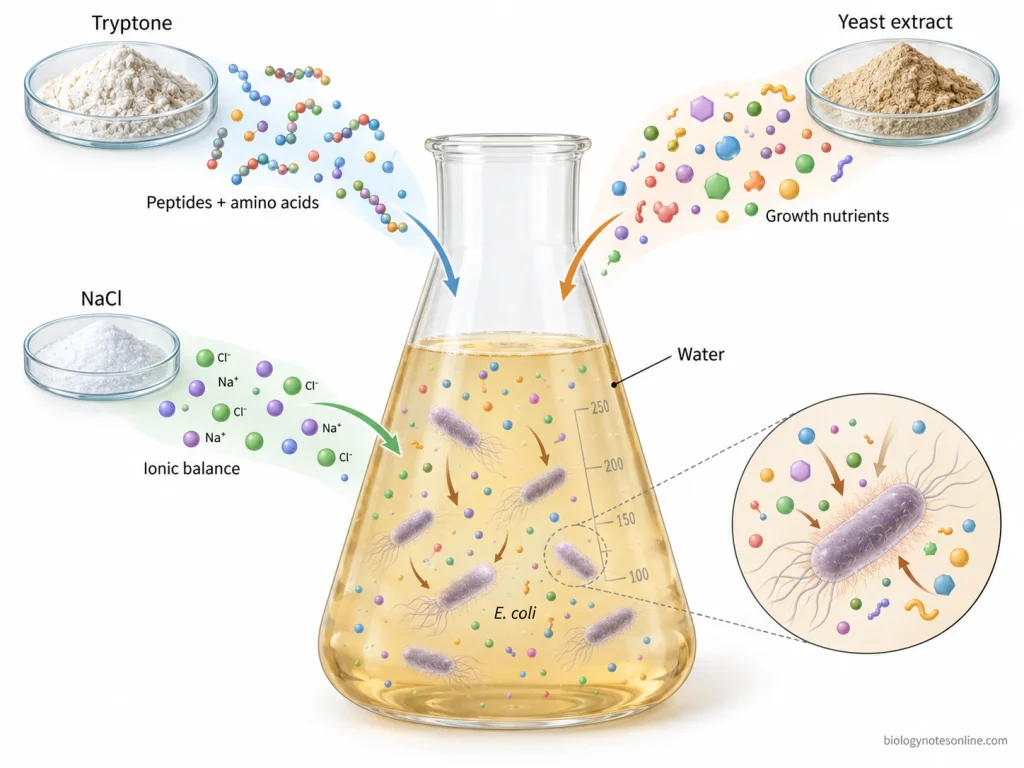
Lysogeny Broth (LB) is a nutrient-rich, complex bacterial culture medium that is used for the growth and maintenance of bacteria, particularly Escherichia coli. It is a chemically undefined medium. LB contains tryptone, yeast extract and sodium chloride (NaCl), although the amount of NaCl differs between common LB formulations.
Tryptone and yeast extract provide peptides, amino acids, vitamins and other nutrients, and their exact chemical composition is not fixed. Bertani originally developed the medium during lysogeny studies for improving Shigella growth and phage plaque formation, and the abbreviation “LB” was intended to mean “lysogeny broth.”
LB originally stands for Lysogeny Broth. Giuseppe Bertani, who formulated the medium during his studies on bacterial lysogeny, later clarified that this was the intended meaning of the abbreviation “LB.” However, names such as Luria broth and Luria-Bertani broth are also commonly found in research papers and laboratory protocols. These names came into widespread use over time, although they were not the original expansion of LB. In laboratory use, “lysogeny broth,” “Luria broth,” and “Luria-Bertani broth” generally refer to the same LB family of bacterial culture media, rather than completely separate fundamental media. Particular LB formulations may still differ, especially in the amount of sodium chloride (NaCl) used.
Characteristics of LB Medium
- Complex medium- LB is a nutrient-rich and chemically undefined bacterial culture medium.
- Components- The main components of LB medium are tryptone, yeast extract, and sodium chloride (NaCl).
- Nutrients- Tryptone and yeast extract mainly supply peptides, amino acids, vitamins, and other nutrients required for growth.
- Growth- It is commonly used for the growth of bacteria, particularly Escherichia coli.
- Carbon source- Standard LB medium does not contain added glucose. During bacterial growth, amino acids act as important carbon sources.
- Salt- The amount of NaCl is not fixed in all LB formulations. LB Miller contains 10 g/L NaCl, whereas LB Lennox contains 5 g/L.
- pH- The pH of LB medium is usually near neutral, around pH 7.0.
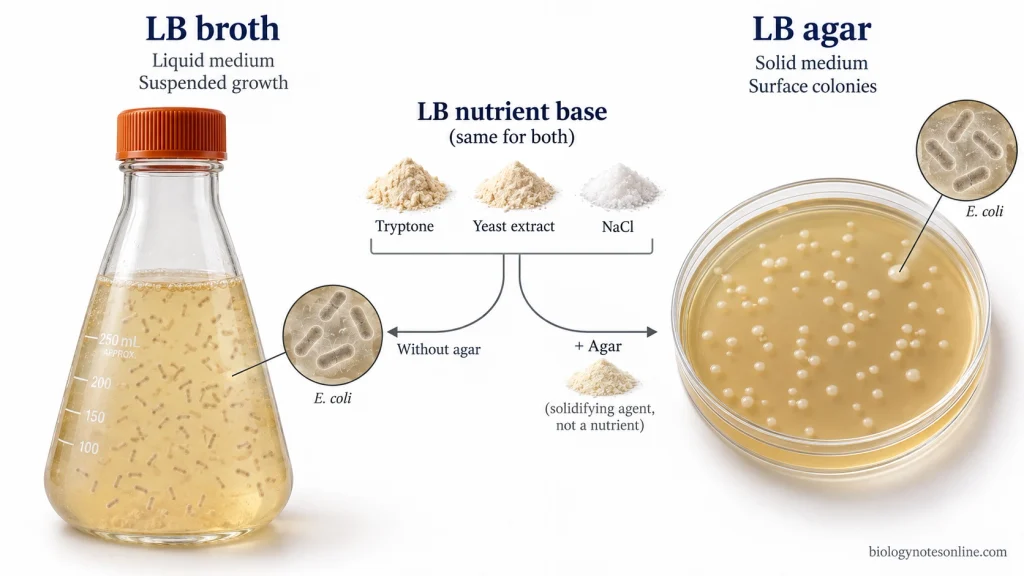
- Form- It is used in the form of liquid broth. With addition of agar, solid LB agar is prepared.
- Selection- Plain LB does not contain antibiotic. Antibiotic is added separately when required.
Composition of LB Broth
Core Ingredients
- Tryptone- Generally 10 g/L is used in LB broth.
- Yeast extract- It is added at 5 g/L.
- Sodium chloride (NaCl)- Common LB Miller contains 10 g/L NaCl. In LB Lennox, the amount is 5 g/L.
- Water- Distilled or deionized water is added to make the final volume of 1 L.
Functions of the Ingredients
- Tryptone- It is a casein digest and provides peptides and amino acids required for bacterial growth.
- Yeast extract- It acts as a complex source of vitamins, growth factors, nitrogenous compounds and other nutrients. Amino acids, peptides, nucleotides and minerals are also present in it.
- NaCl- It provides the ionic condition of the medium and helps to maintain suitable osmotic conditions for the bacterial cells.
Types of LB Broth
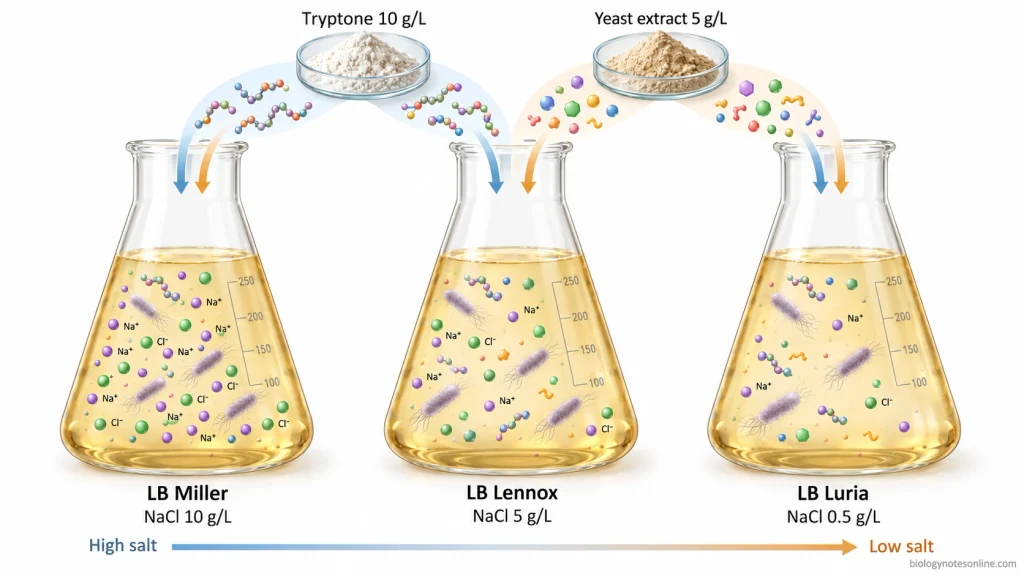
LB broth is mainly available in three common formulations. Tryptone and yeast extract remain the same, while the amount of sodium chloride (NaCl) is different.
- LB Miller- It contains 10 g/L tryptone, 5 g/L yeast extract and 10 g/L NaCl. This is the higher-salt LB formulation.
- LB Lennox- The NaCl content is reduced to 5 g/L. Tryptone (10 g/L) and yeast extract (5 g/L) are present.
- LB Luria- It is the low-salt form of LB, containing only 0.5 g/L NaCl. Tryptone and yeast extract are 10 g/L and 5 g/L, respectively.
LB Broth Recipe
A commonly used formulation is LB Miller broth. The recipe is as follows-
| Ingredient | 1 L LB Miller | 100 mL LB Miller |
|---|---|---|
| Tryptone | 10 g | 1 g |
| Yeast extract | 5 g | 0.5 g |
| NaCl | 10 g | 1 g |
| Distilled/deionized water | To 1 L | To 100 mL |
- Formulation- These quantities are for LB Miller. LB Lennox contains less NaCl (5 g/L), so the two formulations should not be mixed while preparing the medium.
- Water- The ingredients are dissolved in water and the final volume is made up to the required volume, either 1 L or 100 mL.
- Premixed powder- Commercial LB powders are also available. Their formulation may differ, so the preparation amount given for that particular product is followed.
Preparation of LB Broth
Preparation from Individual Ingredients
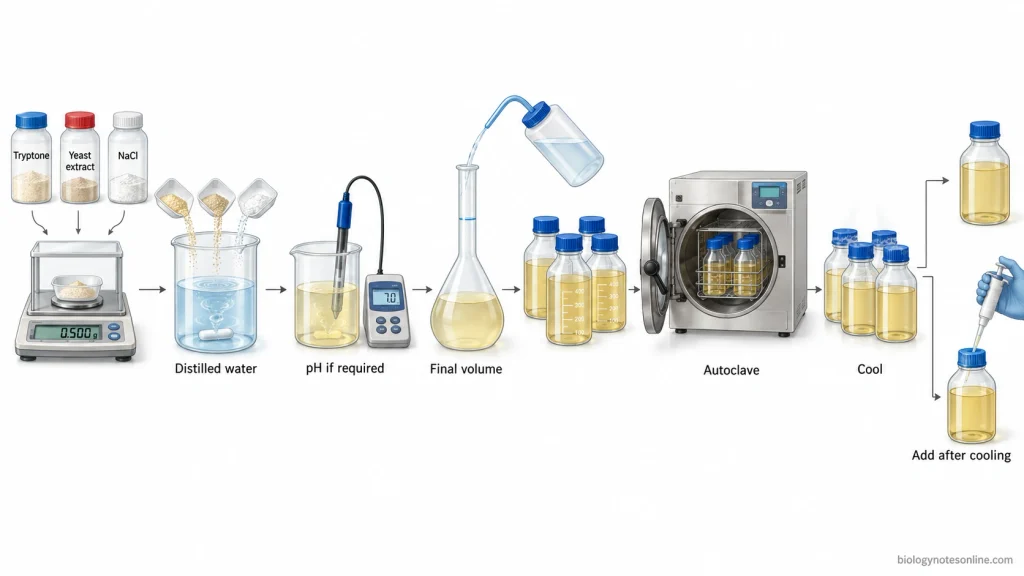
The following are the steps used for preparing LB broth from its individual components-
- Tryptone, yeast extract, and sodium chloride (NaCl) are first measured according to the selected LB formulation. The amount of NaCl is not same for Miller, Lennox, and other LB formulations.
- The measured components are added into most of the required distilled or deionized water. Mix the components until they are properly dissolved.
- The pH is adjusted if required by the particular recipe or laboratory protocol. Some published formulations of LB are prepared without doing a separate pH adjustment.
- Water is then added to make up the required final volume of the medium.
- Dispense the prepared medium into autoclavable bottles, flasks, or other suitable containers. The container used should be suitable for the volume that is being sterilized.
- The medium is sterilized by autoclaving. The validated liquid-cycle condition of the laboratory or the condition given in the selected protocol is followed. A published Lennox LB protocol, for example, uses 20 minutes at 15 psi, while different conditions are also used for other LB preparations.
- After autoclaving, allow the LB broth to cool before it is used. Heat-sensitive supplements are added after sufficient cooling of the medium.
Preparation from LB Powder
- For preparation from premixed LB powder, the required amount of powder is measured according to the manufacturer instructions and volume to be prepared.
- Add the powder into distilled or deionized water and mix properly for dissolving the medium.
- The dissolved medium is then sterilized following the instructions given for that product.
- Miller, Lennox, and other commercial LB powders can have different formulation and preparation amount. Hence, the same grams per liter is not assumed for all of them. Sigma Lennox broth powder, for example, has its specified reconstitution amount and its own preparation procedure.
Sterilization and Cooling
- Prepared LB broth is commonly sterilized by autoclaving.
- Temperature, holding time, and cycle condition depend on the selected protocol, container, and volume being sterilized. The same condition is not followed as a universal condition for every LB preparation.
- In Sigma Lennox LB powder instructions, the medium is autoclaved at 121°C for 15 minutes. A Cold Spring Harbor Lennox protocol uses a 20-minute liquid cycle at 15 psi.
- The sterilized broth is allowed to cool. Heat-sensitive materials are mixed with the broth only after sufficient cooling.
Addition of Antibiotics and Supplements
- Antibiotics and other heat-sensitive selection agents are generally added after autoclaving. The medium is first allowed to cool sufficiently, and around 50-55°C is used in several laboratory protocols.
- Selection agent and its final concentration vary with the bacterial strain, plasmid, experiment, and established laboratory protocol.
- When required, other heat-sensitive supplements are also added aseptically after cooling of the medium.
Storage of Prepared LB Broth
- Sterile LB broth is kept in clean and properly closed sterile containers. The storage condition is followed according to the formulation and laboratory protocol.
- After addition of antibiotics or other supplements, the storage condition can change. Some antibiotics lose activity when stored for extended period, and refrigerated storage is commonly used for media containing these additives.
- Uninoculated LB broth should remain without any unexpected microbial growth. Development of cloudiness or other visible growth during storage can indicate contamination. Such medium should not be used.
- There is no single shelf life fixed for every prepared LB broth. It varies depending on the formulation, added supplements, storage temperature, and the protocol being followed.
Uses of LB Broth
- LB broth is commonly used for routine cultivation of bacteria, particularly laboratory strains of Escherichia coli.
- It is used to prepare starter and overnight bacterial cultures. These cultures can be further used for plasmid isolation or for inoculation of larger cultures.
- In molecular cloning, transformed E. coli carrying recombinant plasmids are grown in LB broth. Suitable selective antibiotic is added when required.
- LB is also used for growing bacterial cells before plasmid DNA extraction. Both small starter cultures and larger cultures for plasmid preparation can be grown in this medium.
- For recombinant protein production, E. coli expression strains can be cultivated in LB broth before induction of the target protein.
- It is used in bacteriophage studies for growing the bacterial host and propagation of phages. LB cultures are also employed during several phage growth and plaque-assay procedures.
- LB broth is used for bacterial growth experiments where culture growth is followed by measuring optical density (OD).
LB Broth vs LB Agar
| Feature | LB Broth | LB Agar |
|---|---|---|
| Form | It is a liquid culture medium. | It is the solid form of LB medium. |
| Basic composition | Contains tryptone, yeast extract, NaCl and water. | Contains the same LB components with agar added as a solidifying agent. |
| Agar | Agar is absent. | Agar is present, commonly about 15 g/L. |
| Bacterial growth | Bacteria grow throughout the broth, usually producing turbidity. | Bacteria grow on the solid surface and can form visible colonies. |
| Major use | It is used for growing bacterial cultures in larger numbers, starter cultures and overnight cultures. | Mainly used for isolation, selection and growth of individual bacterial colonies. |
| Culture vessel | Generally used in culture tubes, bottles or flasks. | It is poured and solidified in Petri plates. |
| Selection | Antibiotics or other supplements can be added when required. | Selective agents can also be added after sterilization and sufficient cooling. |
| Preparation | LB components are dissolved in water and sterilized. | Agar is added with the LB medium before sterilization, then the molten medium is poured into plates. |
LB Broth at a Glance
| Feature | LB Broth |
|---|---|
| Full form | Lysogeny Broth |
| Type | Nutrient-rich, complex and chemically undefined medium |
| Form | Liquid bacterial culture medium |
| Major components | Tryptone, yeast extract, NaCl and water |
| Tryptone function | Provides peptides and amino acids |
| Yeast extract function | Provides vitamins, growth factors, nitrogenous compounds and other nutrients |
| NaCl function | Maintains ionic and osmotic conditions |
| Common formulation | LB Miller |
| LB Miller composition (1 L) | Tryptone 10 g, yeast extract 5 g, NaCl 10 g |
| pH | Generally near neutral, commonly around pH 7.0 |
| Common organism | Mainly used for cultivation of Escherichia coli and other bacteria |
| Sterilization | Usually sterilized by autoclaving |
| Major uses | Bacterial cultivation, overnight cultures, plasmid preparation, cloning, recombinant protein production and bacteriophage studies |
| Solid form | Agar is added to prepare LB agar |
| Other formulations | LB Lennox and low-salt LB formulations differ mainly in NaCl concentration |
Reference
- Arakawa, K., Matsunaga, K., Takihiro, S., Moritoki, A., Ryuto, S., Kawai, Y., Masuda, T., & Miyamoto, T. (2015). Lactobacillus gasseri requires peptides, not proteins or free amino acids, for growth in milk. Journal of Dairy Science, 98(3), 1593–1603. https://doi.org/10.3168/jds.2014-8860
- Baaziz, H., Makhlouf, R., McClelland, M., & Hsu, B. B. (2024). Bacterial resistance to temperate phage is influenced by the frequency of lysogenic establishment. iScience, 27(4), 109595. https://doi.org/10.1016/j.isci.2024.109595
- Bertani, G. (2004). Lysogeny at mid-twentieth century: P1, P2, and other experimental systems. Journal of Bacteriology, 186(3), 595–600. https://doi.org/10.1128/JB.186.3.595-600.2004
- Bhadra, S., Paik, I., Torres, J.-A., Fadanka, S., Gandini, C., Akligoh, H., Molloy, J., & Ellington, A. D. (2022). Preparation and use of cellular reagents: A low-resource molecular biology reagent platform. Current Protocols, 2(3), e387. https://doi.org/10.1002/cpz1.387
- Christensen, D. G., & Visick, K. L. (2020). Vibrio fischeri: Laboratory cultivation, storage, and common phenotypic assays. Current Protocols in Microbiology, 57(1), e103. https://doi.org/10.1002/cpmc.103
- Dan, H., Balachandran, A., & Lin, M. (2009). A pair of ligation-independent Escherichia coli expression vectors for rapid addition of a polyhistidine affinity tag to the N- or C-termini of recombinant proteins. Journal of Biomolecular Techniques, 20(5), 241–248. https://pmc.ncbi.nlm.nih.gov/articles/PMC2777343/
- Elbing, K. L., & Brent, R. (2019). Recipes and tools for culture of Escherichia coli. Current Protocols in Molecular Biology, 125(1), e83. https://doi.org/10.1002/cpmb.83
- Ezraty, B., Henry, C., Hérisse, M., Denamur, E., & Barras, F. (2014). Commercial Lysogeny Broth culture media and oxidative stress: A cautious tale. Free Radical Biology and Medicine, 74, 245–251. https://doi.org/10.1016/j.freeradbiomed.2014.07.010
- LB (Luria-Bertani) liquid medium. (2006). Cold Spring Harbor Protocols, 2006(1), pdb.rec8141. https://doi.org/10.1101/pdb.rec8141
- LB plates. (2026). Cold Spring Harbor Protocols, 2026(1), pdb.rec108607. https://doi.org/10.1101/pdb.rec108607
- Lessard, J. C. (2013). Growth media for E. coli. In J. Lorsch (Ed.), Laboratory methods in enzymology: Cell, lipid and carbohydrate (Methods in Enzymology, Vol. 533, pp. 181–189). Academic Press. https://doi.org/10.1016/B978-0-12-420067-8.00011-8
- Lindqvist, B. H., Haggård-Ljungqvist, E., & Calendar, R. (2015). Giuseppe Bertani (1923–2015). Bacteriophage, 5(2), e1054060. https://doi.org/10.1080/21597081.2015.1054060
- Lysogeny broth (LB, Lennox formulation; 1-L). (2023). Cold Spring Harbor Protocols, 2023(9), pdb.rec108100. https://doi.org/10.1101/pdb.rec108100
- Manoli, M.-T., Hernández-Herreros, N., Rivero-Buceta, V., Rodríguez, A., & Prieto, M. A. (2025). Protocol for obtaining polyhydroxyalkanoates from microbial cultures: Production, quantification, and analytical assays. STAR Protocols, 6(4), 104261. https://doi.org/10.1016/j.xpro.2025.104261
- Marinos, G., Kaleta, C., & Waschina, S. (2020). Defining the nutritional input for genome-scale metabolic models: A roadmap. PLOS ONE, 15(8), e0236890. https://doi.org/10.1371/journal.pone.0236890
- Moratti, C. F., Yang, S. N. N., Scott, C., & Coleman, N. V. (2024). Development of a whole-cell biosensor for ethylene oxide and ethylene. Microbial Biotechnology, 17(6), e14511. https://doi.org/10.1111/1751-7915.14511
- Nabergoj, D., Modic, P., & Podgornik, A. (2018). Effect of bacterial growth rate on bacteriophage population growth rate. MicrobiologyOpen, 7(2), e00558. https://doi.org/10.1002/mbo3.558
- Reyna, N., Plymale, R., & Johnson, K. (n.d.). Lab manual: Synthetic biology protocols. Biology LibreTexts. https://bio.libretexts.org/Bookshelves/Biotechnology/Lab_Manual%3A_Synthetic_Biology_Protocols
- Sezonov, G., Joseleau-Petit, D., & D’Ari, R. (2007). Escherichia coli physiology in Luria-Bertani broth. Journal of Bacteriology, 189(23), 8746–8749. https://doi.org/10.1128/JB.01368-07
- Tao, Z., Yuan, H., Liu, M., Liu, Q., Zhang, S., Liu, H., Jiang, Y., Huang, D., & Wang, T. (2023). Yeast extract: Characteristics, production, applications and future perspectives. Journal of Microbiology and Biotechnology, 33(2), 151–166. https://doi.org/10.4014/jmb.2207.07057
- Xiao, Y., Tan, X., He, Q., & Yang, S. (2024). Systematic metabolic engineering of Zymomonas mobilis for β-farnesene production. Frontiers in Bioengineering and Biotechnology, 12, 1392556. https://doi.org/10.3389/fbioe.2024.1392556
- Zimbro, M. J., Power, D. A., Miller, S. M., Wilson, G. E., & Johnson, J. A. (Eds.). (2009). Difco & BBL manual: Manual of microbiological culture media (2nd ed.). Becton, Dickinson and Company. https://books.google.com/books?id=WW45cgAACAAJ