

The nucleolus is a prominent, non-membrane bound structure present inside the nucleus of eukaryotic cells. It is mainly involved in the synthesis and processing of ribosomal RNA (rRNA) and assembly of ribosomal subunits. Thus, it acts as the major site for ribosome biogenesis in the cell.
The nucleolus is formed around specific chromosomal regions containing repeated rRNA genes, known as nucleolar organizing regions (NORs). It is a dynamic nuclear structure and its size can vary depending on the ribosome-producing activity of the cell.
What is the Nucleolus?
Nucleolus is a prominent nuclear body present inside the nucleus of eukaryotic cells. The plural form is nucleoli. It is generally seen as a dense region of the nucleus and unlike the membrane-bound cell organelles, no surrounding lipid membrane is present around it.
Ribosome biogenesis is the major function associated with the nucleolus. Ribosomal RNA (rRNA) is transcribed and processed here. Ribosomal proteins are brought into this region and combine with the rRNA, and during this process the early ribosomal subunits are formed.
Meaning and Origin of the Term Nucleolus
The term nucleolus is a Latin diminutive of nucleus. It means “little nucleus”. The name came from its appearance as a small body lying within the nucleus.
Structures now called nucleoli were observed from the early period of microscopic studies. Rudolf Wagner gave one of the first properly documented accounts in 1835 and Gabriel Gustav Valentin described the structure in 1836. Earlier observation was also made by Felice Fontana in the eighteenth century.
The word nucleolus, however, was introduced by Valentin in 1839, while giving an abstract of Schwann’s work. Thus, the description of the structure and introduction of its present term did not occur at exactly the same time.
Where is the Nucleolus Located?
The nucleolus is located inside the nucleus of eukaryotic cells, within the nucleoplasm. It does not occupy a separate membrane-bound compartment. Instead, nucleoli are formed at particular regions of chromosomes containing many copies of ribosomal DNA (rDNA). These chromosomal regions are known as nucleolar organizer regions (NORs).
The location of nucleolus is therefore associated with the position of active NORs in the nucleus. Around these regions the rRNA genes are transcribed and nucleolar materials become organized. One nucleus may contain a single nucleolus or several nucleoli, depending on the cell and activity of the NORs.
In human cells, the NORs carrying the major rRNA gene arrays are present on the short arms of five acrocentric chromosome pairs, chromosomes 13, 14, 15, 21 and 22. Nucleoli develop around the active NORs after cell division. Thus, their position within the nucleus is closely related with these rDNA-containing chromosome regions, rather than being present at any fixed central position.
The location-section sentence pattern was matched to the uploaded samples, where the location is stated first and then the associated cellular region is described in uneven short and longer sentences.
Characteristics of the Nucleolus
- Nucleolus is a dense and prominent nuclear body present inside the nucleus. It has no surrounding lipid membrane.
- It is mainly associated with ribosome biogenesis. Ribosomal RNA (rRNA) is synthesized and processed here, together with the assembly of ribosomal proteins to form pre-ribosomal particles.
- Nucleoli are formed in association with the nucleolar organizer regions (NORs). These are the chromosomal regions containing repeated genes for rRNA.
- The nucleolus contains large amount of rRNA and different proteins. rDNA regions are also associated with its organization.
- The internal structure is not uniform. In mammalian cells, three regions are generally recognized, fibrillar center (FC), dense fibrillar component (DFC) and granular component (GC).
- Different events of ribosome formation take place in these regions. rRNA transcription is mainly associated with the FC-DFC region, processing occurs largely in DFC, while later assembly of ribosomal particles takes place in GC.
- Number of nucleoli is not same in every cell. One or more nucleoli may be present inside a nucleus.
- The size of nucleolus also varies. Cells having high rate of ribosome production generally possess more prominent nucleoli.
- Nucleolus is a dynamic structure and does not remain unchanged throughout the cell cycle. During mitosis, it becomes disassembled and is formed again around active NORs after completion of chromosome segregation.
- No membrane separates the nucleolar components from surrounding nucleoplasm. The different RNA and proteins remain concentrated together and this organization is maintained partly by molecular interactions and phase separation.
Structure of the Nucleolus
- Nucleolus is not surrounded by any membrane. It occurs as a dense structure in the nucleoplasm, containing rRNA, proteins and the associated ribosomal DNA (rDNA) chromatin.
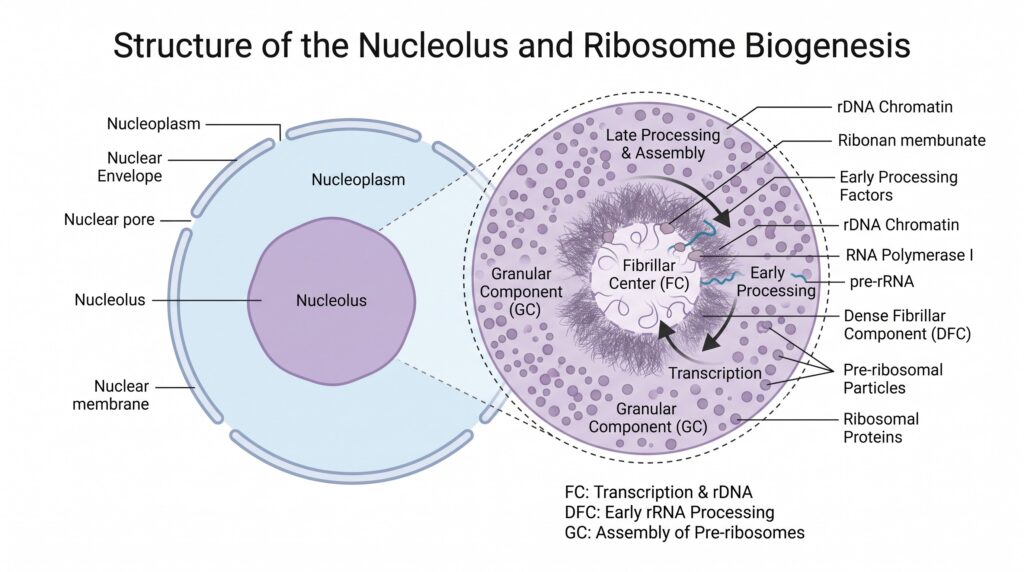
- In most higher eukaryotic cells, three major structural regions can be distinguished in the nucleolus. These are fibrillar center (FC), dense fibrillar component (DFC) and granular component (GC). They can be clearly differentiated under electron microscope.
- Fibrillar Center (FC) is the comparatively pale fibrillar region, generally found toward the inner part of the nucleolus. The rDNA and much of the RNA polymerase I transcription machinery are associated with this region. Active rRNA transcription occurs in or near the FC and particularly around the FC-DFC boundary.
- Surrounding the fibrillar center is the Dense Fibrillar Component (DFC). It appears more electron-dense. Newly formed pre-rRNA rapidly enters this region, where the early processing and modification of pre-rRNA takes place.
- Granular Component (GC) forms a large part of the nucleolar structure and is generally present around the fibrillar regions. It contains numerous pre-ribosomal particles. Later processing of rRNA and assembly with ribosomal proteins are carried out mainly in this region.
- The three regions are not simply separated structures. FC is commonly surrounded by DFC, while these fibrillar regions remain within the larger granular component, giving the nucleolus its characteristic internal organization.
- Nucleolar chromatin is also associated with the nucleolus. The rRNA genes are arranged in repeated clusters at the nucleolar organizer regions (NORs), and nucleolar organization develops around the transcriptionally active regions.
- The amount and arrangement of FC, DFC and GC are not always same. They change with the type of cell and the level of rRNA synthesis, so an active nucleolus may differ considerably in its appearance and size.
Nucleolar Organizer Region (NOR)
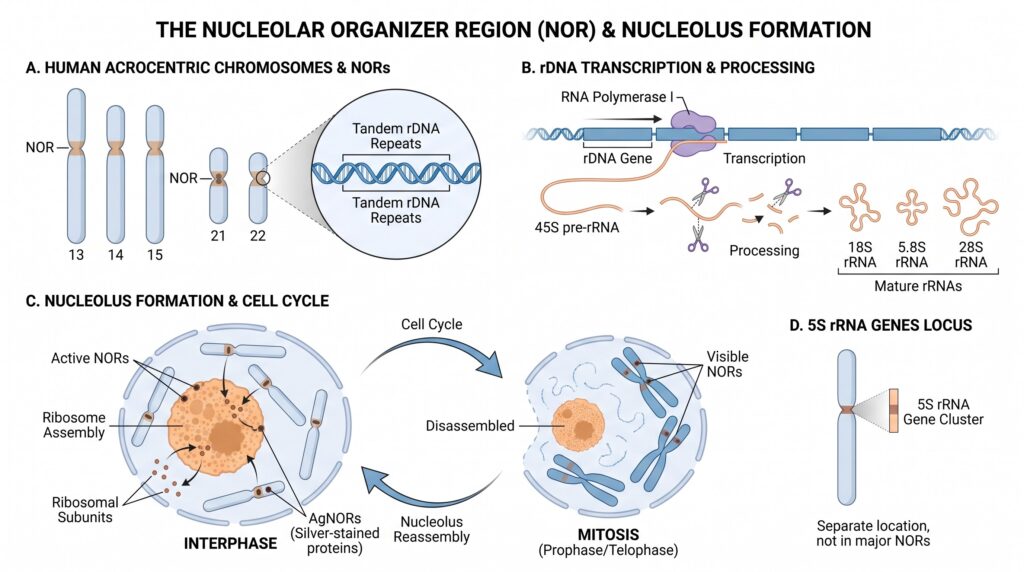
- Nucleolar Organizer Region (NOR) is a particular region of chromosome having repeated copies of ribosomal DNA (rDNA). These rDNA genes are arranged one after another in tandem repeats.
- It is the chromosomal region around which the nucleolus becomes organized. The transcriptionally active NORs take part in nucleolus formation.
- The rDNA of NOR forms a large precursor rRNA, called 45S pre-rRNA in mammals. From this precursor, 18S, 5.8S and 28S rRNAs are produced after processing.
- RNA polymerase I is involved in transcription of these rRNA genes. Transcription takes place in the nucleolar region, followed by processing of the newly formed pre-rRNA.
- In humans, NORs are present on the short arms of five pairs of acrocentric chromosomes. These are chromosomes 13, 14, 15, 21 and 22.
- All the rDNA repeats present in NOR do not remain active at the same time. Some are transcriptionally active, while other repeats remain inactive or silent.
- During mitosis, the nucleolus becomes disorganized. The NORs, however, remain as chromosomal regions and after mitosis nucleolar materials again assemble around the active NORs.
- Some proteins associated with active NORs can be detected by silver staining. These silver-stained regions are known as AgNORs. The staining mainly represents NOR-associated proteins, not simply the rDNA itself.
- The number of active NORs is not always same in every cell. Their activity is related with the requirement of rRNA synthesis and production of ribosomes.
- 5S rRNA genes are not included in the major NOR rDNA repeats in humans. They are present separately, mainly as a repeated gene cluster on chromosome 1.
Labeled Diagram of the Nucleolus
Chemical Composition of the Nucleolus
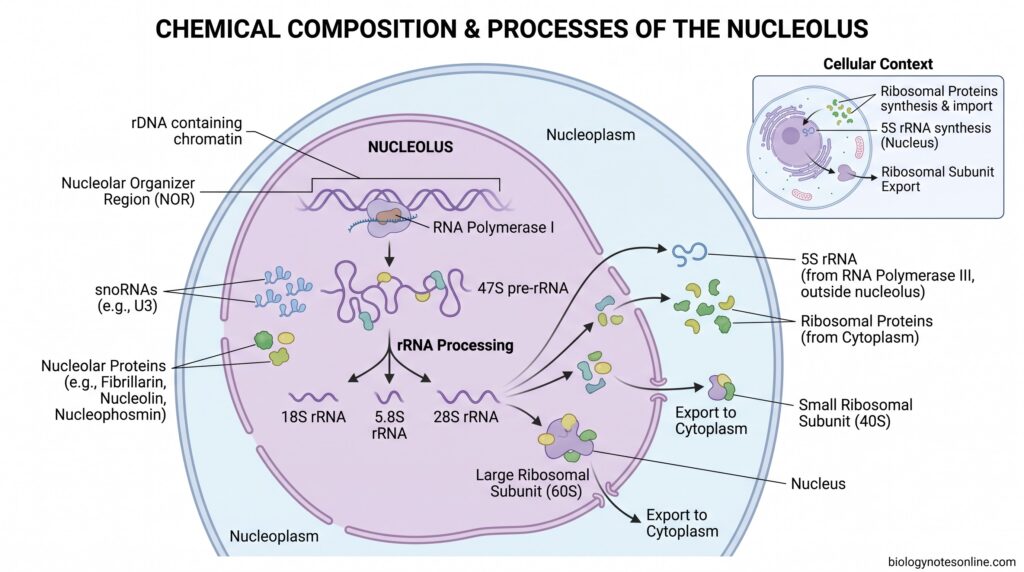
The nucleolus is mainly composed of RNA and proteins, together with the rDNA-containing chromatin associated with it. Different RNA and protein components are present.
- Ribosomal RNA (rRNA)- A major RNA component of nucleolus. In mammalian cells, 47S pre-rRNA is formed by RNA polymerase I. It is then processed to give 18S, 5.8S and 28S rRNAs.
- Small nucleolar RNAs (snoRNAs)- These small RNAs are found in nucleolus and take part in processing of pre-rRNA. Some are involved in modification of rRNA also. U3 snoRNA is an important example.
- Ribosomal proteins- Ribosomal proteins are another important component. They are formed in the cytoplasm, enter the nucleus and then nucleolus, where association with rRNA takes place during ribosomal subunit formation.
- Nucleolar proteins- A large number of non-ribosomal proteins are also present. Fibrillarin, nucleolin and nucleophosmin (NPM1/B23) are some of them. These proteins have functions in rRNA processing, ribosome assembly and nucleolar organization.
- Ribosomal DNA (rDNA)- The rDNA containing chromosomal regions remain associated with nucleolus. These genes occur in repeated form at the nucleolar organizer regions (NORs) and code for the precursor of 18S, 5.8S and 28S rRNAs.
- 5S rRNA- It forms part of the large ribosomal subunit. Unlike the other major rRNAs, 5S rRNA is synthesized outside the nucleolus by RNA polymerase III. It later enters the pathway of large ribosomal subunit assembly.
- Other RNA-processing factors and ribosome assembly factors are also found in nucleolus. The nucleolar components are not permanently fixed, many proteins continuously move between the nucleolus and surrounding nucleoplasm.
Functions of the Nucleolus
- rRNA synthesis- The major function of nucleolus is the production of ribosomal RNA. RNA polymerase I transcribes the rDNA to form a large precursor rRNA.
- Processing of rRNA- The newly formed pre-rRNA undergoes cleavage and different chemical modifications in the nucleolus. Small nucleolar ribonucleoproteins (snoRNPs) take part in several of these reactions.
- Formation of ribosomal subunits- Ribosomal proteins formed in the cytoplasm enter the nucleus and associate with rRNA. During this process, the early 40S and 60S ribosomal subunits are formed. They are later transported to the cytoplasm.
- Assembly of other ribonucleoproteins- Nucleolus is also involved in the formation or maturation of some other ribonucleoprotein (RNP) particles. Signal recognition particle (SRP) is one of the important examples.
- Cellular stress response- The nucleolus is involved in response of cell to different stress conditions. Disturbance of rRNA synthesis or ribosome formation produces nucleolar stress, which can activate p53-dependent and other stress-response pathways.
- Regulation of cell growth and cell cycle- Ribosome production is closely associated with cellular growth and proliferation. Different nucleolar proteins also take part in regulation of cell-cycle progression.
- Maintenance of genome stability- The nucleolus and the associated rDNA regions have roles in maintenance of genome stability. Protection and repair of rDNA are particularly important because these genes occur as highly repeated and actively transcribed sequences.
- Telomerase maturation- A nucleolar stage is also found during the maturation and assembly of telomerase components. Nucleolus therefore takes part in some cellular RNP-processing events other than ribosome formation.
How Does the Nucleolus Make Ribosomes?
The formation of ribosomes begins in the nucleolus. rRNA is formed and processed, which then combines with ribosomal proteins. The process takes place in following steps-
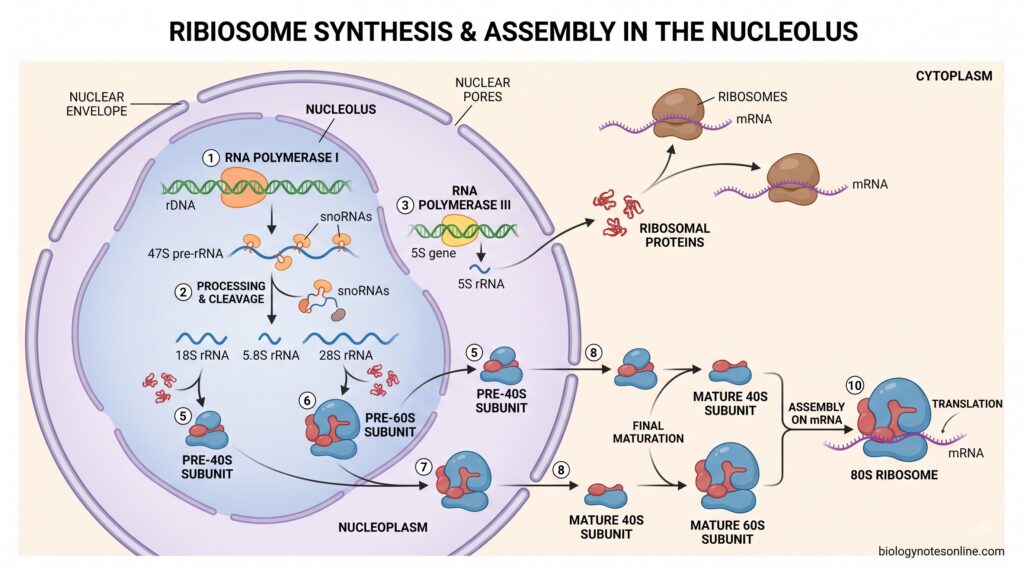
- rDNA transcription- The rDNA is first transcribed by RNA polymerase I. 47S pre-rRNA is formed in mammalian cells.
- Processing of pre-rRNA- The formed pre-rRNA is now cleaved and modified. During this process, 18S, 5.8S and 28S rRNAs are produced.
- Action of snoRNAs- Different snoRNAs are involved in processing and modification of pre-rRNA. They act together with nucleolar proteins.
- Formation of 5S rRNA- 5S rRNA is formed separately by RNA polymerase III. It later enters into the large ribosomal subunit.
- Entry of ribosomal proteins- Ribosomal proteins are formed in cytoplasm and transported into nucleus. These proteins then enter the nucleolus.
- Formation of pre-40S subunit- 18S rRNA combines with small-subunit ribosomal proteins. A pre-40S particle is formed.
- Formation of pre-60S subunit- 28S, 5.8S and 5S rRNAs combine with large-subunit proteins. During this process, pre-60S particle is formed.
- Movement into nucleoplasm- The formed pre-40S and pre-60S particles now move into nucleoplasm. Further maturation takes place here.
- Transport into cytoplasm- Both particles are transported separately through the nuclear pore complex (NPC) and enter into cytoplasm.
- Final maturation- Some final processing takes place in cytoplasm. Mature 40S and 60S ribosomal subunits are now formed.
- Formation of 80S ribosome- During protein synthesis, 40S and 60S subunits join together on mRNA. The 80S ribosome is formed.
Role of Different rRNAs in Ribosome Formation
| rRNA | Ribosomal subunit | Role in ribosome formation |
|---|---|---|
| 18S rRNA | 40S small subunit | Forms the major RNA part of small subunit and is involved in decoding of mRNA. |
| 5.8S rRNA | 60S large subunit | Associates closely with 28S rRNA and helps in formation and stability of large subunit. |
| 28S rRNA | 60S large subunit | Major rRNA of large subunit. It takes part in peptide bond formation during protein synthesis. |
| 5S rRNA | 60S large subunit | Forms part of the large subunit and helps in its structural organization and function. |
Nucleolus During the Cell Cycle
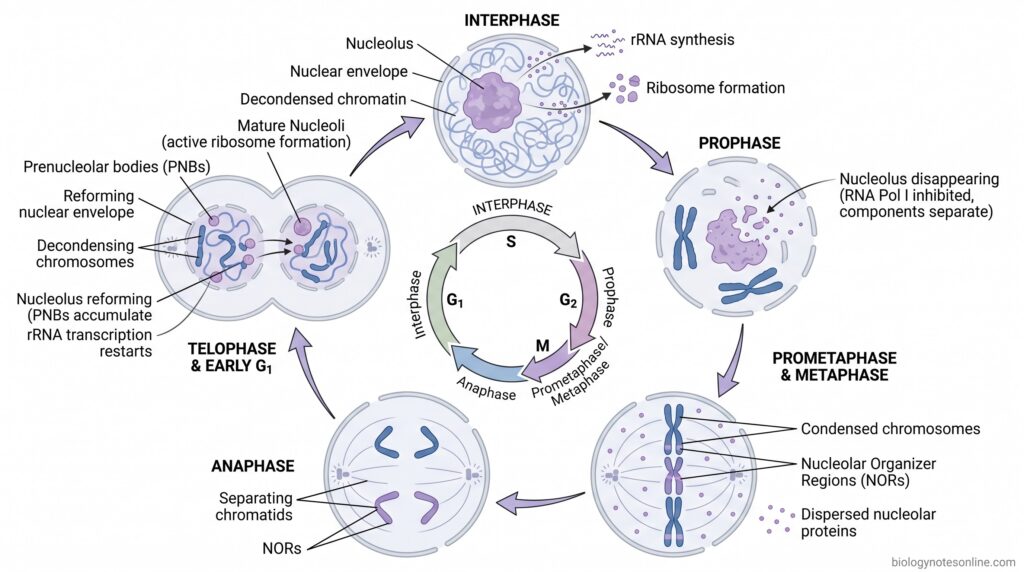
- Interphase- Nucleolus is clearly visible during interphase and remains active. rRNA synthesis and ribosome formation take place during this period.
- Prophase- During prophase, the nucleolus starts to disappear. RNA polymerase I activity is inhibited and different nucleolar components begin to separate from the nucleolus.
- Prometaphase and Metaphase- The nucleolus is absent as a distinct structure. The nucleolar organizer regions (NORs) remain present on chromosomes, but many nucleolar proteins are dispersed in the mitotic cell.
- Anaphase- Chromosomes move towards opposite poles. Nucleolus is still absent during this stage.
- Telophase- The chromosomes begin to decondense and rRNA transcription starts again. Nucleolar components now accumulate around active NORs and small prenucleolar bodies (PNBs) are formed.
- Early G1 phase- The newly formed nucleoli become organized. rRNA processing and ribosome formation again become active in the daughter cells.
- In higher eukaryotic cells having open mitosis, nucleolus disappears during mitosis and forms again after chromosome separation. This pattern is not same in all organisms.
Nucleolus in Plant and Animal Cells
- Nucleolus is present inside the nucleus of both plant and animal cells. No membrane is present around it. The major activity is rRNA formation and ribosome biogenesis.
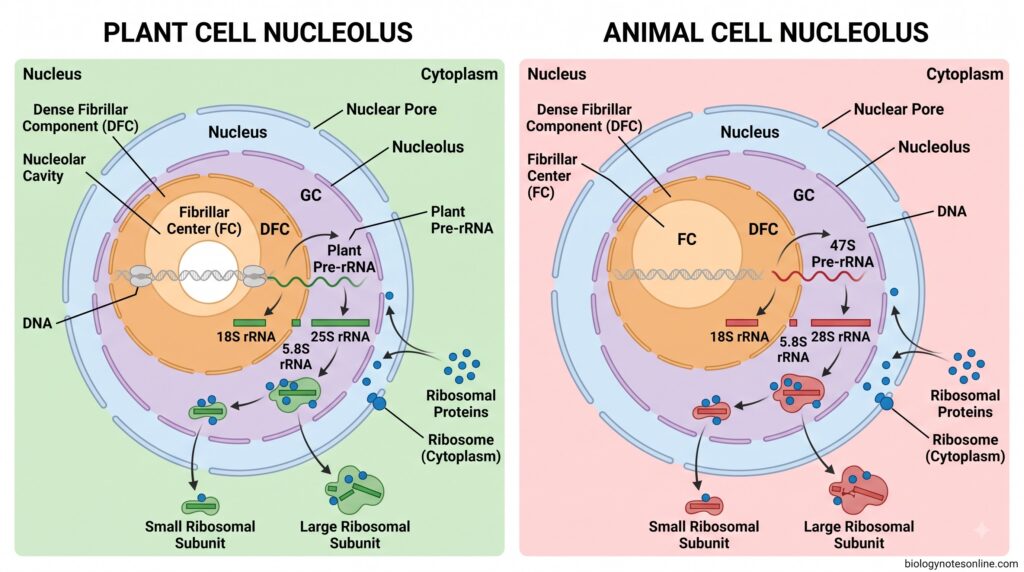
- Plant cell nucleolus- It has fibrillar center (FC), dense fibrillar component (DFC) and granular component (GC). A central nucleolar cavity is also found in many plant nucleoli.
- In Arabidopsis thaliana, the long pre-rRNA contains 18S, 5.8S and 25S rRNAs. These are separated during rRNA processing.
- Animal cell nucleolus- In mammalian cells, three major regions are present, FC, DFC and GC. rRNA synthesis and processing takes place in association with these regions.
- The primary pre-rRNA in mammalian cells is 47S pre-rRNA. It is processed to form 18S, 5.8S and 28S rRNAs.
- Ribosomal proteins are formed in cytoplasm and then transported into nucleus. In nucleolus these proteins associate with the developing rRNAs, during formation of small and large ribosomal subunits.
- The large rRNA is commonly 25S rRNA in plants such as Arabidopsis, while in mammals it is 28S rRNA.
Plant vs Animal Nucleolus
| Feature | Plant Nucleolus | Animal Nucleolus |
|---|---|---|
| Location | Present inside the nucleus. | Present inside the nucleus. |
| Membrane | No surrounding membrane. | No surrounding membrane. |
| Major function | Mainly involved in rRNA synthesis, processing and ribosome formation. | Same major function, ribosome biogenesis. |
| Main regions | Fibrillar center (FC), dense fibrillar component (DFC) and granular component (GC) are present. | FC, DFC and GC are also present. |
| Nucleolar cavity | A nucleolar cavity is commonly seen in many plant nucleoli. | Usually not a characteristic prominent feature. |
| Large rRNA | Commonly 25S rRNA in higher plants such as Arabidopsis. | 28S rRNA in mammals. |
| Other major rRNAs | 18S and 5.8S rRNAs are also formed. | 18S and 5.8S rRNAs are also formed. |
| Pre-rRNA | A long precursor rRNA is processed to form mature rRNAs. | In mammals, 47S pre-rRNA is processed to form 18S, 5.8S and 28S rRNAs. |
| Ribosomal proteins | Formed in cytoplasm and later enter nucleus and nucleolus. | Same process takes place. |
| General organization | Similar basic nucleolar organization, with some plant-specific structural features. | Similar basic organization, especially well described in mammalian cells. |
Nucleus vs Nucleolus
| Feature | Nucleus | Nucleolus |
|---|---|---|
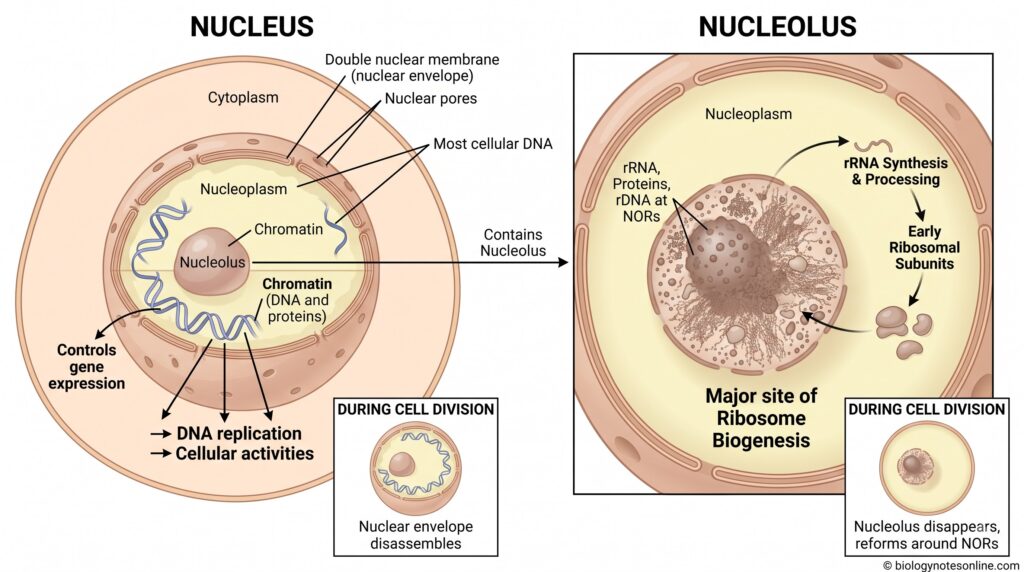
| Definition | A membrane-bound cell organelle containing the major genetic material of eukaryotic cells. | A dense nuclear body present inside the nucleus. |
| Location | Present within the cytoplasm of eukaryotic cells. | Present within the nucleoplasm. |
| Membrane | Surrounded by a double nuclear membrane or nuclear envelope. | No surrounding lipid membrane. |
| Major components | Contains DNA, chromatin, nucleoplasm, nucleolus and different nuclear proteins. | Mainly contains rRNA, proteins and associated rDNA regions. |
| Major function | Controls gene expression, DNA replication and different cellular activities. | Mainly involved in ribosome biogenesis. |
| Genetic material | Contains most of the cellular DNA. | Associated mainly with repeated rDNA genes present at NORs. |
| RNA synthesis | Different types of RNA are transcribed in the nucleus. | Major site for synthesis and processing of precursor rRNA. |
| Ribosome formation | Provides the nuclear region where ribosome biogenesis takes place. | The main site where early ribosomal subunits are formed. |
| Structure | Larger and more complex nuclear compartment. | Smaller, dense structure present inside nucleus. |
| During cell division | Nuclear envelope disassembles during open mitosis and forms again later. | Nucleolus also disappears during mitosis and is formed again around active NORs. |
Nucleolus vs Ribosome
| Feature | Nucleolus | Ribosome |
|---|---|---|
| Definition | A dense nuclear body present inside the nucleus. | A small ribonucleoprotein particle involved in protein synthesis. |
| Location | Present in the nucleus. | Present freely in cytoplasm or attached to rough endoplasmic reticulum (RER). |
| Membrane | No surrounding lipid membrane. | No surrounding membrane. |
| Major components | Mainly rRNA, proteins and associated rDNA regions. | Made up of rRNA and ribosomal proteins. |
| Major function | Mainly involved in ribosome biogenesis. | Mainly involved in protein synthesis. |
| rRNA synthesis | Pre-rRNA is synthesized and processed here. | Does not synthesize rRNA. It contains mature rRNAs. |
| Subunits | Helps in formation of 40S and 60S pre-ribosomal subunits in eukaryotes. | Functional eukaryotic ribosome contains 40S and 60S subunits, forming 80S ribosome. |
| DNA association | Closely associated with rDNA at nucleolar organizer regions. | No DNA is present as a structural component. |
| Role in protein synthesis | Indirect role by producing ribosomal subunits. | Directly translates mRNA into protein. |
| During cell division | Becomes disorganized during open mitosis and forms again later. | Ribosomes remain as cellular particles and are not formed into a nucleolus-like structure. |
Do Prokaryotes Have a Nucleolus?
Prokaryotic cells do not possess a nucleolus. They are without a true membrane-bound nucleus. The nuclear material remains in a region of cytoplasm called nucleoid. Hence, a separate nucleolus as found in eukaryotic cells is absent.
Ribosomes however are present in prokaryotes. Ribosome formation also takes place, but without a nucleolus. In bacteria, rRNAs combine with different ribosomal proteins and form two unequal subunits, 30S and 50S. Both subunits together form the 70S ribosome.
Bacteria and Archaea have 70S cytoplasmic ribosomes. The basic subunits are 30S and 50S, although their molecular composition is not same in both groups.
Why Is the Nucleolus Not Surrounded by a Membrane?
The nucleolus has no surrounding lipid membrane. No lipid boundary is formed around it. Instead, rRNA and different nucleolar proteins become concentrated around the active rDNA regions, forming a dense region within the nucleoplasm. A membrane is not required for keeping this organization.
Different RNA and proteins present in nucleolus interact with each other. These components can separate from the surrounding nucleoplasm into liquid-like phases. This process is called phase separation. The nucleolus is therefore a membrane-less nuclear body or biomolecular condensate.
During ribosome biogenesis, many proteins, rRNA and processing factors continuously move into and out of the nucleolus. The absence of a membrane allows rapid exchange of these molecules with the nucleoplasm. The components however remain concentrated, and rRNA processing and early ribosomal subunit formation takes place within this region.
Nucleolus and Disease
Changes in the nucleolus are found in different human diseases. Abnormal rRNA formation, ribosome biogenesis or changes in nucleolar proteins may be involved. Some of the important conditions are-
- Cancer- Large and prominent nucleoli are commonly seen in cancer cells. Ribosome production is also increased in many cancers, particularly in rapidly growing cells. Changes in nucleolar size and number have long been associated with malignant cells.
- Ribosomopathies- These are a group of diseases caused by defects in ribosome formation or ribosomal components. Diamond-Blackfan anemia (DBA), Treacher Collins syndrome (TCS) and Shwachman-Diamond syndrome are some of the important examples. Many ribosomopathies also show increased risk of cancer later in life.
- Diamond-Blackfan anemia- Mutations in different ribosomal protein genes are commonly involved. Ribosome formation becomes affected, particularly in developing blood cells.
- Treacher Collins syndrome- It is mainly associated with abnormal ribosome biogenesis during development. Mutations in TCOF1 are most common, while defects in some RNA polymerase I subunits can also produce the disease. Craniofacial abnormalities are characteristic.
- Neurodegenerative diseases- Abnormal nucleolar activity and nucleolar stress have been reported in Parkinson’s disease, Alzheimer’s disease and some other neurodegenerative disorders. Changes in rRNA transcription and nucleolar organization may occur in affected neurons.
- Nucleolar stress- Disturbance of rRNA transcription, rRNA processing or ribosome assembly can produce this condition. The nucleolar structure becomes altered. p53 pathway is frequently activated during this process, which may cause cell-cycle arrest or cell death.
- Genome instability- The rDNA present in nucleolus consists of highly repeated genes. Damage or abnormal regulation of these regions can affect genome stability and cellular stress responses.
References
- Aubert, M., O’Donohue, M.-F., Lebaron, S., & Gleizes, P.-E. (2018). Pre-ribosomal RNA processing in human cells: From mechanisms to congenital diseases. Biomolecules, 8(4), 123. https://doi.org/10.3390/biom8040123
- Boisvert, F.-M., van Koningsbruggen, S., Navascués, J., & Lamond, A. I. (2007). The multifunctional nucleolus. Nature Reviews Molecular Cell Biology, 8(7), 574–585. https://doi.org/10.1038/nrm2184
- Chen, D., & Huang, S. (2001). Nucleolar components involved in ribosome biogenesis cycle between the nucleolus and nucleoplasm in interphase cells. The Journal of Cell Biology, 153(1), 169–176. https://doi.org/10.1083/jcb.153.1.169
- Cooper, G. M. (2000). The nucleolus. In The cell: A molecular approach (2nd ed.). Sinauer Associates. https://www.ncbi.nlm.nih.gov/books/NBK9939/
- Dubois, M.-L., & Boisvert, F.-M. (2016). The nucleolus: Structure and function. In D. P. Bazett-Jones & G. Dellaire (Eds.), The functional nucleus (pp. 29–49). Springer. https://doi.org/10.1007/978-3-319-38882-3_2
- Dundr, M., Misteli, T., & Olson, M. O. J. (2000). The dynamics of postmitotic reassembly of the nucleolus. The Journal of Cell Biology, 150(3), 433–446. https://doi.org/10.1083/jcb.150.3.433
- Feric, M., Vaidya, N., Harmon, T. S., Mitrea, D. M., Zhu, L., Richardson, T. M., Kriwacki, R. W., Pappu, R. V., & Brangwynne, C. P. (2016). Coexisting liquid phases underlie nucleolar subcompartments. Cell, 165(7), 1686–1697. https://doi.org/10.1016/j.cell.2016.04.047
- Floutsakou, I., Agrawal, S., Nguyen, T. T., Seoighe, C., Ganley, A. R. D., & McStay, B. (2013). The shared genomic architecture of human nucleolar organizer regions. Genome Research, 23(12), 2003–2012. https://doi.org/10.1101/gr.157941.113
- Hernandez-Verdun, D. (2011). Assembly and disassembly of the nucleolus during the cell cycle. Nucleus, 2(3), 189–194. https://doi.org/10.4161/nucl.2.3.16246
- Jiao, L., Liu, Y., Yu, X.-Y., Pan, X., Zhang, Y., Tu, J., Song, Y.-H., & Li, Y. (2023). Ribosome biogenesis in disease: New players and therapeutic targets. Signal Transduction and Targeted Therapy, 8, 15. https://doi.org/10.1038/s41392-022-01285-4
- Jüttner, M., & Ferreira-Cerca, S. (2022). A comparative perspective on ribosome biogenesis: Unity and diversity across the tree of life. In K.-D. Entian (Ed.), Ribosome biogenesis: Methods and protocols (pp. 3–54). Humana. https://doi.org/10.1007/978-1-0716-2501-9_1
- Kalinina, N. O., Makarova, S., Makhotenko, A., Love, A. J., & Taliansky, M. (2018). The multiple functions of the nucleolus in plant development, disease and stress responses. Frontiers in Plant Science, 9, 132. https://doi.org/10.3389/fpls.2018.00132
- Kang, J., Brajanovski, N., Chan, K. T., Xuan, J., Pearson, R. B., & Sanij, E. (2021). Ribosomal proteins and human diseases: Molecular mechanisms and targeted therapy. Signal Transduction and Targeted Therapy, 6, 323. https://doi.org/10.1038/s41392-021-00728-8
- Krüger, T., Zentgraf, H., & Scheer, U. (2007). Intranucleolar sites of ribosome biogenesis defined by the localization of early binding ribosomal proteins. The Journal of Cell Biology, 177(4), 573–578. https://doi.org/10.1083/jcb.200612048
- Lam, Y. W., & Trinkle-Mulcahy, L. (2015). New insights into nucleolar structure and function. F1000Prime Reports, 7, 48. https://doi.org/10.12703/P7-48
- Lafita-Navarro, M. C., & Conacci-Sorrell, M. (2023). Nucleolar stress: From development to cancer. Seminars in Cell & Developmental Biology, 136, 64–74. https://pubmed.ncbi.nlm.nih.gov/35410715/
- Oborská-Oplová, M., Fischer, U., Altvater, M., Panse, V. G., & Hurt, E. (2022). Eukaryotic ribosome assembly and nucleocytoplasmic transport. In K.-D. Entian (Ed.), Ribosome biogenesis: Methods and protocols (pp. 151–184). Humana. https://doi.org/10.1007/978-1-0716-2501-9_7
- Parlato, R., & Kreiner, G. (2013). Nucleolar activity in neurodegenerative diseases: A missing piece of the puzzle? Journal of Molecular Medicine, 91(5), 541–547. https://doi.org/10.1007/s00109-012-0981-1
- Pederson, T. (2011). The nucleolus. Cold Spring Harbor Perspectives in Biology, 3(3), a000638. https://doi.org/10.1101/cshperspect.a000638
- Pontvianne, F., Matía, I., Douet, J., Tourmente, S., Medina, F. J., Echeverria, M., & Sáez-Vásquez, J. (2007). Characterization of AtNUC-L1 reveals a central role of nucleolin in nucleolus organization and silencing of AtNUC-L2 gene in Arabidopsis. Molecular Biology of the Cell, 18(2), 369–379. https://doi.org/10.1091/mbc.E06-08-0751
- Sáez-Vásquez, J., & Delseny, M. (2019). Ribosome biogenesis in plants: From functional 45S ribosomal DNA organization to ribosome assembly factors. The Plant Cell, 31(9), 1945–1967. https://doi.org/10.1105/tpc.18.00874
- Shaw, P. J., & Jordan, E. G. (1995). The nucleolus. Annual Review of Cell and Developmental Biology, 11, 93–121. https://doi.org/10.1146/annurev.cb.11.110195.000521
- Sirri, V., Urcuqui-Inchima, S., Roussel, P., & Hernandez-Verdun, D. (2008). Nucleolus: The fascinating nuclear body. Histochemistry and Cell Biology, 129(1), 13–31. https://doi.org/10.1007/s00418-007-0359-6
- Stępiński, D. (2014). Functional ultrastructure of the plant nucleolus. Protoplasma, 251(6), 1285–1306. https://doi.org/10.1007/s00709-014-0648-6
- Yang, K., Yang, J., & Yi, J. (2018). Nucleolar stress: Hallmarks, sensing mechanism and diseases. Cell Stress, 2(6), 125–140. https://doi.org/10.15698/cst2018.06.139
- Zhu, P., Wang, Y., Qin, N., Wang, F., Wang, J., Deng, X. W., & Zhu, D. (2016). Arabidopsis small nucleolar RNA monitors the efficient pre-rRNA processing during ribosome biogenesis. Proceedings of the National Academy of Sciences of the United States of America, 113(42), 11967–11972. https://doi.org/10.1073/pnas.1614852113