

Nylander’s test is a qualitative chemical test used for the detection of reducing sugars, especially in urine, by using an alkaline bismuth reagent. It is a reducing-sugar test and not a glucose-specific test, because glucose as well as other reducing sugars can give the reaction.
In this test, Nylander’s reagent containing bismuth subnitrate, Rochelle salt and strong alkali is heated with the sample, and the reducing sugar reduces bismuth(III) to metallic bismuth. A darkening of solution or formation of brown to black precipitate indicates a positive reaction.
Historically, Nylander’s test was used in urine examination for detecting reducing sugar and it was generally used with other tests when glucose or another urinary sugar had to be identified. It is not a current diagnostic test for diabetes. Diabetes is now diagnosed using blood plasma glucose or HbA1c based criteria rather than this old urinary reduction test.
Objectives of Nylander’s Test
The following are the objectives of Nylander’s test–
- To detect the presence of reducing sugars in a given sample.
- To examine urine qualitatively for the presence of reducing sugar.
- To demonstrate the reduction of Bi³⁺ into black metallic bismuth by reducing carbohydrate.
- To study the reducing property of carbohydrates during biochemical practicals.
Principle of Nylander’s Test
Nylander’s test is based on the oxidation-reduction reaction between reducing carbohydrate and bismuth(III) (Bi³⁺) present in Nylander’s reagent. In this reaction, reducing sugar acts as the reducing agent whereas Bi³⁺ acts as the oxidizing agent.
During this process, the reducing carbohydrate is oxidized and Bi³⁺ is reduced into elemental bismuth (Bi⁰). It is a reducing sugar test and not specific only for glucose, because other reducing carbohydrates can also give this reaction. Nylander’s reagent contains bismuth subnitrate, alkali and Rochelle salt (potassium sodium tartrate).
Rochelle salt helps to keep the bismuth in solution in alkaline condition. On heating, the reduced metallic bismuth gets deposited as a brown to black precipitate, which indicates a positive test. The reaction is as follows- 3R-CHO + 2Bi³⁺ + 9OH⁻ → 3R-COO⁻ + 2Bi + 6H₂O. Here, the reducing group of carbohydrate is oxidized while bismuth is reduced from Bi³⁺ to Bi⁰.
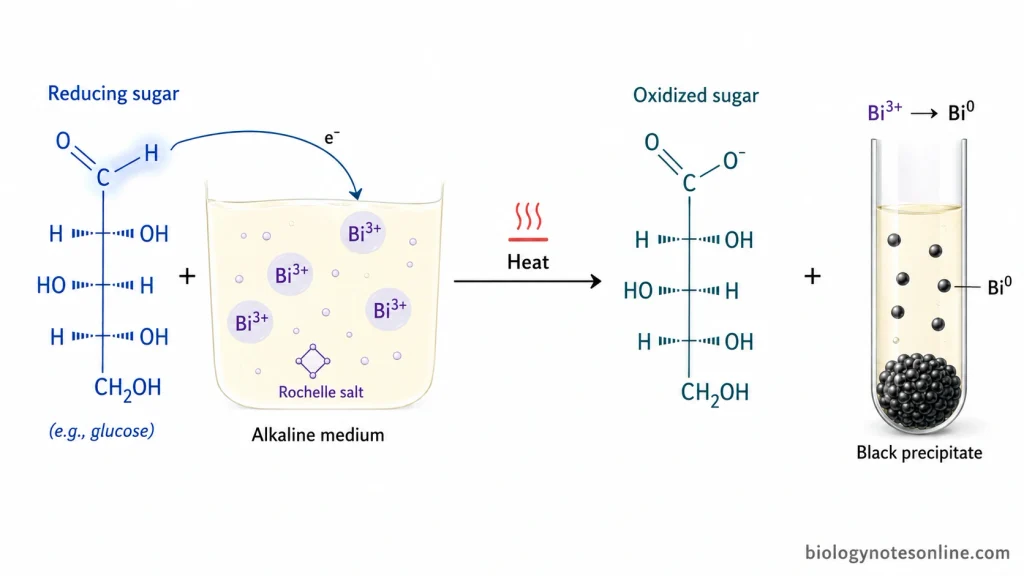
Reaction of Nylander’s Test
The reaction is based on the reduction of bismuth(III) into black metallic bismuth, while the reducing sugar is oxidized.
For glucose, the reaction can be represented as-
Here, glucose is oxidized to gluconate, while Bi³⁺ is reduced to metallic bismuth (Bi). The formation of brown to black metallic bismuth indicates a positive Nylander’s test.
Why a Black Precipitate Forms?
The black precipitate in Nylander’s test is formed due to reduction of bismuth(III) (Bi³⁺) into elemental metallic bismuth by the reducing carbohydrate. During heating in alkaline condition, the reducing group of carbohydrate gives electrons and becomes oxidized, whereas Bi³⁺ accepts these electrons and is reduced. The metallic bismuth (Bi⁰) formed is insoluble and separates from the reaction mixture as dark particles. When these particles are deposited together, a brownish-black to black precipitate is produced. Thus, the black colour observed in a positive Nylander’s test is mainly due to the formation and deposition of elemental bismuth.
Nylander’s Reagent: Composition and Function
Nylander’s reagent is an alkaline bismuth reagent used for the detection of reducing sugars. A commonly used preparation contains bismuth subnitrate, Rochelle salt (potassium sodium tartrate) and 10% potassium hydroxide (KOH). For 100 mL reagent, 2 g bismuth subnitrate and 4 g Rochelle salt can be dissolved in 100 mL of 10% KOH. Some formulations use sodium hydroxide (NaOH) instead of KOH and the concentration of alkali also differs slightly in different published methods.
| Component | Common formulation | Role in the test |
|---|---|---|
| Bismuth subnitrate | 2 g | It provides Bi³⁺, which is reduced into black metallic bismuth. |
| Rochelle salt | 4 g | It keeps bismuth in soluble form in the alkaline reagent. |
| KOH or NaOH | 100 mL of about 10% solution | It provides the strongly alkaline condition required for the reduction reaction. |
Bismuth Subnitrate as the Bismuth(III) Source
Bismuth subnitrate is the major reacting component of Nylander’s reagent. It acts as the source of bismuth(III). During the test, Bi³⁺ is reduced by reducing carbohydrate and finally forms metallic bismuth, which appears as the characteristic dark brown to black precipitate.
Role of Rochelle Salt
Rochelle salt (potassium sodium tartrate) is used to maintain the bismuth in solution in the alkaline medium. Without tartrate, bismuth compounds can form insoluble material under strongly alkaline condition. The tartrate binds the bismuth and helps in keeping the reagent clear and available for the reaction with reducing sugar.
Role of the Alkaline Medium
The alkaline medium is generally provided by potassium hydroxide or sodium hydroxide. It provides the required basic condition in which the reducing carbohydrate can react with bismuth(III) during heating. Different preparations therefore may contain KOH or NaOH, but the reagent remains strongly alkaline in both cases.
Materials Required for Nylander’s Test
The following are the materials required for performing Nylander’s test–
Chemical reagents
- Nylander’s reagent– It is the alkaline bismuth reagent containing bismuth subnitrate, Rochelle salt (potassium sodium tartrate) and sodium hydroxide or potassium hydroxide.
- Distilled water– Required when Nylander’s reagent is prepared in the laboratory.
Test sample
- Urine sample– The urine to be examined for reducing sugar. A known reducing-sugar solution can also be used during laboratory demonstration.
Basic laboratory equipment
- Test tubes.
- Pipette or dropper for taking the required amount of sample and reagent.
- Test tube rack and test tube holder.
- Boiling water bath or suitable heating source for heating the reaction mixture.
Step-by-Step Procedure of Nylander’s Test
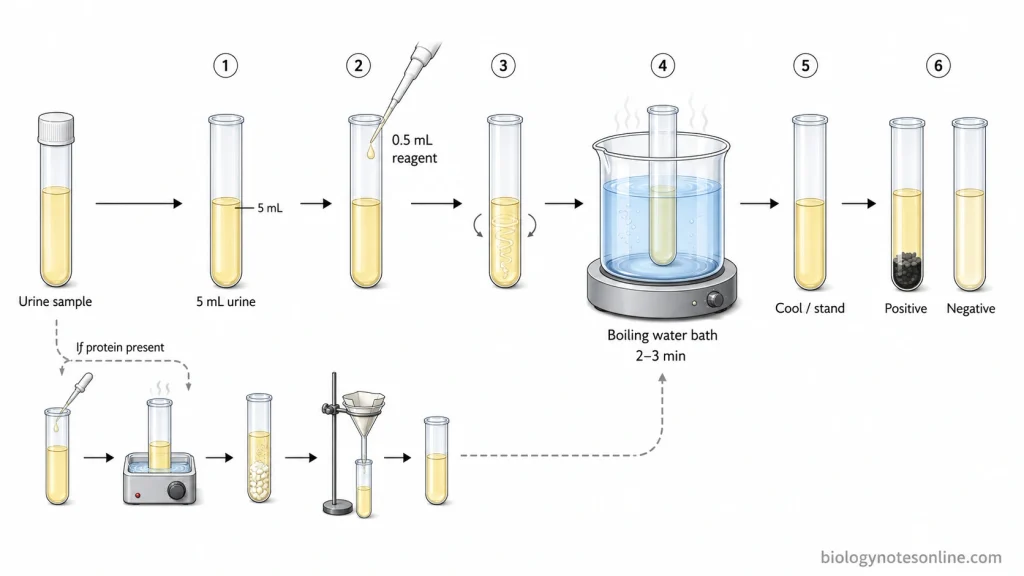
Preparing a Urine Sample When Protein Is Present
- The urine sample should be clear before performing Nylander’s test. If albumin is present, it should be removed first as protein can interfere with the reaction.
- Add a few drops of dilute acetic acid to the urine and heat it. The protein gets coagulated during heating.
- Filter the heated urine to remove the coagulated protein. The clear filtrate is collected and used for Nylander’s test.
Adding Nylander’s Reagent and Heating the Sample
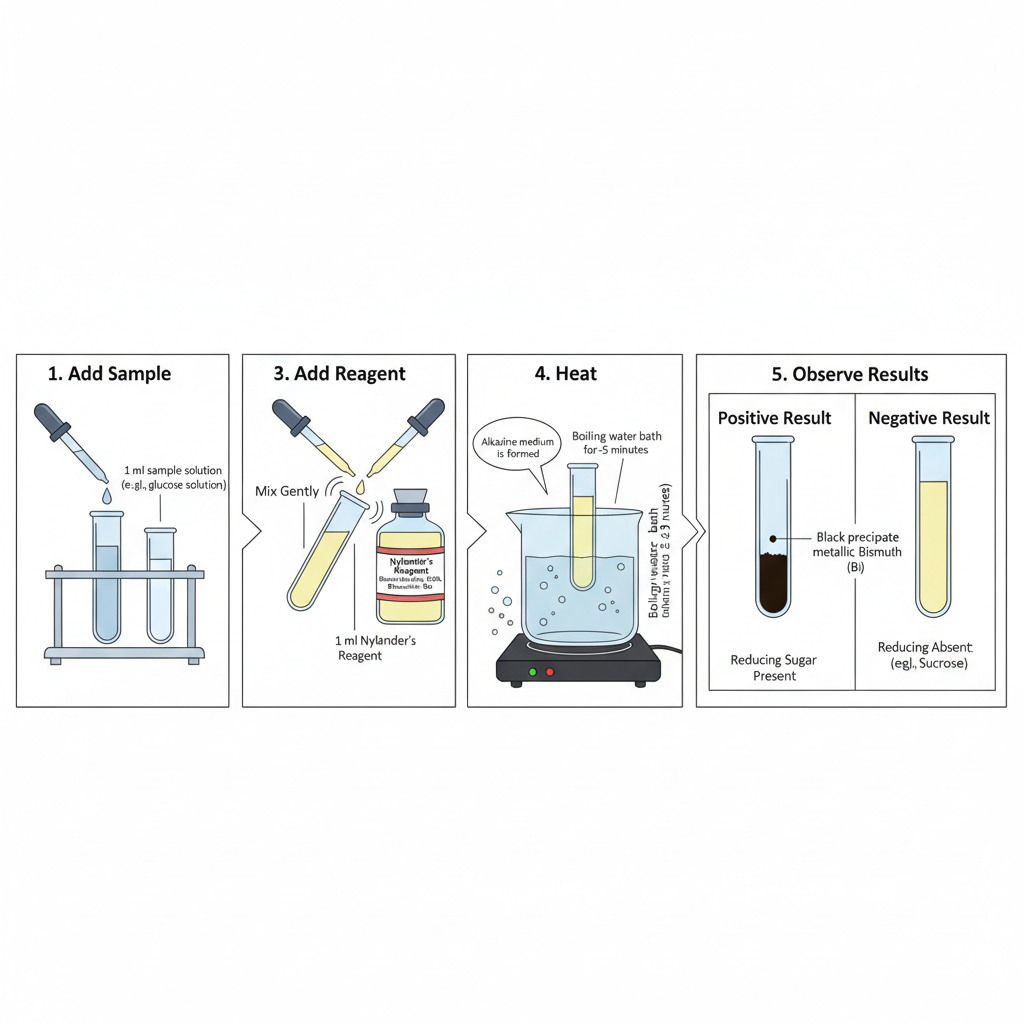
- Take about 5 mL of clear urine in a clean test tube.
- Add 0.5 mL of Nylander’s reagent to it and mix properly. The urine and reagent are generally used in about 10:1 proportion.
- Place the test tube in a boiling water bath and heat for about 2-3 minutes.
- Remove the tube and allow it to stand or cool for some time.
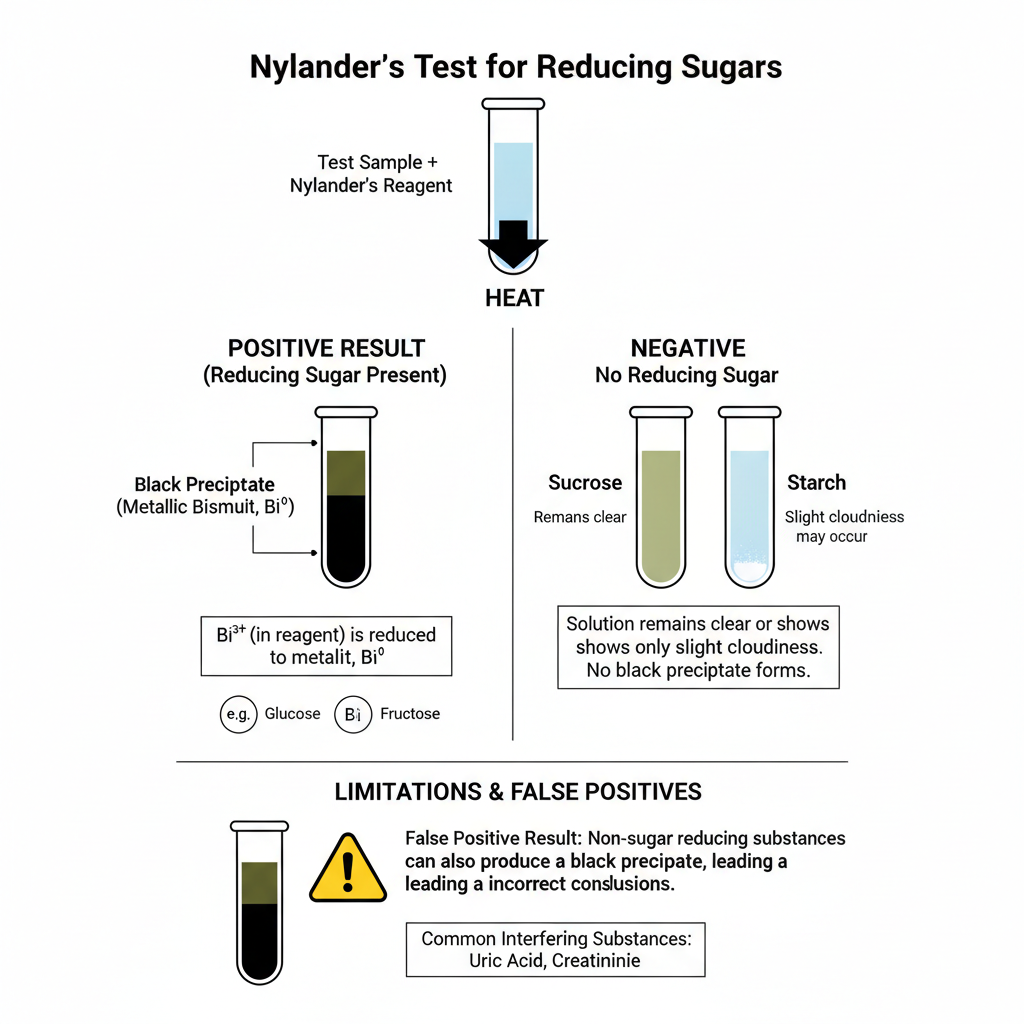
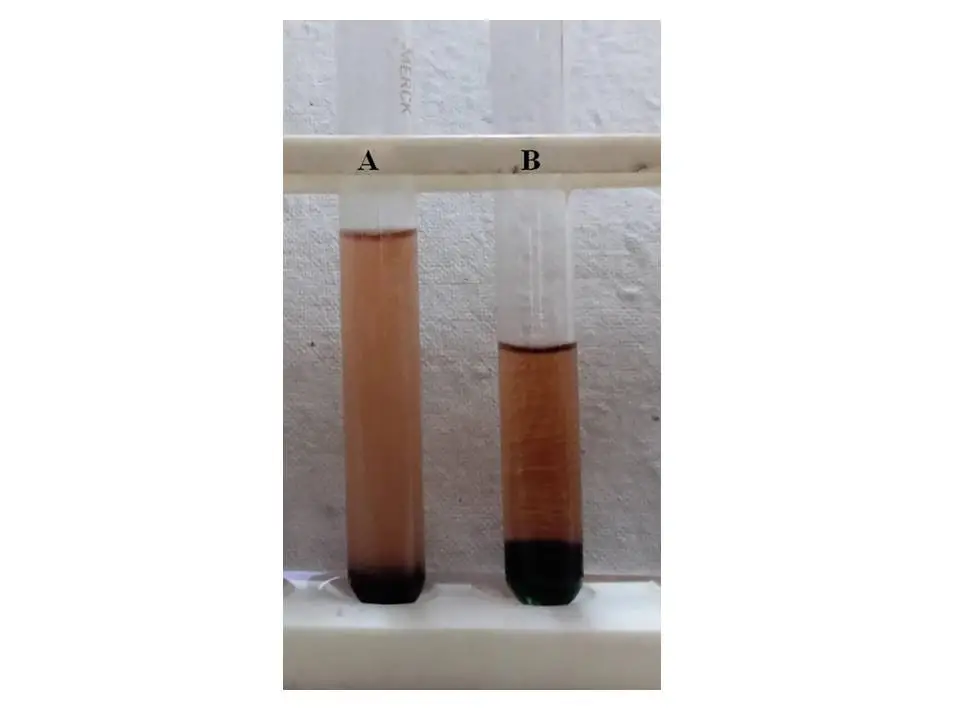
- Observe the colour and formation of precipitate. Development of a brown to black colour or black precipitate of metallic bismuth indicates a positive reaction for reducing sugar.
Observation and Interpretation of Nylander’s Test
The observation of Nylander’s test is based mainly on formation of dark precipitate after heating. Black colour is due to reduced metallic bismuth. It shows the presence of reducing activity in the sample, but it does not itself confirm that the reducing sugar is glucose. Other reducing sugars can also give positive reaction.
| Observation | Interpretation | Important caution |
|---|---|---|
| Brownish-black to black precipitate is formed. | Positive test for reducing substance. Black precipitate is mainly metallic bismuth produced by reduction of Bi³⁺. | It should not be reported as glucose specifically, because other reducing sugars can also produce the reaction. |
| No brown or black precipitate is observed after proper heating. | Negative Nylander’s test for detectable reducing activity under the test condition. | A whitish turbidity or precipitate may sometimes occur and this alone is not considered a positive sugar reaction. |
| Brown colour, unusual darkening or black precipitate in an untreated protein-containing urine. | Result may be doubtful or due to an interfering substance. | Protein and some other urinary constituents can interfere with the reaction. The result should be interpreted carefully. |
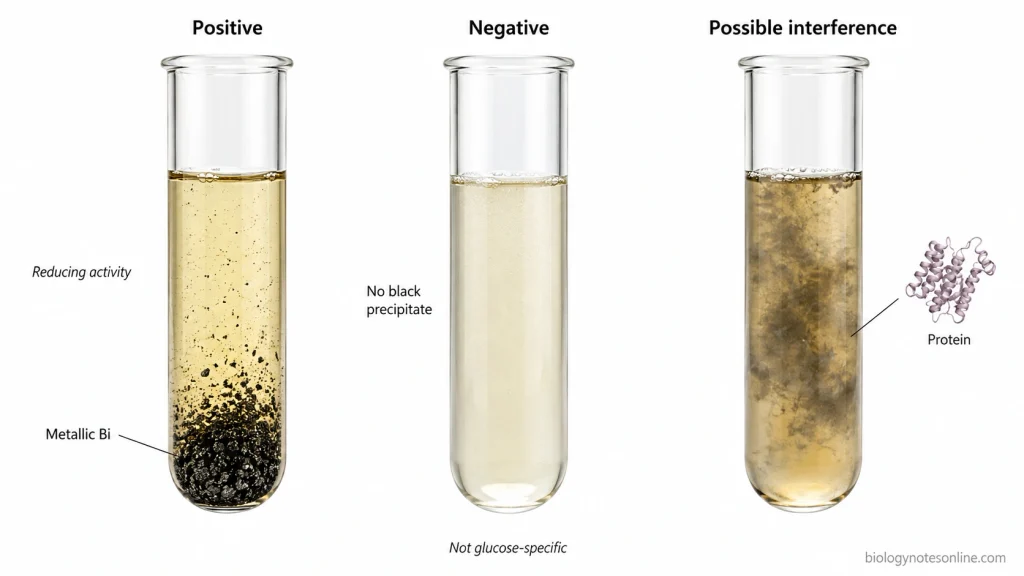
Positive Result
A positive Nylander’s test gives brownish-black to black precipitate after heating. The characteristic black material is elemental bismuth (Bi) formed by reduction of Bi³⁺. This indicates reducing carbohydrate or another reducing substance in the sample, and not glucose alone.
Negative Result
In a negative test, the characteristic brown to black precipitate is not formed. A white turbidity may sometimes be seen during the test, but this does not indicate reducing sugar.
Ambiguous or Interfering Reactions
Some reactions can make the observation difficult. Proteins present in urine may produce a black precipitate with Nylander’s reagent due to formation of bismuth sulfide, therefore proteins should be removed before the test when present. Some urinary reducing substances and drugs can also interfere, and prolonged standing after heating may cause darkening of urine. Thus, only black colour should not be used for identifying glucose specifically.
Which Sugars Give a Positive Nylander’s Test?
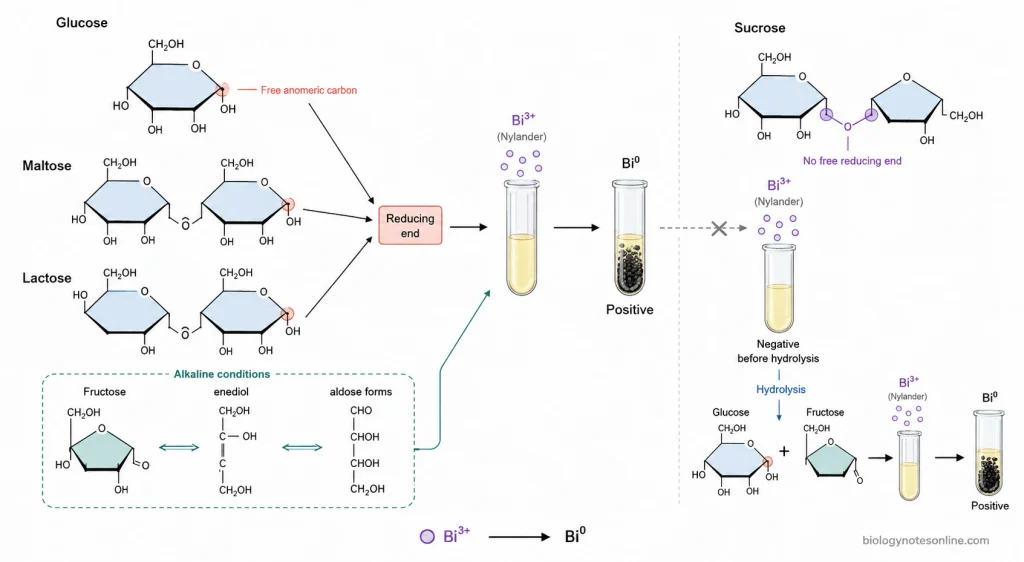
Nylander’s test gives positive reaction with reducing sugars, and not with every carbohydrate. The reducing property depends mainly on presence of a free reducing group in the sugar molecule. Thus, separation only into monosaccharides and disaccharides is not correct for this test, because maltose and lactose are disaccharides but both are reducing sugars.
| Carbohydrate | Reducing or non-reducing | Expected Nylander’s test |
|---|---|---|
| Glucose | Reducing sugar | Positive |
| Galactose | Reducing sugar | Positive |
| Mannose | Reducing sugar | Positive |
| Fructose | Reducing sugar under alkaline test condition | Positive |
| Maltose | Reducing disaccharide | Positive |
| Lactose | Reducing disaccharide | Positive |
| Sucrose | Non-reducing disaccharide | Negative before hydrolysis |
Reducing Sugars
Glucose, galactose and mannose are reducing monosaccharides and can take part in the reduction reaction. Fructose is also positive although it is a ketose. In alkaline condition, fructose undergoes keto-enol tautomerisation and can be converted through an enediol intermediate into aldose forms, therefore it also shows reducing property.
Maltose and lactose are reducing disaccharides. In these sugars one anomeric carbon remains free, which allows formation of the reducing form. Therefore, they can also reduce Bi³⁺ during Nylander’s test and should not be considered negative simply because they are disaccharides.
Why Sucrose Behaves Differently
Sucrose is a non-reducing sugar because the anomeric carbon of glucose and the anomeric carbon of fructose are both involved in the glycosidic linkage. It therefore has no free reducing group available under the usual test condition and gives a negative Nylander’s reaction before hydrolysis. When sucrose is hydrolyzed, glucose and fructose are formed. These products are reducing sugars, so hydrolyzed sucrose can then give a positive reduction reaction
Why Nylander’s Test Is Not Specific for Glucose
Nylander’s test is not specific for glucose because the reaction is based on the reducing property of carbohydrate, and not on recognition of glucose molecule itself. The reagent reacts with a substance which can reduce Bi³⁺ into metallic bismuth under alkaline condition. Thus, glucose gives a positive reaction because it is a reducing sugar, but the same reaction can also be given by other reducing sugars.
Sugars such as fructose, galactose, lactose and other reducing sugars can also reduce the bismuth reagent. The reagent does not contain any glucose-specific enzyme or other system which separates glucose from these sugars. It only detects whether sufficient reducing activity is present in the sample. Therefore, formation of black metallic bismuth indicates a positive reducing-sugar reaction, but from this reaction alone it cannot be stated that the sugar present is glucose.
Uses of Nylander’s Test
Some of the important uses of Nylander’s test are-
- Reducing sugar detection- It is used for the qualitative detection of reducing sugars in a given sample. Formation of black metallic bismuth indicates reducing activity.
- Urine examination- Nylander’s test was commonly used for examination of urine for reducing sugar. Glucose may be present, but other reducing sugars can also produce the reaction.
- Detection of glycosuria- Historically, the test was used for detecting sugar in urine during investigation of glycosuria. It was one of the chemical reduction tests used in older clinical urine analysis.
- Confirmatory test- Nylander’s test was also used along with Fehling’s test and other reactions for further examination of a urine showing reducing property. A positive Nylander’s reaction alone cannot identify which sugar is present.
- Study of reducing carbohydrates- The test can be used in laboratory practicals to demonstrate the reducing property of carbohydrates. Reducing sugars reduce bismuth compound into black metallic bismuth, showing the oxidation-reduction reaction involved.
- Carbohydrate comparison- It is useful for comparing reducing and non-reducing carbohydrates during biochemical study. Reducing sugars give the reaction whereas a non-reducing carbohydrate does not give the characteristic black precipitate under the normal test condition.
- Historical laboratory use- Nylander’s test has importance in older physiological and clinical chemistry methods for examination of urinary sugar. It is mainly of historical and teaching importance now and should not be considered as a present diagnostic test for diabetes mellitus.
Advantages
Some of the important advantages of Nylander’s test are-
- Simple procedure- The test is easy to perform and requires only addition of Nylander’s reagent followed by heating. No complicated laboratory instrument is required for observing the reaction.
- Clear observation- A positive reaction produces a deep brown colour followed by formation of black metallic bismuth precipitate. Thus, the result can be observed directly with the naked eye.
- Fairly sensitive- Nylander’s test is fairly sensitive for detection of reducing sugar in urine. In laboratory descriptions, a positive reaction has been observed with about 0.08% glucose under the stated test condition.
- Less interference by uric acid- Uric acid can reduce Fehling’s reagent and may interfere with some copper reduction tests. It does not readily reduce Nylander’s reagent, which was an important advantage during urine examination.
- Less creatinine interference- Increased creatinine may affect other reducing tests, but it generally does not produce the same misleading reduction with Nylander’s reagent. Because of this, Nylander’s test was considered more reliable than Fehling’s or Trommer’s test in this particular respect.
- Broad reducing-sugar detection- The test can detect different reducing sugars and is not limited only to glucose. Pentoses, fructose, lactose and galactose can also give positive reduction reaction. This makes the test useful when general reducing activity of a sample is to be examined.
- Useful confirmatory test- Historically, Nylander’s test was used together with other urine sugar tests when reactions obtained by copper methods were doubtful. It provided another reduction reaction based on bismuth instead of copper.
Limitations
Some of the important limitations of Nylander’s test are-
- Non-specific test- Nylander’s test is based on reducing property and it cannot specifically detect glucose. Other reducing sugars and reducing substances can also reduce Bi³⁺ and give positive reaction.
- Protein interference- Protein present in urine can interfere with the test. Sulfur-containing amino acid residues in proteins may result in formation of black bismuth sulfide, which can be confused with the black metallic bismuth formed by reducing sugar. Therefore, protein should be removed before performing the test when it is present.
- Other reducing substances- Creatinine, homogentisate, uric acid and certain drugs such as salicylates and tetracyclines may also reduce Nylander’s reagent. Thus, positive reaction does not always indicate that sugar alone is responsible.
- Heating effect- The result depends on proper heating and observation. Characteristic darkening should occur during the specified heating period. If dark colour develops only during cooling, it is not considered as a definite positive sugar reaction.
- Urine concentration- Concentrated urine and some interfering substances may produce darkening even in absence of sugar. This can make weak or doubtful reactions difficult to interpret.
- Qualitative nature- Nylander’s test is mainly a qualitative test. It shows the presence of reducing activity by formation of dark metallic bismuth, but exact amount of sugar or the particular sugar present cannot be determined by this test.
- Limited clinical use- Nylander’s test is an old chemical test and is not used as a present diagnostic test for diabetes mellitus. Current diagnosis is based on plasma glucose or HbA1c criteria instead of this urinary reducing test.
Precautions and Laboratory Safety
Some of the important precautions and laboratory safety measures for Nylander’s test are-
- Personal protection- Laboratory coat, safety goggles and suitable gloves should be used while performing the test. The urine sample should be considered as potentially infectious material and handled carefully.
- Alkali handling- Nylander’s reagent contains sodium hydroxide (NaOH) or potassium hydroxide (KOH) and hence it is strongly alkaline. Contact with skin and eyes should be avoided because these strong bases can cause severe chemical burns.
- Urine handling- Urine should be transferred with a pipette or dropper without producing splashes. Direct contact with urine should be avoided and contaminated materials are handled according to laboratory biohazard procedure.
- Protein removal- If protein is present in urine, it should be removed before carrying out Nylander’s test. Proteins containing sulfur-containing amino acids can form black bismuth sulfide with the reagent and this may interfere with the actual black precipitate of metallic bismuth.
- Reagent condition- Nylander’s reagent should be clear before use. If precipitate or turbidity is already present in the reagent, it should be filtered as required because this may make the final observation difficult. The reagent is generally stored in a dark bottle.
- Proper heating- The sample should be heated only for the required period. A boiling water bath can be used for heating, and excessive or violent boiling should be avoided.
- Test tube direction- During heating, the mouth of test tube should never be directed towards the person performing the test or towards another person. A test tube holder should be used for handling the heated tube.
- Hot glassware- Heated test tube and water bath should be handled carefully to prevent burns. The tube should be allowed to cool before it is handled directly.
- Correct observation- The colour and black precipitate should be observed according to the specified heating period. Slight darkening alone should not be immediately considered as a positive result, as normal or interfering urinary constituents can sometimes produce an atypical colour.
- Waste disposal- Used urine, Nylander’s reagent and the reaction mixture should not be handled as ordinary laboratory material. They should be discarded in the designated chemical or biological waste system according to the laboratory procedure.
Historical Use and Modern Relevance of Nylander’s Test
The following are the historical use and present importance of Nylander’s test–
- Nylander’s test was used earlier in clinical urine examination for detecting reducing sugar. Such chemical reduction tests had an important role when glycosuria was examined by observing the reducing property of urine.
- The test does not identify glucose specifically. Other reducing sugars and some non-sugar reducing substances can also produce reduction reaction, which limits its value when glucose alone has to be detected. Older reducing-substance methods therefore can give reactions from glucose, fructose, lactose, pentoses and several interfering substances.
- Modern urine glucose testing is based mainly on specific reaction-based methods rather than general reducing-substance reactions. Glucose oxidase methods are much more specific for glucose, and current laboratory guidelines do not recommend reducing-substance methods because they are affected by nonglucose sugars, drugs and other interfering compounds.
- Nylander’s test is also not used for present diagnosis of diabetes mellitus. Current diagnosis is based on A1C or plasma glucose, including fasting plasma glucose, 2-hour plasma glucose during an oral glucose tolerance test or random plasma glucose under the specified clinical condition.
- The test, however, is still useful for understanding the old methods of urine analysis and the reducing property of carbohydrates in practical biochemistry. It demonstrates the reduction of bismuth by reducing substances, but its present importance is mainly historical and laboratory teaching rather than glucose-specific clinical diagnosis.
Nylander’s Test vs Benedict’s and Fehling’s Tests
Nylander’s, Benedict’s and Fehling’s tests are reduction tests used for detecting reducing sugars. The main difference is in the metal reagent used and the precipitate formed during reduction.
| Feature | Nylander’s Test | Benedict’s Test | Fehling’s Test |
|---|---|---|---|
| Principle | It is based on reduction of Bi³⁺ by reducing carbohydrate in alkaline condition. | It is based on reduction of Cu²⁺ to Cu⁺ by reducing sugar in alkaline medium. | Reducing sugar reduces complexed Cu²⁺ to Cu⁺ in alkaline condition. |
| Main reagent | Bismuth subnitrate, Rochelle salt and sodium or potassium hydroxide are present in the reagent. | It contains copper(II) sulfate, sodium citrate and sodium carbonate. | It is prepared from two solutions. Fehling’s A contains copper sulfate whereas Fehling’s B contains Rochelle salt and NaOH. |
| Metal involved | Bismuth (Bi³⁺) | Copper (Cu²⁺) | Copper (Cu²⁺) |
| Positive reaction | Brown to black metallic bismuth is formed. | Cu²⁺ is reduced and cuprous oxide (Cu₂O) precipitate is produced. | A brick-red Cu₂O precipitate is formed. |
| Reagent preparation | Generally used as one alkaline bismuth reagent. | Benedict’s reagent is prepared as a single reagent containing citrate, carbonate and copper sulfate. | Fehling’s A and B are mixed before use to prepare the working solution. |
| Sugar specificity | It detects reducing activity and is not specific for glucose. | It is also a reducing-substance test. Glucose and other reducing sugars can give the reaction. | It detects reducing sugars and is not glucose-specific. |
| Earlier use | It was used earlier for examination of urine for reducing sugar and glycosuria. | Benedict’s reduction method was widely used for urine sugar testing. | Fehling’s copper reduction method was one of the earlier chemical methods used for urinary sugar. |
| Present importance | It is mainly of historical and teaching importance. | It is still useful as a common laboratory test for demonstrating reducing sugars, but not preferred for glucose-specific clinical testing. | It is commonly used in practical chemistry and carbohydrate analysis, but has limited role in present glucose-specific clinical testing. |
| Major limitation | Nonglucose reducing substances and other interfering compounds may affect the reaction. | Copper reduction detects glucose as well as fructose, lactose, pentoses, galactose and other reducing substances. | Like other general reduction tests, the reaction depends on reducing ability rather than specific recognition of glucose. |
These three tests therefore show reducing property, but they do not by themselves identify glucose. In present laboratory practice, urine glucose testing when required is preferably done by glucose-specific reaction methods such as glucose oxidase test strips, and urine glucose itself is not recommended for routine monitoring of diabetes mellitus.
References
- Ainsworth, S. K., Ito, S., & Karnovsky, M. J. (1972). Alkaline bismuth reagent for high resolution ultrastructural demonstration of periodate-reactive sites. Journal of Histochemistry & Cytochemistry, 20(12), 995–1005. https://doi.org/10.1177/20.12.995
- Auray-Blais, C., Giguère, R., Draper, P., Shapcott, D., & Lemieux, B. (1978). Simple and rapid system for screening and identification of reducing sugars in urine. Clinical Biochemistry, 11(6), 235–237. https://doi.org/10.1016/S0009-9120(78)80016-2
- Cowart, S. L., & Stachura, M. E. (1990). Glucosuria. In H. K. Walker, W. D. Hall, & J. W. Hurst (Eds.), Clinical methods: The history, physical, and laboratory examinations (3rd ed., Chapter 139). Butterworths. https://www.ncbi.nlm.nih.gov/books/NBK245/
- Cramer, W. (1915). Directions for a practical course in chemical physiology (2nd ed.). Longmans, Green and Co. https://onlinebooks.library.upenn.edu/webbin/book/browse?c=x&key=Biochemistry+–+Dictionaries&type=lcsubc
- Folin, O. (1916). Laboratory manual of biological chemistry: With supplement. D. Appleton and Company. https://ci.nii.ac.jp/ncid/BA65134593
- McMillin, J. M. (1990). Blood glucose. In H. K. Walker, W. D. Hall, & J. W. Hurst (Eds.), Clinical methods: The history, physical, and laboratory examinations (3rd ed., Chapter 141). Butterworths. https://www.ncbi.nlm.nih.gov/books/NBK248/
- Sacks, D. B., Arnold, M., Bakris, G. L., Bruns, D. E., Horvath, A. R., Lernmark, Å., Metzger, B. E., Nathan, D. M., & Kirkman, M. S. (2023). Guidelines and recommendations for laboratory analysis in the diagnosis and management of diabetes mellitus. Diabetes Care, 46(10), e151–e199. https://doi.org/10.2337/dci23-0036
- Wolff, L. (1890). The examination of urine, chemical and microscopical, for clinical purposes: Arranged in the form of questions and answers. W. B. Saunders. https://books.google.com/books?id=ZvgMAAAAYAAJ