Scanning Electron Microscope (SEM) is an advanced magnifying instrument that is used to observe the surface of a sample by using focused beam of accelerated electrons.
It does not use visible light for image formation. It uses electron beam because electrons have much shorter wavelength than light photons. So, SEM can produce image with very high resolution and high magnification.
In SEM, the electron beam sweeps across the specimen surface in a systematic way. During this process, the beam interacts with atoms present inside the material. This interaction produces different signals such as secondary electrons and backscattered electrons.
These emitted signals are collected by specialized detectors. The detectors convert the signals into a highly magnified grey scale image. This image gives information about surface topography, physical structure and chemical composition of the sample.
SEM can magnify the specimen up to million times. It is used to observe very minute structures at nanometer scale which cannot be seen by traditional optical microscope.
The image produced by SEM has good depth of field and gives a three dimensional appearance. It is used in many fields such as materials science, biology, forensics and electronics.
Principle of Scanning Electron Microscope
Scanning Electron Microscope is based on the scanning of specimen surface by using a highly focused beam of accelerated electrons.
In SEM, electrons are produced from the electron gun present at the top of the instrument. These electrons travel through a vacuum column. The electromagnetic lenses concentrate the electron beam into a very fine probe.
The focused electron beam scans the surface of the specimen in a rectangular back and forth pattern. This pattern is called raster. During this scanning, the electron beam moves point by point over the surface of the sample.
When the primary electron beam strikes the sample, it interacts with the atoms of the material. It does not form a direct optical image like light microscope. Instead of this, different signals are produced from the specimen.
The main signals used for image formation are secondary electrons and backscattered electrons. Secondary electrons are low energy electrons released from the top layers of the sample surface. These electrons are useful for showing surface topography and three dimensional surface details.
Backscattered electrons are high energy electrons which are reflected back after collision with the atomic nuclei of the sample. Heavy elements reflect more backscattered electrons. So these electrons are used to show contrast in chemical composition and density of the sample.
The emitted signals are collected by special detectors. These detectors convert the signals into amplified electrical signals. The computer synchronizes the X-Y position of the scanning beam with the intensity of the detected signal.
Finally, the data is converted pixel by pixel on the digital monitor. Thus, a highly magnified grey scale image is formed which shows microscopic structure and composition of the specimen.
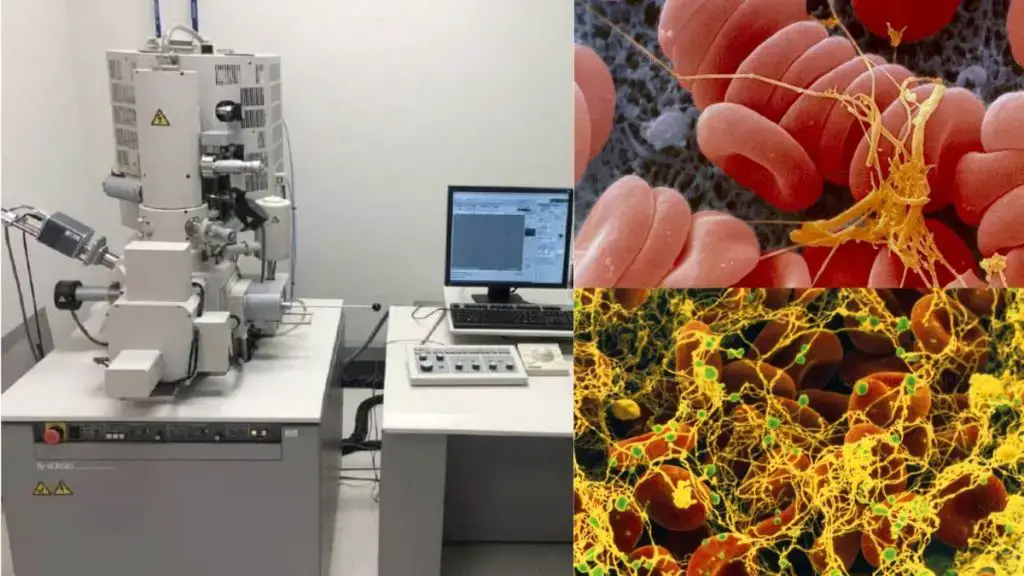
Parts of Scanning Electron Microscope
The following are the main parts of Scanning Electron Microscope-
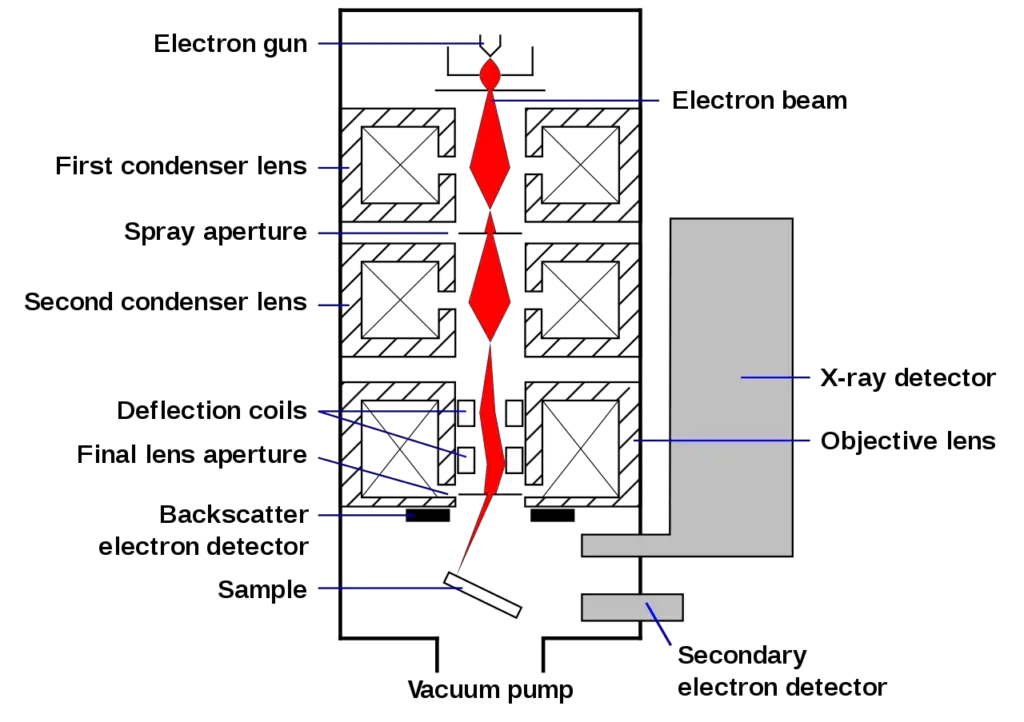
- Electron source or electron gun- It generates and emits a stable high brightness stream of electrons. It acts as the source of primary electron beam.
- Condenser lenses- These are electromagnetic lenses present below the electron gun. They reduce the diameter of the primary electron beam and controls the probe current.
- Objective lens- It is the final electromagnetic lens present in the column. It focuses the electron beam directly on the surface of the sample.
- Electron apertures- These are thin metal plates with small holes. They block the off-axis electrons, reduce the beam diameter and minimize aberrations.
- Scanning coils and scan generator- These are magnetic coils which deflect the focused electron beam along X and Y axis. It scans the beam over the sample in a raster pattern.
- Specimen chamber- It is the highly evacuated area where the sample is placed. The beam and specimen interaction takes place inside this chamber.
- Sample stage- It is a movable platform present inside the chamber. It supports the specimen and allows horizontal, vertical, tilt and rotational adjustments.
- Detectors– These are specialized devices that collect the signals produced by the interaction of beam with the sample. Secondary electron detector, backscattered electron detector and X-ray detector are commonly present.
- Vacuum system- It consists of external pumps which maintain high vacuum in the electron optical column and specimen chamber. It prevents electron scattering and interference.
- Computer and display system- It reconstructs the image pixel by pixel on the monitor. It synchronizes the scan generator position with the signal intensity collected by the detectors.
- Water chilling system- It circulates water to cool the electromagnetic lenses. These lenses produce excess heat due to high electrical current.
Sample Preparation for Scanning Electron Microscope
The following are the steps for sample preparation for Scanning Electron Microscope-
- Put on protective gloves- A new pair of nitrile gloves is worn before handling the sample and other materials. It prevents transfer of oil, dust and contaminants from hands. These contaminants can damage the system or affect the vacuum.
- Expose the area of interest- If internal structure of the sample is to be observed, the required area is exposed first. It can be done by cutting, freeze-fracturing, mechanical polishing or focused ion beam (FIB). This gives a flat cross-section of the sample.
- Dry and fix the sample- The sample should be completely dry before placing in SEM. It should be free from volatile solvents. This prevents outgassing inside the high vacuum chamber.
- For biological or wet samples- Chemical fixation is done to preserve the structure of the sample. Glutaraldehyde is generally used for fixation. After fixation, dehydration is done by ethanol series and then critical point drying or freeze drying is carried out.
- Mount the specimen- The sample is attached firmly on a metal specimen stub, generally aluminium stub. Conductive adhesive like double sided carbon tape, silver paste or graphite paint is used. This helps in proper electrical contact with the grounded stage.
- Remove loose particles- Loose dust and unattached sample particles are removed carefully. Compressed air or nitrogen (N2) nozzle is used for this purpose. Loose particles may detach in vacuum and damage the pump or lens system.
- Apply conductive coating- Non-conductive samples like glass, ceramic, polymer or biological tissues are coated with conductive material. Without coating, these samples accumulate static charge and distort the image. A sputter coater is used to deposit a thin layer of gold, platinum or gold-palladium alloy.
- For EDS or EDX analysis- If the sample is prepared for X-ray compositional analysis, carbon coating is used instead of metal coating. This helps in proper elemental analysis.
- Adjust the sample height- The stub is placed into the specimen holder. A height gauge is used to set the tallest part of the sample at correct level. This prevents collision of the sample with the pole piece of the microscope.
How does the Scanning Electron Microscope (SEM) work?
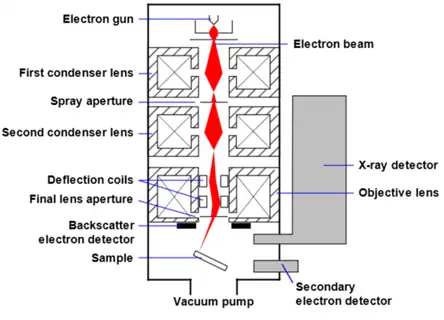
The following are the steps involved in working of Scanning Electron Microscope-
- Generating the beam- The process starts from the top of the microscope column. An electron gun produces a steady beam of electrons.
- Travelling through vacuum- The electrons are accelerated downward through the microscope column. The column and sample chamber are kept under high vacuum. This allows the electrons to travel without collision with gas molecules.
- Focusing the beam- The electron beam passes through electromagnetic lenses. These lenses include condenser lens and objective lens. They focus the electrons into a very fine microscopic point.
- Scanning the surface- The focused beam is deflected by scanning coils. The beam moves back and forth over the surface of the sample. This movement occurs in a rectangular pattern called raster.
- Interacting with the sample- When the electron beam strikes the sample, it penetrates the surface. It interacts with atoms present inside the sample. Due to this interaction, different signals are produced.
- Production of signals- The main signals produced are secondary electrons, backscattered electrons and X-rays. These signals gives information about the surface and composition of the sample.
- Detecting the signals- Special detectors are present inside the chamber. These detectors collect the electrons and other signals coming from the sample.
- Forming the image- The computer synchronizes the X-Y position of the scanning beam with the intensity of detected signals. The collected data is converted electronically into image.
- Final image- The image is formed pixel by pixel on a digital monitor. It is a highly magnified grey scale image showing the surface structure of the specimen.
Operating Procedure of Scanning Electron Microscope
The following are the operating procedure of Scanning Electron Microscope-
- System startup- The SEM computer is logged in first. The control software of the microscope is opened for operating the instrument.
- Loading the sample- Clean protective gloves are worn before handling the sample. The specimen chamber or airlock is vented to atmospheric pressure. The mounted sample is placed securely inside the chamber.
- Starting vacuum- After placing the sample, the chamber door is closed properly. The vacuum pump is started to remove air from the chamber.
- Turning on the beam- The system is allowed to reach the required high vacuum level. After this, High Tension (HT) or accelerating voltage is turned on. The voltage is generally selected between 1 kV to 30 kV depending on the type of sample.
- Navigation and initial focusing- Low magnification is used first to find the required area of interest on the sample. The Z-height of the sample or working distance is adjusted to the proper level.
- Image optimization- The magnification is increased slowly. Focus is adjusted continuously to make the image clear. Brightness and contrast are adjusted for better visibility.
- Stigmation adjustment- If the image looks stretched or distorted, stigmation is adjusted. It corrects astigmatism and makes the image sharp.
- Capturing the image- When the image becomes clear and sharp, slow scan speed or noise reduction mode is used. This improves the quality of image. The frame is frozen and the digital image is saved in the selected folder.
- Shutting down- After finishing the observation, magnification is decreased to minimum. The accelerating voltage or High Tension is turned off.
- Removing the sample- The chamber is vented carefully. The sample is removed safely from the chamber. Then the chamber is closed again and pumped back to vacuum.
- Logging out- After the chamber is under vacuum, the software is closed and the user is logged out from the SEM computer.
Scanning process and image formation
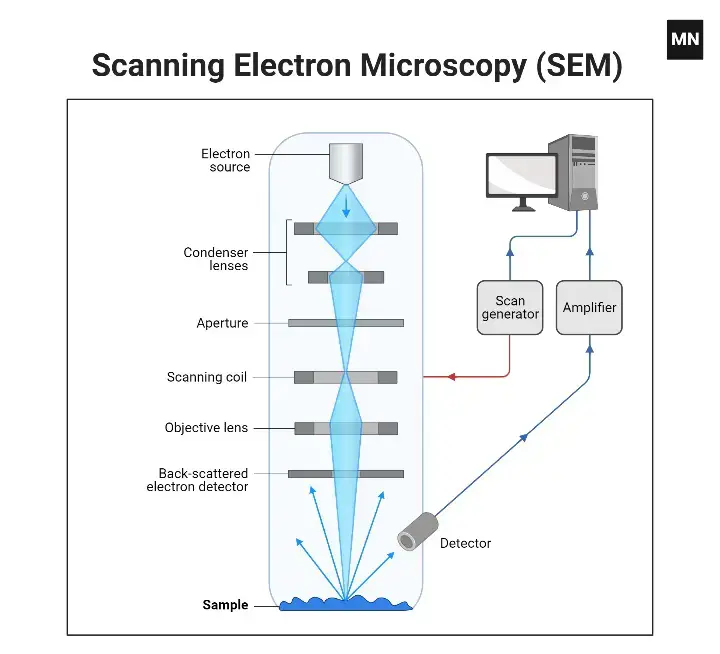
The following are the steps of scanning process and image formation process-
- Beam generation and focusing- The process starts when electron gun emits a beam of electrons. This electron beam is then focused into a very small microscopic point on the surface of the specimen by electromagnetic lenses.
- Raster scanning- The focused electron beam is deflected by scanning coils along X and Y axis. Due to this deflection, the beam moves back and forth over a rectangular area of the sample. This systematic scanning pattern is called raster.
- Signal generation- When the electron beam strikes the specimen point by point, it interacts with atoms of the sample. During this interaction, energy is transferred to the sample atoms. As a result, different signals are produced such as secondary electrons, backscattered electrons and X-rays.
- Signal detection and amplification- The emitted signals are collected by special detectors present inside the microscope. These detectors convert the signals into electrical signals. The electrical signals are then amplified by electronic amplifiers or photomultipliers.
- Position synchronization- The scan generator and computer synchronizes the exact X-Y position of the scanning beam with the intensity of signal collected at that moment. Each point on the sample is therefore connected with a particular signal intensity.
- Image reconstruction- The synchronized data is transferred pixel by pixel on the digital monitor. The intensity of detected signal decides the brightness of each pixel. In this way, a highly magnified grey scale image is gradually formed.
- Final image- The final image shows the surface topography and composition of the sample. It is not formed by direct light but by detected electron signals from the specimen.
Application of Scanning Electron Microscope
The following are the applications of Scanning Electron Microscope-
- Materials science and nanotechnology- SEM is used to study the surface structure, composition and defects of metals, alloys, ceramics and polymers. It is also used for studying nanomaterials such as nanotubes and quantum dots.
- Biological and medical sciences- It is used to observe the microscopic structure of insects, bacteria, viruses, animal tissues and blood cells. It helps in drug discovery, disease diagnosis and development of medical implants.
- Semiconductors and electronics- SEM is used for inspection of silicon wafers and microchips. It is also used to detect very small defects, layer damage and failure in electronic devices.
- Forensic science- It is used to examine trace evidences collected from crime scene. Hair, clothing fibres, paint chips, metal fragments and gunshot residue can be studied by SEM.
- Geology and earth sciences- SEM is used to study soil particles, mineral composition, rock samples and microfossils. It helps in understanding weathering process, mining and energy exploration.
- Industrial manufacturing- It is used for quality assurance and failure analysis in industries. It helps to find out why a part is broken or damaged, especially in aerospace, automotive and battery industries.
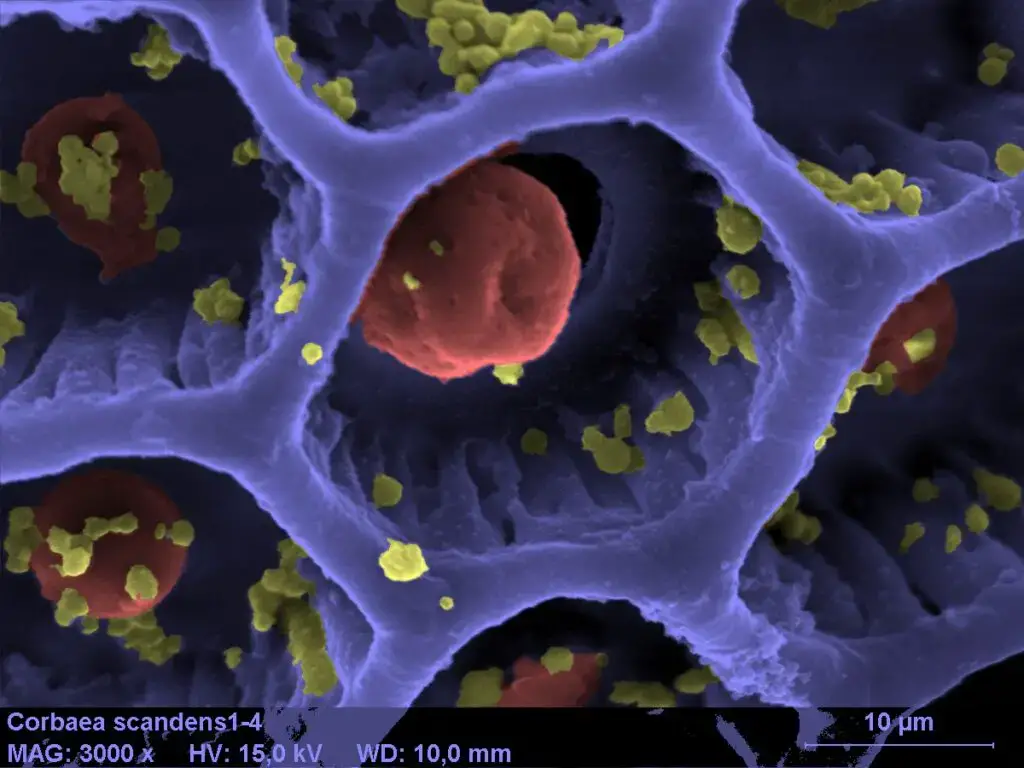
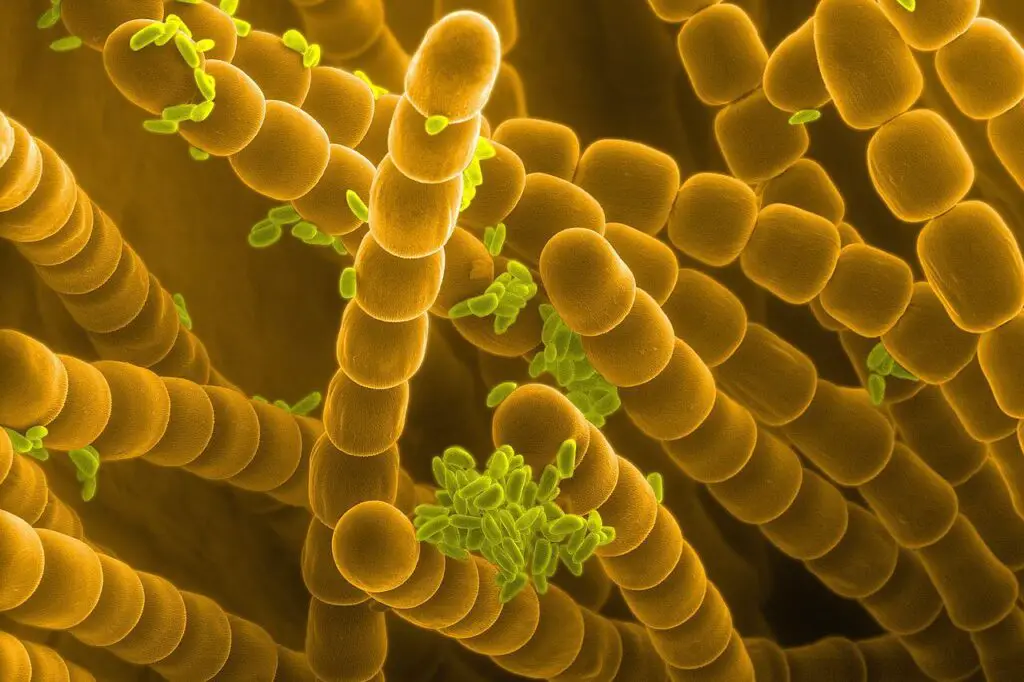
- Digital art- SEM is used to capture highly detailed three dimensional microscopic images. These images can be coloured and modified for digital art and marketing images.
Advantages of Scanning Electron Microscope
The following are the advantages of Scanning Electron Microscope-
- Exceptional magnification and resolution- SEM can produce very high magnification and resolution. It can magnify the specimen up to 1 to 2 million times. So very minute structures can be observed which are not seen by ordinary optical microscope.
- Large depth of field- SEM has greater depth of field than optical microscope. Due to this, uneven and irregular surface also remains in focus. It gives detailed three dimensional image of the sample surface.
- Broad field of view- SEM gives larger field of view than Transmission Electron Microscope. It allows observation of greater area of the sample surface at one time.
- Ability to image bulk materials- SEM can observe bulk materials easily. The sample does not need to be cut into ultra-thin sections like TEM. The specimen can be studied if it fits properly inside the chamber.
- Simpler sample preparation- Sample preparation for SEM is generally simple and fast. The sample is mounted on a stub and sometimes coated with conductive material. It is less complex than TEM sample preparation.
- Versatile analytical capability- SEM can use different detectors at the same time. Energy Dispersive X-ray Spectroscopy and Electron Backscatter Diffraction can be used with SEM. These help to study elemental composition, chemical bonding and crystal structure of the specimen.
- Cost effectiveness- SEM is generally more cost effective than TEM for many applications. It is cheaper to purchase and operate in comparison to TEM.
Limitations of Scanning Electron Microscope
The following are the limitations of Scanning Electron Microscope-
- Vacuum requirement- Most SEM works under high vacuum condition. So wet or biological samples should be completely dried or frozen before observation. It prevents outgassing and damage of the instrument.
- Sample charging- Non-conductive materials like plastics, glass and biological tissue can accumulate static charge from electron beam. This charge distorts the image and deflects the beam.
- Preparation artifacts- Insulating samples usually need thin conductive coating of gold or carbon. This preparation may change the morphology of sample, produce artifacts or cover fine surface details.
- Surface limited data- SEM is used to scan the outer surface of the specimen. It gives information mainly about surface topography and composition. It cannot see through the sample to show internal structure like TEM.
- Beam damage- High energy electron beam can transfer heat to the sample. Fragile samples like polymers and proteins may melt, evaporate or get damaged.
- Size restriction- The specimen must be small enough to fit inside the vacuum chamber. It should also be mounted properly on the specimen stage.
- Magnetic sample issue- Magnetic samples can interfere with the electromagnetic lenses of the microscope. It makes focusing difficult and sometimes the sample may detach and damage the lens.
- Lack of natural colour- SEM uses electrons instead of visible light photons. So the image formed is naturally grey scale and not coloured.
- Resolution limit- SEM has very high resolution, generally about 0.5 to 20 nanometer. But it usually cannot show individual atoms. This is done by Transmission Electron Microscope.
- High cost and infrastructure- SEM is a costly instrument and needs expensive maintenance. It also requires proper room condition such as vibration free room, temperature control and electromagnetic shielding.
- Complex operation- SEM operation and sample preparation needs trained person. Interpretation of the image and other data also requires proper skill.
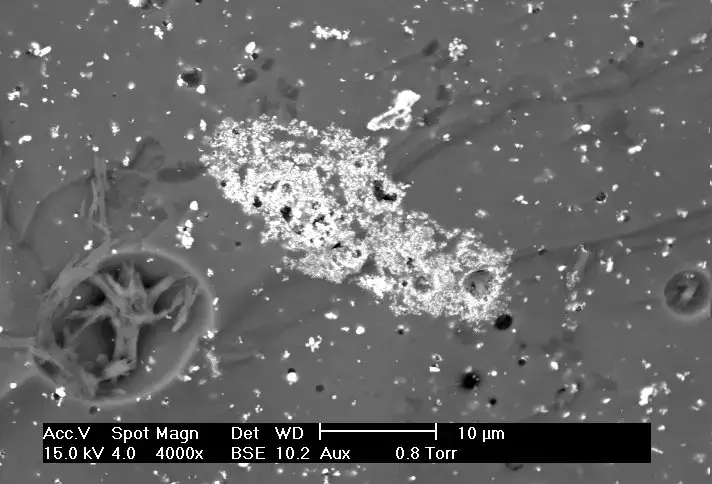
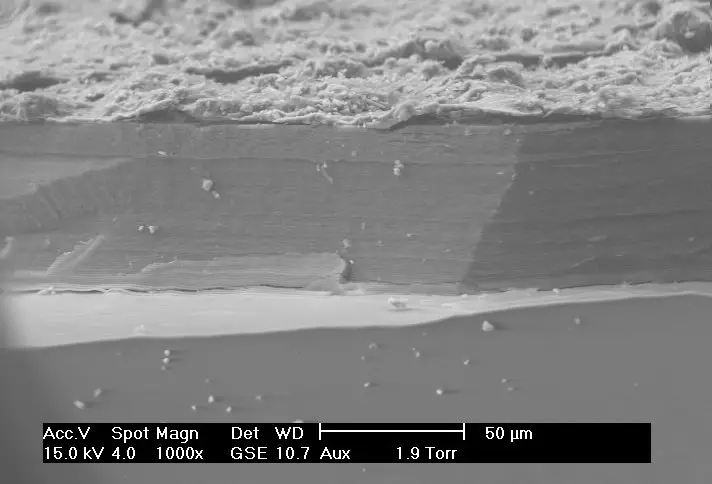
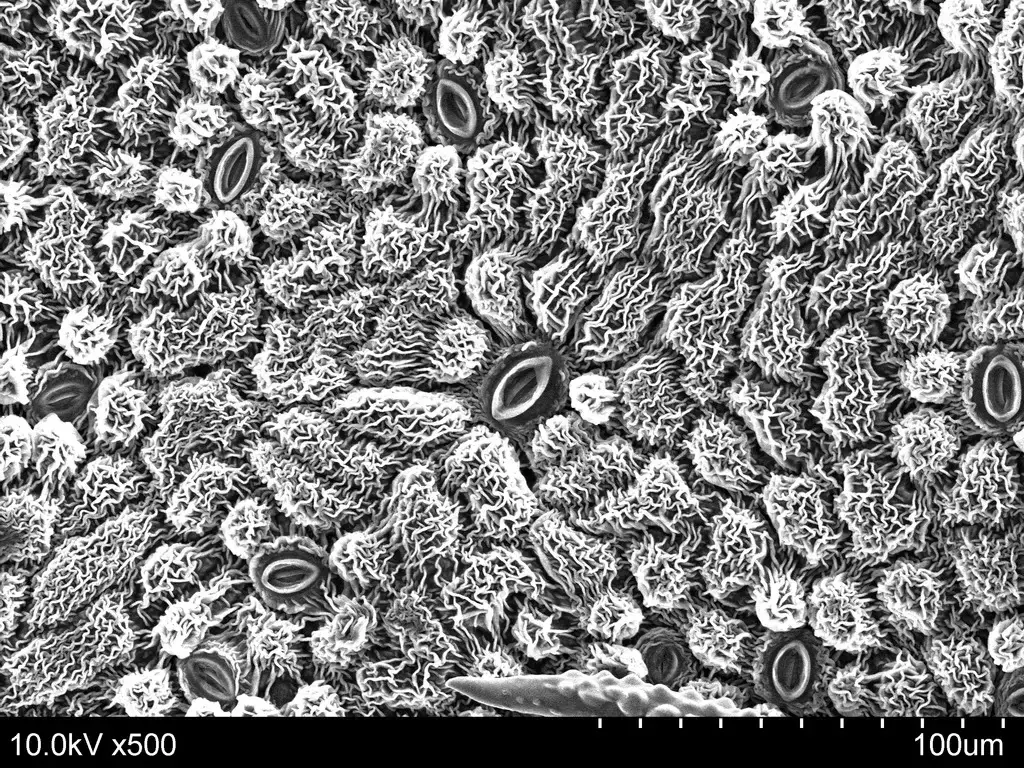
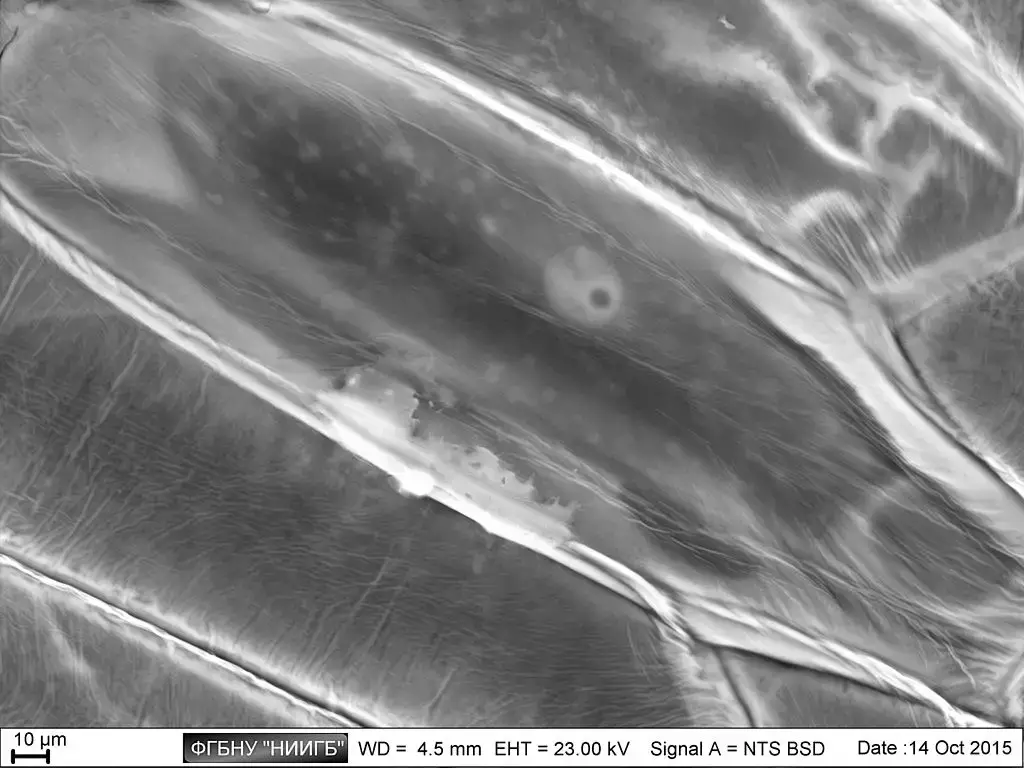
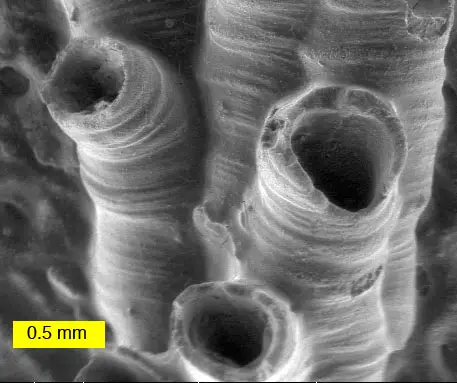
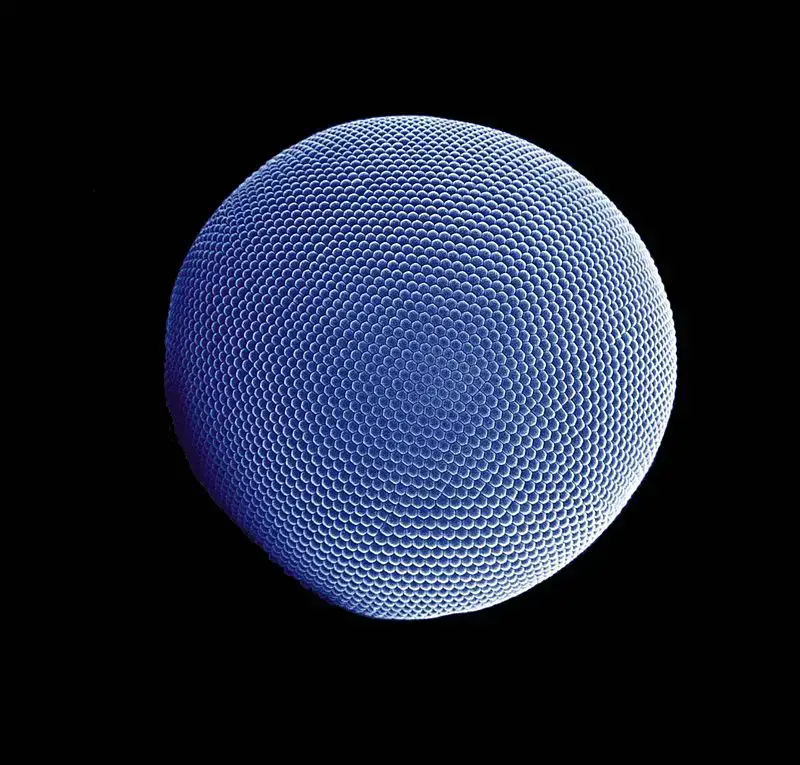
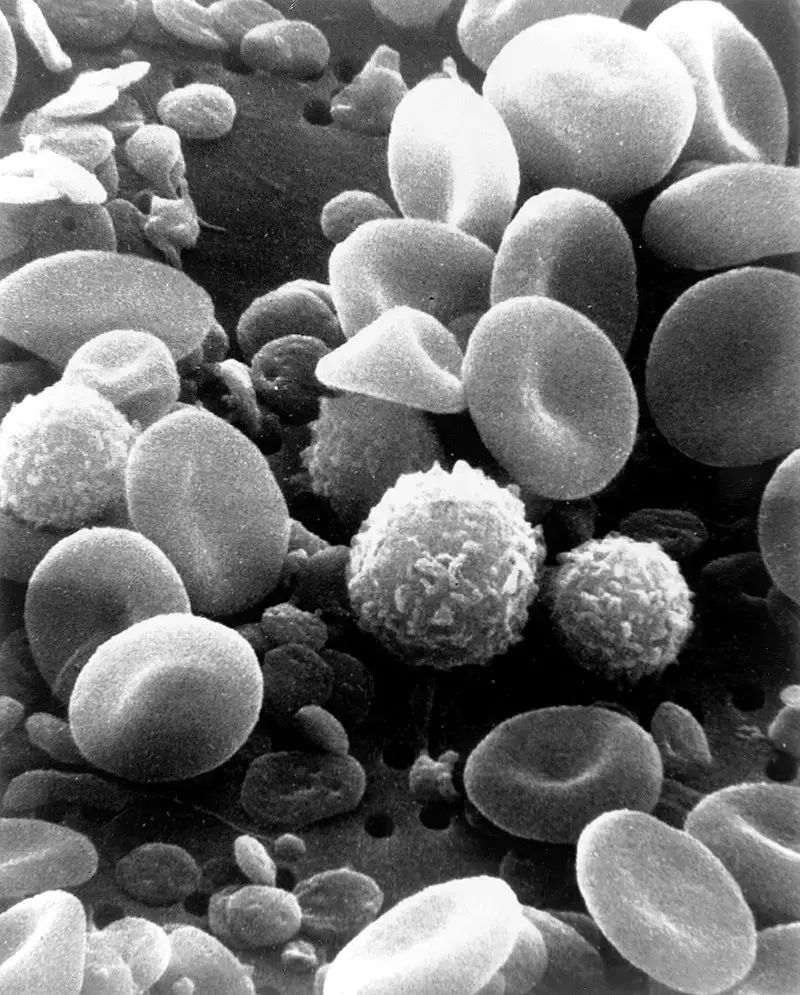
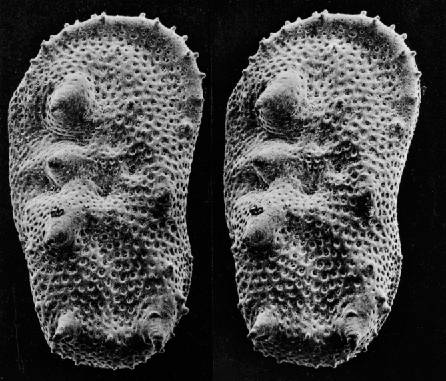
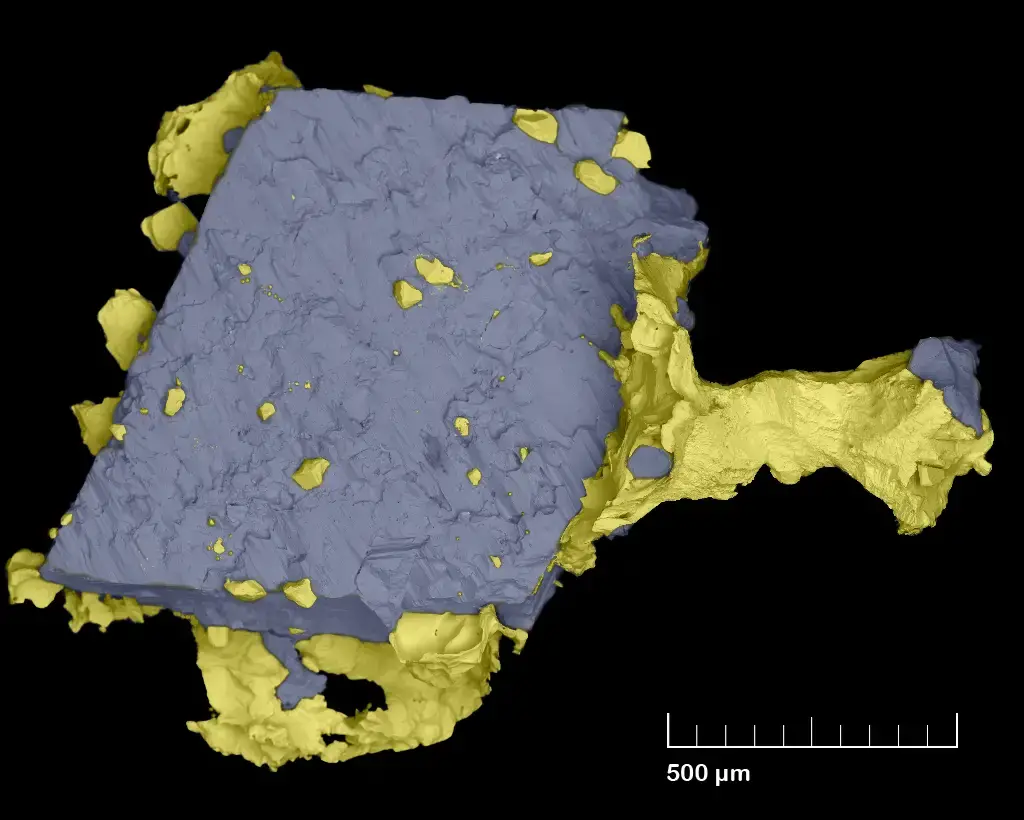
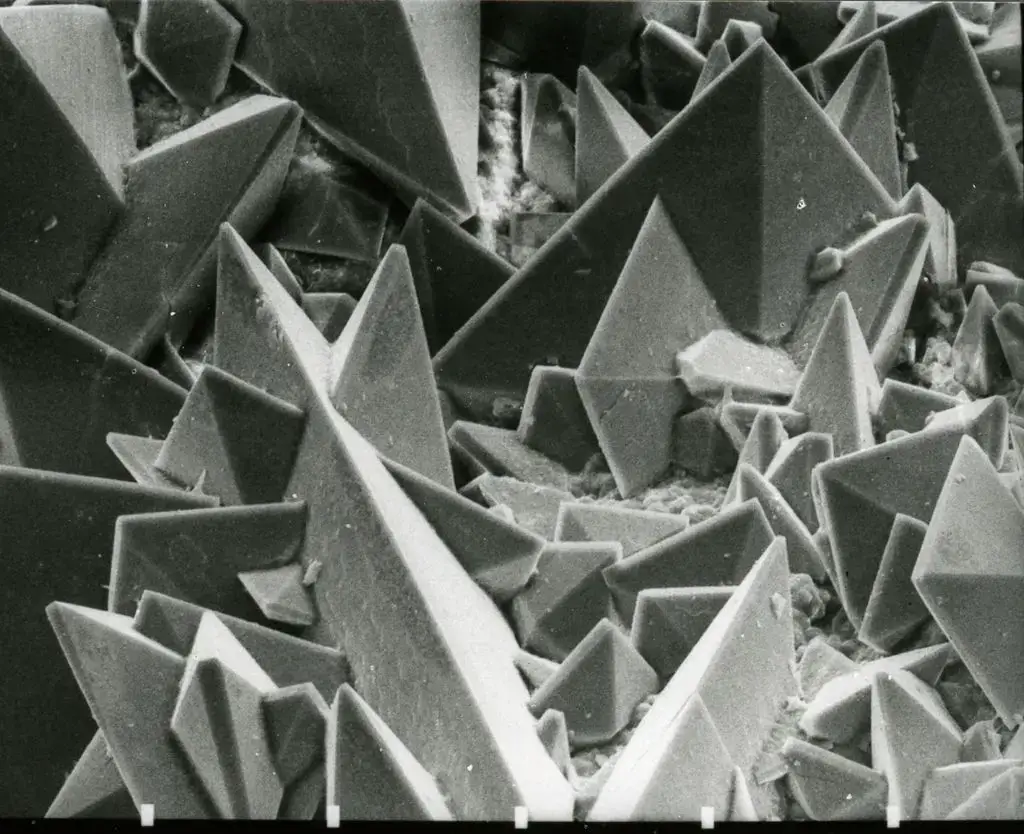
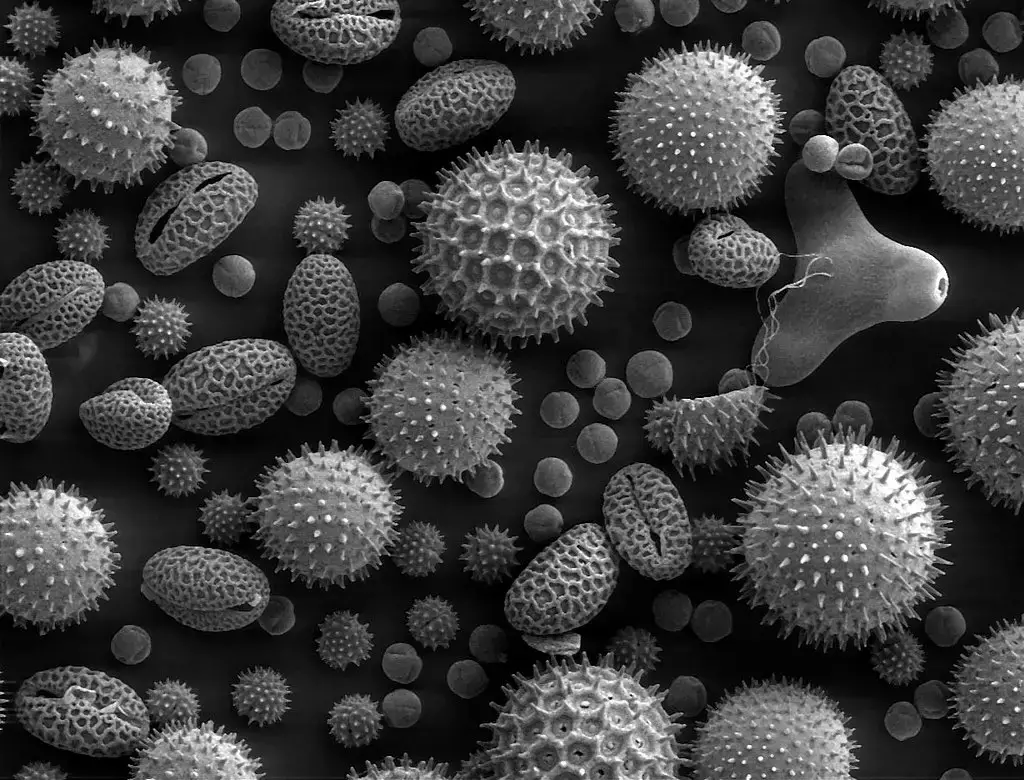
Scanning Electron Microscope (SEM) Images



References
- 24 Market Reports. (2026). Ultra-high resolution scanning electron microscope market 2026 forecast to 2032. [URL]
- Boehlke, P. R. (2025). Scanning electron microscopy. Science | Research starters. EBSCO. [URL]
- Center for Nanoscale Systems. (n.d.). Standard operating procedure Zeiss Gemini 360 FE-SEM Zeiss Gemini 560 FE-SEM. Harvard University. [PDF]
- Coherent Market Insights. (2026). Global electron microscope market size and trends, 2026-2033. [URL]
- Corrected Electron Optical Systems (CEOS) GmbH. (n.d.). Atomic resolution for everybody? [URL]
- Edmund Optics. (n.d.). Aberrations. [URL]
- Electron Optics Instruments. (2026). Scanning electron microscope price: A strategic guide to SEM investment in 2026. [URL]
- Element Pi. (n.d.). SEM charging occurrence: Understanding the process. [URL]
- ensun. (2026). Top 100 scanning electron microscope (SEM) manufacturers in 2026. [URL]
- Evident Scientific. (n.d.). Optical aberrations: Spherical, chromatic, coma & field curvature. [URL]
- Geurts, R., & Potocek, P. (2025). Enhancing automation and accessibility in electron microscopy through generative AI. 13th Asia Pacific Microscopy Congress 2025 (APMC13). ScienceOpen. [URL]
- JEOL Ltd. (n.d.). Scanning electron microscope A to Z. [PDF]
- JEOL Ltd. (n.d.). Wavelength of electron | Glossary. [URL]
- JEOL USA. (n.d.). Scanning electron microscope applications | SEM applications. [URL]
- Kalinin, S. V., Mukherjee, D., Roccapriore, K., Blaiszik, B. J., Ghosh, A., Ziatdinov, M. A., Al-Najjar, A., Doty, C., Akers, S., Rao, N. S., Agar, J. C., & Spurgeon, S. R. (2023). Machine learning for automated experimentation in scanning transmission electron microscopy. npj Computational Materials, 9(1), Article 227. [URL]
- Lab Manager. (n.d.). SEM vs TEM: Which electron microscopy method is best for your analysis? [URL]
- MarketsandMarkets. (2026). Electron microscopy market report 2026-2031, by product, application, and geo. [URL]
- MCscope. (2026). Top 10 global microscope manufacturers in 2026 | Market trends & buyer guide. [URL]
- Measurlabs. (n.d.). SEM vs TEM: Electron microscopy technique comparison. [URL]
- Metoree. (2026). 10 scanning electron microscope (SEM) manufacturers in 2026. [URL]
- Microscopy Australia. (n.d.). A basic guide to using an SEM – MyScope. [URL]
- Microscopy Australia. (n.d.). Applications and uses of SEM – MyScope. [URL]
- Microscopy Australia. (n.d.). Applications and uses of SEM – SEM. [URL]
- Microscopy Australia. (n.d.). Beam/specimen interactions – SEM – MyScope. [URL]
- Microscopy Australia. (n.d.). Image artefacts and trouble-shooting – SEM – MyScope. [URL]
- Microscopy Australia. (n.d.). Overcoming aberrations – concepts – MyScope. [URL]
- Microscopy Australia. (n.d.). SEM basics – SEM – MyScope. [URL]
- Microscopy Australia. (n.d.). Structure of an SEM – MyScope. [URL]
- Microscopy Australia. (n.d.). Types of aberration – concepts – MyScope. [URL]
- Mordor Intelligence. (n.d.). Electron microscope market size & share outlook to 2031. [URL]
- Morishita, S., Sawada, H., Okoshi, N., Waki, S., Tanaka, H., Ichikawa, K., & Kirkland, A. (n.d.). Chromatic and spherical aberration correction with hexapole and quadrupole fields. arXiv. [PDF]
- Nanakoudis, A. (2019). SEM: Types of electrons and the information they provide. Thermo Fisher Scientific. [URL]
- NanoImages. (2026). Desktop SEM comparison 2026: SNE-Alpha vs. top competitors. [URL]
- Nanoscience Instruments. (n.d.). From photons to electrons: Optical and electron microscopy. [URL]
- Nanoscience Instruments. (n.d.). Scanning electron microscopy. [URL]
- Nanoscience Instruments. (n.d.). Understanding the difference between magnification and resolution in scanning electron microscopy. [URL]
- Nanoscience Instruments. (n.d.). Which electron detector is right for your application? [URL]
- Research and Markets. (2026). Automated microscopy market report 2026. [URL]
- Tescan. (2026). ASEM 2026 workshop | Advanced electron microscopy. [URL]
- Thermo Fisher Scientific. (n.d.). Electron microscopy | TEM vs SEM. [URL]
- Thermo Fisher Scientific. (n.d.). Principles of scanning electron microscopy. [URL]
- Thermo Fisher Scientific. (n.d.). Scanning electron microscopy | Electrons in SEM. [URL]
- Thermo Fisher Scientific. (n.d.). SEM resolution | Scanning electron microscopy. [URL]
- Thermo Fisher Scientific. (n.d.). The difference between SEM and optical microscopes. [URL]
- Towards Healthcare. (2026). Electron microscopy market expands with cryo-EM advancements. [URL]
- UC San Diego Materials Research Science and Engineering Center. (n.d.). SEM S.O.P. [PDF]
- Universallab. (2024). Scanning electron microscope (SEM) various applications and case studies. [URL]
- Unknown Author. (n.d.). 10 applications of scanning electron microscopes in modern research. [URL]
- Unknown Author. (n.d.). Brief introduction to scanning electron microscopy (sem). [PDF]
- Unknown Author. (n.d.). Limits to resolution in the electron microscope. [URL]
- Unknown Author. (n.d.). SEM SOP short version. [PDF]
- Unknown Author. (n.d.). Technical principles and structural evolution of scanning electron microscopy: A comprehensive analysis of instrumentation, methodology, and the 2025-2026 analytical landscape. [Markdown]
- West Campus Materials Characterization Core. (n.d.). Standard operating procedure. Yale University. [PDF]
- Wikipedia contributors. (2026). Scanning electron microscope. Wikipedia, The Free Encyclopedia. [URL]