

DNA (deoxyribonucleic acid) and RNA (ribonucleic acid) are the two major types of nucleic acids, made up of repeating units called nucleotides.
Both contain a sugar-phosphate backbone and the nitrogenous bases adenine (A), guanine (G), and cytosine (C), but their chemical composition is not exactly same. DNA contains deoxyribose sugar and thymine (T), whereas RNA has ribose sugar and uracil (U) in place of thymine.
DNA is generally a double-stranded molecule forming the characteristic double helix. RNA, on the other hand, is usually single-stranded and can fold back on itself forming different structures. DNA mainly acts as the stable storage form of hereditary information, while different RNAs take part in expression and use of this genetic information, including protein synthesis, regulation, and some catalytic reactions.
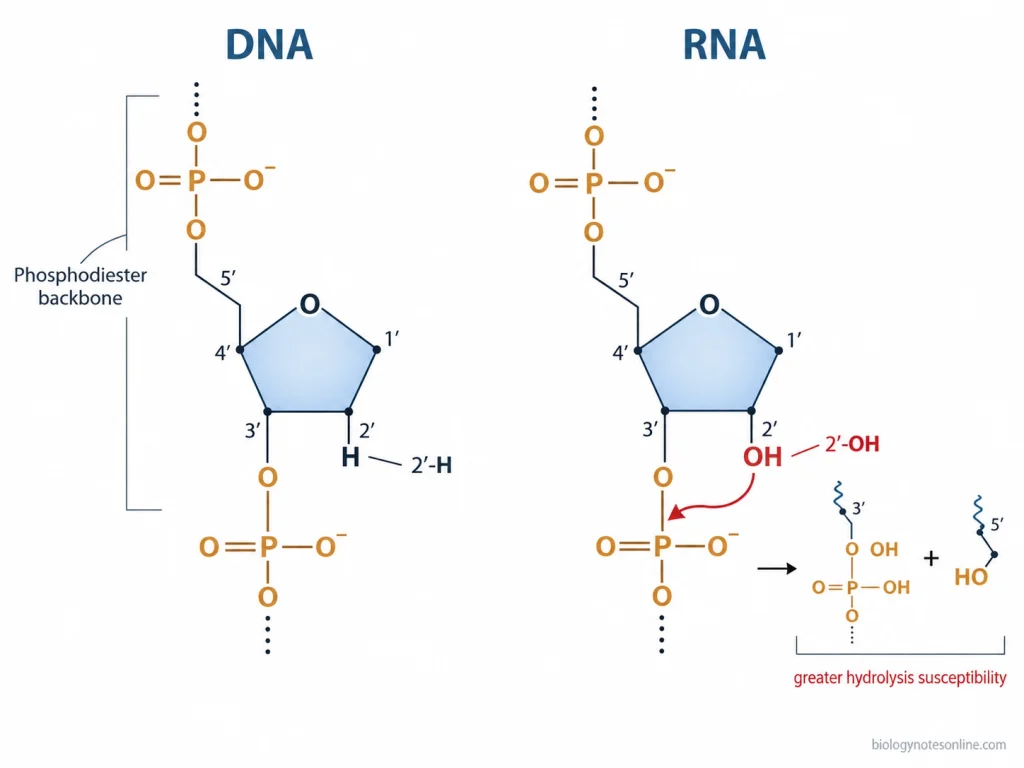
The additional 2′-OH group present in ribose makes RNA chemically more reactive and generally less stable than DNA.
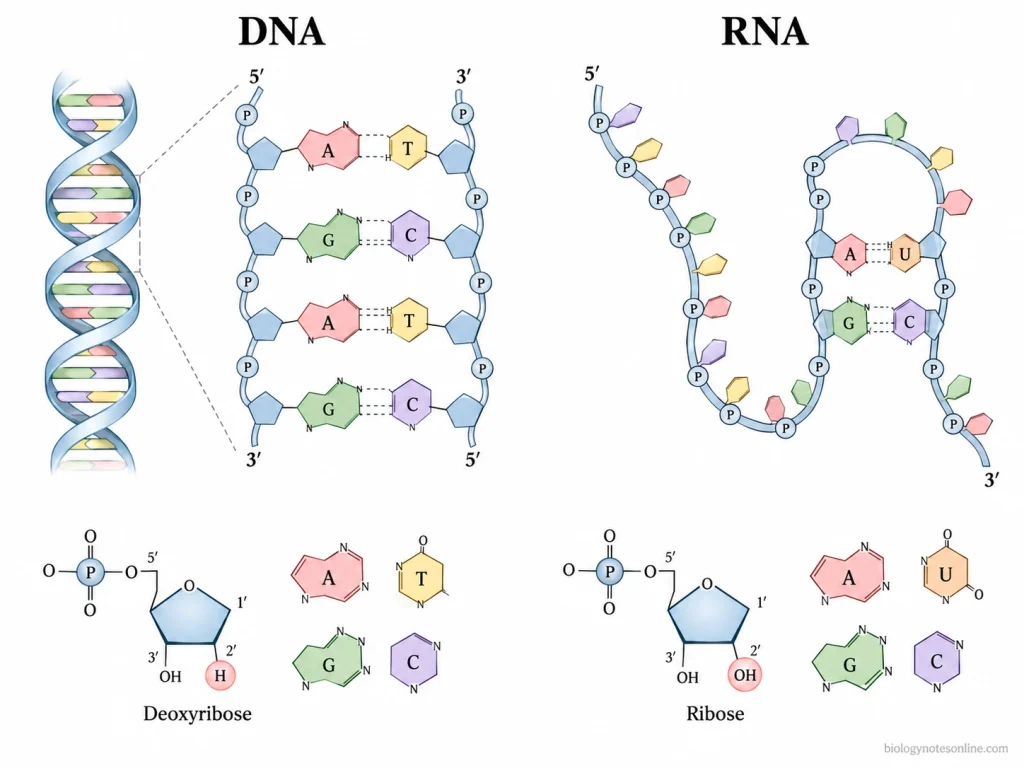
DNA vs RNA Comparison Table
| Basis | DNA | RNA |
|---|---|---|
| Full form | Deoxyribonucleic Acid | Ribonucleic Acid |
| Sugar | Contains 2′-deoxyribose sugar. At 2′ carbon, H is present instead of -OH group. | Contains ribose sugar, having an additional -OH group at the 2′ carbon. |
| Nitrogenous bases | Four major bases are adenine (A), guanine (G), cytosine (C), and thymine (T). | Adenine (A), guanine (G), cytosine (C), and uracil (U) are present. Uracil occurs in place of thymine. |
| Strands | Cellular DNA is generally double-stranded. The two polynucleotide strands run antiparallel and form a double helix. | RNA is usually single-stranded. It can fold back on itself and form short base-paired regions and different shapes. |
| Base pairing | Adenine pairs with thymine (A-T), while guanine pairs with cytosine (G-C). | A pairs with U and G pairs with C. Other non-standard base pairs can also occur in folded RNA. |
| Length | DNA molecules can be extremely long. Chromosomal DNA contains millions or more nucleotide units. | Most RNA molecules are much shorter, commonly ranging up to thousands of nucleotides depending on the RNA. |
| Stability | DNA is chemically more stable, making it suitable for long-term storage of genetic information. | RNA is less stable to hydrolysis because of the 2′-OH group of ribose. |
| Main function | The major function is storage and transmission of hereditary information. | RNA performs different works. mRNA, tRNA, and rRNA take part in protein synthesis, while other RNAs function in processing, regulation, and other cellular activities. |
| Catalytic activity | DNA mainly serves as the stable genetic information molecule in cells. | Some RNAs have catalytic activity. Such catalytic RNAs are referred to as “ribozymes”. |
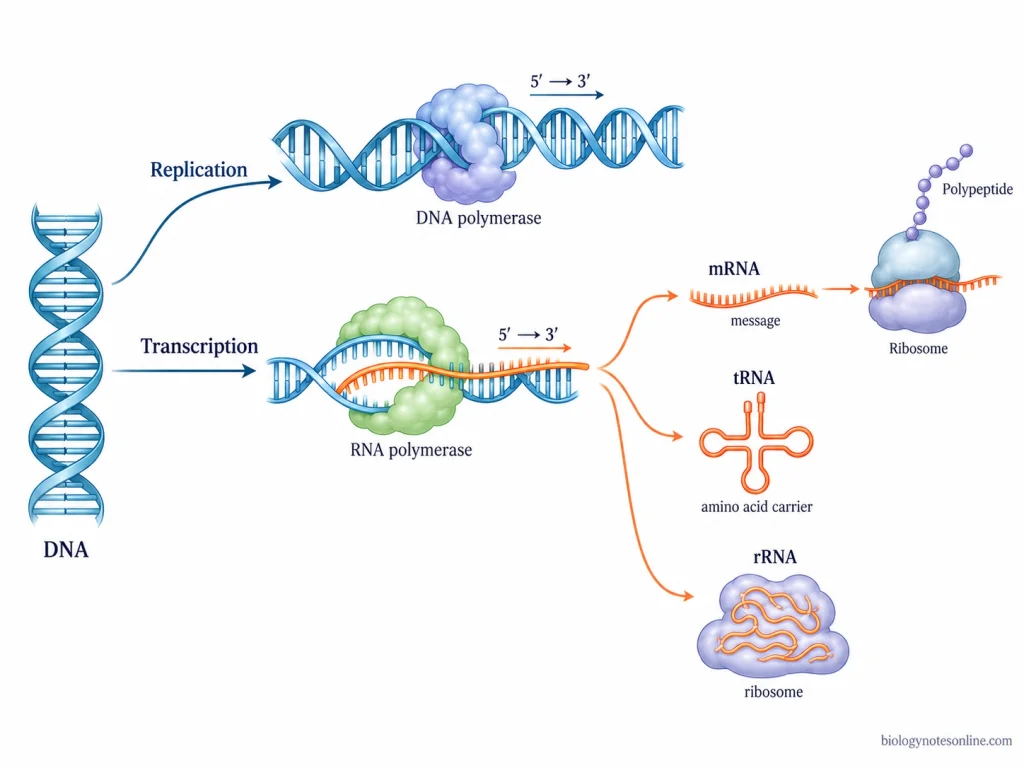
| Synthesis in cells | New DNA is produced during DNA replication, using existing DNA as template. | Most cellular RNA is synthesized from a DNA template during transcription. |
| Enzyme involved in synthesis | DNA synthesis is carried out by DNA polymerases. | RNA synthesis during transcription is performed by RNA polymerase. |
| Direction of synthesis | New DNA strands are synthesized in the 5′ → 3′ direction. | RNA chain also grows in the 5′ → 3′ direction during transcription. |
| Location in eukaryotic cells | Most DNA is enclosed in the nucleus, with additional DNA present in DNA-containing organelles such as mitochondria. | RNA is produced and processed in the nucleus, and different RNAs are also present and function in the cytoplasm. |
| As genetic material | DNA serves as the genetic material of cellular organisms and of many viruses. | RNA can itself act as the genetic material in RNA viruses. |
Differences between DNA and RNA
DNA and RNA differ in their sugar, nitrogenous bases, number of strands, stability and their functions. Some of the important differences between DNA and RNA are as follows-
- Full form- DNA is referred to as Deoxyribonucleic Acid, whereas RNA is Ribonucleic Acid.
- Sugar- The sugar present in DNA is 2′-deoxyribose sugar. At its 2′ carbon, H is present in place of hydroxyl (-OH) group. RNA contains ribose sugar, having an -OH group at the 2′ position.
- Nitrogenous bases- Adenine (A), guanine (G), and cytosine (C) are found in both DNA and RNA. The fourth base is different. DNA contains thymine (T) while in RNA, uracil (U) is present in place of thymine.
- Number of strands- DNA is generally double-stranded, with the two strands running in opposite directions forming a double helix. RNA in most cases is single-stranded. The RNA strand can also fold back on itself, forming short base-paired regions.
- Base pairing- In DNA, adenine pairs with thymine (A-T) and guanine with cytosine (G-C), whereas RNA has A-U and G-C base pairing.
- Molecular size- DNA molecules are usually much longer and chromosomal DNA can contain millions of nucleotides. Most of the RNA molecules are comparatively shorter. Their size varies with the type and function of RNA.
- Stability- DNA is chemically more stable than RNA. The presence of 2′-OH group in RNA makes its phosphodiester backbone more susceptible to hydrolysis.
- Function- The major function of DNA is the storage and transmission of genetic information. RNA performs different functions. mRNA carries genetic information for protein synthesis, tRNA carries amino acids, while rRNA forms an important part of ribosomes. Other RNAs take part in processing and regulation of gene expression.
- Catalytic activity- DNA mainly acts as the genetic information storage material in cells. Some RNA molecules can act as catalysts, and these are referred to as “ribozymes”.
- Formation- DNA is copied during DNA replication, where an existing DNA strand is used as a template. Most cellular RNA is formed from DNA during transcription, producing an RNA copy of the required genetic sequence.
Similarities between DNA and RNA
The following are some of the similarities between DNA and RNA–
- Nucleic acids- Both DNA and RNA are nucleic acids. They are large molecules formed by the polymerization of several nucleotide units.
- Nucleotides- Nucleotide is the basic structural unit in both. Each nucleotide is made up of a nitrogenous base, a five-carbon (pentose) sugar, and phosphate group.
- Common nitrogenous bases- Three bases, adenine (A), guanine (G), and cytosine (C), occur in both DNA and RNA. Adenine and guanine are purines while cytosine is a pyrimidine.
- Sugar-phosphate backbone- Both have an alternating sugar and phosphate backbone. The adjacent nucleotides are linked by 3′-5′ phosphodiester bonds, making a continuous polynucleotide chain.
- Polarity- The polynucleotide chains of DNA as well as RNA have direction. One end is referred to as the 5′ end and the other as the 3′ end, which results from the arrangement of the phosphodiester linkages.
- Base pairing- Complementary bases can pair by hydrogen bonds in both nucleic acids. G pairs with C in DNA as well as RNA. Adenine also forms complementary pairing, with T in DNA and U in RNA. RNA can fold back on itself and form such base-paired regions.
- Genetic information- In both DNA and RNA, information is carried in the sequence or order of nucleotides along the chain. DNA is the major genetic material of cells, while different RNAs are involved in transfer and expression of this information.
- Polynucleotide synthesis- DNA and RNA chains are formed by adding nucleotide units to the growing 3′ end. Nucleoside triphosphates are used as the activated precursors during their synthesis.
References
- Alberts, B., Johnson, A., Lewis, J., Raff, M., Roberts, K., & Walter, P. (2002). Molecular biology of the cell (4th ed.). Garland Science. https://www.ncbi.nlm.nih.gov/books/NBK21054/
- Brown, T. A. (2002). Genomes (2nd ed.). Wiley-Liss. https://www.ncbi.nlm.nih.gov/books/NBK21128/
- Cooper, G. M. (2000). The cell: A molecular approach (2nd ed.). Sinauer Associates. https://www.ncbi.nlm.nih.gov/books/NBK9839/
- Holmes, R. K., & Jobling, M. G. (1996). Genetics. In S. Baron (Ed.), Medical microbiology (4th ed.). University of Texas Medical Branch at Galveston. https://www.ncbi.nlm.nih.gov/books/NBK7908/
- Mercadante, A. A., Dimri, M., & Mohiuddin, S. S. (2023). Biochemistry, replication and transcription. In StatPearls. StatPearls Publishing. https://www.ncbi.nlm.nih.gov/books/NBK540152/