

What is 3 Domains of Life?
The intricate tapestry of life, as we understand it today, is a culmination of extensive scientific research and discoveries. Historically, the living world was bifurcated into two primary domains: Eukaryotes (Eukarya) and Prokaryotes (Bacteria). This classification was rooted in microscopic observations, particularly the presence or absence of membrane-bound nuclei and other cellular organelles. However, the late 20th century witnessed a paradigm shift in this understanding.
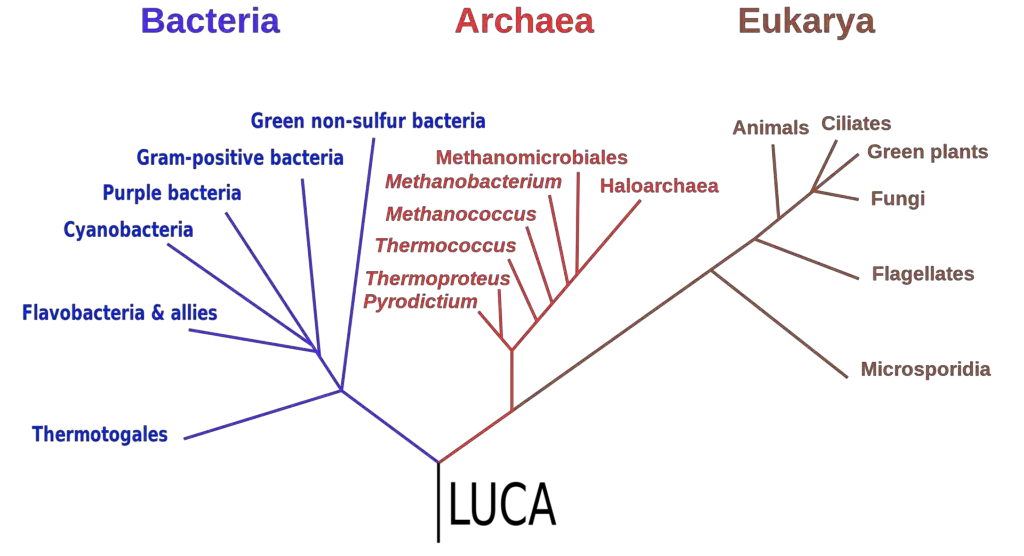
In 1977, Carl Richard Woese, an American microbiologist and physicist, along with his colleagues, unveiled the existence of a distinct group of organisms. Through meticulous analysis of 16S ribosomal RNA (rRNA) signature sequences, they identified what was previously considered a subset of prokaryotes as a separate domain, termed “Archaea”. By 1990, this classification was universally acknowledged, adding Archaea as the third domain of life.
Woese’s groundbreaking research delineated the following distinctions between archaea and bacteria:
- 16S rRNA Genes: A marked difference was observed in the 16S rRNA genes of both domains.
- RNA Polymerases: While archaea are equipped with three RNA polymerases, bacteria possess only one.
- Cell Wall Composition: Archaeal cell walls are primarily composed of pseudopeptidoglycan, in contrast to bacterial cell walls, which are constituted of peptidoglycan and lipopolysaccharide (LPS).
- Phylogenetic Relationships: Intriguingly, archaea exhibited a closer phylogenetic evolutionary kinship with eukaryotes than with bacteria.
This revelation led to the reconfiguration of the Tree of Life (ToL). The revised ToL now encapsulates three distinct domains: Archaea, Eukarya, and Eubacteria (often referred to as true bacteria). This tripartite classification underscores the hypothesis of a Last Universal Common Ancestor (LUCA), a theoretical progenitor to all three domains.
The transition from a morphology-based classification to a genetic approach has been pivotal in evolutionary biology. The universally conserved and distributed rRNA genes serve as molecular chronicles, enabling scientists to trace lineages, understand ancestral connections, and discern the junctures at which life diversified.
In summation, the three domains of life – Bacteria, Archaea, and Eukaryotes – represent the vast diversity and evolutionary history of organisms on Earth. The elucidation of these domains underscores the importance of genetic research in understanding the intricate web of life and its evolutionary trajectory.

Characteristics of three domains
1. Domain Bacteria (Kingdom: Eubacteria (True bacteria))
Bacteria, encompassing the kingdom Eubacteria, are unicellular prokaryotic entities that are microscopic in nature. A defining hallmark of this domain is the presence of peptidoglycan in their cell walls, a feature that distinguishes them from the domains of Archaea and Eukarya. Additionally, the bacterial cell membrane is characterized by unbranched fatty acid chains connected to glycerol through ester linkages, further setting them apart from Archaea. The ribosomal RNA (rRNA) structures inherent to bacteria are distinct, thereby classifying them into a separate domain in both the two- and three-domain systems.
Illustrative examples of bacteria include Cyanobacteria, Mycoplasmas, Gram-Positive bacteria, and Gram-Negative bacteria. Notably, bacteria exhibit sensitivity to a majority of antibacterial antibiotics, yet they manifest resistance to those antibiotics that predominantly affect Eukarya. Reproduction in bacteria is predominantly asexual. While many bacteria are pathogenic, a significant subset functions as essential commensals, contributing to processes such as digestion, nutrient absorption, thwarting pathogenic colonization, and immune system activation.
The vast diversity within the domain Bacteria can be categorized into five primary groups:
- Cyanobacteria: Often referred to as blue-green algae, these bacteria are photosynthetic.
- Chlamydiae: This category encompasses parasitic bacteria, including Chlamydia trachomatis and Chlamydophila pneumoniae, which proliferate within the cells of their hosts.
- Firmicutes: This group consists of Gram-positive bacteria, with representatives like Clostridium, Bacillus, and Mycoplasmas.
- Proteobacteria: A phylum of Gram-negative bacteria, they are further subdivided into alpha-, beta-, gamma-, delta-, and epsilon proteobacteria. This group includes both components of the human microbiota and pathogenic strains.
- Spirochetes: Characterized by their long, helical structure and a unique double-membrane, spirochetes exhibit a twisting motion due to their axial filaments. Examples include Borrelia, Leptospira, and Treponema.
The immense diversity within the bacterial domain is further accentuated by gene exchanges across different bacterial lineages. This genetic interchange complicates the delineation of bacterial species and challenges the construction of a clear phylogenetic tree. Consequently, the representation of bacterial relationships might be better visualized as a network rather than a traditional tree.
In summary, the domain Bacteria, representing Eubacteria, is a vast and diverse group of prokaryotic organisms with a myriad of roles in the ecosystem, from decomposition to symbiotic relationships. Their unique cellular and molecular characteristics distinguish them from other life domains, emphasizing their distinct evolutionary lineage.
2. Domain Archaea (Kingdom: Archaebacteria)
Archaea, falling under the kingdom Archaebacteria, are prokaryotic organisms that, despite their resemblance to bacteria, possess distinct molecular and physiological features. One of the defining characteristics of Archaea is their unique membrane composition. The membrane lipids of Archaea are composed of branched hydrocarbon chains connected to glycerol by ether linkages. This particular configuration confers upon them the resilience to thrive in extreme environments, from highly acidic conditions to extreme temperatures.
Examples of such extremophilic Archaea include halophiles, which flourish in saline environments, and hyperthermophiles, which thrive in exceptionally hot conditions. However, it is essential to note that not all Archaea are extremophiles. Some are found in milder environments, such as soils, oceans, and even the human gut, where methane-producing archaea coexist with bacteria.
In terms of morphology, Archaea exhibit a range of sizes, typically ranging from 0.1 μm to 15 μm in diameter and extending up to 200 μm in length. This places them within the size range of bacteria and eukaryotic mitochondria. The genus Thermoplasma, for instance, represents some of the smallest known Archaea.
Archaea share several features with bacteria, including:
- Their unicellular, prokaryotic nature.
- The absence of a membrane-bound nucleus and other internal organelles.
- The presence of a single, circular, double-stranded DNA chromosome.
- Reproduction through asexual binary fission.
- The presence of flagella for movement.
However, Archaea also exhibit characteristics reminiscent of eukaryotes, especially concerning the enzymatic machinery involved in genetic information processing. Unlike bacteria, Archaea lack a peptidoglycan layer in their cell envelope. This makes them resistant to certain antibiotics that target bacteria but renders them susceptible to some that affect eukaryotes.
Recent evolutionary studies, post-Woese’s three-domain proposal, have posited that eukaryotes might have directly descended from Archaea, rather than being parallel lineages. Within the domain Archaea, three primary phyla are recognized: Crenarchaeota, Euryarchaeota, and Korarchaeota.
- Crenarchaeota: This phylum predominantly comprises hyperthermophiles and thermoacidophiles.
- Euryarchaeota: Methanogens, which produce methane, are the primary members of this phylum.
- Korarchaeota: This phylum remains relatively unexplored. Its members are infrequently found in nature and are postulated to represent the most ancient lineage of archaebacteria.
In conclusion, the domain Archaea, representing Archaebacteria, showcases a diverse group of prokaryotic organisms with unique molecular and physiological attributes. Their ability to inhabit extreme environments, coupled with their evolutionary significance, makes them a fascinating subject of scientific inquiry.
3. Domain Eukarya
The domain Eukarya stands distinctively apart in the tree of life, representing a diverse array of organisms characterized by their complex cellular structures. Unlike the domains of Bacteria and Archaea, Eukarya encompasses both unicellular and multicellular organisms, all of which possess a well-defined nucleus enclosed by a double membrane, replete with pores. This nuclear envelope safeguards the DNA, permitting its regulated movement in and out.
Eukaryotic cells are further distinguished by the absence of peptidoglycan in their cell envelope and a unique ribosomal RNA (rRNA) sequence that differentiates them from bacteria and archaeans. Their cellular intricacy is evident in the presence of specialized membrane-bound organelles such as the endoplasmic reticulum, Golgi complex, and acidified vacuoles. Additionally, they possess specific genes and proteins, including tubulins, actin, myosin, and calmodulin, which play pivotal roles in cellular processes. The division of eukaryotic cells involves a coordinated sequence of mitosis and cytokinesis, and they can reproduce through both asexual (mitosis) and sexual (meiosis) means.
The domain Eukarya is further stratified into four primary kingdoms:
- Kingdom Protista: This kingdom encompasses primarily unicellular eukaryotes, with the exception of certain multicellular entities like brown algae. Protists exhibit both asexual and sexual reproduction, involving cell fusion and zygote formation. Notable examples include Protozoans, Euglenoids, and Dinoflagellates.
- Kingdom Fungi: Fungi are predominantly multicellular heterotrophs with specialized chitin-based cell walls. They reproduce through a diverse array of mechanisms, encompassing sexual, asexual, and vegetative reproduction. Noteworthy fungi include Aspergillus and Agaricus, though unicellular fungi like yeasts also exist.
- Kingdom Plantae: This kingdom represents multicellular, autotrophic organisms. Their cell walls are primarily composed of cellulose. While most plants are autotrophic, exceptions like parasitic or insectivorous plants exhibit partial heterotrophy. A unique feature of their lifecycle is the alternation of generations.
- Kingdom Animalia: Encompassing a vast array of multicellular, heterotrophic organisms, animals are devoid of cell walls and are typically motile. Reproduction is predominantly sexual, involving the union of male and female gametes followed by embryonic development.
A pivotal theory associated with the evolution of eukaryotic cells is the Endosymbiotic theory, postulated by scientist Lynn Margulis in the 1960s. This theory posits that organelles such as mitochondria and chloroplasts originated from prokaryotic cells that were engulfed by ancestral eukaryotic cells, leading to a symbiotic relationship.
In summation, the domain Eukarya represents a vast and diverse group of organisms, unified by their complex cellular organization and unique molecular characteristics. Their evolutionary history and the intricate interplay of cellular processes make them a central focus of biological research.
Endosymbiotic Theory
The evolutionary trajectory of life on Earth has been punctuated by transformative events that have reshaped the landscape of biological diversity. One such pivotal event is the emergence of eukaryotic cells from their prokaryotic predecessors. The Endosymbiotic Theory offers a compelling explanation for this evolutionary leap.
Historical paleontological data indicates that prokaryotic cells made their debut on Earth approximately 4 billion years ago. In stark contrast, eukaryotic cells emerged much later, around 1.8 billion years ago. This temporal disparity prompted scientists to postulate: Could the progenitor of all eukaryotic cells have been a prokaryote?
Central to the Endosymbiotic Theory is the proposition that a symbiotic relationship was established between two distinct prokaryotic cells. Specifically, one prokaryotic cell, acting as the host, engulfed another through a process of membrane infolding. Instead of digesting the engulfed cell, a mutualistic relationship was established, allowing both cells to coexist and benefit from one another. Over time, this partnership gave rise to eukaryotic cells, characterized by membrane-bound organelles.
Several lines of evidence bolster the credibility of the Endosymbiotic Theory:
- Membranous Similarity: Both mitochondria and chloroplasts, quintessential eukaryotic organelles, are enclosed by membranes akin to those of prokaryotic cells.
- Distinct DNA: Mitochondria and chloroplasts harbor their own circular DNA. Intriguingly, chloroplast DNA mirrors that of photosynthetic blue-green bacteria, while mitochondrial DNA is reminiscent of aerobic bacteria.
- Reproductive Mechanism: Mirroring bacterial reproduction, both mitochondria and chloroplasts replicate through binary fission.
- Morphological Resemblance: The size and structural morphology of mitochondria and chloroplasts bear a striking resemblance to bacteria.
- Ribosomal Characteristics: The ribosomes present in bacteria, chloroplasts, and mitochondria share similarities in size and nature, specifically being of the 70S type, composed of 50S and 30S subunits.
- Antibiotic Sensitivity: Certain antibiotics, designed to inhibit bacterial protein synthesis, also impede protein synthesis in chloroplasts and mitochondria, underscoring their shared evolutionary lineage.
In essence, the Endosymbiotic Theory provides a coherent and scientifically substantiated framework for understanding the evolutionary transition from prokaryotic to eukaryotic cells. This theory underscores the intricate interplay of mutualistic relationships in shaping the course of cellular evolution.
Differences Between 3 Domains of Life – Bacteria, Archaea, Eukarya
| Feature/Characteristic | Bacteria | Archaea | Eukarya |
|---|---|---|---|
| Cell Type | Prokaryotic | Prokaryotic | Eukaryotic |
| Nucleus | Absent (no membrane-bound nucleus) | Absent (no membrane-bound nucleus) | Present (membrane-bound nucleus) |
| Membrane Lipid Structure | Unbranched fatty acid chains attached to glycerol by ester linkages | Branched hydrocarbon chains attached to glycerol by ether linkages | Unbranched fatty acid chains attached to glycerol by ester linkages |
| Cell Wall | Typically contains peptidoglycan | Lacks peptidoglycan; may contain pseudopeptidoglycan or other polysaccharides | Varies; plants have cellulose, fungi have chitin, and many protists and animals lack cell walls |
| Ribosomal RNA (rRNA) | Distinct rRNA type | Distinct rRNA type | Distinct rRNA type |
| Antibiotic Sensitivity | Sensitive to antibiotics that target bacteria | Generally resistant to antibiotics that target bacteria | Typically resistant to antibiotics that target bacteria; however, eukaryotic pathogens can be sensitive to antifungal or antiparasitic drugs |
| Organelles | Absent | Absent | Present (e.g., mitochondria, chloroplasts, endoplasmic reticulum) |
| Reproduction | Primarily asexual (binary fission) | Primarily asexual (binary fission) | Both asexual and sexual modes of reproduction |
| RNA Polymerase | Single type | Multiple types | Multiple types |
| Flagella | Simple, composed of flagellin | More complex, not composed of flagellin | Complex, 9+2 arrangement of microtubules |
| Habitats | Diverse, including moderate and some extreme environments | Often extreme environments (e.g., high salt, high temperature) | Diverse, including terrestrial, aquatic, and symbiotic environments |
| Examples | Escherichia coli, Streptococcus | Halobacterium, Methanogens | Plants, animals, fungi, protists |
In summary, while Bacteria and Archaea are both prokaryotic domains, they exhibit significant differences in their molecular and cellular structures, as well as their habitats. Eukarya, on the other hand, represents a vast array of complex, multicellular organisms with distinct cellular features that set them apart from the prokaryotic domains.
Quiz
Which of the following domains is characterized by the presence of a membrane-bound nucleus?
A) Bacteria
B) Archaea
C) Eukarya
D) Both Bacteria and Archaea
[expand title=”Show answer” swaptitle=”Hide answer”]
Answer: C) Eukarya
[/expand]
Which domain primarily consists of prokaryotic cells that often inhabit extreme environments?
A) Bacteria
B) Archaea
C) Eukarya
D) None of the above
[expand title=”Show answer” swaptitle=”Hide answer”]
Answer: B) Archaea
[/expand]
The cell walls of which domain typically contain peptidoglycan?
A) Bacteria
B) Archaea
C) Eukarya
D) Both Archaea and Eukarya
[expand title=”Show answer” swaptitle=”Hide answer”]
Answer: A) Bacteria
[/expand]
Which domain includes organisms like plants, animals, and fungi?
A) Bacteria
B) Archaea
C) Eukarya
D) Both Bacteria and Archaea
[expand title=”Show answer” swaptitle=”Hide answer”]
Answer: C) Eukarya
[/expand]
Which domain’s cell membrane is characterized by branched hydrocarbon chains attached to glycerol by ether linkages?
A) Bacteria
B) Archaea
C) Eukarya
D) Both Bacteria and Eukarya
[expand title=”Show answer” swaptitle=”Hide answer”]
Answer: B) Archaea
[/expand]
Which domain is primarily sensitive to antibiotics that target bacterial cell walls?
A) Bacteria
B) Archaea
C) Eukarya
D) Both Archaea and Eukarya
[expand title=”Show answer” swaptitle=”Hide answer”]
Answer: A) Bacteria
[/expand]
Which domain exhibits a 9+2 arrangement of microtubules in its flagella?
A) Bacteria
B) Archaea
C) Eukarya
D) Both Bacteria and Archaea
[expand title=”Show answer” swaptitle=”Hide answer”]
Answer: C) Eukarya
[/expand]
Which domain primarily consists of unicellular organisms?
A) Bacteria
B) Archaea
C) Eukarya
D) Both Bacteria and Archaea
[expand title=”Show answer” swaptitle=”Hide answer”]
Answer: D) Both Bacteria and Archaea
[/expand]
In which domain do the organisms primarily reproduce through both asexual and sexual modes of reproduction?
A) Bacteria
B) Archaea
C) Eukarya
D) None of the above
[expand title=”Show answer” swaptitle=”Hide answer”]
Answer: C) Eukarya
[/expand]
Which domain’s cell membrane is characterized by unbranched fatty acid chains attached to glycerol by ester linkages?
A) Bacteria
B) Archaea
C) Eukarya
D) Both Bacteria and Eukarya
[expand title=”Show answer” swaptitle=”Hide answer”]
Answer: A) Bacteria
[/expand]
FAQ
What are the three domains of life?
The three domains of life are Bacteria, Archaea, and Eukarya.
How do the three domains differ from each other?
Bacteria and Archaea are prokaryotic, meaning they lack a membrane-bound nucleus, while Eukarya are eukaryotic and have a nucleus. Additionally, each domain has unique cellular and molecular characteristics.
Are all bacteria harmful to humans?
No, while some bacteria can cause diseases, many are beneficial and play essential roles in processes like digestion.
What are extremophiles and to which domain do they belong?
Extremophiles are organisms that thrive in extreme environmental conditions, such as high temperatures or salinity. They primarily belong to the Archaea domain.
Do all eukaryotes belong to the animal kingdom?
No, the domain Eukarya includes animals, plants, fungi, and protists.
Why are Archaea considered similar to both Bacteria and Eukarya?
While Archaea are prokaryotic like Bacteria, they share some molecular processes and sequences with Eukarya, making them a unique bridge between the two other domains.
What is the significance of the Endosymbiotic Theory?
The Endosymbiotic Theory suggests that eukaryotic organelles, like mitochondria and chloroplasts, originated from prokaryotic cells that were engulfed by ancestral eukaryotic cells. This theory explains the origin of eukaryotic cells.
Are all organisms in the Eukarya domain multicellular?
No, while many eukaryotes are multicellular, like plants and animals, there are also many unicellular eukaryotes, such as yeasts and some protists.
How do bacteria reproduce?
Bacteria primarily reproduce asexually through a process called binary fission, where a single cell divides into two identical daughter cells.
Why is the study of the three domains essential?
Understanding the three domains provides insights into the diversity of life, evolutionary relationships, and the fundamental processes that drive biology. It also has implications for medicine, ecology, and biotechnology.
References
- Study.com. (n.d.). Eukarya: Definition, characteristics & examples. https://study.com/academy/lesson/eukarya-definition-characteristics-examples.html
- Biology Wise. (n.d.). Three domains of life. https://biologywise.com/three-domains-of-life
- LibreTexts. (n.d.). Microbiology. https://bio.libretexts.org/Bookshelves/Microbiology/Book%
- NASA Astrobiology. (n.d.). The three domains of life. https://astrobiology.nasa.gov/news/the-three-domains-of-life/
- Earth How. (n.d.). 3 domains of life. https://earthhow.com/3-domains-of-life/
- Microbiology Society. (n.d.). Archaea and the meaning of life. https://microbiologysociety.org/publication/past-issues/what-is-life/article/archaea-and-the-meaning-of-life-what-is-life.html
- Lumen Learning. (n.d.). Reading phylogenetic trees. https://courses.lumenlearning.com/wm-nmbiology1/chapter/reading-phylogenetic-trees-2/
- Biology Dictionary. (n.d.). Domain. https://biologydictionary.net/domain/
- ThoughtCo. (n.d.). Three domain system. https://www.thoughtco.com/three-domain-system-373413
- Bio Explorer. (n.d.). Domain Eukarya. https://www.bioexplorer.net/domain-eukarya.html/
- Sringer. (n.d.). Reference work entry. https://link.springer.com/referenceworkentry/10.1007/978-3-642-11274-4_537