

What do you mean by Biological Organization?
- Biological organization is the structured hierarchy that arranges living entities, helping researchers and scientists study and understand complex life systems by categorizing them into distinct levels. Starting at the most basic level, atoms form the essential molecules required for life, such as proteins and nucleic acids like DNA. These molecules are organized into cells, the smallest units of life, which can carry out fundamental life processes independently. Cells are unique in that they can specialize, forming groups that work together as tissues with distinct roles—for instance, muscle tissue or nervous tissue.
- At the next level, tissues combine to create organs, each organ made of several tissue types designed to fulfill specific functions. For example, the heart, composed of muscle, connective, and epithelial tissues, functions to pump blood throughout the body. Organs then form organ systems, like the digestive or circulatory system, which work to maintain internal stability and support the life of an organism.
- Each organism represents a complete living entity capable of reproduction, metabolism, and adaptation. When organisms of the same species occupy a particular area, they form a population, interacting and sharing resources. Expanding further, communities encompass multiple populations of different species that interact within the same habitat. Ecosystems go a step further by including both the living community and the physical environment, encompassing elements like soil, water, and climate, which interact with the living organisms.
- The biosphere represents the highest level of biological organization, encompassing all ecosystems on Earth and forming a unified “layer” of life. This global perspective highlights how changes at any level—down to a molecular or cellular change—can influence the entire system. For instance, a chemical like DDT might initially affect cellular processes in insects but eventually impact ecosystems by altering species populations and interactions.
- This hierarchical model not only organizes life but also illustrates the concept of emergence, where each level exhibits unique properties that do not exist in its individual components. Biological organization is essential for understanding fields like medicine and ecology, as it helps to link small-scale biological changes, like cellular mutations, to large-scale effects in organisms and ecosystems.
The Historical Origins of Biological Organization
The concept of biological organization has deep roots in the history of philosophy and science. From ancient Greek thought to the rise of modern biology, the idea of hierarchy in nature has evolved significantly. Early frameworks, such as Aristotle’s grading of living things, laid the groundwork for later, more structured systems that emerged during the scientific revolution.
- Ancient Foundations
Aristotle was one of the first to suggest that living organisms could be arranged on a scale, starting with plants at the base and reaching up to humans. This concept was later developed in Neoplatonism, transforming into the medieval idea known as the “Great Chain of Being.” In this view, everything from God to inanimate objects occupied a place on a hierarchical scale. This hierarchical approach to nature provided a foundation for future scientific thinking about biological organization. - From Philosophy to Science
With the rise of Western science during the Renaissance and Enlightenment, ideas of hierarchy in nature began to take on more scientific forms. One of the most notable contributions came from Carl Linnaeus, who created a taxonomical classification system that categorized living organisms in a hierarchical manner. Auguste Comte also proposed a hierarchy of the sciences, which helped lay the groundwork for the systematic approach to biological classification. - Philosophical and Scientific Evolution
By the early twentieth century, ideas of biological organization expanded with the development of new philosophical and scientific theories. Philosophers like Samuel Alexander and Charles Dunbar Broad introduced the notion of “levels of existence” or “complexity.” This idea suggested that nature tends toward increasing complexity as one moves up through different levels of organization. This emergent thinking led to the exploration of how higher-level functions arise from the interaction of lower-level components, a concept that would become foundational in biology. - Emergentism and the Rise of Organicism
The organicist movement, which emerged in the early to mid-twentieth century, was pivotal in shaping modern concepts of biological organization. Organicists such as Joseph Woodger, Ludwig von Bertalanffy, and Joseph Needham emphasized the importance of biological organization as a means of distinguishing living organisms from non-living matter. They argued that biological phenomena could not be fully explained by the physico-chemical components alone. Instead, they emphasized the complex interactions and hierarchical relationships among the different parts of living organisms. - Hierarchical Systems and the Organicist Influence
Organicists viewed the concept of levels as essential for understanding life. They rejected the mechanist view, which saw organisms as mere machines composed of physical components. Instead, organicists argued that organisms are made up of hierarchical systems where each level of organization—such as cells, tissues, organs, and organ systems—contributes to the overall function of the organism. This approach allowed for a more holistic view of biology, where life could be understood through its complex, nested structures. - Levels of Organization and the Debate Between Mechanists and Vitalists
The organicist movement arose partly in response to the mechanist and neovitalist debates. Mechanists argued that biological phenomena could eventually be explained by chemical and physical laws, while neovitalists like Hans Driesch and Henri Bergson insisted that life involved non-physical forces. Organicists sought a middle ground, acknowledging the importance of physical processes while also recognizing that higher-order organization and complexity could not be reduced to simple mechanical explanations. - The Rise of Systems Theory
After the organicist movement, the concept of levels of organization was further developed within the framework of general systems theory and hierarchy theory. Scientists like Ludwig von Bertalanffy and Herbert Simon explored how systems could be understood in terms of their hierarchical structure, with higher levels of organization imposing constraints on lower ones. This work was crucial in advancing the idea that biological systems, like all complex systems, are organized into levels of increasing complexity, each with its own set of rules and functions. - Influence on Contemporary Biology
The early work of organicists and systems theorists laid the foundation for modern understandings of biological organization. The idea that biological systems are hierarchical and composed of nested levels remains central to biology today. From cellular structures to organ systems and entire ecosystems, the levels of organization concept helps explain the complexity and interconnectedness of life.
The historical evolution of the concept of biological organization illustrates how the idea of hierarchy has shaped scientific thinking. From Aristotle to the organicists of the early twentieth century, the idea that life can be understood in terms of levels of organization has been a powerful tool for understanding the complexity of living systems. The development of this concept has played a critical role in advancing fields like biology, medicine, and systems theory.
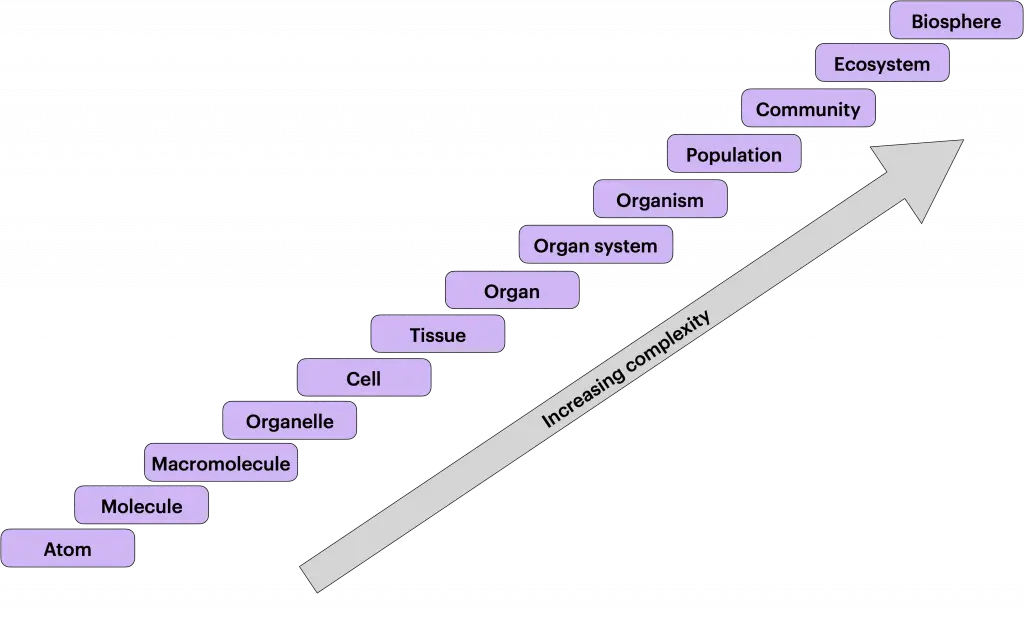
Levels of Biological Organization
Biological organization outlines the levels through which living systems evolve from basic units to complex entities, each level building on the previous to create higher-order functions and interactions. Here’s a clear breakdown of each level:
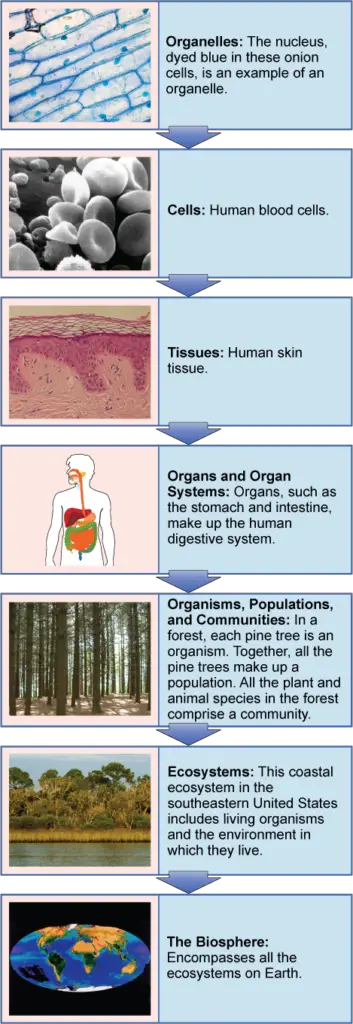
- Subatomic Particle: The smallest known building blocks, such as protons, neutrons, and electrons, which form the foundation of all matter.
- Atom: The simplest unit of an element, with atoms combining to form all substances. Carbon, hydrogen, and oxygen atoms, for instance, are fundamental to organic molecules in biology.
- Molecule: Atoms join to form molecules, the compounds that are crucial for life processes. Examples include DNA for genetic information and proteins for structure and function.
- Organelle: Inside cells, organelles like mitochondria (energy production) and chloroplasts (photosynthesis in plants) each perform specialized tasks necessary for cell survival.
- Cell: Recognized as the fundamental unit of life, cells can function independently (like bacteria) or join to form complex multicellular organisms. Each cell type has unique roles, such as nerve cells for signaling or red blood cells for oxygen transport.
- Tissue: Tissues are groups of similar cells that work together to carry out a particular function. Muscle tissue contracts to allow movement, while epithelial tissue protects body surfaces.
- Organ: Organs consist of multiple tissues that work collectively to perform specific tasks. For example, the heart (composed of muscle and connective tissue) pumps blood, while the lungs facilitate breathing.
- Organ System: Groups of organs that coordinate to accomplish complex bodily functions. Examples include the digestive system (processing food) and the circulatory system (distributing nutrients and oxygen).
- Organism: A complete, individual living being that carries out life processes independently, from single-celled bacteria to multicellular plants and animals.
- Population: A group of organisms of the same species that interact and reproduce within a particular geographic area, such as a herd of deer in a forest.
- Community: Multiple populations of different species that coexist and interact in the same environment, forming intricate food webs and relationships.
- Ecosystem: Combines the community of living organisms with their physical surroundings. Ecosystems include both biotic factors (plants and animals) and abiotic factors (soil, water, climate).
- Biome: Large regions classified by dominant climate and vegetation types, such as deserts, tundras, and rainforests, each supporting distinct groups of organisms.
- Biosphere: The broadest level, the biosphere encompasses all ecosystems globally, covering every part of Earth that hosts life—from the deepest oceans to the upper atmosphere.
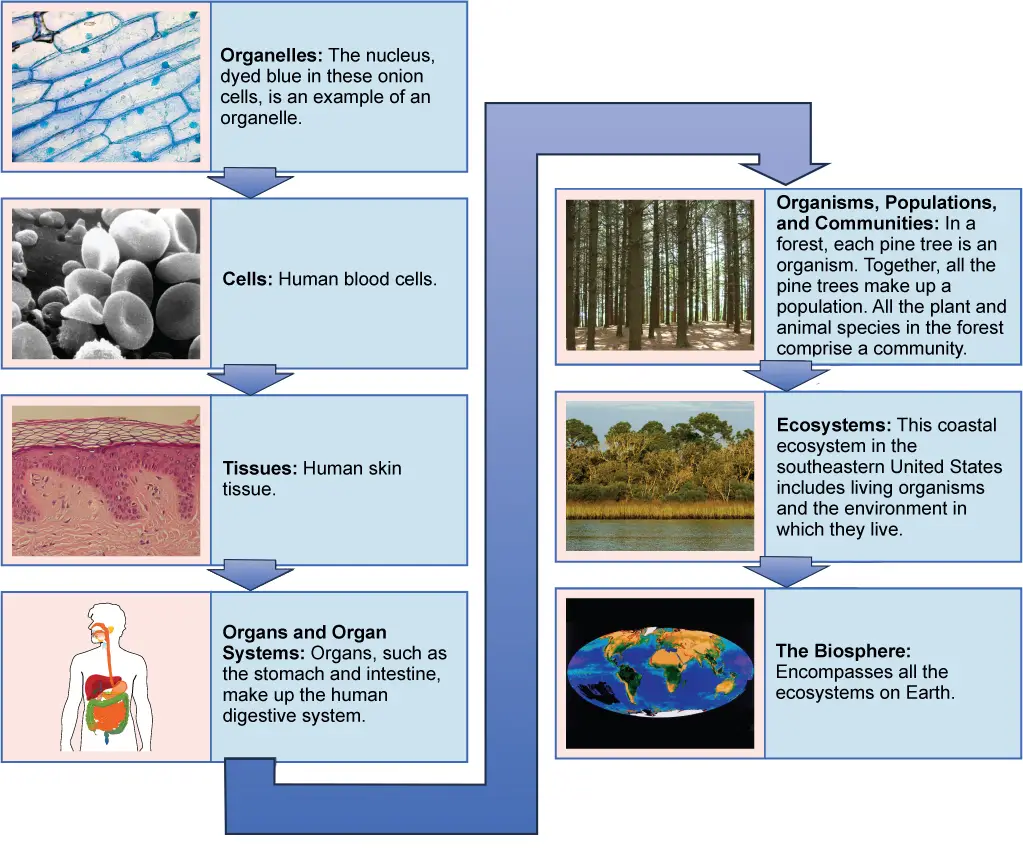
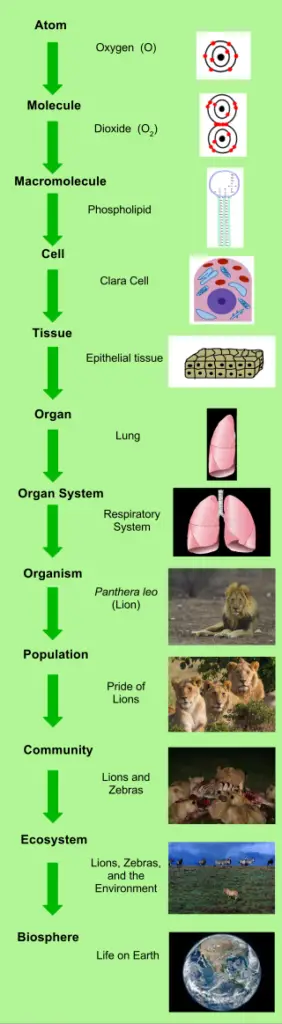
Levels of Biological Organization Diagram
Importance of Biological Organization
Biological organization is the framework that allows scientists to study life in a structured way, from the simplest atoms to complex ecosystems. It breaks down the complexity of life into manageable levels, helping researchers understand how each component contributes to the whole. Here’s why it’s essential:
- Simplifies Complexity: Biological organization organizes life into levels, starting from atoms and molecules, then moving up to cells, tissues, organs, organ systems, and finally, ecosystems. This step-by-step structure helps make sense of the intricacies of life, from the microscopic to the global scale.
- Facilitates Research: By categorizing life into distinct levels, scientists can specialize in specific areas, such as molecular biology, ecology, or anatomy. This organization allows for focused research and advances in fields like medicine, agriculture, and environmental science. It provides clarity when dealing with the complex interplay between life forms and their surroundings.
- Shows Interconnectedness: Each level in biological organization builds upon the one before it. For example, cells form tissues, tissues form organs, and organs combine to form organ systems. This interconnected structure is vital for understanding how different parts of living organisms work together to sustain life. The relationships between these systems are essential for maintaining balance within organisms and ecosystems.
- Emergent Properties: At each higher level of organization, new properties emerge that cannot be found at the lower levels. For example, cells perform basic functions, but when they form tissues, they acquire the ability to perform more complex tasks like movement or nutrient absorption. This emergence is crucial for understanding the complexity of life.
- Insight into Life Processes: The hierarchical organization helps us see how biological functions unfold across different levels. Understanding how organs work together to support a living organism highlights how functions like circulation or digestion are achieved. These insights are essential for understanding both the normal and abnormal functioning of organisms.
- Applications in Medicine: The importance of biological organization is clear in the medical sciences. It helps link changes at the cellular level to systemic effects, like the spread of cancer or the malfunction of organs. This understanding aids in diagnosing diseases and creating targeted treatment strategies. It provides a framework to study how diseases affect different levels of biological organization, from cellular mutations to organ failure.
- Ecological Significance: Biological organization doesn’t just apply to individual organisms; it extends to ecosystems as well. Small changes, like a shift at the cellular level, can have cascading effects that impact entire ecosystems. For example, environmental toxins can disrupt food webs and ecological balance. This principle underscores the interconnectedness of life across multiple scales.
- Evolutionary Insights: The hierarchical structure of biological organization ties directly to evolutionary theory. Understanding how life evolved from simple organisms to more complex ones through natural selection and adaptation is easier when you look at how these levels of organization have developed over time. It provides a lens to understand how life diversified and became more complex.
- Effective Communication: The hierarchical structure also aids scientific communication. With clear distinctions between levels of biological organization, researchers in fields like genetics, physiology, and ecology can easily collaborate. It allows for the efficient sharing of knowledge across disciplines, facilitating advancements and discoveries in various biological fields.
- Panikov, Nicolai. (2010). Microbial Ecology. In: (Wang, L.K., Pereira, N.C. and Hung, Yung-Tse, eds) “Handbook of Environmental Engineering ” The Humana Press, Inc., Totowa, NJ, USA. 10. 10.1007/978-1-60327-140-0_4.
- Themes and Concepts of Biology – Levels of Organization of Living Things. (2022, June 9). https://bio.libretexts.org/@go/page/12651
- https://study.com/academy/lesson/structure-function-in-biological-organization-benefits-disadvantages.html
- https://study.com/academy/lesson/levels-of-biological-organization.html
- https://openoregon.pressbooks.pub/mhccmajorsbio/chapter/levels-of-organization/
- https://slcc.pressbooks.pub/collegebiology1/chapter/1-2-levels-of-biological-organization/
- https://www.slideshare.net/slideshow/unit-3-lesson-32-levels-of-biological-organization/51172768
- https://byjus.com/question-answer/biological-organization-starts-with-organismic-levelatomic-levelcellular-levelsubmicroscopic-molecular-level/
- http://www.moomoomathblog.com/2023/03/levels-of-biological-organization.html
- https://eduinput.com/what-are-levels-of-biological-organization/
- https://www.bioexplorer.net/10-levels-biological-organization.html/
- https://sciencenotes.org/levels-of-organization-in-biology/
- https://www.biologyonline.com/dictionary/organization#Levels_of_organization_in_biology
- https://plato.stanford.edu/entries/levels-org-biology/#LeveBiolTheoUsag