

It is a specific colour reaction used for the detection of amino acid tryptophan present in proteins. This test is also referred to as Adamkiewicz–Hopkins reaction or glyoxylic acid test. It is based on the presence of indole ring which is a characteristic structure of tryptophan and not found in other amino acids. Hence the reaction is considered specific for tryptophan containing proteins.
In this test the protein solution is treated with Hopkins Cole reagent which contains glyoxylic acid. Concentrated sulphuric acid is then added slowly along the sides of test tube so that it forms a separate lower layer. In presence of strong acid the glyoxylic acid reacts with indole ring of tryptophan and a coloured complex is formed. A positive test is indicated by appearance of violet or purple coloured ring at the junction of two layers. Proteins such as casein and egg albumin give positive result while proteins like gelatin and zein which lack tryptophan do not show this reaction.
Objectives of Hopkin’s Cole Test (Adamkiewicz–Hopkins)
- To detect the presence of indole ring in protein molecules.
- To identify amino acid tryptophan present in a given sample.
- To distinguish proteins containing tryptophan from proteins lacking tryptophan such as gelatin.
Principle of Hopkin’s Cole Test (Adamkiewicz–Hopkins)
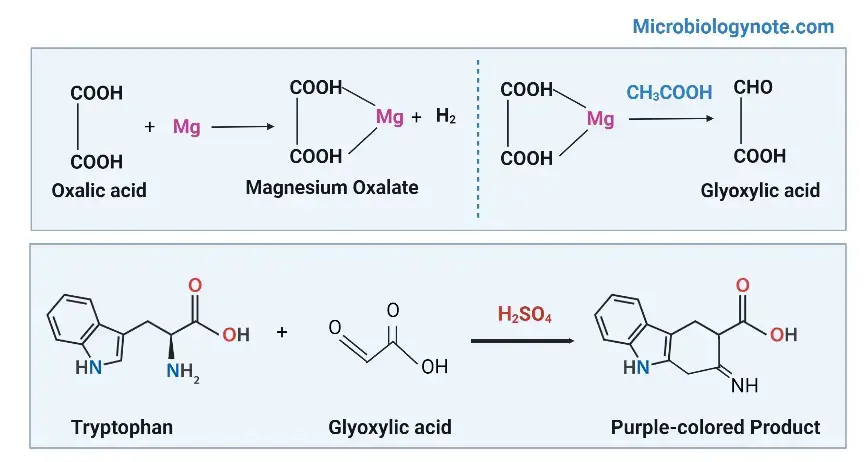
It is based on the specific reaction of amino acid tryptophan present in proteins. The principle depends on the presence of indole ring which is a characteristic structural group of tryptophan. When a protein containing tryptophan is treated with glyoxylic acid in presence of concentrated sulphuric acid a condensation reaction occurs between indole nucleus of tryptophan and glyoxylic acid.
In this reaction the concentrated sulphuric acid acts as dehydrating as well as oxidising agent and also helps in hydrolysis of protein at the junction of two layers. The liberated tryptophan then reacts with aldehyde group of glyoxylic acid forming a coloured complex. As a result a violet or purple coloured ring is formed at the interface of acid layer and protein solution which indicates positive test for tryptophan.
Reaction
Requirements
- Protein solution containing tryptophan such as egg albumin or casein.
- Hopkins Cole reagent containing glyoxylic acid.
- Concentrated sulphuric acid (H₂SO₄).
- Test tubes.
- Pipette for careful addition of sulphuric acid along the side of test tube.
- Test tube stand.
- Cold water bath or running tap water to prevent overheating during reaction.
Procedure of Hopkin’s Cole Test
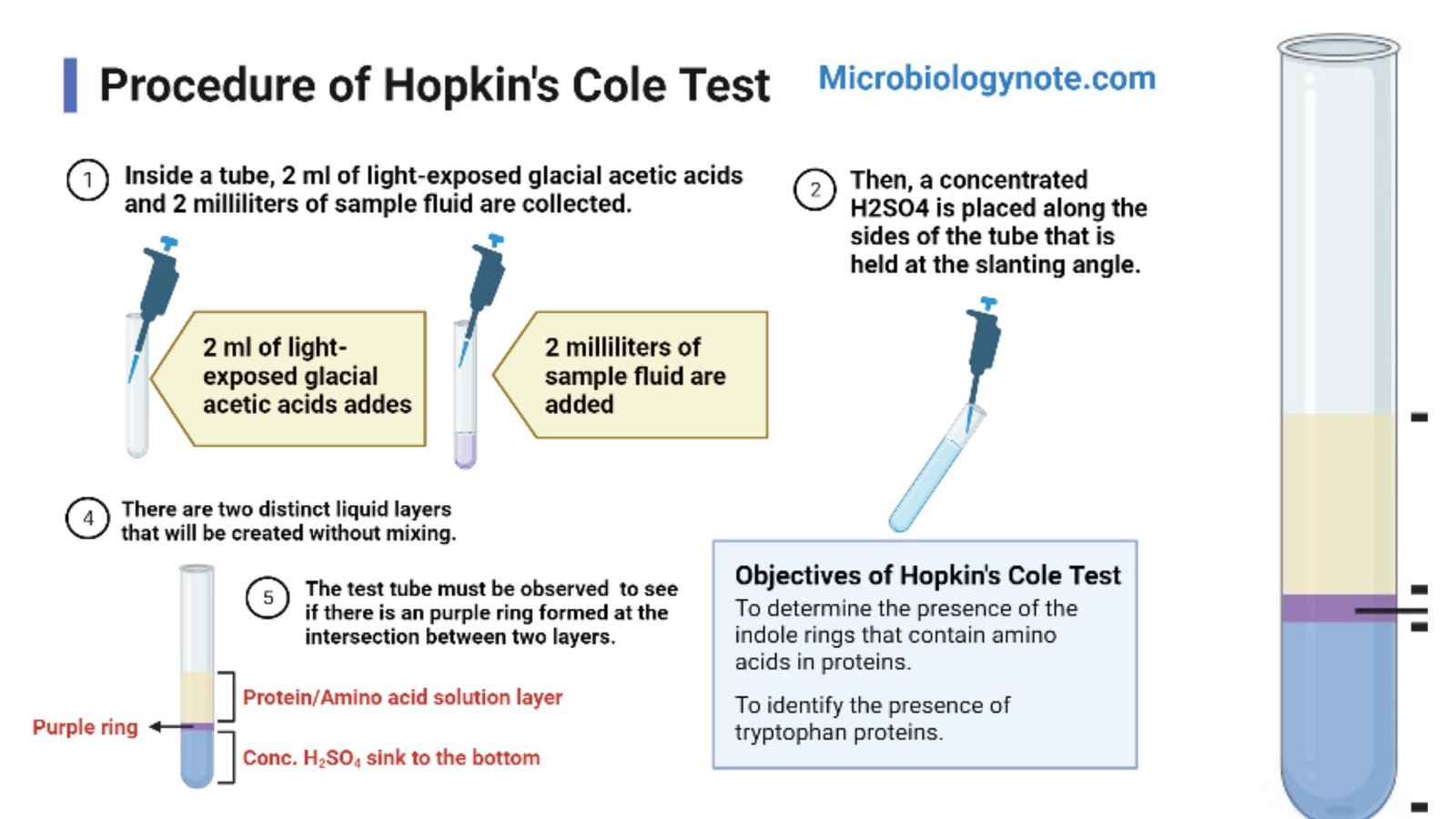
- Take 1–2 mL of protein solution in a clean test tube.
- Add equal volume of Hopkins Cole reagent and mix properly.
- Incline the test tube gently.
- Add concentrated sulphuric acid slowly along the side of test tube so that it forms a separate lower layer.
- Keep the test tube undisturbed and observe the junction of two layers.
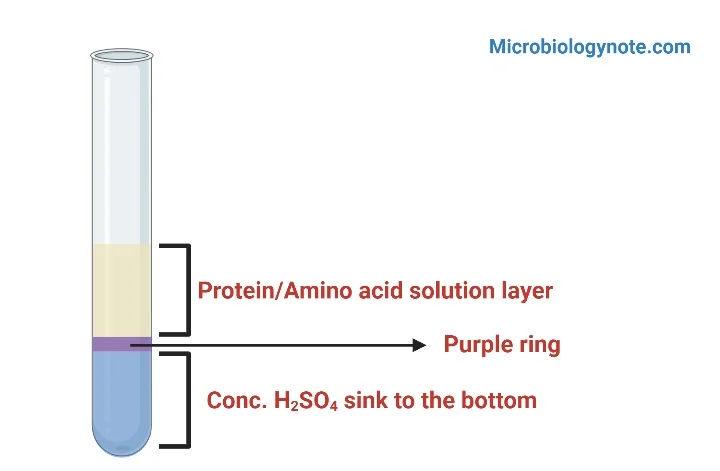
- Formation of violet or purple coloured ring at the interface indicates positive test for tryptophan.
Result and Interpretation of Hopkin’s Cole Test
Positive result
In positive Hopkin’s Cole test a violet or purple coloured ring is formed at the junction of two liquid layers. This colour is produced due to the reaction of glyoxylic acid with indole ring of tryptophan in presence of concentrated sulphuric acid. The appearance of coloured ring indicates the presence of tryptophan or tryptophan containing proteins such as casein and egg albumin.
Negative result
In negative Hopkin’s Cole test no violet or purple coloured ring is observed at the interface of acid and protein solution. This shows the absence of tryptophan in the given sample. Proteins like gelatin and zein do not give positive reaction as they lack the amino acid tryptophan.
Precautions
- Concentrated sulphuric acid should be added slowly along the side of test tube.
- Mouth of test tube should be kept away from face while adding acid.
- The test tube should not be shaken after addition of sulphuric acid.
- Proper separation of two layers should be maintained for correct observation.
- Sample and reagents should be free from nitrites nitrates and chlorates.
- Reaction mixture should be kept cool to avoid charring of protein solution.
Uses of Hopkin’s Cole Test
- It is used to detect the presence of indole ring in organic compounds.
- It is used for identification of amino acid tryptophan.
- It helps in detection of tryptophan containing proteins such as albumin and casein.
- It is used to differentiate complete proteins from incomplete proteins based on presence of tryptophan.
- It is useful in assessing nutritional quality of proteins in food samples.
Advantages of Hopkin’s Cole Test
- It is a specific test for detection of amino acid tryptophan.
- It reacts only with indole ring and does not give reaction with other amino acids.
- It helps in distinguishing complete proteins from incomplete proteins.
- The procedure is simple and easy to perform in laboratory.
- It is a rapid and cost effective qualitative test for protein analysis.
Limitations of Hopkin’s Cole Test
- Presence of nitrites nitrates chlorates and excess chlorides interferes with the reaction.
- Proper formation of glyoxylic acid in Hopkins Cole reagent is essential for the test.
- The coloured complex formed is unstable and may fade on standing or warming.
- Excess heat during addition of sulphuric acid may cause charring of protein solution.
- The reaction is slow and not suitable for accurate quantitative estimation.
- Proteins lacking tryptophan such as gelatin and zein give negative result.
- Abdulwahed, M., Mamoly, L., & Bosnali, W. (2020). A simple spectrophotometric method for determination of glyoxylic acid in its synthesis mixture. International Journal of Analytical Chemistry, 2020, Article 5417549. https://doi.org/10.1155/2020/5417549
- Adamkiewicz reaction. (2024, May 15). In Wikipedia. https://en.wikipedia.org/w/index.php?title=Adamkiewicz_reaction&oldid=1326432042
- Ali, G. (n.d.). Lab biochemistry: Specific tests for proteins [Lecture notes]. Al-Mustaqbal University. https://uomus.edu.iq/img/lectures21/MUCLecture_2024_12520336.pdf
- Al-Mossawi, A. H., & Al-Garawi, Z. S. (2018). Qualitative tests of amino acids and proteins, and enzyme kinetics. Mustansiriyah University. https://cdnx.uobabylon.edu.iq/lectures/rB9gdeZkN0mT4pY6O5sA.pdf
- Al-Sharifi, N. (2021). Biochemistry Lab 6: Xanthoproteic test, Millon’s test, Hopkin-Cole’s test [Lecture notes]. Al-Rasheed University College. https://www.alrasheedcol.edu.iq/lect-download-1680
- Amino acids and proteins. (n.d.). http://14.139.61.83/BioChemicalEstimations/amino_acids_and_proteins.htm
- Delos Santos, C. J. (n.d.). Hopkin’s Cole test. Scribd. https://www.scribd.com/document/538835457/Hopkin-s-Cole-Test
- Fearon, W. R. (1920). A study of some biochemical tests. No. 2: The Adamkiewicz protein reaction. The mechanism of the Hopkins-Cole test for tryptophan. A new colour test for glyoxylic acid. Biochemical Journal, 14(5), 548–564. (Accessed via Scribd: https://www.scribd.com/document/495386375/biochemj01182-0014)
- Hopkins–Cole reaction. (2024, May 22). In Wikipedia. https://en.wikipedia.org/w/index.php?title=Hopkins–Cole_reaction&oldid=1214752256
- King Saud University. (n.d.). Color tests for proteins and amino acids (Test for specific amino acids): Experiment 2 [Lab manual]. https://faculty.ksu.edu.sa/sites/default/files/CLS%20281%20-%20Exp2.%20Color%20Tests%20for%20Specific%20Proteins%20and%20Amino%20Acids%20%20.pdf
- Mustansiriyah University. (2024). Color tests for proteins and amino acids [Lecture notes]. https://uomustansiriyah.edu.iq/media/lectures/3/3_2024_09_24!10_05_15_PM.pdf
- Nico. (n.d.). Experiment 7: Tests for proteins and amino acids [Biochemistry laboratory worksheet]. Scribd. https://www.scribd.com/document/674942750/Experiment-7-Tests-for-Proteins-and-Amino-Acids-Biochem-Lab
- Pablico, J. L. (n.d.). Biochem 2a. Scribd. https://www.scribd.com/document/431027078/Biochem-2a
- Qualitative and quantitative tests for amino acids and proteins. (n.d.). Biology Discussion. https://www.biologydiscussion.com/proteins/qualitative-and-quantitative-tests-for-amino-acids-and-proteins/13065
- Sapkota, A. (2022, May 23). Hopkin’s Cole test- Definition, principle, procedure, result, uses. Microbe Notes. https://microbenotes.com/hopkins-cole-test/
- Subroto, E., Lembong, E., Filianty, F., Indiarto, R., Primalia, G., Putri, M. S. K. Z., Theodora, H. C., & Junar, S. (2020). The analysis techniques of amino acid and protein in food and agricultural products. International Journal of Scientific & Technology Research, 9(10), 29–36. https://www.ijstr.org/final-print/oct2020/The-Analysis-Techniques-Of-Amino-Acid-And-Protein-In-Food-And-Agricultural-Products.pdf
- University of Basrah. (n.d.). Specific tests for proteins [Lecture notes]. http://faculty.uobasrah.edu.iq/uploads/teaching/1614717860.pdf