UV-Vis spectroscopy (Ultraviolet-visible spectroscopy) is an analytical technique used to measure the amount of ultraviolet and visible light absorbed or transmitted by a chemical sample. It measures light in UV and visible region. The reading is taken as absorbance or transmittance.
This technique relies on interaction between electromagnetic radiation and matter. When molecules are exposed to UV (190–400 nm) and visible (400–800 nm) region, photon energy is absorbed. The outer valence electrons absorbs the photon energy. The electrons are promoted from lower energy ground state to higher energy excited state.
Different molecular structures absorb at different wavelength. The functional groups responsible for absorption are called chromophores. These chromophores absorb light at specific wavelength. Because of this, peaks are obtained in the absorption spectrum. The spectrum is used to identify structural features and chemical composition of an unknown substance.
UV-Vis spectroscopy is also used for quantitative analysis by Beer-Lambert Law. It states that amount of light absorbed by a solution is directly proportional to concentration of absorbing molecules in it. So absorbance is measured. Then concentration is calculated from it.
What is the main purpose of UV Vis spectroscopy?
Here are some of the key objectives and applications of UV spectroscopy:
- It is used for quantitative analysis to determine concentration of absorbing species in a solution by Beer-Lambert law.
- It is used for qualitative analysis to identify unknown compound by comparing the absorption spectrum with reference spectrum.
- It is used for structural study of compounds. It helps in identification of functional groups. It helps in checking unsaturation and conjugation. It is used to detect impurities.
- It is used in biochemistry and molecular biology to quantify nucleic acids (DNA, RNA) and proteins. It is also used to check purity of these samples.
- It is used in enzyme kinetics to follow the progress of enzymatic and chemical reactions with time. It is used to determine reaction rate and kinetic parameters.
- It is used in biomolecular studies to study protein structure and ligand-receptor interaction. It is used to study effect of pH and temperature on stability and folding of biomolecules.
- It is used to study chemical equilibria. It is used to determine pKa and study composition of complex ions.
- It is used in pharmaceutical quality control for drug identity testing. It is used to quantify active ingredient. It is used for dissolution profile and stability testing.
- It is used in environmental monitoring to assess water quality. It is used for measuring COD, turbidity and pollutants like nitrates, nitrites and heavy metals. It is also used for air quality and soil contaminants monitoring.
- It is used in food and beverage testing for quality and safety. It is used to estimate vitamins, caffeine and sugars. It is used for colour and chemical composition checking in wines. It is used to assess oxidation of edible oils.
- It is used in clinical diagnostics to measure glucose, cholesterol, uric acid, haemoglobin and bilirubin in patient samples.
- It is used in material science for characterization of nanoparticles (gold, silver). It is used to monitor polymer degradation. It is used to study catalytic reactions.
Which solvent is used in UV spectroscopy?
The solvent used in UV-Vis spectroscopy should be transparent (non-absorbing) at the wavelength being measured. For visible region, almost any colourless solvent can be used.
For UV region, common solvents are-
- Water. It is used for water soluble compounds. It is transparent up to about 180 nm.
- Ethanol (95%). It is used for organic soluble compounds. It is transparent up to about 220 nm.
- Hexane. It is a saturated hydrocarbon. It is transparent up to about 200 nm.
- Cyclohexane. It is transparent up to about 200 nm.
- Diethyl ether. It is transparent up to about 210 nm.
- Carbon tetrachloride. It is transparent up to about 260 nm.
- 1,4-Dioxane. It is transparent up to about 320 nm.
- Acetone. It is transparent up to about 330 nm.
- Acetonitrile. It is an aprotic solvent. It is used alone or mixed with water for drug compounds having low water solubility.
Other saturated hydrocarbons can also be used. These are generally transparent in near UV region because only sigma bonds are present.
UV Visible Spectroscopy Principle
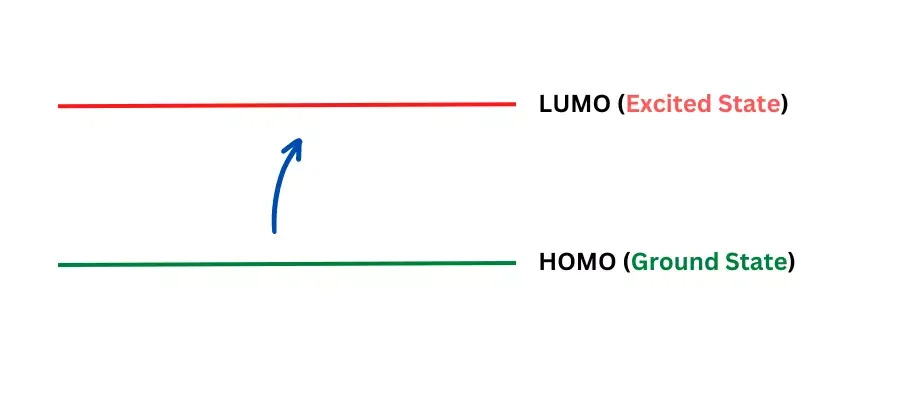
UV-Visible spectroscopy principle is based on the interaction between electromagnetic radiation (UV and visible light) and the chemical sample. When UV or visible light is allowed to pass through the sample, some part of the light is absorbed. The absorbed energy is taken up by the molecule.
In this, the outer valence electrons absorbs the photon energy. The electrons becomes excited. They are promoted from a lower energy ground state to a higher energy excited state. This is an electronic transition.
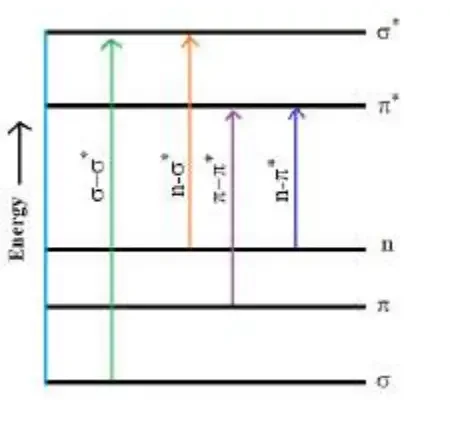
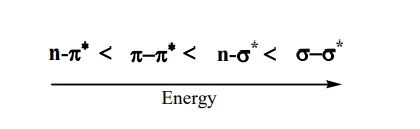
For this transition to occur, the energy of absorbed light must match the energy difference between ground state and excited state. Different chemical bonds and functional groups have different electronic structure. So they need different amount of energy. Because of this, they absorb specific wavelength.
A characteristic absorption spectrum is produced. Peaks are obtained at specific wavelength. This spectrum is used to identify the structural features of the molecule.
This principle is also used for quantitative measurement. It is based on Beer-Lambert law. The amount of light absorbed is directly proportional to concentration of absorbing molecules and the path length. The intensity of light entering and transmitted is compared. The difference is measured as absorbance and concentration is calculated.
Types of UV-Visible spectroscopy
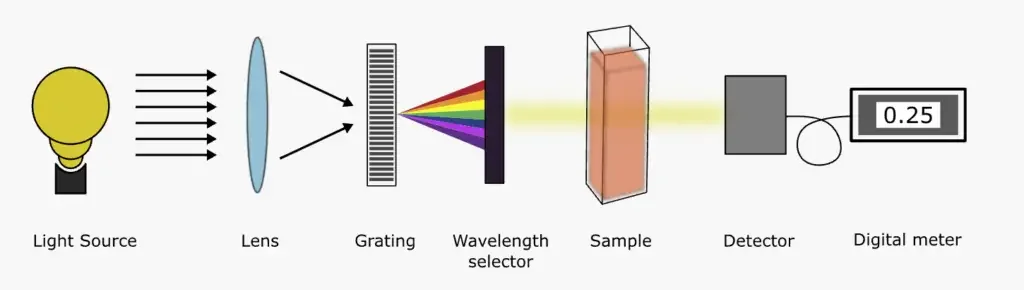
- Single-beam spectrophotometer. It is a simple and economical design. All light from the source passes in a single optical path through the sample to the detector. Blank (reference) is measured first and then the sample is measured.
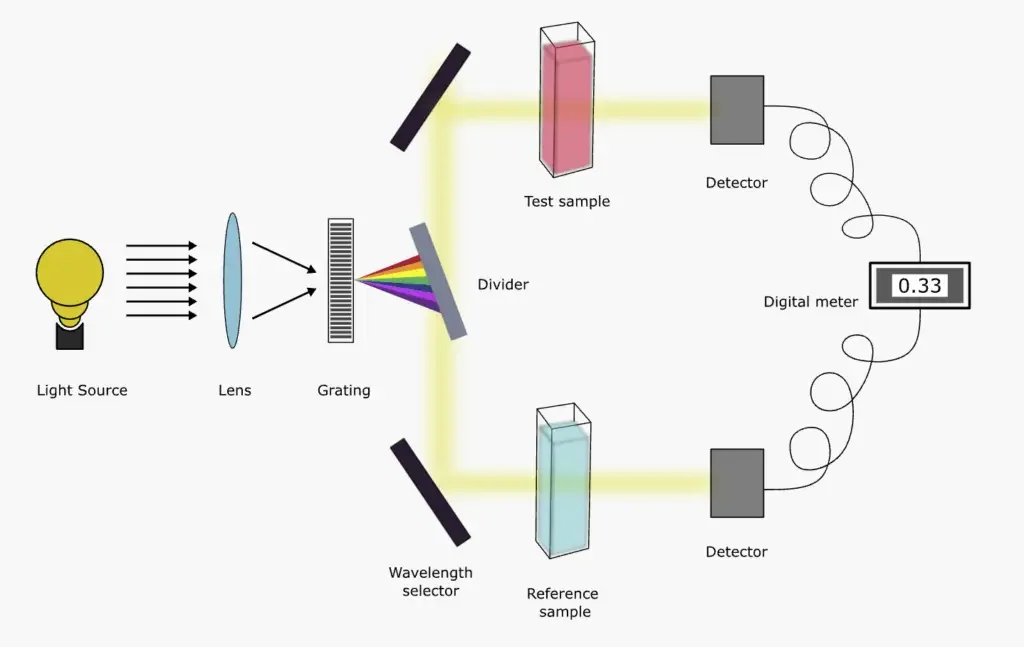
- Double-beam spectrophotometer. The light beam from the monochromator is split into two paths. One beam passes through the sample and other beam passes through the reference at the same time. It compensates lamp intensity fluctuation and signal drift automatically.
- Dual-beam spectrophotometer. It uses dual-beam optical layout with separate sample and reference detectors. The reference detector corrects lamp brightness fluctuations. Layout is simplified and chance of user error is less.
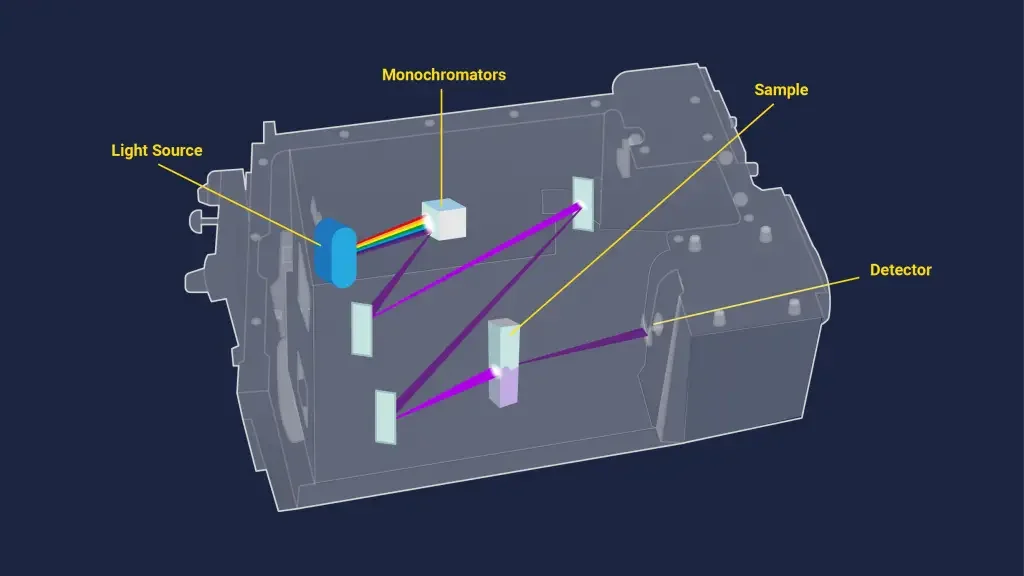
- Single monochromator spectrophotometer. It uses a single monochromator to isolate wavelength of light. It is used for general purpose UV-Vis work. It is compact type.
- Double monochromator spectrophotometer. Two monochromators are arranged in series. Stray light is reduced. Spectral accuracy is increased.
- Derivative spectrophotometry. Spectrum is obtained by plotting derivative of absorbance with respect to wavelength (first or higher order). It is used to enhance spectral details and separate overlapping peaks.
- Dual-wavelength spectrophotometry. Measurement is done at two wavelengths (scanned with offset or taken simultaneously). It is useful when analyte is present with spectral interference.
Instrumentation of UV-Vis Spectroscopy
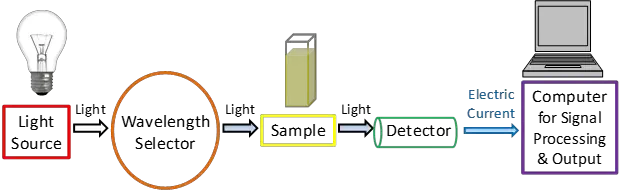
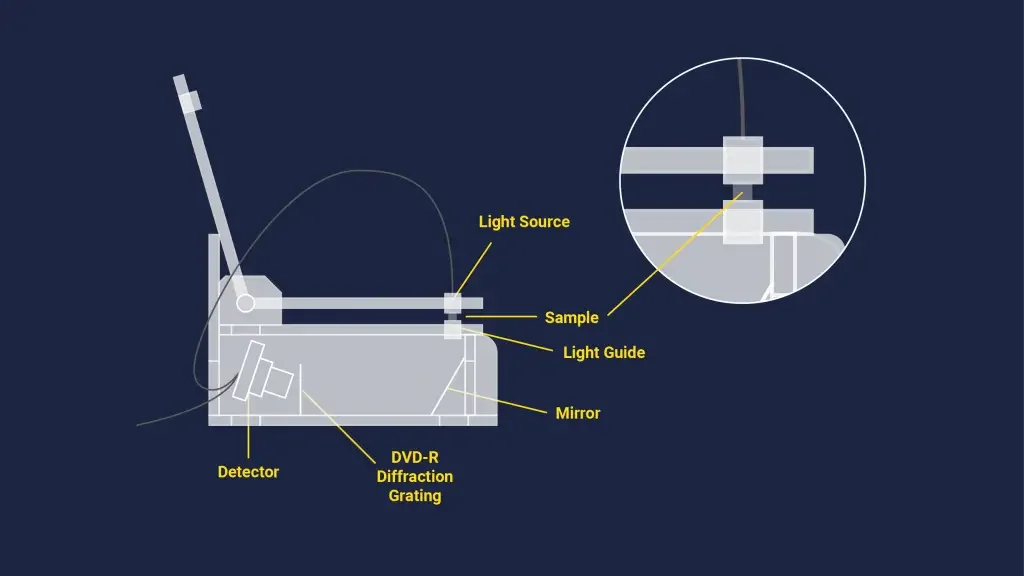
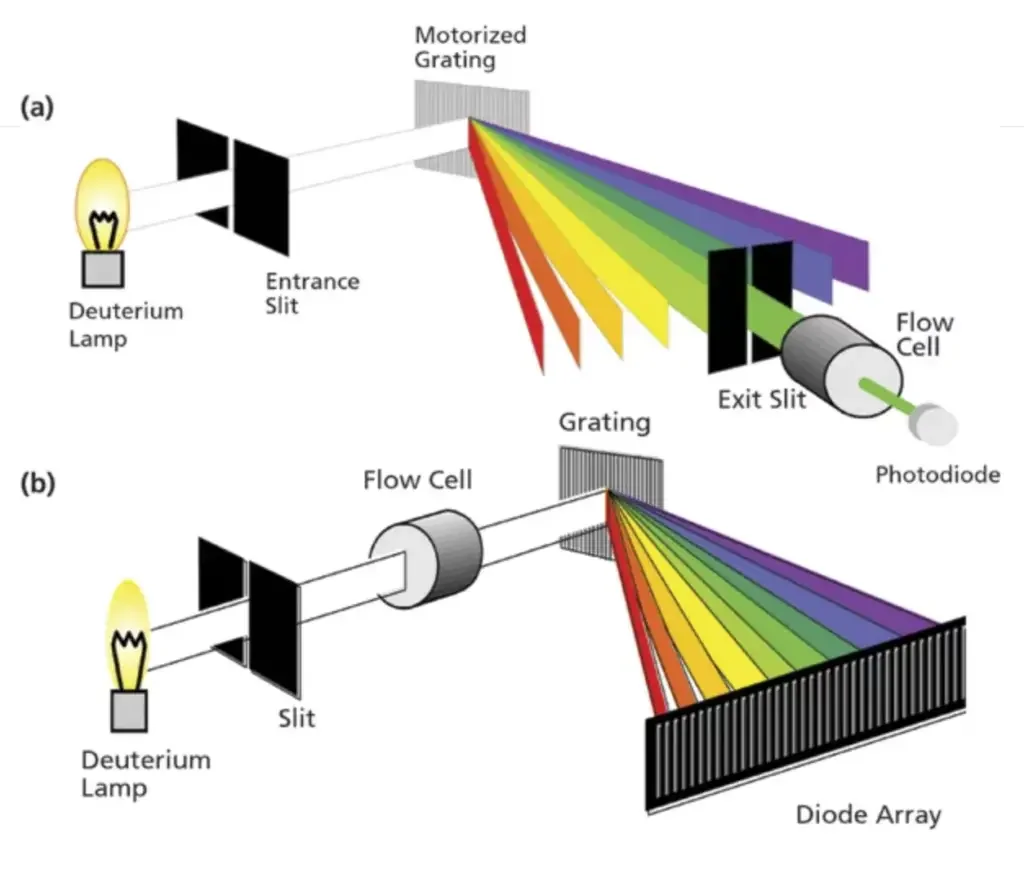
- Radiation source (Light source). It provides continuous electromagnetic radiation in UV and visible region. Deuterium or hydrogen arc lamp is used for UV region. Tungsten or tungsten-halogen lamp is used for visible region. Xenon flash lamp can be used for both UV and visible region.
- Wavelength selector (Monochromator or filter). It is used to isolate a narrow band of wavelength from the polychromatic light. Monochromator has an entrance slit. It has a dispersing element like prism or diffraction grating. It also has an exit slit.
- Sample container (Cuvette or cell). It holds the sample in the path of light beam. It should be transparent to the wavelength used. Quartz or fused silica cuvette is required for UV region. Glass or plastic cuvette is used for visible region.
- Detector. It receives the transmitted light from the sample. It converts photon energy into an electrical signal. Common detectors are photomultiplier tube (PMT), photodiode, photodiode array (PDA) and photovoltaic cell.
- Signal processor and readout device. It receives the electrical signal from detector. The signal is amplified. It is converted into readable output or display.
Types of Detectors in UV-Visible Spectroscopy
- Photomultiplier tube (PMT). It is a highly sensitive detector. It has a photoemissive cathode which emits electrons when light strikes on it. The electrons are multiplied by a series of dynodes and an amplified current is produced. It is used for very low light intensity measurement.
- Photodiode. It is a semiconductor device (generally silicon). It produces electrical current proportional to intensity of light falling on it. It is compact and durable. It is less expensive than PMT but sensitivity is less.
- Photodiode array (PDA). It consists of a linear arrangement of many small photodiodes. It can capture an entire wavelength spectrum at the same time. It gives fast scanning in milliseconds.
- Photovoltaic cell (Barrier-layer cell). It is a simple and inexpensive detector. It generates its own voltage and no external battery is required. It has a metal base plate coated with a semiconductor (like selenium) and a thin collector layer of silver or gold. When light falls, electrons are produced and voltage difference is generated.
- Phototube (Photoemissive tube). It is an evacuated glass bulb having a light sensitive cathode and an anode. When light falls on cathode, electrons are emitted and collected by anode to produce current. It needs an external power supply to maintain voltage between electrodes.
- Charge coupled device (CCD). It works similar to photodiode array. It consists of an array of photocapacitors. It can collect light of different wavelength simultaneously across the pixels.
- Near-infrared detectors (for extended UV-Vis). When UV-Vis instrument range is extended to near infrared (NIR), special detectors are used. InGaAs photodiode is used. PbS detector is also used.
Detail step by step protocol/procedure of UV-Vis spectroscopy
- Prepare the solutions. Prepare a series of standard solutions of the analyte with known different concentrations. Prepare the unknown sample solution also.
- If absorbance is weak, color development is done. A colour forming reagent can be added. Ligand exchange can also be used to form an intensely coloured complex.
- Select proper solvent and cuvette. Solvent should be transparent at selected wavelength. Cuvette should be suitable for UV or visible region.
- Clean the cuvettes. Cuvettes should be perfectly clean. Outside surface is wiped with lens paper. Spectrograde methanol can be used for wiping and it is allowed to evaporate.
- Switch on the instrument and allow warm up. Light source should be stabilized. Wavelength is selected for measurement.
- Prepare the blank. Blank is the solvent without analyte (or reagent blank if reagent is used). Fill the cuvette with blank.
- Zero the instrument (blanking). Place the blank cuvette in the spectrophotometer. Set absorbance to zero (or set 100% transmittance). This removes solvent and cuvette absorption error.
- Measure the standard solutions. Remove blank cuvette. Place standard solution cuvette one by one. Record absorbance for each standard concentration. At least 6 standards are taken for good curve.
- Prepare calibration curve. Plot absorbance on Y-axis and concentration on X-axis. A straight line is obtained at lower concentration as per Beer-Lambert law.
- Measure the unknown sample. Place the unknown sample cuvette. Record the absorbance at same wavelength and same condition.
- Determine the concentration. Locate the absorbance of unknown on the calibration curve. Read the corresponding concentration from the graph. This gives amount of analyte in the sample.
Factors affecting UV-Vis Spectroscopy
- Concentration. Absorbance increases with concentration and path length. But at high concentration, molecules can interact with each other. Refractive index of solution can change. So deviation from Beer-Lambert law is seen.
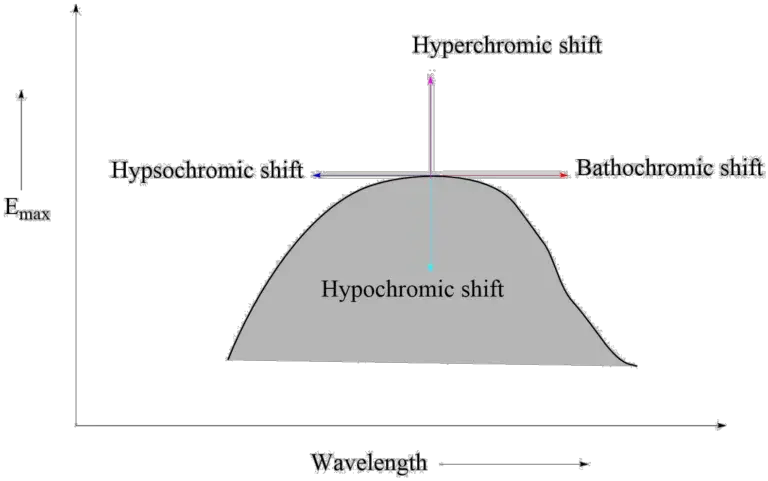
- Solvent selection and polarity. Solvent should be transparent at the wavelength measured. Solvent should dissolve the compound properly. Polarity of solvent can shift the absorption peak (solvatochromism). Polar solvent can stabilize excited state and peak may shift.
- pH of solution. Change in pH can ionize the compound. Ionization changes the electronic structure of the molecule. So absorption peak shifts.
- Temperature. Increase in temperature increases molecular motion. Absorption band becomes broad and small shift in maxima can occur. At high temperature, solvent evaporation can occur and sample becomes concentrated. Sample degradation can also occur.
- Stray light. Unwanted light can reach the detector due to scattering or leakage. It gives wrong transmittance value. Absorbance reading becomes low and linearity is affected.
- Slit width and scan speed. Slit width controls spectral bandwidth. If slit is wide, non-monochromatic light is used and resolution is reduced. Molar absorptivity value is averaged. Scan speed can also affect measurement accuracy.
- Chemical interference and equilibria. High electrolyte concentration or interfering substances can affect effective concentration of absorbing species. Complex formation can occur. So spectrum and absorbance changes.
Types of Cuvette and Compatible Wavelengths for UV-Vis spectroscopy
- Quartz / Fused silica cuvette. It is transparent in UV and visible region. It is required for UV region measurement. Usable wavelength range is about 170 nm to 2700 nm.
- Infrasil quartz cuvette. It is a special quartz cuvette for near infrared (NIR) work. It is compatible for about 220 nm to 3800 nm.
- Optical glass (Silicate glass) cuvette. Glass absorbs radiation below about 340–350 nm. So it cannot be used in UV region. It is used for visible and near infrared region. Usable range is about 334 nm to 2500 nm.
- Plastic (Disposable) cuvette. It is used mainly for visible light measurement. It is made of polystyrene or PMMA. Polystyrene cuvette is used for about 340 nm to 800 nm. PMMA cuvette can be used up to about 300 nm (slightly into UV). UV-transparent polymers are also used for some assays.
Advantages of UV-Vis spectroscopy
- Wide applicability and versatility. It is used for many types of organic and inorganic compounds. It is used in molecular biology, pharmaceutical work and environmental testing. Different parameters can be measured for analysis.
- High sensitivity and accuracy. It can detect very low concentration. Detection limit is about 10⁻⁴ to 10⁻⁵ M. Quantitative accuracy is high and relative uncertainty is about 1% to 3%.
- Speed and ease of use. Data acquisition is simple and convenient. Result is obtained fast and it can be monitored in real time. It is useful for continuous monitoring and kinetic studies. Sample preparation is usually simple and no extra reagents are required.
- Non-destructive testing. Sample is not destroyed during measurement. Only absorption is measured and disturbance is minimum. Sample can be recovered and used for further analysis.
- Cost effectiveness. It is an economical method compared to many other analytical techniques. Single beam instruments are simple, compact and affordable.
- Moderate to high selectivity. It allows targeted detection of light absorbing species in a sample.
Limitations of UV-Vis spectroscopy (DIsadvantages)
- It cannot identify compound clearly in many cases. UV spectrum does not show fine structural details. So for unknown sample, other methods are required for confirmation.
- Concentration limit is present. Quantitative analysis depends on Beer-Lambert law. At higher concentration (generally >10⁻³ M or around 0.01 M), deviation from linearity occurs. It is due to electrostatic interaction between molecules and change in refractive index.
- Problem with solid or turbid samples. Suspended particles scatter the light instead of absorbing it. So data becomes wrong and spectral details are not clear.
- Chemical interferences are common. Absorption spectrum and molar absorptivity can change by pH change. Temperature fluctuation also affects. Association or dissociation of molecules can alter the spectrum.
- Low specificity in complex systems. It is not suitable when multiple equilibria are present. Overlapping absorbance bands of different compounds in mixture also gives error and detection accuracy reduces.
- Instrumental errors. Stray radiation can reach detector due to leakage or scattering inside instrument. Wide instrumental bandwidth can also change absorptivity and reduce accuracy.
- Equipment design limitations. Single-beam instrument is affected by lamp intensity fluctuation and signal drift. Blank reading has to be taken again and again. Double-beam instrument corrects this, but it is complex, bigger in size and more expensive.
Applications of UV-Vis spectroscopy
- Quantitative and qualitative analysis. It is used to identify unknown chemical species. It is used to determine concentration of absorbing species in solutions. It is used for multi-component analysis of mixtures even when spectra overlap.
- Structural elucidation. It helps in identification of functional groups (chromophores). It is used to differentiate conjugated dienes. It is used to predict absorption wavelength of conjugated systems by empirical rules like Woodward-Fieser rules.
- Biochemistry and molecular biology. It is used to quantify nucleic acids (DNA and RNA) and proteins. It is used to check purity of sample. It is used to study protein structure. It is used to monitor melting temperature of proteins and nucleic acids.
- Enzyme kinetics. It is used to monitor progress of enzymatic reactions with time. Reaction rate is determined. Kinetic mechanism is studied.
- Chemical equilibria and complex ions. It is used to determine acid dissociation constant (pKa). It is used to study composition and formation constant of complex ions. Instability constant can also be determined.
- Spectrophotometric titrations. It is used to determine end point of titration by measuring change in absorbance continuously.
- Pharmaceutical analysis. It is used for drug identity testing. It is used to quantify API content. It is used to monitor dissolution rate. Stability and degradation studies are done.
- Environmental monitoring. It is used for water quality assessment. It is used to measure BOD, COD, TOC, turbidity, nitrates and nitrites. It is also used for air quality monitoring and soil or sediment contaminant analysis.
- Food and beverage testing. It is used to quantify vitamins, caffeine, sugars and preservatives. It is used to analyze colour and composition of wines. It is used to check oxidation of edible oils.
- Clinical diagnostics. It is used in routine clinical chemistry testing. It is used to measure glucose, cholesterol, uric acid, bilirubin and haemoglobin in patient samples.
- Material science. It is used to characterize nanoparticles (gold, silver, quantum dots). It is used to monitor polymer degradation. It is used to track oxidation state in catalysis studies.
- Color measurement. It is used to define colour coordinates (lightness, chroma, hue) of solids. It is used to monitor colour changes in solutions during colour based assays.
References
- ABB. (n.d.). Using UV/VIS spectrophotometry for real-time BOD, COD, and TOC monitoring.
- Agilent Technologies, Inc. (2025). The basics of UV-Vis spectrophotometry.
- Agiomavriti, A.-A., Bartzanas, T., Chorianopoulos, N., & Gelasakis, A. I. (2025). Spectroscopy-based methods for water quality assessment: A comprehensive review and potential applications in livestock farming. Water, 17(16), 2488.
- Algar, R. (n.d.). UV-Visible spectrophotometers. In Short stories in instrumental analytical chemistry. Pressbooks.
- Analytical principles and technological advancements in ultraviolet-visible spectroscopy. (n.d.).
- Ashenhurst, J. (2025, September 24). What is UV-Vis spectroscopy? And how does it apply to conjugation? Master Organic Chemistry.
- Berhampore Girls’ College. (n.d.). 1. Introduction 2. Principle 3. Beer – Lambert’s law 4. Instrumentation 5. Single beam spectrophotometer 6. Do.
- Canbay, H. S. (2022). Spectrophotometric determination of acid dissociation constants of some arylpropionic acids and arylacetic acids in acetonitrile-water binary mixtures at 25ºC. Brazilian Journal of Pharmaceutical Sciences.
- Delloyd. (n.d.). Ultraviolet-visible spectroscopy instrument. Delloyd’s Lab-Tech Chemistry Resource.
- Drawell. (n.d.). The difference between single and double beam UV-visible spectrophotometers.
- Edinburgh Instruments. (2021, July 8). Beer-Lambert law | Transmittance & absorbance.
- Factors affecting UV visible spectroscopy | PPTX. (n.d.).
- Haffner, H. (2024, January 5). Measurement of enzyme kinetics by UV-visible spectroscopy and advanced calculations. JASCO.
- Hitachi High-Tech Corporation. (n.d.). 8. Structure of a spectrophotometer (3).
- Imran, M. (n.d.). Factors influencing UV-visible spectra. Scribd.
- JASCO Corporation. (n.d.). Application note: Measurement of enzyme activity – ALP activity (UV-0002).
- JASCO Inc. (n.d.). Measurement of enzyme kinetics by UV-visible….
- Khan, S. (n.d.). Spectrophotometry and the Beer–Lambert law [Video]. Khan Academy.
- Labcompare.com. (n.d.). Tech compare: Single vs. double beam spectrophotometers.
- Mettler Toledo. (n.d.). UV/Vis water testing | Your guide to accurate water quality analysis.
- Mohiuddin, K. (n.d.). Factors influencing UV absorption peaks. Scribd.
- NanoQAM. (n.d.). Applications of ultraviolet-visible molecular absorption spectrometry (Chapter 14).
- PatSnap Synapse. (n.d.). What is enzyme kinetics? Understanding Km and Vmax in biochemical reactions.
- PatSnap Synapse. (n.d.). What is UV-Vis spectrophotometry used for in biochemistry?.
- PMC. (n.d.). Rapid determination of ionization constants (pKa) by UV spectroscopy using 96-well microtiter plates.
- PMC. (n.d.). Wastewater quality estimation through spectrophotometry-based statistical models.
- Real Tech Water. (n.d.). Using UV/Vis spectrophotometry for real-time….
- ResearchGate. (n.d.). Application of UV-visible spectroscopy in the quantitative determination and characterization of organic compounds.
- ResearchGate. (n.d.). Solvent, substituents and pH effects towards the spectral shifts of some highly colored indicators.
- Reusch, W. (2023, January 22). Empirical rules for absorption wavelengths of conjugated systems. Chemistry LibreTexts.
- Scribd. (n.d.). UV-Vis spectrophotometer components.
- Slideshare. (n.d.). BEER-LAMBERT’S LAW (2).pptx.
- Slideshare. (n.d.). Factors affecting UV visible spectroscopy | PPTX.
- Sper Scientific. (2025, July 10). What’s the difference between single and dual beam spectrophotometers?.
- Spectroscopy applications: Real-world uses of UV-Vis analysis … (n.d.).
- Thermo Fisher Scientific. (n.d.). Monitoring enzyme kinetics using UV-visible absorption spectroscopy – Michaelis-Menten analysis.
- Torontech Team. (2025, March 12). Spectrophotometer: Single beam vs double beam explained. Torontech.
- U.V. visible spectroscopy. (n.d.).
- Unchained Labs. (n.d.). UV/Vis spectroscopy for DNA & protein analysis.
- University of Toronto Scarborough. (n.d.). UV spectrophotometer.
- Ultraviolet visible spectroscopy – Principle, applications. (2026). Learning Chemistry.
- UV-Vis absorption spectroscopy – Theory. (n.d.).
- UV-Vis lesson 3 – Woodward-Fieser rules. (n.d.). kdsfun.weebly.com.
- Wikipedia. (2023, August 24). Molecular electronic transition.
- Wikipedia. (2025, November 7). Woodward’s rules.
- Wikipedia. (2026, March 17). Beer–Lambert law.
- WOODWARD-FIESER RULES FOR CALCULATION OF – max FOR π-π (TRANSITION) ABSORPTION BAND OF – a, B-UNSATURATED CARBONYL COMPOUNDS*. (n.d.). Googleapis.com.
- Wu, E. (2025, July 30). Single vs double beam spectrophotometers: Key differences. AELAB.