

The 4-Methylumbelliferyl-β-D-Glucuronide (MUG) test is a rapid diagnostic method used in microbiology for the detection of Escherichia coli in water food and environmental samples. It is based on the detection of β-glucuronidase enzyme activity which is produced by majority of E. coli strains. It is the process in which a specific fluorogenic substrate is utilised to indicate presence of the organism during growth. This test is commonly incorporated in routine water quality analysis and food microbiology laboratories.
In this test MUG acts as a substrate for the enzyme β-glucuronidase. When the enzyme is present it hydrolyses the MUG molecule and releases 4-methylumbelliferone along with glucuronic acid. This reaction is as follows– cleavage of MUG by β-glucuronidase enzyme resulting in formation of a fluorescent compound. The released 4-methylumbelliferone is responsible for the detectable signal and the reaction occurs during incubation of the culture medium.
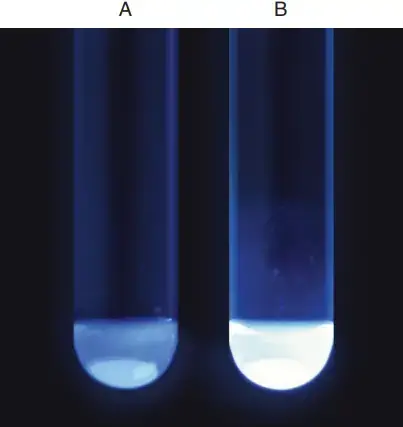
The result of the MUG test is observed by exposing the inoculated medium to long-wave ultraviolet light usually at 365 nm. Under UV light the liberated 4-methylumbelliferone emits a distinct blue fluorescence which indicates a positive result. The fluorescence is pH dependent and is more intense under alkaline conditions though it can also be seen in normal culture media. This allows confirmation of E. coli presence within 24 hours without additional complex procedures.
The MUG test is highly specific for most strains of E. coli but some limitations are present. Certain pathogenic strains such as E. coli O157:H7 do not produce β-glucuronidase and hence remain MUG negative. In few cases some other enteric bacteria may also show positive fluorescence therefore confirmatory tests are required. Despite these limitations the MUG test is considered a reliable rapid screening method for identification of E. coli in microbiological analysis.
Objectives of 4-Methylumbelliferyl-β-D-Glucuronide (MUG) Test
The objectives of 4-Methylumbelliferyl-β-D-Glucuronide (MUG) test are as follows–
- To detect the presence of Escherichia coli in water food environmental and clinical samples.
- To identify the activity of β-glucuronidase enzyme which is produced by majority of E. coli strains.
- To differentiate E. coli from other coliform bacteria which may grow in the medium but do not produce fluorescence.
- To help in screening and differentiation of pathogenic strains such as E. coli O157:H7 which is MUG negative.
- To assess water quality by indicating faecal contamination in drinking water recreational water and wastewater samples.
- To analyse food safety by confirming hygienic conditions of food products such as shellfish juices and processed foods.
- To provide rapid confirmation of E. coli usually within 24 hours without using lengthy biochemical tests.
Principle of 4-Methylumbelliferyl-β-D-Glucuronide (MUG) Test
The principle of 4-Methylumbelliferyl-β-D-Glucuronide (MUG) test is based on the detection of β-D-glucuronidase enzyme activity which is produced by majority of Escherichia coli strains. It is a biochemical assay in which a specific fluorogenic substrate is used to indicate the presence of the organism. Approximately 96–97% of E. coli strains possess this enzyme and are able to hydrolyse the β-glycosidic bond of the MUG substrate during growth.
In this process the colourless and non-fluorescent MUG molecule is enzymatically cleaved by β-D-glucuronidase. As a result 4-methylumbelliferone (4-MU) and glucuronic acid is released. The liberated 4-methylumbelliferone is the key indicator of the reaction and remains undetectable under normal light conditions. This reaction is referred to as a substrate hydrolysis based detection method.
When the test medium is exposed to long-wave ultraviolet light usually at 365 nm or 366 nm the released 4-methylumbelliferone emits a characteristic electric blue fluorescence. This fluorescence is pH dependent and becomes more intense in alkaline conditions (pH 10 or above). The appearance of blue fluorescence confirms a positive MUG test and indicates presence of E. coli. Certain pathogenic strains such as E. coli O157:H7 do not produce β-D-glucuronidase and therefore do not show fluorescence giving a negative result.
Requirements of 4-Methylumbelliferyl-β-D-Glucuronide (MUG) Test
The requirements of 4-Methylumbelliferyl-β-D-Glucuronide (MUG) test are as follows–
- Long-wave ultraviolet light source emitting at 365 nm or 366 nm for observation of fluorescence.
- Dark room or viewing cabinet to clearly observe blue fluorescence under UV light.
- Incubator or water bath capable of maintaining required temperature conditions such as 35°C or 44.5°C.
- Clean disposable glass test tubes preferably borosilicate type which should not show auto-fluorescence.
- Inverted Durham tubes when MPN method is used for gas collection during fermentation.
- 4-Methylumbelliferyl-β-D-Glucuronide (MUG) reagent which acts as fluorogenic substrate.
- Suitable culture medium such as Lauryl tryptose broth EC broth or nutrient agar supplemented with MUG.
- Alkaline reagent such as sodium hydroxide or ammonia fumes to enhance fluorescence if required.
- Indole reagent such as Kovacs’ reagent when MUG test is combined with indole test.
- Positive control organism such as Escherichia coli to confirm enzyme activity.
- Negative control organism which does not produce β-glucuronidase to rule out false fluorescence.
- Proper pH of medium usually near neutral though alkaline pH gives maximum fluorescence.
- Required incubation time ranging from few hours up to 24–48 hours depending on test protocol.
Procedure of 4-Methylumbelliferyl-β-D-Glucuronide (MUG) Test
The procedure of 4-Methylumbelliferyl-β-D-Glucuronide (MUG) test is carried out by the following methods–
1. Tube or Broth Method
- A loopful of culture from a presumptive positive tube showing gas production is transferred into MUG containing broth such as EC-MUG or Lauryl tryptose MUG broth.
- One positive control tube is inoculated with a known MUG-positive strain of Escherichia coli and one negative control tube is inoculated with a MUG-negative organism.
- The inoculated tubes are incubated at 35°C for 24–48 hours or at 44.5°C for 24 hours depending on the medium used.
- After incubation tubes are observed for turbidity and gas production in Durham tubes.
- The tubes are then examined in a dark room under long-wave ultraviolet light at 365 nm.
- Appearance of electric blue fluorescence indicates positive MUG test while absence of fluorescence indicates negative result.
2. Rapid Disk Method
- A MUG impregnated filter paper disk is placed in a sterile petri dish.
- One drop of sterile water is added to moisten the disk without over-saturation.
- A well isolated colony from a fresh culture plate is picked and rubbed gently on the disk surface.
- The petri dish is incubated at 35–37°C for about 2–4 hours.
- After incubation the disk is observed under long-wave UV light in a dark room.
- Development of blue fluorescence on the disk confirms a positive MUG reaction.
3. Agar Plate Method
- Agar medium containing MUG is prepared and poured into sterile petri plates.
- The sample or bacterial colony is streaked on the surface of the agar plate.
- The plates are incubated at 35°C for 18–24 hours or as per protocol.
- After incubation the plates are exposed to long-wave ultraviolet light.
- Bluish fluorescence around the colonies indicates presence of E. coli while non-fluorescent colonies are considered negative.
Results of MUG Disk Test (Direct or Tube Test)
The results of MUG disk test or tube test are interpreted as follows–
Positive Result (+)– The medium or disk shows electric blue fluorescence when observed under long-wave ultraviolet light (365 nm or 366 nm). This indicates the presence of Escherichia coli due to the activity of β-glucuronidase enzyme. In broth methods gas production may also be seen along with fluorescence though some strains may not produce gas.
Negative Result (–)– No blue fluorescence is observed under ultraviolet light. This indicates absence of E. coli or presence of organisms that do not produce β-glucuronidase enzyme. Other coliform bacteria may show growth or gas formation but remain non-fluorescent.
Important Observations– Pathogenic strain E. coli O157:H7 does not show fluorescence and remains MUG negative. Few non-coliform organisms may rarely produce fluorescence and give false positive reaction. Fluorescence becomes more intense under alkaline conditions and may be enhanced by adding alkaline reagent before observation.
Uses of MUG Test
- It is used for detection of Escherichia coli in water food and environmental samples by identifying β-glucuronidase enzyme activity.
- It is used for differentiation of E. coli from other coliform bacteria and members of Enterobacteriaceae which generally do not produce fluorescence.
- It is used as a confirmatory test for E. coli after presumptive positive results in multi-step assays such as MPN method.
- It is used in drinking water analysis for monitoring fecal contamination in treated and bottled water samples.
- It is used in recreational water testing to assess the microbiological safety of bathing beaches and freshwater bodies.
- It is used in wastewater analysis to evaluate treatment efficiency and bacterial load in effluents.
- It is used for analysis of agricultural water sources for quantification of E. coli.
- It is used in food safety testing of chilled and frozen food products for presence of E. coli.
- It is used in shellfish testing during confirmatory analysis to distinguish bacterial E. coli from endogenous shellfish enzymes.
- It is used for testing dairy products such as milk and cheese for fecal contamination.
- It is used as a presence or absence test for E. coli in citrus and fruit juices.
- It is used for screening pathogenic strains by differentiating generic E. coli (MUG positive) from E. coli O157:H7 which is MUG negative.
- It is used in clinical laboratories for rapid identification of E. coli in specimens such as urine cultures.
- It is used in molecular biology as a substrate in β-glucuronidase (uidA or gusA) reporter gene system for studying gene expression.
Advantages of MUG Test
- It is a rapid test which reduces the time required for confirmation of E. coli and results are usually obtained within 24 hours.
- It is highly sensitive and capable of detecting very low numbers of E. coli cells including injured or stressed cells.
- It is able to detect anaerogenic E. coli strains which do not produce gas and are missed in conventional fermentation tests.
- It allows simultaneous presumptive enumeration and confirmation when incorporated directly into primary culture media.
- It shows high specificity as β-glucuronidase enzyme is produced by majority of E. coli strains and is rare in other enteric bacteria.
- It gives easy interpretation of results by production of distinct blue fluorescence under long-wave UV light.
- It reduces cost and labor by eliminating multiple confirmatory biochemical tests and repeated subculturing steps.
- It is versatile and can be used in liquid broths solid agar media and rapid disk assays for different sample types.
Limitation of MUG Test
- It cannot detect E. coli O157:H7 as this pathogenic strain does not produce β-glucuronidase enzyme.
- It may give false positive results due to β-glucuronidase activity present in some strains of Salmonella Shigella and Yersinia.
- It may show interference from endogenous β-glucuronidase present in shellfish meat leading to false fluorescence.
- The fluorescence reaction is pH dependent and weak fluorescence is observed in acidic medium conditions.
- It may give misleading results due to auto-fluorescence produced by non-target bacteria such as Pseudomonas.
- It is difficult to interpret results in highly turbid opaque or colored samples such as sludge soil or manure.
- Enzyme production may be suppressed due to catabolite repression in presence of high glucose concentration causing false negative result.
- Auto-fluorescence from certain glassware materials can interfere with UV observation of results.
- Media containing dyes may interfere with fluorescence during MUG disk test interpretation.
- Stressed or injured E. coli cells may fail to grow or express enzyme efficiently leading to false negative results.
- Acharya, T. (n.d.). MUG (Beta-Glucuronidase) Test for E. coli. Microbe Online. https://microbeonline.com/mug-test-b-glucuronidase-test-for-rapid-identification-of-e-coli/
- American Society for Microbiology. (2010, August 1). Use of EC-MUG Media to Confirm Escherichia coli Contamination in Water Samples Protocol.,
- Aryal, S. (2022, August 10). MUG Test – Principle, Procedure, Uses and Interpretation. Microbiology Info.com. https://microbiologyinfo.com/mug-test/
- Becton, Dickinson and Company. (2009). Difco™ & BBL™ Manual: EC Medium with MUG.
- BenchChem. (2025). An In-depth Technical Guide to the Fluorescent Properties of 4-Methylumbelliferone and its Isotopes.
- Biokar Diagnostics. (2019). Microplate MUG/EC: Enumeration of Escherichia coli in water [Technical Data Sheet].
- Bonadonna, L., Cataldo, C., & Semproni, M. (2007). Comparison of methods and confirmation tests for the recovery Escherichia coli in water. Desalination, 213(1-3), 18–23. https://doi.org/10.1016/j.desal.2006.03.601
- Candeliere, F., Raimondi, S., Ranieri, R., Musmeci, E., Zambon, A., Amaretti, A., & Rossi, M. (2022). β-Glucuronidase Pattern Predicted From Gut Metagenomes Indicates Potentially Diversified Pharmacomicrobiomics. Frontiers in Microbiology, 13, 826994. https://doi.org/10.3389/fmicb.2022.826994
- Cayman Chemical. (n.d.). 4-Methylumbelliferyl-β-D-Glucuronide (hydrate) [Product Information].
- Evaluation of 4-Methylumbelliferyl-β-D-Glucuronide (MUG) Integration in Diagnostic Microbiology and Environmental Surveillance Standards. (n.d.).
- Feng, P. C. S., Weagant, S. D., Grant, M. A., & Burkhardt, W. (2020, December). Bacteriological Analytical Manual (BAM) Chapter 4: Enumeration of Escherichia coli and the Coliform Bacteria. U.S. Food and Drug Administration.
- HiMedia Laboratories. (2024). MUG EC O157 Agar [Technical Data].
- Massachusetts Department of Environmental Protection. (2009, October 21). Rapid Determination of E. coli in Drinking Water under the Total Coliform Rule in Massachusetts [Memorandum].
- McIntosh, F. M., Maison, N., Holtrop, G., Young, P., Stevens, V. J., Ince, J., Johnstone, A. M., Lobley, G., Flint, H. J., & Louis, P. (2012). Phylogenetic distribution of genes encoding β-glucuronidase activity in human colonic bacteria and the impact of diet on faecal glycosidase activities. Environmental Microbiology, 14(8), 1876–1887. https://doi.org/10.1111/j.1462-2920.2012.02711.x
- Monday, S. R., Whittam, T. S., & Feng, P. C. (2001). Genetic and evolutionary analysis of mutations in the gusA gene that cause the absence of beta-glucuronidase activity in Escherichia coli O157:H7. The Journal of Infectious Diseases, 184(7), 918–921. https://doi.org/10.1086/323154
- Neogen. (n.d.). EC Medium with MUG (NCM0107) [Technical Specification Sheet].
- Remel. (2020). MUG Disk [Instructions for Use]. Thermo Fisher Scientific.
- Schutz, K., Cowley, L. A., Shaaban, S., Carroll, A., McNamara, E., Gally, D. L., Godbole, G., Jenkins, C., & Dallman, T. J. (2017). Evolutionary Context of Non–Sorbitol-Fermenting Shiga Toxin–Producing Escherichia coli O55:H7. Emerging Infectious Diseases, 23(12), 1966–1973. https://doi.org/10.3201/eid2312.170628
- Sigma-Aldrich. (2003). 4-Methylumbelliferone (M1381) [Product Information Sheet].
- Sigma-Aldrich. (n.d.). 4-Methylumbelliferyl-β-D-glucuronide hydrate [Product Information].
- Teriosina, A., Barsukov, I. L., Cartmell, A., Powell, A. K., Stachulski, A. V., & Yates, E. A. (2025). Detection of β-D-glucuronidase activity in environmental samples using 4-fluorophenyl β-D-glucuronide and 19F NMR. Analytical Methods, 17, 2015-2020.
- U.S. Environmental Protection Agency. (2010, March). Method 1103.1: Escherichia coli (E. coli) in Water by Membrane Filtration Using membrane-Thermotolerant Escherichia coli Agar (mTEC) (EPA-821-R-10-002).
- U.S. Food and Drug Administration. (2017, October 17). BAM Media M77: Lauryl Tryptose MUG (LST-MUG) Broth.
- U.S. Food and Drug Administration. (2021, December 2). Equivalent Testing Methodology for Agricultural Water – Produce Safety Rule (21 CFR 112).
- WikiGenes. (n.d.). uidA – beta-D-glucuronidase.