

MRS Broth Test is a laboratory test used mainly for cultivation, enrichment and enumeration of Lactobacillus species and other lactic acid bacteria from dairy products, foods and clinical samples. It is a selective broth medium developed by de Man, Rogosa and Sharpe, having glucose (dextrose), peptones and yeast extract with Polysorbate 80 which helps in nutrient uptake and supply fatty acids. It also contains sodium acetate and ammonium citrate which inhibit many unwanted organisms like Gram negative bacteria and molds, so lactobacilli grow well.
In this test the broth is inoculated with the organism and incubated to see growth. Positive test is shown by turbidity (cloudy growth) in the broth. A Durham tube may be kept inside for gas detection, gas bubble indicates heterofermentative bacteria (like Leuconostoc) while only turbidity without gas is seen in homofermentative Lactobacillus.
Principle of MRS Broth Test
Principle of MRS Broth Test is based on using a special broth medium which supports growth of Lactobacillus and other lactic acid bacteria and at the same time it suppress many unwanted organisms. The broth contains peptone, beef extract and yeast extract, these give nutrients and vitamins. Dextrose is present as fermentable sugar and energy source.
Polysorbate 80 (Tween 80) is added which helps the cells to take nutrients and it also supplies fatty acids for growth. Magnesium sulphate and manganese sulphate are present as required salts for bacterial activity. Sodium acetate and ammonium citrate are added to inhibit other bacteria and molds. Dipotassium phosphate is added to keep the pH in control.
After inoculation and incubation, if the organism can grow in this medium then turbidity is produced in the broth. This turbidity is taken as positive growth. If Durham tube is kept inside the broth, gas is collected in it when gas is produced. Gas bubble indicates gas producing (heterofermentative) organisms like Leuconostoc, while only turbidity without gas is seen in homofermentative Lactobacillus.
Objectives of MRS Broth Test
- To cultivate Lactobacillus species from different samples like oral, fecal, dairy and food materials.
- To isolate and enumerate lactic acid bacteria mainly Lactobacillus from mixed sources.
- To determine whether the organism produce gas during glucose fermentation (by Durham tube).
- To help in differentiation of Lactobacillus (no gas in homofermentative type) from Leuconostoc species (gas producing).
Requirements for MRS Broth Test
- MRS broth medium (dehydrated powder or prepared broth).
- Components in medium mainly proteose peptone, beef extract, yeast extract and dextrose.
- Polysorbate 80 (Tween 80).
- Selective agents like sodium acetate and ammonium citrate.
- Mineral salts like magnesium sulphate and manganese sulphate.
- Distilled / deionized water for preparation of medium.
- Sterile test tubes / bottles / flasks to hold the broth.
- Durham tubes (small inverted tube) for gas detection (optional but useful).
- Fresh pure culture (18 to 24 hours) of test organism.
- Sterile inoculating loop / needle and aseptic setup (Bunsen burner / incinerator).
- Autoclave for sterilization (121°C, 15 lbs, 15 minutes).
- Incubator (35°C to 37°C for 24 to 48 hours).
MRS Broth Composition
MRS Broth composition (per 1 litre)
- Dextrose (D-glucose) 20.0 g.
- Peptone / peptic digest of animal tissue 10.0 g.
- Beef / meat extract 8.0 to 10.0 g.
- Yeast extract 4.0 to 5.0 g.
- Sodium acetate 5.0 g.
- Dipotassium phosphate / disodium phosphate 2.0 g.
- Ammonium citrate / triammonium citrate 2.0 g.
- Polysorbate 80 (Tween 80) 1.0 g (or 1 ml).
- Magnesium sulphate 0.1 to 0.2 g.
- Manganese sulphate 0.04 to 0.05 g.
- Final pH 6.2 to 6.5 (±0.2) at 25°C.
Preparation steps
- Take 1000 ml distilled / deionized water in flask.
- Add dehydrated MRS broth powder (about 51.25 g to 55.3 g per litre) and mix.
- If Tween 80 is not present in powder, add 1 ml and mix.
- Heat the medium with frequent shaking and boil till it dissolves properly.
- Dispense into test tubes / flasks as required. (Durham tube can be kept in test tube if gas test is needed).
- Autoclave at 121°C (15 lbs) for 15 minutes.
Procedure of MRS Broth Test
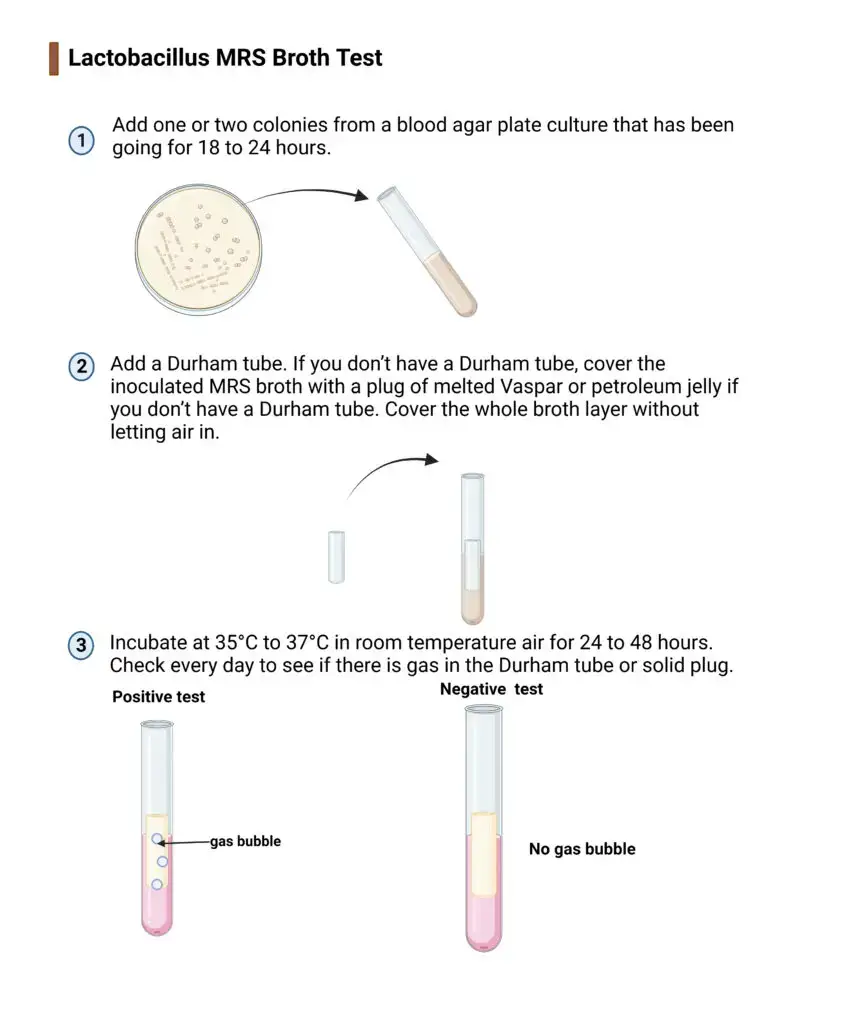
- Prepare sterile MRS broth in test tubes.
- If gas detection is needed, place a sterile Durham tube inverted in the test tube before sterilization.
- Inoculate the MRS broth with the sample directly. (or inoculate with 18 to 24 hours old culture from agar plate / broth).
- Mix gently after inoculation.
- Incubate the tubes in aerobic condition (ambient air).
- Keep temperature at 35°C to 37°C for 24 to 48 hours. It can be extended up to 3 days if needed.
- Another incubation option is 30°C up to 5 days.
- Observe the tubes for growth, marked turbidity (cloudiness) indicates growth.
- Observe Durham tube for gas bubble if kept, gas indicates gas production.
- If further identification is required, subculture from MRS broth onto suitable solid media.
Result of MRS Broth Test
Positive result (growth)
Broth becomes turbid (cloudy) throughout the tube. It indicates the organism can grow in MRS broth and it can ferment dextrose in presence of selective agents.
Positive with gas (heterofermentative)
Broth shows marked turbidity and gas bubble is seen inside Durham tube (if Durham tube is kept). It indicates gas production during glucose fermentation. It is commonly seen in Leuconostoc spp., Weisella paramesenteroides and some heterofermentative Lactobacillus like L. fermentum and L. brevis.
Positive without gas (homofermentative)
Broth shows marked turbidity but no gas bubble in Durham tube. It indicates growth without gas production. It is commonly seen in homofermentative Lactobacillus like L. acidophilus, L. casei, L. plantarum and L. gasseri.
Negative result
Broth remains clear, no turbidity is seen and no gas bubble is formed. It indicates no growth or growth is inhibited by selective agents.
List of organisms showing result in MRS Broth Test
Positive Result (Luxuriant Growth / Turbidity)
- Lactobacillus acidophilus (Growth; no gas production)
- Lactobacillus fermentum (Growth; produces gas)
- Lactobacillus plantarum (Growth; no gas production)
- Lactobacillus casei (Growth; no gas production)
- Lactobacillus delbrueckii (including subsp. lactis)
- Lactobacillus rhamnosus
- Lactobacillus johnsonii
- Leuconostoc species (Growth; produces gas)
- Weisella paramesenteroides (Growth; produces gas)
- Pediococcus species
- Bifidobacterium bifidum (Demonstrates positive growth under anaerobic conditions)
Negative Result (No Growth / Inhibited)
- Pseudomonas aeruginosa
Variable / Non-Target Growth
- Escherichia coli (Can show poor to fair/good growth depending on exact conditions, but it is considered a non-target organism demonstrating the medium’s low degree of selectivity)
Quality Control organisms of MRS Broth Test
- Lactobacillus acidophilus (e.g., ATCC 4356): Exhibits good to luxuriant growth with no gas production.
- Lactobacillus fermentum (e.g., ATCC 9338): Exhibits good to luxuriant growth with gas production.
- Lactobacillus plantarum (e.g., ATCC 8014): Exhibits good to luxuriant growth.
- Lactobacillus casei (e.g., ATCC 393 or ATCC 9595): Exhibits good to luxuriant growth.
- Lactobacillus leichmannii (e.g., ATCC 7830): Exhibits luxuriant growth.
- Lactobacillus johnsonii (e.g., ATCC 33200): Exhibits good growth.
- Lactobacillus rhamnosus (e.g., ATCC 9595): Exhibits good growth.
- Bifidobacterium bifidum (e.g., ATCC 11863): Exhibits good growth under anaerobic conditions.
- Weisella paramesenteroides (e.g., ATCC 33313): Exhibits growth with gas production.
- Escherichia coli (e.g., ATCC 25922): Exhibits fair to good growth, or sometimes poor growth depending on the specific manufacturer’s formulation.
- Pseudomonas aeruginosa (e.g., ATCC 27853): Exhibits no growth to poor growth, serving as a negative control.
Limitations of MRS Broth Test
- MRS broth is low selective medium, so other organisms also can grow, like Pediococcus, Leuconostoc and other secondary microflora.
- Positive growth in MRS broth is only presumptive, confirmatory tests are required for final identification (biochemical / molecular / serology / MS).
- Some Lactobacillus strains may grow poor or may not grow due to specific nutritional requirement of that strain.
- It is mainly for laboratory cultivation and enumeration, it is not used for direct clinical diagnosis.
- In some prepared medium, pH may not stabilize immediately, so pH reading taken immediately can go out of range, it may need recheck after 24 hours.
Advantages of MRS Broth Test
- It provides rich nutrients so Lactobacillus grows well, even slow growing and fastidious strains can be grown.
- It gives good luxuriant growth as compared to many routine media.
- It is a standardized and consistent medium, natural variable ingredients are not needed, so results are more uniform.
- It is useful for recovery, cultivation and enumeration of lactobacilli from many sources like oral, fecal, dairy, food and environmental samples.
- It helps in differentiation by gas production test using Durham tube, gas producing Leuconostoc can be separated from non gas producing Lactobacillus.
- With small modification it can be used as basal medium for other carbohydrate fermentation tests.
- It is useful as confirmatory broth for organisms first isolated on MRS agar.
Uses of MRS Broth Test
- It is used for enrichment, cultivation, isolation and enumeration of Lactobacillus species from oral, fecal, dairy and food samples.
- It is used to check gas production during glucose fermentation by keeping Durham tube, which helps in differentiation of gas producing organisms.
- It is used to differentiate organisms like Leuconostoc (gas producing) from Lactobacillus type which shows only turbidity without gas (in homofermentative type).
- It is used as follow up / confirmatory broth for organisms first isolated on MRS agar.
- With slight modification it is used as basal medium for fermentation testing.
- It is used in probiotic quality checking to see viability and resistance of probiotic strains under low pH or simulated GI condition.
- It is used in research to grow lactic acid bacteria and study antimicrobial activity of their metabolites against pathogens.
Precautions of MRS Broth Test
- MRS broth is for laboratory and R&D use only, it is not for human use or drug use. It should be handled by trained person.
- MSDS should be checked before handling for safety and hazards.
- Media and samples are treated as potentially infectious, because some components are of animal origin. Universal precautions should be followed.
- Do not ingest or inhale the dehydrated powder. Avoid skin and eye contact with powder and prepared broth.
- Aseptic technique should be maintained during preparation and inoculation. Gloves, mask, goggles and safety cabinet is used when required.
- Store dehydrated powder tightly closed in dry place, protected from light. It absorbs moisture easily, so it should not be kept open.
- Do not use powder if it becomes moist, lumpy or colour is changed.
- Prepared medium is stored below 8°C and protected from direct light.
- Do not overheat the prepared medium for long time. Avoid repeated heating, remelting more than once should not be done.
- All used culture, tubes and waste should be sterilized (autoclave) before disposal.
- While checking pH, some formulation need settling time. If pH is out of range immediately, wait 24 hours and recheck.
- If MRS agar plates are used along with broth, plate surface should not be dried, drying increases acetate concentration and inhibits lactobacilli growth.
References
- AdDecent6735. (2022). Hi all! Does anyone know the difference between MRS and M17 broth? I mean what is main ingredient that directs its selectivity? [Online forum post]. Reddit.
- American Type Culture Collection (ATCC). (n.d.). Bacteriology culture guide. https://www.atcc.org
- BD Biosciences / Difco. (2001). Lactobacilli MRS agar – Manual Difco. Interlab.
- Biokar Diagnostics. (2016). MRS broth: Culture of Lactobacillus and other lactic acid bacteria (Technical Data Sheet). FUJIFILM Wako Chemicals.
- Correlation between Api 50 Ch and multiplex polymerase chain reaction for the identification of vaginal lactobacilli in isolates – PMC. (n.d.). PubMed Central (PMC).
- Coudray-Meunier, C. (2015, April 16). Which is the best culture medium for growing lactic acid bacteria except Pediococcus? [Online forum post]. ResearchGate.
- Development of a selective medium for the enumeration of lactic acid bacteria and bifidobacteria in food products – PMC. (n.d.). PubMed Central (PMC).
- Effect of superoxide dismutase and manganese on superoxide tolerance in Lactobacillus casei strain Shirota and analysis of multiple manganese transporters – PMC. (n.d.). PubMed Central (PMC).
- Evaluation of culture media for selective enumeration of bifidobacteria and lactic acid bacteria – PMC. (n.d.). PubMed Central (PMC).
- Expression of a heterologous manganese superoxide dismutase gene in intestinal lactobacilli provides protection against hydrogen peroxide toxicity – PMC. (n.d.). PubMed Central (PMC).
- Fitzpatrick, J., Ahrens, M., & Smith, S. (2001). Effect of manganese on Lactobacillus casei fermentation to produce lactic acid from whey permeate. Process Biochemistry, 36(7), 671-675. https://doi.org/10.1016/S0032-9592(00)00265-X
- Growth of the bacteriocin-producing Lactobacillus sakei strain CTC 494 in MRS broth is strongly reduced due to nutrient exhaustion – PMC. (n.d.). PubMed Central (PMC).
- Hardy Diagnostics. (1996). CRITERION lactobacilli MRS broth for Lactobacillus spp (Instructions for Use). BioTrading.
- Hardy Diagnostics. (2020). Lactobacilli MRS agar – For the identification of Lactobacillus spp. (Instructions for Use).
- Hardy Diagnostics. (2020). Lactobacilli MRS broth – For the identification of Lactobacillus spp (Instructions for Use).
- HiMedia Laboratories. (2015). Lactobacillus MRS broth (MRS broth) M369 technical data.
- Infective endocarditis by Lactobacillus species—A narrative review … (n.d.). PubMed Central (PMC).
- Ioannou, P., Ziogou, A., Giannakodimos, I., Giannakodimos, A., Baliou, S., & Samonis, G. (2024). Infective endocarditis by Lactobacillus species—A narrative review. Antibiotics, 13(1), 53. https://doi.org/10.3390/antibiotics13010053
- Isolation and identification of probiotic Lactobacillus from local dairy and evaluating their antagonistic effect on pathogens – PMC. (n.d.). PubMed Central (PMC).
- Isolation and microencapsulation of Lactobacillus spp. from corn silage for probiotic application – PMC. (n.d.). PubMed Central (PMC).
- Kavitha, P., Sindhuja, D., & Banumathi, M. (2016). Isolation and biochemical characterization of Lactobacillus species isolated from dahi. International Journal of Current Microbiology and Applied Sciences, 5(4), 1042-1049. http://dx.doi.org/10.20546/ijcmas.2016.504.119
- Lactobacillus endocarditis in a healthy patient with probiotic use – PMC – NIH. (n.d.). PubMed Central (PMC).
- Lactobacillus endocarditis: a case report in France and literature review – PMC. (n.d.). PubMed Central (PMC).
- Manganese, superoxide dismutase, and oxygen tolerance in some lactic acid bacteria. (n.d.). PubMed Central (PMC).
- Merck Millipore. (n.d.). MRS broth (Lactosebacillus broth acc. to De Man, Rogosa and Sharpe). Merck Microbiology Manual (12th ed.).
- OpenStax. (n.d.). Atmospheric requirements for microbial growth. Microbiology – Lumen Learning. Retrieved from http://cnx.org/contents/e42bd376-624b-4c0f-972f-e0c57998e765@4.2
- Pyar, H., & Peh, K. (2019). Confirmation of the identity of Lactobacillus species using carbohydrate fermentation test (API 50 CHL) identification system. Journal of Applied Sciences, 19(8), 797-802. https://doi.org/10.3923/jas.2019.797.802
- Remel. (2010). MRS broth (Instructions for Use).
- Sigma-Aldrich. (2013). 69964 MRS agar (Lactobacillus agar acc. to De Man, Rogosa and Sharpe). Merck KGaA.
- Sigma-Aldrich. (2013). 69966 MRS broth (Lactobacillus broth acc. to De Man, Rogosa and Sharpe). Merck KGaA.
- Some probiotic properties of Lactobacillus species isolated from honey and their antimicrobial activity against foodborne pathogens – PMC. (n.d.). PubMed Central (PMC).
- Tallei, T. (2018, October 20). Can anybody suggest me selective media for lactic acid bacteria? [Online forum post]. ResearchGate.
- Technical monograph on De Man, Rogosa, and Sharpe (MRS) broth: Analytical principle, laboratory protocol, and multidisciplinary taxonomic application. (n.d.).
- Tumbarski, Y., Peykova-Shapkova, I., Ivanova, M., Cholakov, R., Dutkiewicz, A., & Grzymajło, K. (2025). Characterization and selection of Lactobacillus strains with potential probiotic applications. Applied Sciences, 15(6), 2902. https://doi.org/10.3390/app15062902