

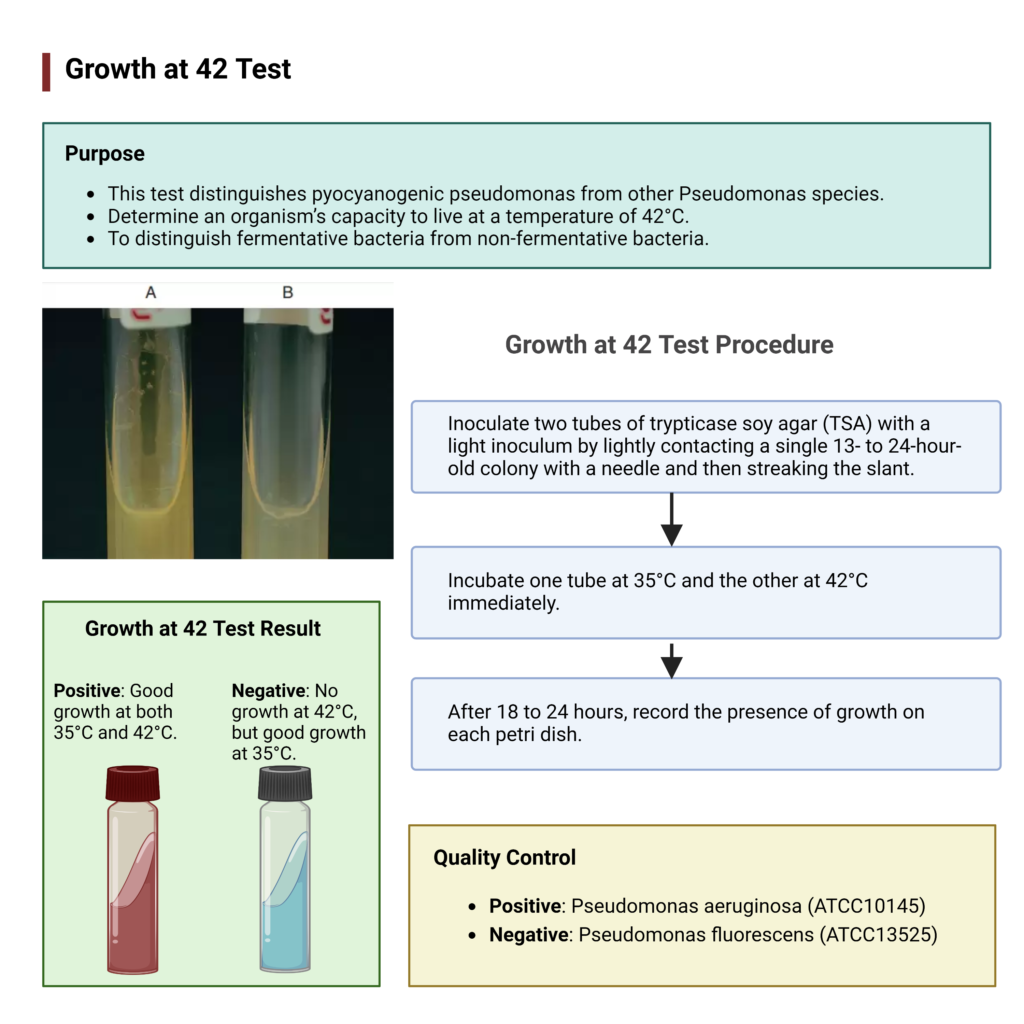
Growth at 42°C Test is a physiological laboratory test used to identify and differentiate bacteria based on their ability to grow at 42°C temperature. It is done because 42°C is higher than the normal incubation temperature (35–37°C) and many bacteria cannot tolerate this heat. Bacteria that can grow at this temperature are considered to have heat tolerance factors like heat shock proteins which helps in survival and multiplication at thermal stress.
Objectives of Growth at 42°C Test
- To differentiate Pseudomonas species, mainly to separate Pseudomonas aeruginosa from other fluorescent pseudomonads which cannot grow at 42°C.
- To differentiate other non-fermentative bacteria based on their ability or inability to grow at elevated temperature.
- To determine thermal survival of the organism, whether it can survive and multiply at 42°C.
Principle of Growth at 42°C Test
Principle of Growth at 42°C Test is based on the fact that different microorganisms have different maximum growth temperature limits. When the organism is inoculated on a suitable culture medium and incubated at 42°C, this high temperature acts as a selective condition. Only thermotolerant bacteria can maintain cell integrity and continue replication at 42°C, while temperature sensitive bacteria are inhibited.
In this test, growth at 42°C along with growth at 35–37°C indicates that the organism can tolerate and multiply at elevated temperature. Pseudomonas aeruginosa can grow at 42°C though its optimum growth is around 37°C, and many other fluorescent pseudomonads fails to grow at 42°C. The result is taken as a binary observation, either growth at both temperatures or growth only at 35–37°C, and this helps in presumptive differentiation of thermotolerant non fermenters.
Requirements for Growth at 42°C Test
- Culture media- Tryptic Soya Agar (TSA) (agar slant can be prepared) or Tryptic Soya Broth (TSB).
- Incubation equipment- two incubators or controlled water bath. One is maintained at 42°C and other is maintained at 35–37°C as control.
- Inoculation tools- sterile inoculating loop or inoculating needle for taking a light inoculum.
- Test sample- pure bacterial colony (18–24 hours old) from primary isolation plate.
- Quality control organisms- Pseudomonas aeruginosa as positive control and Pseudomonas fluorescens as negative control.
- Optional indicator- 0.005% triphenyltetrazolium chloride (TTC) in broth, it gives red formazan colour when growth occurs.
Tryptic Soya Agar (TSA) Composition and Preparation
Composition (per 1 Liter)
- Tryptone or pancreatic digest of casein- 15.0 to 17.0 g.
- Soya peptone or papaic digest of soybean meal- 3.0 to 5.0 g.
- Sodium chloride (NaCl)- 5.0 g.
- Bacteriological agar- 15.0 g.
- Dextrose (glucose)- 2.5 g (in some formulations).
- Dipotassium hydrogen phosphate- 2.5 g (in some formulations).
- Final pH- 7.3 ±0.2 at 25°C.
Preparation
- About 45 g of dehydrated TSA powder is weighed and added into 1000 ml distilled/deionized water.
- The suspension is mixed properly and heated to boiling till the medium is completely dissolved.
- The dissolved medium is dispensed into tubes (or flask) as required.
- Sterilization is done by autoclaving at 121°C (15 lbs pressure) for 15 minutes.
- After autoclaving, the tubes are removed and allowed to cool to about 40–45°C.
- For TSA slants, tubes are kept in slant position and allowed to solidify, butt depth is kept around 1.5 to 2.0 cm.
- Before inoculation, the medium is kept to reach room temperature.
Procedure of Growth at 42°C Test
- A pure colony (18–24 hours old) is selected from the isolation plate and a light inoculum is taken using a sterile inoculating loop or needle.
- Two tubes containing suitable medium (TSA slants or broth) are taken and both are labelled properly.
- The first tube is inoculated by streaking the agar surface (or inoculating the broth) with the organism.
- The second tube is inoculated in the same way with the same organism.
- One inoculated tube is incubated at 35–37°C which is kept as control to check normal viability of organism.
- The other inoculated tube is incubated at 42°C in a properly calibrated incubator.
- Both tubes are incubated for 18–24 hours.
- After incubation, both tubes are examined and the presence or absence of growth is recorded.
Result of Growth at 42°C Test
Positive result- growth is seen at both 35–37°C (control) and at 42°C. Pseudomonas aeruginosa shows this type of result (positive control).
Negative result- growth is seen at 35–37°C (control) but no growth is seen at 42°C. Pseudomonas fluorescens shows this type of result (negative control).
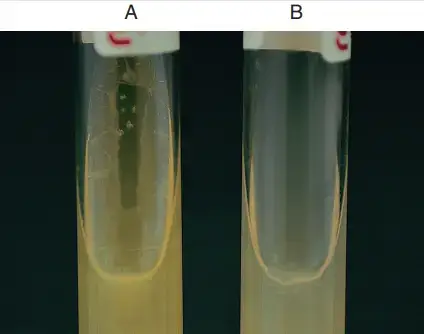
Positive Result (Growth at 42°C)
- Pseudomonas aeruginosa
- Burkholderia pseudomallei
- Achromobacter xylosoxidans
- Acinetobacter anitratus
- Alcaligenes odorans
- CDC IVc (a nonoxidative non-fermenting bacillus)
- Campylobacter jejuni subsp. jejuni
- Campylobacter coli
- Campylobacter lari
Negative Result (No Growth at 42°C)
- Pseudomonas fluorescens
- Pseudomonas putida (generally negative, though slight growth or turbidity can sometimes occur depending on the method)
- Burkholderia mallei
- Pseudomonas diminuta
- Moraxella nonliquefaciens
- Campylobacter jejuni subsp. doylei
Variable or Moderate Growth
- Pseudomonas maltophilia (variable growth)
- Acinetobacter lwoffi (moderate growth)
Quality Control strains of Growth at 42°C Test
Here are the quality control strains used for the Growth at 42°C test:
- Positive Control: Pseudomonas aeruginosa (such as the ATCC 27853 strain) is used as a positive control because it exhibits robust growth at 42°C.
- Negative Control: Pseudomonas fluorescens is used as a negative control because it grows well at standard temperatures (35–37°C) but fails to grow at 42°C.
Uses of Growth at 42°C Test
Growth at 42°C test is used in routine microbiology to check the ability of an organism to grow at elevated temperature. It helps in identification and differentiation of thermotolerant organisms.
Some of the uses include:
- Used to differentiate Pseudomonas aeruginosa from other fluorescent Pseudomonas species (e.g. Pseudomonas fluorescens), specially when pigment is not produced.
- Used to categorize non fermentative gram negative bacilli based on their growth or no growth at 42°C.
- Used to identify thermotolerant pathogens, Burkholderia pseudomallei can be separated from Burkholderia mallei by this heat tolerance.
- Used for selective isolation and detection of thermophilic Campylobacter species (C. jejuni, C. coli, C. lari) as 42°C supports their growth and inhibits competing flora.
Precautions of Growth at 42°C Test
- Temperature should be maintained strictly at 42°C. Incubator or water bath must be calibrated properly, and frequent opening of door should be avoided as small fluctuation can affect result.
- A light inoculum should be used. Culture should be pure and young (18–24 hours). Heavy inoculum can give false positive because growth mass may be mistaken.
- Media should be brought to room temperature before inoculation. Cold media can give cold shock and organism may not respond properly to heat stress.
- Proper medium should be selected. Agar slants are preferred for better specificity. Broth may show slight turbidity and can confuse the result in some non target organisms.
- Control tube at 35–37°C should be kept for checking viability of organism. Along with this, positive and negative control strains should be run (P. aeruginosa as positive and P. fluorescens as negative).
- Result should not be taken as confirmatory alone. It is taken as presumptive and should be correlated with other tests (acetamide utilization, oxidase, motility, etc.).
- If test is used for Campylobacter, then 42°C along with microaerophilic atmosphere should be maintained. Exposure to normal oxygen should be minimized.
Advantages of Growth at 42°C Test
- It is used as a key differential test to separate Pseudomonas aeruginosa from other fluorescent pseudomonads which are less virulent and usually cannot grow at 42°C.
- Growth at 42°C is a stable trait in P. aeruginosa, so it helps in identification of apyocyanogenic (non pigmented) strains which may not show pyocyanin pigment.
- For thermophiles like Campylobacter species, 42°C acts as selective pressure. It supports rapid growth of Campylobacter and inhibits competing intestinal flora (e.g. E. coli).
- It can be used as a supplementary test to confirm doubtful identifications or to resolve low confidence result from automated systems.
- It is also useful for categorizing other non fermenting gram negative bacilli on the basis of heat tolerance (e.g. Achromobacter xylosoxidans, Acinetobacter anitratus).
- It is simple and cost effective test, useful in routine labs and resource limited settings where advanced systems are not available.
Limitations of Growth at 42°C Test
- The result may not be consistent always, it depends on the strain and the method used in the laboratory.
- It is affected by methodological variables like type of medium (broth or agar), age and size of inoculum, and incubator condition.
- False positive result can occur if heavy inoculum is taken, or some other thermotolerant non fermenters grow at 42°C (e.g. some strains of P. putida).
- False negative result can occur when true P. aeruginosa fails to grow due to poor medium, antibiotic effect, or fluctuation of temperature in incubator.
- Intraspecies variation is seen, all isolates of same species may not show same growth at 42°C, so separation of close organisms becomes limited.
- It is not a single confirmatory test. It should be used with other tests (e.g. acetamide utilization test) for final identification.
- Some protocols need repeated passage at 42°C to confirm true growth, this makes it time consuming and not suitable for routine work.
References
- alwayslost999. (2023). Water bath vs incubator [Online forum post]. Reddit.
- American Society for Microbiology. (n.d.). The interplay between temperature and growth phase shapes the transcriptional landscape of Pseudomonas aeruginosa.
- Aryal, S. (2022, August 10). Growth at 42 test – Principle, procedure, uses and interpretation. Microbiology Info.com.
- Association of Public Health Laboratories. (2023). Campylobacter isolation and characterization from clinical specimens: Guidance for public health laboratories.
- Curriculum Research & Development Group. (2011). Practices of science: False positives and false negatives. In Exploring Our Fluid Earth. University of Hawai’i.
- iGene Labserve. (n.d.). What temperature should a bacteriological incubator maintain for diagnostic labs?
- Krūmiņa, A., Reinis, A., Jeske, A., Zeltiņa, I., & Vīksna, L. (2026). Molecular mechanisms underlying the pathogenicity of Pseudomonas aeruginosa. Medicina, 62(3), 462. https://doi.org/10.3390/medicina62030462
- Manning, G. (n.d.). Campylobacter detection: Rapid testing solutions for the detection of Campylobacter. Microbiology Focus Edition 2.1. Merck / Sigma-Aldrich.
- MI – Microbiology. (n.d.). Skin.
- National Center for Biotechnology Information. (n.d.). Accelerated bacterial identification with MALDI-TOF MS leads to fewer diagnostic tests and cost savings. PubMed Central.
- National Center for Biotechnology Information. (n.d.). Effect of incubation temperature on the detection of thermophilic Campylobacter species from freshwater beaches, nearby wastewater effluents, and bird fecal droppings. PubMed Central.
- National Center for Biotechnology Information. (n.d.). Growth and laboratory maintenance of Pseudomonas aeruginosa. PubMed Central.
- National Center for Biotechnology Information. (n.d.). Growth of nonfermentative bacteria at 42° C. PubMed Central.
- National Center for Biotechnology Information. (n.d.). Innovations in MALDI-TOF mass spectrometry: Bridging modern diagnostics and historical insights. PubMed Central.
- National Center for Biotechnology Information. (n.d.). MALDI-TOF MS: A reliable tool in the real life of the clinical microbiology laboratory. PubMed Central.
- Oberhofer, T. R. (1979). Growth of nonfermentative bacteria at 42°C. Journal of Clinical Microbiology, 10(6), 800-804.
- PHC Corporation. (n.d.). Water bath science: Ensuring precision in your lab work. Evolving Science For The Future.
- Physiological and clinical analysis of the growth at 42°C test in diagnostic microbiology. (n.d.).
- Rapid Test Methods Ltd. (n.d.). Campylobacter detection and identification methods. Rapidmicrobiology.
- ResearchGate. (n.d.). Mechanisms of thermoregulation in Pseudomonas aeruginosa.
- ResearchGate. (n.d.). What’s the precipitation when culture E. coli in liquid LB at 42 degree?
- Sapkota, A. (2022, January 27). Growth at 42°C test- Principle, procedure, result, uses. Microbe Notes.
- Scilogex. (n.d.). Water bath: A crucial ally in your laboratory.
- Sciortino, C. V., Jr. (2003). Method and kit for identifying Pseudomonas aeruginosa (WO Patent No. 2003106697A2). World Intellectual Property Organization.
- Taylor & Francis. (n.d.). Thermophiles. Taylor & Francis Knowledge.
- Wikipedia contributors. (2026, March 23). Burkholderia pseudomallei. In Wikipedia, The Free Encyclopedia.
- Winne, J. (2018, January 19). Our best bacterial transformation lab yet. Biology by the Math Mom.
- World Organisation for Animal Health. (2017). Infection with Campylobacter jejuni and C. coli. In Manual of diagnostic tests and vaccines for terrestrial animals (Chapter 3.10.4).