

What is the Litmus Milk Test?
Litmus milk test is a differential biochemical procedure used in microbiology to evaluate metabolic capability of different bacteria. It is done by using a liquid medium containing skim milk and litmus. Skim milk provides lactose(milk sugar) and casein(milk protein) and litmus dye acts as pH indicator and oxidation–reduction indicator.
It is the process where bacteria is inoculated into this medium and different reaction is shown depending on enzymes present. If lactose is fermented lactic acid is produced so pH is dropped and purple litmus is changed to pink or red colour. If milk proteins is broken down ammonia is released so alkaline condition is formed and litmus is changed to blue colour.
In this test some more changes are also observed. Reduction of litmus is seen when the medium becomes white and colourless. Gas production is seen by bubbles. Coagulation of casein is seen by curd formation. Peptonization is seen when proteins is completely digested and a clear watery fluid is formed.
It is used for differentiating bacterial groups in single tube by showing multiple biochemical pathways. It is used in identification of organisms like Clostridium and Enterobacteriaceae. It is also used for cultivation of lactic acid bacteria used in dairy industry.
Objectives of litmus milk test
Objectives of litmus milk test are–
- It is used to determine metabolic capability of organism by showing enzymatic action on milk substrates like lactose(milk sugar) and casein(milk protein) and the end products formed.
- It is used to differentiate specific bacteria like genus Clostridium and it is used for separating Enterobacteriaceae from other Gram negative bacilli based on litmus reduction.
- It is used to grow and maintain cultures of lactic acid bacteria and it is important in dairy industry for assessing bacterial action on milk products.
- It is used for detecting faecal contamination by screening Clostridium perfringens in water sample and it acts as indicator of remote or resistant faecal pollution.
Principle of Litmus Milk Test
Principle of litmus milk test is based on observing how different bacteria metabolize nutrients present in milk. It is mainly lactose(milk sugar) and casein(milk protein) that are utilized by organism. Litmus dye is added in medium and it acts as both pH indicator and oxidation–reduction(redox) indicator.
It is the process where microorganism is inoculated in litmus milk medium and reaction is shown according to enzymes present. If lactose is fermented lactic acid is produced and pH is lowered so purple medium is changed to pink or red colour. This acid accumulation may also precipitate casein and a hard immobile acid curd is formed.
If lactose fermentation is not done and proteins are degraded then ammonia is released and alkaline condition is produced so litmus becomes purplish-blue. Some bacteria shows strong proteolytic activity and casein is completely digested which is referred to as peptonization and the opaque milk becomes translucent watery brownish fluid.
In some organism rennin enzyme is produced and milk is coagulated into a soft semisolid rennet curd. Gas like carbon dioxide(CO2) and hydrogen(H2) may also be produced and bubbles or cracks are seen in curd. In anaerobic respiration litmus dye may be used as terminal electron acceptor and dye is reduced so medium becomes white or colourless.
Composition & Preparation of litmus milk medium
Composition of litmus milk medium(per litre) are–
- Skim milk powder – 100.0 g. It is used instead of whole milk to prevent lipids interfering with visual clarity of test.
- Litmus(Azolitmin) – 0.5 to 0.75 g. It acts as pH indicator and redox indicator.
- Sodium sulphite – 0.5 g. It is a reducing agent and it is added to support anaerobiosis.
- Distilled water – 1000 ml(1 litre).
- Final pH – about 6.8 ± 0.2 at 25°C.
Preparation procedure are–
- In this step dry ingredients are added to 1 litre distilled or demineralized water and it is mixed properly.
- The mixture is agitated continuously until powder is completely dissolved. Preheating water to 50°C helps in preventing clumping of powder.
- After dissolution the medium is dispensed into tubes in 10 ml aliquots usually in 15×150 mm test tubes.
- Tubes are sterilized by autoclaving at 121°C(15 lbs pressure) for exactly 5 minutes.
- Overheating is strictly avoided because excessive heat causes lactose(milk sugar) to caramelize.
Procedure of Litmus Milk test
Procedure of litmus milk test are–
- Pure culture of test organism is taken which is 18 to 24 hours old.
- Litmus milk medium is inoculated by aseptic technique. About four drops of broth culture is added or a well isolated colony is picked by inoculating loop and inoculated in tube.
- If anaerobic organism is tested like Clostridium then anaerobic condition is created. Dissolved oxygen is removed by pre heating the tubes or sterile reduced iron(iron powder or nails) is added or a layer of sterile mineral oil is poured over surface of medium after inoculation.
- Inoculated tubes are incubated at 35°C to 37°C in incubator in ambient air or required atmosphere.
- Tubes are observed daily for visual changes. Some reaction like acid production or initial clotting may be seen within 18 to 48 hours but observation is continued for 7 to 14 days for slow reactions like peptonization or litmus reduction.
- Results are recorded properly. Sequential changes in colour consistency and clarity of medium is noted because one reaction may mask or follow another.
Result Interpretation of Litmus Milk Test
Result interpretation of litmus milk medium test are–
- Acid reaction – Medium changes from purple to pink or red colour. It indicates lactose fermentation and lactic acid is produced.
- Alkaline reaction – Medium changes to purplish-blue colour. It is due to breakdown of milk proteins and ammonia or basic amines are released so pH is increased.
- Litmus reduction – Medium becomes white or colourless usually starting from bottom of tube. It indicates litmus dye is used as terminal electron acceptor in anaerobic metabolism.
- Acid curd – Hard immobile solid clot is formed and sometimes clear watery whey is squeezed out. It occurs due to heavy acid production and casein is precipitated.
- Rennet curd – Soft semisolid jelly like clot is formed and it flows slowly when tube is tilted. It is due to enzymatic coagulation of casein by rennin not by acid precipitation.
- Peptonization(digestion) – Opaque milk becomes clear translucent watery straw colour or brownish fluid. It shows milk proteins are completely digested by proteolytic enzymes into soluble products.
- Gas formation – Bubbles fissures or cracks are formed in curd. It indicates carbon dioxide(CO2) and hydrogen(H2) gases are produced during fermentation.
- Stormy fermentation – Massive gas production is seen and curd is shredded and broken apart. It is a characteristic reaction of Clostridium perfringens.
- Negative reaction – Medium remains opaque purple with no change in consistency. It indicates organism does not show significant reaction with milk substrates.
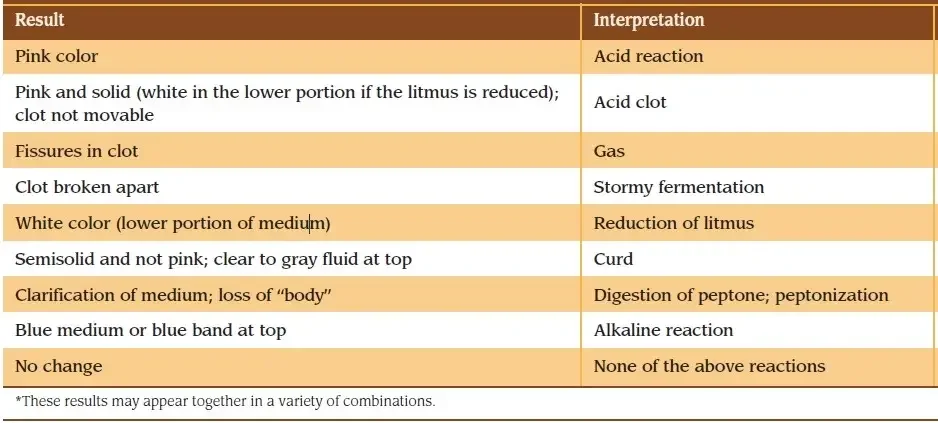
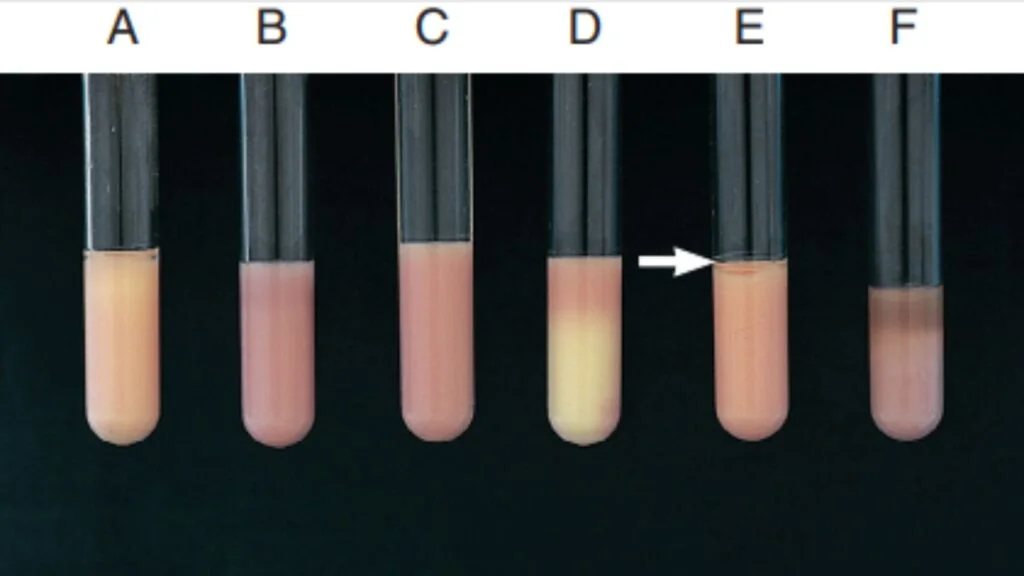
Appearance of Milk
| Consistency of Milk | Interpretation | Organism |
| Coagulation or clot | Formation of clot | |
| Semisolid and not pink; clear to gray fluid at the top | Curd (C) | |
| Pink and solid (white in the lower portion if the litmus is reduced); clot not movable | Acid clot (AC) | Lactobacillus lactis |
| Fissures in clot | Gas (G) | Clostridium acetobutylicum |
| Clot is broken apart | Stormy fermentation (S) | |
| Dissolution of the clot with transparent, grayish, watery fluid and a shrunken, insoluble pink clot. | Digestion of peptone D (acid reaction) | Clostridium sporogenes |
| Dissolution of the clot with grayish, watery fluid and a clear, shrunken, insoluble blue clot | Peptonization* P (alkaline reaction) |
*Peptonization: The conversion of a protein into peptones under the influence of the enzyme pepsin.
The appearance of Litmus Indicator
| Color | Interpretation | Organism |
| Pink or mauve color | Acid reaction (A) | Escherichia coli |
| Blue medium or blue band at top | Alkaline reaction (K) | Alcaligenes faecalis/ Pseudomonas aeruginosa |
| Purple (identical to uninoculated control) | No change (NC) | |
| White color (lower portion of medium) | Reduction of litmus (R). It is recorded as decolorized |
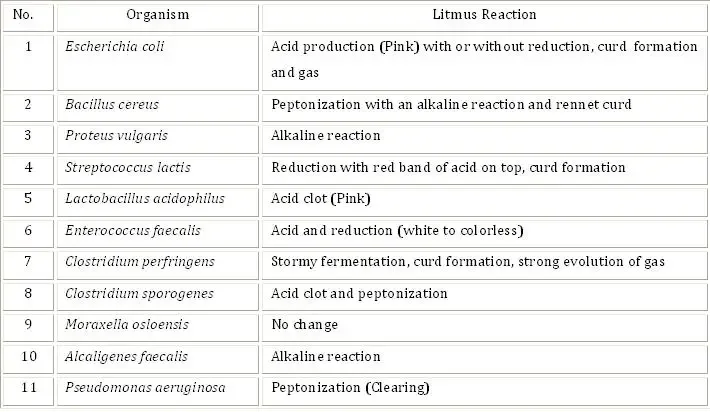
Organisms giving positive result in litmus milk medium test are–
- Clostridium perfringens – Stormy fermentation is shown with acid reaction gas and clot formation with litmus reduction.
- Lactobacillus acidophilus – Acid reaction is produced and medium becomes pink and solid acid clot is formed.
- Pseudomonas aeruginosa – Peptonization is shown with clearing of milk proteins and alkaline reaction is seen.
- Escherichia coli – Acid reaction is produced with acid curd formation and litmus reduction occurs sometimes gas is also produced.
- Enterococcus faecalis – Acid reaction is produced with acid curd and litmus reduction.
- Bacillus cereus – Peptonization is shown with or without prior coagulation.
- Clostridium sporogenes – Acid and gas is produced and proteolysis is seen.
- Clostridium innocuum – Alkaline reaction is shown without clot formation and without protein digestion.
- Proteus vulgaris – Acid reaction is produced and medium becomes red or pink.
- Corynebacterium xerosis – Alkaline reaction is shown and medium becomes purplish-blue.
Organisms giving negative result in litmus milk medium test are–
- Streptococcus bovis – No growth is seen and medium remains unchanged.
- Non reactive bacteria – Any organism which does not ferment lactose and does not attack milk proteins gives negative result so medium remains opaque purple with no change in consistency.
Quality control organisms of litmus milk medium test
Quality control organisms of litmus milk medium test are–
- Clostridium perfringens(ATCC 13124) – Stormy fermentation is shown with vigorous gas production. Acid production is seen and clot formation occurs with litmus reduction.
- Lactobacillus acidophilus(ATCC 11506 or 4356) – Acid reaction is shown and medium becomes pink. Solid acid clot is formed.
- Pseudomonas aeruginosa(ATCC 27853) – Peptonization is shown and milk becomes cleared. It shows alkaline reaction in most cases.
- Escherichia coli(ATCC 25922) – Acid reaction is produced and medium becomes pink. Acid curd is formed and litmus reduction occurs so it may turn white.
- Bacillus cereus(ATCC 10876) – Peptonization is shown with clearing of medium. Alkaline reaction is produced with or without prior coagulation.
- Enterococcus faecalis(ATCC 29212) – Acid reaction is produced with acid curd formation. Litmus indicator is reduced.
- Clostridium innocuum(ATCC 14501) – Alkaline reaction is shown without clot formation and without protein digestion.
Uses of Litmus Milk Test
Uses of litmus milk medium test are–
- It is used for differentiating specific bacterial groups mainly members of genus Clostridium from one another.
- It is used for separating Enterobacteriaceae family from other Gram negative bacilli based on ability to reduce the litmus indicator.
- It is used for identifying and differentiating Gram positive cocci mainly Enterococcus and Streptococcus and it helps in distinguishing Streptococcus bovis from Streptococcus equinus.
- It is used for cultivating and maintaining lactic acid bacteria like Lactobacilli because medium supports their growth.
- It is used in dairy industry for assessing starter cultures by evaluating vigour and acidifying power of lactic acid bacteria used in cheese and yogurt production.
- It is used for detecting faecal contamination by screening water sample for Clostridium perfringens and it acts as indicator of resistant or remote faecal pollution.
Limitations of litmus milk medium test
Limitation of litmus milk medium test are–
- It gives non specific reactions. Similar metabolic pattern may be shown by many unrelated bacteria so it is not specific for single genus or species.
- It requires further testing. It is not a definitive identification test so additional biochemical tests are needed for accurate identification of microorganism.
- Visual interpretation is subjective. Differentiation between acid curd and rennet curd or clot and curd may be difficult and it is not always recorded accurately.
- Results may be unreliable sometimes. It is a complex medium and wide diversity of outcomes are produced so interpretation becomes confusing.
- It is sensitive to preparation. Small variation in preparation like initial pH or concentration of milk solids may alter timing and intensity of reactions.
References
- Aryal, S. (2022, August 10). Litmus milk test – Principle, procedure, uses and interpretation. MicrobiologyInfo.com.,
- BenchChem Technical Support Team. (2025, December). Application notes and protocols: Litmus milk test in bacteriology. BenchChem.,
- Biochemical dynamics and diagnostic significance of the litmus milk test in clinical and industrial microbiology. (n.d.).
- Clostridium perfringens. (2026, February 6). In Wikipedia.,
- Colorimetric detection of bacteria using litmus test. (n.d.). PMC – NIH.
- Define stormy fermentation. (n.d.). Homework.Study.com.,
- Difco & BBL Manual. (n.d.). Litmus milk.
- Food microbiology – Litmus milk test. (n.d.). SlideShare.
- HiMedia Laboratories. (2015). Litmus milk (Technical Data M609).,
- HiMedia Laboratories. (2015). Litmus milk (Technical Data M609S).,
- HiMedia Laboratories. (2015). Milk medium with a reducing agent (Technical Data M816).,
- Litmus milk. (2025, July 19). In Wikipedia.,
- mikekchar. (2023). The logic of acid formed cheeses [Online forum post]. Reddit.
- Olle, D. A. (2024). Biochemical tests. Consumer Health | Research Starters, EBSCO.,
- Rabbit’s Faiy. (n.d.). Litmus milk test: Microbial reactions. Scribd.,
- Remel. (2013, April 4). Litmus milk medium (IFU 61274).,
- Sigma-Aldrich. (n.d.). 17158 Litmus milk.
- Solved: LITMUS MILK TEST OBJECTIVES Be familiar with or be able to describe. (n.d.). Chegg.com.,
- St John, W. D., Matches, J. R., & Wekell, M. M. (1982). Use of iron milk medium for enumeration of Clostridium perfringens. Journal of the Association of Official Analytical Chemists, 65(5), 1129–1133. https://doi.org/10.1093/jaoac/65.5.1129
- Suhail, D. (n.d.). Laboratory (5) Water microbiology.
- TM Media. (2019, November 8). TM 165 – Litmus milk (Litmus sm broth).,
- Virtual Labs. (n.d.). Litmus milk test. Biotechnology and Biomedical Engineering Microbiology Virtual Lab II.,