

Double Beam Balance is a mechanical weighing instrument that is used to measure the mass of an object by comparing it with known reference masses.
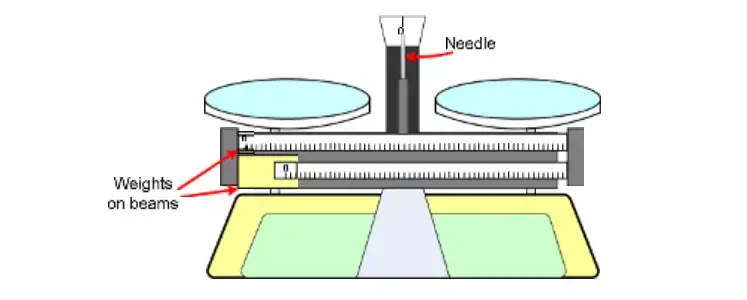
It has two parallel horizontal beams. One beam is coarse beam, which is used for larger weight measurement and another is fine beam, which is used for very small and precise measurement.
It works on the principle of torque equilibrium. It functions like a see-saw balanced on a central pivot or fulcrum.
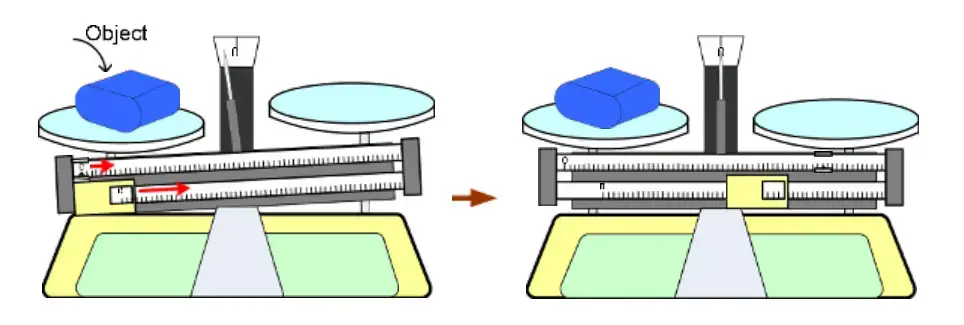
In this instrument, the object is placed on the weighing pan. The sliding weights, called riders or poises, are moved along the two beams until the pointer comes at the zero mark. At this point the balance is obtained and the mass of the object is measured.
It is a mechanical device, so it does not depend on electronic sensor or electric power. It is reliable and is used for accurate comparative weighing in educational, industrial, clinical and laboratory works.
Double Beam Balance Principle
- Double beam balance is based on the law of equilibrium and principle of moments.
- It works as a first class lever. The central pivot or fulcrum acts as the balancing point.
- When unknown mass is placed on the measuring pan, it gives downward force. Due to this force the two parallel beams become tilted from balance.
- The riders or sliding weights are moved on the graduated beams. One beam is coarse beam and another is fine beam.
- The balance is obtained when the pointer comes to zero mark. At this condition, the torque produced by the object is equal to the torque produced by the sliding weights.
- So the unknown mass is measured by comparison with known reference masses. It is a mechanical process and does not depend on electric power.
Parts of double beam balance
The following are the main parts of double beam balance-
- Base– It is the lower supporting part of the balance. It gives stability to the instrument.
- Leveling feet- These are adjustable screws present at the base. It is used to keep the balance level on uneven surface.
- Spirit level- It is a small bubble level. It shows whether the balance is in horizontal position or not.
- Central pillar- It is the vertical metallic support. It holds the bearing planes and beam arrest mechanism.
- Pans– These are the plates where the object and extra weights are placed.
- Beams or rods- These are two parallel horizontal rods. It is mounted on the central pivot.
- Coarse beam– It is used for measuring larger mass. It has markings for large mass increments like 10g or 100g.
- Fine beam- It is used for small and accurate mass measurement. It has small divisions like 0.1g or 0.01g.
- Riders or poises- These are sliding masses placed on the beams. It is moved along the notches to balance the mass.
- Knife edges and agate planes– These are the pivot points of the balance. It reduce friction and allow proper balancing.
- Pointer and scale- Pointer moves along the graduated scale. It shows the zero mark when balance is obtained.
- Zero adjustment knob- It is used to set the pointer at zero before starting measurement.
- Magnetic damping system– It is used to stop the swinging of the beam quickly. It helps in taking reading faster.
- Taring device or weight– It is used in some balances to re-zero the balance when empty container is placed on the pan.
Operating Procedure of double beam balance
The following are the operating procedure of double beam balance-
- The balance is placed on a stable and vibration free surface. The leveling feet are adjusted to keep the balance in horizontal position.
- The pans are kept empty. All riders are moved to the zero position at the left side.
- If the pointer does not come at zero mark, the zero adjustment knob is turned until the pointer comes to zero.
- If any substance is weighed in a container, the empty container is first placed on the left pan.
- The taring weight is adjusted until the pointer again comes to zero.
- The object or sample is placed carefully at the center of the left pan. It is done to avoid side loading error.
- The rider on the coarse beam is moved to the right side notch by notch.
- When the pointer falls below zero, the rider is moved back one notch.
- The rider on the fine beam is moved slowly to the right side.
- It is adjusted until the pointer comes to stable zero mark.
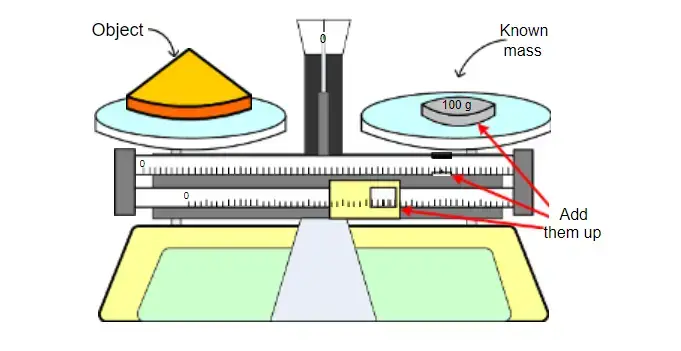
- The values shown on coarse beam and fine beam are added.
- If any standard weight is used, it is also added.
- This gives the final mass of the object.
Applications of Double beam balance
The following are the applications of double beam balance-
- It is used for comparative weighing. It helps to compare two objects and find the difference in their mass.
- It is used in science classroom for practical work. Students can understand mass, gravity, torque and equilibrium by using it.
- It is used in clinical laboratory and blood banks. It helps to balance centrifuge buckets containing blood bags.
- It is used in pharmaceutical compounding. Fine powder samples and drug ingredients are measured by using it.
- It is used in chemical laboratory work. Standard reagents, culture media and samples for analysis are prepared by this balance.
- It is used to check density and reaction yield. The mass of chemicals before and after reaction can be measured.
- It is used in metallurgy. Metal samples are weighed before melting or alloying.
- It is used in industrial quality control. Raw materials, filled products and components are checked for proper mass.
- It is used in food processing, agriculture, textile and mining industries. It helps to maintain correct weight of materials.
- It is used in environmental testing. Soil samples, solid test materials and particulates are weighed by this balance.
- It is used in remote field stations. It can work without electricity and so it is useful where power supply is not stable.
- It is used in places where electronic instruments may be disturbed by electromagnetic interference.
Advantages of double beam balance
The following are the advantages of double beam balance-
- It works mechanically and does not need electricity. So it can be used during power cut and in field station also.
- It does not have electronic sensor or load cell. So the reading is not affected by voltage change or nearby electronic instruments.
- It has two beams for measurement. The coarse beam is used for larger mass and fine beam is used for small divisions.
- It measures mass by torque equilibrium. So it compares the object and standard masses in same gravitational field.
- It does not need frequent electronic calibration. It also does not need battery replacement or firmware update.
- The balancing process can be seen directly by the user. The pointer shows the zero mark when equilibrium is obtained.
- It is less costly than many electronic analytical balances. It also gives good precision for normal laboratory work.
- It is made up of strong materials like die-cast aluminium and stainless steel. So it can be used for weighing solids, liquids, powders and small animals in laboratory and clinical work.
Limitation of double beam balance
The following are the limitations of double beam balance-
- It depends on the visual judgement of the user. So reading error can occur when pointer is not observed properly.
- It takes more time for measurement. The riders are moved manually until the pointer comes to zero mark.
- It is affected by air current, vibration and change in temperature. These factors can disturb the balance and cause wrong reading.
- It should be placed on a level and stable surface. If the balance is tilted, the measurement becomes incorrect.
- It has lower sensitivity than advanced digital balance. Generally it can measure up to 0.1 g only.
- It has fixed weighing range. Heavy objects above its capacity cannot be measured by this balance.
- The knife edge pivots and agate bearings are delicate parts. Dust, chemical residue and wear can affect their working.
- It needs careful cleaning and calibration. Otherwise the balance may stick and give long term error.
- Overloading can damage the balance. It puts stress on the knife edge pivot and may disturb the calibration permanently.
Difference Between a Triple Beam Balance & Double Beam Balance
The following are the difference between triple beam balance and double beam balance-
- Double beam balance has two parallel beams. Triple beam balance has three beams.
- In double beam balance one beam is used for coarse measurement and another beam is used for fine measurement.
- In triple beam balance the three beams are generally marked as 100 g, 10 g and 1 g increments.
- Double beam balance generally has two pans. Triple beam balance generally has only one pan.
- Double beam balance works like a see-saw. It is mainly used for comparative weighing.
- Triple beam balance is used to find the exact mass of a single unknown object.
- In double beam balance, known standard weights may be placed on one pan for counter balancing.
- In triple beam balance, the mass is measured by sliding the riders on the three beams.
- Double beam balance is useful for balancing two objects equally, such as centrifuge tubes.
- Triple beam balance is useful for normal laboratory weighing of one sample.
- Double beam balance is often more compact and takes less bench space.
- Triple beam balance may take more space because it has three beam arrangement.
- Triple beam balance generally gives slightly higher sensitivity than double beam balance.
- Standard double beam balance usually has sensitivity of about 0.1 g to 0.5 g.
- Triple beam balance may have sensitivity about 0.1 g to 0.05 g.
| Basis | Double Beam Balance | Triple Beam Balance |
|---|---|---|
| Number of beams | It has two parallel beams. | It has three independent beams. |
| Beam markings | One beam is coarse beam and another is fine beam. | Beams are generally marked as 100 g, 10 g and 1 g. |
| Number of pans | It generally has two pans. | It generally has one pan. |
| Working type | It works like a see-saw. | It works by sliding riders on three beams. |
| Main use | It is mainly used for comparative weighing. | It is mainly used to find exact mass of one object. |
| Measurement method | Standard weights may be placed on one pan for counter balancing. | Mass is read by adding the values of three riders. |
| Use in laboratory | It is used for balancing two objects equally, such as centrifuge tubes. | It is used for normal weighing of single sample. |
| Space | It is often compact and takes less bench space. | It may take more space due to three beam arrangement. |
| Sensitivity | It usually has sensitivity about 0.1 g to 0.5 g. | It may have sensitivity about 0.1 g to 0.05 g. |
Video Guide for Double beam balance
References
- Neve, T. (2017, December 6). All about the types of balances and scales! Cambridge Environmental Products.
- Lab Manager. (n.d.). Balance calibration basics.
- DSCBalances. (n.d.). Beam balance scale – Overview, components, different types.
- Comprehensive analysis of the double beam balance: Principles, structural engineering, and metrological applications in precision science. (n.d.).
- Labdex. (2025). Double beam balance – 2000 g | Triple beam scale.
- Labmate Scientific. (2026). Double beam balance.
- Labtron Equipment. (2026). Double beam balance LDBB-A10 for accurate lab weighing.
- Labmate. (n.d.). Double beam balance LMDBB-A100 [PDF].
- Labotronics Scientific. (2026). Double beam balance – Uses and applications in laboratory weighing.
- Ajanta Export Industries. (2023). Double pan balance/ scale.
- Brady Systems. (n.d.). Environmental effects on high precision weighing devices.
- The Scale People. (2020, December 18). Four types of laboratory balances.
- HINOTEK. (n.d.). How temperature affects analytical balance accuracy.
- Robinson, C. (n.d.). How weighing performance is influenced by environmental factors. Camlab.
- Labstac. (2026). How to use and maintain your laboratory balance.
- Thomas Scientific. (n.d.). Lab mechanical balances.
- Wincom Company. (n.d.). Laboratory teaching balance doulbe beam balance for Jyt-20A. Made-in-China.
- Ossila. (2026). Maintenance tips for analytical balances and microbalances.
- DSCBalances. (2025, May 12). Mastering precision: How to read triple beam balance accurately.
- Scales Plus. (2026). Mechanical balances.
- Sobek, J. (2017, April 24). The difference between a triple beam balance & double beam balance. Sciencing.
- BYJU’S. (n.d.). To determine the mass of two different objects using a beam balance.
- Wikipedia. (2025, August 13). Triple beam balance.
- jmsmm7. (n.d.). Weighing instrument MB2000 mechanical two pan double beam balance 2kg/0.1g. eBay.
- Wikipedia. (2026, March 31). Weighing scale.
- Rice Lake Weighing Systems. (2025, November 24). What environmental factors impact precision weighing?
- Sciencing. (2022, March 24). What is a double-pan balance scale?
- Weigherps. (2025). What are readability and capacity for a balance, and how should you balance them in your selection?
- WANT Balance Instrument. (2026). Which is more accurate triple beam balance or digital balance?
- Micron Instrument Industries. (n.d.). Mechanics [PDF]. Coral Laboratory & Chemicals.