

What is Tollens’ Test?
Tollens’ test is a chemical test. It is also known as silver mirror test. It is used for differentiating aldehyde and ketone.
In this test Tollens’ reagent is used. It is an alkaline solution of silver nitrate and ammonia. It contains diamminesilver(I) complex ion ([Ag(NH3)2]+).
Aldehyde is easily oxidized. When aldehyde is added to Tollens’ reagent it is oxidized into carboxylic acid (or carboxylate ion). During this process silver ion is reduced into metallic silver.
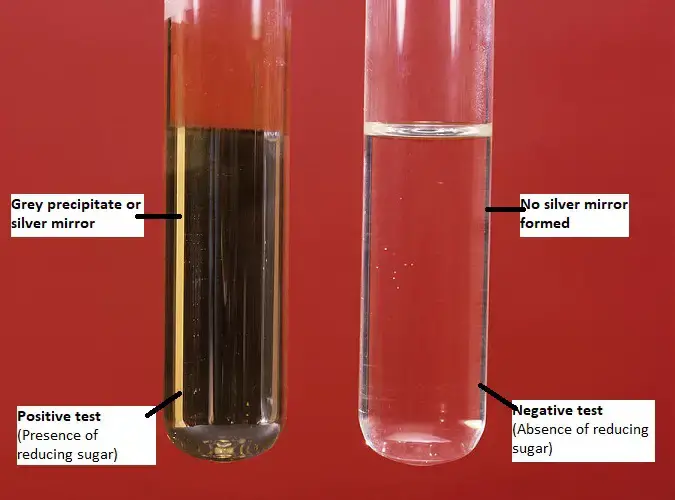
The metallic silver is deposited on inner surface of glass vessel. It forms a shiny silver mirror. It confirms positive test for aldehyde group.
Ketone generally does not give this reaction. It gives negative result and mirror is not formed. Some exception are present like alpha hydroxy ketone (it can form aldehyde by tautomerism) and formic acid. These also gives positive silver mirror effect.
Principle of Tollens’ Test
Principle of Tollens’ test is based on oxidation reduction reaction. It depends on the difference of aldehyde and ketone towards mild oxidation. The reagent used is Tollens’ reagent. It is a colourless alkaline solution. It contains diamminesilver(I) complex ion ([Ag(NH3)2]+).
Aldehyde acts as reducing agent. It contains hydrogen attached to carbonyl carbon. Due to this aldehyde is readily oxidized by Tollens’ reagent. It is converted into carboxylate ion. During oxidation aldehyde gives electron. Silver(I) ion acts as electron acceptor. It is reduced into metallic silver.
The metallic silver is precipitated. It is deposited on inner wall of test tube. It forms reflective silver mirror. It indicates positive Tollens’ test.
Simple ketone lacks oxidizable hydrogen. It cannot reduce silver ion. Due to this mirror is not formed. It gives negative Tollens’ test.
What is Tollens’ Reagent?
Tollens’ reagent
- Tollens’ reagent is a mild oxidizing reagent. It is used for detection of aldehyde group in qualitative organic analysis. It is used for differentiating aldehyde from ketone.
- It is known as silver mirror reagent. In positive test silver ion is reduced into metallic silver and mirror like coating is formed in test tube.
- It is not stored for long time. It has short shelf life. It can form explosive silver compound on standing (silver nitride or silver fulminate). Due to this it is prepared freshly before use and it is not sold commercially.
Composition of Tollens’ reagent
- Active species– Diamminesilver(I) complex ion ([Ag(NH3)2]+).
- Chemical ingredients– Silver nitrate (AgNO3). Ammonia (NH3) or ammonium hydroxide. Sodium hydroxide (NaOH). It is alkaline ammoniacal solution.
Tollens’ reagent Preparation steps
- Step 1 (silver oxide formation)– Silver nitrate solution is prepared in water. Few drops of dilute NaOH is added. Brown precipitate of silver(I) oxide (Ag2O) is formed.
- Step 2 (complex formation)– Aqueous ammonia is added drop wise with continuous stirring. The brown precipitate is dissolved completely.
- Final product– Clear colourless solution is obtained. It contains [Ag(NH3)2]+ complex. It is the prepared Tollens’ reagent.
- Alternative method– Ammonia is added directly to silver nitrate solution. Initially precipitate is formed. On adding more ammonia it is redissolved and clear diamminesilver(I) complex is formed.
Requirements for Tollens’ Test
- Freshly prepared Tollens’ reagent is required. It is ammoniacal silver nitrate solution. It is prepared by using silver nitrate sodium hydroxide (or potassium hydroxide) and aqueous ammonia. It should be prepared immediately before use. Storing should be avoided because explosive by product like silver nitride can be formed.
- The sample compound should contain oxidizable group. Aldehydes (aliphatic and aromatic) gives positive test. Alpha hydroxy ketone also gives positive due to tautomerism. Formic acid reducing sugar and terminal alkyne can also react.
- Alkaline condition is required. The reaction occurs in basic medium. Hydroxide ion present in reagent maintains alkaline environment and oxidation becomes favourable.
- Gentle heating is required. Heating is done in hot water bath (around 60–70°C) for few minutes. Direct flame heating should not be done.
- Clean glassware is required. Test tube or flask should be perfectly clean. If grease fingerprint or contaminant is present silver mirror is not formed properly. Dark or cloudy precipitate may be formed.
- After test remaining solution should be deactivated immediately. Dilute mineral acid like HCl is used. Silver is precipitated safely and explosion risk is reduced.
Procedure of Tollens’ Test
- Glass test tube is cleaned properly. Dirt grease and organic residue should be removed. If tube is not clean silver mirror does not adhere and dark cloudy precipitate is formed.
- Silver oxide precipitate is formed. Aqueous silver nitrate (AgNO3) solution is taken. Few drops of dilute NaOH is added. Brown precipitate of silver(I) oxide is obtained.
- Tollens’ reagent is prepared. Aqueous ammonia is added drop wise with stirring. Brown precipitate is dissolved just completely. Clear colourless solution is obtained containing diamminesilver(I) complex ([Ag(NH3)2]+). This reagent should be prepared fresh and it should not be stored.
- 2–3 mL of freshly prepared Tollens’ reagent is taken in clean test tube. 1–2 drops of test sample is added.
- The mixture is warmed in water bath (60–70°C) for few minutes. Direct heating on flame should be avoided. Local overheating can occur and uneven silver deposition is formed. Risk of explosive by product is increased.
- Result is observed. If aldehyde is present silver ion is reduced into metallic silver. Silver mirror coating is formed on inner wall of test tube. If no visible change is seen test is negative (generally ketone).
- After observation remaining solution is deactivated immediately. Mineral acid like hydrochloric acid is added. Silver is precipitated as stable silver chloride. Formation of explosive compound like silver nitride on standing is prevented.
Result of Tollens’ Test
- Positive result (silver mirror or dark precipitate)– A shiny silver mirror is formed on inner wall of test tube. Sometimes dark grey or black precipitate is also formed. It indicates presence of aldehyde group or reducing sugar. Alpha hydroxy ketone and formic acid also gives positive result.
- Positive result (white or yellow precipitate)– If test substance is terminal alkyne white or yellowish precipitate is formed. It is silver acetylide precipitate.
- Negative result (no change)– No visible change is seen. Reagent remains clear and colourless. It indicates absence of aldehyde group. The compound is generally ketone and it is not oxidized by Tollens’ reagent.
Uses of Tollens’ test
- It is used for distinguishing aldehyde and ketone. Aldehyde gives silver mirror. Most ketone does not give reaction.
- It is used for identifying reducing sugar. Reducing sugar like glucose and fructose gives positive test. It helps in differentiating from non reducing sugar like sucrose. It is used in laboratory analysis and also in food industry quality control.
- It is used for detecting some non aldehyde compound giving positive test. Alpha hydroxy ketone gives positive due to tautomerism. Formic acid also gives positive silver mirror.
- It is used for detecting terminal alkyne. Terminal alkyne gives white or yellowish precipitate of silver acetylide. It helps in differentiating terminal alkyne from internal alkyne.
- It is used in manufacturing mirror. Silvering of glass is done by this reaction. Household mirrors insulated vacuum flasks and optical instruments are prepared.
- It is used in histological staining. A variation is used in Fontana-Masson stain. It detects pigments like melanin argentaffin and lipofuscin in tissue section.
- It is used in forensic detection of explosives. Modified Tollens’ reagent is used for detecting high explosive like RDX (it decomposes into formaldehyde and colour change is produced by silver nanoparticle formation).
- It is used in synthesis of silver nanoparticles (AgNPs). It is used in green synthesis by biological reducing agents like plant extract.
Limitations of Tollens’ test
- Tollens’ reagent is unstable. It cannot be stored. If it is kept standing it decomposes and explosive by product is formed like silver nitride (fulminating silver). Due to this reagent should be prepared fresh before use. After test it should be deactivated by acid immediately.
- False positive result can occur. It is not only positive for aldehyde. In alkaline medium alpha hydroxy ketone can isomerize into aldehyde and it gives silver mirror (example fructose). Some other compound like terminal alkyne hydrazines hydrazones and 1,2-dicarbonyl also reacts with reagent.
- Cleanliness of glassware is very important. Test tube should be scrupulously clean for proper silver mirror formation. Grease fingerprint and contaminant disturbs silver deposition. Dark cloudy or grey precipitate is formed and interpretation becomes difficult.
- Safety risk is present. Preparation involves hazardous chemical. Ammonia and sodium hydroxide are caustic and irritating vapour is produced. Silver nitrate is toxic and it produces dark stain on skin and clothing.
Advantages of Tollens’ test
- Tollens’ reagent should be prepared fresh in exact amount. It should be prepared immediately before use. It should never be stored because explosive compound like silver nitride or silver fulminate can be formed on standing.
- The reagent should not be allowed to dry. Evaporation to dryness increases shock sensitivity of silver residue.
- After completing test remaining reagent and mixture should be deactivated immediately. Dilute mineral acid like HCl is added. It is flushed with large amount of water. Silver is converted into stable silver chloride and risk is reduced.
- Heating should be done gently. Test tube is warmed in hot water bath (60–70°C). Direct heating on flame should be avoided. Local overheating causes uneven silver deposition and explosive by product risk is increased.
- Glassware should be cleaned properly. Reaction vessel should be scrupulously clean. Grease fingerprint and contaminant disrupt mirror formation and dark cloudy precipitate is formed.
- Ammonia is added carefully during preparation. Only enough ammonia is added to dissolve silver oxide precipitate. Excess ammonia stabilizes silver complex and sensitivity of test is reduced.
- PPE should be used. Chemical resistant gloves splash goggles and lab coat is worn. NaOH is caustic. Silver nitrate produces dark stain. Ammonia vapour irritates respiratory system eyes and mucous membrane.
References
- A.G. Metals. (n.d.). The magic of mirrors: The chemistry and physics behind silver-backed reflective surfaces.
- Aakash Educational Services Limited. (n.d.). Tollens test: Principle, preparation, purpose & uses.
- Aljamali, N. M. (2015). Tests of organic compounds. International Journal of Medical Research and Pharmaceutical Sciences, 2(1), 7-20.
- Archer. (2018, August 23). Why does formic acid give positive Fehling’s test? Chemistry Stack Exchange.
- Askiitians Tutor Team. (n.d.). Give reasons for the following. Benzaldehyde reduces tollen’s but not… askIITians.
- Aspirant. (2021, August 27). Do all α-hydroxy ketones give Tollens’ test? Chemistry Stack Exchange.
- Ayub, A., Anjum, K. M., Akram, W., Liaqat, H., Xue, S., Habib, A., Bilal, A., & Majeed, M. B. B. (2025). Silver nanoparticles: Green synthesis and eco-friendly synthetic approaches, characterization and biological applications. In S. Ameen, M. S. Akhtar, & I. Kong (Eds.), Nanotechnology and Nanodevices. IntechOpen. https://doi.org/10.5772/intechopen.1012460
- bdailyherald. (2017). tollens test vs benedicts test. Reddit.
- Brunning, A. (2017, September 6). Making silver mirrors using chemistry. Compound Interest.
- busukxuan. (2016, November 2). Functional difference of Benedict’s solution and Fehling’s solution. Chemistry Stack Exchange.
- BYJU’S. (n.d.). Alpha hydroxy ketone Tollens test.
- Chaiendoo, K., Sooksin, S., Kulchat, S., & Promarak, V. (2018). A new formaldehyde sensor from silver nanoclusters modified Tollens’ reagent. Food Chemistry, 255, 11. https://doi.org/10.1016/j.foodchem.2018.02.030
- Comprehensive analytical report on Tollens’ reagent: Principles, mechanisms, industrial applications, and safety paradigms. (n.d.).
- Department of Chemistry and Chemical Biology. (n.d.). Formation of a silver mirror on a glass surface. Rutgers University.
- Department of Chemistry and Chemical Biology. (n.d.). Silver cyanate vs silver fulminate. Rutgers University.
- Filo. (2025, March 7). Reaction of Tollens’ reagent with formic acid.
- Filo. (2025, November 7). (h) How does Tollen’s reagent react with formic acid?
- Flinn Scientific. (n.d.). Silver mirrors: Copper, silver and gold redox reactions.
- GeeksforGeeks. (2025, July 23). Tollens test.
- Ghosh, N. (2016, January 8). Is Tollen’s test safe? Chemistry Stack Exchange.
- Groves Glass. (2025, December 7). Mirror fabrication process explained by Port Townsend, WA glass experts.
- Gustafson, K. (2026, January 7). 10 modern forensic technologies used today. Forensics Colleges.
- Health, Safety and Environment Office. (n.d.). List of shock sensitive and explosive chemicals. The Hong Kong University of Science and Technology.
- Jeffries, A. M., Wang, Z., Opila, R., & Bertoni, M. I. (n.d.). Tin sensitization and silver activation on indium tin oxide surfaces.
- Khandelwal, S. (n.d.). Tollens’ reagent and the silver mirror (12.2.5). TutorChase.
- Kumar, A. (2017, April 25). Why do α-hydroxy ketones give Tollens’ test? Chemistry Stack Exchange.
- Lexicon. (2015, January 12). Does acetylene give a positive Tollens’ test? If not, why is this so? Chemistry Stack Exchange.
- LibreTexts. (2019, June 5). 16.2: Oxidation of aldehydes. Chemistry LibreTexts.
- LibreTexts. (2023, January 22). Tollens’ test. Chemistry LibreTexts.
- Lynnalradi. (2016). Tollens Benedict Fehling reagents. Reddit.
- MEL Chemistry. (n.d.). “Silver mirror” experiment.
- PCC Group. (2023, October 5). Tollens’ test.
- Rajamani, R., & Djearamane, S. (2025). Green synthesis of silver nanoparticles: A comprehensive review for sustainable nanotechnology applications. NanoNEXT, 6(3), 37–76. https://doi.org/10.54392/nnxt2534
- Rich2189. (2006, September 24). Fehlings solution. Sciencemadness Discussion Board.
- Sapkota, A. (2022, September 17). Tollens’ test- Definition, principle, procedure, result, uses. Microbe Notes.
- ScootThe7th. (2022). Tollen’s test and creating silver mirrors for science fair. Reddit.
- Scribd. (n.d.). Formic acid and Tollen’s test results.
- Shahzadi, S., Fatima, S., ain, Q. u., Shafiq, Z., & Janjua, M. R. S. A. (2025). A review on green synthesis of silver nanoparticles (SNPs) using plant extracts: a multifaceted approach in photocatalysis, environmental remediation, and biomedicine. RSC Advances, 15(5), 3858-3903. https://doi.org/10.1039/D4RA07519F
- StainsFile. (n.d.). Safe working with silver.
- Straub, J. (n.d.). Complex ion equilibria and Tollen’s test. Boston University.
- StudyGuides.com. (n.d.). Silvered glass (Mirror) – Overview.
- Taylor & Francis. (n.d.). Tollens’ reagent – Knowledge and references.
- Umar, A., Syam, R. H. R., Handayani, W., Qaiser, N., Apriandanu, D. O. B., & Yulizar, Y. (2025). Modification of silver nanoparticles (AgNPs) with tollens reagent for selective colorimetric detection of formaldehyde. Results in Chemistry, 17, 102586. https://doi.org/10.1016/j.rechem.2025.102586
- user17319. (2015, July 10). Color of precipitate formed on reaction of acetylene with Tollen’s Reagent. Chemistry Stack Exchange.
- UW Department of Chemistry. (n.d.). Tollens’ test for aldehydes. University of Washington.
- Vedantu. (n.d.). Fehling test – Principle, procedure, result & applications.
- Vedantu. (n.d.). Tollens test: Principle, steps, silver mirror & uses.
- Wetzel, W. (2024, September 16). The future of forensic analysis: The latest studies. Spectroscopy Online.
- Wetzel, W. (2026, January 23). Navigating the latest trends and advancements in forensic analysis. Spectroscopy Online.
- Wikipedia contributors. (n.d.). Silver fulminate. Wikipedia, The Free Encyclopedia.
- Wikipedia contributors. (n.d.). Silvering. Wikipedia, The Free Encyclopedia.
- Wikipedia contributors. (n.d.). Tollens’ reagent. Wikipedia, The Free Encyclopedia.