

Salt Tolerance Test is a biochemical test used to determine the ability of bacteria to survive and grow in high salt concentration, commonly 6.5% sodium chloride (NaCl). The high salt acts as a selective agent and increases the osmotic pressure outside the cell, so non tolerant bacteria undergo osmotic shock, plasmolysis and growth is inhibited. Salt tolerant organisms can grow because they maintain osmotic balance by pumping out Na+ ions or by accumulating compatible solutes inside the cell.
This test is mainly used to differentiate Enterococcus species (salt tolerant) from non enterococcal group D streptococci like Streptococcus bovis/gallolyticus (salt sensitive). The organism is inoculated into 6.5% NaCl broth which may contain dextrose and a pH indicator like bromcresol purple. Positive result is shown by growth or turbidity in broth within 24-72 hours, and often colour change from purple to yellow due to acid production from dextrose fermentation. Negative result is shown by clear broth with no growth and no colour change.
Objective of Salt Tolerance Test
- To determine whether the organism can tolerate and grow in high salt concentration, usually 6.5% NaCl.
- To differentiate Enterococcus species (salt tolerant) from non enterococcal Group D streptococci like Streptococcus bovis / Streptococcus gallolyticus (salt intolerant).
- To identify Aerococcus species by showing growth in 6.5% NaCl and separate it from similar catalase negative gram positive cocci like Stomatococcus and Helcococcus.
- To differentiate rapidly growing mycobacteria in salt medium, mainly to separate Mycobacterium abscessus (salt tolerant) from Mycobacterium chelonae (salt intolerant) (commonly 5% NaCl used).
- To enrich and screen MRSA samples by inhibiting normal skin flora and allowing salt tolerant MRSA to grow to detectable level.
Principle of Salt Tolerance Test
Principle of Salt Tolerance Test is based on the use of high concentration of sodium chloride (usually 6.5% NaCl) as a selective condition to check whether bacteria can survive and grow in hypertonic environment. In this high salt medium, osmotic pressure outside the cell becomes high and water is drawn out from the bacterial cell. Salt intolerant bacteria undergo plasmolysis (cell membrane shrinks away from cell wall) and growth is inhibited or the organism dies.
Salt tolerant organisms can grow in this medium because they maintain osmotic balance inside the cell. They pump out excess sodium ions and they accumulate compatible solutes inside the cell to balance the osmotic pressure. In salt tolerance broth, dextrose is kept as fermentable carbohydrate and bromcresol purple is used as pH indicator. When salt tolerant bacteria grow, they ferment dextrose and acid is produced, pH drops and indicator changes from purple to yellow.
Requirements for Salt Tolerance Test
- Culture media
6.5% NaCl broth (modified salt broth).
BHI broth with 6.5% NaCl.
Tryptic soy broth with 6.5% NaCl. - Indicator (if indicator broth is used)
Bromocresol purple (about 0.1%). - Reagents
Sodium chloride (lab grade).
Bromocresol purple indicator. - Test tubes
Sterile test tubes for broth preparation and inoculation. - Inoculating tools
Sterile inoculating loop / needle. - Incubator
Incubation at suitable temperature (commonly 35-37°C). - Media preparation items
Weighing balance.
Autoclave for sterilization.
Bunsen burner / spirit lamp for aseptic work. - PPE and lab materials
Gloves, coat, basic lab safety materials. - Quality control strains
Positive control. Enterococcus faecalis (ATCC 29212).
Negative control. Streptococcus bovis (ATCC 33317).
Composition of Modified Salt Broth (per 1000 ml)
- Peptone (Peptic digest of animal tissue) 10.0 g.
- Heart digest / Heart infusion solids 10.0 g.
- Glucose (Dextrose) 1.0 g.
- Sodium chloride (NaCl) 65.0 g.
- Bromocresol purple 0.016 g.
- Final pH 7.2 ± 0.2 at 25°C.
Preparation of Modified Salt Broth
- Weigh the required amount of modified salt broth powder (about 86.01 g for 1000 ml) (or 8.6 g for 100 ml).
- Add the powder into distilled / purified water in a flask or bottle.
- Mix well and heat if required till complete dissolving is done.
- Dispense about 5 ml into sterile test tubes and keep cap loose / cotton plug.
- Sterilize by autoclaving at 121°C at 15 lbs pressure for 15 minutes.
- Cool the medium to about 40-45°C and then it is ready for inoculation.
Procedure of Salt Tolerance Test
- Take 6.5% NaCl broth tube and keep it at room temperature before inoculation.
- Take a fresh pure culture (18-24 hours) of the test organism from non selective medium (blood agar).
- With sterile inoculating loop / swab pick 1-3 well isolated colonies and inoculate the 6.5% NaCl broth.
- Light inoculum should be used. Heavy inoculum can produce immediate turbidity and gives false positive result. (For some organisms, 1 McFarland suspension can be used).
- Incubate the inoculated tubes aerobically at 35-37°C with loose cap / cotton plug.
- Observe after 18-24 hours. Growth is seen by turbidity in broth. If bromcresol purple is present then colour change from purple to yellow is also noted.
- If no growth is seen at 24 hours, re-incubate and check again at 48 hours and 72 hours.
- Negative result is reported only after full 72 hours incubation (no turbidity and no colour change).
- For slow growing organisms like Mycobacterium / Actinobacteria, incubation may be extended (2-4 weeks) and weekly observation is done.
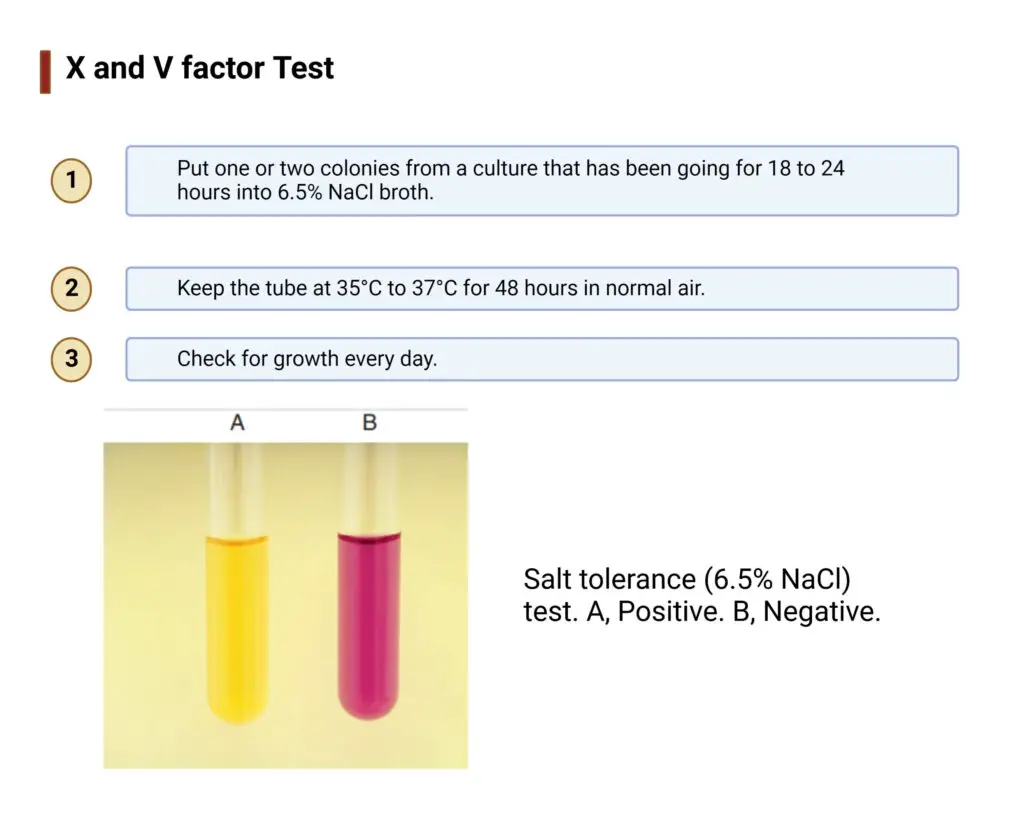
Results of Salt Tolerance Test
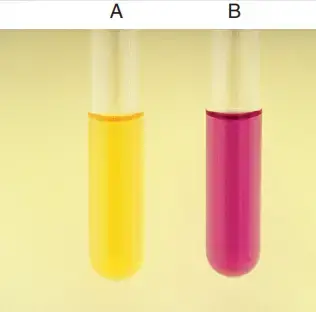
- Positive result (turbid and yellow). Broth shows visible growth (turbidity) and colour changes from purple to yellow. It indicates organism tolerated 6.5% NaCl and dextrose is fermented with acid production.
- Positive result (turbid and purple). Broth shows visible growth (turbidity) but no colour change. Turbidity alone is taken as positive, it may occur in weak fermenters or slow fermenters (example Streptococcus agalactiae).
- Negative result (clear and purple). Broth remains clear with no turbidity and no colour change even after full 72 hours incubation. It indicates organism is salt intolerant and growth is inhibited.
- Invalid result (clear and yellow). Broth is clear but indicator becomes yellow. It indicates contamination or breakdown of indicator, so result is not taken.
Organisms Showing Positive and Negative Result in Salt Tolerance Test
Positive (salt tolerant)
- Enterococcus species (E. faecalis, E. faecium, E. durans, E. avium, E. zymogenes, E. liquifaciens).
- Aerococcus species (A. viridans, A. urinae).
- Staphylococcus aureus (including MRSA).
- Streptococcus agalactiae (Group B). It shows turbidity, but colour change may be absent.
- Mycobacterium abscessus (positive in 5% NaCl medium).
- Some strains may show variable growth. Pediococcus. Leuconostoc. Some beta hemolytic Streptococcus.
Negative (salt intolerant)
- Non enterococcal Group D streptococci. Streptococcus bovis. Streptococcus equinus. Streptococcus gallolyticus.
- Streptococcus pyogenes (Group A).
- Stomatococcus species.
- Helcococcus species.
- Mycobacterium chelonae (negative in 5% NaCl medium).
Quality Control of Salt Tolerance Test
Positive control strains
- Enterococcus faecalis (ATCC 29212). It gives growth (turbidity) in 6.5% NaCl broth. Colour may change to yellow if indicator is present.
- Enterococcus faecium. It gives growth in 6.5% NaCl broth and used as additional positive control.
Negative control strains
- Streptococcus gallolyticus / Streptococcus bovis (ATCC 9809 or ATCC 33317). It gives no growth, broth remains clear and no colour change.
- Streptococcus pyogenes (ATCC 19615). It gives no growth in 6.5% NaCl broth (negative).
Precautions of Salt Tolerance Test
- Light inoculum should be used. Heavy inoculum can make broth cloudy at starting and it may be read as false positive.
- Negative result should not be given at 24 hours only. If no growth is seen, re-incubate and wait upto full 72 hours before reporting negative.
- While preparing 6.5% NaCl broth by adding salt, the salt already present in base medium should be considered. Final NaCl concentration should be correct (6.5%).
- Pure culture should be used. Test is not done directly from clinical specimen for primary isolation. Well isolated colonies are taken to avoid mixed growth.
- Aseptic technique should be followed. Universal precautions are followed because media contains animal components and it supports growth of pathogens. Media should not be inhaled, ingested or allowed to contact skin.
Uses of Salt Tolerance Test
- It is used to differentiate Enterococcus species (salt tolerant) from Group D streptococci like Streptococcus bovis / Streptococcus gallolyticus (salt intolerant).
- It is used to identify Aerococcus species by growth in 6.5% NaCl and differentiate from Stomatococcus and Helcococcus (no growth).
- 6.5% NaCl broth is used for enrichment of MRSA in screening samples. High salt inhibits normal skin flora and MRSA grows.
- It is used to differentiate rapidly growing mycobacteria in special salt medium (5% NaCl). Mycobacterium abscessus shows growth and Mycobacterium chelonae shows no growth.
- It is used in lab studies to characterize halotolerant bacteria and halophiles. It may be used for some Actinobacteria and Vibrio species also.
Advantages of Salt Tolerance Test
- It is used as a good test to differentiate Enterococcus (salt tolerant) from non enterococcal Group D streptococci like Streptococcus bovis / Streptococcus gallolyticus. This helps in identification where drug response can be different.
- It helps in identification of Aerococcus species. It separates Aerococcus from similar catalase negative cocci like Stomatococcus and Helcococcus which do not grow in 6.5% NaCl.
- 6.5% NaCl broth can be used as enrichment medium for MRSA screening. Normal skin flora is suppressed and MRSA grows to detectable level.
- In special 5% NaCl medium it is useful to differentiate rapidly growing mycobacteria. Mycobacterium abscessus shows growth and Mycobacterium chelonae shows no growth.
- It is a simple phenotypic test and gives reliable result by turbidity and indicator colour change. It can be used along with Gram stain, catalase, PYR, bile esculin for bacterial profiling.
- Principle of salt tolerance is also useful in environmental or industrial studies. It helps to study salt tolerant microbes for high salinity waste water and saline soil related works.
Limitations of Salt Tolerance Test
- It is not a confirmatory test alone. It should be used with other biochemical / serological / molecular tests for final identification.
- Heavy inoculum can give false positive. Immediate turbidity can be produced and it may be taken as growth.
- It is not specific only for Enterococcus. Some other organisms can also grow in 6.5% NaCl (Pediococcus, Leuconostoc, some beta hemolytic streptococci).
- Growth may occur without colour change. Some organisms show turbidity but do not produce enough acid to change indicator (example Streptococcus agalactiae). So yellow colour is not always seen.
- Reaction may be slow. Some broths show sluggish growth, so early reading is confusing. Negative result is given only after 72 hours.
- Pure culture is required. It is not used for primary isolation directly from specimen, mixed culture can give wrong pattern.
References
- Bile-esculin test for presumptive identification of enterococci and streptococci: Effects of bile concentration, inoculation technique, and incubation time. (n.d.). PubMed Central (PMC).
- Comprehensive clinical and physiological analysis of the salt tolerance test in diagnostic microbiology. (n.d.).
- Dalynn Biologicals. (2014). Bile esculin agar (Catalogue No. PB65 & TB65).
- Dalynn Biologicals. (2018). Salt tolerance broths (Catalogue No. TS27 & TS28).
- Delost, M. E. (n.d.). Streptococcus, Enterococcus, and related organisms. In JBLearning (Chap. 10).
- Hardy Diagnostics. (2020). Sodium chloride (NaCl) 6.5% media – For identification of enterococcus – salt broth (IFU-10602[D]).
- Hardy Diagnostics. (2020). Tryptic soy broth with 6.5% sodium chloride (IFU-10783[B]).
- HiMedia Laboratories. (2011). Salt broth, modified (M1290).
- HiMedia Laboratories. (2026). Salt broth, modified – technical data (M1290).
- Identification of Enterococcus spp. with a biochemical key. (n.d.). PubMed Central (PMC) – NIH.
- InformationBoxTicket Lifestyles. (n.d.). Salt tolerance test in microbiology | Principle, procedure, and applications explained! [Video]. YouTube.
- Massange-Sánchez, J. A., Sánchez-Hernández, C. V., Hernández-Herrera, R. M., & Palmeros-Suárez, P. A. (2021, November 22). The biochemical mechanisms of salt tolerance in plants. In M. Hasanuzzaman & K. Nahar (Eds.), Plant stress physiology – Perspectives in agriculture. IntechOpen.
- Plant-Ditech. (n.d.). Salinity stress in plants: Physio & biochemical effect.
- Remel. (2012). Tryptic soy broth w/ 6.5% NaCl (IFU 65030). Thermo Fisher Scientific.
- Salt tolerance of methicillin-resistant and methicillin-susceptible Staphylococcus aureus. (n.d.). PubMed Central (PMC).
- Variables affecting results of sodium chloride tolerance test for identification of rapidly growing mycobacteria. (n.d.). PubMed Central (PMC).