

Rapid Furfural Test is a qualitative chemical test used to differentiate ketohexoses from aldohexoses based on the rate of dehydration reaction. It is mainly used for the identification of fructose and other ketose sugars in the presence of aldose sugars like glucose. It is based on the principle that ketohexoses are dehydrated rapidly when heated with concentrated hydrochloric acid (HCl) to form 5-hydroxymethyl furfural.
Principle of Rapid Furfural Test
It is based on the principle of difference in the rate of dehydration between keto sugars and aldo sugars. When sugars are heated with concentrated hydrochloric acid (HCl), ketohexoses like fructose are dehydrated rapidly within a short time to form 5-hydroxymethyl furfural. This intermediate then condenses with α-naphthol to produce a violet or purple coloured complex. Aldohexoses require longer time or stronger dehydrating agent for this reaction, therefore they do not give colour within 30 seconds. The rapid appearance of colour is thus used as an indicator for presence of ketose sugars.
Objectives of Rapid Furfural Test
The objectives of Rapid Furfural Test are–
- To detect the presence of ketose sugars especially ketohexoses like fructose.
- To distinguish between ketoses and aldoses based on the rate of colour development within short heating time.
- To differentiate glucose and fructose, where fructose gives rapid violet colour reaction and glucose does not react within 30 seconds.
- To identify sucrose, as it is hydrolysed under acidic condition to release fructose which gives positive reaction.
Requirements for Rapid Furfural Test
The requirements for Rapid Furfural Test are–
- Sugar solution (1% or 2%) containing the test carbohydrate.
- Molisch’s reagent (α-naphthol dissolved in ethyl alcohol).
- Concentrated hydrochloric acid (HCl).
- Clean and dry test tubes.
- Pipette or dropper for measuring reagents.
- Spirit lamp or Bunsen burner for heating.
- Test tube holder.
- Stopwatch or timer to note reaction time.
Procedure for Rapid Furfural Test
- Take a clean test tube and add small amount of the sugar solution to be tested (about 1–2 mL).
- To this solution add about 6 drops of Molisch’s reagent (ethanolic α-naphthol solution) carefully.
- Now add concentrated hydrochloric acid (HCl) slowly along the side of the test tube (about 3–5 mL).
- Mix the contents properly and place the test tube over a flame.
- Heat the mixture and bring it to boiling condition.
- Allow the solution to boil exactly for 30 seconds only.
- After boiling observe the colour developed in the solution.
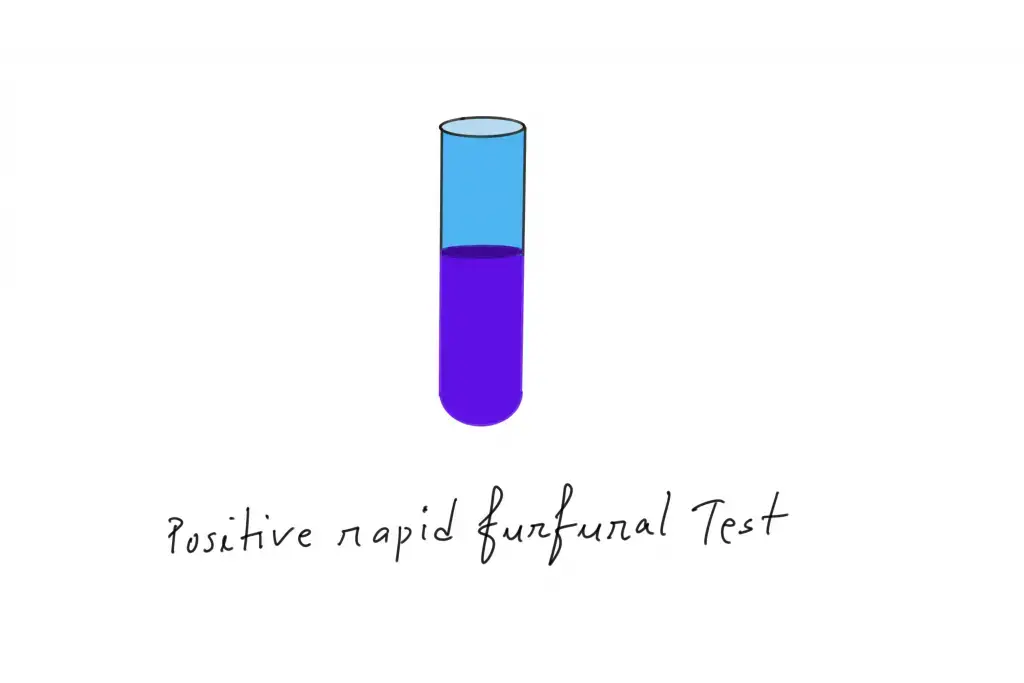
- Formation of deep violet or purple colour within 30 seconds indicates presence of ketohexose sugar such as fructose or sucrose (after hydrolysis).
- Absence of violet colour within the given time indicates presence of aldohexose sugar such as glucose.
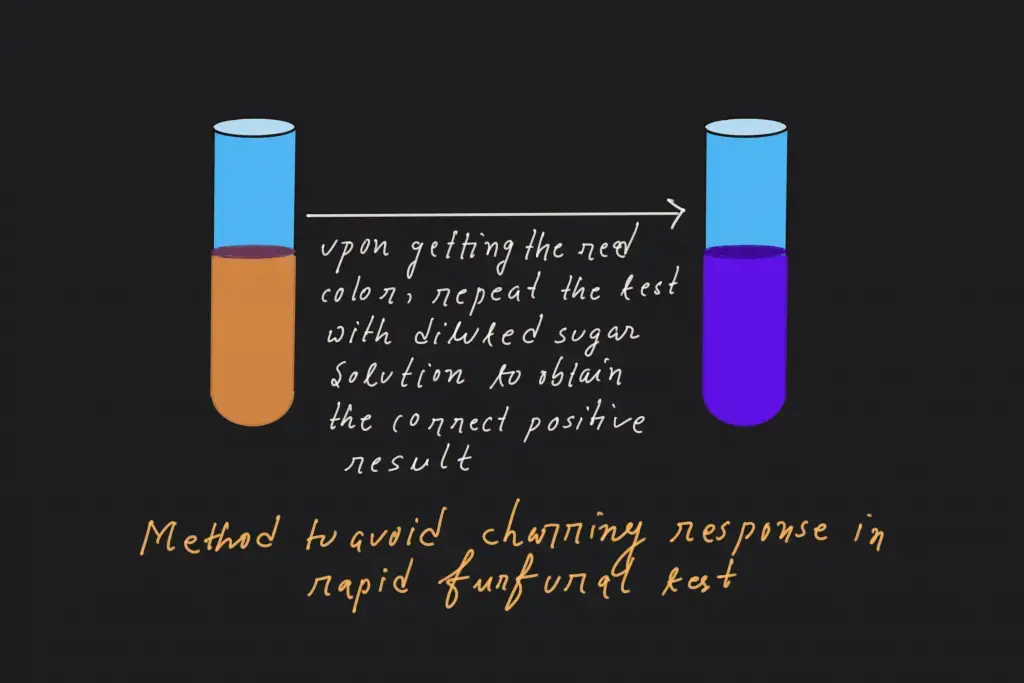
- If red or brown colour appears due to charring the sugar solution should be diluted with water and the test is repeated.
Result for Rapid Furfural Test
Positive result
- Deep violet or purple colour is developed immediately or within 30 seconds of boiling.
- It indicates presence of ketohexose sugar such as fructose.
- Sucrose also gives positive result as it is hydrolysed in acidic condition to release fructose.
Negative result
- Violet or purple colour is not observed within 30 seconds of boiling.
- It indicates presence of aldohexose sugar such as glucose.
- Sugars like lactose and maltose also do not show violet colour within the given time.
Charring reaction
- Red or dark brown colour is formed instead of violet colour.
- This is due to charring action of concentrated acid because of high sugar concentration or excess heating.
- In such case the sugar solution should be diluted with water and the test is repeated.
Uses of Rapid Furfural Test
- It is used to differentiate between ketose sugars and aldose sugars.
- It is used to distinguish fructose from glucose based on rapid colour formation.
- This test is used for qualitative detection of ketohexose sugars in a given sample.
- It helps in identification of sucrose as sucrose gives positive result due to formation of fructose after hydrolysis.
- It is used to differentiate sucrose from other disaccharides such as lactose and maltose.
- It is commonly used in carbohydrate analysis for rapid identification of ketoses.
Advantages of Rapid Furfural Test
- It helps in differentiation between ketohexose sugars and aldohexose sugars.
- The test gives result within short time period as colour is developed within 30 seconds of boiling.
- It is more specific than general carbohydrate tests as it differentiates sugars based on reaction rate.
- The test is based on rapid dehydration of ketoses compared to aldoses.
- It is useful for detection of fructose even when present in combined form like sucrose.
- The procedure is simple and requires minimum reagents and apparatus.
- It is useful for laboratory and teaching purpose for understanding carbohydrate reactions.
Limitations of Rapid Furfural Test
- The test depends strictly on boiling time of 30 seconds and slight excess heating may give false positive result.
- Aldohexose sugars may also give colour if heating is prolonged beyond the given time limit.
- The result is based on visual observation of colour which may vary from person to person.
- High concentration of sugar solution may cause charring giving red or brown colour.
- The coloured compound formed is not stable and colour may fade if conditions are not controlled.
- Other interfering substances present in sample may react with reagent and affect the result.
- Sucrose gives positive result similar to fructose and cannot be distinguished by this test alone.
- Amarasekara, A. S., Williams, L. D., & Ebede, C. C. (2008). Mechanism of the dehydration of D-fructose to 5-hydroxymethylfurfural in dimethyl sulfoxide at 150 °C: An NMR study. Carbohydrate Research, 343(18), 3021–3024. https://doi.org/10.1016/j.carres.2008.09.008
- Davidson, A. G. (1987). The difference spectrophotometric assay of 5-hydroxymethylfurfuraldehyde in parenteral formulations of dextrose. Journal of Clinical Pharmacy and Therapeutics, 12(1), 11–18.
- Ma, H., Li, Z., Chen, L., & Teng, J. (2021). LiCl-promoted-dehydration of fructose-based carbohydrates into 5-hydroxymethylfurfural in isopropanol. RSC Advances, 11, 1404–1410. https://doi.org/10.1039/D0RA08737H
- Sánchez-Viesca, F., & Gómez, R. (2018). Reactivities involved in the Seliwanoff reaction. Modern Chemistry, 6(1), 1–5. https://doi.org/10.11648/j.mc.20180601.11
- van Putten, R.-J., Soetedjo, J. N. M., Pidko, E. A., & Van der Waal, J. C. (2013). Dehydration of different ketoses and aldoses to 5-hydroxymethylfurfural. ChemSusChem, 6(9). https://doi.org/10.1002/cssc.201300345
- Zhang, C., Chai, X., Luo, X., & Fu, S. (2010). Rapid method for determination of furfural and 5-hydroxymethyl furfural in pre-extraction stream of biomass using UV spectroscopy. Guang pu xue yu guang pu fen xi = Guang pu, 30(1), 247–250. https://doi.org/10.3964/j.issn.1000-0593(2010)01-0247-04
- Damodaran, K. G. (n.d.). Reactions of carbohydrates. In Practical Biochemistry. Jaypee Brothers Medical Publishers. https://www.jaypeedigital.com/eReader/chapter/9789350251416/ch1
- Dholariya, S. J., & Orrick, J. A. (2022). Biochemistry, fructose metabolism. In StatPearls. StatPearls Publishing. https://www.ncbi.nlm.nih.gov/books/NBK576428/
- International Agency for Research on Cancer. (1995). Furfural. In IARC Monographs on the Evaluation of Carcinogenic Risks to Humans (Vol. 63, pp. 409–430). World Health Organization.
- Khan, S. (2025). Lab 9: Tests for carbohydrates. Chemistry LibreTexts. https://chem.libretexts.org/Courses/Triton_College/Elementary_Organic_Chemistry_(Lab_Manual)/09%3A_Lab_9-_Tests_for_Carbohydrates
- KorAcademy. (n.d.). Molisch’s reaction [Lab manual].
- Mondal, S. (2021). Tests for specific carbohydrates: Anthrone test; Mucic acid test; Osazone test; Test for non-reducing sugars; Bial’s test [Lecture notes]. ResearchGate. https://doi.org/10.13140/RG.2.2.25055.53920
- Practical Biochemistry Section One: Carbohydrates. (n.d.). [Lab manual excerpt].
- Experimental Biochemistry and Physiology. (n.d.). I Biochemical Tests I (pp. 375–380).Sapkota, A. (2022, September 5). Anthrone Test- Definition, Principle, Procedure, Result, Uses. Microbe Notes. https://microbenotes.com/anthrone-test/
- Sapkota, A. (2022, June 19). Seliwanoff’s Test- Definition, Principle, Procedure, Result, Uses. Microbe Notes. https://microbenotes.com/seliwanoffs-test/
- Wikipedia. (n.d.). Rapid furfural test. Retrieved from https://en.wikipedia.org/wiki/Rapid_furfural_test