

Bunsen burner is a laboratory instrument used for heating, sterilization and burning of substances. It gives an open flame. The flame can be controlled by changing the air supply.
It uses gas like natural gas, propane or butane. The gas enters into the burner tube and mixes with air. Then the mixture burns at the top of the tube.
At the lower part of the burner, air holes are present. These holes are controlled by a collar. When the collar is rotated, more or less air enters into the burner.
When air supply is less, yellow flame is produced. This flame is luminous and gives soot. It is not mostly used for heating.
When air supply is more, blue flame is produced. This flame is non-luminous and hotter. It is used for heating and sterilizing work in laboratory.
Bunsen burner is named after Robert Wilhelm Bunsen. He was a German chemist. He needed a hot and smokeless flame for laboratory experiment.
The burner was made with the help of Peter Desaga. He added adjustable air holes in the burner. This helped to mix gas and air properly.
Before this burner, spirit lamp and simple gas flame were used. These flames were weak, smoky and not steady. So Bunsen burner became useful in laboratory heating work.
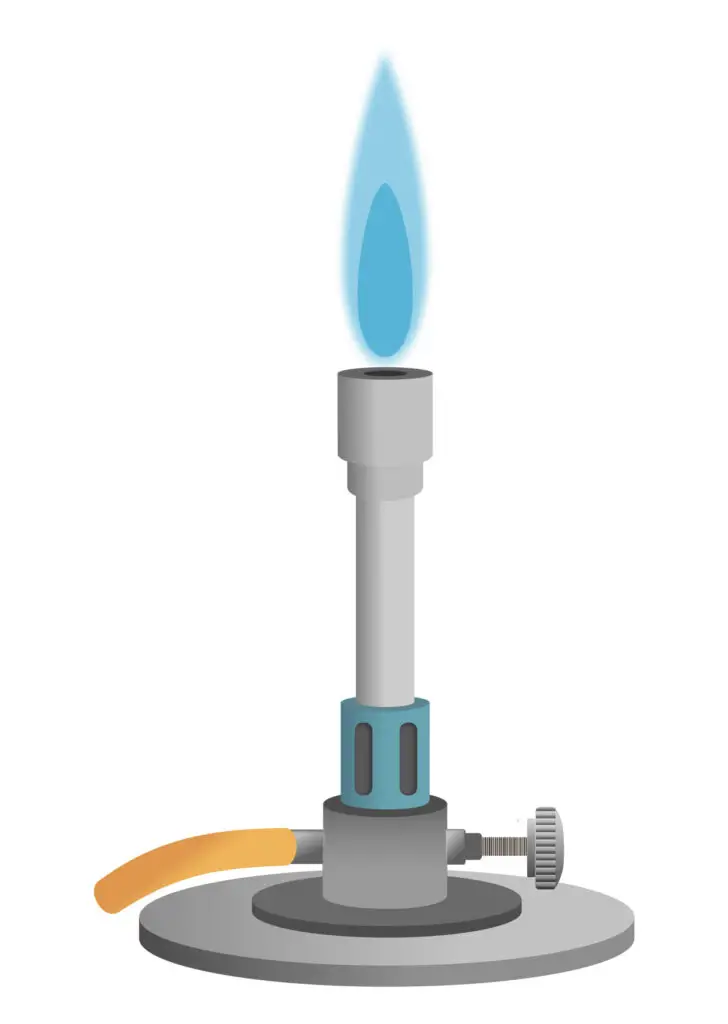
Principle of Bunsen burner
Principle of Bunsen Burner is based on mixing of combustible gas with air before burning. The gas and air mixture gives a hot flame when it is ignited.
The gas enters into the burner through a small nozzle present at the bottom. The gas comes out with high speed and moves upward through the barrel.
Due to fast movement of gas, low pressure is produced near the air holes. So air is drawn inside the burner tube through the openings at the base.
This is called Venturi effect. The entering air mixes with the gas inside the barrel. The mixture then moves upward and burns at the top.
When enough air is mixed with gas, complete combustion takes place. It produces blue, hot and non-luminous flame. This flame does not give much soot.
When air supply is less, incomplete combustion occurs. It produces yellow luminous flame and soot may be formed.
The air supply is controlled by rotating the collar. By changing the air hole opening, the colour, temperature and intensity of flame can be controlled.
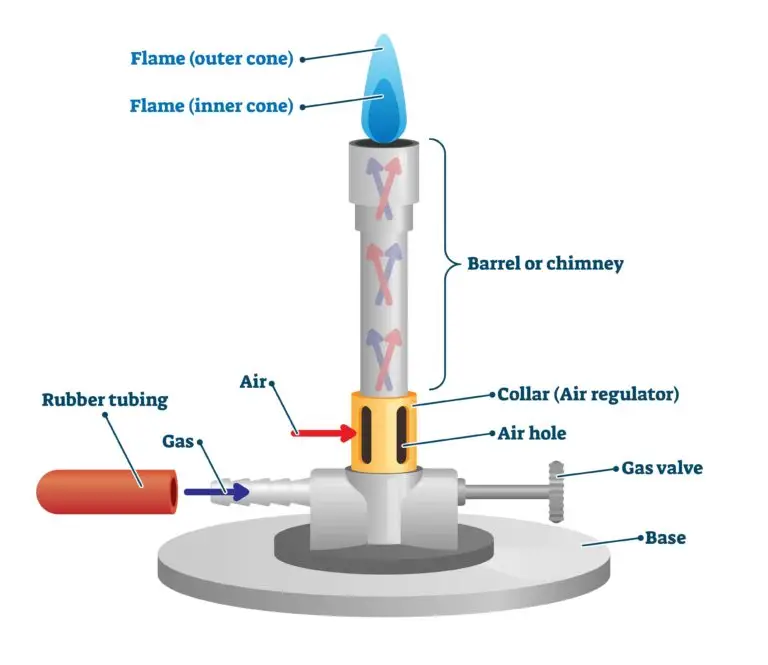
Types of Bunsen burners
The following are the types of Bunsen Burners–
- Standard Bunsen burner
It is the common laboratory burner. It has a base and a vertical barrel. Air supply is controlled by rotating collar or sliding metal part at the lower side. - Meker burner
It is also called Meker-Fisher burner. It has wider barrel and wire grid at the top. The grid divides the flame into many small flames and gives large uniform heating area. - Tirrill burner
It has a needle valve at the base. This valve controls the gas supply directly from the burner. It also gives better control of flame height and temperature. - Teclu burner
It has conical lower tube and screw nut for controlling air entry. It gives better mixing of gas and air. So the flame becomes hotter and more stable. - Safety Bunsen burner
It is a modern type burner with automatic ignition system. It may have sensor or foot switch. If the flame goes out, gas supply is stopped automatically. - Electric Bunsen burner
It is a flameless burner. It uses electric heater to produce heat. It is used where open flame is not safe or not allowed.
Fuel Sources for Bunsen Burner
The following are the fuel sources for Bunsen Burner–
- Natural gas
It is the most common fuel used in Bunsen burner. It mainly contains methane and is usually supplied through gas pipeline in laboratory. - Liquefied petroleum gas
It is also called LPG. It contains propane, butane or their mixture. It is used from cylinder when pipeline gas is not available. - Coal gas
It is also called artificial gas or mixed gas. It contains methane and other hydrocarbon gases. It was the original fuel used during early use of Bunsen burner.
Bunsen burner Parts With their functions
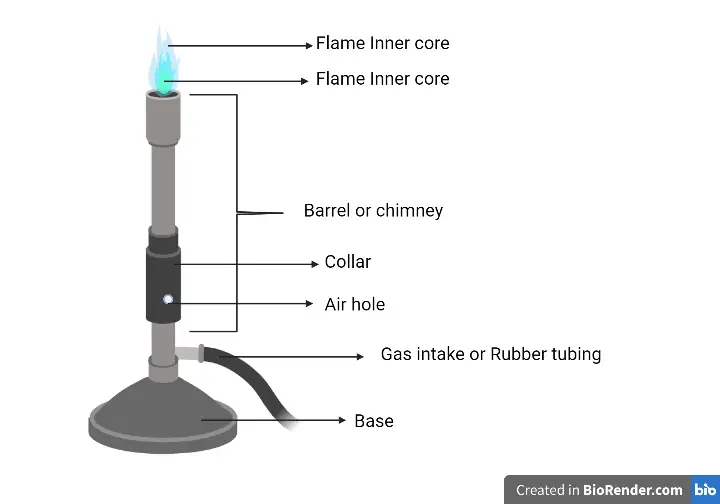
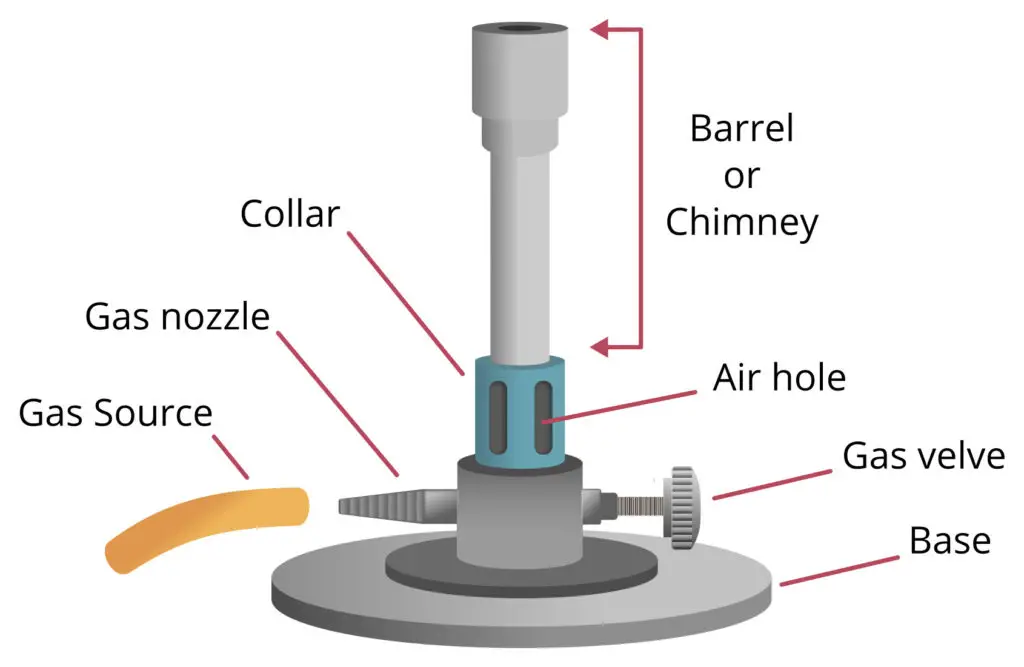
The following are the main parts of Bunsen Burner with their functions-
- Stand or base
It is the heavy lower part of the burner. It supports the burner and keeps it stable on the laboratory bench. - Gas intake tube
It is a side tube present near the base. It connects the burner with rubber gas tube and allows gas to enter into the burner. - Gas flow valve
It is used to control the amount of gas entering into the burner. By adjusting it, the height and strength of flame can be changed. - Air holes
These are openings present near the lower part of the barrel. Air enters through these holes and mixes with the gas. - Collar
It is a rotating metal sleeve present over the air holes. It is turned to open or close the air holes and control the air supply. - Barrel or chimney
It is the vertical metal tube of the burner. Inside this tube, gas and air mix together and the flame is produced at the top.
Operating Procedure of Bunsen Burner
The following are the operating procedure of Bunsen Burner–
- The working area is cleared before lighting the burner. Paper, notebook, inflammable chemical and other combustible materials are removed from nearby place.
- Safety goggles and lab apron should be worn before use. Long hair, loose cloth and hanging jewellery should be tied back properly.
- The rubber tube is checked before connection. Crack, hole or hardening of tube should not be present.
- The burner is placed on heat proof mat. The rubber tube is attached properly with gas inlet of burner and laboratory gas tap.
- The air hole is closed by rotating the collar. This gives yellow safety flame at the time of ignition.
- A flint striker or long nozzle lighter is kept ready. It should be held about 3 to 5 cm above the top of barrel.
- The gas tap is opened slowly. Then spark is produced immediately at the mouth of the barrel.
- After ignition, yellow flame is first obtained. This flame is visible and used as safety flame.
- The collar is rotated slowly to open the air hole. Air enters and mixes with gas inside the barrel.
- When more air enters, the yellow flame changes into blue flame. This blue flame is hotter and used for heating work.
- The flame should be watched during the experiment. The burner should not be left unattended.
- After work is completed, the gas supply is closed from the main bench valve. This stops gas flow and prevents gas remaining in rubber tube.
- The burner is allowed to cool after use. The barrel becomes hot and should not be touched immediately.
- After cooling, the burner is cleaned if needed and kept in proper place.
Types of flame on a Bunsen burner
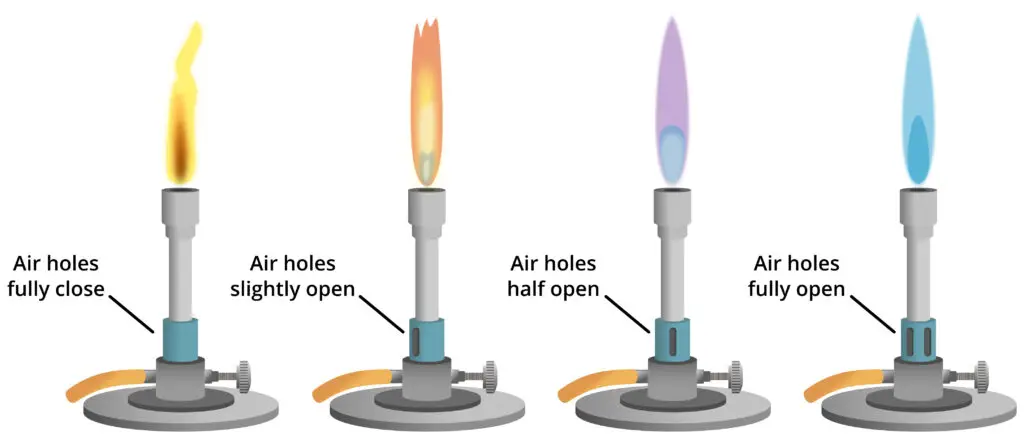
The following are the types of flame on a Bunsen Burner–
- Yellow flame
It is produced when the air hole is closed. It is also called luminous flame or safety flame. It is yellow, visible and sooty due to incomplete combustion. - Reddish flame
It is produced when the air hole is opened slightly. Some air enters into the barrel and combustion becomes little more than yellow flame. - Purple flame
It is produced when the air hole is opened more. It shows half combustion condition and has more heating power than reddish flame. - Blue flame
It is produced when the air hole is half opened or mostly opened. It is non-luminous and hotter than yellow flame. It is used for heating, sterilization and flame test. - Roaring blue flame
It is produced when the air hole is fully opened. It is the hottest flame and makes a roaring sound. It has inner pale blue cone and outer blue cone. The hottest part is just above the tip of inner cone.
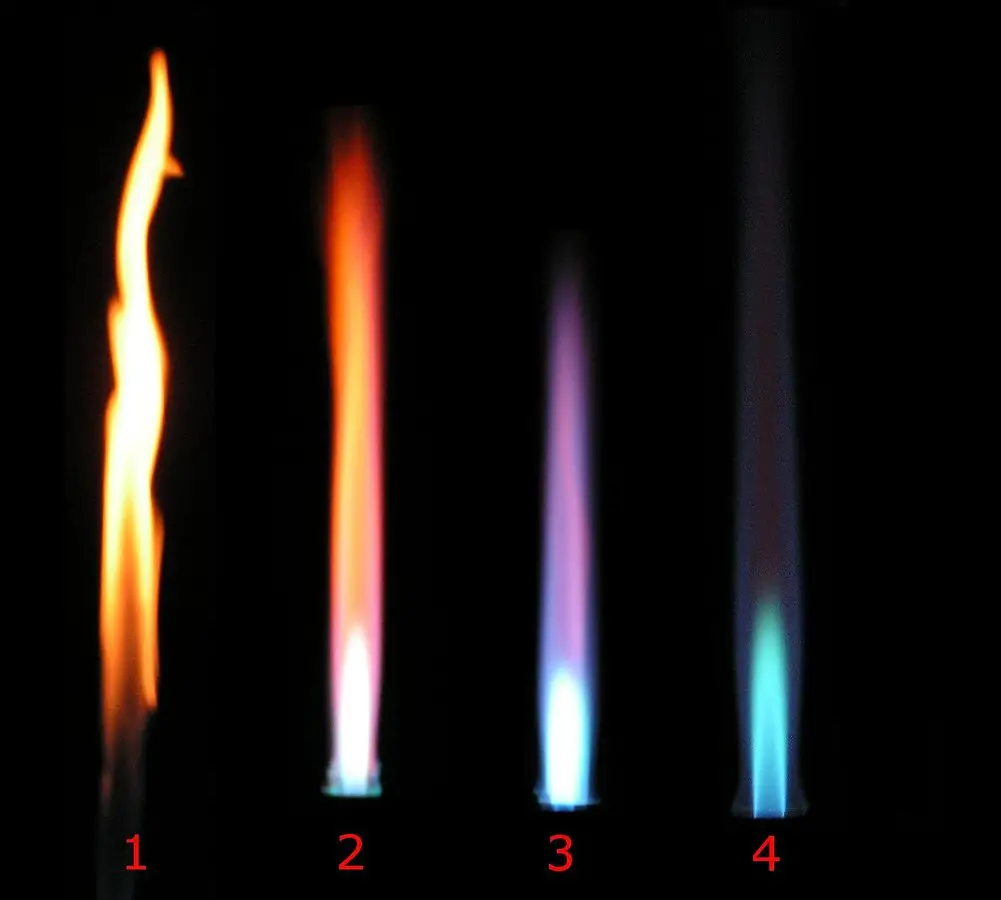
Uses of Bunsen Burner
The following are the uses of Bunsen Burner–
- It is used for heating in laboratory. Liquids, chemical reagents and other materials are heated by using yellow or blue flame.
- It is used in microbiology for sterilization. Inoculating loop, needle and mouth of culture tube are sterilized by passing through the flame.
- It is used for aseptic work. The hot flame produces upward air current and reduces dust and microbes near the working area.
- It is used in flame test. Some elements give special colour in non-luminous flame and this helps in their identification.
- It is used in spectroscopy work. Heated elements emit coloured light which can be studied for qualitative analysis.
- It is used for evaporation and crystallization. Solvent is removed by heating and crystals may be formed.
- It is used for dehydration and drying of salts. Water of crystallization may be removed from hydrated salts by heating.
- It is used for melting point and boiling point related experiments. Thiele tube method and other simple heating methods may use Bunsen flame.
- It is used for testing flammability of substances. Flash point of some solvents can also be studied with proper safety.
- It is used in mineral fusion test. Minerals and salts are heated strongly for analysis.
- It is used in glass working. Glass tube can be bent, capillary tube can be sealed and sharp glass end can be fire polished.
Advantages of Bunsen Burner
The following are the advantages of Bunsen Burner–
- It is easy to handle. It can be set, lighted and used in laboratory without complicated arrangement.
- The heat can be controlled easily. By rotating the collar, the air supply is changed and flame size, colour and temperature can be adjusted.
- It gives clean flame when air and gas are mixed properly. The blue flame is non-luminous and does not produce much soot.
- It does not blacken glassware much. So beaker, test tube and other apparatus remain cleaner during heating.
- It uses easily available fuel. Natural gas, coal gas, propane or butane can be used.
- It is economical for laboratory heating. The fuel cost is low and the burner can be used many times.
- It is used for many laboratory works. Heating, evaporation, sterilization, flame test and simple glass bending can be done.
- It helps in aseptic work. The hot flame produces upward air current and reduces dust and microbes near the working area.
- It is available in different sizes and forms. Meker burner, Tirrill burner and other types can be selected according to need.
Limitations of Bunsen Burner
The following are the limitations of Bunsen Burner–
- It has constant fire risk. It produces open flame, so paper, solvent and other inflammable materials may catch fire.
- It does not give exact temperature control. The flame temperature can be changed by air and gas supply, but fixed precise temperature is difficult to maintain.
- Flashback or striking back may occur. In this condition the flame goes down inside the barrel and burns near the base.
- Striking back can make the burner very hot. It may also damage the burner and sometimes small explosion may occur.
- It makes the laboratory hot and stuffy. So it should be used in well ventilated place.
- It can cause burn injury. The flame and metal barrel become very hot during use.
- Loose cloth and hair may catch fire. So proper care is needed while working near the flame.
- It is not safe for some sterile working area. Bunsen burner should not be used inside biological safety cabinet because open flame is not suitable there.
Precautions of Bunsen Burner
The following are the precautions of Bunsen Burner–
- The working area should be cleared before lighting the burner. Paper, notebook, combustible material and excess chemicals should be removed from nearby place.
- The burner should be used in well ventilated place. It should not be used inside biological safety cabinet.
- Safety goggles and flame resistant lab coat or apron should be worn. Long hair, loose dress and hanging jewellery should be tied back.
- Rubber tube should be checked before connecting gas. Crack, hole, pinch, hardening or loose fitting should not be present.
- The rubber tube should fit tightly with gas tap and burner inlet. Damaged tube should be replaced before use.
- Flint striker or long nozzle lighter should be kept ready before opening gas. Match stick should be avoided as far as possible.
- Gas should not be opened for long time before ignition. The burner should be lighted immediately after opening gas.
- The flame should not be left unattended. Even yellow safety flame should be watched during work.
- If striking back occurs, gas supply should be turned off immediately. The burner should be allowed to cool before lighting again.
- After work, gas should be closed from main bench valve. This prevents gas remaining under pressure inside the rubber tube.
- The burner should be kept on heat proof mat after use. The barrel becomes very hot and should not be touched directly.
- The burner should be allowed to cool completely before cleaning, touching or storing.
Video Guide on Bunsen Burner
Bunsen Burner Basics – by Dr Sapna Gupta
How to use a Bunsen burner safely
How to Light a Bunsen Burner
References
- Brunning, A. (2023, March 31). Today in chemistry history: Robert Bunsen and the Bunsen burner. Compound Interest.
- Bunsen burner. (2018, June 11). Encyclopedia.com.
- Bunsen burner. (2025, September 9). In Wikipedia.
- Cadence CFD. (n.d.). The Venturi effect and Bernoulli’s principle. System Analysis Blog | Cadence.
- Campbell, J. (2024). Bunsen burner. Science | Research Starters – EBSCO.
- Campbell, J. (2024). Bunsen burner. Science | Research Starters | EBSCO Research.
- Certified MTP. (n.d.). Top quality Bunsen burners | Laboratory equipment & supplies.
- Filo. (2025, October 22). What do you understand by striking back of abunsen burner.
- Gauth. (n.d.). Define the term “striking back” as applied to a Bunsen burer flame.
- Heney, P. (2020, October 28). What are Bunsen burners? R&D World.
- Jensen, W. B. (2009). The origins of the Meker and Tirrill burners. Journal of Chemical Education, 86, 1362-1363.
- Karki, P. (2025, April 9). Bunsen burner explained: Principle, types & uses. Microbe Notes.
- Pierrel, F. (2025, July 14). Preventing flashback in process heater burners. Enertherm Engineering.
- Ramirez, G., & Seeboo, H. (n.d.). Robert Bunsen | Biography & inventions. Study.com.
- School Specialty. (n.d.). How to find the perfect laboratory burner. Schoolyard Blog.
- Technical monographs on laboratory combustion systems: The Bunsen burner as a paradigm of controlled thermochemical reaction. (n.d.).
- Termotecnica Pericoli. (n.d.). The Venturi effect. What it is and its application fields.
- Texas A&M University-San Antonio. (n.d.). Guidelines: Bunsen burner.
- The Bunsen burner. (n.d.).
- Venturi effect. (2026, April 28). In Wikipedia.
- Vidrio Industrial Pobel. (2026, February 17). Bunsen burner: Parts, flame types, uses and safety guidelines.
- Wassertec Ozone Systems. (n.d.). Explanation of the Venturi effect and its applications.