

Pyruvate Broth Test is a biochemical test that is used in microbiology for identification and differentiation of certain bacteria. It is mainly used for differentiating species of Enterococcus group. It is the process in which ability of organism to utilize sodium pyruvate as a sole source of energy is determined. The medium used in this test contains pyruvate as the only carbohydrate source and lacks other fermentable sugars. If the organism is able to metabolize pyruvate it produces acidic end products which results in change in pH of medium.
The detection of this reaction is done by the presence of a pH indicator known as bromothymol blue in the broth. When pyruvate is utilized acid is formed and pH of medium is reduced below 6.0. Due to this the colour of medium changes from greenish blue to yellow. This positive reaction is characteristic for Enterococcus faecalis. If the organism is unable to utilize pyruvate then no acid is produced and the colour of broth remains greenish blue which indicates a negative result. This reaction is commonly observed in Enterococcus faecium and Streptococcus bovis.
Objectives of Pyruvate Broth Test
- To determine the ability of organism to utilize sodium pyruvate as a sole source of energy in absence of carbohydrates.
- To detect production of acidic end products formed during metabolism of pyruvate by observing colour change of indicator.
- To differentiate species of Enterococcus based on pyruvate utilization reaction.
- To help in identification of Enterococcus faecalis which shows positive reaction in pyruvate broth.
- To differentiate Enterococcus faecium and other non-pyruvate utilizing enterococci which shows negative reaction.
- To distinguish enterococci from Group D streptococci such as Streptococcus bovis group which do not utilize pyruvate.
Principle of Pyruvate Broth Test
Pyruvate Broth Test is based on the principle that certain bacteria are able to utilize sodium pyruvate as a sole source of energy in the absence of other carbohydrates. The medium used in this test is restricted of fermentable sugars therefore organism are forced to metabolize pyruvate if the required enzyme system is present. When pyruvate is utilized it is converted into acidic end products such as lactic acid which leads to reduction in pH of the medium.
The broth contains bromothymol blue as a pH indicator which helps in detection of this reaction. Due to acid production the pH falls below the neutral range and the colour of medium changes from greenish blue to yellow which is taken as positive reaction. If the organism is unable to utilize pyruvate it instead degrades peptones present in the medium producing alkaline end products. In such condition no significant drop in pH occurs and the medium remains greenish blue or may turn deep blue indicating negative reaction. This principle is mainly applied for differentiation of Enterococcus faecalis from Enterococcus faecium.
Requirements of Pyruvate Broth Test
- Pyruvate broth containing sodium pyruvate as the only carbohydrate source and bromothymol blue as indicator.
- Fresh pure culture of test organism preferably 18–24 hours old.
- Positive control organism such as Enterococcus faecalis.
- Negative control organism such as Enterococcus faecium or Streptococcus bovis.
- Sterile inoculating loop or needle for inoculation.
- Sterile test tubes containing required quantity of pyruvate broth.
- Incubator maintained at 35°C–37°C under aerobic condition.
Procedure of Pyruvate Broth Test
- Pyruvate broth tubes are allowed to attain room temperature before inoculation.
- A fresh pure culture of test organism of 18–24 hours is selected from non selective medium.
- Using sterile inoculating loop or needle 2–3 well isolated colonies are picked.
- The colonies are directly inoculated into pyruvate broth with light inoculum.
- The tubes are incubated aerobically at 35°C–37°C with caps kept loose.
- The broth is observed after 24–48 hours for colour change.
- If no definite reaction is seen incubation is continued and observed daily up to 5 days before reporting result.
Expected Results of Pyruvate Broth Test
Positive result (+)– The colour of broth changes from greenish blue to bright yellow. It indicates utilization of pyruvate with formation of acidic end products. This reaction is seen in Enterococcus faecalis.
Negative result (–)– The broth remains greenish blue with no colour change. It shows inability of organism to utilize pyruvate. This reaction is common in Enterococcus faecium and Streptococcus bovis.
Alkaline negative reaction– The broth may turn deep blue in colour. It occurs due to utilization of peptones instead of pyruvate with release of alkaline products.
Weak or doubtful reaction– Yellowish green colour is considered as negative result. In such case incubation is continued up to 5 days to observe development of definite yellow colour.
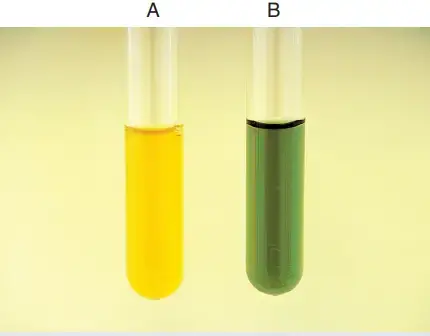
Organisms Showing Results in Pyruvate Broth Test
Positive result (yellow colour change)
- Enterococcus faecalis
Negative result (broth remains greenish blue or blue)
- Enterococcus faecium
- Streptococcus bovis
- Enterococcus durans
- Enterococcus hirae
- Enterococcus avium
- Enterococcus mundtii
- Enterococcus raffinosus
Variable or negative result
- Enterococcus gallinarum
- Enterococcus casseliflavus
Quality Control of Pyruvate Broth Test
- Positive control organism such as Enterococcus faecalis is inoculated to check performance of medium.
- The positive control shows growth with colour change of broth from greenish blue to yellow within 24–48 hours.
- Negative control organism such as Enterococcus faecium is used to confirm negative reaction.
- The negative control shows growth but broth remains greenish blue with no colour change.
- Streptococcus bovis may also be used as alternative negative control which shows no colour change.
- Before use the pyruvate broth is examined for proper colour pH clarity and sterility.
Precautions of Pyruvate Broth Test
- The pyruvate broth should not be over sterilized as excess heat may destroy sodium pyruvate or indicator.
- The broth tubes should be stored at 4–8°C in upright position and protected from direct light.
- The broth must be allowed to reach room temperature before inoculation.
- A light inoculum should be used to avoid false positive reaction due to carryover acids.
- The caps of test tubes should be kept loose during incubation for proper gas exchange.
- The test should not be discarded early and incubation should be continued up to 5 days if required.
- The media used should be free from residual carbohydrates to prevent false results.
- Yellowish green colour should be considered as negative reaction and not positive.
- All cultures and inoculated tubes should be handled using proper aseptic technique.
Uses of Pyruvate Broth Test
- It is used for differentiation of Enterococcus species based on pyruvate utilization.
- It helps in identification of Enterococcus faecalis which gives positive pyruvate reaction.
- It is used to differentiate Enterococcus faecium which shows negative reaction in pyruvate broth.
- It helps in differentiation of Enterococcus from Group D streptococci such as Streptococcus bovis.
- It is useful as a supplementary biochemical test in identification of Gram positive catalase negative cocci.
- It is applied in determining ability of organism to utilize pyruvate as sole source of energy.
Advantages of Pyruvate Broth Test
- It helps in easy differentiation of Enterococcus faecalis and Enterococcus faecium.
- It provides supportive information for selection of appropriate antibiotic therapy.
- It is useful in distinguishing Enterococcus from Group D streptococci.
- It is a simple and cost effective biochemical test.
- It can be performed in routine microbiology laboratory without special equipment.
- It gives clear visual result due to distinct colour change of indicator.
- It is helpful as a confirmatory test when identification results are doubtful.
Limitations of Pyruvate Broth Test
- It has limited application and is mainly used for differentiation of Enterococcus species.
- It cannot be used as a sole test for complete identification of organism.
- Presence of residual carbohydrates in media may give false positive reaction.
- Use of heavy inoculum may lead to misleading colour change.
- Slow growing strains may show false negative result if incubation is stopped early.
- The indicator bromothymol blue is light sensitive and improper storage may affect result.
- Occasional strain variation may give atypical reaction.
- Weak yellowish green colour may create difficulty in interpretation of result.
- Advanced Metabolic Phenotyping in Clinical Microbiology: A Comprehensive Technical Analysis of the Pyruvate Broth Test. (n.d.).
- Akhter, J., Ahmed, S., & Anwar, S. (2014). Antimicrobial susceptibility patterns of Enterococcus species isolated from urinary tract infections. Bangladesh Journal of Medical Microbiology, 8(1), 16–20.
- Aryal, S. (2022, August 10). PYR Test- Principle, Uses, Procedure and Result Interpretation. Microbiology Info.com.
- Aryal, S. (2022, August 10). Pyruvate Broth Test – Principle, Procedure, Uses and Interpretation. Microbiology Info.com.
- Bacterial diagnosis (Gram negative bacteria) 1- IMViC Test. (n.d.).
- Dahal, P. (2023, June 5). Pyruvate Broth Test- Principle, Procedure, Results, Uses. Microbe Notes.
- Dalynn Biologicals. (2014). Pyruvate Broth [Technical Data Sheet].
- Food Safety and Standards Authority of India. (2023). Manual of Methods of Analysis – Microbiological Examination of Food and Water. Ministry of Health and Family Welfare, Government of India.
- Hanson, A. (2008, September 8). Oxidative-Fermentative Test Protocol. American Society for Microbiology.
- HiMedia Laboratories. (2024). Tryptone Soya Broth w/ 10% NaCl and 1% Sodium Pyruvate [Technical Data].
- Lejan, J. U. (n.d.). Biochemical Tests. Pre-Med.
- Manero, A., & Blanch, A. R. (1999). Identification of Enterococcus spp. with a biochemical key. Applied and Environmental Microbiology, 65(10), 4425–4430.
- Microbe Online. (n.d.). Gram Positive Cocci Archives.
- Module 10 Gram Positive Cocci. (n.d.). Scribd.
- Ramsey, M., Hartke, A., & Huycke, M. (2014). The physiology and metabolism of enterococci. In M. S. Gilmore, D. B. Clewell, Y. Ike, et al. (Eds.), Enterococci: From Commensals to Leading Causes of Drug Resistant Infection. Massachusetts Eye and Ear Infirmary.
- Repizo, G. D., Mortera, P., & Magni, C. (2011). Disruption of the alsSD operon of Enterococcus faecalis impairs growth on pyruvate at low pH. ResearchGate.
- Watson, R. (n.d.). Tests used to identify Gram Negative Bacteria. University of Wyoming.