

The Cetrimide Test is a biochemical and microbiological test that is used for the selective isolation and identification of Pseudomonas aeruginosa. It is mainly applied for the examination of water samples, clinical specimens and pharmaceutical products. It is performed using cetrimide agar which is a selective solid culture medium. The medium contains cetrimide (cetyltrimethylammonium bromide) which is a quaternary ammonium compound having detergent property.
The principle of cetrimide test is based on the ability of Pseudomonas aeruginosa to resist the inhibitory action of cetrimide. Most of the other bacteria are inhibited because cetrimide damages the cell membrane and causes leakage of essential cellular components such as nitrogen and phosphorus. As a result, the growth of accompanying microbial flora is suppressed while P. aeruginosa is allowed to grow.
The test also helps in identification by stimulating pigment production. The cetrimide agar contains magnesium chloride and potassium sulfate which enhances the synthesis of characteristic pigments. These pigments include pyocyanin which gives blue-green colour and pyoverdine which produces yellow-green fluorescence. A positive cetrimide test is indicated by visible bacterial growth showing blue-green pigmentation or yellow-green fluorescence under ultraviolet light. A negative test is indicated by complete absence of growth on the medium.
Objectives of Cetrimide Agar Test
- To selectively isolate Pseudomonas aeruginosa from different materials such as clinical specimens (pus sputum) water cosmetics and non-sterile pharmaceutical products.
- To presumptively identify Pseudomonas aeruginosa and differentiate it from other microorganisms mainly other non-fermenting Gram-negative bacilli.
- To detect pigment production by organism where the medium enhances formation of specific pigments such as pyocyanin (blue-green pigment) and fluorescein (pyoverdine).
- To determine the ability of organism to grow in presence of cetrimide which is a toxic quaternary ammonium detergent inhibiting growth of most other bacteria.
- To enumerate Pseudomonas aeruginosa colonies particularly during analysis of water samples and environmental sources.
- To use the test as a microbial limit and quality control test for ensuring non-sterile products like cosmetics and pharmaceutical preparations are free from Pseudomonas aeruginosa contamination.
Principle of Cetrimide Agar Test
The principle of cetrimide agar test is based on the selective inhibitory action of cetrimide (cetyltrimethylammonium bromide) on bacterial growth. Cetrimide is a quaternary ammonium compound which acts as a cationic detergent and reduces surface tension at the point of contact. It disrupts the cell membrane of susceptible bacteria leading to denaturation of membrane proteins and release of essential intracellular components such as nitrogen and phosphorus. Due to this toxic effect, the growth of most bacteria is inhibited on the medium.
Pseudomonas aeruginosa shows intrinsic resistance to the germicidal action of cetrimide and hence it is able to survive and grow on the agar. The medium also contains magnesium chloride and potassium sulfate which helps in stimulating the production of characteristic pigments. These pigments include pyocyanin which produces blue-green colour and pyoverdin which gives yellow-green fluorescence. This selective growth along with pigment production forms the basis for identification of Pseudomonas aeruginosa using cetrimide agar.
Requirements for Cetrimide Agar Test
Culture Medium Components (for 1 litre of Cetrimide Agar)
- Pancreatic digest of gelatin (20.0 g) – It provides essential nitrogen vitamins and amino acids required for growth. It is low in phosphorous which helps in minimizing inhibition of pyocyanin production.
- Magnesium chloride (1.4 g) – It acts as an activator and stimulates production of pyocyanin (blue-green pigment) and pyoverdin (fluorescein).
- Potassium sulfate (10.0 g) – It works as a co-activator along with magnesium chloride and enhances pigment production.
- Cetrimide (0.3 g) – It is chemically cetyltrimethylammonium bromide. It is the selective agent which inhibits most other bacteria by damaging cell membrane while Pseudomonas aeruginosa remains resistant.
- Glycerol (10.0 mL) – It acts as carbon and energy source for the organism and is generally added during preparation of medium.
- Agar (13.6 g–15.0 g) – It is used as solidifying agent for providing solid surface for colony isolation.
- Distilled or deionized water (1000 mL) – It is used to dissolve all the components of medium.
- pH adjusters – The final pH of medium is adjusted to 7.2 ± 0.2 at 25°C.
Laboratory Equipment and Supplies
- Sterile inoculating loop needle or applicator stick – It is used for streaking the specimen on agar surface.
- Incubator – It is required to maintain aerobic condition at 30°C–37°C usually 35–37°C for 18–72 hours.
- UV lamp (Wood’s lamp) – It is required to observe yellow-green fluorescence of pyoverdin under ultraviolet light.
- Autoclave – It is used for sterilization of medium at 121°C at 15 lbs pressure for 15 minutes.
- Petri dishes or test tubes – These are used for pouring and solidifying the medium.
Biological Requirements
- Test specimen – Pure culture (18–24 hours old) or clinical and environmental samples such as pus sputum and water.
- Positive control – A known strain of Pseudomonas aeruginosa showing growth and pigment production.
- Negative control – An organism which is inhibited by cetrimide such as Escherichia coli.
Optional Supplement
- Nalidixic acid – It may be added in some modified media to further inhibit enteric bacteria like Proteus and Klebsiella species.
Procedure of Cetrimide Agar Test
Media Preparation
- Suspend dehydrated Cetrimide agar powder (about 45.3–46.7 g) in 1000 mL of distilled or purified water.
- Add 10 mL of glycerol to the medium as it acts as carbon source and supports pigment production.
- Heat the mixture to boiling with frequent agitation until the medium is completely dissolved.
- Sterilize the medium by autoclaving at 121°C for 15 minutes at 15 lbs pressure.
- Cool the medium to 45–50°C and pour into sterile Petri dishes or dispense into test tubes and allow to solidify (tubes are kept in slanting position).
Inoculation
- Using a sterile inoculating loop or needle pick a well isolated colony from 18–24 hours old pure culture.
- Streak the organism on the surface of Cetrimide agar plate by quadrant streak method or on agar slant by fish-tail motion.
- For water samples filter the sample through membrane filter and place the membrane directly on the agar surface.
- If organisms are stressed a pre-enrichment step in non-selective broth may be done before inoculation.
Incubation
- Incubate the inoculated media under aerobic conditions.
- Maintain the temperature at 35–37°C (in some cases 30–35°C is followed).
- Examine the plates after 18–24 hours of incubation.
- If no growth is observed incubate further and examine daily up to 4–7 days.
Examination and Interpretation
- Observe the plates for bacterial growth indicating resistance to cetrimide.
- Examine the colonies for blue-green pigmentation due to pyocyanin production.
- Observe the colonies under ultraviolet light for yellow-green fluorescence indicating fluorescein (pyoverdin) production.
Result and Interpretation of Cetrimide Agar Test
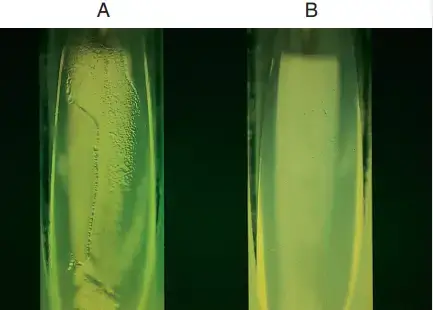
Positive Result (Presumptive Pseudomonas aeruginosa)
- Growth of colonies on Cetrimide agar is observed which indicates resistance of organism to cetrimide.
- Colonies may show blue-green pigmentation due to production of pyocyanin pigment.
- Yellow-green fluorescence is observed when colonies are examined under ultraviolet light which indicates production of fluorescein (pyoverdin).
- A characteristic grape-like or fruity odor may be produced by the organism.
- Some strains may produce other pigments such as pyorubrin (pink to red) or pyomelanin (brown).
- Non-pigmented strains may also grow on the medium and growth alone is considered as positive result.
Negative Result
- No bacterial growth is observed on the medium.
- This indicates the organism is inhibited by cetrimide and is not Pseudomonas aeruginosa.
- Most enteric bacteria and Gram-positive organisms show complete inhibition of growth.
Atypical or Interfering Results
- Slight growth with see yellowing of medium may be observed with some enteric organisms.
- The yellow colour does not show fluorescence under ultraviolet light and is differentiated from fluorescein.
- Some other non-fermenting organisms may grow and fluoresce but usually do not produce pyocyanin pigment.
Organisms Showing Positive and Negative Result in Cetrimide Agar Test
Positive Result (Growth observed)
- Pseudomonas aeruginosa – Shows good to luxuriant growth with blue-green pigmentation due to pyocyanin and yellow-green fluorescence due to pyoverdin.
- Pseudomonas fluorescens – Shows growth with yellow-green fluorescent colonies but pyocyanin is not produced.
- Pseudomonas putida – Shows growth with fluorescent colonies and absence of blue-green pigment.
- Serratia species – Some strains may grow and produce pink pigmentation.
- Klebsiella, Enterobacter, Citrobacter, Proteus, Providencia – Occasional growth may be seen with slight yellowing of medium but no fluorescence.
- Alcaligenes, Aeromonas, Achromobacter xylosoxidans, Alcaligenes faecalis – May grow on medium but do not produce characteristic pigments.
Negative Result (No growth / inhibited)
- Escherichia coli – Growth is inhibited by cetrimide.
- Staphylococcus aureus – Shows complete inhibition of growth.
- Proteus mirabilis – Usually inhibited on Cetrimide agar.
- Salmonella Typhimurium – No growth observed.
- Shigella flexneri – Growth is inhibited.
- Stenotrophomonas maltophilia – Generally inhibited though some strains may show poor growth.
Precautions of Cetrimide Agar Test
- Handle cetrimide carefully as it is irritant to skin eyes and respiratory tract.
- Wear protective gloves laboratory coat and eye protection while handling medium and specimens.
- Treat all clinical and environmental samples as potentially infectious and follow standard microbiological safety practices.
- Autoclave all used media contaminated plates and materials before disposal.
- Store prepared Cetrimide agar plates away from direct light as the medium is light sensitive.
- Store dehydrated medium in tightly closed container at recommended temperature and store prepared plates at refrigerated condition.
- Do not allow moisture to accumulate on agar surface as it may interfere with colony isolation.
- Do not keep molten medium for long duration before pouring as it may affect selectivity of medium.
- Do not use medium showing cracks discoloration contamination or deterioration.
- In case of stressed or injured organisms perform pre-enrichment in non-selective broth before inoculation.
- Do not confuse slight yellowing caused by some enteric organisms with fluorescein production.
- should be considered presumptive positive.
- Growth on Cetrimide agar should always be confirmed by further biochemical tests for final identification.
Uses of Cetrimide Agar Test
- To selectively isolate Pseudomonas aeruginosa from mixed microbial flora as cetrimide inhibits growth of most other bacteria.
- To presumptively identify Pseudomonas aeruginosa based on its ability to grow in presence of cetrimide.
- To detect pigment production such as pyocyanin (blue-green) and fluorescein (yellow-green fluorescence under UV light).
- To examine clinical specimens like sputum pus urine and wound samples for presence of Pseudomonas aeruginosa.
- To detect and enumerate Pseudomonas aeruginosa in water samples including drinking water swimming pool water and industrial water sources.
- To perform microbial limit test for non-sterile pharmaceutical products and cosmetic preparations to ensure absence of Pseudomonas aeruginosa.
- To examine food samples for contamination with Pseudomonas aeruginosa.
- To determine ability of organism to tolerate and grow in presence of cetrimide which is a toxic quaternary ammonium compound.
Advantages of Cetrimide Agar Test
- It allows selective isolation of Pseudomonas aeruginosa as cetrimide inhibits growth of most other Gram-positive and Gram-negative bacteria.
- It enhances identification by stimulating production of characteristic pigments such as pyocyanin and fluorescein.
- Colonies can be easily recognized by blue-green colour and yellow-green fluorescence under UV light.
- It supports relatively rapid growth of Pseudomonas aeruginosa as compared to some other selective media.
- It is a standard medium recommended by pharmacopoeial and ISO guidelines for routine testing.
- It permits presumptive identification in a single step without requirement of immediate confirmatory tests.
- It is simple to prepare and easy to interpret in routine laboratory practice.
- It is cost effective and reliable for detection of Pseudomonas aeruginosa in clinical and environmental samples.
Limitations of Cetrimide Agar Test
- Cetrimide is highly toxic therefore stressed or injured strains of Pseudomonas aeruginosa may show poor growth or may fail to grow.
- The medium does not inhibit all non-target organisms and some non-fermenters may grow on it.
- Certain enteric bacteria may show slight growth and cause yellowing of the medium which may interfere with interpretation.
- Yellow discoloration produced by some organisms may be confused with fluorescein production if not examined under UV light.
- Other Pseudomonas species such as Pseudomonas fluorescens and Pseudomonas putida may also grow and produce fluorescence.
- Some strains of Pseudomonas aeruginosa are non-pigmented therefore absence of blue-green pigment does not rule out the organism.
- Fluorescence may reduce or disappear if plates are kept at room temperature for long time.
- Growth on Cetrimide agar is only presumptive and further biochemical tests are required for confirmation.
- Variation in media composition may influence pigment production and growth pattern.
- Abdelaziz, A. A., Abo Kamer, A. M., Al-Monofy, K. B., & Al-Madboly, L. A. (2023). Pseudomonas aeruginosa’s greenish-blue pigment pyocyanin: its production and biological activities. Microbial Cell Factories, 22(110). https://doi.org/10.1186/s12934-023-02122-1
- Acumedia. (2017). Cetrimide Agar (7222): Product information. Neogen Corporation.
- Al-Daghistani, H. I., Abu-Niaaj, L. F., & Zein, S. (2025). Accurate diagnosis of Pseudomonas aeruginosa is critical to mitigating development of antibiotic resistance. Antibiotics, 14(5), 509. https://doi.org/10.3390/antibiotics14050509
- Aryal, S. (2022, August 10). Cetrimide Agar- Composition, principle, uses, preparation and colony morphology. Microbiology Info. https://microbiologyinfo.com/cetrimide-agar-composition-principle-uses-preparation-and-colony-morphology/
- Aryal, S. (2022, August 10). Cetrimide Test – Principle, procedure, uses and interpretation. Microbiology Info. https://microbiologyinfo.com/cetrimide-test/
- Bio-Rad. (n.d.). RAPID’P.aeruginosa Agar for water testing [Product information].
- Biokar Diagnostics. (2016). Cetrimide Agar: Detection and enumeration of Pseudomonas aeruginosa [Technical data sheet].
- Dalynn Biologicals. (2014). Cetrimide Agar [Technical data sheet].
- Hardy Diagnostics. (2020). Pseudomonas Agar F and P (Tech Agar) [Instructions for use].
- Hassett, D. J., Charniga, L., Bean, K., Ohman, D. E., & Cohen, M. S. (1992). Response of Pseudomonas aeruginosa to pyocyanin: Mechanisms of resistance, antioxidant defenses, and demonstration of a manganese-cofactored superoxide dismutase. Infection and Immunity, 60(2), 328–336.
- HiMedia Laboratories. (2024). Cetrimide Agar Base (w/1.3% Agar) [Technical data].
- HiMedia Laboratories. (2025). Pseudomonas Agar Base (CN Agar) [Technical data].
- Jami Al-Ahmadi, G., & Zahmatkesh Roodsari, R. (2016). Fast and specific detection of Pseudomonas aeruginosa from other Pseudomonas species by PCR. Annals of Burns and Fire Disasters, 29(4), 264–267.
- Kaiser, G. E. (2024, January 3). 12.6.3: Cetrimide Agar (Pseudomonas P agar). Biology LibreTexts. https://bio.libretexts.org/
- Lemare, M., Puja, H., David, S. R., Mathieu, S., Ihiawakrim, D., Geoffroy, V. A., & Rigouin, C. (2022). Engineering siderophore production in Pseudomonas to improve asbestos weathering. Microbial Biotechnology, 15(9), 2351–2363. https://doi.org/10.1111/1751-7915.14099
- Merck KGaA. (2018). 22470 Cetrimide Agar (Pseudomonas selective agar base) [Product information]. Sigma-Aldrich.
- Merck Millipore. (n.d.). Cetrimide Agar Pseudomonas selective agar base acc. harm. EP/USP/JP [Technical data sheet]. Sigma-Aldrich.
- Micromaster Laboratories. (n.d.). Cetrimide Agar Base (DM057) [Product specification sheet].
- Mudaliar, S. B., & Bharath Prasad, A. S. (2024). A biomedical perspective of pyocyanin from Pseudomonas aeruginosa: its applications and challenges. World Journal of Microbiology and Biotechnology, 40(3), 90. https://doi.org/10.1007/s11274-024-03889-0
- Neogen. (n.d.). Neogen® Pseudomonas Agar Base [Product page].
- PanReac AppliChem. (n.d.). Cetrimide Agar (Ph. Eur.) (Dehydrated culture media) for microbiology [Product data sheet]. ITW Reagents.
- Parsons, J. F., Greenhagen, B. T., Shi, K., Calabrese, K., Robinson, H., & Ladner, J. E. (2007). Structural and functional analysis of the pyocyanin biosynthetic protein PhzM from Pseudomonas aeruginosa. Biochemistry, 46(7), 1821–1828. https://doi.org/10.1021/bi6024403
- Pokhrel, P. (2015, September 3). Cetrimide Test- Principle, procedure, result interpretation and limitation. Microbiology Notes. https://microbiologynotes.com/cetrimide-test-principle-procedure-result-interpretation-and-limitation/
- Ringel, M. T., & Brüser, T. (2018). The biosynthesis of pyoverdines. Microbial Cell, 5(10), 424–437. https://doi.org/10.15698/mic2018.10.649
- Sapkota, A. (2022, January 27). Cetrimide Agar Test- Principle, procedures, results, uses. Microbe Notes. https://microbenotes.com/cetrimide-agar-test-principle-procedure-and-result-interpretation/
- Siegrist, J. (2007). Pseudomonas media and tests. Analytix, 5. Sigma-Aldrich.
- Spies, K., Pleischl, S., & Sartory, D. (2020). Comparison of the Pseudalert™/Quanti-Tray® MPN test for the enumeration of Pseudomonas aeruginosa in cooling tower water with the ISO 16266 membrane filtration culture-based method. Journal of Applied Microbiology, 128(6), 1843–1850. https://doi.org/10.1111/jam.14586
- Tsoraeva, A., & Rodríguez Martínez, C. (2000). Comparison of two culture media for selective isolation and membrane filter enumeration of Pseudomonas aeruginosa in water. Revista Latinoamericana de Microbiología, 42(4), 149–154.
- Voulhoux, R., Filloux, A., & Schalk, I. J. (2006). Pyoverdine-mediated iron uptake in Pseudomonas aeruginosa: the Tat system is required for PvdN but not for FpvA transport. Journal of Bacteriology, 188(9), 3317–3323. https://doi.org/10.1128/JB.188.9.3317-3323.2006
- Wikipedia. (2024, May 19). Cetrimide agar.
- Wikipedia. (2024, June 3). Pyoverdine.