

Nosocomial infection is an infection acquired from hospital or health care centre. It occurs during treatment of a patient. It is also called hospital-acquired infection or healthcare-associated infection (HAI).
The word nosocomial is derived from Greek word nosokomeion. It means hospital. This term is used when the infection was not present in the patient before admission.
It is also used when there is no sign that the infection was incubating before medical care. The patient gets the infection after entering the hospital environment.
For classifying as nosocomial infection, symptoms usually appear after 48 hours of hospital admission. It may also appear up to 3 days after discharge. In surgical cases, it may appear up to 30 days after surgery.
The infection may be caused by bacteria, viruses or fungi. But bacteria are the main cause. About 90% cases are caused by bacteria.
The common diseases caused by nosocomial infection are urinary tract infection (UTI), surgical site infection, pneumonia, gastroenteritis and meningitis.
These infections are important in hospital practice. It increases hospital stay, patient suffering and treatment cost. It may also cause serious complication in weak and operated patients.
Types of Nosocomial Infections
The following are the important types of nosocomial infections–
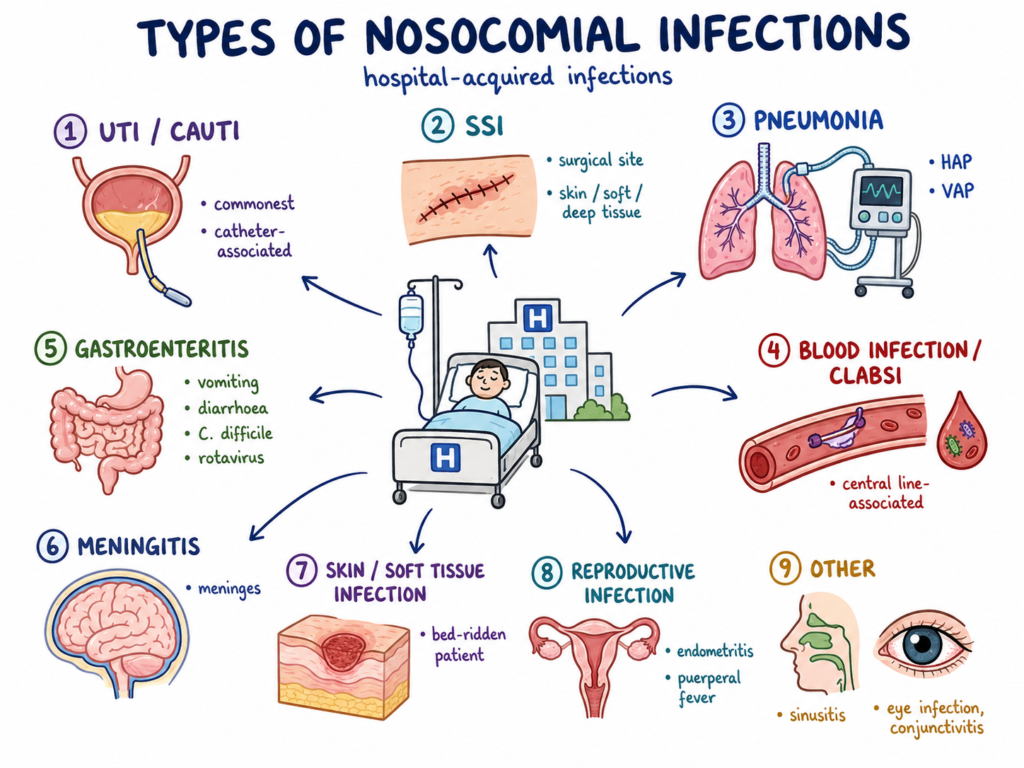
- UTI– Urinary tract infection (UTI) is the commonest nosocomial infection. It is mostly related with urinary catheter. This is called Catheter-Associated Urinary Tract Infection (CAUTI). The organisms pass into urinary tract through catheter.
- SSI– Surgical site infection (SSI) is infection of surgical wound. It occurs in the operated part of body. It may involve skin, soft tissue and deep tissue.
- Pneumonia– Pneumonia is infection of lungs acquired in hospital. It is of two main forms, Hospital-Acquired Pneumonia (HAP) and Ventilator-Associated Pneumonia (VAP). VAP is common in patient kept on ventilator in ICU.
- Blood infection– Bloodstream infection is infection of blood. It mostly occurs through central venous catheter. This infection is called Central Line-Associated Bloodstream Infection (CLABSI).
- Gastroenteritis– Gastroenteritis is infection of alimentary tract. It causes vomiting, nausea and diarrhoea. It may be caused by Clostridioides difficile, rotavirus and other organisms.
- Meningitis– Meningitis is infection of meninges. These are the protective membranes of brain and spinal cord. It may occur in hospital admitted patient after procedure or infection spread.
- Skin infection– Skin and soft tissue infection is infection of skin, sore, burn, ulcer and bedsore. It is common in long time bed ridden patient. Sometimes it may spread into blood.
- Reproductive infection– Reproductive organ infection occurs after delivery or childbirth. The examples are endometritis and puerperal fever. It affects reproductive tract.
- Other infection– Other nosocomial infections are sinusitis, eye infection and conjunctivitis. These are local infections. It may become severe in weak patient.
Risk Factors of Nosocomial Infections
The following are the important risk factors of nosocomial infections–
- Age– Advanced age mainly above 70 years is an important risk factor. Neonate and premature infant are also susceptible. Their immune system is weak or not fully developed.
- Weak immunity– Compromised immune system increases the chance of nosocomial infection. It occurs in HIV/AIDS, cancer, and patient taking immunosuppressive drugs or corticosteroids.
- Chronic disease– Patient with diabetes, renal failure and chronic lung disease are more at risk. These conditions reduce body defence. Healing also become slow.
- Poor body condition– Malnutrition and obesity are important risk factors. Malnutrition decreases resistance power. Obesity delay wound healing and increase infection chance.
- Lifestyle factor– Cigarette smoking and alcohol abuse also increase risk. These habits decrease normal body defence. It also affect lung and wound healing.
- Severe illness– Patient with major trauma, shock or coma are highly susceptible. In this condition body defence become weak. Patient also need many hospital procedures.
- Invasive device– Urinary catheter, central venous line, endotracheal tube and ventilator are common risk factors. These devices break normal body barrier. Organisms enter through these devices.
- Surgery– Surgical procedure produces wound in the body. This wound act as entry point for opportunistic pathogens. So surgical site infection (SSI) may occur.
- Antibiotic use– Long time or wrong use of antibiotics increase risk. It destroy normal protective flora. It also helps in development of multidrug-resistant organisms.
- Hospital stay– Long duration of hospital stay increases exposure to hospital organisms. More the stay, more chance of infection. It is common in weak patient.
- ICU admission– Intensive Care Unit (ICU) patient are more at risk. They are severely ill and many invasive devices are used. So infection chance become high.
- Special treatment– Total parenteral nutrition (TPN), organ transplant and blood transfusion may increase risk. These treatment are used in serious patient. Immunity may also be low.
- Hospital environment– Contaminated hospital surface, water system and medical equipment are source of infection. Organisms remain on bed, table, door handle and instruments.
- Health worker– Infection may spread through unwashed hands of health care workers. Contaminated gloves, cloth and instruments also transmit pathogens from one patient to another.
- Visitors– Roommates and visitors may bring or spread pathogens. Sharing room with infected or colonized patient also increases the chance of nosocomial infection.
Epidemiology of Nosocomial Infections
The following are the epidemiological features of nosocomial infections–
- Nosocomial infections are found in hospitals all over the world. At any time, more than 1.4 million people are suffering from hospital acquired infection. It is a common hospital problem.
- About 8.7% hospital patients have nosocomial infection on average. It occurs after admission and during hospital care. Many patient become infected after taking treatment.
- The rate is low in developed countries than poor resource countries. In Europe and North America, the rate is about 5-10%. In Latin America, Sub-Saharan Africa and Asia, it may be more than 40%.
- The infection rate is highest in Eastern Mediterranean region, about 11.8%. In South-East Asia, it is about 10.0%. In Western Pacific, it is 9.0% and in Europe, about 7.7%.
- In United States, about 1 in 31 hospital patients have at least one healthcare-associated infection (HAI) on any day. It is about 3% hospital patient.
- About 1.7 million HAIs occur every year in United States. It causes or contributes about 99,000 deaths. In another report, 687,000 infections were found in 2015, with about 72,000 deaths.
- In United Kingdom, about 300,000 patients were affected in 2017. In Belgium, prevalence is about 6.2% and nearly 125,500 patients affected every year. In Italy, the rate is about 6.7%, with 450,000-700,000 patients infected yearly.
- Urinary tract infection (UTI) is the commonest type of nosocomial infection. It forms about 32% of all HAIs in United States. About 80% of these infection are related with urinary catheter.
- Surgical site infection (SSI) forms about 22% of HAIs. It occurs in the site of operation. It may affect wound, tissue and deeper operated part.
- Hospital-acquired pneumonia (HAP) and Ventilator-associated pneumonia (VAP) forms about 15% of HAIs. These are more common in patient kept on ventilator. It is mostly seen in ICU patient.
- ICU patient have more chance of infection. The rate is about three times higher than general ward patient. It is because the patient is very ill and many invasive devices are used.
- Acute surgical ward, burn unit, neonatal unit and pediatric unit have more infection. In neonatal and pediatric unit, the chance of HAI may be 6.1% to 29.6%.
- ESKAPE pathogens cause many nosocomial infections. These are Enterococcus faecium, Staphylococcus aureus, Klebsiella pneumoniae, Acinetobacter baumannii, Pseudomonas aeruginosa and Enterobacter species. They are responsible for about 66% infections worldwide.
- Bacteria are the main cause. About 90% cases of nosocomial infections are bacterial. Staphylococcus aureus is an important cause of ventilator-associated pneumonia, about 24.7%.
- Coagulase-negative Staphylococci are important in central line-associated bloodstream infection. It causes about 16% of these infection. It mostly enter through central line.
- Nosocomial infections increase hospital stay. Patient usually need extra 4-5 days in hospital. In surgical wound infection, the stay may increase about 8.2 days.
- Nosocomial infections increase health care cost. In United States, the cost is about $4.5 billion to $11 billion every year. Surgical site infection alone costs about $3.3 billion yearly.
Source of Nosocomial Infection
The following are the important sources of nosocomial infection–
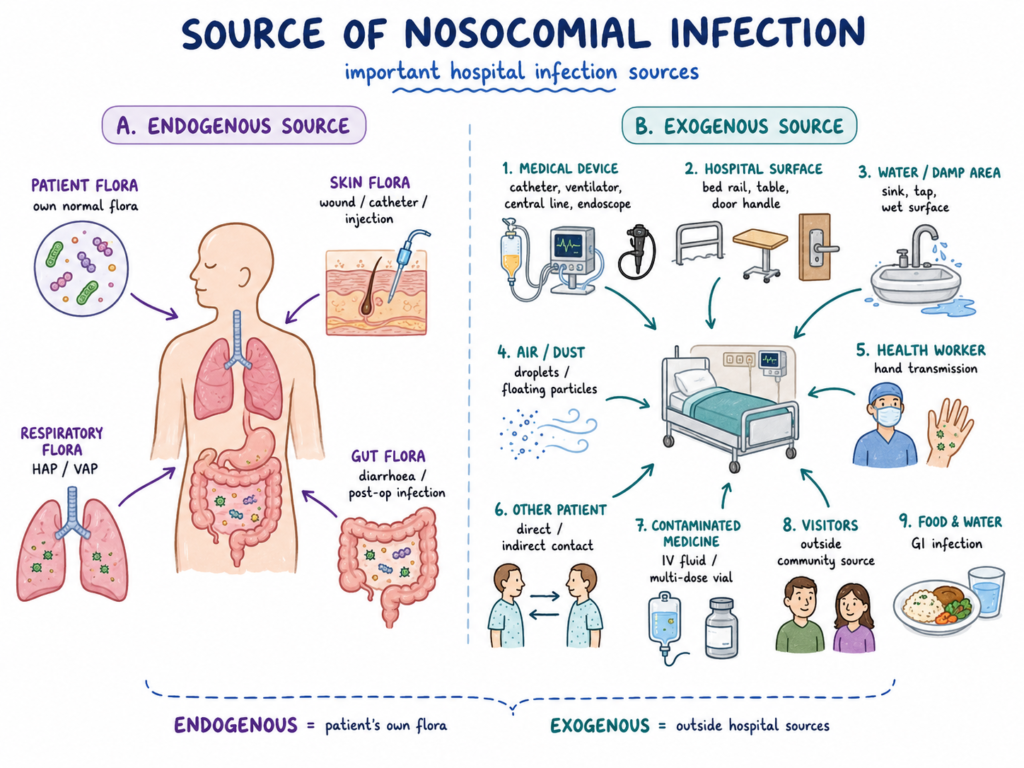
A. Endogenous source
- Patient flora– The patient own normal flora is the most common source of nosocomial infection. These organisms are normally present on skin, mucous membrane, respiratory tract and gastrointestinal tract. When they enter into sterile site, infection occurs.
- Skin flora– Skin flora may enter into body through surgical wound, injection site, catheter and other invasive procedure. It may cause wound infection, blood infection and device related infection.
- Respiratory flora– Organisms present in nose, throat and respiratory tract may cause infection. It may pass into lower respiratory tract. This may produce hospital-acquired pneumonia (HAP) or ventilator-associated pneumonia (VAP).
- Gut flora– Gastrointestinal flora may become source of infection. It may cause diarrhoea, wound infection and infection after abdominal surgery. It may also spread when immunity is low.
B. Exogenous source
- Medical device– Contaminated medical devices are important source. Urinary catheter, ventilator, central venous line, endoscope and other instruments may carry organisms. These devices break normal body defence and organisms enter easily.
- Hospital surface– Hospital environment is an important source. Organisms may remain on bed rail, table, door handle, call button and counter surface. They may survive for days or months.
- Water and damp area– Hospital water system, sink, bathroom and damp places may contain organisms. These organisms may infect weak patient. It is more common in intensive care and long admitted patient.
- Air and dust– Airborne dust and droplet nuclei may carry pathogens. These may spread during coughing, sneezing, cleaning and movement in ward. It may cause respiratory infection.
- Health worker– Doctors, nurses and other hospital staff may transmit infection. Unwashed hands are the main source. Contaminated gloves, apron and cloth may also carry organisms from one patient to another.
- Other patient– Infected or colonized patient may act as source. Organisms may spread by direct contact or indirect contact. Sharing room with infected patient increases the chance of infection.
- Contaminated medicine– Multi-dose vial, intravenous fluid and other drug may become contaminated. These may introduce organisms directly into body. It may cause serious blood infection.
- Visitors– Visitors may bring organisms from outside community. They may spread infection by hand, cloth and close contact with patient. It is important source in weak and operated patient.
- Food and water– Contaminated hospital food and water may cause infection. It may spread bacteria and parasite. It mainly causes gastrointestinal infection such as diarrhoea and gastroenteritis.
Common Pathogens Responsible for Nosocomial Infections
The following are the common pathogens responsible for nosocomial infections–
A. ESKAPE pathogens
- Enterococcus faecium– It is a Gram-positive bacterium. It may be present as VRE. It causes bloodstream infection, UTI, wound infection and endocarditis.
- Staphylococcus aureus– It is a Gram-positive bacterium. It is normally found on skin. MRSA and VRSA are important hospital form. It causes surgical wound infection, bacteremia, osteomyelitis and pneumonia.
- Klebsiella pneumoniae– It is a Gram-negative bacterium. It is common in ICU patient. It also infects patient present on ventilator. It causes pneumonia, UTI and blood infection.
- Acinetobacter baumannii– It is a resistant Gram-negative bacterium. It can live in hospital environment for long time. It causes VAP, UTI and wound infection.
- Pseudomonas aeruginosa– It is an opportunistic Gram-negative bacterium. It mostly infects weak patient and burn patient. It causes ventilator-associated pneumonia, UTI and burn wound infection.
- Enterobacter species– These are Gram-negative bacteria. They are found in hospital infection. It causes respiratory infection, UTI and bacteremia.
B. Other bacterial pathogens
- Escherichia coli– It is normally present in intestinal tract. It becomes pathogenic when enter urinary tract or sterile site. It is the common cause of UTI.
- Coagulase-negative Staphylococci– These are normal skin bacteria. It becomes important in patient with central line. It causes central line-associated bloodstream infection (CLABSI).
- Clostridioides difficile– It is a spore forming bacterium. It causes nosocomial gastroenteritis. It also causes severe diarrhoea, mainly after antibiotic use.
- Legionella pneumophila– It is found in water system of hospital. It may be present in shower, cooling tower and water pipe. It spreads by aerosol. It causes Legionnaires’ disease.
- Proteus species– These are Gram-negative bacteria. It is common in catheterized patient. It causes UTI, wound infection and blood infection.
- Serratia marcescens– It is a Gram-negative bacterium. It colonizes weak patient. It causes respiratory infection, surgical site infection and bloodstream infection.
C. Fungal pathogens
- Candida species– These are opportunistic fungi. Important species are Candida albicans and Candida auris. They form biofilm on catheter and device. It causes catheter-associated bloodstream infection and UTI.
- Aspergillus species– These are environmental fungi. Spores spread through air. It is common during hospital construction and dust. It causes severe infection in immunocompromised patient.
- Cryptococcus neoformans– It is an environmental fungus. It mainly affects weak immune patient. It may cause meningitis and systemic infection.
D. Viral pathogens
- Respiratory viruses– Influenza virus, RSV and Varicella-zoster virus are important. They spread by droplet and air. It causes respiratory infection in hospital ward.
- Gastrointestinal viruses– Rotavirus, norovirus and enteroviruses are important. Rotavirus is common in pediatric ward. It causes vomiting and diarrhoea.
- Bloodborne viruses– HBV, HCV and HIV may spread in hospital. It spreads through contaminated needle, blood transfusion, dialysis and endoscope.
E. Parasitic pathogens
- Sarcoptes scabies– It is an ectoparasite. It causes scabies. It may cause outbreak in hospital and nursing care unit.
- Giardia lamblia– It is a protozoan parasite. It causes gastrointestinal infection. It may spread by contaminated water and common bath.
- Cryptosporidium– It is a diarrhoeal parasite. It spreads by contaminated water. It is more severe in weak immune patient.
Mode of Transmission of Nosocomial Infection
The following are the important modes of transmission of nosocomial infection–
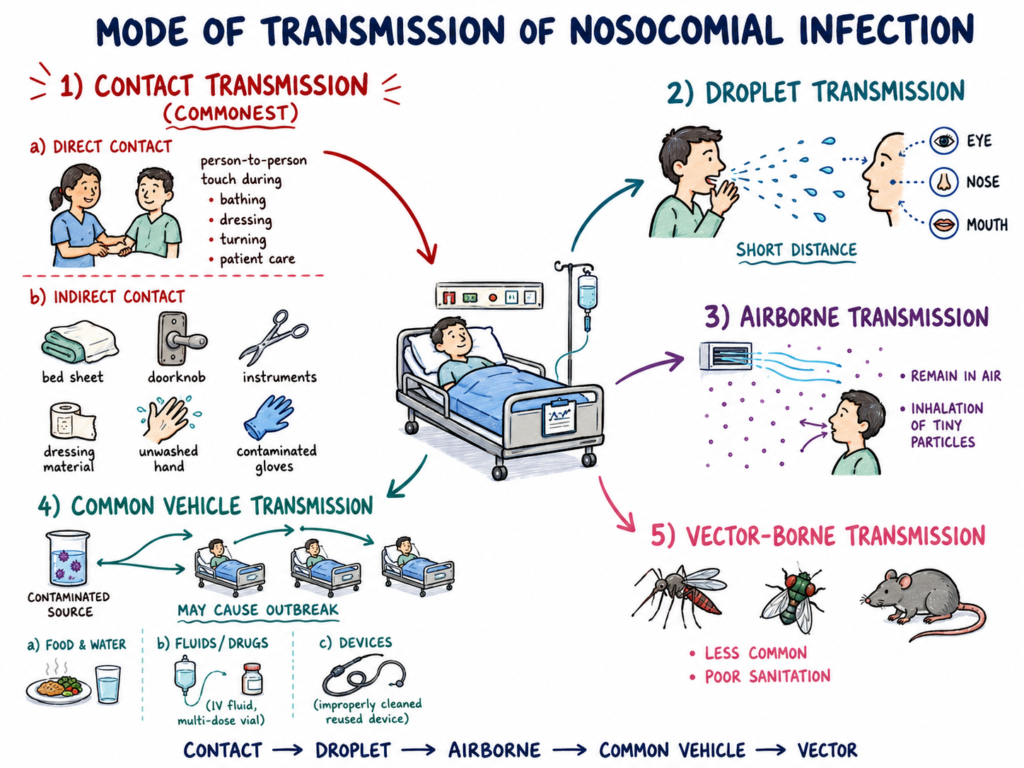
- Contact transmission– It is the commonest mode of transmission in hospital. Organisms pass by contact from patient, health worker or contaminated articles.
- Direct contact– It occurs by direct physical contact. Organisms pass from infected or colonized person to susceptible patient. It may occur during bathing, dressing, turning and other patient care.
- Indirect contact– It occurs through contaminated object. These objects are called fomites. Bed sheet, doorknob, instruments, dressing material, unwashed hand and contaminated gloves may spread infection.
- Droplet transmission– It occurs by large respiratory droplets. Droplets are produced during coughing, sneezing, talking, suctioning and bronchoscopy. These droplets travel short distance. They enter through eye, nose and mouth.
- Airborne transmission– It occurs by small particles or droplet nuclei. These particles remain suspended in air for long time. It may spread through air current and ventilation system. Patient inhale these particles and infection occurs.
- Common vehicle transmission– In this type, one contaminated source infects many patient. It may produce hospital outbreak.
- Food and water– Contaminated hospital food and water may carry organisms.
- Fluids and drugs– IV fluid, multi-dose vial and contaminated medicine may transmit infection.
- Devices– Improperly cleaned and reused medical devices may act as source.
- Vector-borne transmission– It occurs through living vectors. The vectors may be mosquito, fly, rat and other vermin. It is less common in modern hospital. But it may occur when sanitation and vector control is poor.
Reservoirs of Nosocomial Infections
Reservoir is the place where pathogen live and multiply. It may be patient body or hospital environment. From this place organism may pass to other patient.
The following are the important reservoirs of nosocomial infections–
A. Endogenous reservoirs
- Normal flora– Normal flora of patient is the most common reservoir. These organisms are present on skin and mucous membrane. They are harmless normally. But they cause infection when enter into sterile site.
- Skin– Skin of patient contain many bacteria. It may enter through surgical wound, injection site, catheter and dressing site. It may cause wound infection and blood infection.
- Respiratory tract– Nose, throat and respiratory tract may act as reservoir. Organisms may pass into lower respiratory tract. It may cause hospital-acquired pneumonia (HAP) and ventilator-associated pneumonia (VAP).
- Gastrointestinal tract– Gastrointestinal tract contain many organisms. It may become reservoir for diarrhoeal infection, wound infection and abdominal infection. It is important after surgery and antibiotic use.
- Body fluids– Blood, saliva, urine and faecal matter may contain pathogens. These fluids can spread infection during care, cleaning, catheterization and other procedure.
B. Exogenous reservoirs
- Medical equipment– Medical equipment is important external reservoir. Urinary catheter, ventilator, endoscope, central line and other shared instruments may contain organisms. If not cleaned properly, infection may occur.
- Hospital surface– Hospital surface may keep pathogens for long time.
- High touch surface– Bed rail, bedside table, doorknob, floor, call button and counter surface are common places.
- Patient care area– Bed, trolley, chair and dressing table may also act as reservoir.
- Health care personnel– Doctors, nurses and other staff may carry organisms. Hands are the main reservoir. Skin, cloth, gloves and apron may also carry pathogens from one patient to another.
- Contaminated medicine– Drugs, multi-dose vial and intravenous solution may become contaminated. These may directly introduce organisms into body. It can cause serious blood infection.
- Food and water– Hospital food and water may act as reservoir. Contaminated water system, sink and food supply may carry bacteria or parasite. It mainly causes gastrointestinal infection.
- Other patient– Infected or colonized patient may act as reservoir. Organisms may spread by direct contact or through hospital articles. Sharing room increases chance of infection.
- Visitors– Visitors may bring organisms from outside. They may carry pathogen on hand, cloth and respiratory droplet. It is important for weak, old and operated patient.
Prevention, Control and Management of Nosocomial Infections
The following are the important prevention, control and management of nosocomial infections–

Prevention of Nosocomial Infections
- Hand hygiene– Hand hygiene is the most important method. Hands should be washed with soap and water. Alcohol based hand rub is also used before and after patient contact.
- PPE use– Personal protective equipment (PPE) is used to prevent spread of organisms. It includes gloves, gown, mask and eye protection. It is used during patient care, wound dressing, suction and handling of body fluids.
- Isolation– Highly infectious patient should be isolated. It prevents spread to other patient. Isolation may be done according to contact, droplet and airborne transmission.
- Contact precaution– It is used for infection spread by touch and contaminated articles.
- Droplet precaution– It is used for infection spread by coughing, sneezing and talking.
- Airborne precaution– It is used for infection spread by small droplet nuclei in air.
- Cleaning of environment– Hospital surface should be cleaned regularly. Bed rail, call button, door handle, table and floor should be disinfected. It removes reservoir of pathogens.
- Disinfection– Disinfection is used for killing many pathogens from instruments and surfaces. It is done by hospital disinfectant. It is needed for reusable patient care articles.
- Sterilization– Sterilization is used for complete killing of microorganisms including spores. Surgical instruments and invasive devices should be sterilized properly. It prevents infection during procedure.
- Catheter care– Urinary catheter should be inserted only when needed. Aseptic technique should be followed. Catheter should be removed as early as possible to prevent CAUTI.
- Central line care– Central venous line should be inserted with sterile precautions. Skin should be cleaned with chlorhexidine. This helps to prevent CLABSI.
- Ventilator care– Ventilator-associated pneumonia (VAP) can be prevented by proper care. Head of patient should be kept elevated at 30-45 degree. Oral care should be done regularly. Ventilator time should be reduced when possible.
- Surgical care– Surgical site infection (SSI) can be prevented by proper pre-operative and operative care. Patient may be washed with chlorhexidine before surgery. Antibiotic prophylaxis should be given at proper time. Blood sugar and body temperature should be controlled.
- Safe injection– Injection should be given by sterile needle and syringe. Needle should not be reused. Sharps should be discarded in proper container.
- Vaccination– Health care workers and patient should receive needed vaccines. Influenza vaccine and pneumococcal vaccine are important. It reduces hospital spread of respiratory infection.
Control of Nosocomial Infections
- Surveillance– Infection rate should be checked regularly. Hospital should record HAI cases. It helps to find high risk ward, common organism and outbreak early.
- Infection control committee– A hospital should have infection control committee. It includes doctors, nurses, microbiologist and infection control staff. They make rules, train staff and check infection control practice.
- Outbreak investigation– Sudden increase of infection should be investigated. Cases are identified. Source of infection is searched. Control measures are taken quickly.
- Patient cohorting– Infected patient may be kept together.
- Unit control– A ward or unit may be restricted when outbreak is severe.
- Source removal– Contaminated device, medicine, water or surface should be removed or disinfected.
Management of Nosocomial Infections
- Early diagnosis– Infection should be diagnosed early. Sample should be collected from blood, urine, sputum, wound or catheter site. Culture and sensitivity helps to identify the organism.
- Rapid test– Rapid molecular test may be used when needed. It helps to detect pathogen faster. Then treatment can be started more correctly.
- Antibiotic treatment– Correct antibiotic should be selected. Dose and duration should be proper. Broad antibiotic should not be used for long time without need.
- Antimicrobial stewardship– Antimicrobial stewardship programme (ASP) controls unnecessary antibiotic use. It helps to prevent MRSA, Clostridioides difficile and other drug resistant organisms.
- Source control– The source of infection should be removed. Unnecessary catheter, central line and drain should be discontinued. Infected wound may need cleaning and drainage.
- Supportive care– Patient should be given proper fluid, nutrition and oxygen when needed. Fever, pain and dehydration should be managed. Weak patient need more care and monitoring.
- Follow up– Patient should be observed after treatment. Infection signs, culture report and response to drug should be checked. Treatment is changed if the organism is resistant.
Reference
- Centers for Disease Control and Prevention. (2025). 2025 NHSN surgical site infection (SSI) checklist.
- Centers for Disease Control and Prevention. (2025). 2025 NHSN ventilator-associated event (VAE) checklist.
- eCFR. (2026, June 25). 42 CFR 482.42 — Condition of participation: Infection prevention and control and antibiotic stewardship programs.
- COLA. (2019, November 7). 5 steps CDC recommends for hand-washing.
- Centers for Disease Control and Prevention. (2023, November 28). A rational approach to disinfection and sterilization.
- Infection Control Team. (2017, May). ATP bioluminescence and fluorescent markers. NHS National Services Scotland.
- Hygiena. (n.d.). ATP cleaning verification vs. fluorescent gel for healthcare [Video]. YouTube.
- Centers for Disease Control and Prevention. (n.d.). About HAIs.
- Centers for Disease Control and Prevention. (2024, February 16). About handwashing | Clean hands.
- California Department of Public Health. (2021). Acute care hospital online course: CLABSI and VAE surveillance.
- California Department of Public Health. (2018). Acute care hospital online course: CLABSI, CAUTI, and pneumonia prevention.
- Assessment of percent positive agreement between fluorescent marker and ATPase for environmental cleaning monitoring during sequential application in an intensive care unit. (n.d.). PMC.
- Bundle (ABCDE) checklist for prevention of CAUTIs. (n.d.). UroToday.
- Can the adenosine triphosphate (ATP) bioluminescence assay be used as an indicator for hospital cleaning? – A pilot study. (n.d.). PMC.
- Centers for Disease Control and Prevention. (n.d.). Catheter-associated urinary tract infection (CAUTI) toolkit.
- Centers for Disease Control and Prevention. (2025, June 12). Central line-associated bloodstream infection (CLABSI) basics.
- National Institute for Occupational Safety and Health. (n.d.). Chain of infection components. Centers for Disease Control and Prevention.
- Centers for Disease Control and Prevention. (n.d.). Checklist for prevention of central line associated blood stream infections.
- Centers for Disease Control and Prevention. (2024, February 27). Clinical safety: Hand hygiene for healthcare workers.
- Centers for Disease Control and Prevention. (n.d.). Clinical safety: Preventing catheter-associated urinary tract infections (CAUTIs).
- Olmsted, R., Gilmartin, H. M., & Washer, L. (n.d.). Core concepts for hand hygiene: Clean hands for healthcare personnel. Centers for Disease Control and Prevention.
- Centers for Disease Control and Prevention. (2019). Core elements for hospital antibiotic stewardship programs – 2019.
- Centers for Disease Control and Prevention. (n.d.). Core elements of antibiotic stewardship.
- Centers for Disease Control and Prevention. (n.d.). Core elements of hospital antibiotic stewardship programs.
- Core elements of hospital antibiotic stewardship programs from …. (n.d.).
- Thermo Fisher Scientific. (n.d.). Core elements of an antibiotic stewardship program.
- Wikipedia. (2026, June 4). ESKAPE.
- Dahal, P. (2023, May 17). ESKAPE pathogens and antimicrobial resistance. Microbe Notes.
- Effectiveness of ATP bioluminescence to assess hospital cleaning: a review. (n.d.). PMC.
- The Joint Commission. (n.d.). Evidence-based principles and practices for preventing surgical site infections.
- CS Medical. (n.d.). FAQ: What is Spaulding classification?.
- Guidelines to prevent catheter-associated urinary tract infection: 1980 to 2010. (n.d.). PMC.
- Centers for Disease Control and Prevention. (2024, March 28). Healthcare-associated infections (HAIs).
- Pearson. (n.d.). Healthcare-associated infections explained: Definition, examples, practice & video lessons.
- Weill Department of Medicine. (n.d.). Hospital epidemiology and antimicrobial stewardship.
- Healthline. (n.d.). Hospital-acquired infection: Definition and patient education.
- Wikipedia. (2026, June 26). Hospital-acquired infection.
- Impact of a comprehensive care bundle educational program on device-associated infections in an emergency intensive care unit. (n.d.). PMC.
- Infection prevention and control, and antimicrobial stewardship …. (n.d.).
- Centers for Disease Control and Prevention. (2024, March 19). Introduction | HAIs.
- Centers for Disease Control and Prevention. (2022). NHSN’s guide to the 2022 baseline standardized infection ratios.
- Nosocomial infections: A comprehensive treatise on source reservoirs, transmission dynamics, diagnostic frameworks, and multi-modal prevention protocols. (n.d.).
- Centers for Disease Control and Prevention. (2026, January). Pneumonia (ventilator-associated [VAP] and non-ventilator-associated pneumonia [PNEU]) event.
- California Department of Public Health. (2018). Pneumonia and ventilator-associated pneumonia prevention.
- Hughes, R. G. (Ed.). (2008, April). Preventing health care–associated infections. In Patient safety and quality: An evidence-based handbook for nurses. Agency for Healthcare Research and Quality.
- Ducel, G., Fabry, J., & Nicolle, L. (Eds.). (2002). Prevention of hospital-acquired infections: A practical guide (2nd ed.). World Health Organization.
- Centers for Disease Control and Prevention. (n.d.). SIR tables SSI.
- SSI prevention checklists. (n.d.).
- The Tao of Medicine. (2024, November 27). Standardized infection ratio (SIR) examples using Excel.
- Palmer, G. H., & Buckley, G. J. (Eds.). (2021, October 20). Combating antimicrobial resistance and protecting the miracle of modern medicine. National Academies Press.
- Centers for Disease Control and Prevention. (2024, March 25). Summary of recommendations | Infection control.
- Centers for Disease Control and Prevention. (n.d.). Surgical site infection event (SSI).
- Patient Safety Movement Foundation. (n.d.). Surgical site infections (SSI).
- CS Medical. (n.d.). The importance of understanding Spaulding classification.
- Centers for Disease Control and Prevention. (n.d.). The NHSN standard infection ratio (SIR).
- Using the manufacturer’s instructions for use and Spaulding classification system to assess disinfection practices for ultrasound transducers in the perioperative setting. (n.d.). Ovid.
- Patient Safety Movement Foundation. (2022). Ventilator-associated pneumonia (VAP) actionable patient safety solutions.
- Centers for Disease Control and Prevention. (2024, January 22). Ventilator-associated pneumonia basics | VAP.
- Kumar Malesu, V. (2026, April 30). What are ESKAPE pathogens and why are they so dangerous?. News-Medical.Net.
- UV Smart. (n.d.). What is the Spaulding classification?
- Your 5 moments for hand hygiene. (n.d.).
- Stryker. (n.d.). The NHSN standardized infection ratio (SIR).