

Cytokines are small soluble protein molecules which are produced by immune cells and some other body cells. It is used as chemical messenger between cells. It help in sending signal from one cell to another cell. These molecules mainly control immunity, inflammation and formation of blood cells.
Cytokines are produced by T lymphocytes, B lymphocytes, macrophages, monocytes, dendritic cells, endothelial cells and many tissue cells. They are released in very small amount. Still it can show strong effect on target cell. The target cell must have specific receptor for that cytokine.
The action of cytokines depends on binding with receptor. After binding, the signal passes inside the cell and the cell becomes activated. The cell may divide, move, differentiate or release other molecules. This response is different in different cells. So same cytokine may show different action in different condition.
Cytokines may act on the same cell which produce it. This is called autocrine action. It may act on nearby cells and this is called paracrine action. Sometimes it may pass through blood and act on distant cells. This is called endocrine action.
The major types of cytokines include interleukins (ILs), interferons (IFNs), tumor necrosis factors (TNFs), chemokines and colony stimulating factors (CSFs). Interleukins act mainly between leukocytes. Interferons are formed during viral infection. Tumor necrosis factors are related with inflammation and fever. Chemokines attract leukocytes to infection site. Colony stimulating factors stimulate production of blood cells in bone marrow.
Cytokines are needed in both innate immunity and acquired immunity. They activate phagocytes, lymphocytes, natural killer cells and other defense cells. They help in inflammation, fever, wound healing and destruction of microbes. Some cytokines increase immune response and some cytokines decrease immune response.
Excess release of cytokines may produce harmful effect. In some severe infection and immune disorder, many cytokines are released together. This condition is called cytokine storm. It causes severe inflammation, tissue injury, high fever and sometimes organ failure.
What is Cytokinesis?
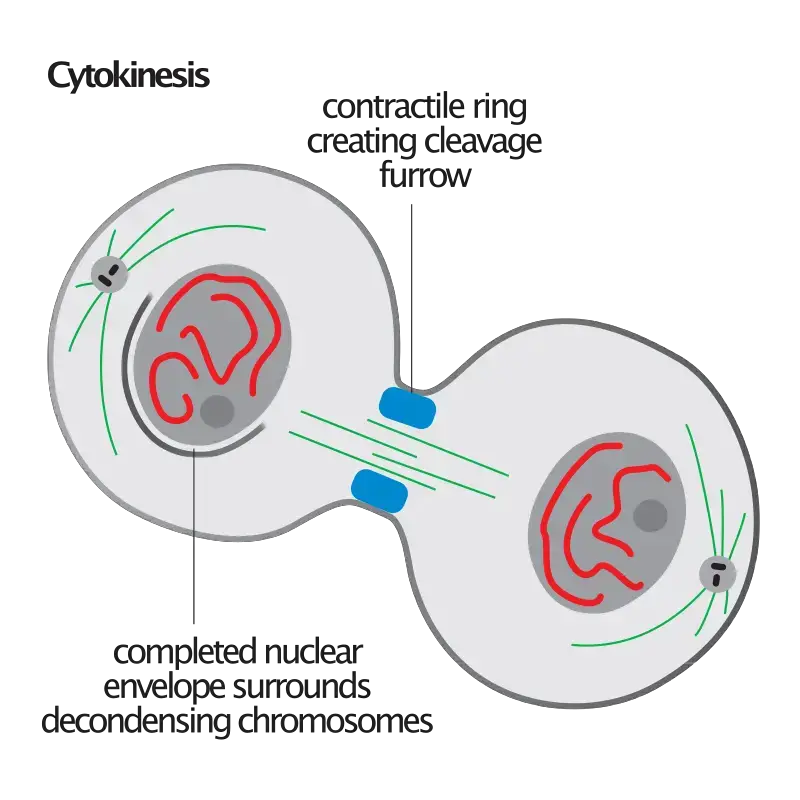
Cytokinesis is the final physical step of cell division in which the cytoplasm of a mother cell is divided into two daughter cells. It usually takes place after nuclear division. In this process, the cytosol and cell organelles are separated into two newly formed cells.
It generally starts in late anaphase and continues during telophase of mitosis or meiosis. It helps each daughter cell to receive enough cytoplasm and organelles like ribosomes, mitochondria and other cell materials. Without cytokinesis, one cell may contain more than one nucleus but cytoplasm is not separated.
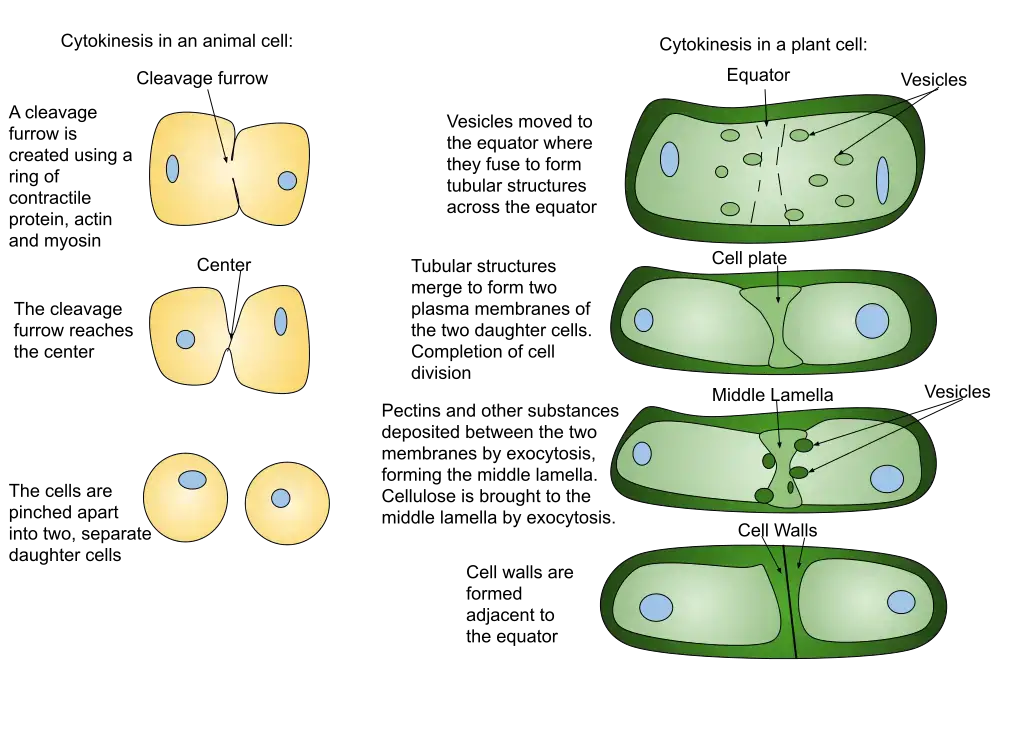
In animal cell, cytokinesis occurs by the formation of cleavage furrow. The cell membrane starts constricting from outside towards inside. A contractile ring made up of actin and myosin pulls the membrane inward. Finally the cell is pinched into two daughter cells.
In plant cell, cytokinesis is different because plant cell has rigid cell wall. So the cell cannot form cleavage furrow. In this cell, small vesicles collect at the centre and form cell plate. This cell plate grows outward and joins with the old cell wall.
The cell plate later develops into new cell wall between the two daughter cells. This process is helped by phragmoplast, which is made up of microtubules and other cell materials. In this way plant cell divides from inside to outside.

Properties of Cytokines
The following are the important properties of cytokines–
- Cytokines are small soluble protein or glycoprotein molecules, formed by immune cells and also by many other body cells.
- They are produced in very little amount. Still their action is strong on the target cell.
- Cytokines act only when the target cell has specific cytokine receptor on its surface.
- They are not stored in large quantity inside the cell. Most of the cytokines are newly synthesized after stimulation.
- Their action is generally short time action. After doing function they are degraded quickly.
- Cytokines are not antigen specific like antibody. Same cytokine may take part in different type immune reactions.
- They act mainly near the site where they are produced. So most cytokines show local action rather than long distance action.
- Cytokines may act on the same cell which produce it, nearby cell or distant cell through blood, and these are called autocrine, paracrine and endocrine action.
- Cytokines show pleiotropy, in which one cytokine act on different cells and gives different effects.
- Cytokines show redundancy, in which different cytokines can give same type of effect on same cell.
- Cytokines show synergism, in which two cytokines act together and the effect become more strong.
- Cytokines show antagonism, in which one cytokine inhibit the action of another cytokine.
- They regulate growth, activation, differentiation and movement of immune cells such as T-cells, B-cells, macrophages, neutrophils and natural killer cells.
- They are important in inflammation, fever, wound healing, immune response and blood cell formation.
- Excess formation of cytokines is harmful. It may produce severe inflammation and this condition is called cytokine storm.
Classification of Cytokinesis
The following are the classification of cytokinesis–
- Animal– This type of cytokinesis is found in animal cells. It is outside to inside type division. In this process, cleavage furrow is formed at the middle region of the cell. A contractile ring made up of actin filaments and myosin pulls the plasma membrane inward and finally the cell is divided into two daughter cells.
- Plant– This type of cytokinesis is found in plant cells. It is inside to outside type division, because plant cell has rigid cell wall. In this process, phragmoplast helps to bring vesicles at the centre of the cell. These vesicles form cell plate, which grows outward and later forms new cell wall between two daughter cells.
- Fungal– This type of cytokinesis is found in fungi like yeast. The fungal cell has high internal turgor pressure. Here actomyosin ring does not simply pinch the cell. It acts as a scaffold and guides inward formation of rigid partition called septum, which separates the cell into two parts.
- Prokaryotic– This type of cytokinesis is found in bacteria like Escherichia coli. It does not use myosin ring like animal cell. The division is controlled by small protein ring made up of FtsZ and FtsQ. This ring forms at the middle region and helps in separation of bacterial cell.
Stages of Cytokinesis
The following are the stages of cytokinesis–
Animal Cell Cytokinesis
- Ring assembly– In this stage, contractile ring is formed just below the plasma membrane at the equator of the cell. This ring is made up of many actin filaments and myosin motor proteins.
- Furrow formation– In this stage, the contractile ring starts contraction. Due to contraction, the plasma membrane is pulled inside. This forms a groove like structure called cleavage furrow.
- Bridge formation– In this stage, the cleavage furrow becomes more deep and the two side membrane come close to each other. A narrow cytoplasmic connection remain between two forming daughter cells. This is called intercellular bridge or midbody.
- Abscission– In this stage, the remaining cytoplasmic bridge is cut. The microtubules and actin are removed from this region. Finally the two daughter cells become completely separated.
Plant Cell Cytokinesis
- Vesicle accumulation– In this stage, many vesicles carrying cell wall materials come to the centre of the dividing cell. These vesicles are guided by phragmoplast, which is made up of microtubules.
- Vesicle fusion– In this stage, the collected vesicles start to fuse with each other. They form early tubulo-vesicular network at the middle region of the cell.
- Tubular network– In this stage, the fused vesicles form a more flat and connected tubular network. Callose is deposited first and it helps in making the early cell plate strong.
- Sheet formation– In this stage, the cell plate expands outward toward the parental cell wall. It becomes flat sheet like structure and extra membrane materials are removed.
- Wall maturation– In this stage, the growing cell plate reaches the old cell wall and fuses with it. The remaining gaps are closed. Later callose is replaced by cellulose and mature primary cell wall is formed.
Function of Cytokinesis
The following are the functions of cytokinesis–
- Cell separation– Cytokinesis physically separates one dividing mother cell into two daughter cells. It is the last mechanical step of cell division.
- Cytoplasm division– It divides the cytoplasm of mother cell between two newly formed daughter cells. So each daughter cell get its own cytoplasmic part.
- Organelle distribution– It helps in distribution of important cell organelles like ribosomes, mitochondria and Golgi apparatus into daughter cells. These organelles are needed for survival and normal function of the cell.
- Daughter cell formation– Due to cytokinesis, two separate daughter cells are formed after nuclear division. Without this step, nucleus may divide but cell body remain undivided.
- Growth– Cytokinesis helps in growth of living organisms by increasing the number of cells. More cells are formed from pre-existing cells.
- Development– It is needed during development of body and tissues. New cells are continuously produced and arranged in different parts.
- Reproduction– Cytokinesis helps in reproduction of unicellular organisms and also in formation of reproductive cells in multicellular organisms.
- Tissue formation– It helps in formation and repair of tissues by producing new daughter cells. Damaged or old cells can be replaced by new cells.
- Specialized cell formation– In some animal tissues, failure of cytokinesis may occur in controlled way. This makes polyploid cells, such as large hepatocytes and megakaryocytes, which have special function.
- Platelet formation– In megakaryocytes, incomplete cytokinesis helps the cell to become large and mature. These cells later produce blood clotting platelets.
- Plant evolution– In plants, failure of cytokinesis may cause whole genome doubling or polyploidy. This is tolerated by plants and helps in plant evolution.
- Agricultural yield– Polyploidy in plants may increase size of vegetative and reproductive organs. It is useful in agriculture for increasing food yield.
Examples of Important Proteins of Cytokinesis and Their Roles
The following are the important proteins and complexes of cytokinesis–
- RhoA GTPase– It is an important molecular initiator of animal cell cytokinesis. It helps in formation of contractile ring at the equatorial region of the cell.
- Centralspindlin complex– It is present at the middle region of dividing cell. It recruits Ect2 and helps in activation of RhoA, so the cleavage furrow is formed at correct position.
- Myosin II– It is a motor protein present in the contractile ring. It pulls the actin filaments and makes the ring smaller, due to which plasma membrane moves inward.
- ESCRT machinery– It includes ESCRT-III, TSG101 and ALIX. These proteins act during the last stage of cytokinesis and help in cutting the intercellular bridge between two daughter cells.
- VPS4– It is an AAA-ATPase enzyme. It gives energy for disassembly and recycling of ESCRT complexes after membrane cutting is completed.
- Cep55– It is a midbody adaptor protein of animal cell. It acts as a bridge and brings ESCRT machinery at the site of cell division.
- KNOLLE– It is a plant specific SNARE protein. It helps in fusion of vesicles at the centre of plant cell and forms the new cell plate.
- TRAPPII complex– It is a tethering factor in plant cell cytokinesis. It catches Golgi-derived vesicles at the division plane and helps in formation of cell plate.
- Exocyst complex– It is also a vesicle tethering complex of plant cell. It holds the vesicles at proper place so they can fuse and mature into cell plate.
- FtsZ– It is a tubulin like protein found in prokaryotes like Escherichia coli. It forms a small protein ring at the middle of bacterial cell and helps in bacterial cytokinesis.
References
- Abscission: Orchestration of vesicle transport, ESCRTs and kinase … (n.d.). PubMed Central (PMC). https://pmc.ncbi.nlm.nih.gov/articles/PMC4215936/
- Actomyosin ring driven cytokinesis in budding yeast – PMC – NIH. (n.d.). PubMed Central (PMC). https://pmc.ncbi.nlm.nih.gov/articles/PMC4884668/
- Agromayor, M., Carlton, J. G., Phelan, J. P., Matthews, D. R., Carlin, L. M., Ameer-Beg, S., Bowers, K., & Martin-Serrano, J. (2009). Essential Role of hIST1 in Cytokinesis. Molecular Biology of the Cell, 20(5), 1269-1280. https://doi.org/10.1091/mbc.e08-05-0474
- Analysis of Phragmoplast Kinetics During Plant Cytokinesis – ResearchGate. (n.d.). ResearchGate. https://www.researchgate.net/publication/319412574_Analysis_of_Phragmoplast_Kinetics_During_Plant_Cytokinesis
- Animal Cell Cytokinesis: The Rho-Dependent Actomyosin … (n.d.). PubMed Central (PMC). https://pmc.ncbi.nlm.nih.gov/articles/PMC7575755/
- Bi, E. (2001). Cytokinesis in budding yeast: the relationship between actomyosin ring function and septum formation. Cell Structure and Function, 26(6), 529-537. https://doi.org/10.1247/csf.26.529
- Biddle, K., & Chin, G. (n.d.). Cytokinesis in Animals and Plants | Definition & Example – Lesson. Study.com. https://study.com/learn/lesson/cytokinesis-animal-versus-plant.html
- Cell plate. (2026, April 5). In Wikipedia. https://en.wikipedia.org/wiki/Cell_plate
- Comparative Biophysics and Evolutionary Regulation of Eukaryotic and Prokaryotic Cytokinesis. (n.d.). [Markdown document].
- Coordinating Septum Formation and the Actomyosin Ring during … (n.d.). PubMed Central (PMC). https://pmc.ncbi.nlm.nih.gov/articles/PMC6904431/
- Coordinating septum formation and the actomyosin ring during cytokinesis in Schizosaccharomyces pombe – PubMed. (n.d.). PubMed. https://pubmed.ncbi.nlm.nih.gov/31533197/
- Cytokinesis in Eukaryotes – PMC. (n.d.). PubMed Central (PMC). https://pmc.ncbi.nlm.nih.gov/articles/PMC120788/
- Cytokinesis in Prokaryotes and Eukaryotes: Common Principles and Different Solutions – PMC. (n.d.). PubMed Central (PMC). https://pmc.ncbi.nlm.nih.gov/articles/PMC99029/
- Cytokinesis in plant and animal cells: endosomes ‘shut the door’ – PubMed. (n.d.). PubMed. https://pubmed.ncbi.nlm.nih.gov/16580662/
- Cytokinesis: Robust cell shape regulation – PMC – NIH. (n.d.). PubMed Central (PMC). https://pmc.ncbi.nlm.nih.gov/articles/PMC4837095/
- Dissection Of Cell Plate Dynamics During Cytokinesis And The Role Of Callose In Cell Plate Maturation – eScholarship.org. (n.d.). eScholarship. https://escholarship.org/content/qt0c44m34d/qt0c44m34d_noSplash_2486dea2c882b2dd3bf5ba01a433d7a7.pdf
- Dynamics of endosomal sorting complex required for transport (ESCRT) machinery during cytokinesis and its role in abscission | PNAS. (n.d.). PNAS. https://www.pnas.org/doi/10.1073/pnas.1102714108
- Electron Tomographic Analysis of Somatic Cell Plate Formation in Meristematic Cells of Arabidopsis Preserved by High-Pressure Freezing – PMC. (n.d.). PubMed Central (PMC). https://pmc.ncbi.nlm.nih.gov/articles/PMC412860/
- Functional characterization of the KNOLLE-interacting t-SNARE … (n.d.). PubMed Central (PMC). https://pmc.ncbi.nlm.nih.gov/articles/PMC2198836/
- Growth under pressure: The pros and cons of polyploidy induced by stress | PNAS. (n.d.). PNAS. https://www.pnas.org/doi/10.1073/pnas.2522063123
- Investigating cytokinesis failure as a strategy in cancer therapy – PMC. (n.d.). PubMed Central (PMC). https://pmc.ncbi.nlm.nih.gov/articles/PMC5349991/
- Kozgunova, E., et al. (2019, March 25). What happens to plants when cell division goes wrong? eLife. https://elifesciences.org/digests/43652/what-happens-to-plants-when-cell-division-goes-wrong
- Liu, B., Ho, C.-M. K., & Lee, Y.-R. J. (2011). Microtubule Reorganization during Mitosis and Cytokinesis: Lessons Learned from Developing Microgametophytes in Arabidopsis Thaliana. Frontiers in Plant Science, 2, 27. https://doi.org/10.3389/fpls.2011.00027
- Luo, C., Shi, Y., & Xiang, Y. (2022). SNAREs Regulate Vesicle Trafficking During Root Growth and Development. Frontiers in Plant Science, 13, 853251. https://doi.org/10.3389/fpls.2022.853251
- Maciver Lab. (2003, January 27). The Cleavage Furrow (contractile ring) and Cytokinesis. Biomedical Sciences, University of Edinburgh. https://maciverlab.bms.ed.ac.uk/Cyto-Topics/cleavage_furrow.htm
- Mechanics and regulation of cytokinesis – PMC – NIH. (n.d.). PubMed Central (PMC). https://pmc.ncbi.nlm.nih.gov/articles/PMC7336204/
- Molecular Mechanism of Cytokinesis – PMC. (n.d.). PubMed Central (PMC). https://pmc.ncbi.nlm.nih.gov/articles/PMC6588489/
- Molecular organization of cytokinesis nodes and contractile rings by super-resolution fluorescence microscopy of live fission yeast | PNAS. (n.d.). PNAS. https://www.pnas.org/doi/10.1073/pnas.1608252113
- Polyploidy in Cancer: causal mechanisms, cancer-specific … (n.d.). PubMed Central (PMC). https://pmc.ncbi.nlm.nih.gov/articles/PMC11174144/
- Sharma, P., et al. (2025, September 12). Differentiate between cytokinesis in plant and animal cells. Sathee Forum. https://forum.prutor.ai/index.php?threads/differentiate-between-cytokinesis-in-plant-and-animal-cells.17422/
- Shi, Y., Luo, C., Xiang, Y., & Qian, D. (2023). Rab GTPases, tethers, and SNAREs work together to regulate Arabidopsis cell plate formation. Frontiers in Plant Science, 14, 1120841. https://doi.org/10.3389/fpls.2023.1120841
- Swulius, M. T., Nguyen, L. T., Ladinsky, M. S., Ortega, D. R., Aich, S., Mishra, M., & Jensen, G. J. (2018). Structure of the fission yeast actomyosin ring during constriction. Proceedings of the National Academy of Sciences, 115(7), E1455-E1464. https://doi.org/10.1073/pnas.1711218115
- The Arabidopsis KNOLLE Protein Is a Cytokinesis-specific Syntaxin – PMC. (n.d.). PubMed Central (PMC). https://pmc.ncbi.nlm.nih.gov/articles/PMC2132613/
- The ESCRT machinery: From the plasma membrane to endosomes and back again – PMC. (n.d.). PubMed Central (PMC). https://pmc.ncbi.nlm.nih.gov/articles/PMC4381963/
- The contractile ring – PMC. (n.d.). PubMed Central (PMC). https://pmc.ncbi.nlm.nih.gov/articles/PMC3395197/
- Vesicle Dynamics during Plant Cell Cytokinesis Reveals Distinct Developmental Phases – PMC. (n.d.). PubMed Central (PMC). https://pmc.ncbi.nlm.nih.gov/articles/PMC5490904/
- Zhang, J., Zhang, S., Shi, Q., Yang, D., & Allen, T. D. (2020). Emerging Strategies to Attack Polyploid Cancer Cells. Journal of Cancer Immunology, 2(4), 199-206. https://doi.org/10.33696/cancerimmunol.2.031