

Urease test is a biochemical assay used in microbiology to detect whether microorganism produces urease enzyme or not. It is the process in which urea is broken down into ammonia and carbon dioxide by urease enzyme. When urease producing organism is inoculated in urease broth or agar the ammonia is rapidly accumulated and pH is raised and medium becomes alkaline.
This change is detected by pH indicator which is present in medium and most commonly phenol red is used. In positive test the colour changes from yellow or light orange to bright pink or magenta. In negative test the organism do not produce urease and medium remains yellow or shows no colour change. It is used in identification of pathogens like Helicobacter pylori in gastric ulcer. It is used to differentiate rapid urease producing bacteria like Proteus species in urinary tract infection and it is also used to distinguish yeast like Cryptococcus neoformans.
Objective of Urease Test
- It is used to determine the ability of microorganism to produce urease enzyme.
- It is used to test whether the organism can hydrolyse urea into ammonia and carbon dioxide.
- It is used to differentiate rapid urease producing enteric bacilli (Proteeae tribe) such as Proteus, Morganella and Providencia from other Enterobacteriaceae.
- It is used in diagnosis and monitoring of Helicobacter pylori infection in gastritis and peptic ulcer.
- It is used to confirm the eradication after treatment in H. pylori infection.
- It is used for identification of other clinically important bacteria such as Brucella and Pasteurella.
- It is used to identify Gram positive rods like Corynebacterium and Rhodococcus spp.
- It is used to differentiate Gram positive cocci such as Staphylococcus saprophyticus and Staphylococcus epidermidis.
- It is used to differentiate medically important yeasts.
- It is used to distinguish urease positive yeast like Cryptococcus neoformans from urease negative yeast like Candida species.
- It is used to assess environmental and soil health by urease activity.
- It is used to monitor environmental reservoirs for zoonotic pathogens and for nitrogen mineralization rate and microbial biomass in soil.
Principle of Urease Test
Principle of urease test is based on detection of urease enzyme production by microorganism. It is the process in which urea is hydrolysed by urease enzyme and ammonia and carbon dioxide is formed. The reaction is as follows-
Urea + H2O → NH3 + CO2
In this test the ammonia is accumulated rapidly and the surrounding medium becomes alkaline and pH is increased. This change in pH is detected by pH indicator present in medium and most commonly phenol red is used in broth or agar. When the pH is raised (around 8.1 or above) the indicator changes the colour of medium from yellow or light orange to bright pink or magenta which indicates positive urease test. If urease enzyme is absent no ammonia is produced and medium remains yellow or shows no colour change and it is negative.
Media, Reagents, and Supplies Used for Urease Test
- Christensen’s urea agar is used as solid medium for urease test. It is used for growth of wide range of organism including slow urease producer and it contains less buffer with nutrients like peptone and dextrose.
- Stuart’s urea broth is used as liquid medium. It is highly buffered with minimal nutrients and it is mainly used for rapid urease producing bacteria like Proteus species.
- Commercial rapid urease test (RUT) kits are used in clinical diagnosis for Helicobacter pylori from gastric biopsy sample.
- Gel based kits are used such as CLOtest and Hp kit.
- Paper based kits are used such as PyloriTek and ProntoDry.
- Liquid based kits are used such as UFT300 and Helicotest.
- Urea is used as main substrate which is hydrolysed by urease enzyme to form ammonia and carbon dioxide.
- Phenol red is used as pH indicator in the media. It changes from yellow or light orange to bright pink or magenta in alkaline pH.
- Buffer salts are used such as monopotassium phosphate and disodium (or dipotassium) phosphate to control buffering capacity of medium.
- Nutritional supplements are used such as yeast extract, peptone (peptic digest of animal tissue) and dextrose for growth.
- Sterile 40% urea solution is used and it is prepared separately and added aseptically after cooling because urea is heat sensitive and it decomposes on autoclaving.
- Sterile inoculating loop or wooden stick is used for taking heavy inoculum and streaking on agar slant or inoculating in broth.
- 0.45 μm membrane filter is used for filter sterilization of heat sensitive urea solution.
- Autoclave is used to sterilize base medium (without urea) at 121°C and 15 psi for 15–20 minutes.
- Incubator is used for incubation at 35–37°C for clinical isolates and around 30°C for environmental samples and some non fermenting bacteria.
- Sterile tubes (13×100 mm) are used for holding broth and for preparing agar slant with butt.
- Warming device is used sometimes (37–38°C) to speed up the reaction in rapid urease test kits.
Procedure of Urease Test
- Christensen’s urea agar is prepared by dissolving the base ingredients in water and it is sterilized by autoclaving. After sterilization it is cooled to 50–55°C and then filter sterilized urea is added aseptically and it is dispensed in sterile tubes and slant is prepared.
- Stuart’s urea broth is prepared by dissolving the powder in distilled water and it is filter sterilized. It is not boiled or autoclaved because urea is decomposed by heat.
- Heavy inoculum is taken from 18–24 hours pure culture of test organism.
- Inoculation in agar slant is done by sterile inoculating loop or wooden stick and it is streaked back and forth on the entire surface of slant. The butt is not stabbed because it acts as internal colour control for comparison with slant.
- Inoculation in broth is done with heavy inoculum and tube is shaken gently to suspend the organism.
- The tubes are incubated aerobically at 35–37°C (sometimes 30°C is used for environmental isolates or some non fermenting bacteria). The caps are kept loosened for gas exchange and to prevent accumulation of acidic products.
- The tubes are observed for colour change from yellow or light orange to bright pink, red or magenta which indicates positive urease test.
- The reaction is checked at intervals like 2 hours 4 hours 6 hours 24 hours and 48 hours. Rapid urease producer gives positive in 1–6 hours. For slow urease producing organism it is observed daily up to 6–7 days before reporting negative.
Result of Urease Test
Result interpretation of urease test is done by observing the colour change in medium. It is based on ammonia production and increase in pH due to urease enzyme activity.
- Positive result- The medium changes from yellow or light orange to bright pink or magenta. It indicates the microorganism produces urease enzyme and urea is hydrolysed into ammonia and carbon dioxide and alkaline pH is formed.
- Rapid positive- The bright pink colour is developed quickly within few minutes to 6 hours. It is seen in rapid urease producing organism like Helicobacter pylori and Proteus species.
- Delayed (weak) positive- The colour change to pink is slow and it is seen after 24 hours and it may take up to 7 days. It indicates weak or slow urease activity and it is commonly seen in Klebsiella and Enterobacter.
- Negative result- No colour change is seen and medium remains yellow or light orange. Sometimes it becomes deeper yellow due to acid production. It indicates urease enzyme is absent and it is seen in organism like Escherichia coli Salmonella and Shigella.
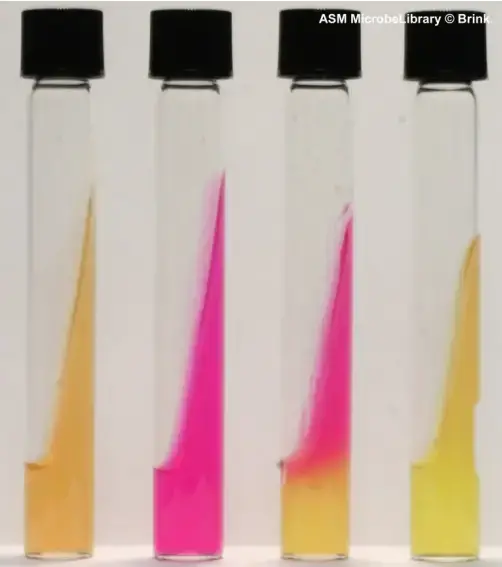
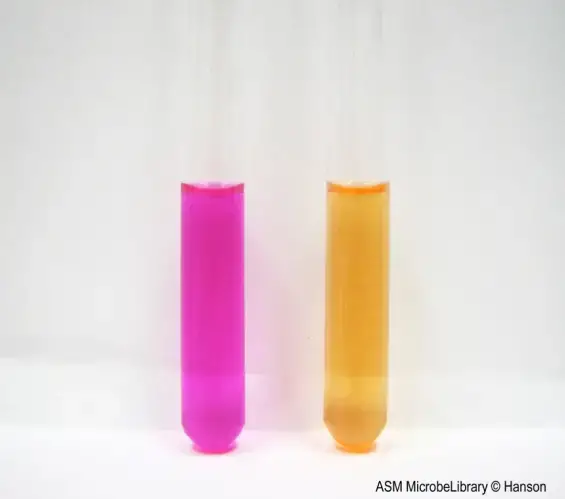
Urease positive and negative test Organisms
| Urease positive organisms (rapid producer) | Urease positive organisms (delayed/weak/variable producer) | Urease positive organisms (Gram positive and others) | Urease positive organisms (yeast/fungi) | Urease negative organisms |
|---|---|---|---|---|
| Helicobacter pylori | Klebsiella species (Klebsiella pneumoniae, Klebsiella oxytoca) | Staphylococcus species (Staphylococcus aureus, Staphylococcus epidermidis, Staphylococcus saprophyticus) | Cryptococcus species (Cryptococcus neoformans) | Escherichia coli |
| Proteus species (Proteus mirabilis, Proteus vulgaris) | Enterobacter species (Enterobacter cloacae) | Corynebacterium species | Rhodotorula species | Salmonella species (Salmonella typhimurium) |
| Morganella species | Citrobacter species (Citrobacter freundii) | Rhodococcus equi | Trichosporon species | Shigella species |
| Providencia species | Serratia species | Nocardia | Saccharomyces species | Enterobacter aerogenes |
| Brucella species | Yersinia species (Yersinia enterocolitica) | Ureaplasma | Candida species |
Uses of Urease Test
- It is used for diagnosis of Helicobacter pylori infection. It is used in gastric biopsy sample and it is used to know the cause of gastritis and peptic ulcer.
- It is used to monitor H. pylori and to confirm eradication after treatment.
- It is used to differentiate enteric bacteria. It is used to distinguish rapid urease producing Enterobacteriaceae such as Proteus Morganella and Providencia from urease negative organism like Escherichia coli and Salmonella.
- It is used for identification of pathogenic yeast. It is used to differentiate urease positive Cryptococcus species (Cryptococcus neoformans) from urease negative yeast like Candida.
- It is used for early presumptive diagnosis of brucellosis. It can be applied directly in positive blood culture broth for rapid detection.
- It is used for identification of other urease producing pathogens like Klebsiella Yersinia Brucella Corynebacterium Staphylococcus epidermidis and Staphylococcus saprophyticus.
- It is used in soil microbiology. Urease activity is used as indicator for nitrogen mineralization rate and microbial biomass.
- It is used in environmental monitoring and for screening environmental sample for reservoirs of zoonotic pathogens.
Limitations of Urease Test
- False negative result can be obtained when bacterial load is low (minimum concentration is required for colour change). It is seen in early stage infection and in children due to patchy distribution.
- False negative can occur due to recent use of proton pump inhibitors (PPI) antibiotics or bismuth compounds. These drug suppress the growth and urease activity and PPI can shift the bacteria location causing sampling error.
- False negative can occur in gastric atrophy intestinal metaplasia and active gastrointestinal bleeding. These conditions reduce bacterial load or buffer the reaction.
- Weak urease producing microorganism may not produce sufficient ammonia to overcome buffer of some media (such as Stuart’s urea broth) so the colour change may not be seen.
- False positive result can occur when incubation is prolonged and reading is taken after 24–48 hours. The organism may hydrolyse peptones and alkaline byproducts is formed or other urease producing organism may overgrow.
- False positive can occur due to presence of non target urease producing bacteria (Staphylococcus Proteus Klebsiella etc.) in sample especially in low stomach acid condition (hypochlorhydria or achlorhydria).
- Alkaline contaminants can give false positive. Excess salivation alkaline bile reflux or antacid drug can increase pH and phenol red changes colour without enzymatic reaction.
- Urea is heat and light sensitive. Overheating during media preparation or improper storage can cause urea autohydrolysis and medium becomes alkaline before inoculation and false positive is obtained.
- It is not a test of cure for H. pylori. Negative rapid urease test should not be taken as only criteria because low bacterial load can be missed.
- It is qualitative test. It confirms presence or absence of urease enzyme but exact rate of urease activity is not measured.
- It requires supplementary tests for final identification. It is combined with other biochemical immunological molecular or mass spectrometry tests for confirmation.
Quality Control
Control organisms of urease test are used to check the performance of the media and procedure. These are taken as positive control weak positive control and negative control.
- Positive control (rapid urease producer)- Proteus mirabilis (ATCC 25933 or ATCC 12453) and Proteus vulgaris (ATCC 13315 or ATCC 8427). It gives intense bright pink or magenta colour usually within 6 hours.
- Weak positive control (delayed urease producer)- Klebsiella pneumoniae (ATCC 13883). It shows slow colour change and it is used to check sensitivity of medium for slow urea hydrolysis (24–48 hours).
- Negative control- Escherichia coli (ATCC 25922) Enterobacter aerogenes (ATCC 13048) and Salmonella typhimurium (ATCC 14028 or ATCC 13311). It shows no colour change and medium remains yellow or it may become more yellow due to acid production.
References
- Aryal, S. (2022, August 10). Urease test – principle, media, procedure and result. Online Microbiology Notes.
- Becton, Dickinson and Company. (n.d.). Difco™ & BBL™ manual, 2nd edition: Urea media.
- Brink, B. (2010, November 11). Urease test protocol. American Society for Microbiology.
- Comprehensive analysis of the urease test: Biochemical principles, diagnostic protocols, and clinical significance. (n.d.).
- Hardy Diagnostics. (2020). Instructions for use: Urea agar slant.
- Lee, H., Hwang, H. S., Chung, J. W., Kim, K. A., & Kim, S. T. (2023). Development of a new liquid type rapid urease test kit (Helicotest®): Comparison with other commercial kits. The Korean Journal of Gastroenterology, 81(5), 209-215. https://doi.org/10.4166/kjg.2022.139
- Sapkota, A. (2023, January 13). Urease test – principle, media, procedure, result, uses. Microbe Notes.
- Sigma-Aldrich. (n.d.). Product information: U1757 urea agar base (Christensen).