

Pipette dropper is a simple laboratory device used to measure and transfer small volume of liquid in the form of drops. It is also called as Pasteur pipette or eye dropper. It is used when controlled amount of liquid is required, without using a graduated pipette.
It is made up of a narrow glass or plastic tube which is tapered at the lower end. The upper end is fitted with a flexible bulb (rubber, nitrile or silicone). The tube holds the liquid and the taper helps in releasing the liquid drop by drop.
It works by a simple vacuum mechanism. When the bulb is squeezed, air is pushed out from the tube. When the bulb is released, liquid is drawn inside the tube due to suction and it can be dispensed again by pressing the bulb slowly.
Pipette droppers are used in laboratory work, medical dosing and also in packing of liquid products (essential oils, skin serums, liquid supplements). It gives better control during dispensing and also reduces chance of contamination when used properly.
Components of Dropper Pipettes
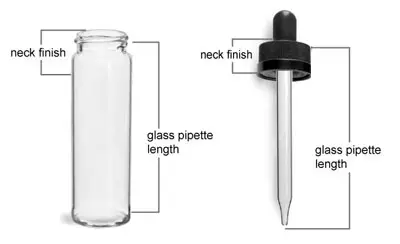
The following are the parts of dropper pipettes.
- Bulb (Squeezer)
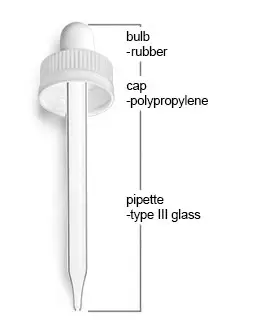
It is the flexible rubber or silicone or plastic part present at the top. It is squeezed to push out air. When it is released, vacuum is formed and liquid is drawn inside. It is again squeezed to dispense the liquid drop by drop. - Cap (Closure)
It is the threaded outer part that holds the bulb and the pipette tube. It is used to close and tighten on the container. It provides a seal and prevents leakage during storage and use. - Pipette tube
It is the main glass or plastic tube that carries the liquid. It holds the liquid during transferring. In some droppers, graduation markings are present to measure small volume. - Tip
It is the narrow delivery end of the pipette tube. The tip may be straight or blunt or curved or ball-tipped. It controls the drop size and speed of dispensing. - Bottle neck
It is the part of the container where the cap is fixed. It matches with the threads of the cap. It helps in making airtight and leak proof seal.
Types of Dropper Pipettes
The following are the types of dropper pipettes.
- Straight tip (Pointed)
It is the common standard type. It is used for low viscous liquids like water and alcohol. It gives a consistent drop size and used for general dispensing. - Blunt tip (Wide-bore tip)
This type has a wider opening at the tip. It is used for thick viscous liquids and suspensions. It reduces clogging and allows larger drop to pass. - Curved tip (Bent tip)
It is bent or curved near the end. It is used to reach the bottom corners of the bottle. It helps in taking out the remaining liquid without wastage. - Ball tip (Round tip)
This type has a smooth round end. It is used for safety purpose, mostly in eye drops or ear drops. It can give a uniform drop even when the pipette is held at different angle. - Graduated dropper pipette
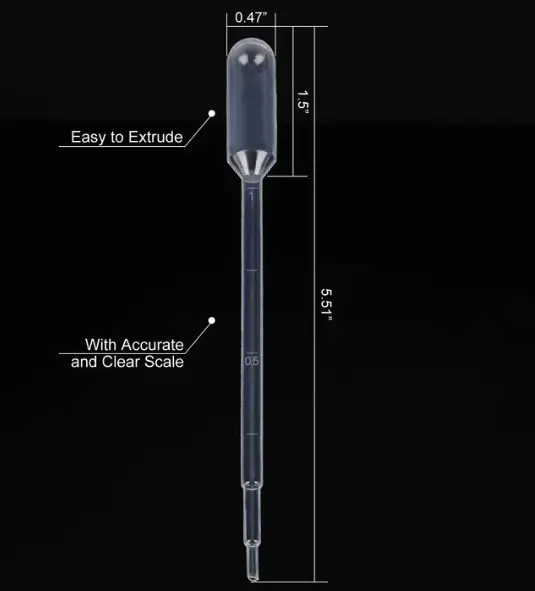
This type has etched or printed markings (0.25 ml, 0.5 ml etc.). It is used to dispense exact small volume. It is better for dosing than only counting drops. - Long fine tip
It has an extended long narrow tip. It is used for narrow-neck vessels and deep containers. It is also used for careful layering of liquids without mixing the lower layer. - Capillary drawn tip
It has very fine ultra thin tip made by heating and pulling glass. It is used for special laboratory work like microinjection and single cell handling. It is not used for routine dropping. - Glass Pasteur pipette
It is a rigid reusable dropper made of glass (borosilicate). It is chemical resistant to organic solvents. It can be heat sterilized and used again. - Plastic Pasteur pipette
It is lightweight and disposable type. It is shatter resistant and commonly made of LDPE. It is used for aqueous solutions and biological samples, and used where cross contamination is to be avoided.
How to Use a Pipette Dropper
The following are the steps to use a pipette dropper.
- Prepare the dropper
The pipette and bulb should be clean and free from contaminants. If the bulb is separate, it is fitted on the wider end of the pipette properly. It should not be forced too much, as glass may break. - Hold the dropper correctly
The pipette is held vertically with bulb at the top and the tip down. It prevents liquid from going up and contaminating the bulb. - Expel the air
The rubber bulb is squeezed to push out the air before dipping the tip into the liquid. - Aspirate the liquid
The tip is dipped just below the surface of the liquid. The bulb pressure is released slowly and smoothly so that the liquid is drawn inside the tube in required amount. - Transfer the liquid
The pipette is moved to the receiving container. It should be kept vertical to avoid spilling and contamination. - Dispense the liquid
The tip is kept close to the target surface. The bulb is squeezed gently and liquid is released drop by drop. For continuous flow, it is pressed slightly harder. - Finish up
A small amount of liquid may remain in the tip due to surface tension and it is normal. It should not be forcefully squeezed out. After use, glass droppers are washed and dried, and disposable plastic droppers are discarded properly.
Differences Between Droppers and Pipettes
The following are the differences between droppers and pipettes.
- Accuracy and precision
Pipettes are calibrated instruments and they are highly accurate for measuring exact volume. It is designed for precise volume transfer (generally very low error). Droppers are not accurate and mostly used for approximate measurement and general dropping. - Purpose and volume control
Pipettes are used to measure and transfer a fixed volume or adjustable volume using proper setting. It gives specific volume delivery. Droppers are used to dispense liquid drop by drop by manual bulb pressure and usually they do not have proper markings for exact volume. - Applications
Pipettes are used in scientific and medical work like molecular biology, chemical analysis, and pharmaceutical research. Droppers are used for simple low precision works like basic lab demonstration, mixing essential oils, and giving liquid medicines. - Cost
Pipettes are costly because of their mechanism and calibration feature. Droppers are economical and many times it is made as disposable type. - Maintenance requirement
Pipettes require regular maintenance and calibration to keep the accuracy. Droppers require minimal maintenance and generally replaced after use.
Applications of Dropper Pipettes
Applications of dropper pipettes
- Dispensing essential oils and aromatherapy blends in small amount.
- Measuring cooking extracts in small volume.
- Preparing custom skincare formulations and mixing small liquids.
- Administering liquid supplements drop by drop.
- Dosing liquid medicines, mainly in pediatric use.
- Applying eye drops and ear drops in controlled manner.
- Applying serums, facial oils and concentrated essences for spot treatment.
- Transferring small uncalibrated volume of reagents between vials and tubes.
- Adding indicators or color agents during titration.
- Dispensing routine buffers and lab solutions.
- Seeding cells in culture dish evenly by gentle dropping.
- Removing supernatant after centrifugation without disturbing pellet.
- Draining wash solutions and adding reagents in diagnostic works (immunohistochemistry).
- Layering liquids of different density in density gradient work.
- Spotting samples on microscope slide and TLC plate.
- Handling organic solvents or volatile chemicals in small amount with better control.
Advantages of Dropper Pipettes
- It allows dispensing of small controlled amount of liquid drop by drop.
- It can transfer exact small amount when markings are present in some droppers.
- It reduces contamination because bottle content is not touched directly.
- It helps in maintaining purity and reduces cross contamination during repeated use.
- It is safer for handling hazardous chemicals as liquid transfer is controlled.
- It is easy to use and most users can operate it without training.
- It can handle different types of liquids like viscous, foamy and high vapor pressure liquids.
- It fits well with safety closures like child resistant and tamper evident caps.
- It gives better user experience in cosmetics, application can be controlled and looks premium.
- Glass droppers are chemical resistant and reusable after proper cleaning.
- Plastic droppers are lightweight, flexible and disposable, good when contamination is to be avoided.
Limitations of Dropper Pipettes
- It is not calibrated and it gives only approximate drops, not exact volume.
- It is not suitable for highly accurate scientific measurement work.
- Drop size is not fixed and it varies with user technique and handling.
- Drop volume also changes with viscosity, density and surface tension of liquid.
- Glass Pasteur dropper is fragile and it can break easily if dropped.
- Broken glass may cause injury and it becomes a lab safety problem.
- Plastic droppers can deform with some organic solvents and aggressive chemicals.
- Plastic droppers cannot tolerate high heat and cannot be autoclaved properly.
- Standard droppers may not create enough suction for very thick viscous liquids.
- Plastic droppers may develop static charge and dust may get attracted on it.
- Due to static, small droplets may stick to inner wall and dispensing becomes poor.
- Cross contamination risk is there if tip touches outside surface and again inserted into bottle.
- It may become messy during use and spillage can occur easily.
- Single use plastic droppers increase lab waste and gives environmental load.
References
- Frederick National Laboratory for Cancer Research. (2021, November 29). Use and maintenance of pipettes (SOP 26009). https://frederick.cancer.gov/sites/default/files/2022-05/26009_Use_and_Maintenance_of_Pipettes_v.1.0_COMPLIANT.pdf.
- Li, R. (2026, January 26). A complete guide to dropper types for glass dropper bottles. Roetell. https://www.roetell.com/a-complete-guide-to-dropper-types-for-glass-dropper-bottles/.
- University of Tennessee, Knoxville. (n.d.). Biohazardous waste categories. Biosafety Program. https://biosafety.utk.edu/biosafety-program/waste/.
- University of California San Francisco. (n.d.). Biohazardous waste. Environment, Health & Safety. https://ehs.ucsf.edu/biohazardouswaste.
- Vanderbilt University Medical Center. (n.d.). Biohazardous waste: Segregation, collection & disposal guide. Office of Clinical and Research Safety. https://www.vumc.org/safety/waste/biological-waste-guide.
- Cornell University. (n.d.). Biological waste guide. Environment, Health and Safety. https://ehs.cornell.edu/research-safety/biosafety-biosecurity/biological-waste/biological-waste-guide.
- The University of Texas at Austin. (n.d.). Biological, medical, sharps and pharmaceutical waste (regulated). Environmental Health & Safety. https://ehs.utexas.edu/environment-waste/waste-management/biological-medical-sharps-and-pharmaceutical-waste-regulated.
- Home Science Tools. (n.d.). Burettes, pipettes & lab droppers for chemistry. https://www.homesciencetools.com/chemistry/glassware-plasticware/burettes-pipettes-droppers/.
- MIRON Violetglass. (n.d.). Choosing the right pipette dropper. https://www.miron.com/usa/collections/pipette-collections.
- Gast, U. (2021). Cleaning and inspection of pipettes. Eppendorf AG. https://www.eppendorf.com/product-media/doc/en/116566_Userguide/Eppendorf_Liquid-Handling_Userguide_024_Pipettes_Cleaning-Inspection-Pipettes.pdf.
- Comprehensive analysis of liquid handling systems: Engineering, metrology, and applied methodologies of pipettes and droppers. (n.d.)..
- Kedkaew, C., & Imraksa, S. (2026, March 18). Determination of surface tension by pendant drop method: Effect of tip’s diameters. Burapha Science Journal, 27(3), 1950–1962. https://li05.tci-thaijo.org/index.php/buuscij/article/view/1261.
- Jiaxing Glass. (2025, October 15). Diagnosing and preventing dropper bottle failures. https://www.glass-cosmetic-bottles.com/info/diagnosing-and-preventing-dropper-bottle-103166899.html.
- West, Z. (2021, February 23). Dosing with standard droppers. Optimus Medica. https://www.optimusmedica.com/dosing-with-standard-droppers/.
- Wikipedia. (2025, October 3). Drop (unit). https://en.wikipedia.org/wiki/Drop_(unit).
- Carow, S. (n.d.). Dropper pipette buyer’s guide. Carow Packaging. https://f.hubspotusercontent30.net/hubfs/2969680/Resources/Dropper%20Pipette%20Buyers%20Guide.pdf.
- Bios, L. (n.d.). Dropper vs pipette distinguish design principles & usage boundaries. Ucallmlabs. https://ucallmlabs.com/dropper-vs-pipette-distinguish-design-principles-usage-boundaries/.
- Comella, E. (2024, February 29). Droppers and pipettes in cosmetic packaging. New High Glass. https://www.newhigh.com/blogs/news/droppers-and-pipettes-in-cosmetic-packaging.
- Yelimeshyn, S. (2025, December 24). Electronic vs. digital pipettes: Which one should you choose? Bostonmedsupply. https://bostonmedsupply.com/electronic-vs-digital-pipettes-which-one-should-you-choose/.
- Mettler Toledo. (n.d.). Ergonomic electronic pipettes. https://www.mt.com/au/en/home/products/pipettes/rainin-pipettes/electronic-pipettes.html.
- Afshan. (2024, January 3). Everything you need to know about droppers and pipettes. Wuxi AFshan Packaging Co., Ltd. https://www.afushan.net/blogs/286.html.
- Virospack. (n.d.). Glass droppers or plastic droppers: What’s the difference? https://virospack.com/glass-droppers-or-plastic-droppers/.
- Culbertson, B. (2025, February 15). Glass vs plastic pipettes: Which is right for your application? RTN Applicator Company. https://rtnapplicator.com/glass-vs-plastic-pipettes-which-is-right/.
- Zafar, S. (2025, March 15). Glass vs. plastic pipettes: Which one is best for your experiment? EcoMENA. https://www.ecomena.org/glass-vs-plastic-pipettes-which-one-is-best-for-your-experiment/.
- Karki, P. (2024, December 25). Guide to pipettes: Principle, types & key uses. Microbe Notes. https://microbenotes.com/pipette-principle-parts-types-procedure-uses-examples/.
- Microlit. (2023, October 10). How is electronic pipette better than manual pipette? https://www.microlit.com/how-is-electronic-pipette-better-than-manual-pipette/.
- r/PharmacyTechnician. (n.d.). How many drops per 1ml? I’ve been hearing different things lol! Reddit. https://www.reddit.com/r/PharmacyTechnician/comments/hmmnvk/how_many_drops_per_1ml_ive_been_hearing_different/.
- Transcat Pipettes. (n.d.). How to clean pipettes. https://www.pipettes.com/calibration-services/pipettes-university/accuracy-matters-blog/pipette-maintenance-101-learn-how-to-properly-clean-pipettes.
- GMP Plastic. (2025, March 14). How to use a Pasteur pipette: A complete guide. https://gmpplastic.com/blogs/useful-articles-on-lab-supplies-faq-section/how-to-use-a-pasteur-pipette-a-complete-guide.
- Richmond Containers. (n.d.). In depth: Cosmetic dropper pipettes (part 3 of 3). https://www.richmondgroup.com/news-insights/insights/in-depth-cosmetic-dropper-pipettes-part-3-of-3.
- Thomas Scientific. (n.d.). Lab dropper pipettes. https://www.thomassci.com/laboratory-supplies/pipets/droppers.
- Lecture 8. (n.d.). https://uomustansiriyah.edu.iq/media/lectures/4/4_2021_09_24!06_37_40_PM.pdf.
- Biotix. (n.d.). Liquid handling & lab automation | Innovative lab products. https://biotix.com/products/.
- Mass variability in drops of multidose eyedrops: A quality and reliability study. (n.d.). PubMed Central (PMC). https://pmc.ncbi.nlm.nih.gov/articles/PMC11884367/.
- Brenner, B. (2026, February 10). Medical laboratory waste disposal regulations 2026. MedPro Disposal. https://www.medprodisposal.com/medical-laboratory-waste-disposal-regulations-2026/.
- Clinical Lab Products. (n.d.). New electronic pipette features high-resolution touchscreen. https://clpmag.com/lab-equipment/pipetting-fluid/thermo-fisher-launches-fluid-ease-pro-cliptip-electronic-pipette/.
- Lee, C. (2025, November 19). Pasteur pipette dropper – Glass & plastic types. Kelabscience. https://kelabscience.com/pasteur-pipette-dropper-guide/.
- RightPatient. (2026, March 13). Pasteur pipette: The complete guide to glass and disposable droppers. https://www.rightpatient.com/guest-blog-posts/pasteur-pipette-the-complete-guide-to-glass-and-disposable-droppers/.
- Wikipedia. (2026, March 25). Pipette. https://en.wikipedia.org/wiki/Pipette.
- Thermo Fisher Scientific. (n.d.). Pipette types for different applications. https://www.thermofisher.com/us/en/home/life-science/lab-plasticware-supplies/lab-plasticware-supplies-learning-center/lab-plasticware-supplies-resource-library/fundamentals-of-pipetting/liquid-handling-selection/pipette-types-for-different-applications.html.
- Thermo Fisher Scientific. (n.d.). Pipette decontamination. https://www.thermofisher.com/es/en/home/life-science/lab-plasticware-supplies/lab-plasticware-supplies-learning-center/lab-plasticware-supplies-resource-library/fundamentals-of-pipetting/pipette-maintenance-service/pipette-decontamination.html.
- Transcat Pipettes. (n.d.). Pipetting best practices. https://www.pipettes.com/calibration-services/pipettes-university/pipetting-best-practices.
- Nanoscience Instruments. (n.d.). Surface & interfacial tension. https://www.nanoscience.com/techniques/tensiometry/surface-and-interfacial-tension/.
- Clinical Lab Products. (2025, January 27). Tecan unveils automated liquid handling platform. https://clpmag.com/lab-essentials/lab-automation/tecan-unveils-automated-liquid-handling-platform/.
- LabX. (2026). The best automated liquid handling systems of 2026. https://www.labx.com/resources/the-best-automated-liquid-handling-systems-of-2026/4816.
- Gilson. (n.d.). The ultimate guide to cleaning and decontaminating your pipette. https://www.gilson.com/default/learninghub/post/the-ultimate-guide-to-cleaning-and-decontaminating-your-pipette.html.
- Integra Biosciences. (n.d.). The different types of pipette tips (and when to use them). https://www.integra-biosciences.com/global/en/blog/article/different-types-pipette-tips.
- Eggers, J. (1995, May). Theory of drop formation. Physics of Fluids, 7(5), 941-953. https://people.maths.bris.ac.uk/~majge/PHF00941.pdf.
- ChemScience. (n.d.). Ultimate guide to pipettes: Everything you need to know. https://www.chemscience.com/blog/ultimate-guide-to-pipettes-everything-you-need-to-know.
- United Poly Engineering Pvt. Ltd. (2026, February 13). Wash bottles v/s pipettes v/s droppers: When to use in a lab. https://www.unitedpoly.com/wash-bottles-vs-pipettes-vs-droppers-when-to-use-in-a-lab/.
- Wang, H., Mucha, P. J., & Turk, G. (n.d.). Water drops on surfaces. Georgia Institute of Technology. https://faculty.cc.gatech.edu/~turk/my_papers/droplet.pdf.
- APackaging Group. (n.d.). What is the difference between glass and plastic dropper bottles? https://apackaginggroup.com/blogs/news/what-is-the-difference-between-glass-and-plastic-dropper-bottles.