

The Butyrate Disk Test is a rapid biochemical test used in microbiology laboratory for the detection of enzyme butyrate esterase in bacteria. It is mainly used for the presumptive identification of Moraxella catarrhalis, which is an important human pathogen associated with respiratory tract infections. It is useful because this organism shows morphological similarity with Neisseria species under microscope, appearing as Gram-negative oxidase positive diplococci. This test helps in differentiation of these organisms at early stage.
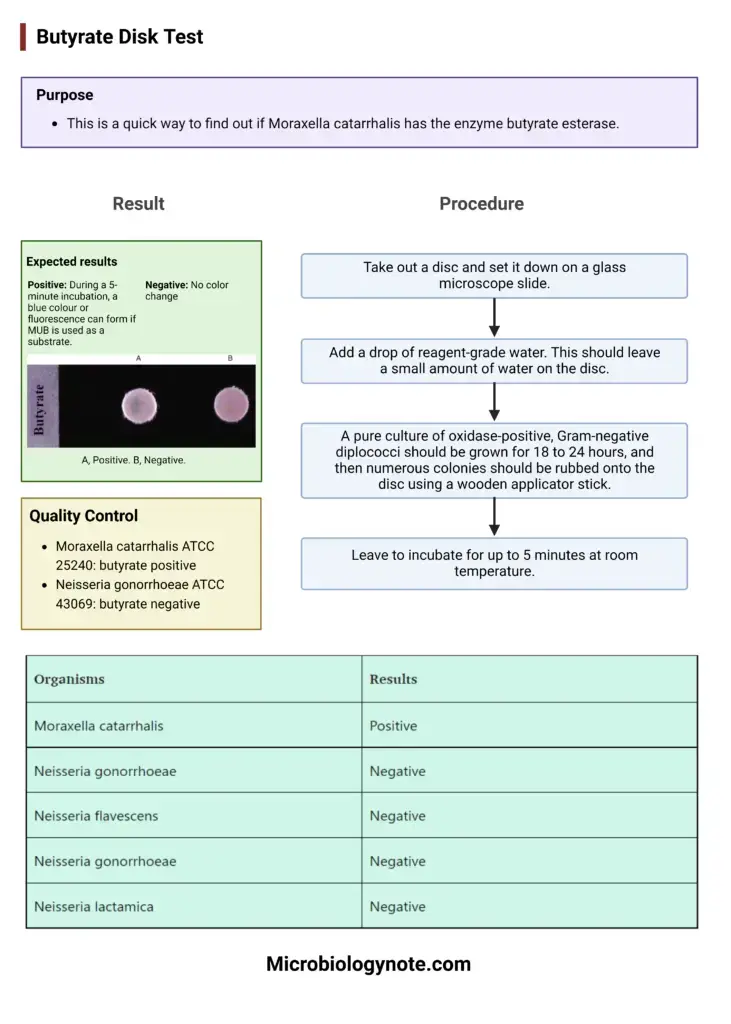
The principle of the test is based on the hydrolysis of a chromogenic substrate present in the paper disk. The disk is impregnated with bromo-chloro-indolyl butyrate. When bacteria possessing butyrate esterase enzyme is applied on the disk the substrate is hydrolyzed. This reaction releases indoxyl which in presence of oxygen is oxidized to indigo. Due to this reaction a visible blue or blue-violet colour is produced on the disk. This colour change indicates a positive reaction.
The procedure is simple and rapid. A butyrate disk is placed on a clean glass slide or petri dish and moistened with a drop of sterile water. A heavy inoculum from a pure bacterial culture is taken using a wooden applicator stick and rubbed directly on the disk surface. The disk is then observed at room temperature for a maximum of 5 minutes. If blue colour develops within this time it is considered positive, while no colour change indicates a negative result.
This test is especially important in distinguishing Neisseria gonorrhoeae and other Neisseria species from Moraxella catarrhalis. Neisseria species usually do not produce butyrate esterase and hence give a negative reaction. The results must be read within the specified time because prolonged incubation may lead to false positive reactions. Therefore the test is performed only after preliminary identification as oxidase positive Gram-negative diplococci showing typical colony morphology.
Objectives of Butyrate Disk Test
- To detect the presence of enzyme butyrate esterase in bacterial isolate.
- To presumptively identify Moraxella catarrhalis from clinical samples.
- To differentiate Moraxella catarrhalis from Neisseria gonorrhoeae and other Neisseria species which are butyrate negative.
- To assist in rapid identification of oxidase positive Gram-negative diplococci.
- To support early clinical diagnosis by providing results within few minutes.
- To help in indirect indication of beta-lactamase producing strains of Moraxella catarrhalis.
Principle of Butyrate Disk Test
The principle of Butyrate Disk Test is based on the detection of enzyme butyrate esterase produced by certain bacteria. In this test a paper disk is impregnated with a specific substrate known as bromo-chloro-indolyl butyrate. When the bacterial organism possessing butyrate esterase is applied on the disk the enzyme hydrolyzes the substrate. This hydrolysis leads to the release of indoxyl compound. In presence of atmospheric oxygen this indoxyl is oxidized and converted into indigo which produces a blue to blue-violet colour on the disk. This colour formation indicates a positive reaction and is characteristic of Moraxella catarrhalis. In some variations of the test another substrate such as 4-methylumbelliferyl butyrate may be used which produces fluorescence under ultraviolet light after hydrolysis. This reaction is used for differentiation of Moraxella catarrhalis from Neisseria species which do not possess butyrate esterase enzyme and therefore give a negative result.
Reagents and Supplies Used for Butyrate Disk Test
- Butyrate test disks impregnated with bromo-chloro-indolyl butyrate substrate.
- Distilled or deionized water used for moistening the disk.
- Sterile wooden applicator sticks or bacteriological loop for picking bacterial growth.
- Clean glass slide or petri dish for placing the disk during test procedure.
- Forceps used for handling the disk aseptically.
- Ultraviolet (UV) light source when 4-methylumbelliferyl butyrate substrate is used.
- Positive control strain of Moraxella catarrhalis for quality control.
- Negative control strain of Neisseria gonorrhoeae or other Neisseria species.
Procedure of Butyrate Disk Test
- Ensure that the test organism is a pure culture of oxidase positive Gram-negative diplococci.
- Remove a butyrate disk from the vial using sterile forceps and place it on a clean glass slide or petri dish.
- Add one drop of distilled or deionized water to the disk to moisten it. The disk should not be over saturated.
- Using a sterile wooden applicator stick or loop take a heavy inoculum from an 18–72 hour old pure culture.
- Rub the bacterial growth directly onto the surface of the moistened disk.
- Keep the disk at room temperature for incubation for a period of up to 5 minutes.
- Observe the disk for development of blue or blue-violet colour or fluorescence depending on the substrate used.
- Read the results within 5 minutes only as prolonged incubation may give false positive reaction.
Expected results
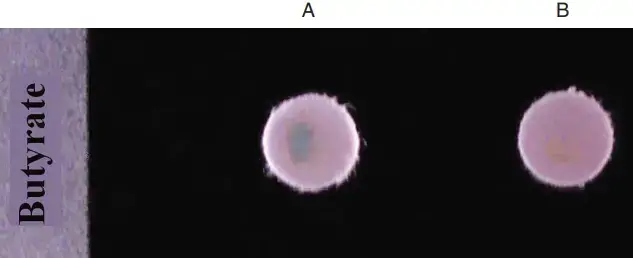
- Positive result – Development of blue to blue-violet or blue-green colour on the disk within 5 minutes. This indicates presence of butyrate esterase enzyme and supports identification of Moraxella catarrhalis.
- Fluorescent positive result – Appearance of fluorescence under ultraviolet light when 4-methylumbelliferyl butyrate substrate is used.
- Negative result – No colour change is observed and the disk remains colourless. This indicates absence of butyrate esterase and is commonly seen in Neisseria gonorrhoeae and other Neisseria species.
- False positive result – Colour development after 5 minutes should be ignored as delayed reactions may occur.
- False negative result – May occur if insufficient bacterial inoculum is applied on the disk.
List of organisms showing result in Butyrate Disk Test
Organisms giving positive result
- Moraxella catarrhalis – Gives strong positive reaction within 5 minutes.
- Branhamella caviae – Shows positive reaction.
- Branhamella ovis – Gives positive result.
- Moraxella species – Some strains may give positive or weak reaction.
- Pseudomonas aeruginosa – May show positive reaction.
- Staphylococcus aureus – Can give positive reaction.
- Coagulase negative staphylococci – May show positive result.
- Acinetobacter species – Some strains give weak positive reaction.
- Eikenella species – May show positive or weak reaction.
- Candida albicans – Gives positive reaction.
Organisms giving negative result
- Neisseria gonorrhoeae – Shows negative reaction.
- Neisseria meningitidis – Negative result.
- Neisseria lactamica – Gives negative reaction.
- Neisseria sicca – Negative result.
- Neisseria subflava – Shows negative reaction.
- Neisseria flavescens – Negative result.
- Neisseria mucosa – Gives negative reaction.
- Neisseria cinerea – Negative result.
- Neisseria polysaccharea – Shows negative reaction.
- Neisseria denitrificans – Negative reaction.
- Neisseria canis – Gives negative result.
- Kingella species – Shows negative reaction.
Precautions of Butyrate Disk Test
- Perform the test only on pure culture of oxidase positive Gram-negative diplococci.
- Mixed cultures should not be used as it may give false positive result.
- Read the test result strictly within 5 minutes. Any colour change after this time should be ignored.
- A heavy inoculum should be applied on the disk as light inoculum may give false negative result.
- The disk should be white and free from any discoloration before use. Discoloured disks must be discarded.
- Do not over moisten the disk with water as excess moisture can interfere with colour development.
- Use sterile wooden applicator stick preferably and avoid metal loop if possible.
- Used disks and cultures should be treated as biohazard and disposed properly.
- Store the disks properly in closed container away from moisture and light to maintain activity.
Uses of Butyrate Disk Test
- Used for presumptive identification of Moraxella catarrhalis from clinical isolates.
- Helps in differentiation of Moraxella catarrhalis from Neisseria gonorrhoeae and Neisseria meningitidis which show similar morphology.
- Used for detection of butyrate esterase enzyme in bacteria.
- Helps in rapid identification of oxidase positive Gram-negative diplococci.
- Useful in early screening of beta-lactamase producing Moraxella catarrhalis strains.
- Reduces time required for identification as results are obtained within few minutes.
Advantages of Butyrate Disk Test
- Gives rapid result within 5 minutes as compared to conventional biochemical tests.
- The procedure is simple and easy to perform in routine microbiology laboratory.
- Helps in effective differentiation of Moraxella catarrhalis from Neisseria species which show similar morphology.
- Useful for early presumptive identification directly from primary culture.
- Helps in early indication of beta-lactamase producing Moraxella catarrhalis strains.
- Cost effective test requiring minimal reagents and equipment.
- Saves time and improves diagnostic efficiency in clinical laboratories.
Limitations of Butyrate Disk Test
- The result must be read strictly within 5 minutes as delayed reading may give false positive result.
- Spontaneous hydrolysis of substrate may occur if incubation time is prolonged.
- False negative result may be obtained if very small or insufficient inoculum is used.
- The test is not specific only for Moraxella catarrhalis as some other organisms may also give positive reaction.
- Staphylococcus species Pseudomonas species and Candida albicans may produce false positive reaction.
- Some non-human Moraxella species and rod shaped Moraxella strains may show weak or positive reaction.
- The test should not be performed on mixed culture as it may give misleading result.
- Disks are sensitive to moisture and light and improper storage may affect the accuracy of test.
- This test gives only presumptive identification and confirmatory tests may be required.
- Aryal, S. (2022, August 10). Butyrate disk test – Principle, procedure, uses and interpretation. Microbiology Info.
- Comprehensive analysis of the butyrate disk test in clinical microbiology: Principles, methodologies, and diagnostic significance. (n.d.).
- Dealler, S. F., Abbott, M., Croughan, M. J., & Hawkey, P. M. (1989). Identification of Branhamella catarrhalis in 2.5 min with an indoxyl butyrate strip test. Journal of Clinical Microbiology, 27(6), 1390–1391.
- Dr. Oracle. (2025, April 22). How can we differentiate between Neisseria and Moraxella in a laboratory setting?
- Hardy Diagnostics. (2020). CatScreen™ [Instructions for Use].
- Lakewood Biochemical. (2005). M.CAT ID test technical information.
- Pérez, J. L., Pulido, A., Pantozzi, F., & Martin, R. (1990). Butyrate esterase (4-methylumbelliferyl butyrate) spot test, a simple method for immediate identification of Moraxella (Branhamella) catarrhalis [corrected]. Journal of Clinical Microbiology, 28(10), 2347–2348.
- Remel. (2010). Rapid Tributyrin [Instructions for Use]. Thermo Fisher Scientific.
- Remel. (2020). M. Cat. Butyrate Disk [Instructions for Use]. Thermo Fisher Scientific.
- Speeleveld, E., Fossépré, J. M., Gordts, B., & Van Landuyt, H. W. (1994). Comparison of three rapid methods, tributyrine, 4-methylumbelliferyl butyrate, and indoxyl acetate, for rapid identification of Moraxella catarrhalis. Journal of Clinical Microbiology, 32(5), 1362–1363.
- Tankeshwar, A. (n.d.). Butyrate disk test: Principle, procedure, results, uses. Microbe Online.