

Single Use Bioreactor is a cell cultivation system where the reusable glass or stainless steel vessel is replaced by a disposable plastic bag. It is also known as Disposable Bioreactor. The bag is pre-sterilized and used only for one batch.
This flexible polymeric bag acts as the sterile place for the growth of cells. It is placed inside a permanent outer hardware system such as steel cuboid or rocker. This outer system gives support, temperature control and agitation.
The part which directly touches the culture medium is discarded after single use. So, cleaning and sterilization of vessel is not required. Thus, Single Use Bioreactor reduces the need of CIP and SIP process used in conventional bioreactor.
Working Principle of Single Use Bioreactor
Single Use Bioreactor is based on the use of disposable pre-sterilized plastic bag as the culture vessel. This bag is used in place of stainless steel or glass vessel. The bag provides sterile condition for the growth of cells.
The plastic bag is kept inside a permanent outer supporting system. This system gives mechanical support, heating and temperature control. The bag is already sterilized by manufacturer, generally by gamma irradiation.
As the bag is pre-sterilized and disposable, cleaning of vessel is not needed. CIP (Clean-in-place) and SIP (Steam-in-place) are not required in this bioreactor. After one batch, the used bag is discarded.
Agitation is done by two methods. In one method, an internal impeller is present inside the bag and it is moved by outer motor. In another method, the whole bag is placed on rocking platform. The rocking movement forms waves in the medium and mixing takes place.
The bag also contains gas sparger, feed line, sampling line and sensors. Optical sensors are used to measure pH, dissolved oxygen and temperature. These sensors are connected with external control unit.
During this process, gas supply, pH, temperature and oxygen level are controlled by the control unit. Thus, Single Use Bioreactor works by providing sterile disposable culture chamber with controlled mixing, aeration and monitoring condition.
Parts of Single Use Bioreactor
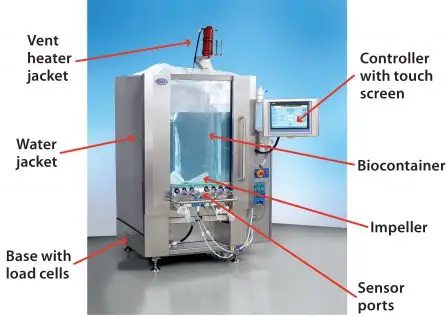
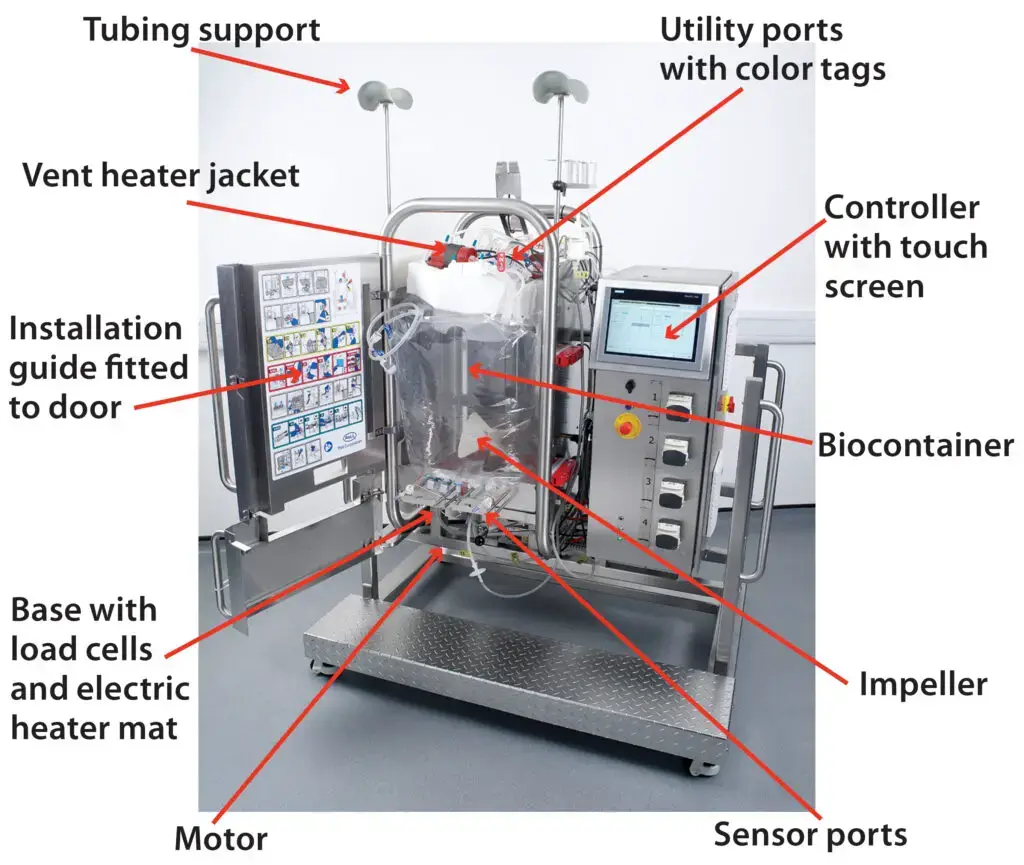
- Disposable polymeric bag – It is the main culture vessel of Single Use Bioreactor. It is a sterile plastic bag where cell culture grows. The bag is made up of multilayered films with inner contact layer, gas barrier layer, strength layer and outer protective layer.
- Hardware structure – It is the permanent outer support system of the bioreactor. It holds the flexible plastic bag and gives proper shape and mechanical support. It may be steel cuboid, tank like support or rocker.
- Agitation system – It is used for mixing of the culture medium. Mixing is done either by rocking movement of the bag or by an internal impeller present inside the bag. The impeller is moved by external motor through magnetic or mechanical connection.
- Sparger – It is used to supply gas into the culture medium. Oxygen or air is passed through sparger and dispersed into small bubbles. It helps in aeration and oxygenation of cells.
- Sensors and probes – These are used for measuring the important culture conditions. Optical sensors or optodes are commonly attached with the bag. They measure pH, dissolved oxygen, temperature, conductivity and biomass.
- Feed lines and ports – These are the tubing and connection parts present in the bag. They are used to add nutrients, gases and other materials into the culture. They are also used for sampling during the process.
- Temperature control system – It is used to maintain suitable temperature for cell growth. Heating jacket, heating plate or temperature controlled system are used around the bag holder. Temperature sensor helps to monitor the culture temperature.
- pH control system – It is used to maintain the required pH of the culture medium. The pH sensor detects the change in pH. Acid or base may be added through the control system when needed.
- Sterilization port – It is present in some single use bioreactor. It is used to add sterilizing agents when required. It helps to maintain sterile condition before use.
- Control unit – It is the electronic controlling part of the bioreactor. It controls temperature, pH, dissolved oxygen, gas flow and agitation speed. It also receives readings from sensors and maintains suitable condition for cell growth.
Types of Single Use Bioreactor
- Stirred-Tank Single Use Bioreactor – This type is similar to traditional stirred tank bioreactor. It contains an internal impeller or stirrer inside the disposable bag. The stirrer mixes the culture medium by mechanical or magnetic connection from outside.
- Wave-Induced Single Use Bioreactor – This type contains a disposable bag placed on a rocking platform. The platform moves backward and forward and forms wave in the medium. This gives gentle mixing and low shear condition for cell growth.
- Fixed-Bed Single Use Bioreactor – This type is mainly used for adherent cell culture. It contains fixed bed with macrocarriers or fibres for attachment of cells. The cells grow on the surface and oxygenation may be done by flow or waterfall type movement.
- Bubble-Column Single Use Bioreactor – This type does not contain mechanical stirrer. Gas is passed from the bottom of the bag or vessel. The rising gas bubbles mix the culture medium and also supply oxygen.
- Airlift Single Use Bioreactor – This type is similar to bubble column bioreactor. It uses gas flow for mixing and aeration. It contains internal structure such as draft tube which helps in circulation of the medium.
- Hollow Fiber Single Use Bioreactor – This type contains bundle of semi-permeable hollow fibres. Nutrients and oxygen are supplied through these fibres and waste products are removed. It is used for perfusion culture and high cell density culture.
- Orbital Shaking Single Use Bioreactor – This type contains disposable bag placed on an orbital shaking platform. The whole vessel moves in circular motion. Mixing takes place without any internal moving part.
On the basis of cell growth, Single Use Bioreactor are of three types-
- Suspension culture bioreactor – In this type, cells grow freely suspended in the liquid medium.
- Adherent culture bioreactor – In this type, cells grow attached to a surface or carrier.
- Embedded culture bioreactor – In this type, cells are grown inside a matrix or support material.
Operating Procedure of Single Use Bioreactor
- The pre-sterilized disposable plastic bag is first unpacked carefully. Then it is placed inside the permanent bioreactor holder or support structure. The bag is fitted properly without folding or damage.
- In this step, pressure integrity test is done. The bag is inflated and deflated to check leakage. It confirms that there is no defect in the bag before filling the medium.
- The attached tubes are connected by sterile connection. Gas inlet, gas outlet and feed lines are joined properly. Media, acid, base and antifoam lines are also connected when required.
- The pre-installed single use sensors are connected with control system. Optical sensors are generally used for pH, dissolved oxygen and biomass. These sensors help to monitor the culture condition.
- The stirrer or impeller is connected with mechanical or magnetic drive. In rocking type system, the bag is fitted on rocking platform. Temperature control system is then started to maintain suitable growth condition.
- The culture medium is filled into the bag and cells are added aseptically. During this process, agitation speed, gas flow, temperature, pH, nutrient feed and oxygen level are controlled. The cultivation is continued until required cell growth or product formation takes place.
- After completion of cultivation, the culture or product is collected from the bioreactor. Harvesting is done when required cell density, virus titre or metabolite concentration is obtained.
- The used bag, tubing and sensors are removed after single batch. These are discarded safely as biological or hazardous waste. Thus, cleaning-in-place (CIP) and steam-in-place (SIP) are not required in this system.
Applications of Single Use Bioreactor
- Single Use Bioreactor is used for the production of viral vaccines. It is used in vaccine production of COVID-19, Influenza, Rabies, Ebola, Zika, Dengue and Enterovirus.
- It is used in gene therapy and cell therapy. Viral vectors like Lentivirus, Adenovirus and Adeno-associated virus are produced in this bioreactor.
- It is used for production of therapeutic proteins and antibodies. Mammalian cells and microbial cells are cultivated for producing monoclonal antibodies and recombinant proteins.
- It is used for production of oncolytic viruses. These viruses are used in targeted cancer treatment.
- It is used for exosome production. Stem cells are cultivated for producing extracellular vesicles which are used in drug delivery and bioactivity studies.
- It is used in tissue engineering and stem cell expansion. Human mesenchymal stem cells, anchorage dependent cells and 3D tissues are grown in this system.
- It is used in cultured meat production. Muscle cells are grown outside the animal body by in vitro myogenesis for artificial meat production.
- It is used in microbial fermentation. Bacteria and yeast are grown for production of organic acids, amino acids, enzymes and other bio-based chemicals.
- It is used in biofuel production. Microalgae are cultivated for biodiesel production and modified microorganisms are used for production of biojet fuels.
- It is used in bioremediation process. Microorganisms are grown under controlled condition for breaking dyes, aquaponics waste and petroleum hydrocarbons.
- It is used in general bioprocessing works. It is used for mixing, preparation and storage of media and buffers, tangential flow filtration and diafiltration.
Advantages of Single Use Bioreactor
- Single Use Bioreactor requires low capital investment than stainless steel bioreactor. It does not need complex piping system, large utility support and costly cleaning equipment.
- It reduces the risk of contamination. The disposable bag is closed and pre-sterilized. So, cross contamination between two batches is very less.
- It does not require cleaning process after each batch. The product contact surface is discarded after one use. So, CIP and SIP are not needed.
- It saves time between two batches. Cleaning, sterilization and validation time is reduced. So, next batch can be started quickly.
- It gives more operational flexibility. The system can be arranged easily according to need. It is useful for scale up, scale down and production of different products.
- It requires less water and energy. Steam generation and large amount of purified water are not required for cleaning. Chemical waste is also reduced.
- It needs smaller production area. Large permanent pipelines, cleaning tanks and holding tanks are not required. So, facility space is reduced.
- It is useful for multi-product facility. Different products can be produced in same area with less chance of batch to batch contamination.
- It is easy to install and operate. The pre-sterilized bag and ready tubing system make the process simple and faster.
- It reduces labor requirement. Less work is needed for cleaning, sterilization and maintenance of the vessel.
Limitations of Single Use Bioreactor
- Single Use Bioreactor has limited scale up capacity than stainless steel bioreactor. Stainless steel bioreactor can be made up to very large volume, but single use system is generally limited. It is mainly because of bag manufacturing, transport and sterilization problem.
- It has high operating cost for long time use. New pre-sterilized bag, tubing and other disposable parts are required for every batch. So, repeated purchase of consumables increases the cost.
- It produces large amount of solid plastic waste. The used bag, tubing and sensors are discarded after one batch. These wastes are generally treated as hazardous waste and destroyed by incineration.
- There is risk of leachables and extractables. Some chemical substances from plastic film may come into the culture medium. These substances may affect cell growth or product quality.
- It has limitation in oxygen transfer. High density microbial culture needs large amount of oxygen. In single use system, oxygen transfer may be low and increase of agitation or gas flow may damage sensitive cells.
- Heat removal is not very efficient in this system. Plastic film has lower thermal conductivity than stainless steel. So, removal of heat becomes difficult during highly exothermic fermentation.
- The disposable bag may face mechanical damage. Puncture, leakage, weak sealing and flex-cracking may occur due to movement and weight of liquid. This may cause contamination and loss of whole batch.
- It is not suitable for extreme process condition. Highly acidic condition, very high temperature or aggressive chemical condition may damage the plastic bag. So, it cannot be used for all type of bioprocess.
- It is dependent on supplier and ready-made disposable parts. If proper size or design of bag is not available, then process arrangement becomes difficult.
- It has limited strength compared to steel vessel. The flexible bag cannot tolerate high pressure and heavy mechanical stress like conventional bioreactor.
Precautions of Single Use Bioreactor
- The disposable bag should be handled carefully. Excess folding, pressing and overhandling should be avoided. It may cause puncture, leakage, weak seal and flex-cracking.
- The bag should be checked properly before use. Any damage, leakage or defect should be observed. It helps to prevent contamination and loss of culture.
- Extractables and leachables should be checked before using the bag for culture. Chemicals from plastic film may enter into the medium. These chemicals may inhibit cell growth and affect product purity.
- Compatibility test should be done for culture medium and plastic material. The bag material should not react with medium, product or added chemicals. Quality risk management should be followed.
- Agitation speed should be controlled carefully. High stirrer speed may improve oxygen transfer but it can produce high shear force. Delicate cells like mammalian cells may be damaged.
- Oxygen transfer should be monitored during cultivation. Gas flow and aeration should be maintained according to oxygen demand. This is more important for microbial culture where oxygen requirement is high.
- The sensors should be used carefully because they are pre-installed inside the closed bag. pH and dissolved oxygen sensors cannot be calibrated like normal reusable probes before use. So, pre-configured optical sensors are used.
- Proper supply of disposable bags, tubing, sensors and connectors should be maintained. Single use system depends on ready pre-sterilized parts. If these parts are not available, the process may be stopped.
- Sterile connection should be maintained during line joining. Gas lines, feed lines and sampling lines should be connected without contamination. Aseptic condition should be maintained throughout the process.
- The bag should not be used under extreme temperature, high pressure or strong chemical condition. These conditions may damage the plastic film and cause leakage.
References
- CellBios. (n.d.). 2D & 3D single-use bioprocessing bags.
- French, V. (2025). 7 best AI bioprocess optimization platforms for pharmaceutical manufacturing in 2025. Invert.
- Softweb Solutions. (2025). AI in predictive maintenance: How it works, benefits & examples.
- Dow Inc. (n.d.). Advanced films for single-use bioprocessing bags.
- GE Healthcare. (2013). An environmental life cycle assessment comparison of single-use and conventional bioprocessing technology [PDF].
- Fang, Z., Lyu, J., Li, J., Li, C., Zhang, Y., Guo, Y., Wang, Y., Zhang, Y., & Chen, K. (2022). Application of bioreactor technology for cell culture-based viral vaccine production: Present status and future prospects. Frontiers in Bioengineering and Biotechnology, 10, 921755.
- Artificial intelligence of things for next-generation predictive maintenance. (n.d.). PMC – NIH.
- Cytiva. (n.d.). Bio-based polymers towards net zero in single-use bioprocessing.
- Thermo Fisher Scientific. (n.d.). Bioprocess films.
- Sigma-Aldrich. (n.d.). Bioprocessing bag films: Key characteristics & properties.
- Palladino, F., Marcelino, P. R. F., Schlogl, A. E., José, Á. H. M., Rodrigues, R. d. C. L. B., Fabrino, D. L., Santos, I. J. B., & Rosa, C. A. (2024). Bioreactors: Applications and innovations for a sustainable and healthy future—A critical review. Applied Sciences, 14(20), 9346.
- Basetwo AI. (2026). Developing an AI digital twin for bioreactors: A step-by-step guide.
- Development and scale-up of rVSV-SARS-CoV-2 vaccine process using single use bioreactor. (n.d.). PMC.
- ZETA BIOSYSTEM. (n.d.). Difference between a bioreactor and a fermentor.
- Kim, H. (2025). Digital twins in bioprocessing explained. The Medicine Maker.
- Digital twins and AI in biopharma manufacturing. (n.d.). Drug Discovery News.
- Cytiva. (n.d.). Eco-friendly matters: Can sustainable and single use coexist?
- Engineering paradigms and industrial integration of single-use bioreactor technologies: A comprehensive analysis of principles, materials, and regulatory evolution. (n.d.).
- Environmental impact of single-use and reusable bioprocess systems. (n.d.). ResearchGate.
- Sartorius. (n.d.). Exploring sustainable & novel materials.
- Sigma-Aldrich. (n.d.). Leak resistant film for single-use bioprocessing bags.
- Cytiva. (n.d.). Literature review of applications and processes in iCELLis™ bioreactor [PDF].
- Cytiva. (2024). Literature review of applications and processes in iCELLis™ bioreactor.
- Beckman Coulter. (n.d.). Mode of operation of optical sensors for dissolved oxygen and pH value.
- AdvantaPure. (2025). Moving to USP <665>.
- Hamilton Company. (n.d.). Optical dissolved oxygen sensors & principles of operation.
- Oosterhuis, N. M. G., Neubauer, P., & Junne, S. (2013). Single-use bioreactors for microbial cultivation. Pharmaceutical Bioprocessing, 1(2), 167–177.
- Labcorp. (2025). Preparing for USP <665>: What you need to know.
- Endress+Hauser. (2025). Principles of quenched fluorescence (QF).
- DelveInsight. (2025). Single use bioreactors market size and share analysis.
- Single-use bioreactors. (n.d.). American Pharmaceutical Review.
- Eppendorf. (n.d.). Single-use bioreactors.
- Alicat Scientific. (n.d.). Single-use bioreactors vs stainless steel on environment.
- Sartorius. (n.d.). Single-use bioreactors.
- Boulais, A. (n.d.). Single-use platforms accelerate viral vaccine development and manufacturing. BioProcess International.
- RAUMEDIC. (2023). Single-use technology vs. stainless steel for biopharma – What’s more sustainable?
- PatSnap. (2025). Single-use vs. stainless steel bioreactors: Which one should you choose?
- Wikipedia contributors. (2026). Single-use bioreactor. In Wikipedia, The Free Encyclopedia.
- TECNIC Bioprocess Solutions. (n.d.). Single-use bioreactors (SUB) for cell & microbial processes.
- Low, A. (2025). Single-use bioreactors vs stainless steel: Key differences. Cytiva.
- Thermo Fisher Scientific. (n.d.). Single-use vs. stainless steel [PDF].
- Cytiva. (n.d.). Sustainability – Products and innovation.
- The journey of a lifetime — development of Pfizer’s COVID-19 vaccine. (n.d.). PMC – NIH.
- Sigma Technology Group. (2025). Top 10 predictive maintenance examples by industry.
- FILAB. (n.d.). USP 665 testing laboratory.
- Otte, T. (n.d.). Understanding regulatory frameworks for single-use systems: USP <665>, USP <1665>, and BPOG extractables guidance in biopharmaceutical manufacturing. Intertek.
- Hamilton Process Analytics. (2023). What are the principles of operation of DO sensors? AZoSensors.
- FLTR. (n.d.). iCELLis® single-use fixed-bed bioreactor systems [PDF].
- iCELLis™. (n.d.) [PDF].