

Sampling of bacteria from water, also called bacteriological or microbiological water sampling, is a procedure used to collect a portion of water in a sterile container for bacteriological examination. In this process, the water itself is the specimen.
It does not mean the bacteria are physically separated or isolated from the water at the sampling site. The bacteria present in the collected water are detected or enumerated later by the required microbiological method. These include culture, membrane filtration, or most probable number (MPN) method.
During sampling, the collected specimen should represent the water which is being examined. Outside microorganisms should not enter into the sample. Contamination may come from the container, sampling point, hands, or improper handling, which can change the bacterial content of the specimen and affect the obtained result.
Sterile containers are used for collection. Careful handling is also required for maintaining the microbiological condition of the water sample until it is examined.
Purpose of bacteriological water sampling
The following are some of the important purposes of bacteriological water sampling–
- To determine the microbiological quality of water by detecting or enumerating bacteria present in the collected water sample. Indicator bacteria are commonly examined for this purpose.
- It is used to check the fecal contamination of water, particularly by detecting fecal indicator bacteria such as Escherichia coli and enterococci. Their presence indicates that the water has been exposed to fecal pollution.
- To check whether the water treatment and disinfection process has worked adequately. Bacterial indicators are used for monitoring the effectiveness of treatment, and their presence in treated water may indicate treatment problem.
- Bacteriological samples are also collected from the water distribution system. It is used to find whether microbiological quality remains protected during distribution and to detect bacterial regrowth, contamination, or deterioration occurring within the system.
- To provide microbiological data during routine water-quality monitoring. Regular sampling can detect a change from the normal bacterial condition and is also used for checking water against the required microbiological quality standards.
- Sampling may be increased when microbial contamination is suspected. Samples collected from different locations and at different times can be used to confirm the contamination and help in finding its possible source.
Equipment and Sample Containers Required
The following are some of the important equipment and containers used for bacteriological water sampling–
- Sterile sample bottle- A sterile glass or plastic bottle with a tight, leak-proof cap is used for collecting the water sample. The container should provide enough volume for at least 100 mL of sample and some air space is generally left for mixing before analysis. The inner surface of bottle and cap should not be touched during sampling.
- Sodium thiosulfate bottle- For chlorinated water, the sterile sampling bottle contains sodium thiosulfate (Na₂S₂O₃). It neutralizes residual chlorine or other halogen disinfectants, preventing their bactericidal action after the sample has been collected. The chemical present in such bottle should not be rinsed out.
- Disposable gloves- Clean gloves are used while collecting bacteriological samples, particularly to reduce accidental contamination during handling of the bottle and sampling equipment. A new pair can be used before collection.
- Alcohol wipes- These are used for cleaning or disinfecting the sampling tap or spigot when samples are taken from a closed water system. The bottle mouth is kept away from the tap surface while collecting.
- Labels and permanent marker- Sample bottles are properly labelled with the required identification. Sampling location, date and time of collection are commonly recorded, with other required sample information entered on the field or laboratory form.
- Cooler and ice packs- A clean insulated cooler containing frozen ice packs is used to carry the collected samples to the laboratory. Bacteriological samples are kept cool during transportation, but freezing of the water sample should be avoided.
- Field record sheet- A field sheet or sample submission form is carried for recording the sampling details and identification of each specimen. It accompanies the sample when required by the laboratory.
General Procedure for Collecting a Bacteriological Water Sample
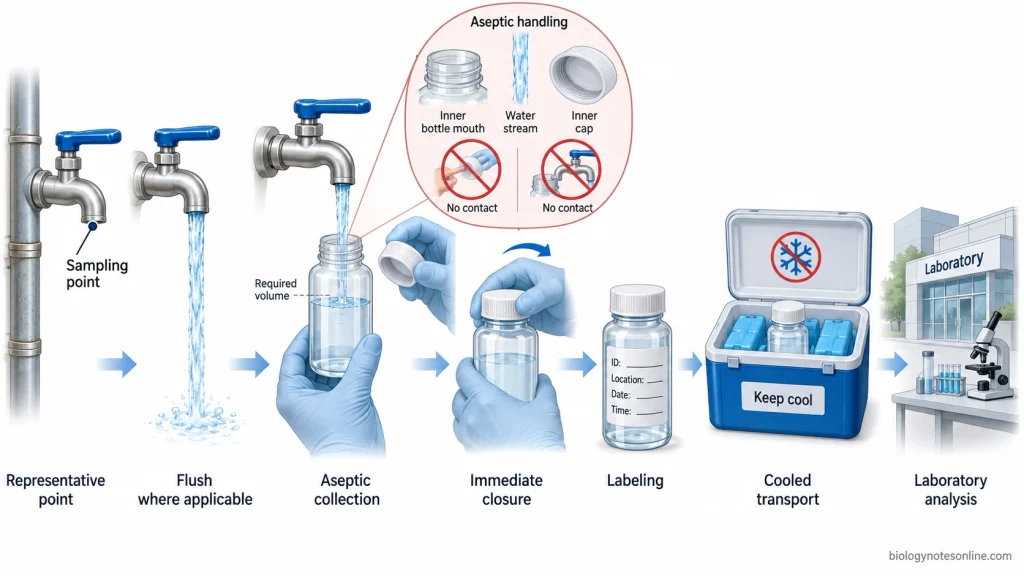
The following points detail the general procedure for collecting a bacteriological water sample–
- Select the sampling point which properly represents the water to be examined. For drinking water sampling, a clean cold-water tap which is not leaking is generally used. Remove the filters, screens, aerators, hoses, or other attachments from the tap before collection.
- Take a sterile bottle prepared for microbiological examination. Do not rinse the bottle. For chlorinated water, sodium thiosulfate (Na₂S₂O₃) may already be present inside the bottle for neutralization of residual chlorine, and it should be kept as such.
- Clean or disinfect the sampling tap when required. The water is then allowed to run for a few minutes to flush out the stagnant water present in the tap and pipe. After this, reduce the flow. A steady stream without much splashing is required.
- Open the sterile bottle just before taking the sample. Hold its cap only from the outside surface. The inside of the cap and bottle neck should not be touched with fingers, and the bottle mouth should not touch the sampling tap.
- Place the bottle under the flowing water and collect the required amount of sample. Water is usually filled up to the marked level (commonly 100 mL). A small air space is left for mixing of the sample before examination. Do not overfill.
- After collection, close the bottle immediately and tighten the cap properly. Care should be taken during handling so that leakage or further contamination of the sample does not occur.
- When sampling directly from a stream or other surface water, collect it from undisturbed water, away from bottom sediment and floating surface debris. In flowing water, the mouth of bottle is directed towards the current. Water disturbed by the sampler should not be collected.
- Label the sample properly after collection. Sampling location, sample identification, date and time of collection, along with other required field information are recorded.
- Keep the collected sample cool and send it to the laboratory as soon as possible. It should not be frozen. The bacteriological examination is carried out within the holding time required for the particular laboratory or microbiological method.
Sampling Procedures for Different Water Sources
A single sampling procedure cannot be used for bacteriological examination of every type of water source. Tap water is collected from a controlled outlet, while river water, well water, and wastewater are available under different sampling conditions.
The sampling point, its preparation, and the method of filling the sterile bottle are changed according to the water source. The collected sample should represent the particular water which is intended for examination.
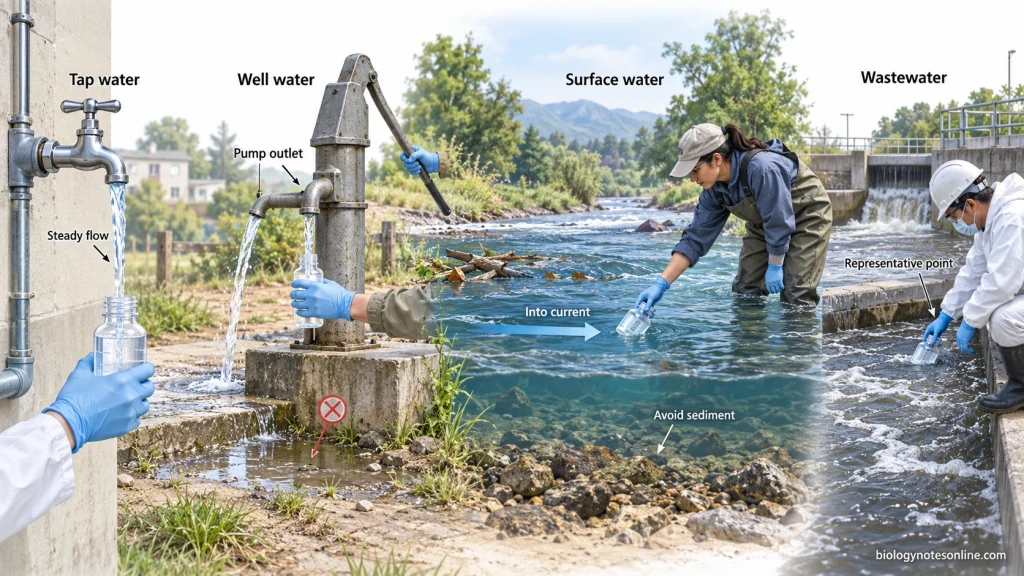
| Water source | Sampling-point preparation | Collection approach | Source-specific precautions |
|---|---|---|---|
| Tap and distribution water | Remove removable aerator, screen, filter, hose, etc. Flush the outlet before collection. | Water is collected directly from a steady flow into the sterile bottle. | Avoid leaking taps and splashing. The bottle mouth should not touch the tap. |
| Wells and hand pumps | Pump sufficient water before collection to remove stagnant water from outlet and pipe. | Sample is collected directly from the well outlet or pump discharge where possible. | Standing water around the well or hand-pump platform should not be collected. |
| Rivers, lakes and reservoirs | Select a representative location and required depth. Bottom sediment should not be disturbed. | Collect below the water surface. In flowing water, the bottle opening is kept towards the current. | Avoid floating debris, bank water, and bottom sediment unless these are required for examination. |
| Wastewater and highly contaminated water | Select a representative and sufficiently mixed sampling point. | Water is collected aseptically into the sterile bottle with minimum unnecessary transfer. | Avoid splashing and direct contact. Suitable dilution is usually required during examination because bacterial numbers may be very high. |
Tap and Drinking-Water Distribution Samples
- A suitable tap is first selected which represents the water of the distribution system. Where available, a tap supplied directly from the main is preferred. A leaking tap around its stem is not suitable for normal bacteriological sampling.
- Aerator, screen, hose, filter, or other removable attachment is taken off before sampling. These attachments may retain microorganisms and the water passing through them may not represent the actual distribution water.
- Open the tap and allow the water to flow. It is flushed for sufficient time so that the standing water present in the tap and nearby pipe is removed. After flushing, the flow is reduced to a steady stream and excessive splashing is avoided.
- The sterile bottle is opened only at the time of collection. The inside of the cap, neck, or inner surface of the bottle should not be touched. Keep the mouth of the bottle away from the tap.
- Water is collected directly from the flowing stream. For chlorinated water, the sampling bottle may contain sodium thiosulfate (Na₂S₂O₃) for neutralizing the residual disinfectant. It is not rinsed out before collection.
Wells and Hand Pumps
- Before collecting the sample, sufficient water is pumped from the well. In this step, stagnant water present in the outlet and connecting pipe is removed. In some well-sampling procedures, pumping is continued for several minutes or until sufficient well water has been withdrawn.
- The sample is preferably collected from a suitable outlet close to the well source. When raw groundwater is required for examination, collection is made before treatment or disinfection where such sampling point is available.
- For a hand pump, operate the pump first and allow water to flow for sufficient time. The sterile bottle is then placed under the flowing outlet. Its mouth should not touch the pump outlet.
- Water accumulated around the pump platform, drain, or well surroundings is not collected. This is standing surface water and does not represent the water coming from inside the well.
Rivers, Lakes, Reservoirs, and Other Surface Waters
- The sampling location is selected according to the water which is required for examination. Water present very close to the bank or collected from an unsuitable depth may differ from the main water body.
- In rivers and streams, a well-mixed portion is generally selected for sampling. The bottle is placed below the water surface with its mouth facing the current. The sampler should not disturb the water upstream of the bottle.
- Bottom sediment should remain undisturbed during collection. Sediment may carry attached bacteria, and mixing of sediment with water can considerably change the bacterial count of the collected sample.
- Floating matter and surface scum are also avoided unless these materials themselves are required for examination. In still water where no current is present, the bottle can be moved forward through the water while filling.
- Sampling from lakes and reservoirs may require selection of a particular position and depth. When the water supplied through an intake is being examined, the sample should represent the water reaching that intake.
Wastewater and Highly Contaminated Waters
- Wastewater is collected from a point which represents the wastewater under examination and where it is sufficiently mixed. In treatment plants, the selected point depends on the stage of treatment being studied. A convenient standing pool is not used only because it is easy to reach.
- Aseptic handling is used during collection. The sterile bottle remains closed until the sample is taken. Unnecessary transfer of wastewater from one container to another is avoided.
- Bacterial numbers in wastewater and other highly contaminated waters can be very high. These numbers may also change during storage. The collected sample is therefore kept cool and examination is started as early as possible.
- Splashing should be kept to minimum. Direct contact with wastewater is also avoided, and suitable protective equipment is used according to the sampling condition.
- During laboratory examination, highly contaminated samples commonly require dilution for obtaining countable bacterial numbers. The original field sample, however, is kept representative and is not unnecessarily altered during collection.
Preservation and Transport of Microbiological Water Samples
After collection, bacterial number in a water sample may change before examination. Bacteria may multiply, die, or get affected by residual disinfectant. Proper preservation and transport is therefore required.
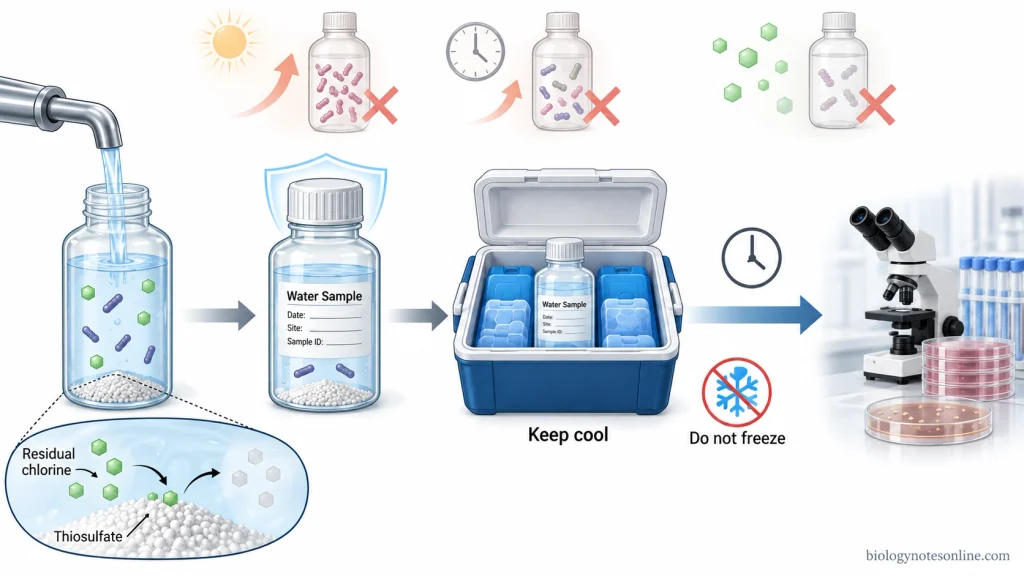
- Rapid transport- Send the sample to laboratory as soon as possible. Longer storage may change the recoverable bacterial count.
- Cooling- Keep the collected sample cool during transport. An insulated box with ice packs can be used when immediate examination is not possible.
- Avoid freezing- The sample should be kept cold but not frozen. Freezing may injure or kill some bacterial cells.
- Chlorine neutralization- For chlorinated water, sodium thiosulfate (Na₂S₂O₃) is generally present in the sterile bottle. It stops residual chlorine from continuing its bactericidal action after collection.
- Closed container- Keep the bottle tightly closed. Opening, leakage, or contact of bottle mouth and cap with other surfaces may contaminate the sample.
- Temperature control- Do not leave the sample for long time under warm or uncontrolled temperature. Bacterial population may change rapidly under such condition.
- Proper labeling- Sample identification, collection point, date and time should be recorded properly and kept with the specimen.
- Holding time- Examine the sample within the holding time specified for the particular microbiological test. The acceptable holding period is not same for every type of sample and method.
Laboratory Analysis After Water Sampling
After sampling, the collected water is examined in the laboratory for detection or enumeration of bacteria. Different methods give different type of result. Sampling provides the specimen, while these laboratory methods are used for its bacteriological examination.
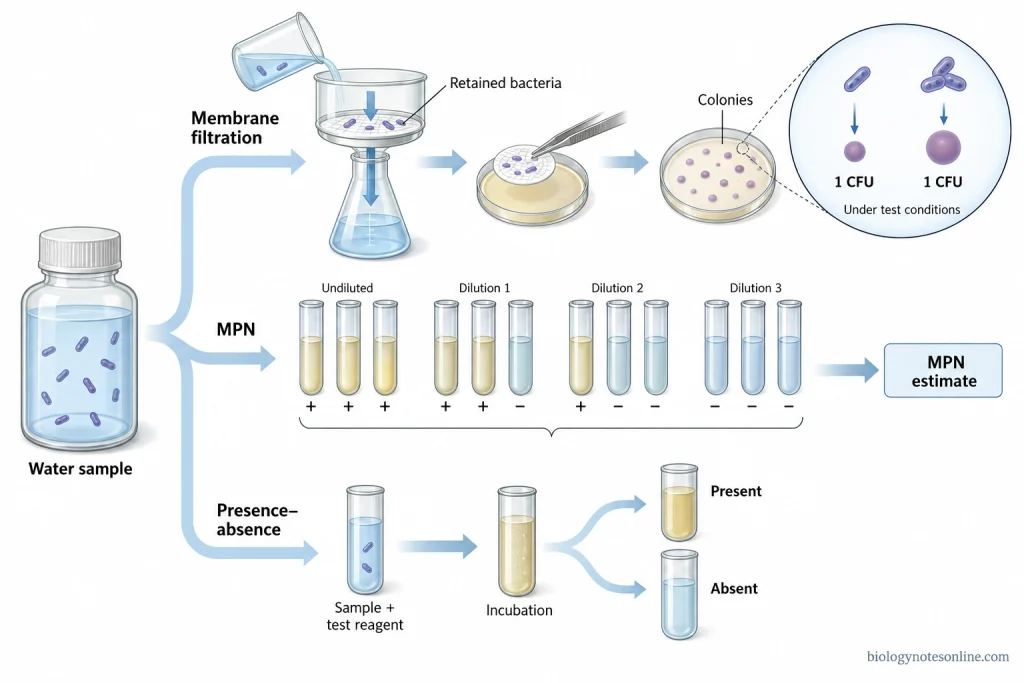
Membrane Filtration
- A known volume of water is passed through a membrane filter. Bacteria present in the sample are retained on the membrane.
- The membrane is placed on a suitable culture medium and incubated. Colonies developing from the retained organisms are then observed.
- When quantitative culture is required, the characteristic colonies are counted and related to the volume of water filtered. For drinking water methods, a volume of 100 mL is commonly examined.
Multiple-Tube/MPN and Presence–Absence Methods
- In the Most Probable Number (MPN) method, portions or dilutions of water are inoculated into a series of tubes. The combination of positive and negative tubes is used for estimating the bacterial density statistically. It is not a direct colony count.
- Some tests simply detect whether the required bacterial group is present or absent in the tested water volume. A numerical bacterial count is not always required.
- Detailed culture media, incubation conditions, MPN calculations and method validation depend on the particular test being followed and are described separately in method-specific procedures.
CFU and Bacterial Counts
- Colony-forming unit (CFU) refers to a culturable unit capable of producing a visible colony under the given test conditions. It is used for estimating viable, culturable bacteria rather than counting every bacterial cell directly.
- Counts may be expressed as CFU/mL when related to one milliliter of sample, or CFU/100 mL when the result is calculated for 100 mL of water. The latter is commonly applicable in bacteriological examination of water.
- One CFU does not always mean one individual bacterial cell. A single cell may form a colony, but pairs, chains or clusters of cells can also produce one colony.
- CFU also depends on the culture conditions being used. Bacteria which fail to grow on the selected medium or under the specified test condition will not appear in the obtained colony count.
Quality Control and Common Sampling Errors
Quality control during bacteriological water sampling is used to check contamination and variation introduced during collection, handling, transport, or later examination. Small sampling errors can change the bacterial result.
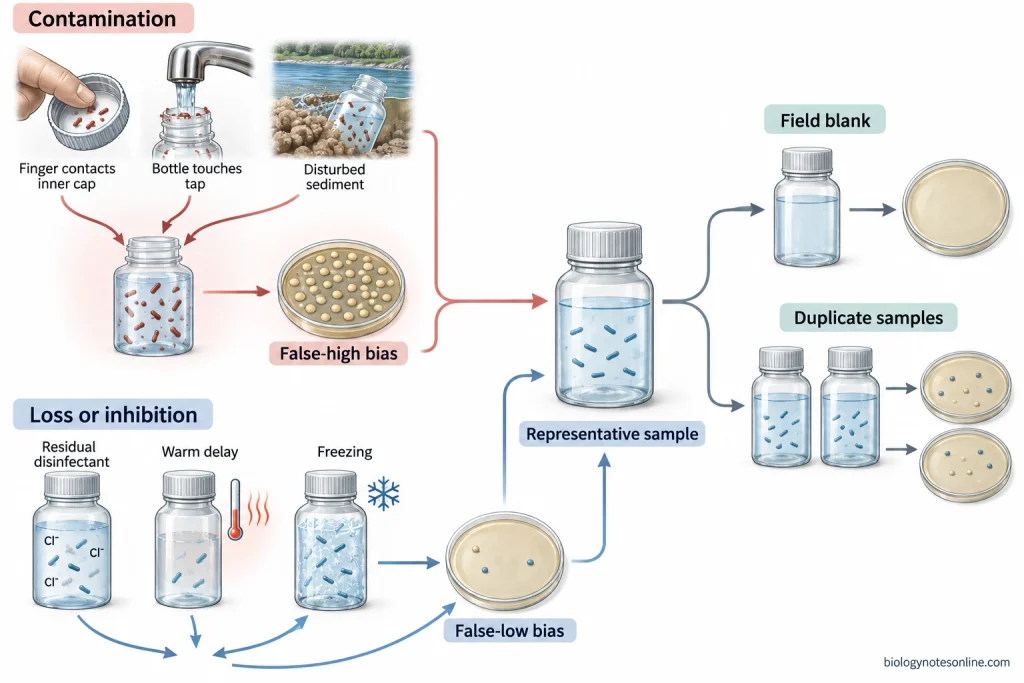
- Field blank- Sterile water is handled along with field samples and examined in the same manner. Bacterial growth in the blank can indicate contamination introduced during sampling, transport, or processing.
- Duplicate sample- Two samples may be collected from the same place and at the same time. Their results are compared for checking sampling and analytical precision.
- Sterile bottle- Use only sterile microbiological sample container. Do not rinse it before collection. Rinsing may also remove sodium thiosulfate already present in bottles intended for chlorinated water.
- Aseptic handling- The inside of cap, bottle neck and inner surface should not be touched. Putting the cap on an unclean surface or touching the bottle mouth with the tap are common sources of contamination.
- Sampling point- A wrong or poorly prepared sampling point may give a non-representative sample. Stagnant water, tap attachments, disturbed sediment, or an unsuitable outlet can affect the obtained bacterial count.
- Equipment cleaning- Reusable sampling equipment should be properly cleaned or sterilized between samples. Equipment blanks can be used for checking carry-over or cross-contamination.
- Dechlorination- Residual chlorine should be neutralized when required, commonly with sodium thiosulfate (Na₂S₂O₃). If not neutralized, disinfectant can continue acting on bacteria after collection.
- Preservation errors- Keep samples cool and send them for examination within the specified holding time. Warm storage, freezing, or unnecessary delay can alter the bacterial population.
- Sample records- Label the bottle correctly with required sample identification, location, date and time. Wrong or incomplete identification can make the obtained laboratory result difficult to assign to the correct sampling point.
References
- Ahammed, M. M. (2003). Effect of holding time and temperature on bacterial counts. Indian Journal of Environmental Health, 45(3), 209–212. https://pubmed.ncbi.nlm.nih.gov/15315143/
- Dutka, B. J., & El-Shaarawi, A. (1980). Microbiological water and effluent sample preservation. Canadian Journal of Microbiology, 26(8), 921–929. https://doi.org/10.1139/m80-159
- Murray, A. L., Kumpel, E., Peletz, R., Khush, R. S., & Lantagne, D. S. (2018). The effect of sodium thiosulfate dechlorination on fecal indicator bacteria enumeration: Laboratory and field data. Journal of Water and Health, 16(1), 70–77. https://doi.org/10.2166/wh.2017.077
- National Research Council. (2004). Indicators for waterborne pathogens. The National Academies Press. https://doi.org/10.17226/11010
- Sanders, E. R. (2012). Aseptic laboratory techniques: Plating methods. Journal of Visualized Experiments, (63), e3064. https://doi.org/10.3791/3064
- Selvakumar, A., Borst, M., Boner, M., & Mallon, P. (2004). Effects of sample holding time on concentrations of microorganisms in water samples. Water Environment Research, 76(1), 67–72. https://doi.org/10.2175/106143004×141591