

Rotor Stator Homogenizer is a mechanical homogenizer used for mixing, emulsification and particle size reduction. It consists of two main parts, the rotor and the stator. The rotor is the rotating part and the stator is the fixed outer part.
The rotor rotates at high speed inside the stator. Due to this rotation, the liquid and solid materials are pulled into the small space between rotor and stator. This space is called shear gap.
In this region, the material undergoes strong shearing action. Turbulence and centrifugal force are also produced. As a result, large particles and droplets are broken into smaller and uniform size.
After this, the processed material comes out through the small openings present in the stator. This gives a uniform mixture. It is used to prepare stable emulsions, suspensions and dispersions in food, pharmaceutical, cosmetic, biotechnology and chemical industries.
Principle of Rotor-Stator Homogenization
Rotor-stator homogenization is based on the production of intense mechanical and hydraulic shear force between a fast rotating rotor and a fixed stator. The rotor rotates at very high speed inside the stator. Due to this rotation, strong suction force is produced.
In this process, liquid and solid materials are first drawn into the centre of the mixing head. Then the materials are pushed outward by centrifugal force. The materials enter into the narrow space between the rotor blade and inner wall of stator.
This narrow space is called shear gap. In this region, the liquid near the rotor moves with very high speed, while the liquid near the stator remains almost fixed. Due to this difference in speed, strong velocity gradient is formed.
As a result, high shearing force, pressure change and turbulence are produced. These forces break the solid particles, aggregates and liquid droplets into small and uniform size. The processed material is then expelled through the holes or slots of the stator.
This circulation continues again and again in the mixture. Finally a uniform homogenized mixture is formed. It produces fine emulsion, suspension and dispersion by reducing the particle or droplet size.
Parts of Rotor-Stator Homogenization
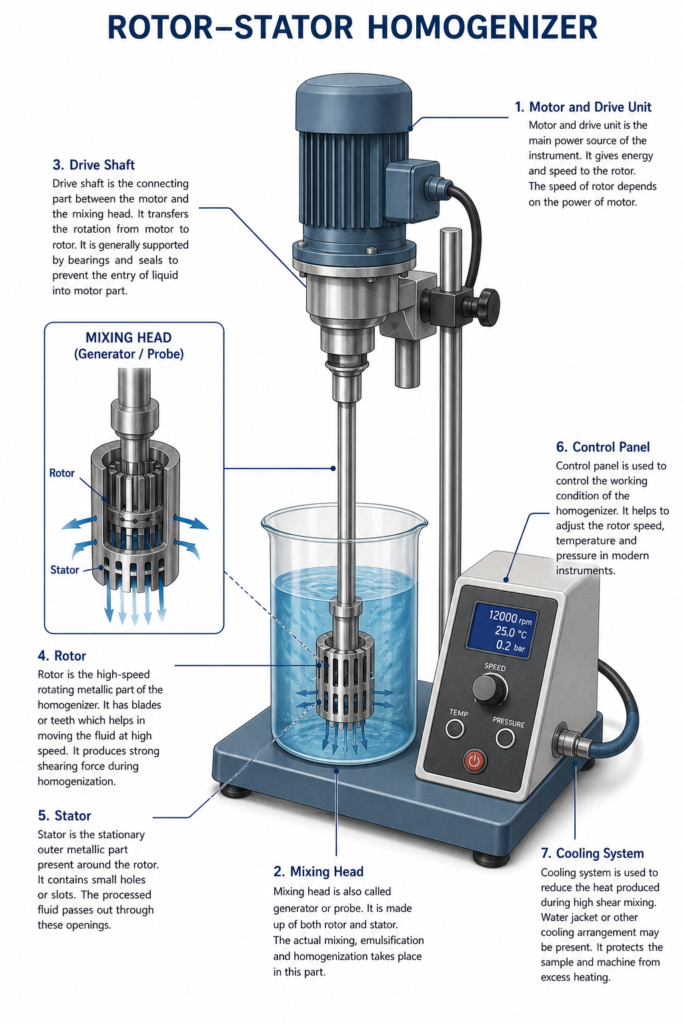
The following are the important parts of Rotor-Stator Homogenizer–
- Rotor
Rotor is the high-speed rotating metallic part of the homogenizer. It has blades or teeth which helps in moving the fluid at high speed. It produces strong shearing force during homogenization. - Stator
Stator is the stationary outer metallic part present around the rotor. It contains small holes or slots. The processed fluid passes out through these openings. - Mixing Head
Mixing head is also called generator or probe. It is made up of both rotor and stator. The actual mixing, emulsification and homogenization takes place in this part. - Motor and Drive Unit
Motor and drive unit is the main power source of the instrument. It gives energy and speed to the rotor. The speed of rotor depends on the power of motor. - Drive Shaft
Drive shaft is the connecting part between the motor and the mixing head. It transfers the rotation from motor to rotor. It is generally supported by bearings and seals to prevent the entry of liquid into motor part. - Control Panel
Control panel is used to control the working condition of the homogenizer. It helps to adjust the rotor speed, temperature and pressure in modern instruments. - Cooling System
Cooling system is used to reduce the heat produced during high shear mixing. Water jacket or other cooling arrangement may be present. It protects the sample and machine from excess heating.
Operating Procedure of rotor stator homogenizers
The following are the operating procedure of rotor stator homogenizer–
- The sample is first prepared properly before homogenization. Solid materials are cut or reduced into small particles. The particle should be small enough to enter into the narrow gap between rotor and stator.
- During the working of rotor stator homogenizer, heat is produced due to friction. So cooling arrangement is used for heat sensitive sample. In laboratory work, the sample container is generally kept in an ice bath.
- In batch processing, the rotor-stator probe is dipped directly into the beaker or tank containing sample. The probe should remain properly inside the liquid. It helps in proper suction of the sample into the mixing head.
- In inline processing, the liquid and solid materials are passed into the mixer. The feeding may be done by gravity or by using a pump. The material then enters into the high shear region.
- The machine is then switched on. The sample is drawn into the space between rotor and stator. In this step, strong shear force, turbulence and centrifugal force are produced. The probe may be moved slowly in the sample for uniform processing.
- The process is continued until the desired particle size, droplet size or viscosity is obtained. This condition is called equilibrium mixing. After this stage, further mixing does not improve the product much.
- After complete homogenization, the finished product is collected from the container. In inline system, the recirculation line is closed and the mixer helps to transfer the final mixture to next vessel or process.
- The generator probe should be cleaned immediately after use. If the residue dries on the part, the probe may become blocked or seized. The homogenizer can be run in 70% ethanol for fast cleaning and drying.
- For sterile work, the probe may be opened and cleaned separately. It can be kept in disinfectant solution or in an ultrasonic bath. This helps to remove remaining sample and microbial contamination.
Uses of Rotor-Stator Homogenization
The following are the uses of rotor-stator homogenization–
- It is used for mixing two immiscible liquids like oil and water to form stable emulsion.
- It is used for uniform distribution of solid particles or powders into liquid medium.
- It is used for reducing the size of large particles and droplets present in liquid samples.
- It is used for preparing stable suspensions from unstable solid-liquid mixtures.
- It is used for rapid mixing of powders like gums, starches and proteins into liquids without forming clumps.
- It is used in wet milling for reducing the materials into very fine and uniform size.
- It is used in granulation where fine powders are mixed with binder and converted into dense granules.
- It is used for cell lysis and disruption of cells to release intracellular materials.
- It is used for homogenization and breaking down of soft tissues.
- It is used for isolation of cells and extraction of cell organelles.
- It is used for extraction of microorganisms, generally at low speed.
- It is used for shearing of DNA and chromatin by operating at high speed for longer time.
- It is used for processing frozen samples in cryogenic homogenization with special probes.
- In food industries, it is used for making soups, mayonnaise, salad dressings, sauces and spreads.
- In cosmetic industries, it is used for preparing smooth lotions, creams and gels.
- In pharmaceutical industries, it is used for making stable medicinal suspensions, ointments and fine emulsions.
- In chemical industries, it is used for blending high viscous materials, paints, coatings and printing inks.
Advantages of Rotor-Stator Homogenization
The following are the advantages of rotor-stator homogenization–
- It is used for fast and efficient mixing of materials. It reduces the processing time and cycle time.
- It can process different types of materials like liquids, semi-solids, viscous fluids and solid-liquid suspensions.
- It has interchangeable generator probes. So the same instrument can be used for different sample size and different type of sample.
- It is useful for tearing fibrous tissues by using special probe like saw-tooth probe.
- It can be used from small laboratory scale to large industrial scale. So it has good scalability.
- In inline system, the process can be carried out continuously. It can handle large volume of materials.
- It produces fine and uniform particles or droplets due to strong mechanical shear force.
- It gives stable emulsions, suspensions and dispersions. It also gives smooth texture to the final product.
- It produces less residual heat than ultrasonic homogenization. So it is useful for temperature sensitive samples.
- It can be used in both batch process and continuous inline process.
- Inline models can be fitted with existing instruments without much disturbance. It can also be used for more than one batch tank.
Limitation of Rotor-Stator Homogenization
The following are the limitations of rotor-stator homogenization–
- It is generally used for single sample processing. So it is not very useful for high number of samples at a same time.
- For processing many samples, expensive multi-sample unit is required. Otherwise the work becomes slow.
- The probe should be cleaned properly after each sample. It is done to prevent cross contamination.
- The cleaning process takes more time because the probe may need to be opened and washed separately.
- Large solid samples cannot be used directly. The materials should be small enough to enter into the narrow gap between rotor and stator.
- Hard or fibrous tissues need cutting or chopping before homogenization. Otherwise proper shearing does not take place.
- Heat is produced during the process due to friction. So heat sensitive sample may need cooling arrangement like ice bath.
- It has limited particle size reduction capacity. Generally the particle size can be reduced up to about 2 to 3 µm.
- It cannot reduce particles as fine as ultrasonic or high-pressure homogenizer in many cases.
- It is not much effective for very high viscous samples. Materials having viscosity above 10,000 cP are difficult to process.
- In high viscosity sample, the working volume should be reduced for proper flow and mixing.
- In normal design, shear force and flow rate are connected with each other. So when rotor speed is increased, flow rate also increases.
- This may create problem for shear sensitive products because high shear and high flow may damage the product.
Precautions of Rotor-Stator Homogenization
The following are the precautions of rotor-stator homogenization–
- Solid samples should be cut or pre-processed before homogenization. The particles should be small enough to enter into the narrow gap between rotor and stator.
- Heat production should be controlled during the process. For heat sensitive sample, the container should be kept in an ice bath or other cooling system.
- The instrument should not be operated continuously for very long time. Long running may damage the motor or causes burning of the motor.
- The generator probe should be cleaned immediately after use. If the material dries on the probe, it may block the grooves and make the probe seized.
- The probe should be washed properly between different samples. It helps to prevent cross-contamination of one sample with another sample.
- Air entry should be avoided during homogenization. Powder should be added slowly and deep vortex should not be formed in the tank.
- Only manufacturer approved parts should be used in the instrument. Wrong probe or other parts may damage the machine and make it unsafe.
- The instrument should be checked during operation. If unusual noise or discoloured bearing is seen, the bearing should be replaced.
- In inline system, very high flow rate should not be forced by pump. It may produce mechanical problem in the mixer.
- The sample container should be held properly during homogenization. Loose container may cause spilling of sample and improper mixing.
- The probe should be dipped properly into the sample before switching on the machine. It prevents splashing and air mixing.
Differences Between Rotor-Stator Homogenizers and High-pressure Homogenizers
Differences Between Rotor-Stator Homogenizers and High-pressure Homogenizers
The following are the differences between rotor-stator homogenizers and high-pressure homogenizers–
- Rotor-stator homogenizer works by the rotation of a fast moving rotor inside a fixed stator.
High-pressure homogenizer works by forcing the liquid sample through a narrow valve or membrane under very high pressure. - In rotor-stator homogenizer, mainly mechanical shear force is produced.
In high-pressure homogenizer, shear force, pressure drop and cavitation are produced. - Rotor-stator homogenizer generally reduces the particle or droplet size up to about 2 to 3 µm.
High-pressure homogenizer can reduce the particle or droplet size to nanometer level, generally about 100 nm or less. - Rotor-stator homogenizer is used for liquids, suspensions, viscous materials and soft solid tissues.
High-pressure homogenizer is mainly used for liquid samples. - Rotor-stator homogenizer can handle soft solid material after proper cutting or pre-processing.
High-pressure homogenizer is not suitable for solid tissues or large particles because they may block the valve. - Rotor-stator homogenizer produces moderate heat due to friction.
High-pressure homogenizer produces more heat due to high pressure processing. - In rotor-stator homogenizer, external cooling like ice bath may be used for heat sensitive sample.
In high-pressure homogenizer, built-in cooling system or heat exchanger is often required. - Rotor-stator homogenizer is comparatively easy to clean. The probe can be cleaned by running in solvent like 70% ethanol.
High-pressure homogenizer is more difficult to clean because it has complex internal parts. - Rotor-stator homogenizer is compact and less costly.
High-pressure homogenizer is generally large, heavy and expensive. - Rotor-stator homogenizer is available as small handheld laboratory unit and also industrial model.
High-pressure homogenizer is mostly used as large machine for continuous liquid processing. - Rotor-stator homogenizer is useful for batch processing and also inline continuous mixing.
High-pressure homogenizer is more useful for continuous processing of large volume liquid. - Rotor-stator homogenizer gives good mixing, dispersion and emulsification.
High-pressure homogenizer gives finer particle size and more uniform nanoscale emulsion.
| Basis | Rotor-Stator Homogenizer | High-pressure Homogenizer |
|---|---|---|
| Working mechanism | It works by the rotation of fast moving rotor inside a fixed stator. | It works by forcing the liquid sample through a narrow valve or membrane under high pressure. |
| Force produced | Mainly mechanical shear force is produced. | Shear force, pressure drop and cavitation are produced. |
| Particle size | It generally reduces particle or droplet size up to about 2 to 3 µm. | It can reduce particle or droplet size to nanometer level, about 100 nm or less. |
| Sample type | It is used for liquids, suspensions, viscous materials and soft solid tissues. | It is mainly used for liquid samples. |
| Solid sample | Soft solid material can be used after cutting or pre-processing. | Solid tissues or large particles are not suitable because they may block the valve. |
| Heat production | It produces moderate heat due to friction. | It produces more heat due to high pressure processing. |
| Cooling | External cooling like ice bath may be used for heat sensitive sample. | Built-in cooling system or heat exchanger is often required. |
| Cleaning | It is comparatively easy to clean. The probe can be cleaned by running in solvent like 70% ethanol. | It is difficult to clean because complex internal parts are present. |
| Cost and size | It is compact and less costly. | It is generally large, heavy and expensive. |
| Scale | It is available as small handheld laboratory unit and also industrial model. | It is mostly used as large machine for continuous liquid processing. |
| Processing type | It is useful for batch processing and also inline continuous mixing. | It is more useful for continuous processing of large volume liquid. |
| Final product | It gives good mixing, dispersion and emulsification. | It gives finer particle size and more uniform nanoscale emulsion. |
References
- 4ma Valves. (2024). Ultimate guide to CIP and SIP in pharmaceutical production.
- Admix Inc. (n.d.). High shear mixer guide: Inline vs in-tank, powder induction, and applications.
- Bematek. (2020, March 9). Colloid mill shear fundamentals. Scott Process Equipment Corp.
- Bioengineering AG. (n.d.). Scale up: Simpler than you think.
- Bioprocess Engineering Services Ltd. (n.d.). Cell lysis methods compared: Sonication vs high-pressure cell disruption.
- Cadence CFD Solutions. (n.d.). Rotor-stator homogenizers: Widely used mechanical homogenizers. Cadence System Analysis Blog.
- Cadence CFD Solutions. (n.d.). Rotor-stator mixers for high-speed mixing. Cadence System Analysis Blog.
- Cavitron Maschinenbau. (n.d.). Operating principle of machines.
- Charles Ross & Son Company. (n.d.). Choose the right inline high shear mixer for your process.
- Chaudhry, M. A. (2024, February 7). Lessons in bioreactor scale-up: Part 1 — Exploring introductory principles. BioProcess International.
- Dosimix Technologies. (2025, February 11). Inline high shear homogenizer vs. batch mixer.
- Fischer, L. (n.d.). Advanced emulsification technologies. Pharma Focus Asia.
- FoodTechProcess. (2025, November 14). Homogenization of food products. FoodTechProcess Blog.
- Genemco. (2024, June 13). Exploring different types of homogenizers in the industrial food processing industry.
- Genizer LLC. (2024). A deep dive into types of homogenizers.
- Hanspire. (n.d.). How ultrasonic sonicators work vs other homogenizers.
- Hinotek. (n.d.). What is a homogenizer?
- Homogenising Systems. (n.d.). Sonication vs high pressure homogenizers – comparison.
- Hosokawa Micron B.V. (n.d.). CIP/SIP cleaning solutions.
- IMMAY. (2025, January 4). Homogenizer machine: Uses, types and appliactions.
- Industrial Quick Search. (n.d.). High shear mixer: Types, processes and comparisons. IQS Directory.
- Industrial Quick Search. (n.d.). Rotor-stator technology: How high-shear mixers work. IQS Directory.
- James, J., Cooke, M., Trinh, L., Hou, R., Martin, P., Kowalski, A., & Rodgers, T. L. (2017). Scale-up of batch rotor-stator mixers. Part 1 – Power constants. Chemical Engineering Research & Design. https://doi.org/10.1016/j.cherd.2017.06.020
- JUMO. (n.d.). CIP and SIP processes – what’s the difference?
- Lab Manager. (n.d.). Precision in homogenization: The vital role of rotor-stator generator probes.
- Laboratory Supply Network. (n.d.). Rotor-stator homogenization.
- MXD Process. (2024, November 4). The basics of rotor stator mixers & high shear mixing.
- O’Driscoll, A. (2018a, July 13). Choosing a homogenizer technology for your application. Laboratory Supply Network Blog.
- O’Driscoll, A. (2018b, November 16). Cleaning and maintaining a rotor-stator homogenizer. Laboratory Supply Network Blog.
- O’Driscoll, A. (2019, March 5). Scaling up a rotor-stator homogenization process. Laboratory Supply Network Blog.
- O’Driscoll, A. (2020a, March 21). Rotor stator homogenizers versus ultrasonic homogenizers (sonicators). Laboratory Supply Network Blog.
- O’Driscoll, A. (2020b, December 20). Rotor stators versus high pressure homogenizers. Laboratory Supply Network Blog.
- PRO Scientific Inc. (n.d.). Rotor-stator homogenizers | High-shear mixers.
- Revvity. (2026, February 10). What is a lab homogenizer? Revvity Blog.
- Shechter, D. (2019, November 4). The pros and cons of high shear homogenizers. Pion Inc Blog.
- Shechter, T. (2016, March 31). Inline mixing vs. homogenization: What’s the difference? Pion Inc Blog.
- Tao, T. (2026, February 22). Pharmaceutical homogenizer machine: Types, features, and benefits. Finetech.
- Thapar, N. (n.d.). Scale-up of rotor-stator equipment. Tech Trends.
- Unknown Author. (n.d.). The design principle working technology of stator rotor.
- Unknown Author. (n.d.). Theoretical and applied frameworks of rotor-stator homogenization: A technical analysis of high-shear fluid processing.
- VisiMix. (n.d.). Rotor–stator homogenizer.
- YeKeey. (2024, January 30). What is the principle of rotor stator homogenizer mixer?