

What is Rothera’s test?
Rothera’s test is a qualitative biochemical test used for detection of ketone bodies in biological fluids like urine and blood. It is mainly used to detect acetoacetic acid and acetone. It is a sensitive diagnostic test and it is used for identifying ketonuria and ketonemia. These condition is commonly seen in diabetic ketoacidosis starvation prolonged vomiting and in other metabolic disorders where body breaks down fat for energy.
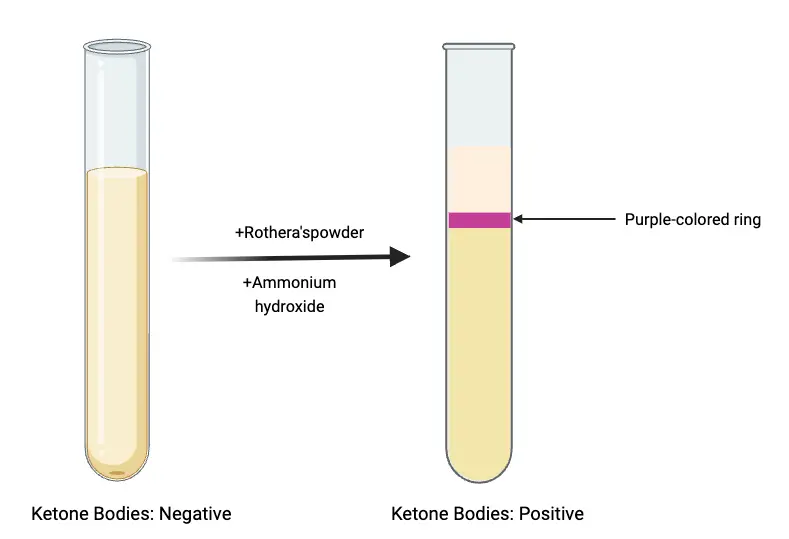
In this test the sample is first saturated with ammonium sulphate. Then few drops of freshly prepared sodium nitroprusside solution is added. After that an alkaline agent like concentrated ammonia is carefully layered over the mixture. If acetoacetic acid or acetone is present then it reacts with sodium nitroprusside in alkaline medium and a purple or violet coloured ring is formed at the junction of two layers. The depth of purple colour and the speed of formation give a rough idea about severity of ketosis. It is to be noted that this test cannot detect β-hydroxybutyrate which is also a major ketone body produced in body.
Objectives of Rothera’s test
Objectives of Rothera’s test are–
- It is used for qualitative and semi quantitative detection of ketone bodies in biological fluids like urine or serum. The ketone bodies mainly detected is acetoacetic acid and acetone.
- It is used for identification of ketonuria and ketonemia. It indicate that body is shifted from carbohydrate metabolism to excessive fat catabolism.
- It is used as a rapid screening test for diabetic ketoacidosis (DKA). It helps in early detection in poorly controlled diabetes mellitus.
- It is used for detecting ketosis due to non diabetic conditions like prolonged starvation fasting frequent vomiting and strict high fat low carbohydrate diet.
- It is used in veterinary medicine. It helps for screening and management of subclinical ketosis in high yielding dairy cows by testing milk or urine.
Principle of Rothera’s test
Principle of Rothera’s test is based on reaction between ketone bodies and sodium nitroprusside in alkaline medium. The ketone bodies mainly involved is acetone and acetoacetic acid. When the medium is made alkaline by ammonia the ketones undergo enolization and reactive enolate ions is formed. These enolate ions combines with sodium nitroprusside and a purple or violet coloured complex is formed. The intensity of colour is proportional to concentration of ketone present in sample.
In this test ammonium sulphate is added in solid form to saturate the sample. It produces salting out effect and water molecules is competed. Due to this the reacting substances is concentrated at the liquid interface and sensitivity of test is increased. A distinct purple ring at junction indicates positive test for ketonuria. It is to be noted that β-hydroxybutyric acid cannot be detected by this test.
Requirements for Rothera’s test
Requirements for Rothera’s test are–
- Specimen – Freshly voided urine is taken. It should be fresh because acetone is volatile and acetoacetate is unstable.
- Ammonium sulphate crystals – Solid analytical grade crystals is required for saturation of urine sample.
- Sodium nitroprusside solution – Freshly prepared 5% aqueous solution is used. It is light sensitive so it should be kept in dark container or prepared immediately before use.
- Concentrated liquor ammonia – It is also known as ammonium hydroxide. It is used for providing alkaline medium.
- Basic laboratory apparatus – Clean test tubes measuring cylinder and droppers is required.
Procedure for Rothera’s test
Procedure for Rothera’s test are–
- Take 5 ml of freshly voided urine sample in a clean test tube.
- Add ammonium sulphate crystals gradually. The tube is shaken well between each addition. It is added till urine is fully saturated and little undissolved salt remain at bottom.
- Add few drops of freshly prepared sodium nitroprusside solution (2–3 drops of 5% solution or about 10 drops of 2% solution). Shake well so it is mixed properly.
- Tilt the test tube at 45° angle. Add concentrated ammonia carefully along side of test tube so a separate layer is formed on top without mixing (about 1–2 ml or 10 drops).
- Keep the test tube in upright position and allow it to stand undisturbed for 1–15 minutes.
- Observe the junction of two layers for colour ring. Reddish purple/violet/blue purple ring indicates positive test for ketone bodies.
Results of Rothera’s test
Results of Rothera’s test are–
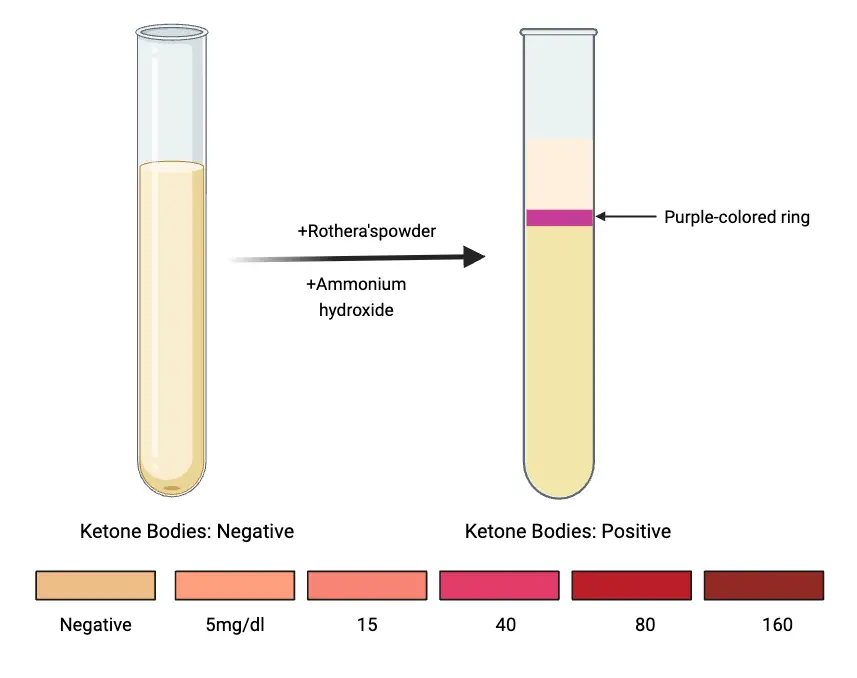
- Negative – No colour change is seen. Sometimes faint brown or orange ring may appear. It indicate absence of significant ketone bodies (less than 1–2 mg/dL).
- Trace (+) – Faint purple ring is formed after 1–2 minutes. It indicate low level ketosis (about 2–5 mg/dL).
- Moderate (++) – Clear purple ring is formed immediately. It indicate moderate ketonuria (about 20 mg/dL).
- Strong (+++) – Deep dark purple ring is formed and it may spread into liquid layers. It indicate severe ketonuria (more than 40 mg/dL).
- Very strong (++++) – Intense blackish purple colour is formed and it may permeate whole sample. It indicate critical ketonuria (more than 80 mg/dL).
Uses of Rothera’s test
Uses of Rothera’s test are–
- It is used for qualitative and semi quantitative detection of ketone bodies. Acetoacetic acid and acetone is detected in urine serum and blood. It helps for detecting ketonuria and ketonemia.
- It is used for diagnosis of diabetic ketoacidosis (DKA). It is used as rapid bedside or laboratory test for early detection and for monitoring metabolic decompensation in poorly controlled diabetes mellitus.
- It is used for detecting non diabetic ketosis. It is seen in prolonged starvation fasting severe vomiting (hyperemesis gravidarum) and in high fat ketogenic diet.
- It is used for evaluation of exercise induced ketosis. Transient ketonuria is detected after acute strenuous physical exertion due to depletion of glycogen store.
- It is used in pregnancy and postpartum states. Ketone bodies is detected in urine during third trimester labour and postpartum period. It helps for detecting toxemia of pregnancy.
- It is used for detecting ketosis in other medical disorders like glycogen storage diseases and prolonged febrile illness.
- It is used in veterinary and agricultural screening. Milk and urine of high yielding dairy cows is tested for early detection and management of subclinical bovine ketosis.
- It is used in scientific and experimental research. Urine of small experimental animals is tested to assess severity of ketosis.
Limitations of Rothera’s test
Limitations of Rothera’s test are–
- It cannot detect all ketone bodies. β-hydroxybutyric acid is not detected because required keto group is absent.
- The test is less sensitive for acetone. Nitroprusside reaction is about 10–20 times more sensitive to acetoacetic acid than acetone so acetone alone may be missed.
- False positive may occur due to drugs having sulfhydryl (-SH) group like mesna captopril N-acetylcysteine penicillamine. High dose of levodopa can also give false positive or atypical dark colour.
- Colour masking is seen with dyes like phthaleins and anthraquinone derivatives. These substances turn red in alkaline medium and purple ring may be masked.
- Atypical colour interference may occur. Phenylpyruvic acid (in phenylketonuria) can give green blue or brownish colour. Urinary melanogens (in metastatic melanoma) may oxidize and urine becomes black so reading is interfered.
- High nitrite level can inhibit or delay the colour development. It is seen in urinary tract infection.
- Fresh urine sample is required. Acetoacetate is unstable and acetone is volatile so delayed testing may give false negative due to reduced ketone concentration.
- Reagent is unstable and proper handling is required. Sodium nitroprusside solution is light sensitive and decomposes rapidly so fresh preparation is needed. Diluted or stale ammonia and incomplete saturation with ammonium sulphate can reduce sensitivity and accuracy.
Precautions of Rothera’s test
Precautions of Rothera’s test are–
- Freshly voided urine is used. The sample should be fresh because acetone is volatile and acetoacetate is unstable. Delay in testing may give false negative result.
- Sodium nitroprusside solution is prepared fresh (5% aqueous). It is light sensitive and decomposes rapidly so it should be made immediately or kept in dark container. If solution becomes brown or murky it should not be used because sensitivity is reduced.
- Complete saturation of urine is done by ammonium sulphate crystals. If saturation is not complete then salting out effect is reduced and trace ketone may not be detected.
- Concentrated and fresh ammonia is used for alkaline medium (pH about 8.2). Diluted or stale ammonia may fail to give proper colour ring.
- Drug interference should be considered. Drugs having sulfhydryl (-SH) group like mesna captopril N-acetylcysteine penicillamine can give false positive red/purple colour. High dose levodopa can also give false positive.
- Colour masking substances should be avoided. Dyes like phthaleins turn red in alkaline medium and purple ring may be masked. Phenylpyruvic acid (in phenylketonuria) can produce atypical colour.
- If commercial dipsticks (Ketostix) is used then container should be tightly closed. It should be protected from air and moisture because nitroprusside reagent may get oxidized and false negative result is obtained.
FAQ
What is Rothera’s Test used for?
Rothera’s Test is a qualitative laboratory test used to detect the presence of ketone bodies in urine.
Why is it important to detect ketone bodies in urine?
Detecting ketone bodies in urine can indicate conditions like uncontrolled diabetes or starvation, where the body starts breaking down fats for energy, leading to ketone production.
How is Rothera’s Test performed?
The test involves adding a specific amount of Rothera’s powder to a urine sample in a test tube, followed by layering with ammonium hydroxide. A positive result is indicated by the formation of a pink-purple ring at the interface.
What does a positive Rothera’s Test indicate?
A positive result, indicated by a pink-purple ring, means that ketone bodies are present in the urine.
Can Rothera’s Test detect all types of ketone bodies?
No, Rothera’s Test primarily detects acetoacetic acid and acetone. It does not detect beta-hydroxybutyrate.
Is Rothera’s Test specific to diabetes?
While the test is commonly used to detect ketonuria in diabetic patients, it can also indicate ketonuria due to other conditions like starvation or prolonged vomiting.
How accurate is Rothera’s Test?
Rothera’s Test is a qualitative test, meaning it can confirm the presence or absence of ketone bodies but does not quantify their concentration. It is considered reliable for detecting ketonuria.
Are there any other tests to detect ketone bodies in urine?
Yes, there are other tests like Gerhardt’s test, Lang’s test, and tablet tests. However, many of these are based on the principle of Rothera’s nitroprusside test.
What precautions should be taken while performing Rothera’s Test?
It’s essential to handle chemicals with care, avoid direct contact with urine samples, use sterilized apparatus, and always use test tube holders when handling test tubes.
Can I perform Rothera’s Test at home?
While there are home-based urine ketone test strips available, Rothera’s Test is typically performed in a laboratory setting due to the chemicals involved and the need for accurate interpretation of results.
References
- Comprehensive analytical report on the Rothera nitroprusside methodology: Definition, principle, procedure, and clinical interpretation. (n.d.).
- Comstock, J. P., & Garber, A. J. (1990). Ketonuria. In H. K. Walker, W. D. Hall, & J. W. Hurst (Eds.), Clinical methods: The history, physical, and laboratory examinations (3rd ed., Chapter 140). Butterworths.
- Csako, G. (1987). False-positive results for ketone with the drug mesna and other free-sulfhydryl compounds. Clinical Chemistry, 33(2 Pt 1), 289–292.
- Diabetic ketoacidosis, ketone bodies and management. (2025, November 6). Labpedia.net.
- Free, H. M., Smeby, R. R., Cook, M. H., & Free, A. H. (1958). A comparative study of qualitative tests for ketones in urine and serum. Clinical Chemistry, 4(4), 323–330.
- Palandurkar, K., & Basak, A. (2010). Development of a solid phase single reagent for the detection of ketone bodies. Journal of Clinical and Diagnostic Research, 4(1), 2139–2143.
- Rothera’s test. (2026, March 18). In A Dictionary of Nursing. Encyclopedia.com.
- Rukkwamsuk, T., Suksiri, J., Chutiyanawat, N., & Kaewsakhorn, N. (2008). Relationship between the sodium nitroprusside test for ketone bodies in urine and serum β-hydroxybutyrate concentrations in dairy cows. Kasetsart Journal – Natural Science, 42(3).
- Sapkota, A. (2022, September 5). Nitroprusside test- Definition, principle, procedure, result, uses. Microbe Notes.
- The Protein Man. (2017, September 6). Ammonium sulfate protein precipitation: The key to salting-out. G-Biosciences.
- Vissa, S., & Rao, B. S. S. (n.d.). Test for ketone bodies in urine. Histopathology.guru.
- Wikipedia contributors. (2025, November 1). Ammonium sulfate precipitation. In Wikipedia, The Free Encyclopedia.
- Wikipedia contributors. (2026, March 24). Sodium nitroprusside. In Wikipedia, The Free Encyclopedia.