

Energy flow in an ecosystem is the process by which energy is transferred from one trophic level to the next, and it is always unidirectional. It is the sun that acts as the major source of energy for most ecosystems and this solar energy is captured by the producers through photosynthesis. It is converted into chemical energy in the form of organic compounds. This energy is then passed to herbivores that feed on plants and later to carnivores when they feed on herbivores. It is the movement of energy from one level to another that forms food chains and food webs.
It is the grazing food chain that starts when living green plants are eaten by herbivores and then by carnivores. The detritus food chain begins with dead organic matter which is decomposed by microorganisms and the energy is transferred through decomposers. These two pathways together help in maintaining the ecosystem functioning. This process occurs following the laws of thermodynamics where energy transfer is always inefficient and a large part of energy is lost as heat during metabolic activities.
It is estimated that only nearly 10% of the energy at one trophic level is transferred to the next level. This is referred to as the 10% law. The remaining energy is used by the organisms for respiration, reproduction, movements, and other activities or lost as heat. Because of this continuous loss of energy at each step, the length of food chains is limited and higher trophic levels receive very little energy. Thus, energy flow in an ecosystem is always non-cyclic and it finally leaves the system as heat.
Importance/Significance of Energy Flow in an Ecosystem
- It is important because energy flow helps in sustaining the life processes of organisms. It is the energy that supports growth, reproduction, movement and different metabolic reactions in all living organisms.
- It helps in determining the trophic structure of an ecosystem. The amount of energy available in producers will decide how many levels of consumers can be supported in a food chain.
- It is the process that controls the productivity of an ecosystem. The Gross Primary Productivity (GPP) and Net Primary Productivity (NPP) depend on how efficiently producers capture and use solar energy.
- It regulates the biomass formation in different trophic levels. It is the energy that is converted into new tissues in plants, herbivores and carnivores.
- It is the detritus pathway that makes nutrient recycling possible. Dead organic matter is decomposed and the nutrients are returned to the ecosystem while energy is released during decomposition.
- It is helpful in maintaining stability of the ecosystem. By analysing energy pathways, the importance of different species can be understood and disruptions in food webs can be identified.
- It helps in defining the nature of different ecosystems. Some ecosystems have grazing food chains as the main pathway while some depend more on the detritus food chain.
- It explains the process of biomagnification. When energy moves to higher trophic levels, organisms need to consume more food and as a result harmful substances accumulate in top consumers.
- It shows that energy flow is always unidirectional. Energy enters the ecosystem as sunlight and is eventually lost as heat, so a constant supply of energy is essential for ecosystem functioning.
Models of Energy Flow in Ecosystem
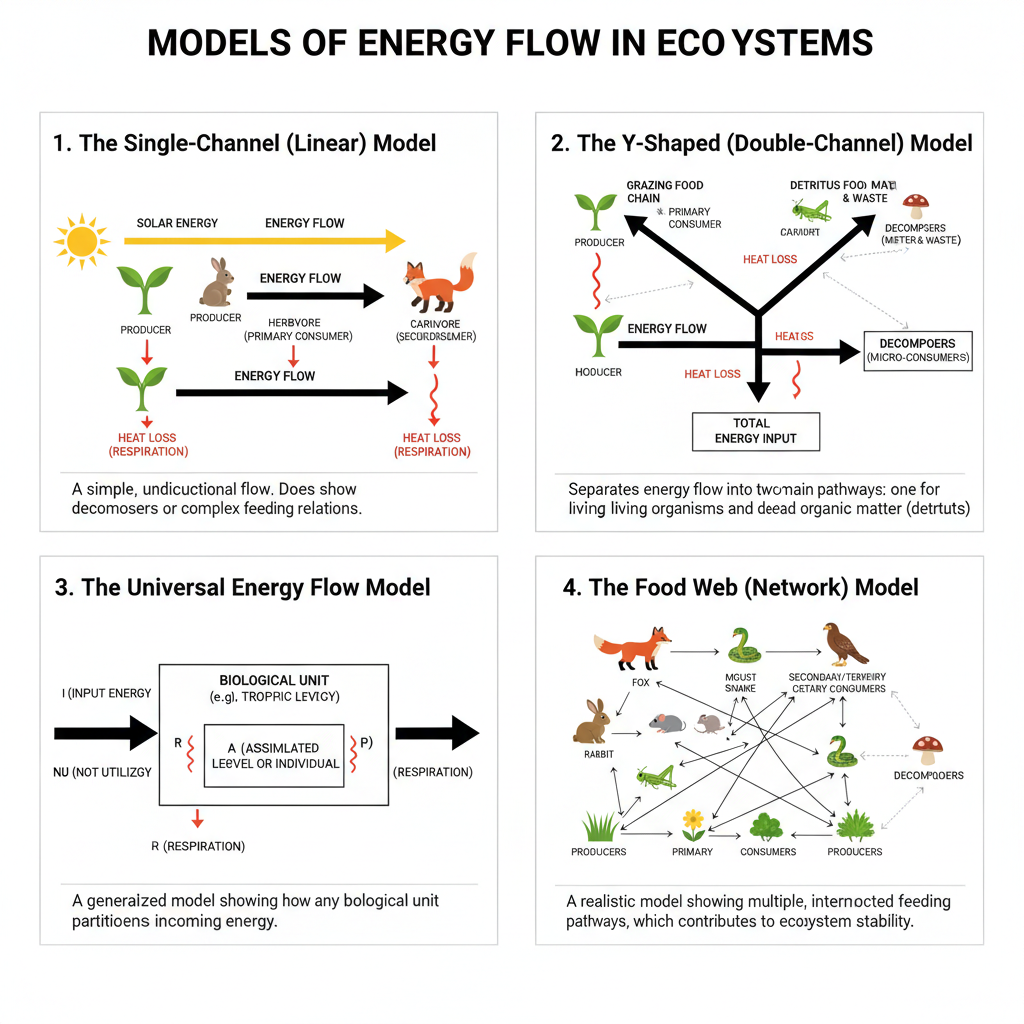
1. The Single-Channel (Linear) Energy Flow Model
It is the simplest model that shows energy moving in a straight pathway. It begins from the sun to the producers and then to herbivores and carnivores. It is the flow that is always unidirectional and the energy never comes back to the source. It is based on the thermodynamic rule that a large part of energy is lost as heat during respiration. It is helpful in understanding the basic idea but it does not show the role of decomposers and the complex feeding relations.
2. The Y-Shaped (Double-Channel) Energy Flow Model
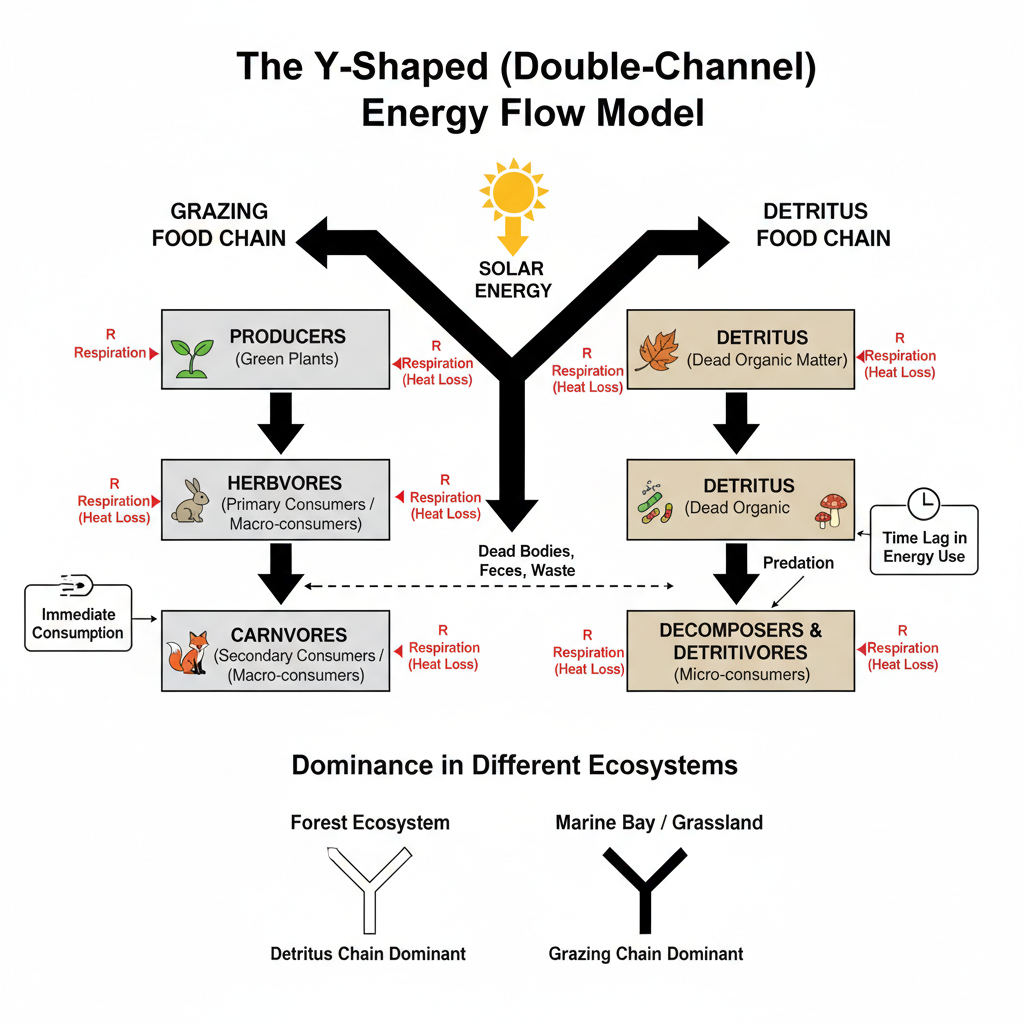
It is the model proposed by Odum which shows that energy moves through two separate food chains. One chain is the grazing food chain where living plants are eaten by animals. The other chain is the detritus food chain where dead organic matter is used by microorganisms. It is the Y shape that shows the two pathways and how they are connected because dead organisms and waste materials enter the detritus pathway. It separates macro-consumers and micro-consumers and explains which chain is dominant in different ecosystems.
3. The Universal Energy Flow Model
It is a generalized model used to understand energy flow in any biological unit such as an individual, population or trophic level. It divides the energy into input, assimilation, respiration, production, storage and non-utilized parts. It is the model that explains how organisms use energy for maintenance and for growth. It is useful because it can be applied to plants, animals or any trophic group.
4. The Food Web (Network) Model
It is a realistic model that shows energy movement through many interconnected feeding links. It is based on the idea that organisms do not feed on one type of food only. This model shows that energy passes through producers, consumers and decomposers in a network of relations. It is the complexity that explains ecosystem stability because more pathways help in balancing disturbances.
5. Adaptive Foraging Models
It is the modern concept where feeding links are not fixed. It shows that predators can change their food choice depending on the availability of prey. It is the model that explains dynamic changes in food chains. When resources change, the length and direction of energy pathways also change. This helps in understanding how ecosystems adjust under different environmental conditions.
1. Linear Energy Flow Model (Single Channel Energy Flow Model)
- It is the simplest model that shows energy movement in a straight and single pathway. It begins with the sun as the main source where producers capture the solar energy and convert it into chemical energy.
- It is the process where energy moves from producers to herbivores and then to carnivores in a unidirectional way. The energy never cycles back like nutrients. It always moves forward and finally leaves the ecosystem as heat.
- It explains that the flow follows the laws of thermodynamics. The first law shows that energy is only transformed but not created. The second law explains that a large part of energy is lost as heat during respiration in every trophic level.
- It uses a simple diagram with boxes and pipes where boxes represent trophic levels and pipes represent the flow of energy. The pipes become narrower at higher trophic levels because only a small part of energy is transferred upward.
- It shows that only a small percentage of solar energy is used by plants. It is estimated that only around 1% is changed into net primary production and only about 10% of energy is transferred from one trophic level to the next.
- It is this loss of energy at each step that limits the length of the food chain. Very few trophic levels can be supported because higher levels receive very little usable energy.
- It is helpful in understanding basic concepts of trophic dynamics but it is considered an oversimplified model. It does not show the detritus pathway and the complex relations that occur in actual ecosystems.
How The Linear Energy Flow Model Works?
The Linear Energy Flow Model is the model that explains how energy moves in an ecosystem in a single direction. It is also referred to as the single channel energy flow model. It is the process where energy enters the system, passes through different trophic levels and finally leaves the system as heat. These are unidirectional steps controlled by the laws of thermodynamics.
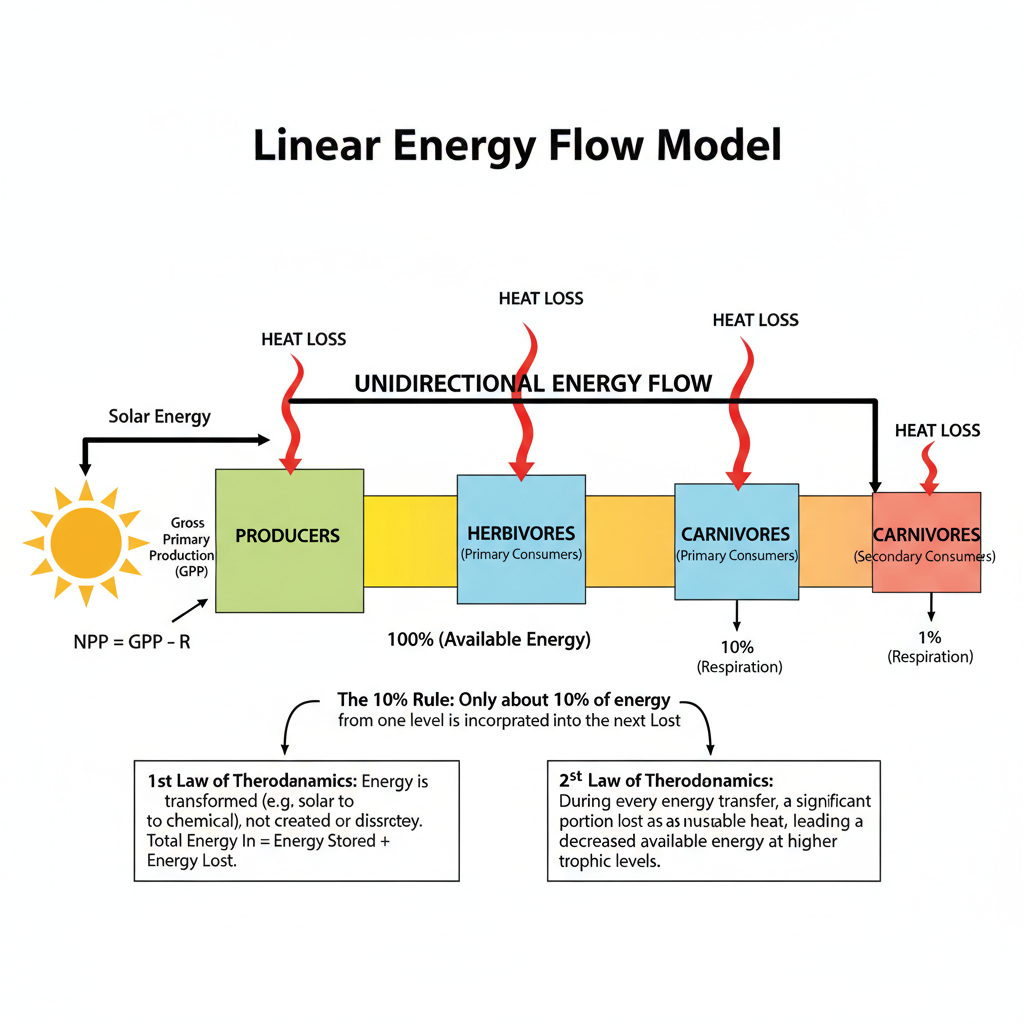
Some of the main steps in this model are–
1. Unidirectional Input and Conversion
- It is initiated by the sun which is the major source of energy for all ecosystems.
- Green plants absorb solar radiation but only a very small part is converted into chemical energy. It is seen that about 50% of the total incoming radiation is absorbed but nearly 1% is used in photosynthesis.
- It is the process where energy moves only in one direction. Energy flows from Sun → Producers → Herbivores → Carnivores.
- This energy never goes back to the sun and also it is not returned to the plants once it is transferred to consumers. If this primary sunlight input is stopped the entire system is affected.
2. Thermodynamic Constraints
- It is the process controlled by the first and second laws of thermodynamics.
- First law explains that energy is neither created nor destroyed. It is converted from one form to the other. In every trophic level the energy entering must be equal to the energy stored and the energy lost.
- Second law states that energy transformation is never 100% efficient. A part of the energy becomes dispersed as heat. So at each step the energy available is less than the previous level. This is referred to as the decrease in usable energy or increase in entropy.
3. Energy Partitioning (The “Pipes”)
- The pipes in the diagram represents the flow and reduction in energy. It becomes narrow at each trophic level because a large part of energy is lost as heat.
- The incoming energy at each level is divided into pathways like Gross Primary Production (GPP), respiration (R), Net Primary Production (NPP).
- GPP is the total energy fixed by plants during photosynthesis.
- Respiration is the process where organisms use part of this energy for metabolic work and release heat. This is the major loss.
- Net Primary Production is the remaining part after respiration (NPP = GPP – R). This is the energy made available to herbivores.
- There is also unutilized and unassimilated energy which is not consumed or not digested by organisms.
4. Progressive Loss (10% Law)
- At each trophic transfer a large part of the energy is lost through respiration and excretion. Only about 10% of the energy becomes stored in the next trophic level.
- Example– If producers store 15 Kcal, herbivores may store nearly 1.5 Kcal and carnivores may store 0.3 Kcal.
- Due to this continuous loss of energy the food chains are short as higher levels cannot get enough energy.
5. Biomass Reduction (The “Boxes”)
- The boxes represent the trophic level biomass. Biomass decreases with each successive level because it is supported by the amount of usable energy present at that level.
- The producer level has the highest biomass. The herbivore box is smaller and the carnivore box is the smallest.
- This is the process that explains why energy flow is always decreasing and why the ecological pyramids of energy are upright.
Uses of Linear Energy Flow Model (Single Channel Energy Flow Model)
- It is used as a basic educational model to explain the trophic dynamics of an ecosystem. It simplifies the complex food relations into a single straight pathway so that the flow of energy from producers to consumers can be understood easily.
- It is the process where the laws of thermodynamics are shown clearly.
– First Law is shown by the balance between energy input and output in different trophic levels.
– Second Law is shown by the gradual loss of energy as heat during each transfer. - It is used to visualize the loss of energy and the efficiency of transfer. The diagram of a narrowing pipe is used to show that a major part of energy is lost as heat and only a small amount is available to the next trophic level.
- It is used to explain the limit of food chain length. This process occurs when energy becomes too low after several transfers and cannot support higher-level predators.
- It is used to compare the biomass and production of different trophic levels. It is the model where boxes represent the standing crop and help in relating biomass with production rate.
- It is used to differentiate different types of production. Some of the main features are–
– Gross Primary Production (GPP)
– Net Primary Production (NPP)
It explains that NPP is the actual energy available for consumers after respiration. - It is used as the single grazing pathway in advanced models. It is the part that forms the baseline for Y-shaped or multi-channel models where decomposers and detritus pathways are later added.
Advantages
- It is used as a basic educational tool to explain trophic levels and the laws of thermodynamics.
- It helps in understanding why food chains remain short because the transfer of energy is low and most of the energy is lost as heat.
Limitations
- It oversimplifies natural systems by assuming a single straight pathway of energy flow.
- It does not include decomposers properly and treats unutilized energy only as loss instead of a parallel pathway.
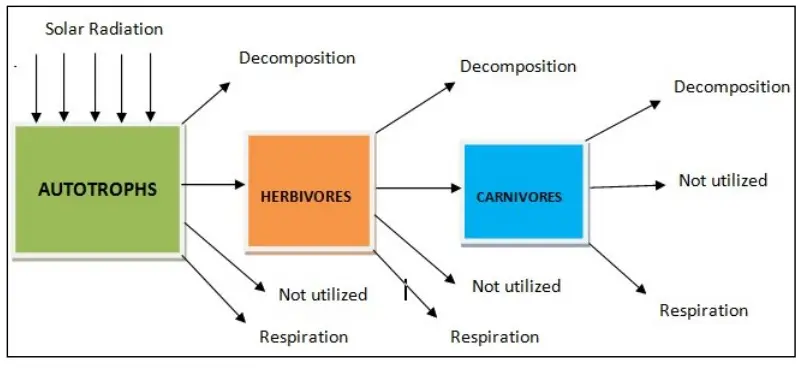
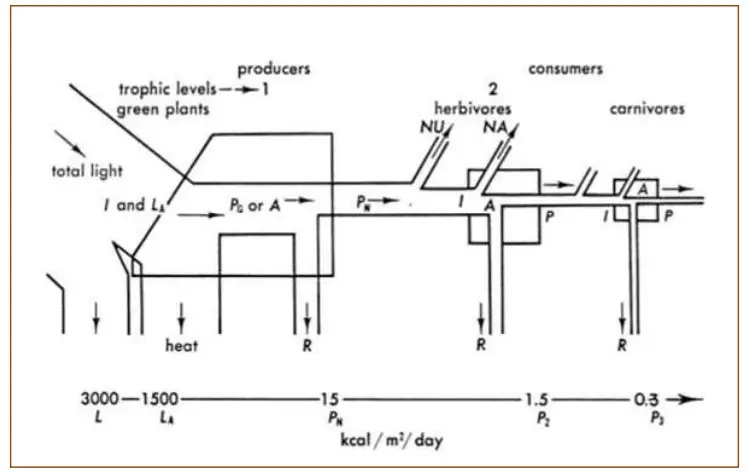
2. The Y-Shaped (Double-Channel) Energy Flow Model
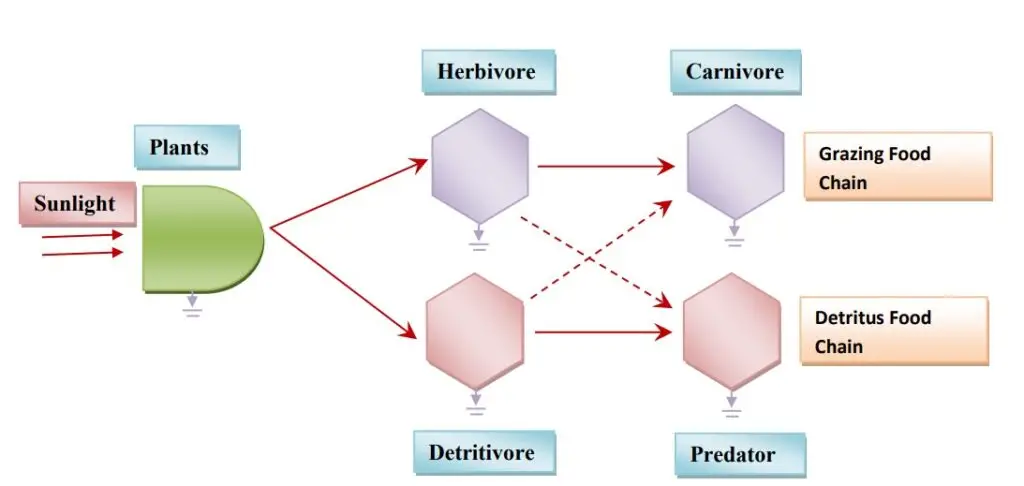
The Y-Shaped (Double-Channel) Energy Flow Model is the model that explains energy movement through two interconnected pathways of an ecosystem. It is the process where the grazing food chain and the detritus food chain operate together forming a Y-shaped structure. It is considered more realistic because energy in nature does not move in a single line but is distributed between living plant consumption and the breakdown of dead organic matter. The grazing chain starts from the green plants and moves to herbivores and carnivores, while the detritus chain begins from dead plant and animal materials that are decomposed by microbes like bacteria and fungi.
In this model, both the arms are linked closely because materials from the grazing chain such as feces and dead bodies enter into the detritus chain. It is also observed that some predators feed on organisms from both the chains. This is referred to as the interconnected functioning of the two pathways. The model also separates macro-consumers which are animals and micro-consumers which are decomposers because their size and metabolic activities is different. It is the process that helps in identifying which chain is more dominant in a particular ecosystem. Among the important examples, forest ecosystems usually show dominance of the detritus chain, whereas grazing chain is more active in marine bays.
How the Y-Shaped (Double-Channel) Energy Flow Model Works
- The model begins with two separate pathways of energy movement that form the two arms of the Y. One arm is the grazing food chain where living plants act as primary producers and the energy flows from these plants to herbivores and then to carnivores.
- The second arm is the detritus food chain. It is the process where dead organic matter like fallen leaves or dead bodies becomes the starting point. This detritus is decomposed by bacteria, fungi, and detritivores, and the energy stored in it is released slowly.
- Both pathways are linked together to form the Y-shaped structure. The wastes like dead bodies and feces produced in the grazing chain is shifted into the detritus chain for decomposition. Predators from the grazing chain sometimes feed on organisms of the detritus chain which also connects the two pathways.
- Consumers in both chains are separated based on their size and metabolic features. Macro-consumers are the animals of the grazing chain, while micro-consumers are the bacteria and fungi of the detritus chain. These is different in size and energy use, so the model explains them separately.
- It is the model used to find the dominant pathway of an ecosystem. In marine bays or grasslands, most of the energy passes through the grazing arm. In forest ecosystems, the detritus arm is dominant because a large amount of biomass dies and enters decomposition.
- It also shows the time lag in energy use. In the grazing chain, the consumption of living plants occurs immediately. In the detritus chain, the energy is used only after the biomass has died, so the pathway functions with a delay.
Uses of The Y-Shaped (Double-Channel) Energy Flow Model
- It is used to show that two food chains operate at the same time in an ecosystem. These are the grazing food chain and the detritus food chain, and it explains that energy does not move through a single straight line.
- It is the model that demonstrates the interconnection between the two pathways. Waste materials like feces and dead bodies from the grazing chain is transferred to the detritus chain where decomposers process them.
- It is used to compare the dominance of energy pathways in different ecosystems. In marine bays, the grazing chain becomes the major flow, while in forest areas the detritus chain uses most of the net primary production.
- It is used to separate macro-consumers and micro-consumers based on their metabolic features. Animals are placed in the grazing chain and microbes like bacteria and fungi in the detritus chain because their size and energy use is different.
- It helps in explaining the time lag in energy use. The grazing chain shows immediate use of living plant material, while the detritus chain shows delayed use of dead organic matter.
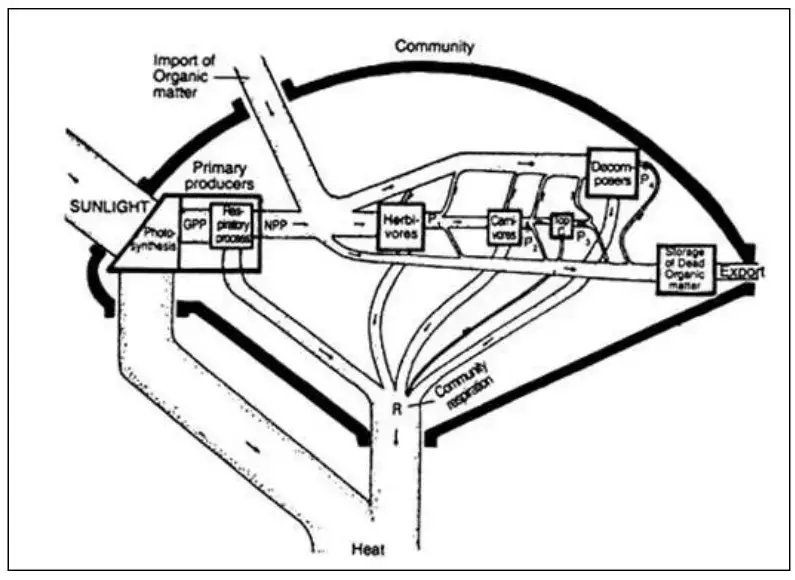
- It is used to present a complete energy budget of an ecosystem. It includes the flow of light energy, heat loss, storage of organic matter, and also the import or export of materials which is not covered in simpler energy flow models.
Advantages
- It is more realistic because it separates grazing and detritus pathways and includes the role of decomposers.
- It is used to compare ecosystems based on the dominance of grazing or detritus chains.
- It distinguishes macro-consumers and micro-consumers which differ in their metabolic rates.
Limitations
- It still groups many species into broad categories and does not show specific feeding relations of each species.
3. The Universal Energy Flow Model
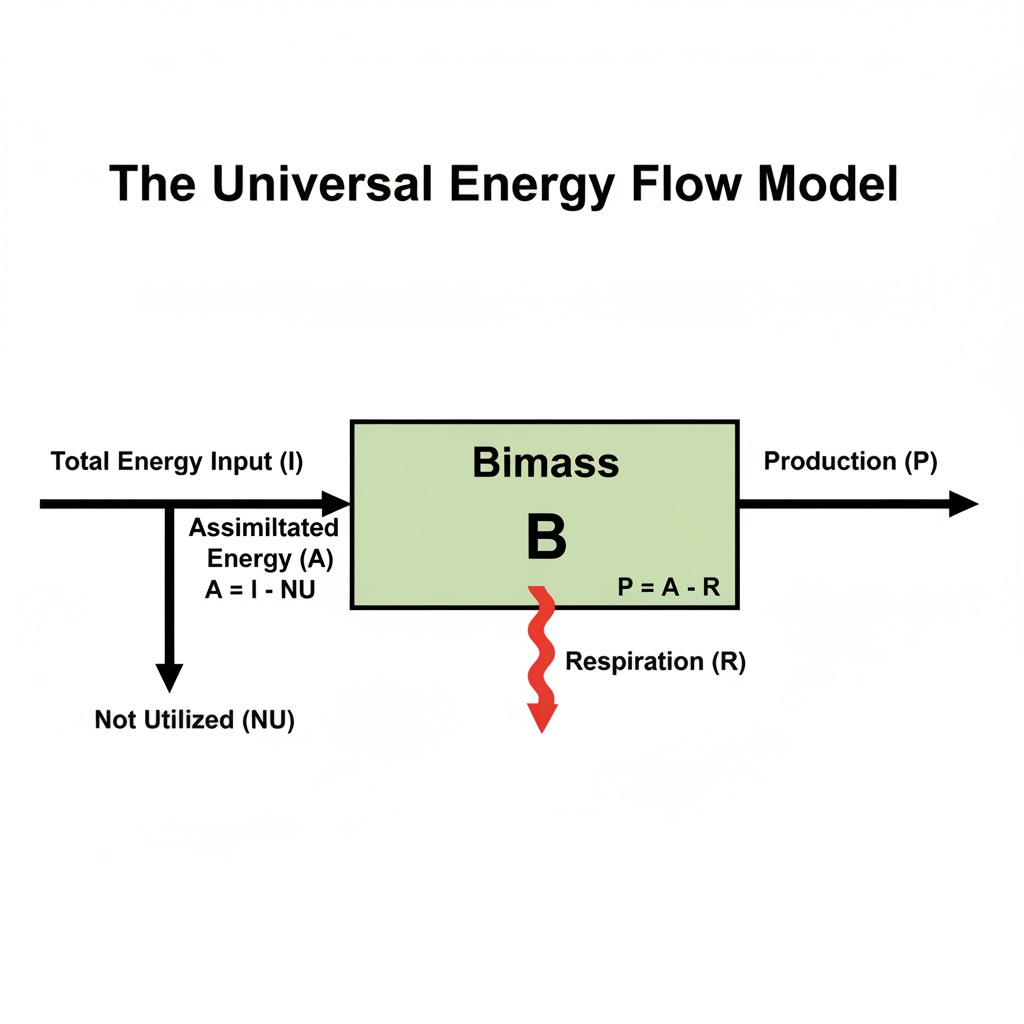
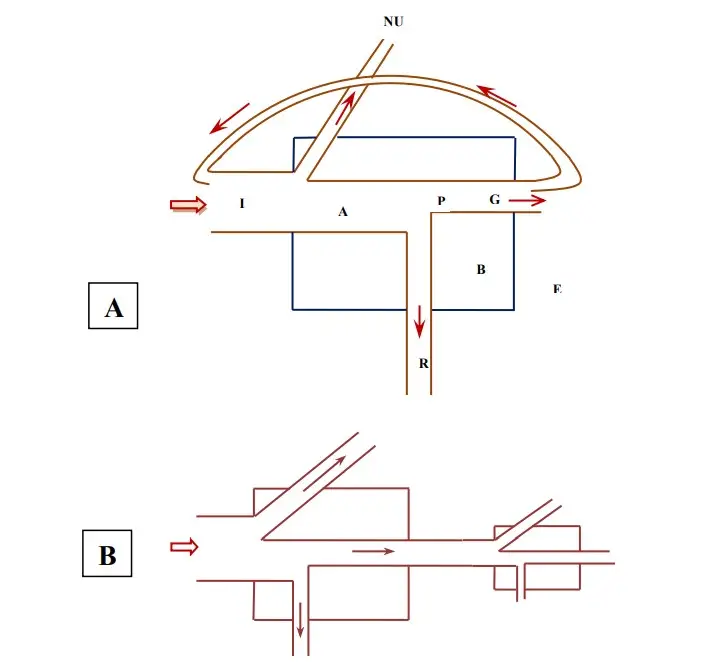
The Universal Energy Flow Model is the model that explains how energy moves through any biological unit of an ecosystem. It is the process where the unit, which may be an individual organism, a population, or a trophic group, is represented as a biomass compartment (B). The total energy input (I) is shown entering this unit. For plants this energy is the solar radiation, and for animals it is the food that is ingested. It is then divided into different components that show how the energy is used.
A part of the input energy is not utilized (NU) and leaves the system without being processed. The remaining portion becomes the assimilated energy (A). This assimilated energy is now separated into two pathways. One part is respiration (R), which is used for maintaining the structural and metabolic activities of the organism. The other part is production (P). This is referred to as the energy used for growth, reproduction, storage, and formation of new tissues.
The model is used widely because it can compare the energy use of different organisms. Among the important examples, it shows that warm-blooded animals spend a larger amount of assimilated energy on respiration compared to cold-blooded animals. It is also the model that can be expanded and linked with other units to explain the energy flow through complex food webs of an ecosystem.
How The Universal Energy Flow Model Works
- The model begins as a universal template that can represent any biological unit such as an individual organism, a population, or a trophic group. It is the process used for explaining bioenergetics in both plants and animals.
- The energy input (I) enters the system. For autotrophs this is the solar radiation, and for heterotrophs it is the food that is ingested. This is referred to as the starting point of the energy movement.
- A part of this input remains not utilized (NU). It is the portion that is not absorbed or digested and is lost as egested waste or unabsorbed materials.
- The remaining part becomes the assimilated energy (A). This is the energy that is taken in by the organism and forms the basis of further division.
- A large portion of the assimilated energy is used in respiration (R). It is the process needed for maintaining body structure, repair, and metabolic activities, and it is always lost as heat from the system.
- The energy that remains after respiration becomes the net production (P). This is used for growth and reproduction. Growth (G) increases the biomass, and reproduction helps in forming new individuals.
- Some part of this net production is stored (S). It is kept as organic reserves like fats and other compounds for future use. Another part is excreted (E) and leaves the system.
- The model can be scaled up easily. A single unit can represent one species, while several units linked together can show the flow of energy through a food chain or a complete trophic structure.
Uses of The Universal Energy Flow Model
- It is used as a universal model that can be applied to any living component of an ecosystem. It can describe an individual organism, a population, a plant, an animal, a microbe, or a full trophic group because the structure of the model remains the same.
- It is used to represent the energetics of a particular species population. It explains how a selected population receives its energy input and how it is connected with other organisms within the food web.
- It is used to represent a discrete trophic level. The biomass box in the model can include all the herbivores or all the carnivores of the system, and this helps in showing the combined energy flow of many populations supported by the same energy source.
- It is used to study the partitioning of energy inside the system. It explains the input energy (I), the assimilated energy (A), the respiration loss (R), and the production (P) used for growth and reproduction.
- It is used for comparing different survival strategies among organisms. It shows that warm-blooded animals spend more energy in respiration while cold-blooded animals use less, and predators also use a higher fraction of energy for movement compared to herbivores.
- It is used to describe the bioenergetics of a complete ecosystem. It provides a generalized explanation of how trophic flows operate together and how energy is passed, stored, or lost across different levels of the ecosystem.
Advantages
- It can be applied to an individual organism, a population, or a whole trophic level because of its flexible structure.
- It allows comparison of bioenergetic strategies such as differences in respiration between warm-blooded and cold-blooded animals.
Limitations
- It focuses mainly on a single component. To study the whole ecosystem, many units must be linked together which becomes complicated.
4. The Food Web (Network) Model
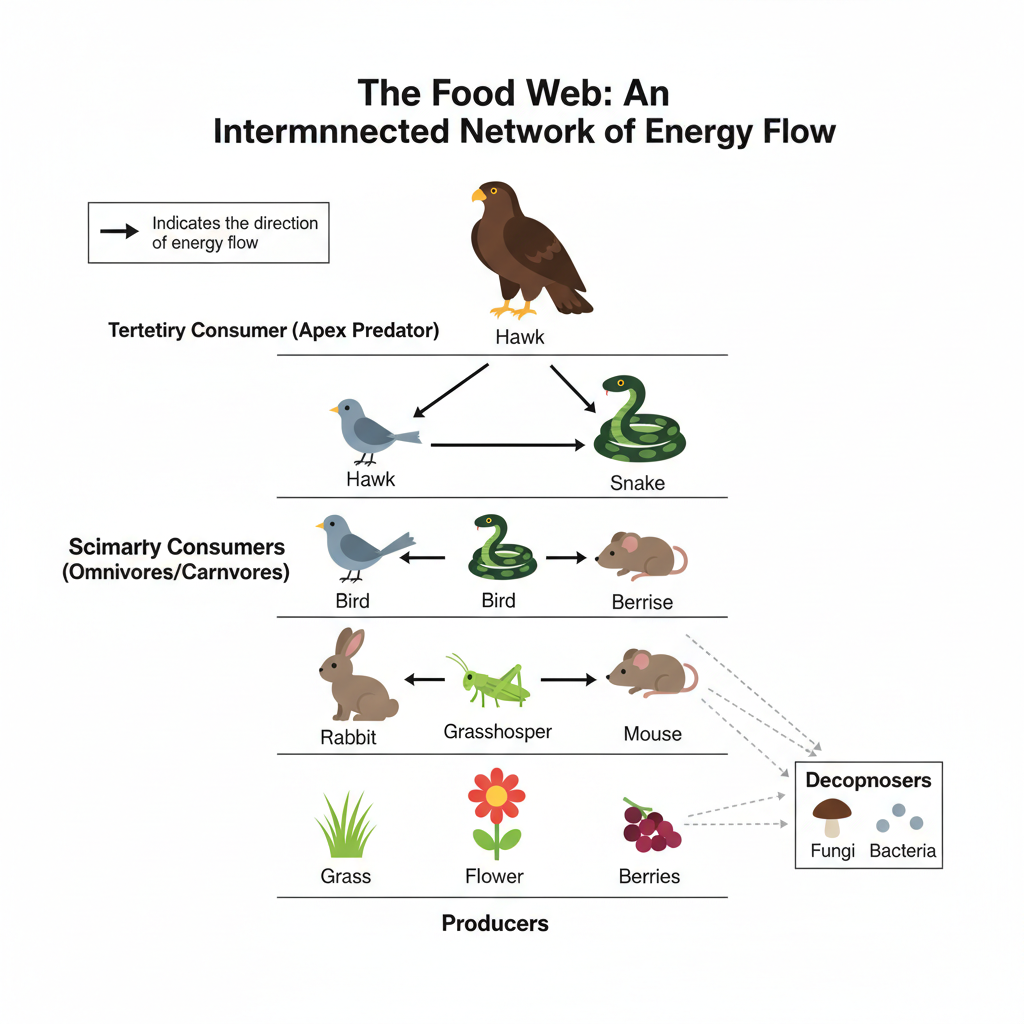
The Food Web (Network) Model is the model that explains the feeding relations in an ecosystem in a complex way. It is the process where many food chains are connected together, forming a network rather than a single straight pathway. This model is considered more realistic because most organisms feed on more than one type of food and are also eaten by different predators. Omnivores that eat both plants and animals occupy more than one trophic level, and their interactions form intersecting pathways of energy flow.
In this model, the movement of energy and nutrients is shown through multiple connected links that describe the structure and stability of an ecosystem. It shows that when one pathway is disturbed, the community can continue functioning by depending on alternative routes. It is the framework that gives a complete picture of how organisms depend on each other and how the ecosystem maintains balance through these interconnected feeding networks.
How The Food Web (Network) Model Works
- The model begins by connecting many simple food chains together. It is the process where different feeding paths like plant–herbivore–carnivore are linked into a large network because organisms do not depend on a single chain.
- It shows multiple feeding relations for each species. A single organism may eat different types of prey and may also be eaten by different predators, and the model represents these many links together.
- The arrows in the diagram indicate the direction of energy flow. It moves from the organism that is eaten to the organism that consumes it, helping in understanding how energy and nutrients travel through the ecosystem.
- It explains that trophic levels are not always fixed. Organisms like omnivores may occupy more than one trophic level, and some species may act as both primary and secondary consumers, which creates an uneven and realistic trophic position.
- The model connects the grazing food web and the detrital food web. It shows how decomposers recycle nutrients from dead materials and how predators may feed on organisms from both pathways, linking the two systems.
- It is used to explain the stability of an ecosystem. Because many alternative feeding links are present, the loss of one food source does not collapse the system. Consumers can shift to another available prey, helping the ecosystem continue functioning.
Uses of The Food Web (Network) Model
- It is used to represent realistic feeding relations in nature. Most organisms feed on more than one food source and some occupy more than one trophic level, so the food web shows these complex and interconnected pathways clearly.
- It is the model used to study ecosystem stability. When predators have several food sources, the system becomes more stable because a decline in one prey does not collapse the entire chain.
- It helps in identifying keystone species. These are species that have a major influence on the community structure, and the model shows how removal of such species can destabilize the whole network.
- It is used in tracing the movement of pollutants. Bioaccumulation and biomagnification can be explained because toxins pass through many pathways of the food web and become concentrated in higher-level consumers.
- It provides data for simulation studies. Ecologists use it to predict how changes such as habitat loss or introduction of new species may alter the energy flow and structure of the ecosystem.
- It is used for calculating fractional trophic levels. Because organisms may feed on several types of prey, their trophic position can be given as a specific value like 2.5 rather than a whole number.
- It helps in studying adaptive foraging. Predators may change their diet depending on prey availability, and the food web model explains these dynamic feeding behaviors.
- It is used to measure the health of an ecosystem. Through ecological network analysis, the model helps in calculating energy recycling and transfer efficiency, giving an idea of the maturity and functional state of the system.
Advantages
- It gives a complete picture of natural feeding interactions including omnivory and multiple prey species.
- It is useful for studying stability because ecosystems with more alternate pathways are more resistant to disturbance.
- It helps in understanding bioaccumulation and biomagnification of pollutants through complex feeding networks.
Limitations
- It becomes complex with many species and interactions, making quantitative analysis difficult.
- Traditional diagrams are static and do not show changes in feeding behaviour over time.
5. Adaptive Foraging Models
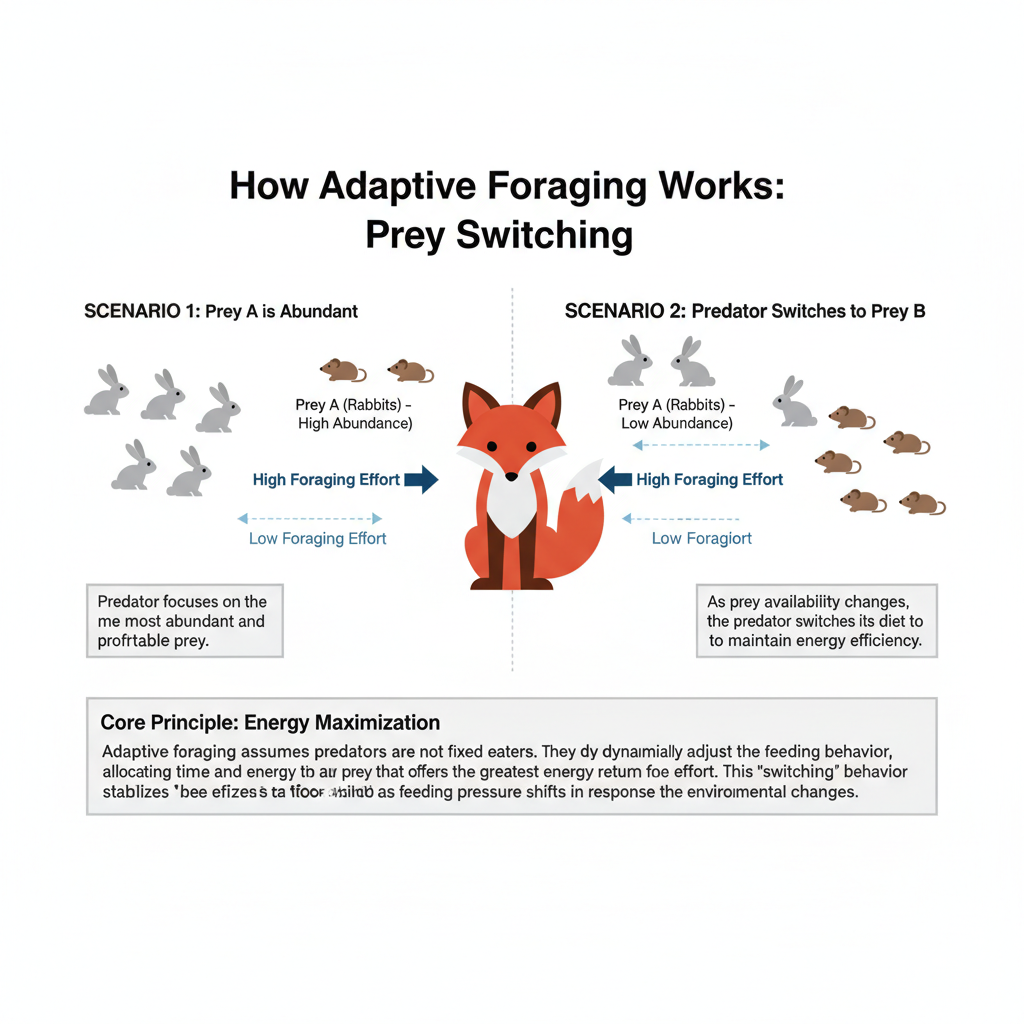
Adaptive Foraging Models are the models that explain food webs as dynamic systems rather than fixed structures. It is the process where predators can change their feeding behaviour depending on the availability and condition of their prey. In these models, feeding links are not permanent because consumers shift their preference towards the most abundant or energy-efficient prey at that moment. This is referred to as switching behaviour, and it helps in understanding how predators adjust themselves when the environment changes.
The model is considered important because it explains ecological patterns that simpler energy flow models cannot describe. It helps in showing why food chains often stay short even when enough resources are present, since predators may redistribute their feeding pressure and prevent long chains from forming. It also shows how ecosystems maintain stability. When one prey declines, the feeding links are rewired towards other prey, so the flow of energy continues through alternate pathways. In this way, the model gives a realistic view of how organisms behave and how ecosystems adjust to environmental variation.
How the Adaptive Foraging Models Work
- The model begins by assuming that predators do not follow a fixed feeding pattern. It is the process where consumers can modify their diet temporarily through learning or behavioural adjustments, allowing the food web to change its structure over time.
- Predators follow an energy maximization rule. They choose prey that gives the highest energy gain for the least foraging effort, and this becomes the base for deciding which prey to target.
- The model assigns a certain foraging effort toward each possible prey species. When a prey becomes more abundant or more profitable, the predator increases its effort toward that prey. If a prey becomes less profitable, the effort is reduced.
- This shifting of effort leads to switching behaviour. It is the pattern where predators change their main food source depending on which prey is abundant or easy to capture at that time.
- A trade-off is included in the model. Since the predator has limited time and energy, increasing effort on one prey will decrease the effort on others, so the diet breadth and performance must remain balanced.
- The model helps in explaining why food chains often remain short even when resources increase. When basal species become abundant, predators may switch to feeding on these lower-level species instead of feeding on higher-level predators, and this switching behaviour reduces or prevents the extension of food chain length.
Uses of Adaptive Foraging Models
- It is used to explain why food chains do not become longer even when resources increase. Adaptive predators may switch to feeding on lower trophic levels when these prey become abundant, and this can shorten or keep the food chain unchanged.
- It is used to resolve contradictions between simple experimental models and natural ecosystems. In laboratory systems the feeding links remain fixed, but in natural environments predators can adapt their diet, so the food chain behaves differently.
- It is used to model prey switching behaviour. The models show how predators change their preference and focus on the most abundant or energy-efficient prey at a particular time.
- It helps in studying the relation between habitat size and food chain structure. Larger habitats may support longer chains because species richness and spatial separation reduce the chances of predators switching to lower-level prey.
- It is used to predict ecosystem stability. When predators can adjust their diet, the system becomes more resistant to disturbance, and the model explains this dynamic feedback more accurately than static models.
- It is used to build realistic food web structures. Adaptive foraging produces networks with shorter chains and more links, which matches closely with the food web patterns observed in natural ecosystems.
Advantages
- It explains why food chains often remain short even when more resources are available.
- It includes behavioural flexibility and shows how predators shift their feeding to maintain ecosystem stability.
- It helps explain why larger habitats may support longer food chains because species are more separated spatially.
Limitations
- It requires detailed mathematical calculations and information on foraging behaviour which is difficult to obtain for many species.
Differences between Different Models of Energy Flow in a Ecosystem
| Feature | Single-Channel | Y-Shaped | Universal | Food Web | Adaptive Foraging |
| Structure | Linear (Line) | Branched (Y) | Box (Input/Output) | Network (Web) | Dynamic Network |
| Flow Direction | Unidirectional | Two Channels | Partitioned | Multi-directional | Flexible/Switching |
| Key Focus | Thermodynamics & Energy Loss | Grazing vs. Detritus linkage | Bioenergetic partitioning (P vs R) | Interconnectivity & Stability | Behavior & Diet Switching |
| Decomposers | Ignored/As loss | Central component | Can be a “box” | Integrated node | Dynamic resource |
| Dynamics | Static | Static | Static | Static | Dynamic (Changes over time) |
- Aakash Educational Services Limited. (n.d.). Food chain: Trophic levels, types, 10% law of energy transfer, grazing food chain vs detritus food chain, food web, significance of food chain, practice problems and FAQs. Aakash Institute. https://www.aakash.ac.in/important-concepts/biology/food-chain
- Advanced ecological modeling: A comparative analysis of linear and Y-shaped models of energy flow in ecosystems. (n.d.).
- Babu, S. (2020, September 2). Y-shaped energy flow model: Who eats whom in nature. Eco-intelligent. https://eco-intelligent.com/2016/11/17/y-shaped-model-of-energy-flow-who-eats-whom-in-nature/
- BYJU’S. (n.d.). Difference between grazing and detritus food chain. https://byjus.com/biology/difference-between-grazing-and-detritus-food-chain/
- BYJU’S. (n.d.). Energy flow in ecosystem. https://byjus.com/biology/energy-flow-in-ecosystem/
- Choudhary, R. (n.d.). Energy flow models [PowerPoint slides]. SlideShare. https://www.slideshare.net/slideshow/energy-flow-modelspdf/262682635
- GeeksforGeeks. (2025, July 23). Difference between grazing and detritus food chain. https://www.geeksforgeeks.org/biology/difference-between-grazing-and-detritus-food-chain/
- Gupta, R. (n.d.). Module 7: Energy flow in ecosystem: Energy flow models. e-PG Pathshala. https://ebooks.inflibnet.ac.in/esp01/chapter/energy-flow-in-ecosystem-energy-flow-models/
- Ha, M., & Schleiger, R. (2022, January 9). 15.5: Energy flow through ecosystems. Biology LibreTexts. https://bio.libretexts.org/Courses/University_of_Pittsburgh/Environmental_Science_(Whittinghill)/15%3A_Community_and_Ecosystem_Ecology/15.05%3A_Energy_Flow_Through_Ecosystems
- Kondoh, M., & Ninomiya, K. (2009). Food-chain length and adaptive foraging. Proceedings of the Royal Society B: Biological Sciences, 276(1670), 3113–3121. https://doi.org/10.1098/rspb.2009.0482
- Kumari, B. (2020, May). Energy flow through the ecosystem [PDF]. Magadh Mahila College, Patna University. http://magadhmahilacollege.org/wp-content/uploads/2020/05/Energy-Flow-through-the-Ecosystem-converted.pdf
- Lumen Learning. (n.d.). Food chains and food webs. Biology for Non-Majors II. https://courses.lumenlearning.com/wm-nmbiology2/chapter/food-chains-and-food-webs/
- Mannion, A. M. (2025). Primary production of organic matter. Research Starters. https://www.ebsco.com/research-starters/biology/primary-production-organic-matter
- Marjot, A. (2025, June 30). Energy transfers in ecosystems (College Board AP® Environmental Science): Study guide. Save My Exams. https://www.savemyexams.com/ap/environmental-science/college-board/20/revision-notes/unit-1-the-living-world-ecosystems/energy-flow-and-the-10-per-cent-rule/energy-transfers-in-ecosystems/
- Prepp. (n.d.). Detritus food chain – Environment notes. https://prepp.in/news/e-492-detritus-food-chain-environment-notes
- Sustainability Directory. (2025, November 29). Energy flow in ecosystems. https://energy.sustainability-directory.com/term/energy-flow-in-ecosystems/
- Wikipedia. (2024, December). Food chain. Retrieved from https://en.wikipedia.org/wiki/Food_chain