

What is Folin-Wu Method?
Folin-Wu method is a old colorimetric method which is used for estimation of glucose in blood. It was developed in 1919 by Otto Folin and Hsien Wu. It is based on oxidation-reduction reaction. The blue colour is produced and this colour intensity is measured for glucose level.
In this method the first step is deproteinization. The blood protein is precipitated and removed to get a clear filtrate. Sodium tungstate and sulphuric acid is used for precipitation of proteins. The protein free filtrate is obtained and it is used for further reaction.
In next step the filtrate is heated with alkaline copper tartrate reagent. The glucose (reducing sugar) reduces cupric ions (Cu2+) into cuprous oxide (Cu2O). This is the reduction step and it is important for colour formation.
After this phosphomolybdic acid is added. It reacts with cuprous oxide and deep blue complex is formed. This blue complex is referred to as phosphomolybdenum blue. The intensity of blue colour is directly proportional to glucose concentration in sample. It is measured by colorimeter or spectrophotometer.
This method was used as standard laboratory technique earlier but now it is mostly obsolete. It is replaced by modern enzymatic methods which is more specific. The main limitation is lack of specificity. Other reducing substances (non sugar) in blood also reacts with reagent and due to this blood glucose value may appear slightly higher than true value.
Principle of Folin-Wu Method
Principle of Folin-Wu method is based on oxidation-reduction reaction and colour formation. It is a colorimetric method which is used for estimation of glucose in blood. In this method the blood proteins are first removed to get a clear filtrate. Sodium tungstate and sulphuric acid is used for precipitation of proteins and protein free filtrate is formed.
In alkaline medium the filtrate is heated with alkaline copper tartrate reagent. The glucose act as reducing agent (it is converted to enediol form) and it reduces cupric ions (Cu2+) into cuprous oxide (Cu2O). The cuprous oxide is insoluble and it is produced during heating step.
After this phosphomolybdic acid is added. It reacts with cuprous oxide and a deep blue coloured complex is formed. This blue colour is referred to as phosphomolybdenum blue (molybdenum blue). The intensity of blue colour is directly proportional to glucose concentration in original blood sample. It is measured by colorimeter or spectrophotometer.
Requirements for Folin-Wu Method
Requirements for Folin-Wu Method are as follows-
Equipment and glassware are-
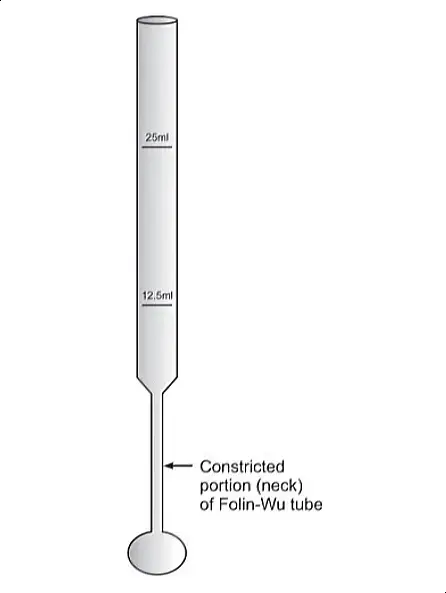
- Folin-Wu tubes– Special glass tube with constricted neck and bulb at bottom (it is used to minimize exposure to atmospheric oxygen and prevent reoxidation of cuprous oxide).
- Colorimeter or spectrophotometer– It is used to measure intensity of final blue colour (reading can be taken at 420 nm or 680 nm).
- Boiling water bath– It is required for heating reaction mixture for reduction of cupric ions.
- Centrifuge or filtration setup– It is used to get clear protein free filtrate (Whatman No. 1 filter paper can be used).
- General laboratory glassware– Pipettes test tubes beakers measuring cylinders volumetric flasks and funnel.
Chemicals and reagents are-
- Deproteinization reagents– 10% sodium tungstate and 2/3 N sulphuric acid (H2SO4).
- Alkaline copper tartrate reagent– It is mixture of anhydrous sodium carbonate tartaric acid (or Rochelle salt-sodium potassium tartrate) and copper sulphate in distilled water.
- Phosphomolybdic acid reagent– It is colour developing reagent containing molybdic acid sodium tungstate 10% sodium hydroxide and 89% orthophosphoric acid.
- Glucose standard solutions– Stock glucose standard (1 g/dL in 0.25% or 0.3% benzoic acid as preservative) and working standard (example 10 mg/dL) for calibration.
- Distilled water– It is used for dilution and for blank.
Specimen are-
- Blood sample– Usually 1 mL whole blood is taken (fluoride-oxalate tube can be used to prevent glycolysis) and protein free filtrate is prepared for assay.
Procedure of Folin-Wu Method
Procedure of Folin-Wu method is as follows-
Phase 1 (Preparation of protein free filtrate)-
- Blood sample (1 mL) is taken in a tube and distilled water (7–8 mL) is added for hemolysis of cells.
- 10% sodium tungstate solution is added to the mixture.
- 2/3 N sulphuric acid is added slowly with mixing and it is allowed to stand for 5–10 minutes.
- The mixture is centrifuged or it is filtered by Whatman No. 1 filter paper and clear protein free filtrate is obtained.
Phase 2 (Reduction and colour development)-
- Folin-Wu tubes are taken and it is labelled as Blank (B) Standard (S) and Test (T) (constricted neck tube is used to prevent reoxidation by atmospheric oxygen).
- Distilled water is added in Blank tube. Working glucose standard solution is added in Standard tube. Protein free filtrate is added in Test tube.
- Alkaline copper tartrate reagent is added in all three tubes.
- Contents are mixed and tubes are kept in boiling water bath for 8–10 minutes then it is cooled quickly to room temperature (running tap water can be used).
- Phosphomolybdic acid reagent is added in each tube and blue colour is developed.
- The contents are diluted upto mark (12.5 mL or 25 mL) with distilled water and it is shaken gently to remove air bubbles.
Phase 3 (Measurement and calculation)-
- Blank is used to set zero absorbance in colorimeter or spectrophotometer.
- Absorbance (O.D.) of Standard and Test is measured at required wavelength (420–680 nm).
- The glucose concentration is calculated by comparing absorbance of Test with Standard (ratio is used for final value).
Calculations of Folin-Wu Method
Calculations of Folin-Wu method are as follows-
Standard formula is-
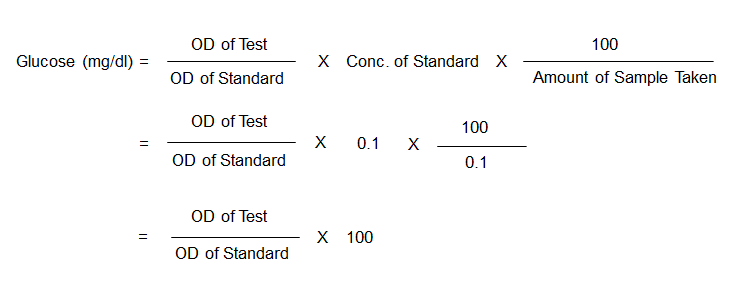
- Blood glucose (mg/dL) = (O.D. of Test / O.D. of Standard) × Concentration of Standard × (100 / Amount of sample taken)
Where,
- O.D. of Test– It is absorbance of unknown protein free filtrate.
- O.D. of Standard– It is absorbance of known glucose standard.
- Concentration of Standard– It is usually 0.1 mg (when 1 mL of 10 mg/dL working standard is used).
- Amount of sample taken– It is usually 0.1 mL (when 1 mL of 1:10 diluted protein free filtrate is used which represents 0.1 mL whole blood).
Simplified calculation is-
- Blood glucose (mg/dL) = (O.D. of Test / O.D. of Standard) × 100
(It is because standard concentration 0.1 mg and actual blood volume 0.1 mL is same so it is cancelled.)
Alternative method (Standard calibration curve)-
- A series of glucose standard solution is prepared and absorbance is measured.
- Graph is plotted (Concentration in X-axis and Absorbance in Y-axis).
- The unknown sample concentration is calculated from calibration curve (linear equation Y = mX + c is used).
Uses of Folin-Wu method
Uses of Folin-Wu method are as follows-
- Quantitative estimation of blood glucose– It is used to measure concentration of glucose (blood sugar) in blood sample.
- Diagnosis and management of diabetes– It was used for monitoring blood glucose fluctuations and it helps in detection and management of diabetes mellitus and other carbohydrate metabolism disorder.
- Determination of reducing sugars– It can be used to estimate total reducing sugars in sample (reducing sugar reduces cupric ions in alkaline medium).
- Educational purpose– It is used as teaching method for students to show redox reaction electron transfer and colour formation (polyoxometalate chemistry is also demonstrated).
- Use in resource limited setting– Reagents are cheap and easily available and it can be stored at room temperature for long time so it can be used where enzymatic method is not available or costly.
Limitations of Folin-Wu method
Limitations of Folin-Wu method are as follows-
- Lack of specificity (Saccharoid effect)– It is not specific for glucose. Other reducing sugars like fructose lactose also reacts. Non carbohydrate reducing substances in blood also reacts like glutathione uric acid ergothioneine creatinine and ascorbic acid.
- Overestimation of glucose level– Since saccharoids are also measured the glucose value is shown higher than true glucose. It is usually about 20–30 mg/dL higher and it can cause error in glucose tolerance test and insulin therapy adjustment.
- Colour instability– The blue complex formed can fade fast due to reoxidation by dissolved oxygen. So absorbance reading is to be taken immediately after colour development.
- Time consuming method– Many steps are involved like preparation of protein free filtrate and heating in boiling water bath for 8–10 minutes. Total time required is around 30–45 minutes.
- Hazardous reagents– Sodium tungstate and sulphuric acid are used and these are toxic and hazardous so careful handling is needed.
- Non linear analytical range– The range is limited (around 40–200 mg/dL) and coefficient of variation is higher so precision and accuracy is less than modern methods.
- Obsolete method– Due to these limitations it is considered outdated and it is replaced by enzymatic methods like glucose oxidase (GOD-POD) and hexokinase methods in clinical laboratories.
References
- Dungrela, D. (2025, February 14). Folin-Wu method for estimation of blood glucose. BioScience. https://www.bioscience.com.pk/en/topics/biochemistry/folin-wu-method-for-estimation-of-blood-glucose
- HiMedia Laboratories. (2015). Folin & Wu’s alkaline copper solution R006 [Technical data].
- Livingston, J. (n.d.). Determination of glucose in serum. Scribd.
- Mahesha, H. B. (n.d.). Estimation of sugar by Folin-Wu method. Yuvaraja’s College, University of Mysore.
- neerajojha1232. (n.d.). Dextrose measurement via Folin-Wu method. Scribd.
- Paramedical & Allied Science Dept. (n.d.). M.Sc. medical biochemistry lab manual (2nd year). Midnapore City College.
- Remp, D. G. (1953). Influence of saccharoids on blood glucose values. Henry Ford Hospital Medical Bulletin, 1(4), 24-26. https://scholarlycommons.henryford.com/hfhmedjournal/vol1/iss4/5
- Technical monograph on the Folin-Wu method for the quantitative estimation of blood glucose: Analytical principles, procedural methodologies, and clinical evolution. (n.d.).