

What is Euglena?
Euglena is a unicellular microscopic organism which belongs to the group of protists and it shows the characteristics of both plant and animal. It is generally found in fresh water bodies like ponds lakes and marshy places. It is a eukaryotic organism and the cell contains nucleus and other membrane bound organelles. Euglena is photosynthetic in nature because chloroplast is present and chlorophyll helps in preparation of food in presence of light. At the same time it can also depend on organic substances for nutrition in absence of light and this type of nutrition is referred to as mixotrophic. The cell wall is absent and instead a flexible pellicle is present which helps in changing shape of the body. Locomotion is carried out with the help of a flagellum and an eyespot is present which helps in detecting light. The reserve food material in Euglena is paramylon and this organism is considered important in studying evolution because of presence of both plant like and animal like features.
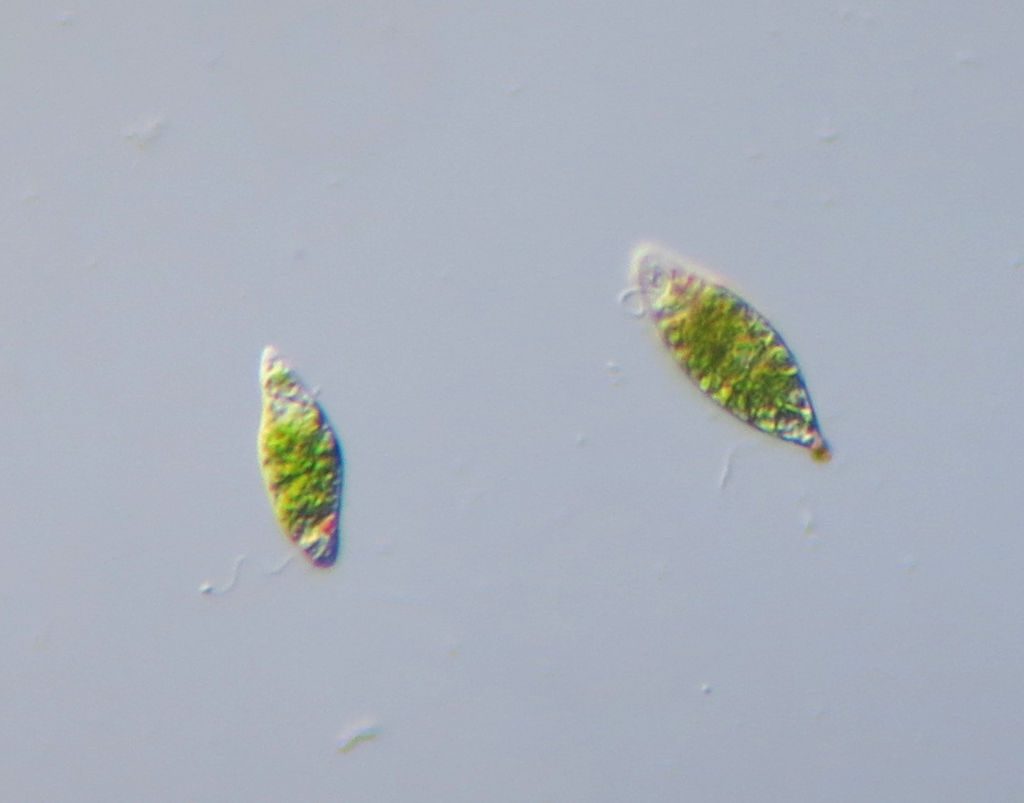
Definition of Euglena
Euglena is a genus of single-celled microorganisms found in water, capable of photosynthesis and movement.
General Characteristics of Euglena
- Euglena is a unicellular microscopic organism and it is eukaryotic in nature.
- It belongs to phylum Euglenozoa and shows both plant and animal characters.
- The body is elongated spindle shaped and the size is very small.
- Cell wall is absent and instead a flexible pellicle is present around the body.
- Pellicle helps in changing the shape of the body during movement.
- One long flagellum is present which helps in locomotion of the organism.
- Eyespot (stigma) is present near the base of flagellum which helps in light perception.
- Chloroplast is present and photosynthesis occurs in presence of light.
- In absence of light it shows heterotrophic mode of nutrition.
- This type of nutrition is referred to as mixotrophic.
- Reserve food material is paramylon and not starch.
- Contractile vacuole is present which helps in osmoregulation.
- Movement also occurs by euglenoid movement due to flexible pellicle.
- Reproduction takes place by longitudinal binary fission.
- Sexual reproduction is absent in Euglena.
- It is commonly found in fresh water bodies like ponds and ditches.
- Euglena is considered as a connecting link between plants and animals.
Habitat of Euglena
- Euglena is commonly found in fresh water bodies.
- It occurs in ponds lakes ditches pools and slow moving water.
- It is mostly present in water rich in organic matter.
- Euglena grows well in water containing decaying plants and wastes.
- It is frequently seen in polluted water bodies.
- Sewage water and organically polluted water favors its growth.
- Some species of Euglena are found in brackish water.
- A few species also occur in marine and coastal water.
- It is found in marshy places and water logged soils.
- Euglena can survive in damp terrestrial habitats.
- It shows adaptability to unfavorable conditions like acidic water.
- It is usually present near surface of water where sunlight is available.
Food and Nutrition of Euglen
- Euglena shows mixotrophic mode of nutrition.
- It can prepare its own food as well as depend on external sources.
- In presence of sunlight photosynthesis occurs.
- Chloroplast containing chlorophyll a and b helps in food synthesis.
- Carbon dioxide and water are used to form carbohydrates.
- In absence of light heterotrophic nutrition is seen.
- Dissolved organic substances are absorbed directly from surrounding water.
- This type of nutrition is referred to as saprozoic or osmotrophic nutrition.
- In some species solid food particles are ingested.
- Bacteria small algae and detritus are taken in by phagocytosis.
- Certain vitamins are required for growth.
- Vitamin B1 and Vitamin B12 are essential and obtained from environment.
- Reserve food material is paramylon.
- Paramylon is a carbohydrate and it is stored in cytoplasm.
- Under anaerobic conditions paramylon is converted into wax esters.
- This helps in energy production when oxygen is absent.
Morphology and Anatomy
External Structure and Shape
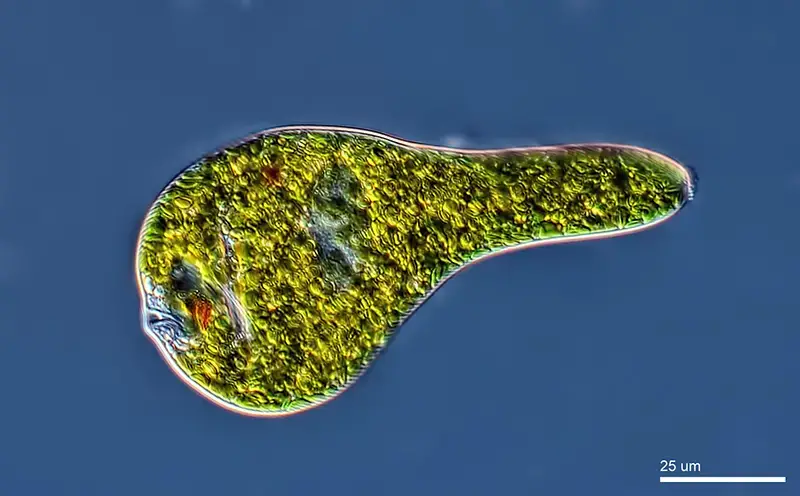
- The body is elongated and spindle shaped in appearance. The anterior end is blunt while posterior end is pointed.
- The size is microscopic and usually ranges from 15–500 µm. In Euglena viridis the length is about 40–60 µm.
- Cell wall is absent and instead body is covered by pellicle.
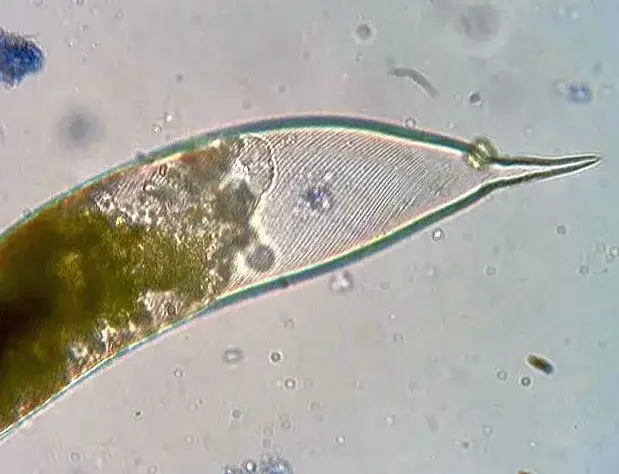
- Pellicle is flexible and proteinaceous in nature and it is made up of helically arranged strips present below plasma membrane.
- Due to flexible pellicle the body shows characteristic movement called metaboly or euglenoid movement.
Locomotory and Sensory Structures
- At the anterior end a flask shaped depression called reservoir is present.
- The reservoir opens to outside through a narrow tube called cytopharynx.
- Two flagella arise from basal bodies present at the base of reservoir.
- One flagellum is long and emerges outside and helps in locomotion.
- The second flagellum is very short and remains inside the reservoir.
- The emergent flagellum contains a paraxonemal rod which provides strength.
- A red pigmented eyespot or stigma is present near reservoir.
- Eyespot contains carotenoid granules and helps in perception of light direction.
- A photoreceptor or paraflagellar body is present at the base of emergent flagellum and it works with stigma in phototaxis.
Internal Organisation
- A single large nucleus is present usually in central or posterior region.
- Nucleus is membrane bound and contains nucleolus also called endosome.
- Chromosomes remain permanently condensed.
- Chloroplasts are present and contain chlorophyll a and b.
- Chloroplasts are surrounded by three membranes and show disc or plate like shape.
- Pyrenoids are present inside chloroplasts and are involved in paramylon formation.
- Paramylon is the reserve food material and it is a β-1,3-glucan.
- Paramylon occurs as solid granules in cytoplasm and it is not starch.
- Contractile vacuole is present near reservoir and helps in osmoregulation.
- Excess water is collected by contractile vacuole and discharged into reservoir.
- Mitochondria are present with discoid or paddle shaped cristae.
- Cytoplasm is differentiated into outer ectoplasm and inner granular endoplasm.
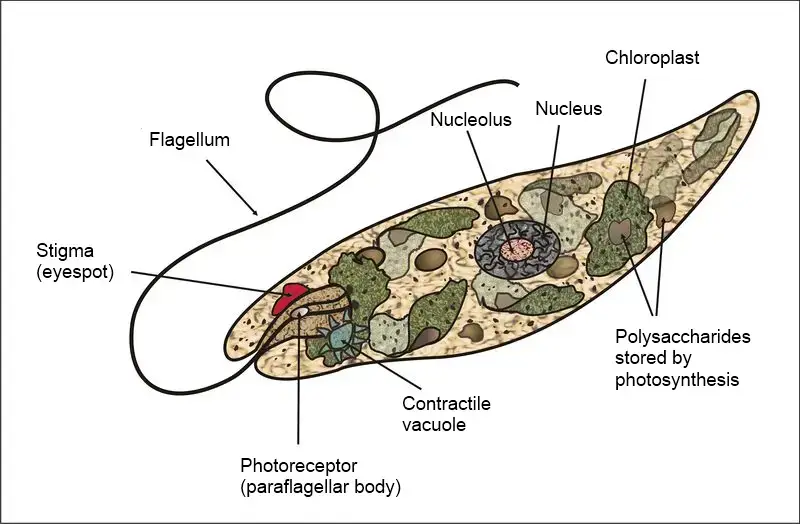
Internal Structure and Components of Euglena – Euglena Cell Anatomy
Outer Envelope and Supporting Structures
- Cell wall is absent and the body is covered by a pellicle.
- Pellicle is proteinaceous and flexible in nature and present below plasma membrane.
- Pellicle is made up of helically arranged interlocking strips.
- This arrangement helps in change of shape which is referred to as metaboly.
- Plasma membrane lies below pellicle and encloses the cytoplasm.
- Microtubules are present below pellicular strips and provide support to the body.
- Muciferous bodies are present below pellicle and secrete mucilage helping in smooth movement.
Motility and Sensory Structures
- At anterior end a flask shaped cavity called reservoir is present.
- Reservoir opens outside through cytostome and continues as cytopharynx.
- Two flagella arise from basal granules present at base of reservoir.
- One flagellum is long and emerges outside and helps in locomotion.
- The long flagellum contains paraflagellar rod which provides rigidity.
- Second flagellum is short and remains inside the reservoir.
- A red pigmented eyespot or stigma is present near reservoir.
- Eyespot contains carotenoid granules and helps in perception of light direction.
- A paraflagellar body or photoreceptor is present near base of long flagellum.
- Photoreceptor works with stigma and helps in phototactic movement.
Internal Organelles and Metabolic Structures
- A single large nucleus is present usually in central or posterior region.
- Nucleus is bounded by nuclear membrane and contains nucleolus or endosome.
- Chromosomes remain permanently condensed.
- Chloroplasts are present and contain chlorophyll a and b.
- Chloroplasts are surrounded by three membranes.
- Shape of chloroplasts may be disc like or plate like.
- Pyrenoids are present inside chloroplasts.
- Pyrenoids help in formation of reserve food material.
- Paramylon is the reserve food material and it is β-1,3-glucan.
- Paramylon is stored as solid granules in cytoplasm around pyrenoids.
- Mitochondria are present and contain discoid or paddle shaped cristae.
Excretory and Transport Structures
- Contractile vacuole is present near reservoir.
- It collects excess water from cytoplasm and discharges into reservoir.
- This process helps in osmoregulation.
- Golgi apparatus is present and helps in secretion and transport of materials.
- Endoplasmic reticulum is present and involved in protein synthesis.
- Lysosomes are present and contain digestive enzymes.
Cytoplasm
- Cytoplasm is differentiated into two regions.
- Outer clear region is called ectoplasm.
- Inner granular region is called endoplasm.
- Endoplasm contains most of the cell organelles.
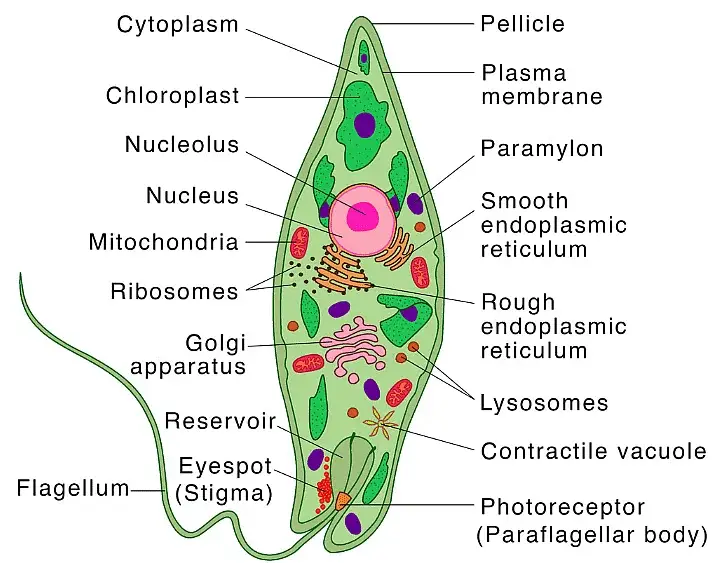
Classification of Euglena
- Domain – Eukaryota.
- Supergroup – Excavata.
- Phylum – Euglenozoa.
- Class – Euglenophyceae.
- Order – Euglenales.
- Genus – Euglena.
Euglena shows characters of both plants and animals. Due to presence of chloroplast it was placed under plants by botanists. Due to absence of cell wall and presence of flagellum it was placed under animals by zoologists. Hence Euglena is considered as a connecting link between plants and animals.
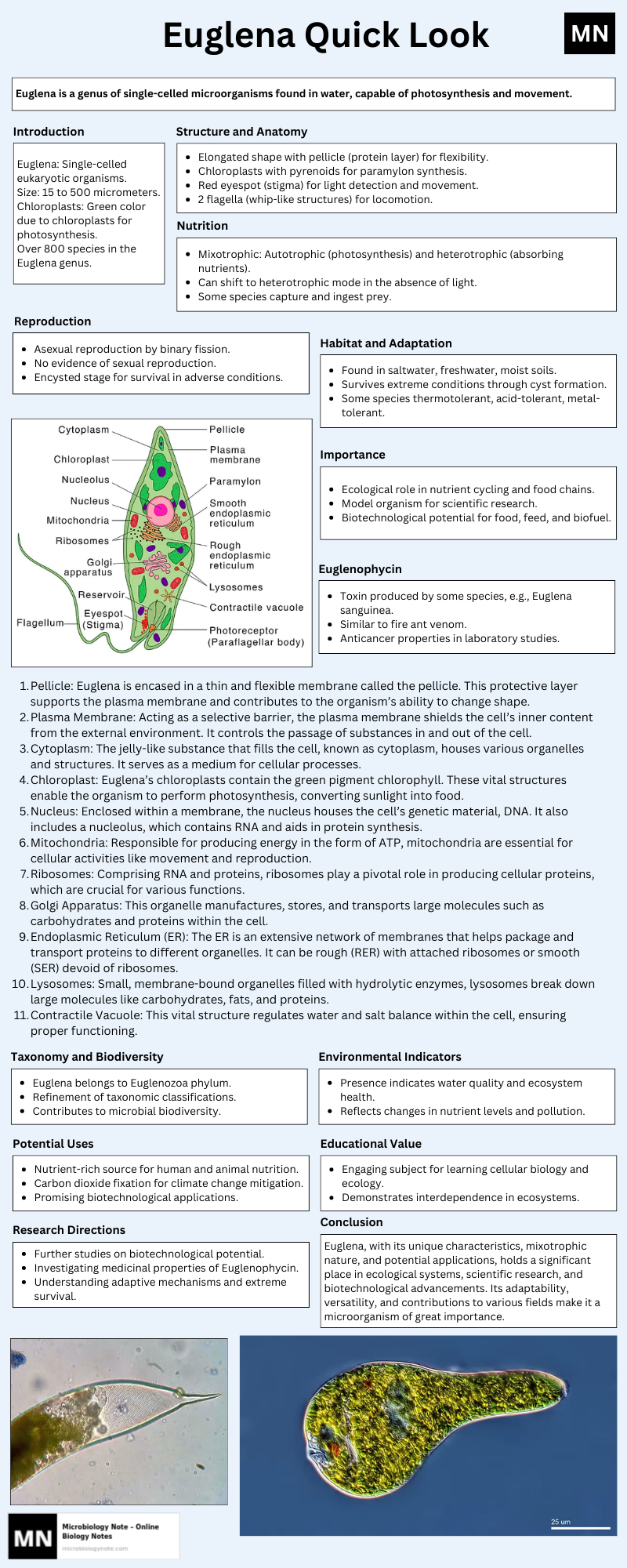
Euglena’s Dual Nature
Plant-Like Characters
- Euglena contains chloroplasts with chlorophyll a and b.
- Due to presence of chloroplast it performs photosynthesis.
- Photosynthesis helps in preparation of its own food.
- Pyrenoids are present inside chloroplasts.
- Pyrenoids help in synthesis of reserve food material.
- The reserve food material is paramylon.
- Presence of chlorophyll gives green colour to the body.
Animal-Like Characters
- Euglena is a motile organism.
- Locomotion is carried out by a long flagellum.
- In absence of light it shows heterotrophic mode of nutrition.
- It can absorb dissolved organic substances from surroundings.
- Cell wall is absent.
- Body is covered by flexible pellicle instead of rigid wall.
- Pellicle allows change in shape of body.
- A red pigmented eyespot is present.
- Eyespot acts as a sensory structure for light detection.
- Contractile vacuole is present for osmoregulation.
- Centrioles or blepharoplasts are present at base of flagella.
Significance of Dual Nature
- Euglena shows characters of both plants and animals.
- Due to this it is considered as a connecting link.
- Botanists placed it under plants because of photosynthesis.
- Zoologists placed it under animals due to motility and heterotrophy.
- It shows metabolic flexibility depending on environmental conditions.
Locomotion of Euglena
Euglena viridis shows two different kinds of locomotion. These are flagellar movement and euglenoid movement.
1. Flagellar movement
- It is the main method of locomotion in Euglena viridis and it swims freely in water with the help of a single long locomotory flagellum.
- The flagellum is almost equal to the length of body and it helps in free swimming of the organism.
- During swimming the flagellum is directed obliquely backward towards the side bearing the stigma.
- The flagellum shows spiral undulations and waves are transmitted from the base to the tip. This is referred to as the beating or sideways lashing of flagellum.
- The flagellum beats at an average rate of about 12 beats per second.
- The beating of flagellum produces water waves which drive the water backward and the body is pushed forward.
- Each beat throws the body forward and also slightly to one side. Due to repeated beating the organism revolves in a circle or shows gyration.
- As the flagellum is obliquely placed to the long axis of body the organism rotates on its own axis.
- It has been calculated that Euglena rotates at the rate of one turn per second.
- Due to flagellar activity three types of movements are produced–
– forward movement
– rotational movement
– revolutionary movement - The movement of flagellum involves contraction of 9 peripheral fibres. These fibres are suitable for bending and undulating action around the flagellar axis.
- The energy for contraction is supplied by ATP(adenosine triphosphate) formed in mitochondria which are present in blepharoplasts.
2. Euglenoid movement
- This type of movement is also known as metaboly and it occurs due to presence of flexible pellicle.
- The pellicle is contractile in nature and it enables the organism to show slow worm-like peristaltic movements.
- The peristaltic movements produce waves of contraction and expansion in pellicle layers.
- The contraction is caused by stretching of protoplasm on pellicle or by cytoplasmic fibrils called myonemes.
- These waves pass from anterior end to posterior end and the organism moves forward.
- During movement the body becomes shorter and broader first at anterior end then at middle and lastly at posterior end.
- Due to this the adjacent pellicular strips bend and slide against each other.
- The sliding of ridges in grooves is facilitated by secretion of underlying muciferous bodies.
Locomotion Process / Steps of Euglena
The locomotion of Euglena is carried out by two main processes. These are flagellar movement and euglenoid movement. The direction of movement is further controlled by sensory responses.
1. Flagellar locomotion (Swimming)
- The process of locomotion is mainly carried out by a single long locomotory flagellum present at the anterior end.
- The flagellum acts as a pulling organ and it draws the body forward in water.
- The movement is initiated by spiral undulations of flagellum. The waves pass from base to tip.
- Due to this undulation a sideways lashing or whipping action is produced.
- The flagellum beats at an average rate of about 12 beats per second.
- The beating produces backward water currents and the body is pushed forward.
- As the flagellum is directed obliquely backward the body rotates on its own axis.
- At the same time the organism also revolves in a circular or spiral path.
- It has been observed that the body rotates at the rate of about one turn per second.
- Thus three types of movements are produced–
– forward movement
– rotational movement
– revolutionary movement - The contraction of 9 peripheral fibres of flagellum is responsible for this movement.
- The energy required is supplied by ATP(adenosine triphosphate) formed in mitochondria.
2. Euglenoid locomotion (Metaboly)
- This type of movement occurs when flagellar swimming becomes difficult.
- It is produced by rhythmic contraction and expansion of body.
- The movement is possible due to presence of flexible pellicle on the body surface.
- The pellicle shows sliding of protein strips over one another.
- Peristaltic waves pass from anterior end to posterior end.
- During this process the body becomes short and broad at anterior region first.
- Later the middle and posterior regions undergo contraction and expansion.
- Due to these changes the organism slowly creeps forward.
- The contraction is brought about by stretching of protoplasm or by myonemes present in cytoplasm.
3. Sensory control of locomotion
- During swimming the body continuously rotates and this helps in sensory perception.
- The stigma periodically shades the paraflagellar body present at the base of flagellum.
- This change in light intensity helps in determining the direction of light.
- The flagellar beating is adjusted and the organism moves towards or away from light.
- Sudden change in light causes shock reaction and the body bends at right angle.
- The organism also responds to gravity by pressure of cell contents on membrane channels.
- This response alters the flagellar movement and corrects the orientation of body.
Reproduction of Euglena
Reproduction in Euglena is mainly asexual in nature. Sexual reproduction is absent.
- Reproduction is asexual in Euglena.
- The common method is longitudinal binary fission.
- Sexual reproduction and meiosis is not observed in Euglena.
Binary fission
- Binary fission usually occurs during favourable conditions such as proper light temperature and availability of food.
- The organism reproduces in free swimming condition.
- The division is longitudinal and takes place along the long axis of body.
- First the nucleus divides by mitosis.
- The nuclear membrane does not disappear during division and this is referred to as closed mitosis.
- The nucleolus or endosome divides and remains distinct.
- Before cytoplasmic division the anterior organelles are duplicated.
- These include reservoir stigma and basal bodies (blepharoplasts).
- After nuclear division a cleavage furrow appears at the anterior end.
- The furrow gradually moves towards the posterior end.
- Cytoplasm divides longitudinally and two daughter individuals are formed.
- The two daughter cells are genetically identical and are mirror images of each other.
Reproduction during unfavourable conditions
- Under unfavourable conditions like lack of food moisture or oxygen Euglena enters into resting stage.
- The flagellum is withdrawn and the body becomes rounded.
- A thick protective wall is secreted around the body forming a cyst.
- This process is known as encystment.
- Inside the cyst the nucleus may divide repeatedly.
- Multiple fission may occur producing about 16 to 32 daughter cells.
- When favourable conditions return the cyst wall ruptures and young Euglena are released.
Palmella stage
- Sometimes Euglena enters into palmella stage.
- In this stage the flagellum is discarded.
- The cells remain embedded in a gelatinous or mucilaginous mass.
- The cells continue metabolism and reproduction by binary fission.
- This stage often appears as green scum on the surface of ponds.
Respiration in Euglena viridis
- Euglena viridis shows aerobic respiration.
- It uses free oxygen dissolved in surrounding water for respiration.
- During daytime oxygen released during photosynthesis is also utilised for respiration.
- Exchange of gases takes place through general body surface by diffusion.
- The pellicle acts as the respiratory surface.
- Oxygen enters into the body and carbon dioxide diffuses out.
- Respiration involves oxidation of food materials.
- The oxidation reactions are catalysed by enzymes present in mitochondria.
- The energy released during oxidation is stored in ATP(adenosine triphosphate).
- ATP provides energy for metabolic activities of the cell.
- Water and carbon dioxide are formed as by-products of respiration.
- In darkness carbon dioxide is released outside by diffusion.
- In light carbon dioxide produced during respiration is used in photosynthesis.
- Under normal conditions respiration remains aerobic in Euglena viridis.
Behavior of Euglena viridis
Reaction to Light (Phototaxis)
- It is highly sensitive to light and shows avoidance to strong sunlight as well as deep shade.
- The organism shows positive phototaxis and swims towards moderate light intensity.
- It orients the body parallel to light rays and moves in direction of light source.
- In culture dishes these organisms is seen accumulated on the side facing light.
- When direction of light is suddenly changed a shock reaction is observed and the organism reorients by trial and error movement till uniform illumination occurs.
Avoiding Reaction (Phobotaxis)
- It shows avoiding reaction to mechanical thermal and chemical stimuli.
- In presence of unfavorable stimulus the forward movement is slowed or stopped.
- The body may move backward and turn strongly towards dorsal side.
- The posterior end acts as a pivot and a new spiral path is traced.
Locomotion
- Locomotion is carried out with the help of a long flagellum.
- The flagellum beats in propeller like manner causing forward movement.
- The body rotates and gyrates during swimming.
- It also shows euglenoid movement (metaboly) which is worm like movement due to flexible pellicle.
- This movement helps in passing through viscous medium.
Nutritional Behavior
- It shows mixotrophic mode of nutrition.
- In presence of sunlight it behaves as autotroph and carries out photosynthesis.
- In absence of light it becomes saprophytic and absorbs dissolved organic substances.
- Digestive enzymes is secreted in dark condition to break down organic matter.
- Pinocytosis may occur at base of reservoir for intake of proteins and large molecules.
Survival and Protection
- Under unfavorable conditions such as drought heat or lack of food encystment occurs.
- The organism becomes rounded sheds the flagellum and secretes thick gelatinous cyst.
- Sometimes flagella are discarded and individuals aggregate to form palmella stage.
- The palmella stage appears as green scum on surface of ponds.
Encystment of Euglena viridis
- It is protective process shown by the organism during unfavorable conditions.
- The major causes are lack of food lack of oxygen drying excessive heat and fouling of water.
- Under these conditions the organism stops movement completely.
- The body becomes rounded in shape.
- The flagellum is thrown off or shed.
- A thick protective wall is secreted around the body forming cyst.
- The cyst wall is made up of special carbohydrate substance.
- The cyst is spherical and yellowish brown in colour.
- The wall is thick and consists of two or three concentric layers.
- The size of cyst is generally equal to diameter of animal.
- During encysted condition multiple fission may occur.
- The cell may divide to form 16 to 32 daughter euglenas.
- Sometimes many individuals lose flagella and remain embedded in mucilaginous mass.
- This condition is referred to as palmella stage and appears as green scum on ponds.
- When favorable conditions return the cyst wall dissolves.
- The organisms come out develop new flagella and become free swimming again.
Osmoregulation and Excretion in Euglena viridis
- Euglena viridis lives in freshwater and maintains water balance by osmoregulation.
- Osmoregulation is carried out by a large contractile vacuole.
- The contractile vacuole is situated near the reservoir.
- It consists of a large central vacuole surrounded by many small accessory vacuoles.
- Excess water enters the body by endosmosis due to higher salt concentration inside body.
- The excess water from cytoplasm is collected by the small accessory vacuoles.
- These small vacuoles fuse together and transfer water into the large central vacuole.
- During diastole the contractile vacuole gradually increases in size.
- During systole the vacuole contracts and expels its contents.
- The collected water is discharged into the reservoir.
- From the reservoir the fluid passes out through the cytopharynx.
- Thus excess water is removed and internal water balance is maintained.
- Excretion in Euglena viridis is mainly ammonotelic in nature.
- The chief nitrogenous waste product is ammonia.
- Ammonia diffuses out through the general body surface or pellicle.
- Some soluble metabolic wastes are also collected by the contractile vacuole.
- These wastes are expelled along with excess water through the reservoir.
Culture of Euglena viridis
The culture of Euglena viridis can be carried out easily by simple laboratory and natural methods. The commonly used culture methods are given below.
1. Wheat grain method
- Take clean wide-mouthed large glass bottles.
- Fill the bottles with boiled tap water or pond water.
- Add a few boiled wheat grains into each bottle.
- Place the bottles in a sunny place.
- After about one week Euglena starts appearing in large number.
- To maintain the culture fresh boiled wheat grains are added once in a month.
2. Manure solution method
- Take a jar containing pond water or distilled water.
- Add horse manure or cow manure into the jar and boil it properly.
- Allow the solution to cool for about two days.
- Introduce weeds or algal mass collected from a pond containing Euglena.
- Keep the jar near a well-lighted window.
- Within a few days Euglena viridis appears in the nitrogen rich infusion.
3. Soil-water laboratory method
- Prepare a liquid soil-water medium.
- Add a small piece of garden pea to enrich the medium.
- Maintain the temperature around 17 °C.
- Provide alternating light and dark periods.
- Light is supplied for about 16 hours and darkness for 8 hours.
- Cool white fluorescent tubes are commonly used as light source.
- Under these conditions healthy growth of Euglena viridis is obtained.
4. Nutritional requirements
- Euglena viridis is mixotrophic in nature.
- In presence of light it prepares food by photosynthesis.
- In darkness it absorbs dissolved organic matter from medium.
- Autotrophic growth depends on external supply of Vitamin B₁₂ (cyanocobalamin).
- Vitamin B₁ (thiamine) is also required for proper growth.
- These vitamins are usually supplied by bacteria present in the culture medium.
Importance of Euglena
- It is an important primary producer in freshwater bodies and it helps in fixation of carbon dioxide and release of oxygen.
- It forms the base of aquatic food chains and serves as food for small aquatic organisms.
- Some species act as decomposers and help in breakdown of organic matter present in water.
- Euglena is used as a bioindicator to assess water quality and organic pollution.
- It is sensitive to heavy metals and toxic chemicals and helps in detecting genotoxic effects in water.
- It plays a role in bioremediation by removing excess nutrients like nitrates and phosphates from wastewater.
- It can absorb and accumulate heavy metals such as cadmium lead and chromium.
- Euglena is used in production of biofuels under anaerobic conditions.
- It produces wax esters which are useful for biodiesel and aviation fuel.
- The biomass is used in cosmetics fibres and bioplastics.
- It is used as a source of valuable metabolites like vitamins amino acids and fatty acids.
- Euglena is rich in proteins lipids and vitamins and is used as nutritional supplement.
- It produces paramylon (β-1,3-glucan) which helps in improving immunity and lowering cholesterol.
- Extracts of Euglena shows antioxidant anti-inflammatory and medicinal properties.
- It is used as a model organism for studying photosynthesis cell biology and gravitaxis.
- It provides information about evolutionary relationship between plants and animals.
- It is studied for use in space research for oxygen production and waste recycling.
- Some species may form toxic blooms and cause fish mortality in ponds and reservoirs.
Comprehensive Review of Euglena sp. Biological and Commercial Data
| Species/Taxon | Geographic Distribution | Habitats and Environmental Traits | Morphological and Physiological Characteristics | Nutritional Values (Vitamins, Minerals, Amino Acids) | Metabolites and Bioactive Compounds | Commercialization and Industrial Applications | Conservation Status |
| Euglena gracilis | Worldwide (Europe, Asia, Americas). | Freshwater (ponds, lakes, puddles, reservoirs), brackish water, and extreme environments (acidic hot mud pools, snow); tolerant to heavy metals (Cd, Cr, Pb, Hg, Zn), hypoxia, and low temperatures; mixotrophic (autotrophic/heterotrophic). | Unicellular flagellate (5–100 μm); spindle-shaped/ovoid; lacks cell wall; flexible proteinaceous pellicle (∼40 helical strips) allowing metaboly; two flagella (one emerging with paraflagellar rod); red eyespot (stigma); secondary chloroplasts with triple membranes; contains paramylon granules. | Rich in protein (40–60% DCW) and essential amino acids (leucine, lysine, threonine, methionine, phenylalanine, arginine); Vitamins A, B1, B2, B6, B12, C, D, E (α-tocopherol), K, niacin, folic acid, pantothenic acid, biotin; Minerals (Fe, Mg, Zn, Cu, Al, P, S, K, Ca); contains PUFAs and >50% β-glucan. | Paramylon (β-1,3-glucan); lipids and wax esters (myristyl myristate); PUFAs (DHA, arachidonic acid, omega-3); antioxidants (ascorbate, α-tocopherol); pigments (chlorophyll a/b, β-carotene, neoxanthin, diadinoxanthin, diatoxanthin); euglenatides (cyclic peptides). | Commercialized across ‘5Fs’: Food (supplements, functional meals); Fiber (bioplastics); Feed (aquaculture/animal nutrition); Fertilizer (biomass/space habitats); Fuel (bio-jet fuel, biodiesel). Also used in pharmaceuticals, cosmetics, wastewater treatment, and CO2 sequestration. | No specific conservation status assigned; microscopic life forms are not regularly assessed. |
| Euglena sanguinea | Worldwide (USA, Brazil, Poland, Amazon, South Africa, Himalayas, Nepal, Nigeria, Czech Republic). | Freshwater (eutrophic ponds, lakes, shallow systems); forms dense red blooms/surface scums in direct sunlight; temperature 21.6–31.1 ∘C; pH 7.23–8.0. | Unicellular; photosynthetic; flagellar movement; cells exhibit metaboly; possesses fusiform mucocysts and double-sheathed pyrenoids; turns red due to high carotenoid (haematochrome) content; capable of forming cysts. | Not in source | Euglenophycin (alkaloid ichthyotoxin similar to fire ant venom); high carotenoid content (astaxanthin, diatoxanthin, lutein); lipids suitable for biodiesel. | Pharmaceutical: Euglenophycin research for anti-cancer, herbicidal, and antibiotic activity; Fuel: Biodiesel production feedstock (cultivated in raceway ponds); harmful to aquaculture (causes significant economic losses). | No specific conservation status assigned. |
| Euglena viridis | Worldwide (including Syria, France, Ecuador). | Freshwater (stagnant pools, ditches, streams, high mountain lakes); associated with organic-rich/nitrogen-rich water; forms green blooms. | Small (40–60 μm); spindle-shaped (fusiform); flexible pellicle with striations (myonemes); single emergent flagellum; star-shaped (axial stellate) chloroplast arrangement with pyrenoid; exhibits metaboly. | Requires Vitamins B1 and B12 for growth. | Paramylon granules (β-1,3-glucans); chlorophyll a and b; β-carotene and other carotenoids. | Bioindicator for water quality and organic pollution; educational and laboratory culture specimen. | No specific conservation status assigned. |
| Euglena mutabilis | Global (acidic and volcanic regions). | Extremophile; thrives in extremely acidic environments (pH 2.0–3.5), hot mud pools, and high salinity (Great Salt Lake). | Photosynthetic; robust metabolic adaptability; gliding motility; both flagella remain within the reservoir (lacks emergent flagellum). | Not in source | Paramylon; photosynthetic pigments. | Potential use in bioremediation of acidic mine drainage; used in metabolic network reconstruction studies. | No specific conservation status assigned. |
| Euglena tuba | Not in source | Freshwater; forms dense blooms. | Unicellular; flagellated; bloom-forming. | Phytochemical constituents. | Antioxidants. | Not in source | Not in source |
Euglena Under Microscope Video
Red Euglena sp.
Euglena mutabilis, showing metaboly, paramylon bodies and chloroplasts
Euglena sanguinea
Euglena, moving by metaboly and swimming
FAQ
Q1. What is Euglena?
A. Euglena is a unicellular microscopic organism which shows both plant and animal like characters.
Q2. What kingdom do Euglena belong to?
A. Euglena belong to kingdom Protista.
Q3. Are Euglena unicellular or multicellular?
A. Euglena are unicellular organism.
Q4. Why are Euglena difficult to classify as a plant or an animal?
A. It is difficult to classify because it shows both plant like and animal like characteristics.
Q5. How do Euglena get their nutrients?
A. It shows mixotrophic nutrition and can prepare food by photosynthesis and also absorb organic substances.
Q6. What characteristic makes Euglena plant-like?
A. Presence of chloroplast and ability to perform photosynthesis makes it plant like.
Q7. What characteristic makes Euglena animal-like?
A. Absence of cell wall and presence of flagellar movement makes it animal like.
Q8. How do Euglena move?
A. Movement occurs with help of long flagellum and also by euglenoid movement.
Q9. What is the function of the eyespot in Euglena?
A. Eyespot helps in detecting light and showing phototactic movement.
Q10. What is the function of the contractile vacuole in Euglena?
A. It helps in osmoregulation by removing excess water from body.
Q11. What is the pellicle in Euglena and what is its function?
A. Pellicle is flexible protein covering which gives shape and helps in metaboly.
Q12. What organelle carries out photosynthesis in Euglena?
A. Chloroplast carries out photosynthesis.
Q13. How do Euglena reproduce?
A. Reproduction is asexual and occurs by longitudinal binary fission.
Q14. Where are Euglena found?
A. They are found in freshwater ponds ditches and stagnant water.
Q15. What are the uses or applications of Euglena?
A. It is used in biological studies as experimental organism and also indicates water pollution.
- Allen. (n.d.). Euglena divides by longitudinal fission. Allen. Retrieved from the provided text.
- Azhar, W. S. W., Aripin, T., Zaini, A. S. M., Amirudin, N. A. S., Kamaruddin, S. A., Rahim, N. S., Nasir, N. A. H. A., Roslani, M. A., Aziz, K. N. A., Shuhaime, N., Hamid, H. A., Nazir, E. N. M., & Fauzi, S. S. M. (2025). Euglena sp. – A comprehensive review on the habitats, characteristics, nutritional values, commercialization opportunities and conservation status. Journal of Information System and Technology Management, 10(39), 238–251. https://doi.org/10.35631/JISTM.1039016
- Bailey, R. (2025, May 15). Euglena cells. ThoughtCo. https://www.thoughtco.com/about-euglena-cells-4099133
- Bicudo, C. E. M., & Menezes, M. (2016). Phylogeny and classification of Euglenophyceae: A brief review. Frontiers in Ecology and Evolution, 4, 17. https://doi.org/10.3389/fevo.2016.00017
- Briggs, G. M. (2021). Euglena: A unicellular algae. In Inanimate Life. Milne Publishing.
- Bullard, E. (2023). Euglena. Salem Press Encyclopedia of Science.
- Carolina Staff. (2024, April 7). Introduction to protists: Euglena. Carolina Knowledge Center.
- Comprehensive Analysis of the Genus Euglena: Taxonomy, Morphology, Physiology, and Industrial Significance. (n.d.). [Source text provided].
- Curran, B., & Arrington, D. (n.d.). Euglena | Characteristics, Structure & Life Cycles. Study.com.
- Delgado-Fernández, E., Cruz, D., Ayavaca, R., Benítez, Á., & Hernández, B. (2025). Microalgal diversity as bioindicators for assessing and sustaining water quality in the high mountain lakes of Quimsacocha, Azuay, Ecuador. Sustainability, 17(4), 1620. https://doi.org/10.3390/su17041620
- Ebenezer, T. E., Low, R. S., O’Neill, E. C., Huang, I., DeSimone, A., Farrow, S. C., Field, R. A., Ginger, M. L., Guerrero, S. A., Hammond, M., Hampl, V., Horst, G., Ishikawa, T., Karnkowska, A., Linton, E. W., Myler, P., Nakazawa, M., Cardol, P., Sánchez-Thomas, R., … Field, M. C. (2022). Euglena International Network (EIN): Driving euglenoid biotechnology for the benefit of a challenged world. Biology Open, 11(11), bio059561. https://doi.org/10.1242/bio.059561
- Gibbs, S. P. (1978). The chloroplasts of Euglena may have evolved from symbiotic green algae. Canadian Journal of Botany, 56(22), 2883–2889. https://doi.org/10.1139/b78-345
- Gutierrez, D. B., Rafalski, A., Beauchesne, K., Moeller, P. D., Triemer, R. E., & Zimba, P. V. (2013). Quantitative mass spectrometric analysis and post-extraction stability assessment of the euglenoid toxin euglenophycin. Toxins, 5(9), 1587–1596. https://doi.org/10.3390/toxins5091587
- Häder, D.-P., & Hemmersbach, R. (2017). Gravitaxis in Euglena. In S. Schwartzbach & S. Shigeoka (Eds.), Euglena: Biochemistry, Cell and Molecular Biology (Advances in Experimental Medicine and Biology, Vol. 979, pp. 237–266). Springer. https://doi.org/10.1007/978-3-319-54910-1_12
- Häder, D.-P., & Hemmersbach, R. (2022). Euglena, a gravitactic flagellate of multiple usages. Life, 12(10), 1522. https://doi.org/10.3390/life12101522
- Hampl, V., Hug, L., Leigh, J. W., Dacks, J. B., Lang, B. F., Simpson, A. G. B., & Roger, A. J. (2009). Phylogenomic analyses support the monophyly of Excavata and resolve relationships among eukaryotic “supergroups”. Proceedings of the National Academy of Sciences, 106(10), 3859–3864. https://doi.org/10.1073/pnas.0807880106
- Hardy, M., & Tanner, W. (n.d.). Supergroup Excavata – Background. In College Biology II Laboratory. Open SLCC.
- Hauslage, J., Strauch, S. M., Eßmann, O., Haag, F. W. M., Richter, P., Krüger, J., Stoltze, J., Becker, I., Nasir, A., Bornemann, G., Müller, H., Delovski, T., Berger, T., Rutczynska, A., Marsalek, K., & Lebert, M. (2018). Eu:CROPIS – “Euglena gracilis: Combined Regenerative Organic-food Production in Space” – A space experiment testing biological life support systems under lunar and Martian gravity. Microgravity Science and Technology, 30, 933–942. https://doi.org/10.1007/s12217-018-9654-1
- Inui, H., Ishikawa, T., & Tamoi, M. (2017). Wax ester fermentation and its application for biofuel production. In S. Schwartzbach & S. Shigeoka (Eds.), Euglena: Biochemistry, Cell and Molecular Biology (Advances in Experimental Medicine and Biology, Vol. 979, pp. 269–283). Springer. https://doi.org/10.1007/978-3-319-54910-1_13
- Inwongwan, S., Kruger, N. J., Ratcliffe, R. G., & O’Neill, E. C. (2019). Euglena central metabolic pathways and their subcellular locations. Metabolites, 9(6), 115. https://doi.org/10.3390/metabo9060115
- Kostygov, A. Y., Karnkowska, A., Votýpka, J., Tashyreva, D., Maciszewski, K., Yurchenko, V., & Lukeš, J. (2021). Euglenozoa: Taxonomy, diversity and ecology, symbioses and viruses. Open Biology, 11(3), 200407. https://doi.org/10.1098/rsob.200407
- Kulczycka, A., Łukomska-Kowalczyk, M., Zakryś, B., & Milanowski, R. (2018). PCR identification of toxic euglenid species Euglena sanguinea. Journal of Applied Phycology, 30(3), 1759–1763. https://doi.org/10.1007/s10811-017-1376-z
- Leander, B. S., Lax, G., Karnkowska, A., & Simpson, A. G. B. (2017). Euglenida. In J. M. Archibald et al. (Eds.), Handbook of the Protists. Springer International Publishing. https://doi.org/10.1007/978-3-319-32669-6_13-1
- Li, M., Gao, X., Wu, B., Qian, X., & Giesy, J. P. (2014). Microalga Euglena as a bioindicator for testing genotoxic potentials of organic pollutants in Taihu Lake, China. Ecotoxicology, 23(4). https://doi.org/10.1007/s10646-014-1214-x
- Makwana, K. (2022). Algae the bioindicator for sustainable environment: A review. Journal of Plant Science and Research, 9(2), 234.
- NASA. (2025, November 19). Space crops. NASA Science Biological & Physical Sciences.
- Neupane, L. (2023, August 3). Euglena viridis – An overview. Microbe Notes.
- Sarıtaş, S., Gezgin, T., Selvi, S., Karadağ, A. E., Gürbüz, S., Yılmaz, K., Witkowska, A. M., & Levent, M. (2025). Biological and nutritional applications of microalgae. Nutrients, 17(1), 93. https://doi.org/10.3390/nu17010093
- Shinde, L. (n.d.). EUGLENA. JES College, Jalna.
- Tomiyama, T., Goto, K., Tanaka, Y., Maruta, T., & Ishikawa, T. (2019). A major isoform of mitochondrial trans-2-enoyl-CoA reductase is dispensable for wax ester production in Euglena gracilis under anaerobic conditions. PLOS ONE.
- Xiang, A. (n.d.). Reproduction. Euglena. https://euglenabiology.weebly.com/reproduction.html
- Zakryś, B., Milanowski, R., & Karnkowska, A. (2017). Evolutionary origin of Euglena. In S. Schwartzbach & S. Shigeoka (Eds.), Euglena: Biochemistry, Cell and Molecular Biology (Advances in Experimental Medicine and Biology, Vol. 979, pp. 3–17). Springer. https://doi.org/10.1007/978-3-319-54910-1_1
- Zimba, P. V., Moeller, P. D. R., Beauchesne, K., Lane, H. E., & Triemer, R. E. (2010). Identification of euglenophycin—A toxin found in certain euglenoids. Toxicon, 55(1), 100–104. https://doi.org/10.1016/j.toxicon.2009.07.004